



The Association for Symbolic Logic publishes analytical reviews of selected books and articles in the field of symbolic logic. The reviews were published in The Journal of Symbolic Logic from the founding of the Journal in 1936 until the end of 1999. The Association moved the reviews to this Bulletin, beginning in 2000.
The Reviews Section is edited by Clinton Conley (Managing Editor), Mark van Atten, Benno van den Berg, Thomas Colcombet, Samuel Coskey, Bradd Hart, Bernard Linsky, Antonio Montalbán, Rahim Moosa, Christian Retoré, and Nam Trang. Authors and publishers are requested to send, for review, copies of books to ASL, Department of Mathematics, University of Connecticut, 341 Mansfield Road, U-1009, Storrs, CT 06269-1009, USA.
Two articles on classification in topology
Joseph Zielinski, The complexity of the homeomorphism relation between compact metric spaces. Advances in Mathematics , vol. 291 (2016), pp. 635–645.
Cheng Chang and Su Gao, The complexity of the classification problem of continua. Proceedings of the American Mathematical Society , vol. 145 (2017), pp. 1329–1342.
It is the natural inclination of mathematicians to classify the objects they find, and it is the natural inclination of logicians to ask how difficult such a project is to undertake. The two articles which are the subject of this review concern exactly this situation in the context of topology. In “The complexity of the homeomorphism relation between compact metric spaces”, Zielinski establishes that the classification of compact metric spaces up to homeomorphism is of maximum complexity among those classification problems reducible to orbit equivalence relations. Building on this work, Chang and Gao, in “The complexity of the classification problem of continua”, show that the same result holds for the smaller class of compact connected metric spaces or continua.
A classification problem, in general, can be thought of a class X of mathematical objets together with an equivalence relation E on X. One classification problem
 $(X,E)$
reduces to another
 $(Y,F)$
if there is a map
 $f:X\to Y$
, called a reduction, such that
 $$ \begin{align*} x\mathbin{E}y \quad\text{if and only if}\quad f(x) \mathbin{F} f(y) \end{align*} $$
for all
 $x,y\in X$
. In other words, objects in Y up to F-equivalence are complete invariants for objects in X up to E-equivalence, as computed by f.
Using the Axiom of Choice, the study of abstract classification problems and the reductions between them just amounts to comparing the cardinalities of the sets of equivalence classes. However, by placing definability constraints on the classes of objects, equivalence relations, and reductions considered, a more useful picture emerges.
From the point of view of descriptive set theory, it is natural to consider classes X which can be realized as Borel subsets of Polish spaces, equivalence relations E which are Borel or analytic as subsets of
 $X^2$
, and Borel reductions between them. This invariant descriptive set theory has become one of the leading areas of the field over the last three decades, and provides powerful tools for analyzing the relative complexity of classification problems across different areas of mathematics.
Among the most prominent classes of analytic equivalence relations, listed in increasing order of complexity, are: the smooth, those reducible to equality on some Polish space; the classifiable by countable structures, those reducible to isomorphism on some class of countable first-order structures; and the orbit equivalence relations, those bireducible with an orbit equivalence relation induced by a continuous action of a Polish group. An equivalence relation is complete for one of these collections if it belongs to the collection and all of the other members are Borel reducible to it.
Some examples of relevant classification problems include: compact metric spaces up to isometry, which is smooth (this follows from properties of the Edwards–Gromov–Hausdorff distance); compact totally disconnected metric spaces up to homeomorphism, which is complete for those classifiable by countable structures (due to Camerlo and Gao); and Polish metric spaces up to isometry, Choquet simplicies up to affine homeomorphism, separable C*-algebras up to isomorphism, and separable Banach spaces up to linear isometry, all of which are complete orbit equivalence relations (the first due to Clemens, Gao, and Kechris, the second and third to Sabok, and the last to Melleray).
Hjorth showed that compact metric spaces up to homeomorphism is not classifiable by countable structures. Gao and Kechris later asked to determine the exact complexity of this equivalence relation, and it is this that is accomplished in the articles under review: compact, and in fact, compact connected, metric spaces up to homeomorphism is a complete orbit equivalence relation. By Gelfand duality and the Banach–Stone theorem, respectively, this implies that isomorphism of separable commutative C*-algebras and linear isometry of
 $C(K)$
-spaces are also complete orbit equivalence relations, strengthening the aforementioned results of Sabok and Melleray.
The class of all compact metric spaces can be realized as a Polish space by using the fact that each embeds in the Hilbert cube
 $\mathcal {Q}=[0,1]^{\mathbb {N}}$
, and then considering its hyperspace
 $K(\mathcal {Q})$
of compact subsets with the topology induced by the Hausdorff metric. Using a trick arising from the notion of a Z-set in infinite-dimensional topology, Zielinski observes that the homeomorphism relation on compact spaces reduces to the orbit equivalence relation arising from the natural action of the (Polish) autohomeomorphism group of
 $\mathcal {Q}$
on
 $K(\mathcal {Q})$
, and is thus an orbit equivalence relation (a fact previously observed by Kechris and Solecki). This also holds for the space of continua, which forms a closed subset of
 $K(\mathcal {Q})$
.
The key technical devices in Zielinski’s work are his coding spaces: given a nested pair
 $X\supseteq A$
of compact spaces,
 $I(X,A)$
consists of X together a new sequence of isolated points accumulating on A. The crucial fact about this construction is that, provided A and B contain all of the isolated points of X and Y, respectively, any homeomorphism from X to Y which maps A onto B extends to a homeomorphism from
 $I(X,A)$
to
 $I(Y,B)$
, and conversely, any homeomorphism from
 $I(X,A)$
to
 $I(Y,B)$
restricts to one from X to Y which maps A onto B. This allows the homeomorphism type of a nested pair of compact sets to be coded in the homeomorphism type of a single compact space.
The proof that the homeomorphism relation on compact metric spaces is complete proceeds by a series of four Borel reductions and ultimately relies on Sabok’s result for affine homeomorphism of Choquet simplices. The first reduction reduces the latter to an equivalence relation
 $\cong _{(3)}$
defined on pairs
 $(X,R)$
in
 $K(\mathcal {Q})\times K(\mathcal {Q}^3)$
with
 $X^3\supseteq R$
, where
 $(X,R)\cong _{(3)}(Y,S)$
if there is a homeomorphism from X to Y which induces one from R to S. The reduction sends a simplex S to
 $(S,\Gamma (S))$
, where
 $\Gamma (S)$
consists of triples
 $(x,y,z)\in S^3$
where z is the midpoint of x and y. This condition ensures that any homeomorphism realizing
 $(S,\Gamma (S))\cong _{(3)}(T,\Gamma (T))$
is actually affine.
The second reduction goes from
 $\cong _{(3)}$
to an equivalence relation
 $\cong _{\text {perm}}$
defined on
 $K(\mathcal {Q})^{\mathbb {N}}$
, where two sequences of compact sets in
 $\mathcal {Q}$
are
 $\cong _{\text {perm}}$
-equivalent if there is an autohomeomorphism of
 $\mathcal {Q}$
which maps the coordinates of one to the other, up to a permutation of the indices. The reduction itself takes a pair
 $(X,R)$
in
 $K(\mathcal {Q})\times K(\mathcal {Q}^3)$
and maps it to a sequence of subsets of
 $I(X,X)^3$
, suitably embedded in
 $\mathcal {Q}$
, whose structure in the subset lattice ensures that any homeomorphism realizing
 $\cong _{\text {perm}}$
restricts to one realizing
 $\cong _{(3)}$
.
The third reduction goes from
 $\cong _{\text {perm}}$
to the homeomorphism type
 $\cong _{(1,1)}$
of nested triples of compact sets
 $(X,B,A)$
with
 $X\supseteq B\supseteq A$
. This reduction uses a straightforward coding of the coordinates of sequences in
 $K(\mathcal {Q})^{\mathbb {N}}$
to certain triples
 $(X,B,A)$
of subsets of
 $\mathcal {Q}^2$
. Notably, the sets X used in this reduction are path-connected and have no cut points.
The final step of Zielinski’s proof uses an iteration of the coding space construction to reduce
 $\cong _{(1,1)}$
to homeomorphism of compact spaces, sending a triple
 $(X,B,A)$
to the space
 $I_2(X,B,A)$
defined as the result of applying the coding map I to the pair
 $(X,A)$
, and then applying it again to the pair consisting of
 $I(X,A)$
and the union of B with the new isolated points from
 $I(X,A)$
. The properties of the coding spaces allow the homeomorphism type of
 $I_2(X,B,A)$
to entirely recover the
 $\cong _{(1,1)}$
-type of
 $(X,B,A)$
, completing the proof.
While the spaces
 $I_2(X,B,A)$
are compact, they are far from connected, being the result of adding many isolated points. Thus, in order to get the same result for continua, Chang and Gao modify Zielinski’s construction to obtain connected coding spaces
 $J(X,A)$
. Since the relation
 $\cong _{(1,1)}$
described above is complete on triples
 $(X,B,A)$
where X is path-connected and without cut points, it suffices to consider X with these properties.
The main idea here is to combine Zielinski’s coding spaces with fan spaces. Given a compact metric space X, the fan space
 $F_X$
of X is the result of connecting every point of X along a unique ray to a new common point. Given compact
 $X\supseteq A$
as before, Chang and Gao define
 $F(X,A)$
like
 $F_X$
except with rays only emanating from points in A. The coding spaces
 $J(X,A)$
are then defined to be
 $F(I(X,A),\bar {D})$
, where
 $I(X,A)$
is as before, and D is the set of new isolated points in
 $I(X,A)$
. If X is path-connected and A nonempty, then clearly
 $J(X,A)$
is path-connected as well.
Chang and Gao’s main technical result, and the bulk of the work in their paper, is that, provided the original spaces are path-connected and without cut points, the homeomorphism type of the nested pair
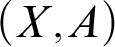 $(X,A)$
is completely coded by the homeomorphism type of
 $J(X,A)$
. Combined with Zielinski’s arguments, this yields a proof that homeomorphism of (path-)connected compact metric spaces is a complete orbit equivalence relation.
A number of compelling open problems are left in the wake of these papers. One, recently solved in the affirmative by Cieśla, is whether the restriction of the homeomorphism relation to locally connected continua remains a complete orbit equivalence relation. Two other notable problems are to consider homeomorphism of homogeneous compact metric spaces, and linear isometry of separable hereditarily indecomposable Banach spaces. For the former, since the nonhomogeneous nature of the coding is spaces is crucial to their ability to code the relevant homeomorphism types, establishing completeness for homogeneous spaces would seem to require new ideas. For the latter, Chang and Gao’s results imply that linear isometry of Banach spaces which are indecomposable as a direct sum of subspaces is complete, but this differs from the notion of indecomposability in Banach space theory, where a summand is allowed to be finite-dimensional. Establishing completeness, or even new lower bounds in complexity, for these classification problems appears both difficult and of substantial future interest.


