Introduction
British social policy research tends to concentrate on the needs of disadvantaged groups in society and on the state as the key actor of welfare provision. In some respects, this seems only reasonable given the emphasis on an encompassing system of public subsistence-based social protection, as formulated by William Beveridge in the aftermath of World War II. On the other hand, it could be argued that such a focus seems somewhat restrictive if the analytical interest is not state action but the quality and scope of social protection as experienced by citizens. Accordingly, instead of assessing the reach of public provision, an alternative point of departure could be individuals and their interests in, and actions towards, achieving a certain level of income protection. Public policy can be assumed to play a part in this, but there is no reason to assume that it does so exclusively.
Indeed, for certain households non-statutory forms of social protection play prominent roles. Workplaces (for pensions, health care), banks and insurance companies (personal pensions, mortgage protection, critical illness cover) as well as home ownership (imputed retirement income) are relevant sources of income security, complementing or substituting statutory provision. Burchardt and Hills (Reference Burchardt and Hills1997) and Burchardt et al., (Reference Burchardt, Hills and Popper1999) have provided important conceptual and empirical groundwork in this field, and, more recently, social policy research has indeed paid more attention to the analysis of public–private mixes of mandatory protection and voluntary options of risk management (e.g., Powell, Reference Powell2007). However, apart from pensions (e.g., Clark and Whiteside, Reference Clark and Whiteside2003; Meyer et al., Reference Meyer, Bridgen and Riedmüller2007; Clark and Strauss, Reference Clark and Strauss2008) empirical research has hardly begun to assess ‘public–private’ security options from the perspective of contemporary households.
In the context of the emergence of a stronger consumer- and choice-orientation in several policy areas since the early 1990s (such as in health care, education or pension provision), and a perceived transformation of the ‘redistributive’ and ‘provider’ towards a ‘regulatory’ and ‘investment’ state, Klein and Millar (Reference Klein and Millar1995: 312) advocated a ‘paradigm shift’ towards studying ‘do-it-yourself’ social policy, that is ways in which citizens design their own ‘welfare packages’. As a consequence, social policy analysis would need to theoretically and normatively engage with and reappraise the notion of choice, autonomy and individual decision making, while reflecting on ways in which collective action could facilitate the exercise of choice without exacerbating inequalities.
On the whole, such a reorientation has not occurred, possibly because it may have tipped social policy analysis too much towards an emphasis on (free) ‘agency’ at the expense of (constraining) ‘structure’. There is ample research which shows that the capacity, and propensity, to actively pursue personal social protection strategies is influenced by class, income, age and other social divisions (Rowlingson, Reference Rowlingson2000, Reference Rowlingson2002; Abbott et al., Reference Abbott, Jones, Quilgars, Taylor-Gooby and Zinn2006; Taylor-Gooby and Zinn, Reference Taylor-Gooby and Zinn2006; Breakwell, Reference Breakwell2007; Cebulla, Reference Cebulla2007; Clark and Strauss, Reference Clark and Strauss2008). Those with lower incomes have often little choice but to rely on public provision, possibly in addition to voluntary and informal forms of support. Apart from anything else, a lack of disposable income makes personal income protection planning prohibitive. Furthermore, certain stipulations attached to private insurance policies linked to job status and employment tenure exclude many low income and other disadvantaged groups from this particular form of ‘do-it-yourself’ social policy.
By contrast, many better-off income earners can be assumed to be in a financial position which allows some form of personal income protection planning. Moreover, above-average income households can be expected to be motivated to do so due to the failure of public provision to maintain relative living standards. During the 1960s, there was a tentative shift towards making unemployment benefits and other transfers more relevant for middle and better income earners with the introduction of earnings-related supplements. This period proved to be rather short-lived however, with the return to flat-rate support in the 1980s. In addition, a retrenchment of insurance-based benefits and steady deterioration in the value of benefits relative to average wages indicates a shift towards an (almost) exclusive orientation on needs-based public provision as the dominant notion of state support endorsed by Conservative and subsequently Labour governments in the 1990s. All major political parties nowadays justify such an approach as directing scarce public resources towards those with no other forms of income protection, implying that other income groups would be able to rely on their own private provision. However, apart from pensions (e.g., Wood et al., Reference Wood, Downer, Lees and Toberman2012), the question of which types of private and public income protection households actually make use of, and to what extent, has rarely been systematically investigated. Moreover, existing research has tended to concentrate on investigations into single means of income protection, such as private unemployment insurance (Cebulla, Reference Cebulla2000) or mortgage payment protection (Pryce, Reference Pryce2002; Pryce and Keoghan, Reference Pryce and Keoghan2002; Ford et al., Reference Ford, Quilgars, Burrows and Rhodes2004), rather than on households and ways in which diverse sources of income protection are perceived and anticipated to be relied upon during periods out of work.
In what follows, we address this issue with respect to the loss of earnings due to unemployment. Based on interviews with sixty-one couples, we investigate how better-off households expect to cope financially during periods out of work, and which sources of income replacement they perceive to be relevant (and which less so). We concentrate on couples rather than individuals, as decisions on the type and level of income protection are likely to be made in the context of the family. We focus on households with above-average earnings (as specified below) for two reasons. First, it allows us to engage with and explore issues such as choice, strategic planning and decision making, as suggested by Klein and Millar (Reference Klein and Millar1995). The option of taking out private insurance, for example, presupposes a certain level of regular disposable income. However, we consider such an approach as relevant beyond this particular social group. For decades, successive governments have shifted the responsibility for, and risk associated with, income protection from the state to (not only better-off) households. Propagating the take-up of private sources of income protection, such as personal pensions, governments have aimed to increase levels of financial ‘capability’ and ‘literacy’ with the hope of improving households’ awareness, willingness and capacity to engage in planning for personal income security (e.g., England and Chatterjee, Reference England and Chatterjee2005). Exploring the perceptions of better-off households should help to assess the credibility of this policy shift more generally.
Data and methods: interviews with couples
Based on a broader project, this article draws on data generated from in-depth face-to-face interviews with sixty-one couples. The interviews were split between the Reading area and Glasgow. One aim of the project was to capture what households with at least one member in full-time employment thought they would rely on financially in the event of unemployment.Footnote 1 The interview schedule covered the areas of public provision, private insurance, savings, property, familial and employer-related provision. There was also scope for interviewees to suggest other forms of income security not given prior consideration by the research team. Couples were asked about both their attitudes towards diverse sources of income protection and any planning related to these.
Couples were interviewed together and the analysis is at the household level. The sample selection process aimed to explore attitudes within a fairly homogenous group of households, rather than to capture much further differentiation. Couples were selected according to certain characteristics, which delineate a group of households likely to have both the means and the motivation to protect their household income.Footnote 2 Both partners were aged between thirty and fifty-five, so as to have the best chance to recruit households of core working age, who had finished training, but were not yet preparing for retirement. Couples had at least one dependent child living with them. As reflected by some of the interviewees, having a young family is a phase in life associated with changing attitudes and increased motivation to consider income protection, and this was the rationale for focusing on couples with dependent children.
All couples had a total household income above £40,000 which put them in the top 40 per cent of the equivalised household income distribution. This threshold was selected as an indicator of a household's relative ability to engage with a range of forms of income protection. The baseline is just a little higher than the median income for households with the above characteristics, and not much above £37,000 which is considered necessary for a couple with two children to have a ‘socially acceptable’ standard of living (Davis et al., Reference Davis, Hirsch, Smith, Beckhelling and Padley2012: 29). The sample was broadly divided into just above middle and higher income households. Only homeowners were selected, typically with a mortgage still to pay. The majority of households in the UK sharing the characteristics outlined above are homeowners.Footnote 3 Furthermore, homeowners have recourse to certain income protection options that are of interest to the study.
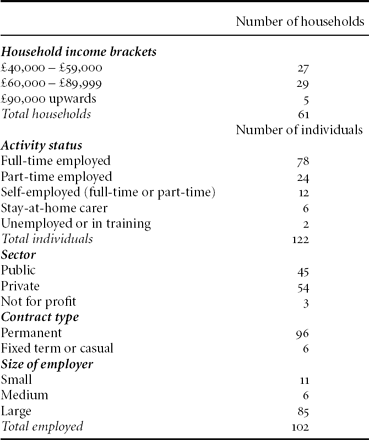
The focus of the paper is on income protection planning against the loss of earnings due to unemployment, hence the selection of households with at least one member of the couple in full-time employment, and, in some cases, in self-employment. The majority of respondents worked as employees, and for these respondents there was a roughly even split between the public and private sector, with just a few working in the third sector. In the public sector, interviewees were working in the NHS, in schools, in local government, as civil servants and police and fire officers. In the private sector, respondents worked for employers in both the manufacturing and service sectors. Of the 122 interviewees, only six did not work due to having to stay at home to care for children, one was unemployed and one was re-training. Most couples were fully dual-earner couples (both working full-time), whilst in just over a third of couples, one of the couple (usually, but not exclusively the female partner) worked part-time. Nearly everyone in employment was on a permanent contract and the majority worked for large employers (see Appendix, Table A1 for further information).
Given their number, interviewees were selected to be indicative of households with these characteristics rather than representative of the whole population of such households.Footnote 4 As such, the Family Resources Survey (FRS) has been used to provide a representative descriptive overview of the unemployment-related private insurances held by households with these characteristics in England and Scotland. Commercial market data provided by Experian on private insurance has also been used (Experian, 2011). Interview transcripts were thematically analysed, and contextualised results are presented in the following sections, each associated with a particular field of income protection. The thematic analysis considered attitudes to the various sources of income protection, both those which households expect to rely on and those they do not. The interviewees’ own words are used where illustrative, and attributed to them by anonymised names. It should be noted that the aim was to identify themes associated with each source of income protection, rather than to derive a typology of responses or attitudes.
Public provision
Public benefits in many European countries reflect incomes from previous employment. Earnings-related unemployment insurance in France or Germany, for example, offers better-paid employees relatively high rates of income replacement. Flat-rate benefits in the UK are considerably less generous, particularly from the perspective of better earners. Jobseekers Allowance (JSA), the current version of publicly available benefits for those unemployed, provides contributory transfers for six months followed by means-tested JSA support. In 2011, claimants aged twenty-five or older were entitled to JSA of £67.50 per week, which represented about 10 per cent of average weekly earnings, having steadily declined from 19 per cent in 1978 (Evans and Williams, Reference Evans and Williams2009: 126). For single persons out of work for a longer period, calculations indicate that the UK provides a level of unemployment benefit which puts it among the five least generous of the twenty-nine OECD countries. Household context matters, however. Taking account of additional benefits, especially housing allowances, the level of public provision in the UK relative to other countries improves considerably, at least for some groups of unemployed (Howell and Rehm, Reference Howell and Rehm2009: 83; OECD, 2011: 42). Still, even relatively modest savings affect the entitlement to means-tested JSA, and claimants are disqualified if partners work for twenty-four hours per week or more. Benefits therefore can be assumed to be of little relevance for better earners, and especially for households with two adults in paid work.
A second public source of income during unemployment is statutory redundancy pay. Once again the reliance on statutory redundancy pay offers relatively little financial security. Many better earners may fulfill the eligibility requirement of two years service with the same employer and those who are at least forty-one years old would be paid more than younger colleagues (1.5 rather than one week's pay per year of service). However, the maximum number of years which count towards redundancy pay is twenty and the maximum weekly pay in 2011 was £400. This makes the UK one of the less generous countries in the EU (Kaupinnen and Meixner, Reference Kaupinnen and Meixner2005).
The fact that neither JSA nor the statutory redundancy payment provide levels of income replacement which above-average earners are likely to consider as adequate is reflected in our interviews. None of the sixty-one couples regarded statutory redundancy support as a sole source of income security, and very few expected state benefits to contribute to family income in the event of unemployment. Even after prompting, only two couples considered unemployment and related benefits as their prospective main source of income replacement.
Overall three key themes emerged with regard to public unemployment benefits: irrelevance, ignorance and ambiguity. Although around a third would still expect to receive whatever they might be eligible for, most of our respondents dismissed JSA or other forms of state benefits as irrelevant to them. The level of unemployment benefit was considered as ‘peanuts’ (Rebecca) or ‘next to nothing’ (Quentin) or ‘a tiny amount’ (Coira) and would ‘probably keep my toothbrush in batteries for a week’ (Pippa). To some extent such perceptions may have been influenced by a lack of knowledge. Even when well-judged in terms of the drop of income these households would experience if they were to rely on JSA as a sole source of income, most respondents were unclear about the actual (or even approximate) amount of JSA. Moreover, there was a widespread assumption that JSA was available only as a means-tested benefit, with respondents ruling themselves out as being eligible because of savings or their partner's earnings.
There were ambiguous feelings about the appropriate basis for entitlement to unemployment support. A notion of reciprocity was strongly supported by many, although not necessarily linked to national insurance. Interviewees referred more generally to having ‘paid in’ and thus being entitled to receive support in return. Representing many others, Justin stated that he had paid ‘probably hundreds of thousands of pounds of tax over the years’ which should entitle him to receive some financial return should he find himself out of work. More specifically, there was some support for a system which ‘for the first three months’ would pay ‘a wee bit more’ in return for ‘a wee bit higher insurance contributions’ (Catherine). By contrast, other respondents supported the principle of need as the appropriate and sole criterion for benefit eligibility, tempered with an anxiety of potentially encouraging perverse incentives. Benefit claimants in receipt of various types of transfers, and in particular of housing allowances, were regarded with suspicion. Even respondents who in the past had relied on JSA themselves rejected the suggestion of increases in benefit rates: ‘if you gave them more money they would stay on the social even longer’ (Gavin). This belief was often held in conjunction with the notion that work was there if you wanted it, even if ‘it was’ stacking shelves at Asda’ or as a ‘security guard’. Similar perceptions of suspicions of widespread benefit fraud, coupled with claims of a strong personal work ethic, are common in other countries too (see, for example, Taylor-Gooby and Martin, Reference Taylor-Gooby, Martin and Clasen2011). However, the strength of the feelings of resentment and dismissal towards state unemployment benefits was striking and this may arguably be reinforced by the level and structure of public provision. In any case, our interviews seem to reflect a clear lack of middle-class solidarity for publicly organised risk sharing in the area of unemployment compensation (see also Clery, Reference Clery, Park, Clery, Curtice, Phillips and Utting2012).
Private insurance, savings and property
Private unemployment insurance is faced with a number of actuarial and other problems (Barr, Reference Barr2001). One is the status of unemployment itself. The probability of becoming, and remaining, unemployed is neither random, independent or individualised. Sudden changes in economic contexts can substantially influence the incidence of unemployment while the closure of large local companies can affect other businesses in a particular region, thereby making unemployment self-reinforcing. Moreover, the actuarial calculation of insurance premiums is hampered by adverse selection problems, as well as potential moral hazard. The former refers to the difficulty of insurers to assess individuals’ risk status, the latter to the inability of monitoring individuals’ behaviour.
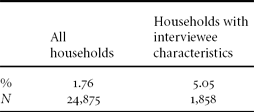
This does not mean that private unemployment insurance is not available. However, it means that insurers tend to offer policies which apply certain restrictions. For example, stand-alone insurance policies (such as Income Protection Insurance; IPI) are open only for people with permanent employment contracts, and provide benefits (typically equal to 50 per cent of previous earnings) up to a certain maximum.Footnote 5 Cebulla (Reference Cebulla2000) estimated that about 6 per cent of working-age individuals were covered by a form of unemployment insurance in 1997 (see also Burchardt and Hills, Reference Burchardt and Hills1997). According to the Family Resources Survey, the proportion of those with stand-alone unemployment or redundancy cover was below 2 per cent of all households in 2004/05 and around 5 per cent of households with the characteristics of our interviewee group (Table 1). Amongst the sixty-one couples we interviewed, only two were covered by an Income Protection Policy (IPI).
Households with at least one policy covering redundancy (England and Scotland), 2004–05
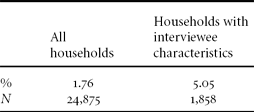
Note: FRS, 2004–05. Estimates produced using weights. Differences between countries are not statistically significant.
More common are policies linked to the need to maintain monthly mortgage payments (Mortgage Payment Protection Insurance – MPPI). Obviously, these already constitute a restriction of unemployment insurance to somewhat better risk groups (mortgagers only). Moreover, eligibility rules exclude persons without permanent work contracts and stipulate a minimum period of employment (often one year), benefit waiting periods apply (generally between one and three months), as well as a maximum period of benefit entitlement (typically twelve months).Footnote 6
MPPI policies may include other risks such as sickness, accident or death. Not surprisingly coverage rates are thus somewhat wider than those of IPI (unemployment) policies. According to Family Resources Survey data for 2009/10, half of the households with the same characteristics as our group of couples had MPPI and, of this group, 27 per cent had a policy covering them for unemployment. This is reflected in our interviews. Of the couples we talked to, fifteen reported some form of unemployment-related MPPI, and seven of these considered it as their main source of income security in case of unemployment. For most of these couples, only the loss of the higher (generally but not exclusively male) income earner was insured. Possibly associated with periods of house buying and the mortgage industry, younger couples were more likely to have MPPI than older couples. This is supported by commercially commissioned surveys which show that MPPI policies are particularly prevalent among couples in their late twenties up to the early forties who have slightly above-average paying jobs (Experian, 2011).
While very few couples expected to rely on private unemployment insurance as their sole source of income replacement, private cover was considered to contribute to a sense of ‘peace of mind’ which could not, or could only to some degree, be gained from other forms of income protection, particularly within a context where accumulating sufficient savings was a perceived impossibility due to other outgoings. However, having private protection is not necessarily evidence of strategic planning associated with unemployment. Since MPPI covers the inability to make mortgage payments, other risks (such as illness) may be more relevant for entering into insurance contracts. Indeed, rather than making references to unemployment insurance specifically, respondents more typically talked about the need of ‘having the mortgage covered’. Moreover, rather than pro-actively selecting private unemployment insurance as a form of income protection, in several cases mortgage advisers seem to have played a role, raising the level of risk awareness associated with the purchase of mortgages, or even suggesting that MPPI was a compulsory policy linked to a mortgage deal.
Cheryl: I'm pretty confident we had to do it . . . Whether it was because we were first time buyers or that was part of the contract, I can't remember.
A few respondents stated that they would like to have been insured, but felt that they could not afford it. Some interviewees felt that private insurance was irrelevant to them given their particular circumstances of perceived job security (discussed below) or because they relied on other forms of income protection, such as savings, but this did not mean that they would not consider it if circumstances changed.
However, many other couples categorically ruled out private unemployment insurance for three main reasons: cost, value for money and lack of trust. Many considered it as ‘ludicrously expensive’ (Justin), and a ‘rip off’ (Ted). The perception of private cover representing poor ‘value for money’ was often associated with suspicions towards the insurance industry. Since the 1990s, there have been several widely publicised instances of banks and insurance companies having to pay compensation for aggressively selling (and mis-selling) policies, such as private pensions (early 1990s), mortgage repayment products (early 2000s) and, most recently, policies which cover credit card repayments. These extensively reported instances may help to explain widespread notions of mistrust. Respondents stated that ‘there has been a lot of bad press about that sort of thing’ (Felix), compounding feelings that they would not receive any pay-outs from the insurance company since ‘there is always a clause that it doesn't let you get it’ (Flora), and that banks made ‘an awful lot of money out of them and they're very poor at paying out . . . always finding ways that they don't have to pay’ (Justin). Some respondents had certain types of optional insurances, such as life insurance, and considered others as ‘necessary evil, you have to have it on buildings and cars but I wouldn't do it on anything else’ (Justine).
Compared with private unemployment insurance, personal savings figured more prominently as a source of income protection, with two main themes becoming apparent. For some, savings were regarded as a temporary source of earnings replacement. Having savings equivalent to three months wages is a commonly expressed ideal espoused by financial advisors, and was often cited by our interviewees ‘sort of three months in the bank as a buffer against the random stuff happening’ (Ben). Respondents considered savings as a way of compensating for the loss of earnings at least for some time: ‘we could survive probably with our savings and that for a year’ (Felix). Couples might also rely on wider family savings support such as ‘the bank of mum and dad’ (Brian). However, savings as a stop-gap until another job had been secured were considered as an important source of income protection typically by couples belonging to the higher income bracket (see Appendix, Table A1).
At the time of our interviews (2010–11), the financial and subsequent global economic crisis had become fully manifest. Somewhat surprisingly, this had some, albeit not very strong, influence on couples’ attitudes towards and engagement with diverse sources of income protection. However, higher inflation and tax rises were felt to be putting pressure on disposable income, making savings more difficult especially for the lower income group. ‘Every time you try to save money then . . . something happens and you've got to spend it on something’ (Quinn). At least one household had used up savings during a recent spell of unemployment and expressed that it would take them some time to build up savings to sufficient levels to provide protection should one partner become unemployed again. In the case that one partner in the couple was not working full-time, a change in their working hours in the event of unemployment of their partner was an oft-cited option by interviewees.
As all of our households were homeowners, and most repaying mortgages, one option of adjusting to reduced income due to unemployment would be to take advantage of some mortgage lenders allowing ‘mortgage holidays’, or even to resorting to re-mortgaging which could free up disposable income. A more radical option would be ‘downsizing’, that is selling the current property and moving into a less expensive dwelling. Many households acknowledged this as a possibility, although most likely only as a last resort after other options had been exhausted, or in case of longer periods of unemployment. As discussed below, such a prospect was not expected by any of our couples.
Employers as a source of income security
Severance pay offered by companies beyond that which is legally required forms part of the employment contract between many employers and employees. Given the mostly private nature of this agreement, there is a paucity of publicly available information. There is no comprehensive database or source of government survey data which would allow for a systematic assessment of the scope of occupational provision with regards to redundancy pay. Commercial ventures offer benchmarking services to human resources departments, but this type of information is not generally available. Nevertheless, it is clear that large employers in particular often exceed the statutory minimum redundancy requirements (IDS, 2009), removing the earnings cap on a week's pay, for example, increasing the number of weeks paid per year of service or simply making additional lump-sum payments to redundant workers. At times such payments are incorporated in collective agreements but often simply either offered by employers or agreed with trade unions at times of looming redundancies. Lloyd (Reference Lloyd2003) found that most large employers exceeded the statutory minimum. Some agreements in manufacturing included up to three-and-a-half weeks pay for each year worked for up to two years, depending on age and completed years of service, with no earnings cap (Lloyd, Reference Lloyd2003). Other corporate arrangements, such as occupational pension schemes, might be used as part of a redundancy package, offering a pension more generous than normal to those taking early retirement. In addition, employers might offer a lump-sum ‘severance payment’ to staff in order to avoid legal action against dismissal. Currently, £30,000 of any redundancy payment is tax free.
The relevance of companies compensating staff made redundant can be gauged in the light of some aggregate information. In 2010–11, the DWP spent a total of £4.04 billion on JSA to about 1.5 million claimants at any one time (DWP, 2012). By comparison, in 2010 British employers paid out a total £4.4 billion in redundancy payments to about 470,000 employees, with an average payment of just under £9,400 (HRmagazine, 2011). It is not only private sector workers but also many public sector employees, such as NHS staff or civil servants, who are offered, for example, a month's (rather than a week's) pay per year of service. Many local authorities use other ‘discretionary multipliers’ (e.g. of 1.5 or two times statutory redundancy pay entitlement) to calculate personal redundancy pay packages. In 2009, the average payout in the public sector was close to £18,000 (The Guardian, 5 July 2010). It should be pointed out though that there is a considerable level of variation, both across sectors and within the same sector.Footnote 7
Against this background it is not surprising that well over half of our couples regarded occupational redundancy pay as a very important source of income protection. This applies especially to those employed in the public sector or by large private companies. Disregarding strong feelings of job or employment security (discussed below), couples in the older age bracket and higher income group in particular perceived firm-level-based redundancy entitlement as by far the most important single source of income protection in case of unemployment. By contrast, interviewees who did not think that they could rely on such protection had either not been in their current job for a sufficient amount of time, were employed by a less generous private employer or were self-employed.
On the whole, three themes emerged from our interviews: a general awareness that the level of redundancy pay is related to tenure, an expectation of occupational severance pay providing a relatively good level of protection, but also notions of declining generosity. Typically, couples were unsure about the exact amount and nature of their potential redundancy packages. However, there was a general understanding that this depended on age and the length of employment with the current organisation.
Justin: ‘Because I've been there over ten years, the redundancy packages are pretty good.’
Nigel: ‘I would be okay, because I'm now, you know, getting into the age where it's going to cost them more to make me redundant than it is to carry on, me carry on for a few more years. Ninety weeks’ money and the first 30 grand of that is tax free.’
Some respondents expected considerable amounts (a ‘big wad’, Pippa) that could provide financial support at current living standards for the household for a period between jobs for at least six months. Cedric stated, ‘probably a year and a half maybe. And obviously you would take stringent measures to cut back. So maybe two years. Two years.’ Others expected to receive sufficient to cover full wages for half a year or so. Rebecca: ‘it's not a huge redundancy, but it's enough to see us through for about six months so there would be a six month period where we could live off of that whilst looking for another job’.
A few interviewees had actually experienced redundancy in recent years, and had received severance pay on what they considered to be generous terms. Moreover, as new employment had been found relatively quickly in many cases, redundancy money had not been used as unemployment cover but as a contribution to savings for something else (such as children's university education). However, several interviewees assumed occupational redundancy as having become less generous in recent years. Mhairi, a public sector employee, stated: ‘in the past many in my department have had thousands and thousands of pounds redundancy payment but the government now are reducing that over time’. Karl, a civil servant, claimed he would be entitled to ‘seventeen or eighteen months’ salary. But he was also aware of recent cut-backs to redundancy payment deals in his sector.
It appears that in some instances the switch to less favourable terms was made more palatable to current employees. Roy, a private sector employee, reported:
what they have done was: right, we give you 40 per cent of that money right now and we'll put you on that other redundancy scheme, which doesn't pay out nearly as much as the old scheme. They were cutting their losses there and then . . . I was only in the company a couple of years, so I didn't get a lot of money (£5,000 which paid off debt) . . . people that have been in the company maybe twenty or thirty years and they were getting, thirty, forty or fifty thousand pounds just to buy out the redundancy package.
Several more responses added to an impression of a scaling down of existing occupational provision in case of redundancy. According to reports in popular papers there are certainly suggestions of redundancy packages becoming less generous both in the private and the public sector in recent years (e.g., Daily Echo, 2 December 2011). Many of our respondents may thus overestimate the actual and future level of redundancy pay they may be entitled to.
Discussion and conclusion
The ways in which better-earning households anticipate managing financially during periods of unemployment needs to be put into a somewhat broader context. For example, it should be noted that many respondents played down the prospect of redundancy and expressed a strong sense of either job or employment security. This was the case particularly amongst those with long tenure and working for large private companies. But also many public sector staff seemed to consider their current employment as providing relatively good job security. Others, who more readily conceived of the possibility of redundancy, regarded long periods out of work as unlikely due to a confidence in their personal employability, coupled with a strong work ethic and occupational flexibility. A typical assumption was that there would always be some kind of work available due to personal expertise, experience or work contacts. Even where there was less confidence in a particular employer, many respondents expressed a strong sense of employment security, as well as willingness to accept jobs below their particular level of qualification.
The global financial and economic crisis seems to have had little influence on such attitudes. It appears that direct effects, such as tax increases, rising consumer prices and lower earnings, as well as longer-term aspects such as the prospects of lower pensions, have influenced couples’ consumption patterns somewhat but perceptions (and behaviour) towards income protection much less so.
Given their age, occupational position and biography, this could be regarded as reasonable. The risk of unemployment is certainly lower for our couples than for the working population as a whole, and responses seem to reflect this. Nevertheless, as the global economic crisis has shown, larger companies are not immune to economic difficulties, and redundancies affect the public sector too. It could thus be argued that feelings of job security are unduly optimistic, especially at times of a major economic downturn. However, at this point it should be reiterated that our analysis has not aimed to contrast subjective perspectives with actual levels of job security or statistical risks of unemployment. Instead we have explored couples’ perceptions and expectations about how they would manage financially during periods of unemployment, as well as attitudes towards different sources of income protection. Potentially, investigations of this kind help to improve our understanding of the respective roles played by public and private types of income security. For example, our findings suggest that private unemployment insurance has remained a niche product not because of a widespread lack of ‘financial literacy’, but due to perceptions of insufficient value for money, a mistrust in the reliability of private insurance, as well as an anticipation of being entitled to comparatively generous occupational redundancy pay. Whether such anticipations are justified or not, whilst being an important question, is beyond the scope of this paper.
The discussion has shown that, on the whole, occupational redundancy pay was clearly perceived as the most important single form of income protection for better-off earners, often in combination with other sources, such as savings. By contrast, only very few British households with above-average earnings seem to consider state benefits as relevant. This is not to say that public provision would be ignored in the event of need but, on the whole, unemployment benefits were dismissed or not perceived as an important contribution to household income during periods out of work. While this may be associated with objectively low levels of support, respondents’ perceptions play a part given the widespread assumption that benefits are exclusively needs-based. The politically driven retrenchment of contributory benefits, combined with an emphasis on means-testing as the all but exclusive condition for public support, seems to be clearly reflected in attitudes. Nevertheless, it is interesting to note that there is still an ambiguity about the basis for social rights to benefits, with some support for reciprocity-based eligibility.
Households were typically not reliant on a single form of income protection but a combination of sources. However, this is rarely the product of strategic planning. As discussed, some households were faced with constraints such as lower disposable income or employment without access to occupational redundancy pay. Others had more options to act and plan ahead, for example building up savings. However, as discussed, the extent of pro-active income protection planning is rather limited. Even the use of private unemployment insurance tends to be less associated with an active exercise of choice than with assumptions about what is an appropriate (or required) course of action in the process of taking out a mortgage. Similarly, the consideration of occupational redundancy pay as the main or even sole source of income in the case of unemployment is rarely based on concrete knowledge or active engagement. Instead, many respondents seem to assume that their current job and employment biographies would translate into what are widely regarded as reasonable levels of redundancy pay.
In the absence of concrete information, employees may well put too much trust in the actual role, and durability, of occupational redundancy pay. This lack of knowledge at the individual level reflects the absence of systematic data about policies and practices as operated by companies more broadly. Based solely on our interviews, it is impossible to infer a general trend of retrenchment in redundancy pay provision which may well be akin to the decline in the generosity and scope of occupational pensions (e.g., Bridgen and Meyer, Reference Bridgen and Meyer2005; Meyer and Bridgen, Reference Meyer, Bridgen and Clasen2011). However, the prominence which households seem to attach to occupational redundancy payment should be ample justification for investigations into the actual scope and development of company-based social protection over and beyond occupational pensions.
Appendix
Interviewee sample