

Introduction
Invasive species are known to have detrimental impacts on island ecosystems and are a major driver of extinctions and loss of biodiversity (Towns et al. Reference Towns, Atkinson and Daugherty2006, Angel et al. Reference Angel, Wanless and Cooper2009, Banks and Hughes Reference Banks and Hughes2012, Shiels et al. Reference Shiels, Pitt, Sugihara and Witmer2014, Spatz et al. Reference Spatz, Zilliacus, Holmes, Butchart, Genovesi, Ceballos, Tershy and Croll2017). Invasive rodents (Rattus spp. and Mus spp.) are among the most damaging, preying on birds, bats, reptiles, snails, and other invertebrates, as well as eating fruits, seeds, and seedlings (Atkinson Reference Atkinson and Moors1985, Campbell and Atkinson Reference Campbell and Atkinson2002, Smith et al. Reference Smith, Avenant and Chown2002, Cuthbert and Hilton Reference Cuthbert and Hilton2004, Shaw et al. Reference Shaw, Hovenden and Bergstrom2005, Towns et al. Reference Towns, Atkinson and Daugherty2006, Auld et al. Reference Auld, Hutton, Ooi and Denham2010, Shiels and Drake Reference Shiels and Drake2011, Pender et al. Reference Pender, Shiels, Bialic-Murphy and Mosher2013). Introduced rodents also wreak havoc on vegetation structure and diversity by reducing native plant recruitment (Traveset et al. Reference Traveset, Nogales, Alcover, Delgado, Lopez-Darias, Godoy, Igual and Bover2009). Moreover, the loss of invertebrate fauna and suppression of seabird abundance following rodent introduction can alter soil fertility (Fukami et al. Reference Fukami, Wardle, Bellingham, Mulder, Towns, Yeates, Bonner, Durrett, Grant-Hoffman and Williamson2006) and affect the condition of island vegetation communities (Holdaway et al. Reference Holdaway, Hawke, Hyatt and Wood2007). To alleviate these often-devastating impacts of rodents, conservation practitioners are increasingly using rodent eradication as a method of conserving species and restoring ecosystem integrity on islands.
Following successful eradications, populations of native species often rapidly recover (Jones et al. Reference Jones, Holmes, Butchart, Tershy, Kappes, Corkery, Aguirre-Monoz, Armstrong, Bonnaud, Burbidge, Campbell, Courchamp, Cowan, Cuthbert, Ebbert, Genovesi, Howald, Keitt, Kress, Miskelly, Oppel, Poncet, Rauzon, Rocamora, Russell, Samaniego-Herrera, Seddon, Spatz, Towns and Croll2016). However, there is potential for unintended consequences (e. g. Bergstrom et al. Reference Bergstrom, Lucieer, Kiefer, Wasley, Belbin, Pedersen and Chown2009), particularly where several introduced species occur. A strong focus of research on such outcomes has been on the effect of mesopredator release (Zavaleta et al. Reference Zavaleta, Hobbs and Mooney2001) where the eradication of an invasive superpredator (e.g. cats) theoretically results in an increase in abundance of its prey (e.g. rats), whose impact on native species then becomes proportionally higher (Rayner et al. Reference Rayner, Hauber, Imber, Stamp and Crodrilout2007). However, where shared prey is long-lived and predation by super and mesopredators differs by age-class, such outcomes are not always realised (Rodriguez et al. Reference Rodriguez, Torres and Drummond2006, Russell et al. Reference Russell, Lecomte, Dumonte and Le Corre2009). Nevertheless, few studies have examined such changes in predator/prey relationships among native species following eradications. Pierce (Reference Pierce2002) looked at a native New Zealand predatory reptile, the tuatara Sphenodon punctatus and its potential impact on two burrowing seabird species following eradication of Pacific rats Rattus exulans on the Marotere Islands in New Zealand, but results were inconclusive. On Lord Howe Island there are several documented pressures on breeding seabirds that are not directly related to rodents. For example, the endemic Lord Howe Woodhen Hypotaenidia sylvestris, a large flightless rail, has been known to remove and kill large Providence Petrel Pterodroma solandri nestlings (Bester et al. Reference Bester, Priddel, Klomp, Carlile and O’Neill2007). Tree nesting White Terns Gygis alba suffer from nest predation by the endemic Lord Howe Currawong Strepera graculina crissalis (Carlile and Priddel Reference Carlile and Priddel2015). The Black-winged Petrel P. nigripennis, which breeds at lower elevations, is subject to burrow competition from the similarly sized Little Shearwater Puffinus assimilis (Hutton and Priddel Reference Hutton and Priddel2002). The introduced Masked Owl Tyto novaehollandiae (Hogan et al. Reference Hogan, Campbell, Harrison, Milledge and Cooke2013) has also been documented taking adult seabirds (Carlile and Priddel Reference Carlile and Priddel2015). The removal of the owl is planned as part of the rodent eradication project (Milledge et al. Reference Milledge, Bower and Carlile2019, Walsh et al. Reference Walsh, Wilson, Bower, McClelland, Pearson, Veitch, Clout, Martin, Russell and West2019). Consequences of any changes in abundance or distribution of any or all of these species in the absence of rodents and their potential impact on breeding seabirds is unknown.
Ship rats R. rattus were introduced to Lord Howe Island in 1918 following the grounding of the SS Makambo (McCulloch Reference McCulloch1921). Several extinctions soon followed including five bird taxa (Hindwood Reference Hindwood1938) and the near extinction of the Lord Howe Phasmid Dryococelus australis (Priddel et al. Reference Priddel, Carlile, Humphrey, Fellenberg and Hiscox2003). Some seabirds that originally bred here, such as Kermadec Petrel P. neglecta and White-bellied Storm-petrel Fregetta grallaria are now confined to rodent-free offshore islands (Hindwood Reference Hindwood1940, Fullagar et al. Reference Fullagar, McKean and Van Tets1974). Mice Mus musculus were introduced some time earlier and while their impacts are not as well understood, damage from mice has been recorded elsewhere (Angel et al. Reference Angel, Wanless and Cooper2009, Dilley et al. Reference Dilley, Davies, Bond and Ryan2015). The Lord Howe Island Rodent Eradication Project (REP) was undertaken in 2019 (Walsh et al. Reference Walsh, Wilson, Bower, McClelland, Pearson, Veitch, Clout, Martin, Russell and West2019). The project used cereal pellet baits containing the anticoagulant brodifacoum at 20mg/kg (Pestoff 20R. Animal Control Products, New Zealand). Bait was applied aerially in the Permanent Park Preserve (PPP), in bait stations in the settlement area, and by hand-broadcast in a buffer zone between the PPP and the settlement.
Petrels (Procellariidae) have high ecological and conservation significance. Because they transfer large amounts of nutrients from the oceans to the terrestrial environment (Polis and Hurd Reference Polis and Hurd1996), their presence on islands benefits a wide range of other island species (Sekercioglu Reference Sekercioglu2006). However, almost half of Procellariiform species are threatened with extinction globally, with invasive species on their breeding islands the main threat to their survival (Rodriguez et al. Reference Rodriguez, Arcos, Bretagnolle, Dias, Holmes, Louzao, Provencher, Raine, Ramirez, Rodriguez, Ronconi, Taylor, Bonnaud, Borrelle, Cortes, Descamps, Friesen, Genovart, Hedd, Hodum, Humphries, Le Corre, Lebarbenchon, Martin, Melvin, Montevecchi, Pinet, Pollet, Ramos, Russell, Ryan, Sanz-Aguilar, Spatz, Travers, Votier, Wanless, Woehler and Chiaradia2019). There is therefore strong interest in the recovery of petrel species following eradications. The Black-winged Petrel is one of five species of procellariids breeding on Lord Howe Island. This species breeds on numerous islands in the south-west Pacific Ocean and migrates to the North Pacific in the non-breeding season (Marchant and Higgins Reference Marchant and Higgins1990). Globally, it has an estimated population of up to 10,000,000 individuals (Brooke Reference Brooke2004) and is assessed as ‘Least Concern’ (BirdLife International 2022). It is, however listed as ‘Vulnerable’ in New South Wales (Department of Environment and Planning 2022) where this study was performed. Black-winged Petrels are thought to be particularly susceptible to rodents due to traits such as burrow nesting, insular tameness, altricial nestlings, and intermittent egg neglect. Our aims were to investigate 1) causes of nest-failure of Black-winged Petrels in the presence of rodents, 2) whether the absence of rodents resulted in an increase in breeding success in this species, 3) whether at-sea distribution of Black-winged Petrels differed between Tasman Sea breeding colonies with and without rodents to account for any potential marine pressures that could influence breeding success, and 4) unforeseen interspecific interactions that may subsequently impact successful petrel breeding in a rodent-free environment.
Methods
Study sites
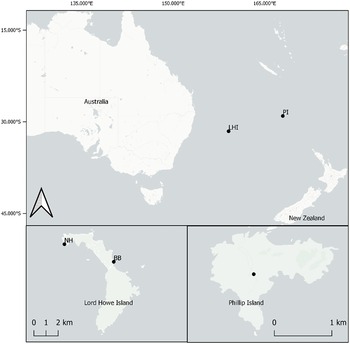
Lord Howe Island (31°31’S, 159°03’E) is situated in the South Pacific, 760 km north-east of Sydney, New South Wales, Australia (Fig. 1). The island is 1,455 ha in area, 12 km long, and 1–2 km wide. The island has a permanent settlement covering about 25% of the island. The remaining 75% is protected under a Permanent Park Preserve (PPP), which has similar status to that of a national park (Department of Environment and Climate Change 2007). Lord Howe Island is a hotspot for endemism: 44% of native vascular plants and more than 50% of native invertebrates are endemic (Recher and Clark Reference Recher and Clark1974, Green Reference Green1994). Black-winged Petrel populations on Lord Howe Island were estimated to be ‘several hundred’ (McAllan et al. Reference McAllan, Curtis, Hutton and Cooper2004) in the early 2000s.
Location of Lord Howe Island (LHI) and Phillip Island (PI) in the South Pacific (above) and the location of the study sites on Lord Howe Island (below left) and Phillip Island (below right).

Phillip Island (29°07’S, 167°57’E), also in the South Pacific, is part of the Norfolk Island Group situated approximately 1,670 km north-east of Sydney and approximately 900 km north-east of Lord Howe Island. Phillip Island is uninhabited, 2.1 km E to W and 1.95 km N to S and 190 ha in area. Pigs Sus scrofa, goats Capra hircus and rabbits Oryctolagus cuniculus were introduced to the island but were eradicated by the 1970s. While rats (R. exulans and R. rattus) occur on Norfolk Island, they have not been recorded on Phillip Island. In 2017, there were an estimated 19,000 breeding pairs of Black-winged Petrels on Phillip Island (Carlile and O’Dwyer pers. obs.).
Breeding success
We monitored Black-winged Petrel nests on Lord Howe Island and Phillip Island before (2017), and after rodent eradication (2020 and 2021). Two study sites were used on Lord Howe Island — Blinky Beach (BB, Fig. 1) and North Head (NH, Fig. 1). A single location was used on Phillip Island where Black-winged Petrels are widespread (Priddel et al. Reference Priddel, Carlile, Evans, Evans and McCoy2010, Figure 1).
On Lord Howe Island in 2017, we identified 40 Black-winged Petrel nests containing incubating adults (31 at Blinky Beach and 9 at North Head), using either a burrow scope or by hand to feel for the presence of both an adult and an egg. Forty active nests were also identified on Phillip Island. On Lord Howe Island, we set up 29 infra-red surveillance cameras (Reconyx Hyperfire®) on 29 nests (24 at Blinky Beach and five at North Head), Cameras were set to motion-sensing mode and placed to view the entrance from 1–2 m away to help determine the cause of any nest failures. We then revisited the active nests monthly to ascertain nest fate. On Phillip Island, nests were checked on 17–20 January, 18–23 February, and 17–18 April.
In 2020, we monitored 43 nests on Lord Howe Island (30 at Blinky Beach and 13 at North Head). To confirm the absence of rodents at the Lord Howe Island sites, surveillance cameras were set viewing the entrance of seven active nests at Blinky Beach and four active nests at North Head in the same manner as 2017. Nest contents were checked on 2–5 February, 3–5 March and on 9 April (Blinky Beach only) and 24 April (North Head only). On Phillip Island, 40 nests were identified in January, but travel restrictions relating to the COVID-19 pandemic (see Miller-Rushing et al. Reference Miller-Rushing, Athearn, Blackford, Brigham, Cohen, Cole-Will, Edgar, Ellwood, Fisichelli, Flanagan Pritz, Gallinat, Gibson, Hubbard, McLane, Nydick, Primack and Super2021) did not allow a final measure of breeding success in 2020.
In 2021, we monitored 46 nests on Lord Howe Island (31 at Blinky Beach and 15 at North Head) and 25 nests on Phillip Island. Surveillance cameras were placed on four nests at Blinky Beach and four at North Head. Nest status was checked on Lord Howe Island on 18–19 February, 20–21 March and 19–21 April 2021. Nests were checked on Phillip Island on 20 March and 27–29 April 2021.
Chi-square tests were used to detect significant changes in breeding success in the presence or absence of rodents, and the frequency of woodhens caught on cameras. A Z-test was used to test for differences in the relative abundance of rats between the two Lord Howe Island study sites in 2017.
Differences in at-sea distributions
In 2017, 32 light-level geolocators (GLS: 19 Intigeo C65, Migrate Technology Ltd. and 13 MK5093, Biotrack Ltd.) were attached to Black-winged Petrels on Lord Howe Island and 39 GLS (23 Intigeo C65 and 16 MK5093) were attached to Black-winged Petrels on Phillip Island. GLS were attached using cable ties and glued to Velcro and wrapped around the tarsus of the bird. In 2020, Intigeo W65 GLS (Migrate Technology Ltd) were attached to the legs of 15 birds on Lord Howe Island and 15 birds on Phillip Island using a stainless steel band and attached by 202 stainless steel wire, in a method applied to White-faced Storm-petrels Pelagodroma marina in Atlantic colonies (F. Zino and M. Biscoito pers. comm). Migrate Technology GLS were programmed in Mode 1 (light sampled every minute with max light recorded every 5 mins, temperature sampled every 5 mins with max and min recorded every 4 hrs, wet/dry and conductivity sampled every 30 secs with number of samples wet and max conductivity recorded every 4 hrs). Biotrack GLS recorded maximum light levels at 5-minute intervals. Geolocators were calibrated at a stationary location (i.e., rooftop calibration) at the breeding site prior to deployment on the bird. Locations of tracked birds were estimated with the geolocation software package FLightR (Rakhimberdiev et al. Reference Rakhimberdiev, Saveliev, Piersma and Karagicheva2017).
The start of migration (i.e., departure from the breeding area) was defined as the date at which an individual was located at least 600 km from its breeding colony and did not return to the colony until the following spring. The date of arrival at the over-wintering area was defined as the first date during an individual’s non-breeding phase when it had stopped moving more than 200 km for three consecutive days. Departure from an individual’s over-wintering area was defined as the date at which an individual moved more than 200 km for three consecutive days. Arrival at the breeding area was defined as the date an individual returned to within 600 km of its breeding colony from its over-wintering area. The 50% utilisation distributions for breeding and non-breeding periods were computed using statistical software environment R, version 3.5.1 (R Core Team 2021) including only the positions while birds were within those areas. Daily positions and polygons were mapped using QGIS version 3.8.2 (QGIS Development Team 2021).
Results
Breeding success
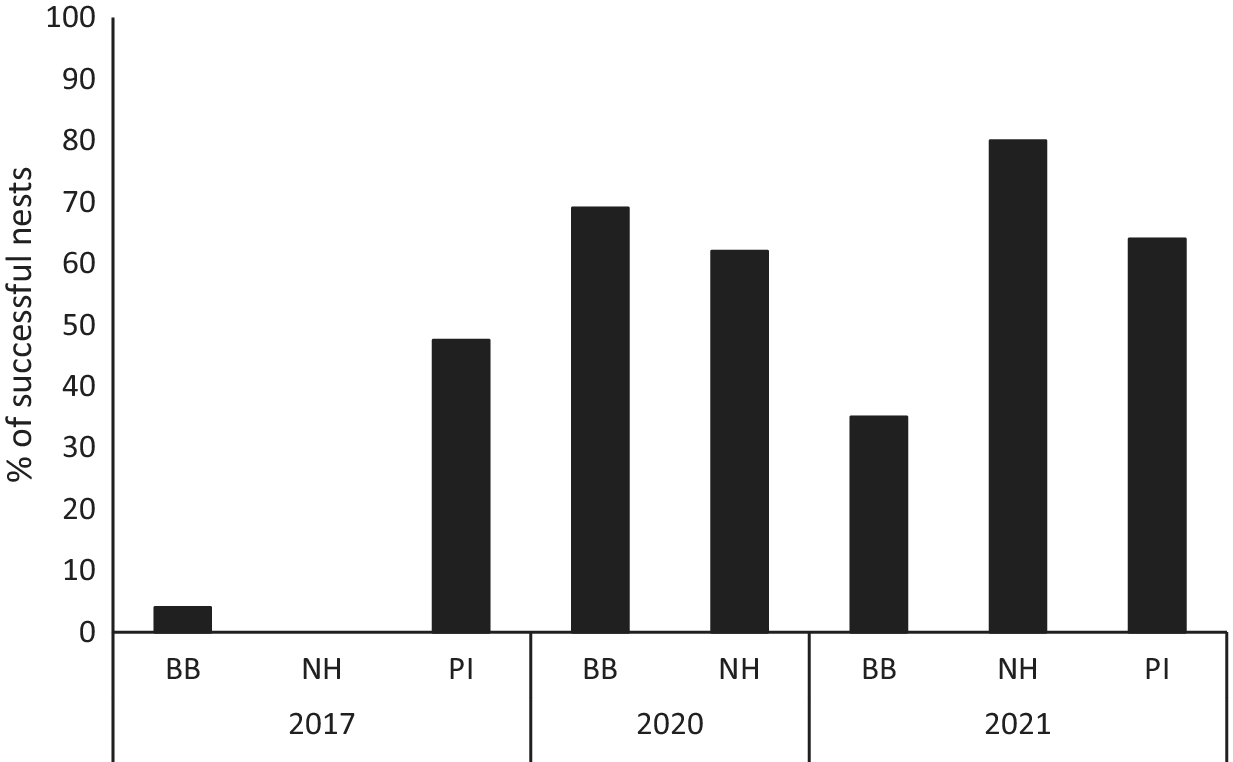
Following completion of the REP, breeding success on Lord Howe Island increased dramatically from 2.5% in 2017 to 67% in 2020 (z = 6.824, P <0.00001). In 2017, only one of 40 Black-winged Petrel nests successfully produced a fledgling. At North Head, nest failure was 100% with all eggs predated prior to hatching (Fig. 2). At Blinky Beach, 11 nests failed at the egg stage and 10 nests failed after hatching. The stage of nest failure could not be established for the remaining nine nests due to timing of nest checks spanning the hatching period.
Breeding success of Black-winged Petrels on Lord Howe Island and Phillip Island before and after the rodent eradication project. N.B. Breeding success was not measured on Phillip Island in 2020 due to travel restrictions related to the Covid-19 pandemic preventing access to the breeding site. NH = Lord Howe Island – North Head, BB = Lord Howe Island – Blinky Beach, PI = Phillip Island – Norfolk Island Group.

In 2017 on Phillip Island, 19 of 40 nests (47.5%) produced a fledgling (Fig. 2). Of the 21 failed nests, 10 failed at the egg stage and six failed at the chick stage. The stage of nest failure for the remaining five nests could not be determined due to the timing of nest checks.
In 2020 on Lord Howe Island, 26 of 39 (67%) nests successfully produced a fledgling. At North Head, where complete breeding failure was recorded in the presence of rodents in 2017, eight of 13 (62%) nests were successful. No data were available from Phillip Island in 2020. In 2021, two years after rodent eradication, breeding success was at 50% on Lord Howe Island (12 fledglings from of 15 eggs at North Head and 11 fledglings from 31 eggs at Blinky Beach, Fig. 2). On Phillip Island, 16 of 25 nests (64%) were successful in 2021. The proportion of successful nests differed between islands and with rodent presence in 2017 versus 2021 (χ2 = 36.904, df = 1, P <0.00001). In addition, of the 30 known nests at North Head, only nine (30%) were occupied in 2017. The occupancy of nests had increased to 12 of 30 nests (40%) in 2020, and to 16 of 30 nests (53%) in 2021.
Camera traps
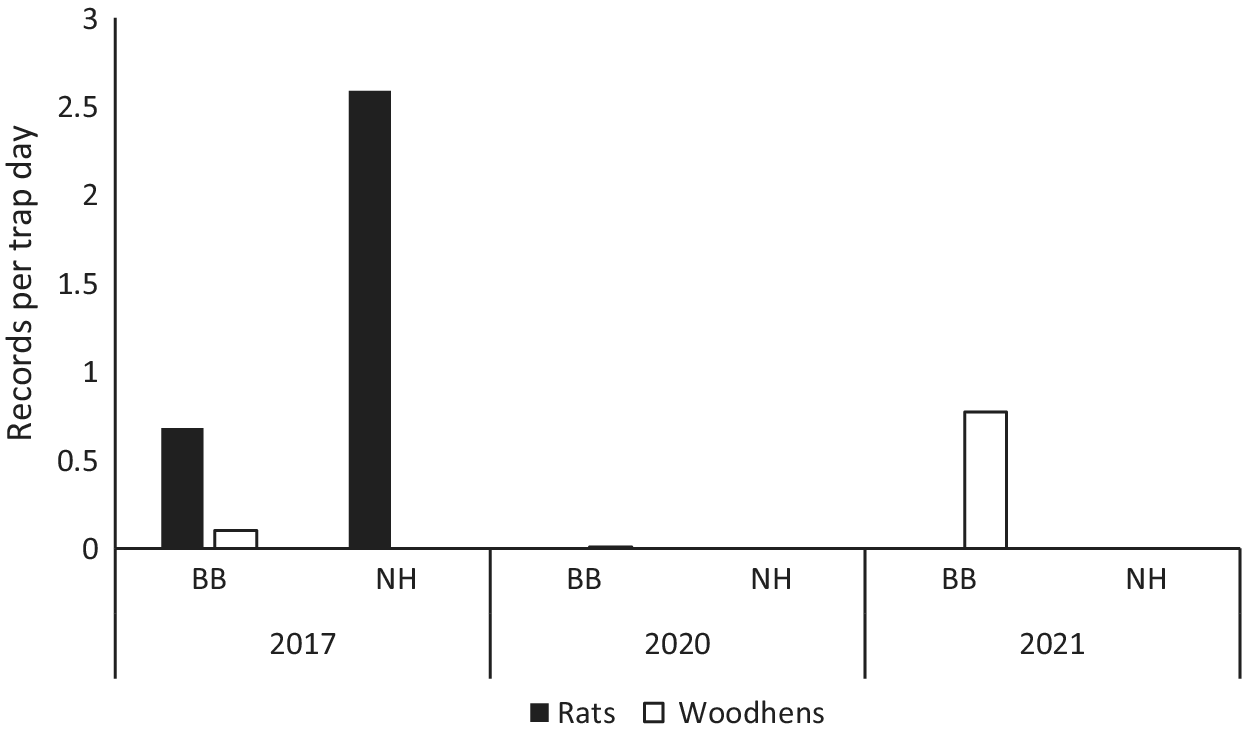
At Blinky Beach in 2017, over a total of 392 camera-trap days, rats were recorded in or around the entrance to a nest 230 times (i.e., 0.59 rats/camera-trap day) but were not recorded in 2020 (252 camera-trap days) or 2021 (338 camera-trap days) (Fig. 3). Lord Howe Woodhens, a known predator of petrel nestlings (Bester et al. Reference Bester, Priddel, Klomp, Carlile and O’Neill2007), were caught on camera-traps 34 times (i.e., 0.09 woodhen/camera-trap day) in 2017, three times (i.e., 0.01 woodhen/camera-trap day) in 2020 and 261 times (i.e., 0.77 woodhen/camera-trap day) in 2021. The number of woodhens on cameras increased substantially following the REP (χ2 = 395.32, df = 2, P <0.00001). Also, of note, was the date of arrival of the austral winter-breeding Little Shearwater at the Blinky Beach colony where they share burrows with Black-winged Petrels and upon arrival will evict Black-winged Petrel chicks from the burrow (Hutton and Priddel Reference Hutton and Priddel2002). In 2017, the earliest date that Little Shearwaters were recorded on cameras was 26 March. In 2020 they were first recorded 31 March and in 2021 they were first recorded 23 February, perhaps an indication of increased presence in the colony in the absence of rodents.
The number of occasions that rats and woodhens were captured on cameras that were focused on active Black-winged Petrel burrows at Blinky Beach (BB) and North Head (NH) on Lord Howe Island in 2017, 2020 and 2021. The Rodent Eradication Project was in 2019.

At North Head in 2017, over a total of 211 camera-trap days, rats were recorded on cameras 564 times, which was a significantly higher rate of captures than the 230 from 392 camera-trap days recorded at Blinky Beach (i.e., 2.67 compared to 0.59 rats/camera-trap day, z = –21.9025, P < 0.00001). Woodhens were not recorded visiting monitored burrows at North Head in 2017. At North Head in 2020, across 187 camera-trap days, no rats or woodhens were recorded. Similarly, over 376 camera-trap days at North Head in 2021, there were no detections of rats or woodhens.
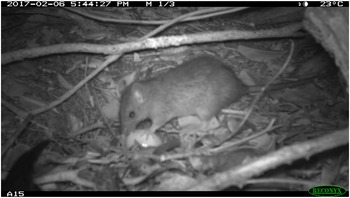
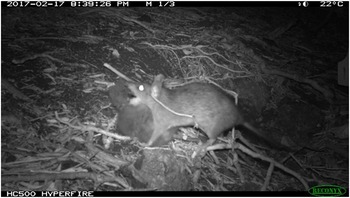
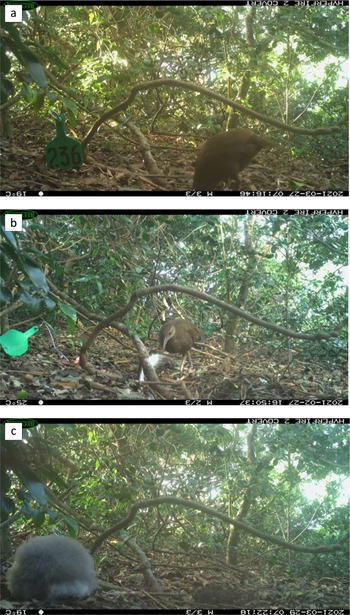
In 2017, the cause of nest failure was determined on 12 occasions using camera-traps. Rats were shown removing eggs from six nests – two at Blinky Beach and four at North Head (Fig 4) and preying on chicks from six nests – all at Blinky Beach (Fig. 5). The cause of nest failure was not recorded on any cameras in 2020 or 2021. While woodhens were seen investigating nests in both 2017 and 2021, sometimes with their head inside the entrance (Fig. 6a), there was no evidence on cameras that they had predated eggs or chicks. At one nest in 2021, a woodhen was recorded attempting to extract an adult petrel from its nest during the incubation period (Fig. 6b). Later, the chick from this nest was observed outside the burrow during the day – presumably evicted by a Little Shearwater (Fig. 7c), it then disappeared from the camera and was not in the nest at the next check of nests. While there was no evidence that the chick was taken by a woodhen, they were frequently seen around this nest and investigating the burrow just prior to the chick being evicted.
A black rat captured in 2017 by surveillance camera removing a Black-winged Petrel egg from an active burrow with a petrel present and presumably, incubating.

A black rat captured in 2017 by surveillance camera removing a Black-winged Petrel chick directly from a burrow on Lord Howe Island.

A woodhen investigating a petrel burrow during the chick rearing period (a); a Lord Howe Woodhen with the wing of an adult Black-winged Petrel in its bill (b); the Black-winged Petrel chick outside its burrow during daylight hours two days later. It was likely evicted by a returning Little Shearwater and would be easy prey for woodhen (c).

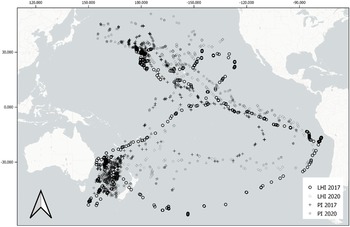
Example of annual movements of four Black-winged Petrels from Lord Howe Island and Phillip Island, Norfolk Island Group, as derived from analysis of GLS.

At-sea distribution
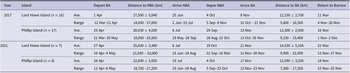
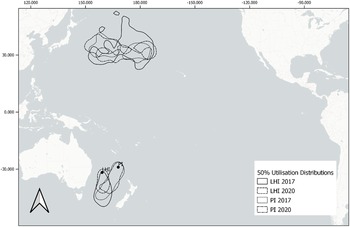
In 2018, we retrieved 16 functioning GLS (7 Intigeo C65 and 9 MK5093) from Lord Howe Island and 17 functioning GLS (8 Intigeo C65 and 9 MK5093) from Phillip Island. In 2021, seven functioning GLS were retrieved from Lord Howe Island and eight were retrieved from Phillip Island. Behavioural movement dates and distances travelled for both populations are shown in Table 1. Fig. 7 shows typical movements during the breeding season and over-wintering period and typical annual migratory routes for both populations. The 50% utilisation distributions are shown in Fig. 8.
Timing of movements and distances travelled for Black-winged Petrels from colonies on Lord Howe Island and Phillip Island (Norfolk Island Group) derived from GLS in two breeding seasons. BA = breeding area, NBA = non-breeding area

Utilisation distributions (50%) for Black-winged Petrels on Lord Howe Island and on Phillip Island, Norfolk Island Group during breeding (Tasman Sea, South Pacific) and non-breeding periods (north-west Pacific) as derived from analysis of GLS.

Discussion
Our results demonstrate remarkable and sudden recovery of seabird breeding success following removal of invasive rodents and suggest that the reproductive output of small seabirds has for decades been heavily suppressed on Lord Howe Island. Prior to the REP in 2019, breeding success of Black-winged Petrels on Lord Howe Island was extremely low (2.5%) compared to rodent-free Phillip Island (47.5%). Such low breeding success on Lord Howe Island would appear to be incompatible with a persistent population. However, similarly low levels (11%) were recorded previously in 2014 at the same sites (N. Carlile and L. O’Neill unpubl. data) demonstrating that the population here has had poor breeding outcomes over an extended period of time. This species is abundant throughout the Pacific and perhaps high levels of migration are balancing the poor fecundity. Before the REP took place, there was pulse-baiting with coumatetralyl and/or difenacoum (Harper et al. Reference Harper, Pahor and Birch2020) to control but not eradicate rodents at the Blinky Beach site. No baiting occurred at the North Head site. This control baiting was having some impact on rat numbers, but this low-level suppression did not translate to any tangible improvement in breeding success for petrels. Only a single Black-winged Petrel fledgling was produced from 31 nests at the Blinky Beach site. Attempts at targeted rodent control, rather than full eradication, have been successful in improving breeding outcomes elsewhere (Cruz and Cruz Reference Cruz and Cruz1987, Raine et al. Reference Raine, Driskill, Vynne, Harvey and Pias2020), but ongoing, high intensity control baiting may be required in these situations to achieve long-term results (e. g. Jouventin et al. Reference Jouventin, Bried and Micol2003).
In the absence of rodents at our study sites in 2020 and 2021 we saw breeding success of Black-winged Petrels increase to levels similar to those found on rodent-free Phillip Island. Breeding success was also within the range expected for a burrow-nesting petrel in the absence of rodents and similar to levels seen following rodent eradications elsewhere (Imber et al. Reference Imber, Harrison and Harrison2000, Reference Imber, West and Cooper2003). Rayner et al. (Reference Rayner, Taylor, Gummer, Phillips, Sagar, Shaffer and Thompson2012) found higher breeding success (70–80%) in their study on established pairs of Chatham Petrel Pterodroma axillaris but our results were similar to the 50% breeding success that Priddel and Carlile (Reference Priddel and Carlile2007) found from a whole of population survey for Gould’s Petrel P. leucoptera. It is possible that future breeding success of Black-winged Petrels on Lord Howe Island will increase further in the absence of rodents. Once Pacific rats were removed from Pycroft’s Petrel P. pycrofti breeding colonies, Pierce (Reference Pierce2002) found that breeding success climbed from levels similar to those seen in our study to peaks of between 60% and 70% within three years following rodent removal. We also found increases in breeding participation at the North Head site where the proportion of burrow occupancy increased from 30% pre-REP to 53% in 2021. This expansion was due to previously abandoned burrows becoming occupied rather than new burrows being excavated.
Through the use of surveillance cameras we were able to show that rodent predation was the major cause of nest failure on Lord Howe Island prior to the REP, with at least 30% of overall failures at the egg stage and at least 60% of failures at the chick stage directly attributable to rats. Camera traps have previously been used to detect the presence of rodents in petrel colonies (e. g. Rendall et al. Reference Rendall, Sutherland, Cooke and White2014) and evidence of predation of eggs and chicks was caught on surveillance cameras on Gough Island (Dilley et al. Reference Dilley, Davies, Bond and Ryan2015). Where such evidence can be obtained, the images can be a useful tool to promote the need for conservation actions. Indeed, some of the images we obtained were published in the Lord Howe Island newsletter and may have had a role in persuading a proportion of the Lord Howe Island community of the urgency for rodent eradication when support for the project was split (Walsh et al. Reference Walsh, Wilson, Bower, McClelland, Pearson, Veitch, Clout, Martin, Russell and West2019). Cameras were also able to demonstrate other factors potentially influencing breeding success such as the increased presence of potential predators or competitors in the colonies.
The aim of the REP on Lord Howe Island in 2019 was full rodent eradication, and there are now strict biosecurity measures in place, including quarantine, surveillance, and response plans, which aim to prevent the introduction and establishment of new or previously eradicated species (Lord Howe Island Board 2020). When the post-REP component of this study commenced in January of 2020 and 2021, no rodents had been detected on Lord Howe Island since October 2019 (Lord Howe Island Board 2021a). In March 2021, rodents were detected on the island (Lord Howe Island Board 2021b). There was, however, no evidence of rodents in the petrel colonies and it is unlikely that a residual population had remained in that area to impact the petrels during the post-REP study period.
On Lord Howe Island, there were more post-hatching failures in 2021 than there were in 2020. Nest failure at the chick stage may be partly attributable to an interaction between prospecting Little Shearwaters competing for nest sites, and the recent large increase in the population of Lord Howe Woodhens from an estimated 200 to 600 individuals since the REP (Lord Howe Island Board unpubl. data). At the Blinky Beach colony, the austral summer breeding Black-winged Petrels share burrows with winter breeding Little Shearwaters. Upon their arrival in March-April, Little Shearwaters sometimes evict Black-winged Petrel chicks from their burrow, making them vulnerable to predation (Hutton and Priddel Reference Hutton and Priddel2002). Included among potential predators of petrels is the Lord Howe Woodhen which is known to prey on petrel chicks. Bester et al. (Reference Bester, Priddel, Klomp, Carlile and O’Neill2007) found that woodhen predation is responsible for up to 33% of nest failures in providence petrels. Prior to the REP, woodhens were rarely seen on surveillance cameras in the Blinky Beach colony (0.09 images/camera trap days). However, since the subsequent increase in the woodhen population, the number of sightings of woodhens on cameras (Fig. 7a) has increased almost ten-fold (0.8 images/camera trap days). Cameras also showed that woodhens investigate petrel burrows (Fig. 7b) and interact with adult petrels. Thus, encounters between woodhens and petrels are also likely to have increased, making survival of chicks outside the burrow less likely. Weka Gallirallus australis, another large rail, also prey on petrels (Imber et al. Reference Imber, West and Cooper2003) and are the main predator of nestlings of Sooty Shearwater Puffinus griseus on Taukihepa, an island off southern New Zealand, where wekas have been introduced (Harper Reference Harper2007). There is no suggestion that Lord Howe Woodhens should be controlled. The woodhen is an endangered species and the increase in their numbers is welcomed. The level of potential Black-winged Petrel nest-failure due to woodhens is not likely to be of concern and may represent a return to a more natural ecosystem. However, where rodent removal results in other introduced species subsequently having a greater impact on native species, further control measures or eradication may be necessary. Ideally, unintended consequences such as these should be considered when planning invasive species eradication programs. Interactions among multiple species following invasive species eradications have occurred elsewhere. Miskelly et al. (Reference Miskelly, Greene, McMurtie, Morrison, Taylor, Tennyson and Thomas2021) found that some species of forest birds benefited more than others from invasive species eradications on islands in Fiordland, New Zealand, with detections of two species occurring more often after eradication and a further five species detected less often. It was suggested that these changes were due to the now widespread South Island Robin Petroica australis outcompeting or displacing the other species. Whether Lord Howe Island experiences changes in relative abundance of its forest birds is not yet known but should be a research priority.
When Austral winter-breeding Little Shearwaters return to Lord Howe Island they are known to eject Black-winged Petrel chicks from burrows (Hutton and Priddel Reference Hutton and Priddel2002). While we saw no evidence of this behaviour on cameras, such imagery can be difficult to obtain due to the failure of infra-red cameras to detect movements of small petrels around burrows (Fischer et al. Reference Fischer, Debski and Wittmer2017). Thus, the level of potential nest failure due to competition with Little Shearwaters was not quantified. However, the co-occurrence of these two species is more prevalent at the Blinky Beach site where control baiting has kept rodent numbers relatively low. With rodents now potentially excluded from the whole island, both Black-winged Petrels and Little Shearwaters can expand into large areas of rodent-free habitat, thus reducing burrow competition (see Pierce Reference Pierce2002). Without interference from Little Shearwaters, advanced-staged Black-winged Petrels nestlings are unlikely to be exposed to surface foraging woodhens in the future.
Our GLS tracking study showed that Black-winged Petrels from Lord Howe Island and Phillip Island were using the same general marine foraging areas during the breeding and non-breeding seasons and that these areas did not vary substantially after the REP. Thus, there is no evidence that off-island factors are responsible for the observed changes in breeding success. The 50% utilisation distribution for both the Lord Howe Island and Phillip Island breeding populations extended further south into the Tasman Sea in 2017 than in 2020. This pattern may be explained by the increase in breeding success on both islands in 2020 compared to 2017 (albeit not statistically significant on PI). In petrels, failed breeders, with no tie to the breeding island, are known to expand their foraging range while still associating with the colony (Phillips et al. Reference Phillips, Lewis, Gonzales-Solis and Daunt2017).
In conclusion, our results demonstrated that rodents were largely responsible for breeding failure in Black-winged Petrels on Lord Howe Island prior to the REP and that breeding success increased dramatically in the absence of rodents. Despite the petrels first colonising both Lord Howe Island and Phillip Island at similar times half a century ago (Fullagar et al. Reference Fullagar, McKean and Van Tets1974, Schodde et al. Reference Schodde, Fullagar and Hermes1983), it is estimated that they have only expanded to a few hundred pairs on Lord Howe Island (Fullagar and Disney Reference Fullagar and Disney1975) compared to up to 19,000 pairs on Phillip Island (NC and TO’D pers. Obs.). Preservation of the current level of breeding success should result in hundreds of additional Black-winged Petrel fledglings and ultimately increased recruitment, which should see the population expand on Lord Howe Island. Given that the presence of petrels on islands has positive impacts on other island species, such an expansion should have wide-ranging benefits for biodiversity on Lord Howe Island.
Acknowledgements
This project was undertaken with the assistance of the Lord Howe Island Board and Parks Australia staff, Norfolk Island National Park. Dean Portelli & Anthony Wilson (2017), Trudy Chatwin (2020) and Annette Dean and Emily Mowat (2021) provided assistance in the field. The study was funded by the Federal Department of Environment Caring for Our Country grants and the New South Wales Environment Trust and the Foundation for Australia’s Most Endangered Species (FAME). Luke Halpin was supported by an Endeavour Postgraduate Leadership Award by the Australian Government and with a research grant by the Holsworth Wildlife Research Endowment Equity Trustees Charitable Foundation and the Ecological Society of Australia. This research was carried out under NPWS Scientific Licence SL100668 and Animal Ethics Approval from NSW Department of Planning, Industry and Environment Animal Ethics Committee No. 021028/02. All procedures contributing to this work comply with the ethical standards of the relevant national and institutional guides on the care and use of laboratory animals.