Approximately 75% of individuals in North America will experience or witness at least one traumatic event that could result in posttraumatic stress disorder (PTSD), and 8–10% will be diagnosed with PTSD in their lifetime (Goldstein et al., Reference Goldstein, Smith, Chou, Saha, Jung, Zhan and Pickering2016; Van Ameringen, Mancini, Patterson, & Boyle, Reference Van Ameringen, Mancini, Patterson and Boyle2008). For many trauma-exposed individuals, symptoms naturally abate over time (i.e. natural recovery; Riggs, Rothbaum, & Foa, Reference Riggs, Rothbaum and Foa1995; Rothbaum, Foa, Riggs, Murdock, & Walsh, Reference Rothbaum, Foa, Riggs, Murdock and Walsh1992). To better understand risk and resilience factors for PTSD, there is a large literature aimed at elucidating factors associated with its onset. Meta-analyses reveal that interpersonal variables (i.e. intimate relationship functioning, posttraumatic social support) have robust and reliable associations with PTSD (Brewin, Andrews, & Valentine, Reference Brewin, Andrews and Valentine2000; Ozer, Best, Lipsey, & Weiss, Reference Ozer, Best, Lipsey and Weiss2003; Taft, Watkin, Stafford, Street, & Monson, Reference Taft, Watkin, Stafford, Street and Monson2011), but may also change over time (Wagner, Monson, & Hart, Reference Wagner, Monson and Hart2016 for review). Relatively few studies have examined the association between interpersonal relationship functioning and PTSD symptoms over time in community samples, and even fewer have included recently traumatized individuals who were assessed with clinician interview of PTSD symptoms. Few studies have also examined self-reported interpersonal relationships with a close other (not just intimate partners) at multiple time points over the course of a year posttraumatization. With the aim of informing theory and intervention efforts, the primary purpose of this longitudinal study was to examine the trajectory of change in PTSD symptoms and interpersonal relationship functioning over time, and to identify the potential changing temporal associations between PTSD symptoms and interpersonal relationship functioning in a sample of recently traumatized individuals.
Given the well-established and robust cross-sectional associations between PTSD symptoms and interpersonal factors, more recent attention has shifted to understanding the longitudinal relationships between these variables. One conclusion of a review of PTSD and interpersonal factors is that the directionality of associations between PTSD symptomatology and interpersonal relationship functioning may be dependent on time since traumatization or chronicity of PTSD symptoms. More specifically, research suggests that social factors influence PTSD symptoms more strongly in the period more proximal to traumatization, while PTSD symptoms influence interpersonal relationships more strongly as PTSD symptoms become more chronic (Wagner et al., Reference Wagner, Monson and Hart2016). This paper summarizes theoretical models accounting for the changes in directionality. One explanation is the ‘social erosion’ or ‘social selection’ model (e.g. Dohrenwend, Reference Dohrenwend2000), which suggests that PTSD symptoms erode or cause problems in interpersonal relationships. Supporting these models, several longitudinal studies document that PTSD symptoms deteriorate relationship functioning at varying times posttraumatization in intimate dyads (e.g. Allen, Rhoades, Stanley, & Markman, Reference Allen, Rhoades, Stanley and Markman2010; Creech et al. Reference Creech, Benzer, Meyer, DeBeer, Kimbrel and Morissette2019; Erbes, Meis, Polusny, & Compton, Reference Erbes, Meis, Polusny and Compton2011, Reference Erbes, Meis, Polusny, Compton and Wadsworth2012; Solomon, Debby-Aharon, Zerach, & Horesh, Reference Solomon, Debby-Aharon, Zerach and Horesh2011).
The ‘social causation’ model holds that pre-trauma interpersonal relationship functioning serves as a risk or resilience factor for the onset of PTSD (e.g. Johnson, Cohen, Dohrenwend, Link, & Brook, Reference Johnson, Cohen, Dohrenwend, Link and Brook1999). Specifically, interpersonal relationship difficulties may be a risk factor that contributes to and maintains PTSD symptomatology, and the traumatized individual' perception of being supported may promote posttraumatic recovery. Fewer studies provide support for this model in PTSD, which may be a result of the challenges with following traumatized individuals in the early weeks or months posttraumatization. In a sample of recently hospitalized burn victims, perceived emotional support at initial assessment negatively and significantly predicted the presence of a PTSD diagnosis at 2, 6, and 12 months posttrauma (Perry, Difede, Musngi, Frances, & Jacobson, Reference Perry, Difede, Musngi, Frances and Jacobson1992). In a sample of male and female US military members, researchers examined whether changes in perceived strength in their intimate relationship from pre- to post-deployment interacted with combat exposure to predict the odds of screening positive for PTSD post-deployment (Skopp et al., Reference Skopp, Reger, Reger, Mishkind, Raskind and Gahm2011). In women, but not men, who had been exposed to higher levels of combat, decreases in the strength of their intimate relationship were associated with greater likelihood of screening positive for PTSD. Also examining intimate relationship functioning and PTSD, LeBlanc et al. (Reference LeBlanc, Dixon, Robinaugh, Valentine, Bosley, Gerber and Marques2016) followed a sample of motor vehicle accident (MVA) survivors who were assessed at 4, 10, and 16 weeks post-MVA. Using cross-lagged, mixed-effects regression, decreasing relationship satisfaction predicted subsequent PTSD symptoms, but not vice versa.
The third explanation posits a bi-directional, or reciprocally causal, association between interpersonal relationship functioning and PTSD symptoms. Several models, including the couple adaptation to traumatic stress (CATS; Nelson Goff and Smith, Reference Nelson Goff and Smith2005), cognitive-behavioral interpersonal theory (C-BIT; Monson, Fredman, & Dekel, Reference Monson, Fredman, Dekel and Beck2010), socio-interpersonal model of PTSD (Maercker & Horn, Reference Maercker and Horn2013), and dyadic responses to trauma model (DRT; Marshall & Kujer, Reference Marshall and Kujer2017) posit that following trauma exposure, individual-, relationship-, and sociocultural-level factors interact to either promote trauma recovery or maintain PTSD symptoms. In close relationships, trauma-exposed individuals and their close others have cognitive, behavioral, and emotional factors that interact within and between persons and influence their relationship milieu. In turn, relationship-level factors reciprocally influence individual PTSD symptomatology. Several longitudinal studies support these bi-directional models as they relate to the associations between social support and PTSD in natural disaster and veteran samples (e.g. Kaniasty & Norris, Reference Kaniasty and Norris2008; King et al., Reference King, King, McArdle, Saxe, Doron-LaMarca and Orazem2006; Shallcross, Arbisi, Polusny, Kramer, & Erbes, Reference Shallcross, Arbisi, Polusny, Kramer and Erbes2016; Woodward et al., Reference Woodward, Morissette, Kimbrel, Meyer, DeBeer, Gulliver and Beck2018).
A less researched aspect of the association between interpersonal relationship functioning and PTSD has been the method of PTSD assessment. In a study of men and women veterans who served in Iraq and Afghanistan approximately 6 years prior, Woodward et al. (Reference Woodward, Morissette, Kimbrel, Meyer, DeBeer, Gulliver and Beck2018) used both clinician interview and self-report of PTSD, as well as self-report measurement of social support. There was support for the bi-directional model with self-reported PTSD symptoms, but support for the social erosion model with clinician-assessed PTSD symptoms. Another measurement issue relates to the relationship constructs of interest. Much research has examined social support across a range of relationships (e.g. Brewin et al., Reference Brewin, Andrews and Valentine2000) and dyadic adjustment or satisfaction in intimate relationships (e.g. Taft et al., Reference Taft, Watkin, Stafford, Street and Monson2011). As Wagner et al. (Reference Wagner, Monson and Hart2016) note, there may be different associations between different positive and negative aspects of relationship functioning and PTSD symptoms and across different types of close relationships. Taken together, time since trauma exposure or chronicity of PTSD, as well as PTSD measurement methods and interpersonal constructs studied may be critical factors in understanding the directionality of the associations between PTSD symptoms and interpersonal relationship functioning.
Expanding the literature, we recruited a sample of individuals who were traumatized within the past 6 months and measured PTSD symptoms with both clinician rating and self-report, as well as participants' perceptions of interpersonal relationship functioning across various dimensions (i.e. conflict, depth, support) four times over 1 year. They reported on their interpersonal relationship functioning in relation to a person they identified as a close significant other (CSO; intimate and non-intimate) to expand understanding of close relationship functioning in PTSD beyond intimate partners. Latent difference score modeling (LDS; McArdle & Hamagami, Reference McArdle, Hamagami, Collins and Sayer2001) was used to independently examine the trajectory of changes in PTSD symptoms and interpersonal relationship functioning posttraumatization, as well as the causal pathways between them over time. Based on prior research and theory, it was hypothesized that PTSD diagnostic status and severity would decline over time. No specific hypotheses were made about the trajectory of changes in interpersonal relationship functioning alone over time because of the lack of research in this area. Based on the relatively early period of assessment after traumatization, we hypothesized there would be support for the social causation model (interpersonal relationship factors influencing PTSD symptoms). Potential differences in the patterns of associations for clinician interview and self-report of PTSD symptoms were examined.
Method
Participants
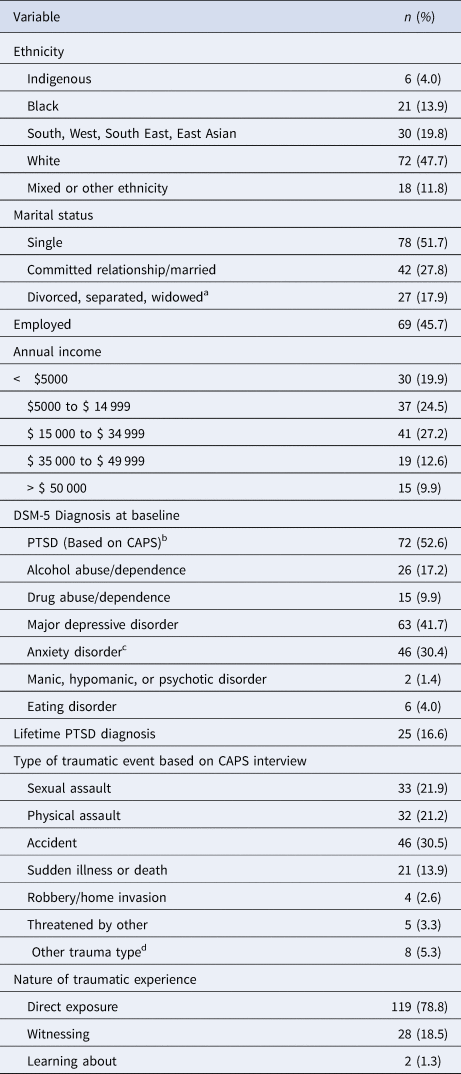
This paper focuses on the primary outcomes of 151 community individuals who reported a Diagnostic and Statistical Manual of Mental Disorder, Fourth Edition, Text Revision (DSM-IV-TR; American Psychiatric Association, 2000) PTSD Criterion A trauma within the past 6 months (108 participated with a concerned significant other; 43 did not have a concerned significant other willing or able to participate with the traumatized individual). There were 13 other participants who were excluded from the study due to not comprehending English (n = 2), concerns about the veracity of their traumatization (n = 2), Criterion A was not met (n = 1), trauma exposure was not within prior 6 months (n = 3), and withdrawal prior to completion of the first assessment (n = 5). Over the course of the study, 122 traumatized participants returned for the time 2 assessment, 118 for time 3 and 123 for time 4. As shown in Table 1, participants were exposed to a variety of criterion A events, and the majority (79.5%) reported experiencing the event directly.Footnote 1
Demographic and clinical information for the sample at initial assessment (N = 151)

a Other ethnicity included Latin American, and Caribbean.
b Valid percent based on 137 participants administered Clinician-Administered PTSD Scale (CAPS) at this assessment. There were no significant differences across participant type (participated with v. without a close other) across any demographic variables presented.
c Panic disorder without agoraphobia, agoraphobia without panic disorder, social phobia, obsessive compulsive disorder, generalized anxiety disorder.
d Other trauma includes being held hostage, dog attack, witnessing attempted suicide, natural disaster.
Measures
Clinician-administered PTSD scale
The current study began prior to the finalization of the Diagnostic and Statistical Manual of Mental Disorders, Fifth Edition (DSM-5; APA, 2013). As a result, the Clinician-Administered PTSD Scale, Fifth Edition (CAPS-5; Weathers et al., Reference Weathers, Blake, Schnurr, Kaloupek, Marx and Keane2015) was not yet available. However, the team was aware of the anticipated three PTSD symptoms to be added to the symptom criteria for PTSD DSM-5. These symptoms were added to the Clinician-Administered PTSD Scale (CAPS; Blake et al., Reference Blake, Weathers, Nagy, Kaloupek, Gusman, Charney and Keane1995), a semi-structured clinical interview that assesses for DSM-IV-TR PTSD diagnostic criteria and symptom severity. PTSD symptom presence and severity were assessed over the past month. The frequency and intensity of the 20 symptoms comprising the PTSD diagnosis in the DSM-5 were each rated on 5-point scales, consistent with the original CAPS (Blake et al., Reference Blake, Weathers, Nagy, Kaloupek, Gusman, Charney and Keane1995). Higher scores are an indication of greater symptom severity. To meet diagnostic criteria, symptom threshold is established based on a minimum frequency rating of 1 and intensity rating of 2 for any given symptom. For the current study, diagnostic criteria for PTSD were considered to have been met based on the criteria specified in the DSM-5 (i.e. 1 intrusion symptom, 1 avoidance symptom, 2 negative alterations in mood and cognition symptoms, and 2 alterations in arousal and reactivity symptoms; APA, 2013).
The original CAPS has been shown to have strong inter-rater reliability on the global severity score (0.89), total frequency score (0.92–1.00) and total intensity score (0.93–0.98; Hovens et al., Reference Hovens, Van der Ploeg, Bramsen, Klaarenbeek, Schreuder and Rivero1994). Additionally, test-retest reliability and internal consistency across the DSM-IV-TR PTSD symptoms clusters are also strong when considered individually (r = 0.77–0.96; α = 0.85–0.87) and altogether (r = 0.90–0.98; α = 0.94; Blake et al., Reference Blake, Weathers, Nagy, Kaloupek, Gusman, Charney and Keane1995). In our sample, internal consistency for the total CAPS was excellent across all assessment points (αs = 0.94–0.97).
To assess the reliability of the administration of the CAPS, 10% of the interviews conducted were randomly selected for review by an expert independent assessment monitor. This resulted in an excellent intra-class correlation coefficient (ICC) between the assessors' ratings and the independent assessment monitor' rating (ICC = 0.976). Additionally, there was a high kappa coefficient (κ = 0.829) for the assessors' and independent assessment monitor' ratings of PTSD diagnostic status.
PTSD checklist
The PCL is a self-report measure that assesses the severity of PTSD symptoms over the past month according to the DSM-IV-TR (Weathers, Litz, Herman, Huska, & Keane, Reference Weathers, Litz, Herman, Huska and Keane1993). As was the case with the CAPS (described above), the PTSD Checklist for DSM-5 (PCL-5; Weathers et al., Reference Weathers, Blake, Schnurr, Kaloupek, Marx and Keane2015) was not yet available at the time that the study began. Accordingly, the same procedure of adding the anticipated additional symptoms to be included in the DSM-5 to the earlier version of the PCL was employed. Participants are asked to answer based on how much they have been bothered by a specific symptom over the past month. Items are rated on a 5-point scale (1 = Not at all; 5 = Extremely). All 20 items on the PCL were summed to establish an overall score, with higher scores reflecting greater symptom severity. Previous work has supported the psychometric properties of the PCL with a total score correlation between the PCL and the CAPS of r = 0.93 and diagnostic efficiency of 0.90 when using a diagnostic cut-off of 44 (Blanchard, Jones-Alexander, Buckley, & Forneris, Reference Blanchard, Jones-Alexander, Buckley and Forneris1996). Internal consistency for the PCL was excellent across all assessment points (αs = 0.94–0.96).
MINI international neuropsychiatric interview
The MINI International Neuropsychiatric Interview (MINI; Lecrubier et al., Reference Lecrubier, Sheehan, Weiller, Amorim, Bonora, Harnett Sheehan and Dunbar1997) is a semi-structured clinical interview that assesses the presence of past and current DSM-IV-TR Axis I disorders. It has been shown to have good concordance with other clinician-administered interviews for DSM Axis I disorders (Sheehan et al., Reference Sheehan, Lecrubier, Harnett Sheehan, Janavs, Weiller, Keskiner and Dunbar1997). In the current study, the MINI was used to characterize and describe the sample. In order to assess inter-rater reliability of the MINI administrations, 10% of the interviews conducted were randomly selected for review by the independent assessment monitor. Reliability with regard to the agreement between assessors and the independent assessment monitor were good across all disorders (κs = 0.755–1.00).
Quality of relationships inventory
The Quality of Relationships Inventory (QRI; Pierce, Sarason, & Sarason, Reference Pierce, Sarason and Sarason1991) is a 25-item self-report measure that assesses the quality of an individual' relationship to a close significant other (e.g. intimate partner, family member, close friend). Items are rated on a 4-point scale (1 = not at all; 4 = very much) describing the individual' relationship with the close significant other. The QRI has three subscales: Support, which assesses the perceived availability of social support from the identified close other; Conflict, which assesses the degree to which the identified relationship is a source of conflict; and Depth, which assesses the degree to which the identified relationship is perceived to be positive, important, and secure. Scores are calculated by taking an average of the ratings of items within each subscale. Higher scores on the subscales reflect higher levels of support, conflict, and depth present in the identified relationship. Previous research has demonstrated that the QRI subscales have adequate internal consistency, as well as good concordance when relationships are assessed by both members of a dyad (Pierce, Sarason, Sarason, Solky-Butzel, & Nagle, Reference Pierce, Sarason, Sarason, Solky-Butzel and Nagle1997). In the current study, trauma-exposed individuals responded to the items on the QRI while keeping in mind the close other who enrolled into the study with them. Individuals who did not have a close other enrolled responded by keeping in mind the person to whom they felt closest. Internal consistency for the QRI subscales was strong across all assessment points (QRI-Support αs = 0.88–0.93; QRI-Conflict αs = 0.93–0.95; QRI-Depth αs = 0.88–0.91).
Procedure
All study procedures were approved by the Ryerson University Research Ethics Board prior to study initiation. Participants were recruited using newspaper advertisements and flyers posted in the community (universities, hospitals, community centers, local newspapers) and online (Facebook, lab website). To be eligible to participate, dyads had to include one individual who had been exposed to a DSM-IV-TR Criterion A traumatic event within the past 6 months and a CSO (e.g. intimate partner, family member, close friend) who was aware of the event but was not exposed to it. If, after three contacts with study personnel, a trauma-exposed individual was still unable to find a CSO to participate in the study with them, they were allowed to participate in the study alone. All participants needed to be able to provide informed consent to participate in the study and had to be between the ages of 18 and 75 years. To increase the study' external validity, there were no other inclusion/exclusion criteria.
Initial phone screens were used to determine whether participants met inclusion/exclusion criteria. Participants completed written informed consent with their assessor prior to the first assessment. Individuals either participated in person (i.e. completed clinician-administered interviews and self-report measures in an interview room at an urban university), or remotely (i.e. completed clinician-administered interviews over the phone and self-report measures online). Following informed consent, participants completed a total of four identical assessments at 4-month intervals over the course of 1 year. Participants were remunerated for their completion of each assessment.
Data analytic plan
We used LDS modeling (McArdle & Hamagami, Reference McArdle, Hamagami, Collins and Sayer2001) to test the trajectory of change between PTSD severity and interpersonal relationship functioning over time. LDS is a type of structural equation modeling (SEM) for longitudinal data that accounts for autoregressive/proportional change (i.e. change due to one' score on a given variable on the subsequent rate of change in that variable at the next assessment interval) and non-stationarity/constant change effects (i.e. the overall trajectory of the variable from first to last assessment interval). Bivariate LDS allows for the addition of cross-lagged effects between variables. Therefore, it can be used to examine the temporal precedence of multivariate change processes. Unlike other analytic methods for time-series data (e.g. cross-lagged panel models), LDS has the benefit of modeling true change by creating different scores between two consecutive latent scores (rather than observed scores). An advantage of creating a latent change score is that it parses out measurement variance and captures a truer estimate of bivariate change. Moreover, as a type of SEM, we were able to account for missing assessment data due to using the full information maximum likelihood (FIML) estimator, which estimates model parameters from all available data. FIML has been shown to produce unbiased parameter estimates with small sample sizes and correct Type I error rates in models with incomplete indicators (Cham, Reshetnyak, Rosenfeld, & Breitbart, Reference Cham, Reshetnyak, Rosenfeld and Breitbart2017).
Descriptive analyses were conducted in SPSS version 24.0 (IBM, 2016). LDS analyses were conducted using the Mplus statistical package (Version 7.0; Muthén & Muthén, Reference Muthén and Muthén2017). Parameters were estimated with the maximum-likelihood method. Models were evaluated on the following fit indices: Chi-square goodness of fit test (χ2), comparative fit index (CFI; Bentler, Reference Bentler1990), root mean square error of approximation (RMSEA; Steiger and Lind, Reference Steiger and Lind1980), and Akaike information criterion (AIC; Akaike, Reference Akaike, Petrov and Caski1973). CFI values greater than 0.95 were considered indicative of good model fit, and RMSEA values of 0.01 and 0.05 represent excellent and good fit, respectively (MacCallum, Browne, & Sugarwara, Reference MacCallum, Browne and Sugarwara1996). Smaller AIC values indicate a better fitting model when comparing competing models (Akaike, Reference Akaike, Petrov and Caski1973).
One limitation of longitudinal SEMs is the assumption of equal intervals across participants (King et al., Reference King, King, McArdle, Saxe, Doron-LaMarca and Orazem2006). In the current study, participants enrolled at any point within the first 6 months posttraumatization. Depending on the time since trauma exposure at the initial assessment, participants had differing assessment schedules relative to time of traumatization. To account for this variation, time from traumatization to the first assessment was included as a covariate in the LDS models. Time was calculated as the number of days between the date of trauma exposure to date of assessment. To establish measurement invariance across time, residual variance of measured variables was constrained to be equal across assessment intervals.
The LDS models were built using a recommended model building approach to determine the appropriate parameter constraints (McArdle & Hamagami, Reference McArdle, Hamagami, Collins and Sayer2001). First, we constructed univariate LDS models for PTSD and each dimension of interpersonal relationship functioning (i.e. conflict, support, depth) to estimate the univariate proportional and constant change processes. For each of the four variables (i.e. PTSD symptoms, relationship conflict, support, depth), we examined both linear and nonlinear trajectories of change by testing three univariate LDS models: (1) constant change only, (2) proportional change only, and (3) dual fixed proportional change, which includes both constant and proportional change factors and constrains the proportional change to be equal over assessment intervals. Models were compared to the dual fixed proportional change model using the Chi-square difference tests (χ2diff).
Next, the best fitting univariate model for each outcome was used to construct the bivariate LDS models for PTSD severity with each dimension of interpersonal relationship functioning. Cross lag paths represent the paths from the score on one variable at time t to the subsequent LDS (i.e. rate of change) for the other variable. Proportional change and cross lag coefficients were both constrained to be equal over time and all other paths were set to one (Grimm, Ram, & Estabrook, Reference Grimm, Ram and Estabrook2016). Initial status (i.e. intercept, G 0) and general growth factor (i.e. slope, Gs) were allowed to correlate for each outcome based on the assumption that these processes are likely interdependent (i.e. initial PTSD severity associated with PTSD severity trajectory of change).
Results
As noted in Table 1, 52.6% of participants met diagnostic criteria for PTSD according to the CAPS at first assessment. Rates of PTSD at subsequent assessments related to the Criterion A event for study inclusion were: 33.9% at time 2, 24.8% at time 3 and 15.8% at time 4 (all % based on total number of assessments done at each given assessment). Means and standard deviations for PTSD severity and relationship functioning subscales at each assessment point, and bivariate correlations for PTSD severity and relationship functioning subscales are in online Supplementary Tables 1 and 2.
Trajectories of clinician- and self-reported PTSD symptom severity over time
The dual fixed proportional change model was the best fit for PTSD severity for both the CAPS and PCL. This indicates an exponential change trajectory in which there were faster declines in PTSD scores earlier that slowed over time (see online Supplementary Table 3).
Trajectories of interpersonal relationship quality dimensions over time
Regarding the univariate model for relationship conflict, the dual fixed proportional change model resulted in the best fit. Like with PTSD symptoms, this indicates an exponential change trajectory in which there were faster declines in relationship conflict earlier that slowed over time. For relationship support and depth, the constant change model resulted in the best fit, indicating a linearly decreasing trajectory of change over time (see online Supplementary Table 3).
Bivariate longitudinal associations between PTSD and interpersonal relationship quality dimensions
PTSD and interpersonal relationship conflict
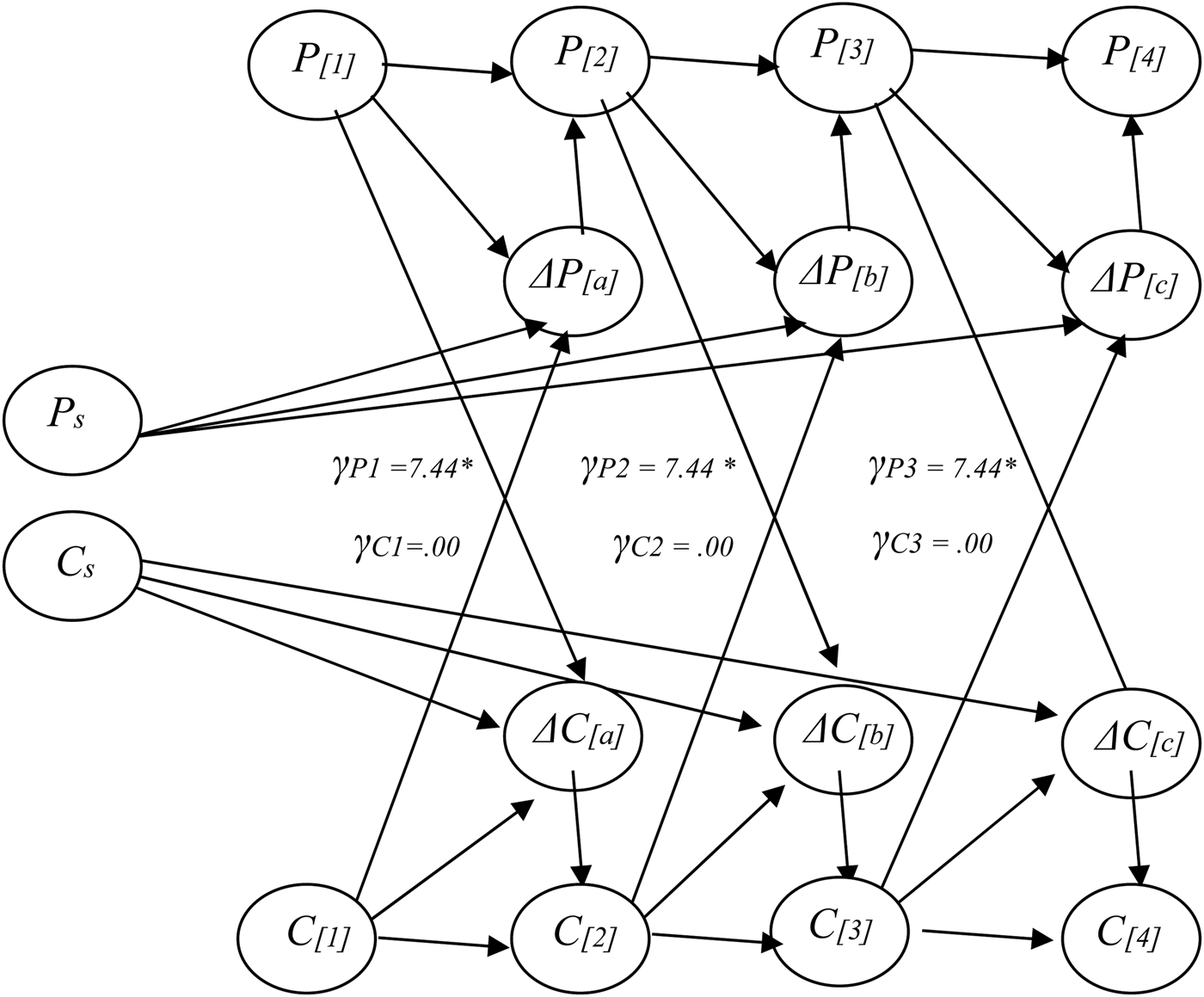
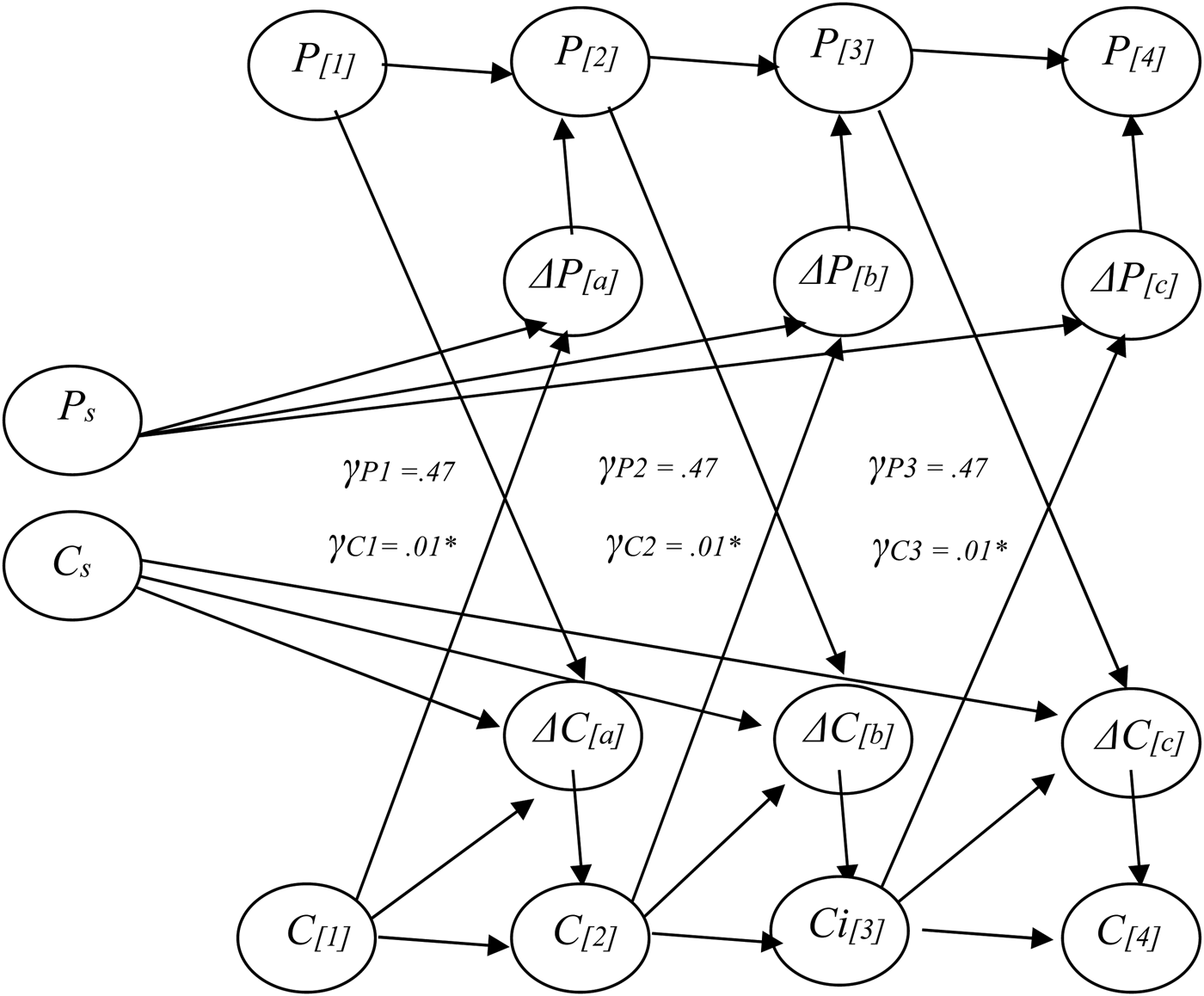
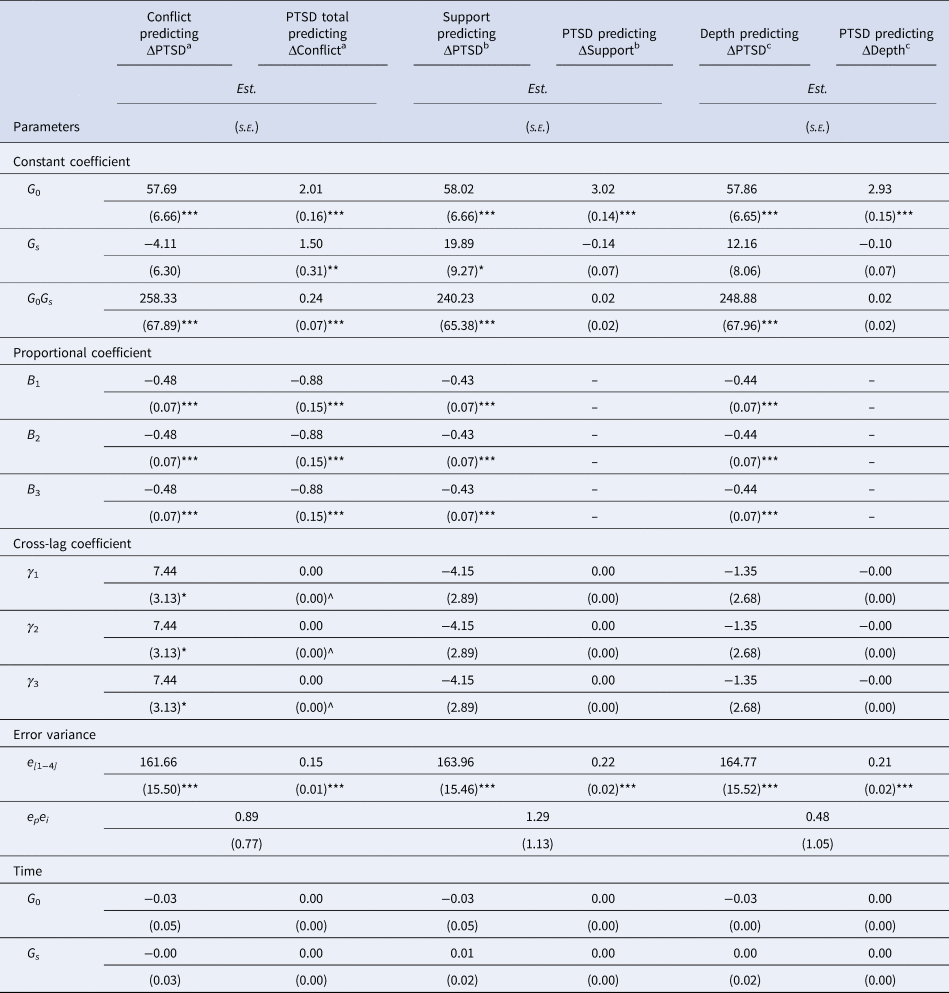
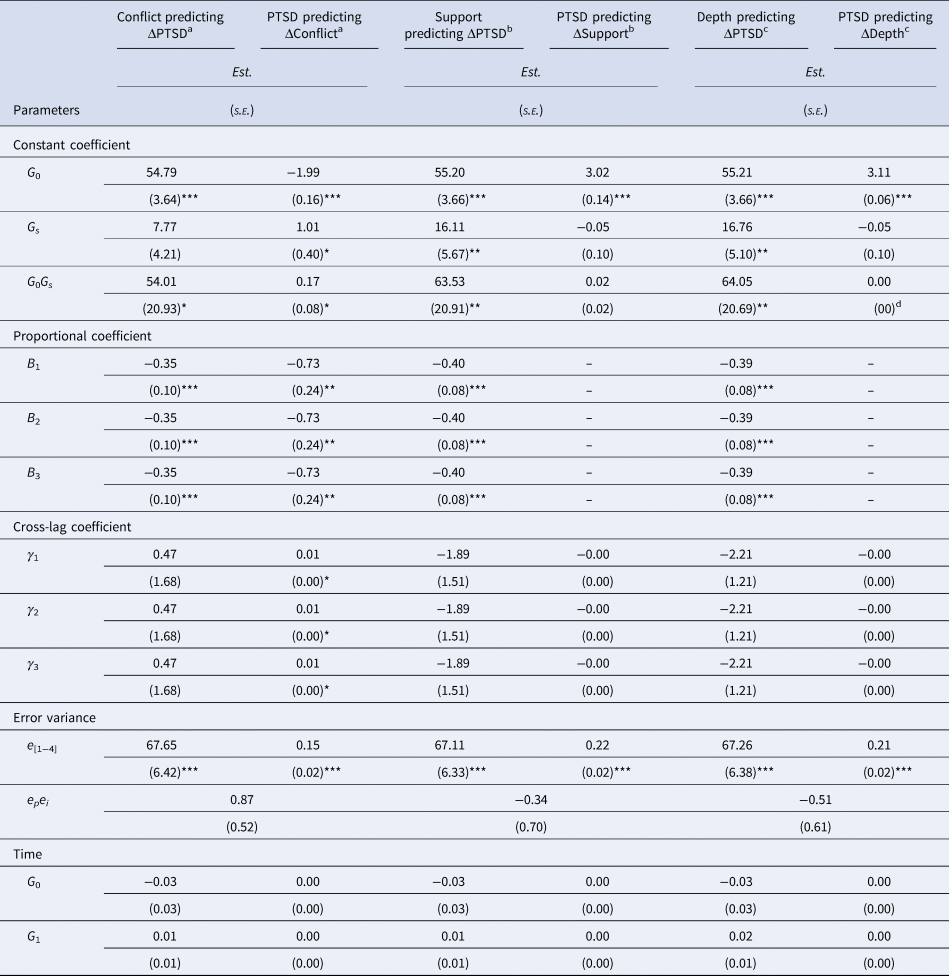
As shown in Tables 2 and 3, fit for the bivariate models between total PTSD severity (CAPS and PCL) and interpersonal relationship conflict (QRI-Conflict), respectively, was good. With regard to the CAPS, there were significant and positive effects from interpersonal relationship conflict to PTSD severity, indicating that interpersonal conflict impeded improvements in PTSD severity over time. The CAPS to interpersonal conflict effect was p = 0.087 (see Fig. 1). In contrast, there were significant and positive effects from PCL to interpersonal relationship conflict, and no effects from interpersonal relationship conflict to PCL. Self-reported PTSD impeded reductions in conflict over time, but conflict did not significantly affect self-reported PTSD (see Fig. 2).
Simplified bivariate LDS path diagram for clinician-rated PTSD and relationship conflict. Notes. *p < 0.05. **p < 0.01. p = Clinician-Administered PTSD Scale. C = Conflict Subscale of Quality in Relationships Inventory. Simplified path diagram with cross-lagged estimates for the bivariate LDS model for Clinician-Rated PTSD dual fixed proportional change model and Conflict dual fixed proportional change model. For simplicity and to highlight the significant bivariate relationships, measured variables, intercepts (i.e. latent variables representing estimated mean of the CAPS and Conflict), time covariates and associated covariances, and residual terms are not included in the figure but were included in the model. Circles represent latent (or unobserved) variables, P [t] represents the latent variable score at time t, and ΔP[t] represents the LDS between corresponding time points. γP represents the cross-lagged effects from the CAPS latent variable at time t on the subsequent LDS for Conflict. γC represents the cross-lagged effects from the Conflict latent variable at time t on the subsequent LDS for CAPS.

Simplified bivariate LDS path diagram for self-reported PTSD and relationship conflict. Notes. *p < 0.05. **p < 0.01. p = PTSD Checklist. C = Conflict Subscale of Quality in Relationships Inventory. Simplified path diagram with cross-lagged estimates for the bivariate LDS model for PTSD Checklist constant change model and Conflict dual fixed proportional change model. For simplicity and to highlight the significant bivariate relationships, measured variables, intercepts (i.e. latent variables representing estimated mean of the PCL and Conflict), time covariates and associated covariances, and residual terms are not included in the figure but were included in the model. Circles represent latent (or unobserved) variables, P [t] represents the latent variable score at time t, and ΔP[t] represents the LDS between corresponding time points. γP represents the cross-lagged effects from the PCL latent variable at time t on the subsequent LDS for Conflict. γC represents the cross-lagged effects from the Conflict latent variable at time t on the subsequent LDS for PCL.

Model fit indices and parameter estimates for clinician-rated PTSD with relationship quality bivariate LDS models

Notes. Values presented as z scores. Est. = unstandardized parameter estimate; G 0 = estimated mean for initial status; Gs = estimated mean for the non-stationarity/constant change effect; G 0Gs = covariance between the estimated mean for initial status and the estimated mean for the non-stationarity/constant change effect; B1−3 = autoregressive/proportional change effects; γ 1- 3 = cross-lagged effects; e [1−4] = error variances; epei = covariance between error variance for the PTSD and relationship conflict; Initial statuses and non-stationarity/constant change effects were allowed to covary between variables. Error terms were constrained to be equal within variables.
^p < 0.10. *p < 0.05. **p < 0.01. ***p < 0.001.
a Model Fit for PTSD – QRI Conflict: df = 29; χ2 = 40.15; p = 0.09, RMSEA = 0.05; CFI = 0.98; SRMR = 0.06; AIC = 5442.89;.
b Model Fit for PTSD-QRI Support: df = 30; χ2 = 29.33; p = 0.50, RMSEA = 0.00; CFI = 1.00; SRMR = 05; AIC = 5553.93;.
c Model Fit for PTSD – QRI Depth: df = 30; χ2 = 26.53; p = 0.65, RMSEA = 0.00; CFI = 1.00; SRMR = 0.04; AIC = 5545.56.
Model fit indices and parameter estimates for self-reported PTSD with relationship quality bivariate LDS models

Notes. Values presented as z scores. Est. = unstandardized parameter estimate; G 0 = estimated mean for initial status; Gs = estimated mean for the non-stationarity/constant change effect; G 0Gs = covariance between the estimated mean for initial status and the estimated mean for the non-stationarity/constant change effect; B1−3 = autoregressive/proportional change effects; γ 1- 3 = cross-lagged effects; e [1−4] = error variances; epei = covariance between error variance for the PTSD and Relationship Conflict; Initial statuses and non-stationarity/constant change effects were allowed to covary between variables. Error terms were constrained to be equal within variables.
a Model Fit for PTSD – QRI Conflict: df = 29; χ2 = 40.15; p = 0.08, RMSEA = 0.05; CFI = 0.98; SRMR = 0.84; AIC = 4820.62;.
b Model Fit for PTSD – QRI Support: df = 30; χ2 = 35.39; p = 0.23, RMSEA = 0.04; CFI = 0.99; SRMR = 0.05; AIC = 4942.56;.
c Model Fit for PTSD – QRI Depth: df = 33; χ2 = 36.88; p = 0.29, RMSEA = 0.03; CFI = 0.99; SRMR = 0.08; AIC = 4927.77.
d Due to a positive definite covariance matrix, the correlation of G 0 and Gs, was set to 0 and the regression of time on G 0 was omitted from this model. ^p < 0.10. *p < 0.05. **p < 0.01. ***p < 0.001.
PTSD and interpersonal relationship support and depth
Fit for these bivariate models was also good. There were no significant effects between clinician-assessed PTSD and QRI-support or QRI-depth over time. The effect of QRI-depth to self-reported PTSD was p = 0.087. There were no significant effects from QRI-depth to self-reported PTSD or effects between QRI-support and PCL over time.Footnote 2
Discussion
This study contributes to the burgeoning literature on trauma recovery and its association with interpersonal relationship factors by examining the trajectories of changes in individual and relationship functioning over time and the directionality of these relationships following traumatization. The percentage meeting clinician-determined PTSD diagnosis, as well as clinician-rated and self-reported PTSD symptom severity decreased over time, with an exponential pattern (i.e. faster initial decreases). In addition, in the overall sample, relationship conflict decreased exponentially and support and depth decreased linearly over time. Examined together, relationship conflict influenced changes in clinician-rated PTSD severity, but self-reported PTSD severity influenced changes in relationship conflict at each subsequent assessment. Neither clinician-rated nor self-reported PTSD symptoms were associated with relationship support in this study.
Consistent with longstanding models of trauma recovery (e.g. Rothbaum et al., Reference Rothbaum, Foa, Riggs, Murdock and Walsh1992), the percentage of participants meeting PTSD diagnosis and severity of symptomatology decreased over the year of assessment. The percentage of participants meeting diagnostic criteria decreased from about 53% at initial assessment to 16% at the final 1-year assessment. This study and others (Rosellini, Liu, Petukhova, & Sampson, Reference Rosellini, Liu, Petukhova and Sampson2018) suggest that abatement of PTSD symptoms after traumatization may take longer than the 1-month period posttraumatization when a diagnosis can be made per DSM-5. In fact, recovery may continue to occur beyond 3 months. Treatment guidelines recommend watchful waiting or active surveillance of symptomatology posttraumatization (e.g. National Institute for Health Care Excellence, 2018), which may be indicated for longer than 3 months. This guidance may be especially prudent in light of extant literature showing iatrogenic or no effects of global posttraumatic prevention strategies, and only modest effects of indicated (e.g. participants having high symptom profile) preventive interventions (Forbes, Bisson, Monson, & Berliner, Reference Forbes, Bisson, Monson and Berliner2020). Although receiving mental health treatment was not associated with improvements in PTSD in this study, future adequately powered longitudinal studies should rule-out this possibility.
Interestingly, across the sample, both positive (i.e. support, depth) and negative (conflict) aspects of interpersonal relationship functioning decreased over time. A review of prior longitudinal studies examining interpersonal relationship functioning over time after traumatization reveals that the pattern of relationship functioning has not generally been reported independently of PTSD or other mental health symptoms. This might represent a salience effect in which traumatization results in a ‘taking stock’ of both positive and negative interpersonal resources in the earlier periods following traumatization and then less salience of them as time passes (Hobfoll, Reference Hobfoll2001). Alternatively, scholars have commented on greater detachment from relationships more generally after traumatization (e.g. Monson et al., Reference Monson, Fredman, Dekel and Beck2010), but tend to theorize and test this in relation to individual traumatic stress symptoms (e.g. anhedonia, emotional numbing or avoidance symptoms of PTSD). As Marshall and Kujer (Reference Marshall and Kujer2017) point out, more attention should be paid to positive and negative relational outcomes themselves that ensue posttraumatization, and there is a need to understand processes that might underlie them (e.g. dyadic coping, communication patterns).
A key finding in this study was the differential patterns in the associations between relationship conflict and PTSD severity based on clinician-assessed v. self-report of PTSD symptoms. Relationship conflict contributed to subsequent clinician-rated PTSD symptoms, and the opposite was found with self-reported PTSD symptoms (i.e. self-reported PTSD symptoms to relationship conflict). The CAPS and PCL approach symptom assessment differently not only in terms of clinician v. self-report, but also orientation to symptom frequency/intensity v. distress, respectively. Moreover, when administering the CAPS, clinicians are instructed to orient the participant to anchor some symptoms in relation to the index trauma and then can evaluate whether they are trauma-related or not. In contrast, participants completing the PCL may not consistently anchor their symptoms to the index event, making it more prone to include general distress than PTSD-specific distress (Marshall, Schell, & Miles, Reference Marshall, Schell and Miles2010; McDonald & Calhoun, Reference McDonald and Calhoun2010; Parker-Guilbert, Leifker, Sippel, & Marshall, Reference Parker-Guilbert, Leifker, Sippel and Marshall2014). Bearing these differences in mind, it follows that self-reported PTSD severity on the PCL might more consistently predict interpersonal relationship functioning, given the emphasis on distress and the potential for symptoms to be un-anchored to index events. The CAPS, with emphasis on the assessment of frequency and severity of symptoms and clinician discretion about whether symptoms are trauma-related or not, may have more discriminatory validity in understanding the associations between PTSD severity and relationship conflict. Future studies that examine different clusters of symptoms that are anchored to specific traumatic events will help test these propositions.
Interestingly, our pattern of findings based on clinician-assessed v. self-reported PTSD assessment is directly opposite of that found by Woodward et al. (Reference Woodward, Morissette, Kimbrel, Meyer, DeBeer, Gulliver and Beck2018), which may be related to the nature of the sample (i.e. Canadian community v. US veterans), time since traumatization (our sample up to 6 months posttraumatization v. 6 + years after service in Iraq/Afghanistan), and/or interpersonal construct measured (relationship conflict v. social support). Nevertheless, because of issues with method variance, we urge future studies to use multi-method assessment, including collateral report, to help disentangle and better understand the association between interpersonal factors and trauma recovery.
When considering the associations between these relationship variables and PTSD symptom severity over time, only the negative factor of interpersonal relationship conflict was significantly associated with PTSD symptom severity. This finding is consistent with prior reviews (e.g. Wagner et al., Reference Wagner, Monson and Hart2016) concluding that negative social factors are more consistently associated with PTSD than positive social factors. In this way, negative interpersonal functioning appears to pose more of a risk factor for PTSD than positive interpersonal functioning serves as a resilience or buffering factor against PTSD.
The consistency of this finding informs what should be targeted in interpersonally oriented prevention and treatment interventions. One study comparing a cognitive-behavioral intervention that included significant others for one session compared with an individually delivered cognitive-behavioral intervention and usual care for Acute Stress Disorder found no differences between the two cognitive-behavioral interventions (both superior to usual care) in improving mental health outcomes or perceptions of social support (Guay, Sader, Boyer, & Marchand, Reference Guay, Sader, Boyer and Marchand2018). The authors note that the limited involvement of the significant other in the intervention may have been insufficient to improve perceived support and that targeting perceptions of support v. objective support is needed. Regarding the latter, we assert that more attention needs to be specifically paid to relationship functioning and decreasing the most negative relationship behaviors (e.g. conflict). In this vein, two treatments that involve significant others throughout treatment, cognitive-behavioral conjoint therapy (Monson & Fredman, Reference Monson and Fredman2012) and strategic approach therapy (Sautter, Glynn, Cretu, Senturk, & Vaught, Reference Sautter, Glynn, Cretu, Senturk and Vaught2015) for PTSD have been shown to be efficacious in improving PTSD and relationship adjustment (see Monson, Fredman, Macdonald, Schumm, & Taft, Reference Monson, Fredman, Macdonald, Schumm, Taft, Friedman, Keane and Schnurr2021 for review). These treatments target negative individual and relationship-level factors, and specifically those that maintain or aggravate PTSD. Following from this, future early intervention strategies that specifically target negative interactions with close others involved throughout the intervention may yield better prevention outcomes.
There are a number of limitations of the current study that must be considered. First, the individuals in this sample may not be representative of the population of recently traumatized individuals in light of the non-random sampling method used. In addition, there was variation in the time that elapsed since traumatization at baseline assessment, even though individuals were traumatized within the past 6 months. We accounted for this variation in the models by controlling for it; however, future studies that can assess as close to traumatization as possible are needed to best capture the dynamic change in PTSD symptoms and relationship factors that likely occurs in the days and weeks posttraumatization. In a related vein, we followed participants for 1 year from their baseline assessment. Given prior research showing that the patterns of association between PTSD and relationship factors change over time, it is unknown in the current sample if, for example, the cross-lagged paths from clinician-rated PTSD symptoms to conflict would have become statistically significant over longer periods of follow-up. Moreover, meta-analyses indicate that these associations are moderated by variables such as gender and type of trauma (Taft et al., Reference Taft, Watkin, Stafford, Street and Monson2011), which was not possible to adequately test in the current study due to sample size and complexity of the models. Larger samples testing these moderators and others (e.g. intimate v. non-intimate relationship status, mental health treatment utilization) are needed. Finally, this study did not account for other individual comorbidities/presentations, such as substance use, dissociation, and depression, that are well known to be independently associated with PTSD and relationship functioning, respectively (see Whisman, Reference Whisman, Fiese, Celano, Deater-Deckard, Jouriles and Whisman2019 for review). Relatively little research has addressed this issue when examining the association between PTSD and interpersonal functioning; future research that disentangles these potentially differential associations will be helpful in informing theory and interventions.
Ongoing efforts to elucidate risk factors and consequences of PTSD, especially those that are dynamic and potentially modifiable, are needed to refine theory and understand the trajectories of those who are traumatized. These advancements, in turn, can inform methods to help facilitate recovery following traumatization. There are a range of interpersonal factors worthy of finer-grained understanding to be explicated and potentially modified to ultimately improve the health and wellbeing of those who are traumatized and their significant others.
Supplementary material
The supplementary material for this article can be found at https://doi.org/10.1017/S0033291721003913.
Acknowledgements
This research was supported by a Canadian Institutes of Health Research operating grant to the first and last two authors. We wish to thank the research participants who so generously contributed to the success of this project. We also wish to honor Dr Suvak, who died during the course of this project, and his legacy. Correspondence regarding this article should be directed to Candice M. Monson, PhD, Professor of Psychology, Ryerson University, 350 Victoria St., Toronto, ON M5B 2K3, 416-979-5000, X556209, Candice.Monson@Ryerson.ca.
Conflict of interest
None.