Increasing evidence about the adverse effects of excessive dietary fat on human health has increased the demand for low-fat and non-fat dairy products in recent years. However, low-fat yogurts normally exhibit some textural defects such as weak structure and whey separation, unless stabilised in some way (Isleten & Karagul-Yuceer, Reference Isleten and Karagul-Yuceer2006) including the utilisation of fat substitutes.
Soy proteins are regarded as health promoting ingredients by Food and Drug Administration (FDA) due to abundant presence of isoflavones (Drake et al. Reference Drake, Chen, Tamarapu and Leenanon2000). These natural phytochemicals suppress the oxidative degradation (Akesowan, Reference Akesowan2009) in body organs and because of structural and functional homology to human oestrogen can bind to oestrogen receptors resulting in prevention of many hormone-dependent diseases. Medical studies have approved the protective actions of isoflavones against osteoporosis, coronary heart disease and type II diabetes (Khurana & Kanawjia, Reference Khurana and Kanawjia2007). In food technology, soy proteins have been applied as fat substitutes in meat, fish, milk, cereal based products and infant formulations (Martins & Netto, Reference Martins and Netto2006). Drake et al. (Reference Drake, Chen, Tamarapu and Leenanon2000) used soy protein concentrate in yogurt formulation to increase its viscosity. Soy protein isolate (SPI) has the mildest flavour and highest protein content (⩾90%) and quality amongst the soy protein products (Akesowan, Reference Akesowan2009). Combination of SPI with milk proteins is nutritionally favourable as whey proteins can supply the amino acid methionine that is absent in soy proteins (Comfort & Howell, Reference Comfort and Howell2002).
The enzyme transglutaminase (EC. 2.3.2.13), by catalysing an acyl transfer reaction between γ-carboxyamide group of glutamine as acyl donor and ε-amino group of lysine as acyl acceptor, forms intra and intermolecular ε-(γ-glutamyl)lysine-isopeptide bonds (Motoki & Seguro, Reference Motoki and Seguro1998; Lauber et al. Reference Lauber, Henle and Klostermeyer2000). The enzyme has been utilised in yogurt preparation to obtain a gel with better appearance and higher consistency (Farnsworth et al. Reference Farnsworth, Li, Hendricks and Guo2006; Pavunc et al. Reference Pavunc, Beganović, Kos, Buneta, Beluhan and Šušković2011) with lower syneresis (Lorenzen et al. Reference Lorenzen, Neve, Mautner and Schlimme2002; Oner et al. Reference Oner, Karahan, Aydemir and Aloglu2008). Soy proteins, especially when denatured, are excellent substrates for transglutaminase. Bin Md Yasir et al. (Reference Bin Md Yasir, Sutton, Newberry, Andrews and Gerrard2007) reported that treatment with the enzyme increased the firmness of tofu. To the best of authors’ knowledge there is no report in the literature on cross-linking of soy proteins within yogurt gel by the enzyme transglutaminase. It was hypothesised at the beginning of this research that enzymatic cross-linking of soy proteins to milk proteins within yogurt gel may improve the microstructure and physicochemical characteristics of non-fat set yogurt, thus obtaining a functional dairy product of higher acceptability.
Materials and methods
Materials
Skim milk powder (0·2% fat) was obtained from Ramak Dairy Company (Shiraz, Iran). SPI (Soy pro 950 M with 90% protein on dry basis and 0·5% fat) was a gift from Crown Soya Protein Group (Qingdao, China). Microbial transglutaminase (Activa YG; 80 U/g) was gifted by Ajinomoto Food Europe S.A.S. (Paris, France). Glutaraldehyde, lactic, acetic, propionic and formic acids, MRS and M17 agar were procured from Merck (Darmstadt, Germany). The freeze-dried direct-vat set starter culture containing Lactobacillus delbrueckii subsp. bulgaricus and Streptococcus thermophilus were purchased from Chr. Hansens Dairy Cultures (Hoersholm, Denmark). All other chemicals including those used in electrophoresis were of analytical grade and procured from Sigma-Aldrich (Dorset, UK).
Yogurt preparation
Four batches of yogurt were prepared as follows: sample enriched with 10 mg SPI/ml milk, sample prepared from the milk treated with 1 unit transglutaminase/g protein, sample enriched with SPI (10 mg/ml) and treated with transglutaminase (1 unit/g), and the control sample. Reconstituted skim milk (12·5% total solids) was supplemented with SPI and heated at 85 °C for 15 min (Yüksel & Erdem, Reference Yüksel and Erdem2010); afterwards it was cooled down rapidly to 43 °C followed by addition of transglutaminase. The enzyme was inactivated after 90 min (Yüksel & Erdem, Reference Yüksel and Erdem2010) by heat treatment of milk at 85 °C for 5 min. The milk was inoculated with 0·02% direct-vat set freeze-dried starter (consisting of Lb. delbrueckii subsp. bulgaricus and Str. thermophiles at ratio of 1 : 1) and incubated at 43 °C until pH had fallen to 4·6±0·1. Yogurt samples were stored at 4 °C for 21 d.
Acidity, water holding capacity and syneresis
The titrable acidity of yogurt was determined according to AOAC method no. 920.124 (AOAC, 2000) through titrating with 0·1 N NaOH and phenolphthalein as indicator. The acidity was expressed as percentage of lactic acid.
Water holding capacity of samples was measured by centrifuging 5 g yogurt at 2000 g for 30 min at 10 °C (Sahan et al. Reference Sahan, Yasar and Hayaloglu2008). The expelled whey was weighted and water holding capacity was calculated as:
 $${\rm WHC} = \displaystyle{{(Y - {\rm WE})} \over Y} \times 100$$
where Y is the initial weight of yogurt and WE is the weight of whey expelled from sample. The syneresis of set yogurt was measured by centrifuging 30 g yogurt at 222 g for 10 min at 4 °C. Syneresis is expressed as the weight of drained whey (Keogh & Kennedy, Reference Keogh and Kennedy1998).
Apparent viscosity measurement
Apparent viscosity of yogurt samples was measured at 55/s (Ozer et al. Reference Ozer, Kirmaci, Oztekin, Hayaloglu and Atamer2007) and 10 °C with a Brookfield viscometer (model LVDV-II+Pro, Brookfield Engineering Laboratories, Inc., Middleboro, USA). The LV-2 spindle (No.64) was used and samples were stirred gently for 10 s before measurements.
Enumeration of starter bacteria
The viable count of starter bacteria was estimated by plating appropriate dilutions of yogurt samples on M17 agar for Str. thermophilus and on acidified MRS agar (pH 5·2) for Lb. delbrueckii. The counting was carried out for Str. thermophilus after aerobic incubation at 37 °C for 48 h and for Lb. delbrueckii after anaerobic incubation at 37 °C for 72 h.
Measurement of organic acids content
The concentrations of lactic, acetic, propionic and formic acids in yogurt samples were measured after 21-d storage by high performance liquid chromatography (HPLC). Organic acid quantification was carried out according to the method of Fernandez-Garcia & McGregor (Reference Fernandez-Garcia and McGregor1994) by some modifications. At first, 8 g yogurt was diluted to 25 ml with 0·1 N H2SO4 and centrifuged at 2600 g for 60 min at 21±1 °C in order to remove the proteins. The supernatant was filtered through a 0·45 μm membrane filter (Minisart High-Flow®, Sartorius Stedim Biotech, Goettingen, Germany) into HPLC vials and 10 μl of sample was injected onto the separation column. The separation of organic acids was performed using a Knauer HPLC system (Berlin, Germany) with an Aminex HPX-87H ion-exchange column (300×7·8 mm; Eurokat H, Knauer Berlin, Germany) equipped with a disposable cartridge guard column. Detection was carried out at 210 nm by a K-2600 UV detector. The mobile phase (H2SO4 0·0075 N) was pumped with a wellChrom pump (K-1001; Knauer, Germany) at rate of 0·7 ml/min. Temperature of the column was set on 65 °C.
Monitoring of proteins cross-linking
To confirm the cross-linking of milk and soy proteins by transglutaminase, sodium dodecyl sulphate-polyacrylamide gel electrophoresis (SDS-PAGE) was carried out using 4% stacking gel and 12% separating gel on a vertical slab gel unit (Bio-Rad Laboratories Ltd., Watford, UK) by the method of Laemmli (Reference Laemmli1970). The resolving gel mixture was poured in the casting modules and overlaid with a 1 mm-layer of butanol to allow a flat surface and protect the mixture from atmospheric oxygen. After polymerisation, the alcohol was replaced by the stacking gel mixture (Pardo & Natalucci, Reference Pardo and Natalucci2002). The electrophoresis running buffer contained 46 g/l Tris base, 4 ml hydrochloric acid (1 M) and 10 g/l SDS (pH 8·9). Aliquots of 15 μl of prepared samples were loaded in the wells of gel which run at 30 mA and 240 V for 2·5–3 h. The gels were then stained with Coomassie blue R 250 while shaken at 10 rpm for 3 h followed by destaining in a solution composed of 400 ml methanol, 100 ml acetic acid and 500 ml water for 1 h and then in distilled water overnight.
Microstructural imaging
Yogurt specimens (3×3×1 mm) for scanning electron microscopy were taken from the centre of yogurt samples with a sharp blade. Specimens were fixed in 2·5% glutaraldehyde for about 4 h after which rinsed in 3 changes of distiled water; each time for 10 min. Samples were dehydrated by a series of aqueous ethanol solutions (20, 40, 60, 70, 90% and finally in absolute alcohol) and then freeze-fractured in liquid nitrogen. The dehydrated samples were mounted on aluminium stubs and sputter-coated (BAL-TEC supper coater, Switzerland) with gold under argon atmosphere. Electron microscopy imagining was performed with a scanning electron microscope (XL 30, Philips, Netherlands) operated at 25 kV at 1000, 2500, 5000 and 10 000×magnifications (Puvanenthiran et al. Reference Puvanenthiran, Williams and Augustin2002).
Statistical analysis
Two-factor analysis of variance by SPSS software version 19.0 (SPSS Inc., Chicago, IL, USA) was performed to determine the effect of SPI incorporation and enzymatic treatment, as well as the effect of the storage time on physicochemical and microbial characteristics of prepared yogurt samples. Samples were prepared in triplicate based on a split plot design and analyses were carried out at least in duplicate. Means were compared using the LSD (Least Significant Difference) test at level of 5%.
Results and discussion
Acidity, water holding capacity, syneresis and viscosity
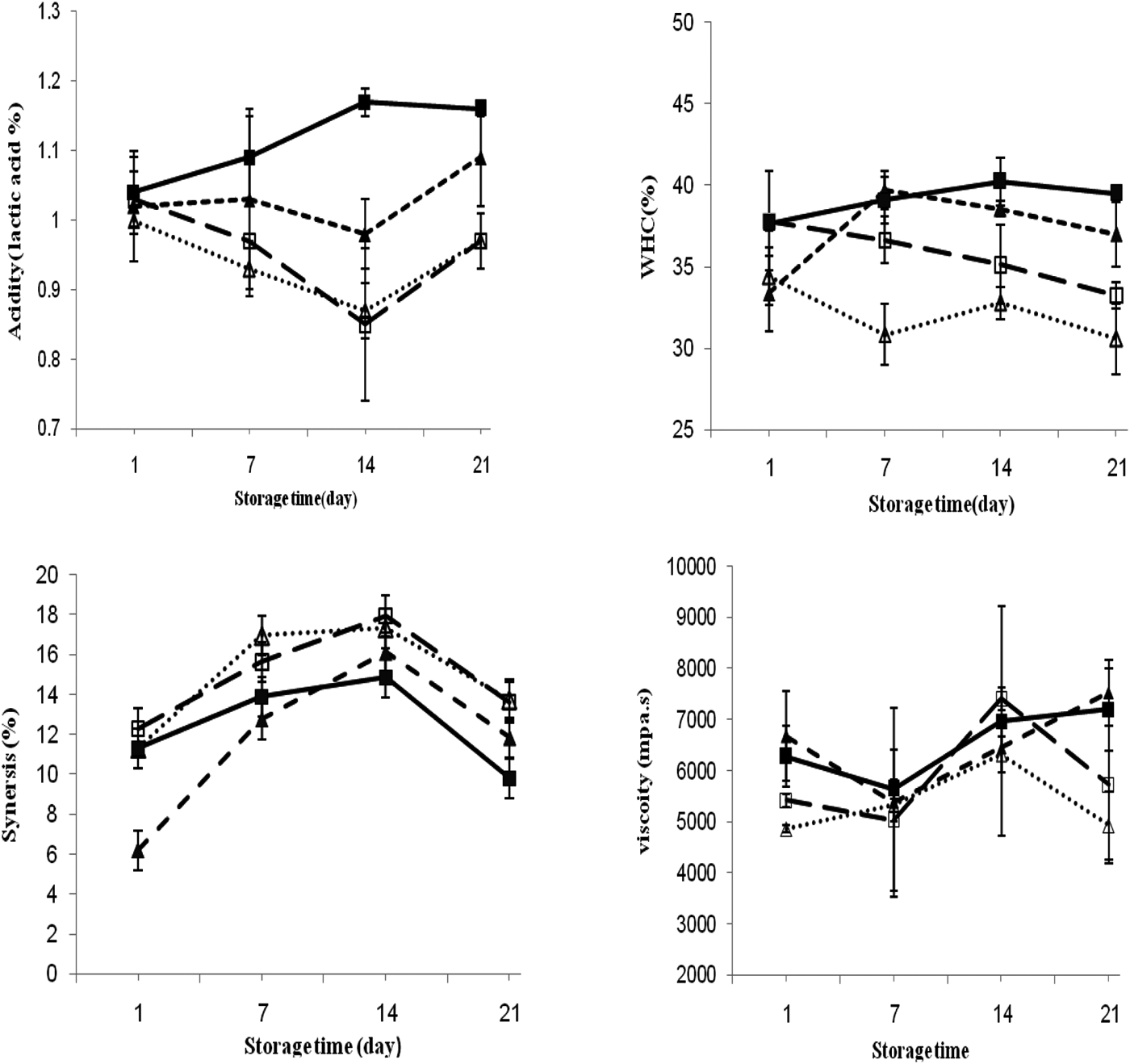
Figure 1 shows the titrable acidity of yogurt samples during 21-d storage at 4 °C. There was no significant difference (P>0·05) in samples acidity at day 1. However, at day 7 and afterwards, samples enriched with SPI had higher acidities than the control and the sample solely treated with the enzyme (with no added SPI). Similarly, Shori (Reference Shori2013) reported that the addition of soybean extract to yogurt samples enhanced the post-acidification extent during storage. The difference observed in samples acidity due to the incorporation of SPI is attributed to the stimulating effect of soy proteins on growth of Lb. delbruckii (see section of bacterial count) resulting in enhanced acid production. There was no statistically significant (P>0·05) difference in acidity of the control sample and the yogurt from enzymatically treated milk. Similarly, Farnworth et al. (Reference Farnworth, Mainville, Desjardins, Gardner, Fliss and Champange2007) reported no significant influence of employing transglutaminase on yogurt acidity. On the contrary, Lorenzen et al. (Reference Lorenzen, Neve, Mautner and Schlimme2002) and Yüksel & Erdem (Reference Yüksel and Erdem2010) reported a significant decrease in titrable acidity of enzymatically treated whole and skim milk yogurts compared with those made from untreated milk. In addition, Ozer et al. (Reference Ozer, Kirmaci, Oztekin, Hayaloglu and Atamer2007) found that the titrable acidity of yogurt samples decreased with the increasing enzyme concentrations. The discrimination has apparently arisen from the lower amount of enzyme used in the present study in comparison with communications reporting conflicting observations. Acidity of the yogurt enriched with SPI and treated with transglutaminase gradually increased during storage; whilst, those of other samples were either stable (for sample enriched with SPI) or mildly decreased (P<0·05) till day 14 of storage, followed by a small increase (P<0·05) at the end of storage period. It is argued that SPI as the source of nutrients such as peptides and amino acids) Pham & Shah, Reference Pham and Shah2008, Reference Pham and Shah2009) in accompaniment of transglutaminase that yielded a more homogenous gel network boosted the growth of starter bacteria, resulting in an increasing acidity throughout the storage period for SPI-enriched and enzymatically treated sample.
The titrable acidity (upper panel, left hand), water holding capacity (upper panel, right hand), syneresis (lower panel, left hand) and apparent viscosity (lower panel, right hand) of yogurt samples during cold storage. Control non-fat yogurt (△), non-fat yogurt enriched with SPI (▲), non-fat yogurt treated with transglutaminase (△) and non-fat yogurt enriched with SPI and treated with transglutaminase (■). The error bars represent the sd (n=3).

Figure 1 also reports the water holding capacity of yogurt samples during storage for 21 d at 4 °C. Although water holding capacity of SPI-enriched yogurt was not statistically different form that of control sample at day 1, but increased significantly at day 7 and remained higher in continue of the storage period. This suggests that soy proteins acted as an inert-filer in yogurt gel matrix at day 1 but underwent a gradual hydration at subsequent days that enhanced their water binding character. Control sample was the weakest water holder amongst all samples throughout the whole storage period. Milk treatment with transglutaminase yielded a higher WHC for yogurt at day 1 irrespective of being enriched with SPI or not. The enhanced WHC of yogurt due to the enzymatic treatment is attributed to formation of additional covalent cross-linkages within the gel structure that reinforced the three dimensional network of yogurt gel and stabilised it against wheying off (Lorenzen et al. Reference Lorenzen, Neve, Mautner and Schlimme2002). It is hypothesised that the cross-linking action of enzyme created a network with finer mesh size (Tamime & Robinson, Reference Tamime and Robinson2007) and resulted in a more interactive participation of soy proteins in yogurt gel; thus, the sample enriched with SPI and treated enzymatically had the highest water holding capacity amongst samples (Fig. 1). It is worth noting that heating of the milk enriched with SPI during yogurt preparation not only denatured the whey proteins but also the soy proteins, exposing their buried sulphydryl and hydrophobic groups (Sabato et al. Reference Sabato, Ouattara, Yu, D'Aprano, Le Tien, Mateescu and Lacroix2001) to the latterly added cross-linker enzyme. In similarity to the trend observed for the control sample, WHC of the yogurt enriched with SPI and treated enzymatically did not change significantly (P>0·05) during the whole storage period. Whereas, water holding capability of the yogurt prepared from enzymatically treated milk decreased at the end of storage (Fig. 1) which is correlated with the increased acidity for this sample (Fig. 1, upper panel). The higher acidity presumably strengthens the proteins interactions (Yüksel & Erdem, Reference Yüksel and Erdem2010), leading to more shrinkage of the gel network and eventually higher whey separation extents.
The syneresis of yogurt samples during cold storage for 21 d is demonstrated in the lower panel of Fig. 1. The sample made from the SPI-enriched milk had the lowest whey separation at day 7 of storage. However, the enzymatic cross-linking of soy proteins with milk proteins resulted in a higher syneresis degree at day 7 compared with the sample enriched only with SPI. This order is in contradiction with WHC measurement results (Fig. 1, upper panel) and informs us about the complicated nature of the yogurt gel network. The SPI-enriched and enzymatically treated sample was of lower syneresis degree at the later days of cold storage.
The lower panel in Fig. 1 represents the changes in the apparent viscosity values of yogurt samples over 21 d cold storage. Fortification with SPI considerably increased the viscosity of yogurt due most probably to the notable water binding capacity and gelling property of soy proteins (Akesowan, Reference Akesowan2009). It is argued that thiol-mediated interactions of heat-denatured β-lactoglobolin and soy proteins led to the increased viscosity. The findings of Drake et al. (Reference Drake, Chen, Tamarapu and Leenanon2000) on the viscosity of the yogurt fortified with soy protein concentrate agree with our results. The viscosity of samples did not however change during storage time nor was it influenced by the enzymatic treatment.
Bacterial count
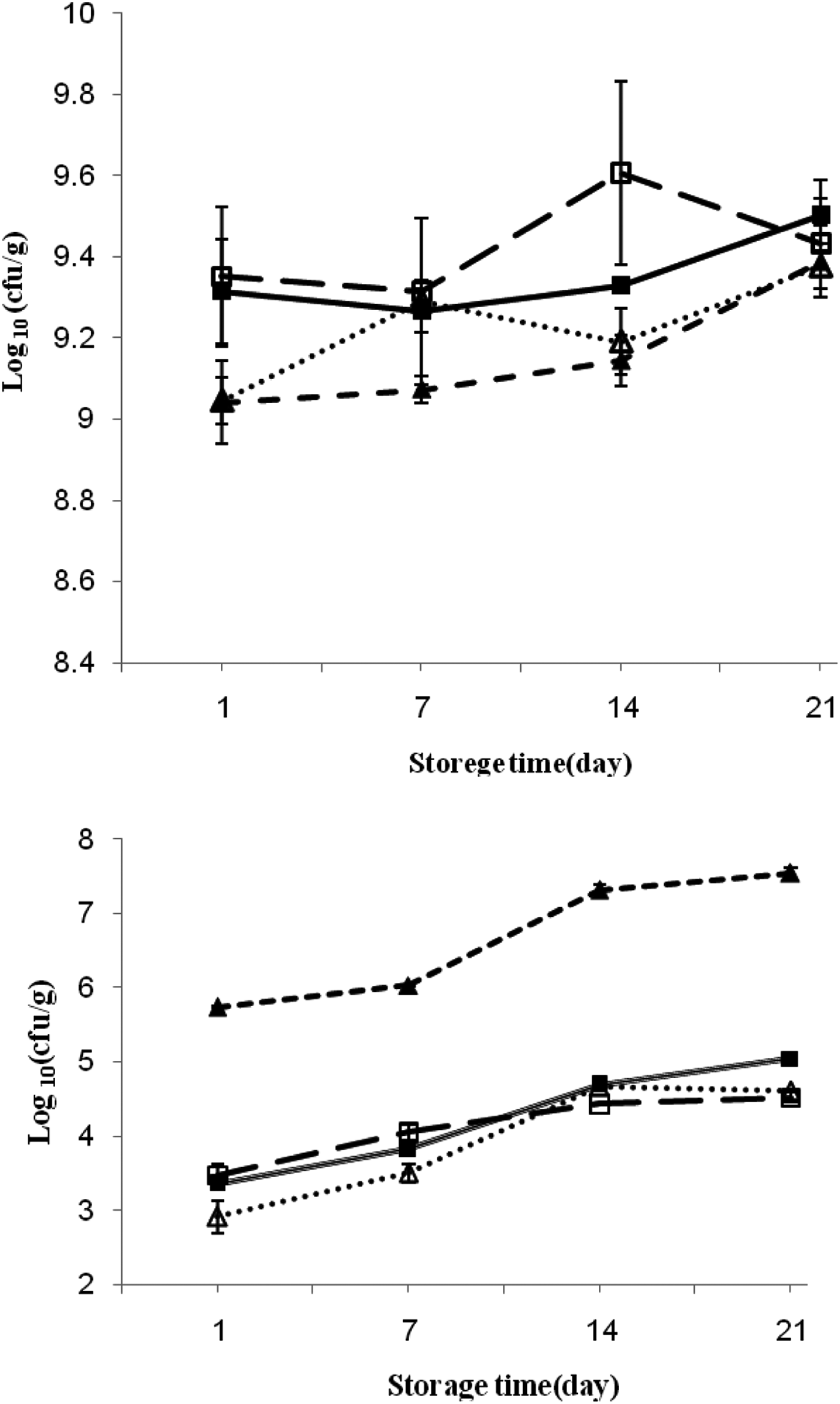
A small increase was observed in the number of Str. thermophilus during cold storage for all samples and the difference between days 1 and 21 was significant (P<0·05; Fig. 2, upper panel). Yogurt samples prepared from the enzymatically treated milk had higher counts of viable Str. thermophilus in the first 14 d storage reaching counts as high as 9·6 cfu/g. The lower panel of Fig. 2 shows that the viable count of Lb. bulgaricus in the enzymatically treated yogurt was also higher at the first 7 d of storage compared with the control. These are in agreement with the result reported by Farnsworth et al. (Reference Farnsworth, Li, Hendricks and Guo2006) who observed a positive effect on survivability of probiotic cultures by transglutaminase. Hypothetically, the more homogenous and reticular gel network architecture formed by the action of transglutaminase provided a suitable microenvironment for starter bacteria, resulting in their higher survivability.
Viability of Str. thermophilus (upper panel) and viability of Lb. bulgaricus (lower panel) of yogurt samples during storage. Control non-fat yogurt (△); non-fat yogurt enriched with SPI (▲); non-fat yogurt treated with transglutaminase (△) and non-fat yogurt enriched with SPI and treated with transglutaminase (■). The error bars represent the sd (n=3).
SPI supplementation of milk did not statistically influence the count of Str. thermophilus but increased that of Lb. bulgaricus ∼3 log cycles throughout the storage period in comparison with the control (Fig. 2). This indicates that Lb. bulgaricus was able to acquire nutrients from soy proteins because of its particular proteolytic activity (Farnsworth et al. Reference Farnsworth, Li, Hendricks and Guo2006). Pham & Shah (Reference Pham and Shah2009) reported higher survival rates for starter bacteria in SPI-fortified yogurts compared with the control during first 7 d storage. The enzymatic treatment of SPI-supplemented yogurt; however, decreased the viability of Lb. bulgaricus (Fig. 2) due to the reduced availability of cross-linked soy proteins by bacteria as a possible source of nutrition (Bönisch et al. Reference Bönisch, Huss, Weitl and Kulozik2007; Ozer et al. Reference Ozer, Kirmaci, Oztekin, Hayaloglu and Atamer2007). This suggests that proteolytic system of Lb. bulgaricus could not utilise the cross-linked soy proteins probably because specific sites in proteins conformation became inaccessible.
Organic acids
Table 1 reports the amount of those in yogurt samples after 21-d cold storage. As expected, in the control sample lactic acid was of the highest concentration amongst the analysed acids with a mean content of 4259 μg/ml. The concentrations of all acids were maxima in control yogurt and the SPI enrichment or enzymatic treatment of yogurt milk reduced the organic acids content. Propionic acid was deficient and formic acid content was negligible in SPI-enriched samples irrespective of being treated with the enzyme or not. Yogurts prepared from the SPI-enriched milks although containing less acetic, propionic and formic acids, was significantly higher in lactic acid content than the sample from enzymatically treated milk (with no added SPI). As discussed earlier, propagation of Lb. bulgaricus was enhanced due to yogurt milk enrichment with SPI which probably increased the production of lactic acid in sample as the main acid secreted by bacterial cells. In contradiction to the results obtained in the present study, Pham & Shah (Reference Pham and Shah2009) reported that enrichment of yogurt milk with SPI increased the amount of acetic acid and decreased that of lactic acid in product. It is worthy noting that samples enriched with SPI had higher titrable acidities (Fig. 1, upper panel) suggesting higher contents of organic acids especially lactic acid in these samples compared with the control. The conflict found between the results of the titrable acidity measurements and organic acids content measured by HPLC has arisen from the significantly lower buffering capacity of soy proteins compared with milk proteins (Farnworth et al. Reference Farnworth, Mainville, Desjardins, Gardner, Fliss and Champange2007). We argue that the organic acids in the SPI-enriched yogurts (which were measured by HPLC) were accessible for titration with alkali during the titrable acidity measurements; whilst, their buffered counterparts in the control SPI-free yogurt were not available for acidity content determination through titration.
Means of organic acids content (μg/ml) in yogurt samples after 21-d cold storage

Means in the same column with different superscripts are significantly different (P<0.05).
Preliminary SDS–PAGE analysis
Electrophoretic gels of yogurt samples were scanned and analysed visually on a display. The bands were of low intensity in samples prepared from the enzymatically treated milks insinuating the cross-linking of proteins by transglutaminase. As a result of protein cross-linking by transglutaminase, high molecular-mass polymers accumulate at the top of the gel lanes and do not enter the stacking gel. Aboumahmoud & Savello (Reference Aboumahmoud and Savello1990) showed that cross-linking of pure and mixed whey protein preparations by transglutaminase disappeared from the original protein bands and appeared as new bands and accumulated as the immobilised protein polymers at the SDS-PAGE gel origin. Similarly to the results obtained in the present study, Ozer et al. (Reference Ozer, Kirmaci, Oztekin, Hayaloglu and Atamer2007) reported a progressive decrease in casein and whey proteins band intensities with the increasing amount of transglutaminase in yogurt. As well, Gauche et al. (Reference Gauche, Vieira, Ogliari and Bordignon-Luiz2008) reported that polymerisation of whey proteins by transglutaminase decreased the band size for both α- lactalbumin and β-lactoglobulin.
Microstructure
Scanning electron micrographs of yogurt samples stored for 21 d at 4 °C are illustrated in Fig. 3. Incorporation of SPI in yogurt gel matrix resulted in a sponge-like and less dense microstructure compared with the control non-fat yogurt. It is argued by us that distribution of soy proteins strands in the yogurt gel enhanced the accommodation of water molecules within the gel network and resulted in creation of a high number of protein-surrounded serum pools within the microstructure of yogurt gel. The chain like aggregates formed via complexation of milk and soy proteins during milk heat treatment could retain high quantities of water, leading to the increased WHC in SPI-enriched yogurt sample (Remeuf et al. Reference Remeuf, Mohammed, Sodini and Tissier2003). A very compact and dense microstructure with low porosity is observed for the yogurt prepared from enzymatically treated milk. The SPI-enriched and enzymatically treated sample was also of lower porosity and more dense microstructure compared with the non-enzymatically treated counterpart. It is evident than increased number of particle-particle junctions and cross-linkages due to action of transglutaminase resulted in a more compact gel network. This microstructural feature may explain why WHC of the enzymatically treated yogurt decreased at the end of storage period (Fig. 1).
Scanning electron micrographs of yogurt samples. Control non-fat yogurt (S1); non-fat yogurt enriched with SPI (S2); non-fat yogurt treated with transglutaminase (S3) and non-fat yogurt enriched with SPI and treated with transglutaminase (S4).
Conclusion
A more comprehensive and detailed study is required to find the interrelation between the water holding capacity and syneresis degree of the non-fat set yogurt as influenced by soy protein enrichment and transglutaminase-induced cross-linking. Milk enrichment with SPI stimulates the growth of Lb. delbruckii resulting in higher titrable acidity. It was hypothesised, based on water holding capacity, syneresis rate and microstructural features and confirmed by SDS-PAGE experiments, that transglutaminase covalently cross-links the soy proteins into yogurt gel. Enzymatic treatment of yogurt milk with transglutaminase resulted in a higher survivability degree for Str. thermophilus during.the initial days of cold storage. Transglutaminase treatment of the milk fortified with soy protein products yields low-fat set yogurt with improved functional characteristics.