





1 Introduction
In 1951, Jónsson and Tarski [Reference Jónsson and Tarski21] introduced the concept of a Boolean algebra with operators (BAO) and developed representation theorems for these structures, marking the first step in the now well-understood connection between relational and algebraic semantics for modal logic (see [Reference Blackburn, de Rijke and Venema9, Reference Chagrov and Zakharyaschev12] for detailed treatments).
Fast forward to the 1990s, Kurucz et al. [Reference Kurucz, Némethi, Sain and Simon28, Reference Kurucz, Némethi, Sain and Simon29] studied the decidability of the equational theory of Boolean algebras with an associative binary operator. Among other results, by a reduction from the Post correspondence problem, they proved that the equational theory of the variety of associative BAOs—corresponding to the least associative normal modal logic
$\mathbf {K}_2\oplus (p\circ q)\circ r\leftrightarrow p\circ (q\circ r)$
 —is undecidable, arguably making it the simplest modal logic known to be undecidable (see [Reference Blackburn, de Rijke and Venema9, Reference Chagrov and Zakharyaschev12] for more on decidability and undecidability in modal logic).
The present research lies in continuation with the work of Kurucz and coauthors. By interpreting a domino problem, we prove that any variety of associative BAOs containing the complex algebra of
$(\mathcal {P}(\mathbb {N}), \cup )$
 has an undecidable equational theory. In modal logical terms, this shows that any normal modal logic extending
$\mathbf {K}_2\oplus (p\circ q)\circ r\leftrightarrow p\circ (q\circ r)$
 and valid over the frame
$(\mathcal {P}(\mathbb {N}), \cup )$
 is undecidable. This result carries substantial implications, resolving several open questions, including the long-standing problem concerning the decidability of hyperboolean modal logic, as posed by Goranko and Vakarelov [Reference Goranko and Vakarelov16].
The proof techniques developed here may also be of independent interest, having already found broader application. In [Reference Knudstorp25, Reference Knudstorp27], similar ideas were applied in relevant logic, showing that the relevant logic
$\mathbf {S}$
 , introduced in [Reference Urquhart36, Reference Urquhart37], is undecidable. Likewise, the present proofs inspired recent unpublished joint work with Nick Galatos, Peter Jipsen, and Revantha Ramanayake [Reference Galatos, Jipsen, Knudstorp and Ramanayake15], establishing the undecidability of Bunched Implication logic (BI) [Reference O’Hearn and Pym34].
The article is structured as follows. Section 2 defines the relevant logical, algebraic, and relational settings.
Section 3 explains the general proof method, which is a reduction from the
$\mathbb {N}\times \mathbb {N}$
 domino (or tiling) problem. Given a finite set of Wang tiles
$\mathcal {W}$
 —unit squares with a colour on each edge—the problem asks whether it is possible to tile the quadrant
$\mathbb {N}\times \mathbb {N}$
 so that adjacent tiles match along their shared edges.
The reduction involves constructing a formula
$\phi ^{}_{\mathcal {W}}$
 for any such
$\mathcal {W}$
 , and proving the following circular setup:

From this, and slight modifications, a number of results are derived, including:
-
• The undecidability of hyperboolean modal logic (Theorem 3.6).
-
• The undecidability of the modal logic of semilattices—or, algebraically, of the equational theory of complex semilattices—(Theorem 3.7), resolving questions raised by Bergman [Reference Bergman and Czelakowski8], Jipsen et al. [Reference Jipsen, Kurd-Misto, Wimberley, Madarász and Székely19], and Knudstorp [Reference Knudstorp22, Reference Knudstorp23].
-
• The undecidability of modal logics over lattices studied by Wang and Wang [Reference Wang, Wang, Ciabattoni, Pimentel and Queiroz39, Reference Wang and Wang40] (Theorem 3.10).
-
• A new proof of undecidability for the least associative normal modal logic (Theorem 3.11).
-
• New proofs of undecidability for various versions of propositional separation logic and Boolean BI (BBI) (Theorems 3.13, 3.14, and 3.17).
-
• That there can be no (computable) translation from modal information logic into truthmaker semantics (Theorem 3.21), answering a question raised by van Benthem [Reference van Benthem4, Reference van Benthem, Weiss and Birman6].
The circular setup follows from two key lemmas, Lemmas 3.3 and 3.4. Their proofs are deferred to Section 4, which thereby constitutes the core of the article.
The main contributions of this article are its results and proof ideas, yet a more foundational objective of this research is to deepen our understanding of the boundary between the solvable and the unsolvable. To that end, the final section, Section 5, compares the achieved undecidability results with known decidability results from related frameworks, including propositional team semantics [Reference Yang and Väänänen41], truthmaker semantics [Reference Fine and Jago14, Reference Knudstorp23], and modal information logic [Reference van Benthem and Copeland3, Reference Knudstorp24].
2 Preliminaries
Algebraically, our setting is varieties of Boolean algebras with an associative operator
$\circ $
 (associative BAOs), also known as Boolean semigroups: Boolean algebras equipped with an associative binary operator
$\circ $
 that distributes over all finite (including empty) joins. Logically, varieties of associative BAOs correspond to normal extensions of the least associative normal modal logic.
Formally, we define as follows.
Definition 2.1 (Logics)
Let
$\mathbf {K}_2$
 denote the least normal modal logic over the language
$\mathcal {L}$
 generated by the grammar

where
$\circ $
 is a binary diamond and
$p\in \mathsf {Prop}$
 for
$\mathsf {Prop}$
 a countable set of propositional variables. The connectives
$\land $
 ,
$\to $
 ,
$\leftrightarrow $
 and the constants
$\bot , \top $
 are defined as usual.
By
$\mathbf {AK}_2$
 we denote the least normal modal logic extending
$\mathbf {K}_2$
 that contains the associativity axiom for
$\circ $
 :

That is,

We say that a normal modal logic
$\mathbf {L}$
 is associative if it contains the associativity axiom, that is, if
$\mathbf {L}\supseteq \mathbf {AK}_2$
 .
Definition 2.2 (Algebras and varieties)
An algebra
$\mathfrak {A}=(A, \lor , \land , \neg , \bot , \top , \circ )$
 is an associative BAO (also referred to as a Boolean semigroup) if
$(A, \lor , \land , \neg , \bot , \top )$
 is a Boolean algebra and
$\circ :A\times A\to A$
 is an associative binary operator, that is, the following holds for all
$x,y,z\in A$
 :
-
• Additivity: $x\circ (y\lor z)=(x\circ y)\lor (x\circ z)$
 and
$(x\lor y)\circ z=(x\circ z)\lor (y\circ z).$
-
• Normality: $x\circ \bot = \bot \circ x=\bot .$
-
• Associativity: $(x\circ y)\circ z= x\circ (y\circ z).$


Note that additivity and normality amount to distribution of
$\circ $
 over all finite joins.Footnote
1
We write
$\mathsf {BSg}$
 for the class of all associative BAOs.
A variety of associative BAOs is a class
$\mathsf {K}$
 of such algebras closed under homomorphic images, subalgebras, and direct products. By
$\mathsf {Var}(\mathsf {K})$
 we denote the variety generated by a class
$\mathsf {K}$
 of associative BAOs.
Terms
$\mathsf {t}$
 , equations (or identities)
$\mathsf {t}\approx \mathsf {s}$
 , and validity of an equation
$\mathsf {t}\approx \mathsf {s}$
 in a class
$\mathsf {K}$
 of associative BAOs, written
$\mathsf {K}\vDash \mathsf {t}\approx \mathsf {s}$
 , are defined in the standard way. Recall also that, by Birkhoff’s theorem, a class of algebras is a variety if and only if it is equationally definable. It follows that the class of all associative BAOs,
$\mathsf {BSg}$
 , is a variety.
By algebraic completeness, every associative normal modal logic
$\mathbf {L}$
 is sound and complete with respect to the variety
$\mathsf {V}_{\mathbf {L}}$
 of associative BAOs defined by

Moreover, the mapping
$\mathbf {L}\mapsto \mathsf {V}_{\mathbf {L}}$
 constitutes a dual isomorphism between the lattice of normal extensions of
$\mathbf {AK}_2$
 and the lattice of subvarieties of
$\mathsf {BSg}$
 , with inverse given by

For our purposes, we highlight the following.
Proposition 2.3. Let
$\mathbf {L}$
 be an associative normal modal logic,
$\varphi \in \mathcal {L}$
 a formula, and
$\mathsf {t}\approx \mathsf {s}$
 an equation. Then:
-
• $\varphi \in \mathbf {L}$
if and only if
$\mathsf {V}_{\mathbf {L}}\vDash \varphi \approx \top $
. -
• $\mathsf {V}_{\mathbf {L}}\vDash \mathsf {t}\approx \mathsf {s}$
if and only if
$\mathsf {t}\leftrightarrow \mathsf {s}\in \mathbf {L}$
.


In particular,
$\mathbf {L}$
 is decidable (i.e., the problem of determining whether
$\varphi \in \mathbf {L}$
 for
$\varphi \in \mathcal {L}$
 is decidable) if and only if the equational theory of
$\mathsf {V}_{\mathbf {L}}$
 is.
Thus, we have the promised correspondence between (decidability of) associative normal modal logics and (decidability of equational theories of) varieties of associative BAOs.
To prove our undecidability results, we proceed via the dual Kripke-semantic perspective. We use that, by canonicity of the associativity axiom (as it is Sahlqvist), the variety of associative BAOs corresponds to the class of all associative Kripke frames. That is,
$\mathbf {AK}_2=\mathbf {K}_2\oplus (p\circ q)\circ r\leftrightarrow p\circ (q\circ r)$
 is sound and complete with respect to the class of associative Kripke frames, defined as follows.
Definition 2.4 (Frames and models)
An associative frame is a pair
$\mathbb {F}=(X,R)$
 where
$R\subseteq X^3$
 is an associative ternary relation, that is, for all
$x,a,b,c\in X$
 ,

Here,
$Rx(ab)c$
 means that there is
$y \in X$
 such that
$Rxyc$
 and
$Ryab$
 , and
$Rxa(bc)$
 means that there is
$z \in X$
 such that
$Rxaz$
 and
$Rzbc$
 .Footnote
2
In addition to the prefix notation
$Rxyz$
 , we occasionally use the infix
$xRyz$
 for
$(x,y,z)\in R$
 .
A model is a triple
$\mathbb {M}=(X,R, V)$
 where
$(X,R)$
 is an associative frame, and V is a valuation on X, that is, a function
$V:\mathsf {Prop} \to \mathcal {P}(X)$
 .
Remark 2.5. Some authors define an associative frame as a pair
$\mathbb {F}=(X,\cdot )$
 where
$\cdot :X\times X\to \mathcal {P}(X)$
 is an associative binary operation, rather than a ternary relation. This formulation makes the use of the term associativity more transparent: associativity of
$\cdot $
 amounts to the equality

where
$\cdot $
 is lifted to sets
$Y,Z\subseteq X$
 by

On the other hand, an advantage of the ternary-relation presentation is that it aligns directly with modal logic.
In any case, the definitions are equivalent: a ternary relation
$R\subseteq X^3$
 induces a binary operation
$\cdot :X^2\to \mathcal {P}(X)$
 by letting
$x\in y\cdot z$
 iff
$Rxyz$
 . Conversely, a binary operation
$\cdot :X^2\to \mathcal {P}(X)$
 induces a ternary relation
$R\subseteq X^3$
 defined by
$R\mathrel {:=}\{(x,y,z)\in X^3\mid x\in y\cdot z\}$
 . The transformations are inverse to each other, and
$R\subseteq X^3$
 is associative if and only if the corresponding operation
$\cdot :X^2\to \mathcal {P}(X)$
 is.
Note that we have defined associativity from the perspective of the first coordinate; that is,
$Rx(ab)c$
 holds iff
$Rxa(bc)$
 does. This choice is also a matter of convention. It contrasts with, for example, the literature on relevant logic, where associativity is typically defined in terms of the third coordinate:
$R(ab)cx$
 iff
$Ra(bc)x$
 , but aligns with the usual Kripke semantics for unary diamonds and boxes, which will become clear as we now provide the Kripke-semantic clause for the binary diamond
$\circ $
 .
Definition 2.6 (Frame semantics)
Given a model
$\mathbb {M}=(X,R, V)$
 and an
$x\in X$
 , we say that a formula
$\varphi \in \mathcal {L}$
 is satisfied at x (in
$\mathbb {M}$
 ), and write
$\mathbb {M}, x\Vdash \varphi $
 or simply
$x\Vdash \varphi $
 , according to the following recursive clauses:

We say that a formula
$\varphi \in \mathcal {L}$
 is valid in a frame
$\mathbb {F}=(X,R)$
 , and write
$\mathbb {F}\Vdash \varphi $
 , if for every model
$\mathbb {M}=(X, R, V)$
 based on
$\mathbb {F}$
 and every
$x\in X$
 , we have
$\mathbb {M}, x\Vdash \varphi $
 ; and that it is refuted by
$\mathbb {F}$
 if it is not valid in
$\mathbb {F}$
 . It is valid in a class of frames
$\mathsf {C}$
 , written
$\mathsf {C}\Vdash \varphi $
 , if it is valid in every frame
$\mathbb {F}\in \mathsf {C}$
 ; and we define the logic of a class of frames
$\mathsf {C}$
 ,
$\mathrm {Log}(\mathsf {C})$
 , as the set of formulas valid in
$\mathsf {C}$
 , that is,
$\mathrm {Log}(\mathsf {C})\mathrel {:=}\{\varphi \in \mathcal {L}\mid \mathsf {C}\Vdash \varphi \}$
 .
For completeness, denoting the class of associative frames by
$\mathsf {A}$
 , let us make explicit that
$\mathbf {AK}_2=\mathrm {Log}(\mathsf {A})$
 , which, as noted earlier, is a consequence of the canonicity of the associativity axiom.
Remark 2.7. If we present models
$\mathbb {M}$
 from the operational perspective, so
${\mathbb {M}=(X,\cdot , V)}$
 , the
$\circ $
 -clause takes the form:

When
$\cdot :X^2\to \mathcal {P}(X)$
 is functional (in that
$y\cdot z$
 is always a singleton), we may treat it as a map
$\cdot :X^2\to X$
 and write
$x= y\cdot z$
 instead of
$x\in y\cdot z$
 . The induced lifting to sets
$\cdot : \mathcal {P}(X) \times \mathcal {P}(X) \to \mathcal {P}(X)$
 , as defined in Remark 2.5 and called a complex operation, then becomes

Given an associative frame
$\mathbb {F}=(X,R)$
 , the complex algebra of
$\mathbb {F}$
 is defined as

where
$\cdot :\mathcal {P}(X)\times \mathcal {P}(X) \to \mathcal {P}(X)$
 is the induced lifting, the complex operation, given by

Observe that
$\mathbb {F}^+$
 is an associative BAO. For a class of frames
$\mathsf {C}$
 , we write
$\mathsf {C}^+$
 for the class of complex algebras of frames in
$\mathsf {C}$
 . We also note, for completeness, that for any class of associative frames
$\mathsf {C}$
 ,

In particular,
$\mathsf {V}_{\mathbf {AK}_2}=\mathsf {Var}(\mathsf {A}^+)=\mathsf {BSg}$
 , that is, the variety of associative BAOs,
$\mathsf {BSg}$
 , is generated by the complex algebras of associative frames,
$\mathsf {A}^+$
 , and precisely contains the algebras validating
$\varphi \approx \top $
 for every
$\varphi \in \mathbf {AK}_2$
 .
With this, we conclude the preliminaries by setting out two central systems; additional systems will be presented alongside the undecidability results in the next section.
First, from the binary-operation perspective
$(X, \cdot )$
 , a natural subclass of associative frames is the class of semilattices,
$\mathsf {SL}$
 , where
$\cdot $
 is functional (i.e.,
$\cdot : X^2 \to X$
 ) and associative, commutative, and idempotent. Note that on semilattices, a point x satisfies
$\varphi \circ \psi $
 if and only if it is the join (or meet) of points y and z satisfying
$\varphi $
 and
$\psi $
 , respectively. The variety generated by complex algebras of semilattices,
$\mathsf {Var}(\mathsf {SL}^+)$
 , is a variety of associative BAOs and has been studied by Bergman [Reference Bergman and Czelakowski8], who, among more, raises the question of its decidability (Problem 4.3)—a question also noted by Jipsen et al. [Reference Jipsen, Kurd-Misto, Wimberley, Madarász and Székely19]. From the logical perspective, the corresponding logic,
$\mathrm {Log}(\mathsf {SL})$
 , aptly described as the modal logic of semilattices, has been studied by the author in connection with modal information logic and truthmaker semantics [Reference Knudstorp22, Reference Knudstorp23] (more on this in the next section and again in the final section). There, the same decidability problem was raised, posed in logical terms as whether modal information logic over semilattices is decidable.
Second, the complex algebra of a Boolean algebra
$(B, \lor , \land , \neg , \bot , \top )$
 yields a structure

with two layers of operators: the (outer or external) Boolean operators
$(\cup , \cap , {^c}, \varnothing , B)$
 , as well as the (inner or internal) complex operators
$(\lor , \land , \neg , \bot , \top )$
 , where, for
$X,Y\in \mathcal {P}(B)$
 , we have

and similarly for the other operators. Observe that the reduct
$(\mathcal {P}(B), \cup , \cap , {^c}, \varnothing , B, \lor )$
 of a complex Boolean algebra is, in particular, an associative BAO; and similarly that, given a Boolean algebra
$(B, \lor , \land , \neg , \bot , \top )$
 , the join-reduct
$(B, \lor )$
 (or meet-reduct
$(B, \land )$
 ) is an associative frame, where, again, relative to a valuation, a point
$x\in B$
 satisfies
$\varphi \circ \psi $
 if and only if it is the join (meet) of points y and z satisfying
$\varphi $
 and
$\psi $
 , respectively. Also, note that
$(B, \lor )^+=(\mathcal {P}(B), \cup , \cap , {^c}, \varnothing , B, \lor )$
 .
Complex Boolean algebras, referred to as hyperboolean algebras by Goranko and Vakarelov [Reference Goranko and Vakarelov16], have a modal analogue in the logic termed hyperboolean modal logic, which treats Boolean algebras as Kripke frames and includes modalities corresponding to each Boolean operation, not only the join (or meet). The decidability of this logic was posed as an open problem already in [Reference Goranko and Vakarelov16] and has remained unresolved, with the question raised again by van Benthem [Reference van Benthem, Weiss and Birman6], who brought it to the author’s attention.
Remark 2.8. More recently, Engström and Olsson [Reference Engström and Olsson13] have examined hyperboolean modal logic from an entirely different perspective, introducing it as a unifying framework for propositional team logics under the name the logic of teams (LT). This connection to team semantics is particularly relevant for our purposes, as it sheds light on the boundary between the decidable and undecidable—a topic we turn to in the final section.
These are the systems and questions that initially motivated this line of undecidability research, the impact of which, however, reaches further.
3 Method and scope
To establish our undecidability results, we employ a reduction from the tiling problem, introduced by Wang [Reference Wang38] and shown to be undecidable by Berger [Reference Berger7]. The problem is formulated in terms of Wang tiles—unit squares with a colour on each edge—and asks whether, given a finite set of tiles
$\mathcal {W}$
 , it is possible to cover the quadrant
$\mathbb {N}\times \mathbb {N}$
 so that adjacent tiles match along their shared edges. The formal definition is as follows.
Definition 3.1 (Wang tiling)
A (Wang) tile is a 4-tuple
$t = (t_u, t_d, t_l, t_r) \in \omega ^4$
 , representing a unit square with edge colours:
$ t_u $
 (up),
$ t_d $
 (down),
$ t_l $
 (left), and
$ t_r $
 (right).
Given a finite set of tiles
$\mathcal {W}$
 , a tiling of the quadrant
$\mathbb {N}^2$
 is a function
$\tau :\mathbb {N}^2\to \mathcal {W}$
 such that for all
$(m,n)\in \mathbb {N}^2$
 :
-
• $ \tau (m,n)_r = \tau (m+1,n)_l $
(adjacent tiles match on horizontal edges); -
• $ \tau (m,n)_u = \tau (m,n+1)_d $
(adjacent tiles match on vertical edges).


The tiling problem asks whether such a tiling exists for a given finite set
$\mathcal {W}$
 .
It was shown to be undecidable by Berger [Reference Berger7].
Theorem 3.2 [Reference Berger7]
There is no Turing machine that, given the specifications of an arbitrary finite set of Wang tiles
$\mathcal {W}$
 , decides whether
$\mathcal {W}$
 tiles
$\mathbb {N}^2$
 .
We reduce the tiling problem to our setting by computably constructing, for each
$\mathcal {W}$
 , a formula
$\phi ^{}_{\mathcal {W}}\in \mathcal {L}$
 such that
$\phi ^{}_{\mathcal {W}}$
 is valid if and only if
$\mathcal {W}$
 fails to tile the quadrant.
To extend this result across a range of systems, we divide this biimplication into two lemmas, each proving one direction. In the remainder of this section, we state these lemmas, show that they suffice for undecidability, and highlight their consequences. Proofs of these tiling lemmas, along with the definition of the tiling formulas
$\phi ^{}_{\mathcal {W}}$
 , are deferred to the next section.
Lemma 3.3. If
$\mathcal {W}$
 does not tile
$\mathbb {N}^2$
 , then
$\phi ^{}_{\mathcal {W}}$
 is valid in the least associative normal modal logic (i.e.,
$\mathsf {BSg}\vDash \phi ^{}_{\mathcal {W}}\approx \top $
 ).
Lemma 3.4. If
$\phi ^{}_{\mathcal {W}}$
 is valid in
$(\mathcal {P}(\mathbb {N}), \cup )$
 (i.e.,
$(\mathcal {P}(\mathbb {N}), \cup )^+\vDash \phi ^{}_{\mathcal {W}}\approx \top $
 ), then
$\mathcal {W}$
 does not tile
$\mathbb {N}^2$
 .
Using these two lemmas, we can derive the following theorem, stated both in algebraic and logical terms. We remind the reader that the two formulations are equivalent, and that results in this section—whether stated algebraically or logically—admit an immediate translation via Proposition 2.3.
Theorem 3.5. Let
$\mathsf {V}$
 be a variety of associative BAOs. If
$\mathsf {V}$
 contains
$(\mathcal {P}(\mathbb {N}), \cup )^+$
 , then its equational theory is undecidable.
Equivalently, let
$\mathbf {L}$
 be an associative normal modal logic. If
$\mathbf {L}\subseteq \text {Log}(\mathcal {P}(\mathbb {N}), \cup )$
 , then
$\mathbf {L}$
 is undecidable.
Proof. We prove the algebraic version; the logical version then follows by Proposition 2.3, although a direct proof is equally simple.
Let
$\mathsf {V}$
 be a class of algebras such that

We claim that
$\phi ^{}_{\mathcal {W}}\approx \top $
 is valid in
$\mathsf {V}$
 iff
$\mathcal {W}$
 does not tile the quadrant. Indeed, the left-to-right direction follows from the latter tiling lemma, and right-to-left from the former.
Consequently, the undecidability of the tiling problem implies the undecidability of the equational theory of
$\mathsf {V}$
 .
We continue by highlighting the main consequences of this theorem. (The reader interested in the more technical part of the article may safely skip ahead to Section 4—the theorems in this section will all be direct consequences of Theorem 3.5, or slight adaptations thereof.) First, the promised solution to the problem posed in [Reference Goranko and Vakarelov16].
Theorem 3.6. Hyperboolean modal logic is undecidable.
Proof. Denote by
$\mathsf {BA}_\lor $
 , the class of join-reducts
$(B,\lor )$
 of Boolean algebras
$(B, \lor , \land , \neg , \bot , \top )$
 . Since the join of a Boolean algebra is associative, and powersets are Boolean algebras, we have
$\mathsf {A}\supseteq \mathsf {BA}_\lor \ni (\mathcal {P}(\mathbb {N}), \cup )$
 , where, we recall,
$\mathsf {A}$
 is the class of associative frames. Consequently,

hence
$\mathrm {Log}(\mathsf {BA}_\lor )$
 is undecidable by Theorem 3.5. It follows that hyperboolean modal logic is undecidable, as undecidability in a subsignature clearly implies undecidability in the full signature [
$\mathrm {Log}(\mathsf {BA}_\lor )$
 is, by definition, the
$\mathcal {L}$
 -fragment of hyperboolean modal logic, where our ‘
$\circ $
 ’ corresponds to [Reference Goranko and Vakarelov16]’s ‘
$\langle \lor \rangle $
 ’-modality (or, alternatively, their ‘
$\langle \land \rangle $
 ’-modality)].
Second, Theorem 3.5 also settles the mentioned problem posed in algebraic terms by Bergman [Reference Bergman and Czelakowski8] and Jipsen et al. [Reference Jipsen, Kurd-Misto, Wimberley, Madarász and Székely19], and in logical terminology by the author in [Reference Knudstorp22, Reference Knudstorp23].Footnote 3
Theorem 3.7. The variety generated by complex algebras of semilattices,
$\mathsf {Var}(\mathsf {SL}^+)$
 , has an undecidable equational theory.
Equivalently, the modal (information) logic of semilattices, here denoted
$\mathrm {Log}(\mathsf {SL})$
 , is undecidable.
Proof. Semilattices are associative and
$(\mathcal {P}(\mathbb {N}), \cup )$
 is, in particular, a semilattice.
The other main protagonist of [Reference Bergman and Czelakowski8, Reference Jipsen, Kurd-Misto, Wimberley, Madarász and Székely19], apart from
$\mathsf {Var}(\mathsf {SL}^+)$
 , is the variety
$\mathsf {BSl}$
 of Boolean semilattices—Boolean semigroups that are commutative (
$x\circ y\approx y\circ x$
 ) and square-increasing (
$x\leq x\circ x$
 ). From Theorem 3.5, we derive the undecidability of its equational theory, and equivalently of the logic

Theorem 3.8. The variety of Boolean semilattices
$\mathsf {BSl}$
 has an undecidable equational theory.
Proof. Clearly,
$\mathsf {BSl}\subseteq \mathsf {BSg}$
 , and the complex union operation of
$(\mathcal {P}(\mathbb {N}), \cup )^+$
 is both commutative and square-increasing (in addition to associative).
Problem 4.4 of [Reference Bergman and Czelakowski8] asks whether
$\mathsf {BSl}$
 is generated by its finite members. Since it is finitely axiomatisable, if it were generated by its finite members, it would have a decidable equational theory.
Corollary 3.9.
$\mathsf {BSl}$
 is not generated by its finite members.
Next, though not explicitly raised, we note that it follows from our result that logics recently explored by Wang and Wang [Reference Wang, Wang, Ciabattoni, Pimentel and Queiroz39, Reference Wang and Wang40] are undecidable.
Theorem 3.10. The modal logics over (modular/distributive) lattices, denoted
$\mathbb {HLSI}_L, \mathbb {HLSI}_{ML},$
 and
$\mathbb {HLSI}_{DL}$
 in [Reference Wang and Wang40], are all undecidable.
Proof. As before, it suffices to note that (i) (modular/distributive) lattices are associative and (ii) powersets are (modular/distributive) lattices. Hence, even the
$\mathcal {L}$
 -fragments of the logics
$\mathbb {HLSI}_L, \mathbb {HLSI}_{ML},$
 and
$\mathbb {HLSI}_{DL}$
 are undecidable, where our ‘
$\circ $
 ’ corresponds to their ‘
$\langle \sup \rangle $
 ’-modality (or ‘
$\langle \inf \rangle $
 ’-modality, for that matter).
We should also point out that our proof yields a new, and to the author’s knowledge the first tiling-based, proof of several known results. To begin, we have the following theorem.
Theorem 3.11 [Reference Kurucz, Némethi, Sain and Simon28, Reference Kurucz, Némethi, Sain and Simon29]
The least associative normal modal logic,

is undecidable.
Next, let
$\mathsf {Rel}$
 and
$\mathsf {CRel}$
 denote the classes of algebras isomorphic to (commutative) algebras of binary relations closed under composition and the Boolean operations of intersection (
$\cap $
 ), union (
$\cup $
 ), and complementation (
$^c$
 ). By a result of Jipsen [Reference Jipsen, Berghammer, Möller and Struth18, Theorem 1], we have
$\mathsf {Rel}=\mathsf {Var}(\mathsf {Sg}^+)$
 and
$\mathsf {CRel}=\mathsf {Var}(\mathsf {CSg}^+)$
 , where
$\mathsf {(C)Sg}$
 denotes the variety of (commutative) semigroups. We thus obtain the following theorem.
Theorem 3.12 (See [Reference Hirsch, Hodkinson, Jackson, Madarász and Székely17, Corollary 11.3]Footnote 4 )
$\mathsf {Rel}=\mathsf {Var}(\mathsf {Sg}^+)$
 and
$\mathsf {CRel}=\mathsf {Var}(\mathsf {CSg}^+)$
 have undecidable equational theories.
A final known result that merits emphasis and follows from ours concerns the undecidability of BBI. This was first proven in [Reference Kurucz, Némethi, Sain and Simon29, Corollary 8.1, stating that CRM is undecidable], thereby predating the formulation of BBI itself, with (intuitionistic) BI only introduced by O’Hearn and Pym in 1999 [Reference O’Hearn and Pym34]. The result remained unknown to the bunched implication community, and BBI’s decision problem was long considered open. It was eventually resolved independently by Brotherston and Kanovich [Reference Brotherston and Kanovich10, Reference Brotherston and Kanovich11], using Minsky machines, and by Larchey-Wendling and Galmiche [Reference Larchey-Wendling and Galmiche30, Reference Larchey-Wendling and Galmiche31], embedding an undecidable fragment of intuitionistic linear logic. All of these proofs use distinct approaches, and we supplement these with yet another: tiling.
Theorem 3.13 [Reference Brotherston and Kanovich10, Reference Kurucz, Némethi, Sain and Simon29, Reference Larchey-Wendling and Galmiche30]
BBI is undecidable.
We also mention that our proof implies the undecidability of several variants of BBI. The paper [Reference Larchey-Wendling and Galmiche30] considers three versions of BBI:
$\mathbf {BBI}_{\text {ND}}$
 ,
$\mathbf {BBI}_{\text {PD}}$
 , and
$\mathbf {BBI}_{\text {TD}}$
 , with the first being BBI and the latter two stronger systems, and shows them all to be undecidable. These logics are defined as the sets of theorems, or the consequence relations, over classes of structures: non-deterministic (or relational) monoids, partial monoids, and total monoids, respectively.
A non-deterministic (or relational) monoid is a triple
$(M, \cdot , \epsilon )$
 , where
$\cdot : M \times M \to \mathcal {P}(M)$
 is associative and commutative (
$x \cdot y = y \cdot x$
 ),Footnote
5
and
$\epsilon \in M$
 is a neutral element (
$\epsilon \cdot x=\{x\}$
 ). A partial monoid is a non-deterministic monoid
$(M, \cdot , \epsilon )$
 in which
$\cdot $
 is partial functional, that is,
$x \cdot y$
 is either a singleton or empty. A total monoid is a partial monoid in which
$\cdot $
 is (total) functional. Theorem 3.5 shows that these three logics are undecidable.
Theorem 3.14 [Reference Larchey-Wendling and Galmiche30]
$\mathbf {BBI}_{\text {ND}}$
 ,
$\mathbf {BBI}_{\text {PD}}$
 , and
$\mathbf {BBI}_{\text {TD}}$
 are all undecidable.
Proof. Observe that (i) given a non-deterministic monoid
$(M, \cdot , \epsilon )$
 , the pair
$(M, \cdot )$
 is an associative frame, and (ii)
$(\mathcal {P}(\mathbb {N}), \cup , \varnothing )$
 is a total monoid. As a result, even the
$\mathcal {L}$
 -fragments of the logics
$\mathbf {BBI}_{\text {ND}}$
 ,
$\mathbf {BBI}_{\text {PD}}$
 , and
$\mathbf {BBI}_{\text {TD}}$
 are undecidable, where our ‘
$\circ $
 ’ corresponds to their multiplicative separating conjunction ‘
$\ast $
 ’.
Like [Reference Larchey-Wendling and Galmiche30], in addition to BBI, the paper [Reference Brotherston and Kanovich10] also addresses the decision problem for multiple of its variants. Among more, it considers:
-
• The class of separation models, which are triples $(H, \cdot , E)$
, where
$\cdot :H\times H\to \mathcal {P}(H)$
is partial functional, associative, commutative, and cancellative (if
$z\cdot x=z\cdot y\neq \varnothing $
, then
$x=y$
), and
$E\subseteq H$
is a set of units in that
$E\cdot x=\{x\}$
.Footnote
6
-
• The class of separation models with indivisible units, where a separation model $(H, \cdot , E)$
has indivisible units if
$x\cdot y\in E$
implies
$x\in E$
and
$y\in E$
. -
• The class of CBI-models, which are quadruples $(H, \cdot , \{e\}, ^{-1})$
such that
$(H, \cdot , \{e\})$
is a separation model and
$^{-1}:H\to H$
satisfies
$x\cdot x^{-1}=e\cdot e^{-1}=e^{-1}$
. -
• The class of CBI-models with indivisible unit.
-
• The logic BBI $+$
eW, which extends BBI and is included in the logic of all separation models with indivisible units. -
• The logic CBI, which extends BBI.
-
• The logic CBI $+$
eW, which extends CBI and is included in the logic of all CBI-models with indivisible unit.


As it stands, the undecidability of these is not an immediate consequence of our main result, since union is not cancellative. However, a simple adaptation of tiling lemma (Lemma 3.4) resolves this. Let
$(\mathcal {P}(\mathbb {N}), \uplus )$
 denote the associative frame where
$\uplus $
 is the partial disjoint-union operation, defined by
$x=y\uplus z$
 iff
$x=y\cup z$
 and
$y\cap z=\varnothing $
 .
Lemma 3.15. If
$\phi ^{}_{\mathcal {W}}$
 is valid in
$(\mathcal {P}(\mathbb {N}), \uplus )$
 (i.e.,
$(\mathcal {P}(\mathbb {N}), \uplus )^+\vDash \phi ^{}_{\mathcal {W}}\approx \top $
 ), then
$\mathcal {W}$
 does not tile
$\mathbb {N}^2$
 .
Proof. Reviewing the proof of Lemma 3.4 in Section 4, one sees that the same reasoning applies to
$(\mathcal {P}(\mathbb {N}), \uplus )$
 .
Theorem 3.16. Let
$\mathsf {V}$
 be a variety of associative BAOs. If
$\mathsf {V}$
 contains
$(\mathcal {P}(\mathbb {N}), \uplus )^+$
 , then
$\mathsf {V}$
 is undecidable.
Equivalently, let
$\mathbf {L}$
 be an associative normal modal logic. If
$\mathbf {L}\subseteq \text {Log}(\mathcal {P}(\mathbb {N}), \uplus )$
 , then
$\mathbf {L}$
 is undecidable.
Theorem 3.17 [Reference Brotherston and Kanovich10]
The logics BBI+eW, CBI, and CBI+eW and the logics of (i.e., the validity problem for) all of the above-listed classes are undecidable.
Proof. Clearly, the
$\mathcal {L}$
 -fragment (where ‘
$\circ $
 ’ is ‘
$\ast $
 ’) of each of these logics extends
$\mathbf {AK}_2$
 . Moreover,
$(\mathcal {P}(\mathbb {N}), \uplus , \{\varnothing \}, {^c})$
 is a CBI-model with indivisible unit. Hence, the
$\mathcal {L}$
 -fragment of each of the logics is included in
$\text {Log}(\mathcal {P}(\mathbb {N}), \uplus )$
 . Thus, Theorem 3.16 applies and shows that the logics are undecidable already in their
$\mathcal {L}$
 -fragments.
As a concluding comment on propositional separation logics and BBI, observe that this not only offers a new proof of the above undecidability results, but also establishes a new result: the
$\{\land , \lor , \neg , \ast \}$
 -fragments of these logics are undecidable. In particular, the logics remain undecidable in the absence of the separating implication (or magic wand)
${\mathrel {-\mkern -6mu*}}$
 .
On another note, our setting and result connect with Skvortsov’s logic of infinite problems [Reference Skvortsov35], an analogue of Medvedev’s logic of finite problems [Reference Medvedev32, Reference Medvedev33]. In their modal versions, these two logics are defined as the sets of theorems, or the consequence relations, in the basic modal language
$\{\land , \lor , \neg , \Diamond \}$
 , interpreted over the classes of Skvortsov and Medvedev frames, respectively.
A Skvortsov frame [resp. Medvedev frame] is a pair
$(\mathcal {P}(X)\setminus \{\varnothing \}, \supseteq )$
 , where X is a non-empty [finite] set and ‘
$\supseteq $
 ’ denotes the superset relation on
$\mathcal {P}(X)\setminus \{\varnothing \}$
 . The decidability of either logic (whether in its modal or intuitionistic propositional version) remains a long-standing open question.
By considering the union operation on
$\mathcal {P}(X)\setminus \{\varnothing \}$
 , we obtain associative frames
$(\mathcal {P}(X)\setminus \{\varnothing \}, \cup )$
 , where, given a model
$\mathbb {M}=(\mathcal {P}(X)\setminus \{\varnothing \}, \cup , V)$
 , the semantics of
$\circ $
 becomes

In particular, it is readily verified that

That is,
$\Diamond $
 is definable in our language
$\mathcal {L}$
 . Hence, the logic

in the language
$\mathcal {L}$
 is a conservative extension of Skvortsov’s modal logic.Footnote
7
A slight adjustment of tiling lemma (Lemma 3.4) yields the undecidability of this extension.
Lemma 3.18. If
$\phi ^{}_{\mathcal {W}}$
 is valid in
$(\mathcal {P}(\mathbb {N})\setminus \{\varnothing \}, \cup )$
 (i.e.,
$(\mathcal {P}(\mathbb {N})\setminus \{\varnothing \}, \cup )^+\vDash \phi ^{}_{\mathcal {W}}\approx \top $
 ), then
$\mathcal {W}$
 does not tile
$\mathbb {N}^2$
 .
Proof. The proof of Lemma 3.4, see Section 4, applies verbatim to
$(\mathcal {P}(\mathbb {N})\setminus \{\varnothing \}, \cup )$
 .
Theorem 3.19. Let
$\mathsf {V}$
 be a variety of associative BAOs. If
$\mathsf {V}$
 contains
$(\mathcal {P}(\mathbb {N})\setminus \{\varnothing \}, \cup )^+$
 , then
$\mathsf {V}$
 is undecidable.
Equivalently, let
$\mathbf {L}$
 be an associative normal modal logic. If
$\mathbf {L}\subseteq \text {Log}(\mathcal {P}(\mathbb {N})\setminus \{\varnothing \}, \cup )$
 , then
$\mathbf {L}$
 is undecidable.
Theorem 3.20. The conservative extension of Skvortsov’s modal logic,

is undecidable.
Proof. Frames of the form
$(\mathcal {P}(X)\setminus \{\varnothing \}, \cup )$
 are associative, and
$(\mathcal {P}(\mathbb {N})\setminus \{\varnothing \}, \cup )$
 is one such frame.
Lastly, leveraging one impossibility result to prove another, we answer a somewhat different open question. Van Benthem [Reference van Benthem4, Reference van Benthem5] shows that truthmaker semantics can be faithfully translated into modal information logic over semilattices (see also [Reference Knudstorp23] for further work), and in [Reference van Benthem4], he poses the question of whether a converse translational embedding exists—a question reiterated in [Reference van Benthem, Weiss and Birman6]. We answer this in the negative.
Theorem 3.21. There is no computable function f that maps formulas
$\varphi $
 in the language of modal information logic to a finite set of premises
$\Phi _f$
 and a conclusion
$\varphi _f$
 in the language of truthmaker semantics such that, for all
$\varphi $
 ,
-
$\varphi $
is valid in modal information logic over semilattices iff
$\Phi _f$
entails
$\varphi _f$
in truthmaker semantics.


Proof. We have proven that modal information logic over semilattices is undecidable (Theorem 3.7), and by contrast, truthmaker consequence is not (cf. [Reference Fine and Jago14, Reference Knudstorp23]).
4 Proofs of the tiling lemmas
We now define the tiling formula
$\phi ^{}_{\mathcal {W}}$
 for a given set of Wang tiles
$\mathcal {W}$
 and prove the tiling lemmas, Lemmas 3.3 and 3.4. This forms the core of the article implying the undecidability results discussed above.
We begin with a few preliminary definitions and observations that will come in handy. As the tiling lemmas will be proved working frame-theoretically, the following remarks are formulated in that setting, though they may be translated into essentially equivalent algebraic terminology.
Remark 4.1 (Associativity and tiling)
Let
$(X,R)$
 be an associative frame. For
$z\in X$
 , define two binary relations

for ‘composition’ on the left and right, respectively. If
$(a,b)\in {_zR}$
 , we draw an arrow from a to b:
 . Likewise if
$(a,b)\in {R_z}$
 . Associativity becomes

and, vice versa,

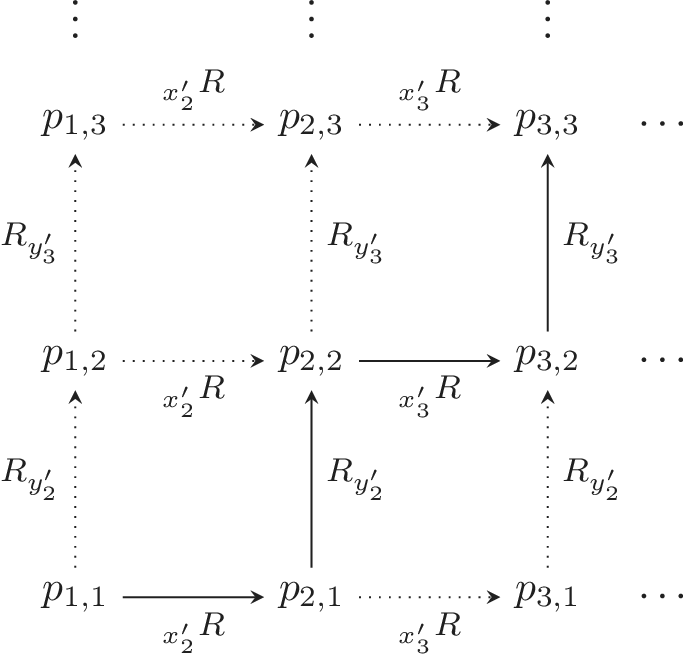
As the diagrams illustrate, to encode the quadrant
$\mathbb {N}^2$
 , it suffices to construct an infinite staircase by alternately taking steps along the first axis (via
${_xR}$
 ) and the second axis (via
${R_y}$
 ). The remaining points in the quadrant
$\mathbb {N}^2$
 are then generated by applying associativity. This idea forms a key component in our definition of the tiling formulas
$\phi ^{}_{\mathcal {W}}$
 as well as in our proof of Lemma 3.3.
Remark 4.2. We abbreviate

and

It is then readily verified that, given a model
$\mathbb {M}=(X,R,V)$
 , the semantics of ‘
$\hookrightarrow $
 ’ and ‘
$\hookleftarrow $
 ’ come down to the following:


Additionally, we define a unary operator ‘
$\Box $
 ’ as

and write
$Sxy$
 , or
$xS y$
 , if there are
$a,b$
 such that
-
• $Rxay$
; or -
• $Rxya$
; or -
• $Rx(ay)b$
.Footnote
8


Observe that

and note that, due to associativity, the relation S is transitive: if
$xS yS z$
 , then
$xS z$
 .
For intuition, consider the case where
$(X,R)$
 is a semilattice; that is,
$Rxyz$
 iff
$x=y\cdot z$
 for
$\cdot :X\times X\to X$
 a function that is
-
• commutative: $x\cdot y=y\cdot x$
; -
• associative: $(x\cdot y)\cdot z=x\cdot (y\cdot z)$
; -
• idempotent: $x\cdot x=x$
.


Then
$S\subseteq X^2$
 is simply the partial order
$\geq $
 on X defined by the semilattice operation,

andFootnote
9
$\Box $
 the ‘past-looking’ boxed modality

With this, we now define the tiling formulas.
Definition 4.3 (Tiling formulas)
Let
$\mathcal {W}$
 be a finite set of tiles. Recall, cf. Definition 3.1, that for a tile t, its edge colours are denoted by
$ t_u $
 (up),
$ t_d $
 (down),
$ t_l $
 (left), and
$ t_r $
 (right). Given a tile
$t\in \mathcal {W}$
 , denote the sets of tiles that match to the right and upward, respectively, by

For each tile
$t\in \mathcal {W}$
 , we introduce a propositional letter
$\mathtt {t}$
 and, by an abuse of notation, identify the tile
$t\in \mathcal {W}$
 with the conjunction of literals

By a further abuse, we define formulas corresponding to the sets of tiles that match to the right and upward, respectively, by

We also introduce propositional letters to encode the quadrant
$\mathbb {N}^2$
 as well as properties of the coordinate components in pairs
$(m,n) \in \mathbb {N}^2$
 :
-
• $\mathtt {x_e}$
, to encode that the first component m is even, that is,
$m=2m'$
. -
• $\mathtt {x_o}$
, to encode that the first component m is odd, that is,
$m=2m'+1$
. -
• $\mathtt {y_e}$
, to encode that the second component n is even, that is,
$n=2n'$
. -
• $\mathtt {y_o}$
, to encode that the second component n is odd, that is,
$n=2n'+1$
. -
• $\mathtt {x'}$
, used in encoding that the first component m is the successor of
$m-1$
. -
• $\mathtt {y'}$
, used in encoding that the second component n is the successor of
$n-1$
.


Using these propositional letters, we define the formulas:

Finally, we let

Clearly, the construction of the tiling formula
$\phi ^{}_{\mathcal {W}}$
 from a finite set of tiles
$\mathcal {W}$
 is computable. It therefore only remains to prove the tiling lemmas, Lemmas 3.3 and 3.4, which we now proceed to do. For convenience we restate the lemmas.
Lemma 3.3 1 (Restated)
If
$\mathcal {W}$
 does not tile
$\mathbb {N}^2$
 , then
$\phi ^{}_{\mathcal {W}}$
 is valid in the least associative normal modal logic (i.e.,
$\mathsf {BSg}\vDash \phi ^{}_{\mathcal {W}}\approx \top $
 ).
Proof of Lemma 3.3
By contraposition, suppose that
$\phi ^{}_{\mathcal {W}}$
 is not valid in the least associative normal modal logic, that is,
$\phi ^{}_{\mathcal {W}}\notin \mathbf {AK}_2$
 (or algebraically,
$\mathsf {BSg}\nvDash \phi ^{}_{\mathcal {W}}\approx \top $
 ). We are then to show that
$\mathcal {W}$
 tiles
$\mathbb {N}^2$
 .
By canonicity it follows that there is some associative model
$\mathbb {M}=(X,R,V)$
 and point
$z\in X$
 such that

that is,

Using this, we prove that
$\mathcal {W}$
 tiles
$\mathbb {N}^2$
 . Before proceeding, we outline the structure of the proof.
Outline
We will begin by identifying elements of
$\mathbb {M}$


which we, in turn, will use to identify what we will call staircase points:

These are so named because they form a staircase in that they will satisfyFootnote 10 :

along with

From the staircase, we find a full grid of elements
$p_{m,n} \in \mathbb {M}$
 for all
$(m,n) \in \mathbb {N}\times \mathbb {N}$
 . Lastly, by associating each point in the quadrant
$(m,n) \in \mathbb {N}\times \mathbb {N}$
 with the corresponding grid point
$p_{m,n} \in \mathbb {M}$
 , we can define the tiling
$\tau :\mathbb {N}\times \mathbb {N}\to \mathcal {W}$
 according to which tile formula
$t \in \mathcal {W}$
 is satisfied at
$p_{m,n}$
 , that is,
$\mathbb {M}, p_{m,n} \Vdash t$
 .
Returning to the proof, we begin by locating the points
$(x_i)_{i\geq 0},(y_i)_{i\geq 0}$
 within
$\mathbb {M}$
 —which, loosely speaking, may be thought of as the first and second axis—along with auxiliary points
$(x_i')_{i> 0}, (y_i')_{i>0}$
 encoding how
$x_{i+1}$
 and
$y_{i+1}$
 are successors of
$x_{i}$
 and
$y_{i}$
 , respectively. Specifically, we use that
$z \Vdash \mathtt {x_e}\circ \mathtt {y_e}\land \bigwedge \alpha _i$
 and show by induction that for all
$i\geq 0$
 :
-
1. $z\,{R}\,x_0\,y_0$
; -
2. $x_i\,{R}\,x_{i+1}'\, x_{i+1}$
; -
3. $y_i\,{R} \,y_{i+1} \,y_{i+1}'$
; -
4. $x_{i+1}'\Vdash \mathtt {x'}$
and
$y_{i+1}'\Vdash \mathtt {y'}$
; -
5. $zSx_i,\; zSy_i,\; zSx_{i+1}',\; zSy_{i+1}'$
; -
6. if i is even: $x_i\Vdash \mathtt {x_e}$
and
$y_i\Vdash \mathtt {y_e}$
; -
7. if i is odd: $x_i\Vdash \mathtt {x_o}$
and
$y_i\Vdash \mathtt {y_o}$
.


For the base case, since
$z\Vdash \mathtt {x_e}\circ \mathtt {y_e}$
 , there exist points
$x_0,y_0\in \mathbb {M}$
 such that
$zRx_0y_0$
 ,
$x_0\Vdash \mathtt {x_e}$
 , and
$y_0\Vdash \mathtt {y_e}$
 .
For the induction step, suppose the induction hypothesis holds for some
$n\geq 0$
 . We treat the case of n even; the case where n is odd is analogous. By induction hypothesis, we have
$x_n\Vdash \mathtt {x_e}$
 ,
$y_n\Vdash \mathtt {y_e}$
 ,
$zSx_n,$
 and
$zSy_n$
 . Hence, since
$z\Vdash \alpha _1\land \alpha _3$
 , there exist points
$x_{n+1}', x_{n+1}, y_{n+1}, y_{n+1}'\in \mathbb {M}$
 such that

as well as

Thus, items 1–4 and 6–7 are met. For item 5, simply recall that S is transitive in the presence of associativity (cf. Remark 4.2), thereby completing the induction.
Next, also by an induction, we show that there are staircase points

such that

while also demonstrating that for all
$k\geq 1$
 ,


For the base case, using that
$zRx_0y_0$
 ,
$x_0Rx_{1}'x_{1}$
 , and
$y_0Ry_{1} y_{1}'$
 , it follows by associativity that there is a point
$p_{1,1}$
 such that

Further,
$x_1$
 witnesses
$p_{1,1}R(x_{2}' x_{2})y_1$
 because
$x_{1}R x_{2}'x_{2}$
 , hence, by associativity,

which means that there is a point
$p_{2,1}$
 such that

As we have already shown that
$z\,S\,p_{1,1}$
 and the former implies that
$p_{1,1}\,S\,p_{2,1}$
 , transitivity of S gives us
$z\,S\,p_{2,1}$
 , completing the base case.
The inductive step has two cases depending on whether we assume the claim up to
$p_{k,k}\,{R} \,x_{k+1}' \,p_{k+1,k}$
 or up to
$p_{k+1,k}\,{R} \, p_{k+1,k+1} \,y_{k+1}'$
 . We treat the former. That is, we must show that there is some
$p_{k+1,k+1}$
 such that

By assumption, we have
$p_{k+1,k}\, R\,x_{k+1}\,y_k$
 , so
$y_k$
 witnesses
$p_{k+1,k}\,R\,x_{k+1} (y_{k+1}y_{k+1}')$
 because
$y_{k}R y_{k+1}y_{k+1}'$
 , so by associativity,

This means that there is a point
$p_{k+1,k+1}$
 such that

which—since
$z\,S\,p_{k+1,k}\,S\,p_{k+1,k+1}$
 implies
$z\,S\,p_{k+1,k+1}$
 —completes the induction and establishes the staircase.
To generate the full grid, we need points
$p_{m,n}\in \mathbb {M}$
 for all
$m,n\geq 1$
 such that

We already have these points along the staircase, hence, by repeatedly applying associativity as noted in Remark 4.1, we get the remaining points as illustrated in Figure 1. To be more precise, the construction can be formalised as a recursion on
$\omega $
 : at stage
$k\in \omega $
 , we construct all points
$p_{m,n}\in \mathbb {M}$
 with
$|m-n|=k$
 . For
$k=0$
 , these are the diagonal points
$p_{m,m}$
 , which are already given. For
$k=1$
 , the points with
$m=n+1$
 are staircase points as well; to construct the points with
$n=m+1$
 , we use that
$p_{m,m}\,{R} \,x_{n}' \,p_{n,m}$
 and
$ p_{n,m}\,{R} \, p_{n,n} \,y_{n}'$
 , whence
$p_{m,m}\,R\,x_{n}'\, (p_{n,n}\,y_{n}')$
 , and so by associativity,

Thus there exists a point
$p_{m,n}$
 such that

for which we also have
$z\, S\, p_{m,n}$
 , as
$z\,S\,p_{m,m}\,S\,p_{m,n}$
 . This completes the case where
$k=1$
 . The cases where
$k>1$
 follow analogously, using the other direction of associativity for when
$m>n$
 .
Generating
$\mathbb {N}^2$
 from the staircase:
$p_{1,1}, p_{2,1}, p_{2,2}, p_{3,2}, p_{3,3},\ldots $
 .

As a consequence of
$zSp_{m,n}$
 along with
$z\Vdash \beta _1$
 and the identification in (1) of
$t\in \mathcal {W}$
 with the conjunction of literals, we have that
$\tau :\mathbb {N}^2\to \mathcal {W}$
 defined by

is well-defined as a function, provided that all
$p_{m,n}\Vdash \bigvee _{\mathtt {a},\mathtt {b}\in \{\mathtt {e},\mathtt {o}\}} \mathtt {x_a} \circ \mathtt {y_b}$
 . In fact, to show that
$\tau $
 defines a tiling, we will need something stronger than this proviso, namely that for all
$p_{m,n}$
 ,

We show this by an induction, using the staircase as our base case. For the staircase points, this follows immediately: (3), together with items 6 and 7, imply the first conjunct; the second then follows from (4) and that
$z\Vdash \beta _2$
 .
For the inductive step, we show that if the claim holds for both
$p_{m',n'}$
 and
$p_{m'+1,n'+1}$
 , then it also holds for
$p_{m',n'+1}$
 and
$p_{m'+1,n'}$
 . As noted, this will, in particular, entail that
$\tau $
 is well-defined as a function. To complete the proof, as part of the same argument, we also show that
$\tau $
 satisfies the tiling conditions:

By our definition of
$\tau $
 and the formulas
$t, \mathtt {R}(t),$
 and
$\mathtt {U}(t)$
 (cf. (1) and (2)), this means showing that

There are four cases to consider, corresponding to the parities of
$m'$
 and
$n'$
 . Since the cases are analogous, we only cover the case where
$m'$
 and
$n'$
 are even and show that the claim follows for
$p_{m',n'+1}$
 . Assume, then, that the claim holds for
$m'=2m$
 and
$n'=2n$
 ; that is,

and

Then, as mentioned,
$zSp_{2m,2n}$
 ,
$p_{2m,2n}\Vdash \mathtt {x_e}\circ \mathtt {y_e}$
 , and
$z\Vdash \beta _1$
 , jointly imply that
$p_{2m,2n}\Vdash t$
 for some
$t\in \mathcal {W}$
 . So to complete the proof of this tiling lemma, we show that not only

but also

Since we have (a)
$z\Vdash \gamma _1^v$
 , (b)
$zSp_{2m,2n}$
 , (c)
$p_{2m,2n}\Vdash \mathtt {x_e}\circ \mathtt {y_e}\land t$
 , (d)
$p_{2m,2n}\,R \,p_{2m, 2n+1}$
 $y_{2n+1}'$
 (by (5)), and (e)
$y_{2n+1}'\Vdash \mathtt {y'}$
 (by item 4), we get that

It follows that
$p_{2m, 2n+1}\Vdash t'$
 for some
$t'\in \mathcal {W}$
 . Hence, if we had
$p_{2m, 2n+1}\Vdash \mathtt {x_e}\circ \mathtt {y_e}$
 , then (a’)
$z\Vdash \gamma _1^h$
 , (b’)
$zSp_{2m,2n+1}$
 , (c’)
$p_{2m,2n+1}\Vdash \mathtt {x_e}\circ \mathtt {y_e}\land t'$
 , (d’)
$p_{2m,2n+1}\,R \,x_{2m+1}'\,p_{2m+1, 2n+1}$
 , and (e’)
$x_{2m+1}'\Vdash \mathtt {x'}$
 , would jointly imply that

which is a contradiction, as we have by assumption that

Thus,
$p_{2m, 2n+1}\nVdash \mathtt {x_e}\circ \mathtt {y_e}$
 , so
$p_{2m, 2n+1}\Vdash \mathtt {x_e}\circ \mathtt {y_o}\land \mathtt {U}(t)$
 , whence the remaining

follows from
$z\Vdash \beta _2$
 and
$zSp_{2m, 2n+1}$
 , finalizing our proof.
We continue with the proof of the other tiling lemma.
Lemma 3.4 (Restated)
If
$\phi ^{}_{\mathcal {W}}$
 is valid in
$(\mathcal {P}(\mathbb {N}), \cup )$
 (i.e.,
$(\mathcal {P}(\mathbb {N}), \cup )^+\vDash \phi ^{}_{\mathcal {W}}\approx \top $
 ), then
$\mathcal {W}$
 does not tile
$\mathbb {N}^2$
 .
Proof of Lemma 3.4
Suppose, contrapositively, that
$\tau :\mathbb {N}^2\to \mathcal {W}$
 is a tiling. We have to show that
$\phi ^{}_{\mathcal {W}}$
 is refuted by
$(\mathcal {P}(\mathbb {N}), \cup )$
 , that is,
$\phi ^{}_{\mathcal {W}}\notin \mathrm {Log}(\mathcal {P}(\mathbb {N}),\cup )$
 (or algebraically,
$(\mathcal {P}(\mathbb {N}), \cup )^+\nvDash \phi ^{}_{\mathcal {W}}\approx \top $
 ).
To this end, write
$2\mathbb {N}=\{2n\mid n\in \mathbb {N}\}$
 for the even numbers and
$2\mathbb {N}+1=\{2n+1\mid n\in \mathbb {N}\}$
 for the odd numbers, and define a valuation V as follows:

We proceed showing that

that is,

First off, observe that
$2\mathbb {N}\Vdash \mathtt {x_e}$
 and
$2\mathbb {N}+1\Vdash \mathtt {y_e}$
 , hence

Alphas (
$\boldsymbol {\alpha _i}$
 ). Second, to see that
$\mathbb {N}$
 also satisfies the
$\alpha $
 ’s, note that if some
$X\Vdash \mathtt {x_e}$
 , then by definition
$X\subseteq 2\mathbb {N}$
 such that
$|2\mathbb {N}\setminus X|$
 is even. In particular, there are even numbers
$2n\in X$
 , and for these, we have
$\{2n\}\Vdash \mathtt {x'}$
 and
$|2\mathbb {N}\setminus (X\setminus \{2n\})|$
 is odd, hence

as required. A fortiori,
$\mathbb {N}\Vdash \alpha _1$
 .
$\mathbb {N}\Vdash \alpha _2\land \alpha _3\land \alpha _4$
 is proven analogously.
Betas (
$\boldsymbol {\beta _i}$
 ). Note that the decomposition of a
$Z\subseteq \mathbb {N}$
 into
$X\cup Y=Z$
 for
$X\in (V(\mathtt {x_e})\cup V(\mathtt {x_o})), Y\in (V(\mathtt {y_e})\cup V(\mathtt {y_o}))$
 is unique when it exists. So since
$\tau :\mathbb {N}^2\to \mathcal {W}$
 in particular is a function, we get that
$\mathbb {N}\Vdash \beta _1$
 ; and since
$V(\mathtt {x_e}), V(\mathtt {x_o}), V(\mathtt {y_e}), V(\mathtt {y_o})$
 are pairwise disjoint, we also have
$\mathbb {N}\Vdash \beta _2$
 .
Gammas (
$\boldsymbol {\gamma _i}$
 ). In proving that
$\mathbb {N}\Vdash \gamma _1^h\land \gamma _1^v\land \cdots \land \gamma _4^h\land \gamma _4^v$
 , we only cover the first conjunct, as the others are proven analogously. Accordingly, suppose
$Z\Vdash \mathtt {x_e}\circ \mathtt {y_e}\land t$
 for some tile t, and let
$Z'\subseteq \mathbb {N}$
 and
$n\in 2\mathbb {N}$
 be arbitrary such that
$Z= \{n\}\cup Z'$
 . For the purpose of demonstrating that
$\mathbb {N}\Vdash \gamma _1^h$
 , we must show that

If
$n\in Z'$
 , then
$Z'=Z\Vdash \mathtt {x_e}\circ \mathtt {y_e}$
 , as required.
If
$n\notin Z'$
 , we use that
$Z\Vdash \mathtt {x_e}\circ \mathtt {y_e}$
 implies that
$Z=X\cup Y$
 for some
$X\in V(\mathtt {x_e})$
 and
$Y\in V(\mathtt {y_e})$
 . Since
$Z\ni n$
 is even, it follows that
$n\in X$
 , whence

Further, using that
$Z\Vdash t$
 , so
$X\cup Y=Z\Vdash \mathtt {t}$
 , which means that
$ \tau (|2\mathbb {N}\setminus X|, |(2\mathbb {N}+1)\setminus Y|)=t$
 , we get that

since
$\tau $
 is a tiling. Consequently,

as desired, completing the proof of
$\mathbb {N}\Vdash \gamma _1^h$
 , and thereby of the lemma.
5 Features of the (un)decidable
With the proofs completed, we conclude by turning to a broader aim of this line of research: to better understand the boundary between the solvable and the unsolvable. To this end, we contrast our undecidability results with known decidability results, accentuating features that appear to separate the decidable from the undecidable.
First, the undecidability of the modal logic of semilattices,
$\mathrm {Log}(\mathsf {SL})$
 (Theorem 3.7), contrasts with two established decidability results. As shown in [Reference Knudstorp24], if we expand the class of structures from semilattices to posets (so we do not require existence of all binary suprema), the resulting logic, typically referred to as modal information logic, is both decidable and finitely axiomatisable.Footnote
11
At first glance, this may appear surprising: why should restricting to semilattices—that is, posets with all binary suprema (or infima)—a seemingly more benign subclass, lead to undecidability? But, as noted by van Benthem [Reference van Benthem, Weiss and Birman6], interpreting ‘
$\circ $
 ’ via supremum (or infimum) over semilattices rather than posets yields an important distinction: only over the former is the associativity axiom validated (recall Remark 4.1 on the role of associativity).
Second, by [Reference Knudstorp23, Corollary 2] (building on [Reference van Benthem4, Reference van Benthem5]), truthmaker consequence can be identified with the
$\{\lor , \circ \}$
 -fragment of
$\mathrm {Log}(\mathsf {SL})$
 . This is significant because truthmaker consequence, unlike
$\mathrm {Log}(\mathsf {SL})$
 , is decidable [Reference Fine and Jago14, Reference Knudstorp23]. In fact, as observed in [Reference Knudstorp22, Remark B.3.8], the decidability proof in [Reference Knudstorp23] extends to the language that includes conjunction. Thus, although
$\mathrm {Log}(\mathsf {SL})$
 is undecidable, its
$\{\land ,\lor , \circ \}$
 -fragment, that is, the negation-free fragment, is decidable.
This inspires the following research question: how much, or how strong a, negation is needed for undecidability? One algebraically formulated precisification of this is whether the equational theory of the variety of Heyting semigroups—Heyting algebras with an associative operator distributing over finite joins—is decidable. In unpublished work with Peter Jipsen [Reference Jipsen and Knudstorp20], this was answered affirmatively. Thus, we find a sharp dividing line: unlike the variety of Boolean semigroups,
$\mathsf {BSg}$
 , the variety of Heyting semigroups is decidable. That is, for undecidability, not even intuitionistic negation suffices; classical negation seems necessary.
Having considered the impact on decidability of altering the language or the frames, we end with a note on the effect of restricting the valuations. As mentioned, [Reference Engström and Olsson13] conceives hyperboolean modal logic as a unifying framework for propositional team logics and studies it under the name LT. This connection is intriguing because propositional team logics are decidable, yet LT is not (Theorem 3.6). The key difference being that valuations in team semantics are principal ideals, while in LT they need not be.
To sharpen this contrast, let
$\mathsf {Pow}_\cup $
 denote the class of associative frames of the form
$(\mathcal {P}(X), \cup )$
 . By Theorem 3.5,
$\mathrm {Log}(\mathsf {Pow}_\cup )$
 is undecidable. However, if we only consider models
$(\mathcal {P}(X), \cup , V)$
 where V is a principal ideal—in that
$V:\mathsf {Prop}\to \{\mathcal {P}(Y)\mid Y\subseteq X\}$
 —instead of allowing arbitrary valuations
$V:\mathsf {Prop}\to \mathcal {P}\mathcal {P}(X)$
 , we achieve a sound and complete semantics for propositional team logic, which, contra
$\mathrm {Log}(\mathsf {Pow}_\cup )$
 , is decidable.Footnote
12
Appendix A Kripke semantics for propositional team logic
In this appendix, we prove the concluding claim of Section 5, namely that a sound and complete Kripke semantics for propositional team logic (PTL) is given by powerset frames
$(\mathcal {P}(X), \cup )$
 with principal valuations
$V:\mathsf {Prop}\to \{\mathcal {P}(Y)\mid Y\subseteq X\}$
 . Recall that this modal view on team semantics is of interest because PTL is decidable, whereas the logic of powerset frames with arbitrary valuations
$\mathrm {Log}(\mathsf {Pow}_\cup )$
 is not (by Theorem 3.5).
A.1 Team semantics recap
The language of PTL is given byFootnote 13

where ‘
$\lor $
 ’ is the split (or tensor or local) disjunction, ‘
 ’ is the inquisitive (or global) disjunction, and ‘
$\sim $
 ’ is the Boolean negation.
In team semantics, formulas are not evaluated over single valuations, but over sets of valuations
$t\in \mathcal {P}(\{v\mid v:\mathsf {Prop}\to \{0,1\}\})$
 (called teams):

Decidability follows since (i) formulas
$\varphi $
 contain only finitely many propositional letters
$\mathsf {Prop}(\varphi )$
 and (ii) to check whether
$t\vDash \varphi $
 for all
$t\subseteq \{v\mid v:\mathsf {Prop}\to \{0,1\}\}$
 , it suffices to check whether
$t\vDash \varphi $
 for all
$t\subseteq \{v\mid v:\mathsf {Prop}(\varphi )\to \{0,1\}\}$
 .
A.2 From teams to worlds
For
$X=\{v\mid v:\mathsf {Prop}\to \{0,1\}\}$
 a set of classical valuations, define the associative frame
$(\mathcal {P}(X), \cup )$
 with valuation V given by

This ensures that

mirroring the team-semantic atomic clause. Observing that the team-semantic clauses for split disjunction ‘
$\lor $
 ’, inquisitive disjunction ‘
 ’, and Boolean negation ‘
$\sim $
 ’ are precisely the standard Kripke-semantic clauses for a binary diamond ‘
$\circ $
 ’, disjunction ‘
$\lor $
 ’, and negation ‘
$\neg $
 ’, respectively, it follows that for all
$t\in \mathcal {P}(X)$
 and
$\varphi $
 ,

Here, ‘
$\vDash $
 ’ denotes the team-semantical satisfaction relation and ‘
$\Vdash $
 ’ the Kripke-semantical satisfaction relation. This yields completeness of the modal semantics for team logic.
A.3 From worlds to teams
Conversely, for soundness, given a powerset frame
$(\mathcal {P}(X), \cup )$
 with principal valuation
$V:\mathsf {Prop}\to \{\mathcal {P}(Y)\mid Y\subseteq X\}$
 , define a classical valuation
$v_x:\mathsf {Prop}(\varphi )\to \{0,1\}$
 for each
$x\in X$
 by

Proposition A.1. For all
$\varphi $
 and
$t\in \mathcal {P}(X)$
 ,

Proof. Observe that

where the first biconditional follows from
$V(p)=\mathcal {P}(Y)$
 for some
$Y\subseteq X$
 . Using this, it is straightforward to see that the map
$t\mapsto \{v_x\mid x\in t\}$
 constitutes a p-morphism (w.r.t.
$\cup $
 ), so the proposition follows.
This yields soundness, thereby providing the promised modal semantics for PTL in terms of powerset frames with principal valuations. The decidability of PTL thus contrasts with the undecidability of
$\mathrm {Log}(\mathsf {Pow}_\cup )$
 , where valuations need not be principal.
Acknowledgments
This research originated during a visit to Chapman University in Fall 2023, where I obtained a first version of the undecidability results presented here. I am sincerely grateful to Peter Jipsen for valuable discussions, and for his kindness and encouragement throughout the visit and beyond. I would also like to thank an anonymous referee for a thorough reading and very detailed feedback. My thanks further go to Maria Aloni and Nick Bezhanishvili for comments on the manuscript, and to Johan van Benthem, Cliff Bergman, Valentin Goranko, and Larry Moss for their input on earlier stages of the project.
Funding
The work was partially supported by the MOSAIC Project (H2020-MSCA-RISE-2020, 101007627), as well as by the Nothing is Logical (NihiL) Project (NWO OC 406.21.CTW.023). Open access funding provided by University of Amsterdam.




 Open access

