INTRODUCTION
Disputes over assertions of religious and cultural identities are very common in peace processes (e.g., Atashi Reference Atashi, Dayton and Kriesberg2009, 45–60; Lederach Reference Lederach1997, 23–36; Ramsbotham, Woodhouse and Miall Reference Ramsbotham, Woodhouse and Miall2011, 302–315). Confrontations over territorial boundaries, clashes concerning historical and contemporary rights, and disagreements over what constitutes equality or mutual respect, may all be juxtaposed with efforts to embed peace. Issues of parity of esteem and equal treatment of rival traditions may be particularly important in cases where a consociational political framework attempts to manage, but not necessarily resolve or remove, the religious and political divisions which gave rise to conflict (Finlay Reference Finlay2010, 89–102; McGarry and O'Leary Reference McGarry and O'Leary2004, 1–61; Requeqo and Nagel Reference Requeqo, Nagel, Requeqo and Nagel2015, 1–11). As consociational peace processes and their attendant political outworking strive to ameliorate deep-rooted ethno-national or ethno-religious divisions, supposedly post-conflict societies may be sites of continuing local strife.
Given the possibility of shows of ethno-religious militancy destabilizing a peace process, their statutory regulation, or even prohibition, may be deemed necessary by the state. In Northern Ireland, parades are the most common form of such identity displays, being used mainly, but not exclusively, by Protestants to mark out territorial boundaries and assert their religious and political (British Unionist) identity. These demonstrations of loyalty to the Protestant faith and the British Crown are regulated by a government-appointed body, the Parades Commission. This quasi-judicial body's decisions to permit or re-route controversial parades has resulted in rioting (from Protestants and Catholics) in more years than not since Northern Ireland's 1998 peace deal, the Good Friday Agreement.
Yet amid such controversy, there has been scant detailed work to date on rival attitudes toward these territorial markers. This article aims to redress this dearth of knowledge by providing the first quantitative examination of the key structural, political, and spatial determinants of attitudes within Northern Ireland's Protestant British Unionist and Catholic Irish Nationalist traditions toward Protestant parades. In examining these determinants, the article seeks to discover the depth of inter-communal polarization and intra-communal differences in attitudes on these strident and exclusivist expressions of religious, cultural and political affiliations. It draws upon recent data from the 2015 Northern Ireland General Election SurveyFootnote 1 to examine public attitudes to one of the most visible polarizing aspects of communal affiliation in a divided polity. Understanding the depth of inter- and intra-communal division and its repositories is the first task of policy-makers in attempting to formulate policies to reduce ethnic rivalries.
The Protestant British Unionist and Catholic Irish Nationalist communities are not homogeneous entities, nor do they offer uniform views. We test which variables matter in explaining the degree of support, antipathy, or ambivalence toward Orange marching rights. Are there significant intra-communal differences within the two main communities, in addition to the main inter-communal binary divide over Protestant parades? Do intra-communal divisions match onto political rivalries between the Unionist and Nationalist parties, or do demographic, religious or geographical (i.e., the proximity to parades) variables matter more? We examine the extent of inter-communal sectarian hostilities over parades; then explore the extent of uniformity or diversity of opinion within both communities and finally, assess the basis of intra-communal division. We begin, however, by briefly explaining the contemporary contextual background to sectarian hostilities over Protestant parades.
BACKGROUND: CONTESTED TERRITORY AND THE REGULATION OF ETHNO-RELIGIOUS PARADES
Although offering a globally admired peace process, Northern Ireland remains a site of contested boundaries and competing ethno-religious identities. Its consociational peace deal legitimizes rival cultural, religious and political identities and little inter-communal thawing is evident. Educational and residential segregation between Protestants and Catholics remains extensive, while the ethno-religious chasm in terms of which political parties are supported remains huge. A plethora of regulatory commissions — on human rights, equality, victims, parades, and culture, identity and tradition — attempt to mitigate ethno-religious rivalries. Elite-level cross-community power-sharing is accompanied by the aspiration that political cooperation will permeate the grassroots of rival communities. Pending such thawing however, regulation of inter-communal rivalry is undertaken via statutory commissions.
The starkest outworking of rivalries in Northern Ireland comes annually during the “marching season” in spring and summer, when thousands of followers of the Orange Order, an exclusively Protestant religious and cultural organization, take part in parades which are unpopular with the Catholic Irish Nationalist population. Not all Protestant parades are organized by the Orange Order, but the bulk comes under its remit. Disputes over the routes and content of a small number of these religious and cultural expressions of identity have been common. Rioting has occurred on several occasions on the main marching day, July 12th, a violent manifestation of deep-rooted sectarian divisions. These disturbances followed adjudications on the routes of Orange Order parades by the quasi-judicial Parades Commission, a body established following serious disturbances over marches during the mid-1990s. Catholic Irish Nationalists have rioted on occasion when parades have been allowed to process adjacent to “their” areas. Protestant British Unionists have done likewise when parades have been banned or re-routed. Parades disorder cost nearly £7million in 2015 (Irish News 2015).
For many among the Protestant British Unionist community within Northern Ireland, their right to march along the “Queen's highway” is inviolate. For its supporters, the Orange Order represents a significant cultural and religious expression of Protestant Britishness, expressed via the parading tradition. Restrictions upon such expressions via Parades Commission edicts are viewed as cultural attacks. For many among the Catholic Irish Nationalist,Footnote 2 the Orange Order is perceived as a militantly sectarian organization, one which should not process near areas populated mainly by Catholics. Critics of the Order see it as anti-Catholic, an exclusively Protestant body which forbids its members from marrying Catholics and prohibits attendance at Catholic services of worship. Orange Order members must demonstrate some commitment to Protestantism as a condition of membership and Bible-related religious images often Orange Order banners (Jarman Reference Jarman1997). As Mitchell's (Reference Mitchell2006) detailed study showed, disentangling religion, cultural identity, and politics in Northern Ireland is a fruitless task. It is fused into a worldview which critics accuse of myopic partisanship and ignorance of competing views. Thus, Porter (Reference Porter1996, 215) contends that for those from the Unionist tradition, Northern Ireland is “primarily the site of a Protestant-British way of life which alone warrants public institutional recognition.” Orange parades place this in public view.
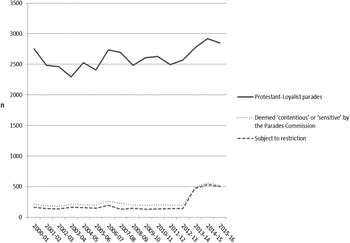
The bulk of Protestant parades in Northern Ireland pass off peacefully with little controversy. Of 2,851 such parades in 2014, 523 were deemed contentious, with 504 of those contentious marches having restrictions placed upon them by the Parades Commission (Parades Commission 2016, 9). The Parades Commission has placed conditions upon a higher percentage of Irish Republican parades than has been applied to Protestant British Unionist parades, but Protestant processions are far more numerous, and in total receive many more restrictive determinations. Figure 1 shows the numbers of Protestant parades, the figures for the number deemed “contentious” or “sensitive” (the Parades Commission has used both terms) and the amount on which restrictions have been placed over the last decade-and-a-half.
Annual Protestant parades and Parades Commission restrictions 2000–2016.

Figure 1 appears to show a large increase in contentious marches in recent years, but most of these are accounted for by near-nightly parades undertaken in Belfast between 2013 and 2016, over the re-routing of a return Orange Order march by the Parades Commission in a protest now ended. Those parades straddling sectarian interfaces have been the subject of major contention. Catholic Nationalists have rioted when the Orange Order return parade has been allowed to proceed; recent years have sometimes seen Protestant Loyalist (working-class Unionists) riots in response to parade bans. Re-routing away from a Catholic area is the most common form of restriction.
Established in 1997 by the outgoing Conservative government and granted legal status under the Labour government's 1998 Public Processions Act, the Parades Commission adjudicates on the routes of contentious parades. Its seven members are appointed by the Secretary of State for Northern Ireland. The Commission came into being following a recommendation in the North Report (Reference Report1997) inquiry into major disturbances in the summers of 1995 and 1996 over an Orange Order march at Drumcree, which was banned, then permitted, then finally banned in 1997. While the Parades Commission encourages resolution through local dialogue, this has often been absent regarding contentious parades, due to mutual hostility between the Orange Order and Catholic Nationalist residents’ groups, themselves divided between mainstream and more militant republican orientations. As Hayward and Komarova (Reference Hayward and Komarova2014, 2) put it, “although elite level actors (including the Parades Commission) place a heavy emphasis on the vital role for local-level negotiation and accommodation … such efforts are inextricably hamstrung by the social realities of post-Agreement Northern Ireland.”
The Parades Commission has attracted the opprobrium of the Orange Order — the “Charades Commission” is a popular derogatory label — and much criticism from Unionist politicians. In boycotting the Parades Commission, the Orange Order has also highlighted the unelected and unaccountable status of the regulatory body (Walsh Reference Walsh2015). The Order's view has found sympathy within Northern Ireland's Unionist parties. The Democratic Unionist Party's (DUP) leader, Arlene Foster, until recently Northern Ireland's First Minister, insisted that “we hope we can get rid of the Parades Commission sooner rather than later as they are completely dysfunctional” (Interview, February 8, 2013). Having unsuccessfully attempted to replace the Commission, the DUP (Democratic Unionist Party 2016, 21) supports “new legislation for a fresh start on how parades and protests are dealt within in Northern Ireland.”
For Orange Protestants, parade restrictions and re-routing represent defeats in an ongoing cultural contest with Nationalists (McAuley Reference McAuley2010). The peace process “exposed the Orange Institution's powerlessness” (Bryan Reference Bryan2001, 44) and became increasingly subject to regulation and control. The Orange Order has engaged in a fruitless war of attrition against the Parades Commission based upon prolonged legal challenges (Kaufmann Reference Kaufmann2009). The statutory status of the Commission, the willingness of the Police Service of Northern Ireland to uphold the Commission's determinations and the disinclination of the Orange Order to engage in meaningful dialogue (which may have seemed a reasonable request to liberal Protestants, the non-aligned and Nationalists) undermined efforts aimed at its removal. 86% of the Orange Order membership wanted the Parades Commission scrapped, according to a 2010 membership study (McAuley, Mycock, and Tonge Reference McAuley, Mycock and Tonge2011, 69).
Each prohibition upon Protestant parades equates in the Orange Order's view to a cultural reversal and an affront to the legitimate expression of their identity. In a zero-sum game polity, described as a raw “sectarianopolis” (Shirlow Reference Shirlow2001, 12; see also Aughey Reference Aughey2005) communal antagonism is the norm, with only victory or loss in an eternal struggle. The Orange Order has struggled to come to terms with the implementation of the Good Friday Agreement — a deal it argued that “no Protestant in good conscience could support” (Orange Standard 1998, 1) — arguing that asymmetry of treatment of cultures, rather than equality, has been its outcome. The Order has argued that there has been a continual process of usurping Protestants as part of a “sustained bid by republicans to ethnically cleanse … This is a struggle for territory and on the republican-Nationalist side it is very much a bid for further expansion” (Orange Standard 2001, 6). Territorial retreat has supposedly been accompanied by British government-sponsored cultural aggrandizement against Protestants and Loyalists. Under this interpretation, Northern Ireland may remain part of the United Kingdom but there has been a hollowing out of its Britishness. The Orange Order's worldview received political endorsement, the DUP (Democratic Unionist Party 2001, 6) claiming that “everything Gaelic, republican and Irish is promoted while all that is British, Unionist or Orange is derided and reviled.”
Within the Nationalist/republican community, Sinn Féin mobilized against some Orange parades for a decade from the mid-1990s, gaining from opportunities to “play the role of engaged street activists, standing for and with the ‘besieged’ people on the ground, thus assisting the party in its image contest with the less confrontational SDLP” [Social Democratic and Labour Party] (Mitchell Reference Mitchell2015, 121). Given the unpopularity of Orange parades among Catholics, these efforts allowed “republicans to present themselves as the foremost champions of northern nationalism,” exacerbating communal division to the advantage of the republican movement (Frampton Reference Frampton2009, 127). For Catholic Nationalists, the emphasis of the Good Friday Agreement upon parity of esteem required not only the already-achieved dismantling of the old Unionist-dominated “Orange state,” but also the removal of sectarian parading from close proximity. With the majority of Belfast's school-age population now Catholic and amid gradual territorial expansion of Catholic Nationalist areas, Protestant fears of encroachment or territorial retreat are also consequences of demographic change, as well as derivatives of political strategies. Catholic opposition to Orange parades cannot however be attributed solely to cunning Irish republicanism; the very first Orange Order parade led to confrontation and a death — in 1796, 109 years before the formation of Sinn Féin (Jarman Reference Jarman2001).
There is a perception among some Protestants that they are losing the cultural and political “wars” and that restrictions upon Orange parades represent part of an enforced retreat. Although the Orange Order remains one of the most important organizations in civil society — attracting tens of thousands of celebrants to its main event on what is a public holiday in Northern Ireland — it has been diminishing in size and influence for decades, a decline attributable to multiple reasons — sectarianism; secularism; diminished social capital; and migration. Its membership fell from a peak of 93,447 in 1968 to 35,758 four decades later (McAuley, Mycock, and Tonge Reference McAuley, Mycock and Tonge2011, 126). In 2005, the Order divorced from the Ulster Unionist Party (UUP), in which it had been a highly influential force for a century (Hume Reference David1996; Walker Reference Walker2012). The UUP supported the Good Friday Agreement, a deal opposed by the majority of Orange Order members; by 2004 only 12% claimed to back the Agreement (McAuley and Tonge Reference McAuley and Tonge2007, 41). Rational civic unionism offered by the UUP leadership confronted Orange skepticism over the supposed dilution of fundamental Unionist and Protestant principles (Tonge and Evans Reference Tonge and Evans2001; Patterson and Kaufmann Reference Patterson and Kaufmann2007).
The violence associated with a small number of parades has been condemned as hugely damaging and an abdication of the Orange Order's original religious mission, according to one of its former chaplains (Kennaway Reference Kennaway2006) and seen as counter-productive and naïve even by those sympathetic to benign parading traditions (Dudley Edwards Reference Dudley Edwards1999). The role of religion within the Order is widely perceived to be in decline, somewhat usurped by a “rougher” parading tradition (Kaufmann Reference Kaufmann2009) and a more secular Loyalist working-class “blood-and-thunder” urban band culture quite distinct from the more genteel Orange lodge parades in more rural areas (Bryan Reference Bryan2000; Smithey and Young Reference Smithey and Young2010). Austere, fundamentalist Protestants, while sharing Orangeism's theological distaste for Roman Catholicism, have tended to eschew the Order, seeing its members as insufficiently religious, arguing that “the principles of Orangeism are fine but the reality is often rioting drunks and attacks on the police” (Bruce Reference Bruce2007, 199). This view may also be held by more liberal middle-class Protestants in addition to the religious hardcore.
INTER- AND INTRA-COMMUNAL DIFFERENCES ON PARADING: TESTING HYPOTHESES
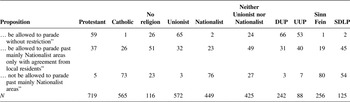
Having outlined the nature, regulation, and criticisms of the Protestant parading tradition, we now quantify the extent of division between the main political and religious communities, using the 2015 Northern Ireland General Election Survey. We focus on respondents’ choice from three possible options on the most appropriate response to Orange Order parades: (a) that they should be allowed to proceed past Nationalist areas without restriction, (b) that they should be allowed to proceed past mainly Nationalist areas only with agreement from local residents, or (c) that they should not be allowed to proceed past mainly Nationalist areas. We begin with the basic overarching binary divisions: Protestant versus Catholic and Unionist versus Nationalist, while also showing the views of the 8% of the survey who declared that they had no religion (the percentage identifying as holding a religion beyond Protestantism or Catholicism was below 1% so those respondents are excluded) and the much more sizeable group (32% of the survey) who do not identify as either Unionist or Nationalist. We also include views according to which political party is supported.
As can be seen from Table 1, there is, unsurprisingly given the very strong overlap of identities, very strong similarity of views between Catholics and Nationalists and between Protestant and Unionists. The table shows clearly the huge gulf in attitudes toward Orange Order marching rights between Protestant Unionists and Catholic Nationalists. An absence of consensus is stark. The largest single category of choice for Protestants (nearly two out of every three respondents) is unfettered marching rights, compared to a tiny percentage of Catholics agreeing to such freedom. Three-quarters of Nationalists favor outright prohibition of any Orange Order parades skirting their areas. A separate survey of Orange Order members showed views in line with the broader Protestant population, 59% advocating unfettered parading rights for their organization with 19% opposed to the idea and 23% undecided (McAuley, Mycock, and Tonge Reference McAuley, Mycock and Tonge2011, 169). The compromise option of parades being permitted following local agreement does have a sizeable number of takers among all the groups, most notably the non-aligned, but there is also considerable polarity. Given the very strong link between religious affiliation, ideology, and party choice in Northern Ireland (e.g., Evans and Tonge Reference Evans and Tonge2013; Tonge and Evans Reference Tonge and Evans2015) it is similarly unsurprising that there is also a very large chasm between the views of supporters of Unionist parties (the DUP and UUP) and those of Nationalist parties (Sinn Féin and the SDLP). Most of those backing Unionist parties want unfettered Protestant marching; while the majority of supporters of Nationalist parties desire a ban on any such parades near Nationalist areas.
Attitudes to Orange Order parades by religious, ideological, and party affiliation (%)
Question: Regarding Orange Order parades, which of the following do you think is the most appropriate? “The Orange Order should …”

Source: Northern Ireland General Election Survey (2015).
Clearly, therefore, there are stark inter-communal differences between attitudes to Protestant parades and their regulation which are likely to remain difficult to resolve. Yet it can also be seen that there are not uniform views within both communities. A sizeable minority of Protestants are prepared to compromise on parades, wanting prior local agreement. Similarly, some Catholics will countenance Protestant parades adjacent to their areas provided there is local agreement. We need to establish the basis of internal communal differences between militancy and moderation. As such, we now test which of the demographic, political, and religious variables matter most overall in terms of the defense or rejection of Protestant parading rights. We also introduce a geographical component to our analysis.
Hypothesis 1:
Religiously observant Protestants are less assertive of parading rights than their non-religiously practicing counterparts.
It may be that the Orange Order's religious mission has been displaced by a more secular or sectarian approach. A more strident and assertive Loyalist band culture may have replaced the quieter, more reverent approach of the Order, as it has been largely removed from political influence and forced to agitate for its demands. If this is true, then we expect that support for unrestricted — and potentially antagonistic — parading rights might be more forthcoming from irreligious, largely nominal Protestants who rarely practice their faith — Kaufmann's (Reference Kaufmann2009) rougher parading tradition, at least as much anti-Catholic Nationalist as pro-Protestant. We thus hypothesize that mammon outflanks God in providing the impetus to hardline attitudes to marches and expect the least religious Protestants to be most demanding of unfettered parading rights.
Hypothesis 2:
The religious denomination of Protestants shapes attitudes to their parading rights, i.e., Church of Ireland members are more moderate in attitudes than other Protestant denominations.
Our second religiously grounded hypothesis is that it is the denomination of Protestants which shapes attitudes. We hypothesize that members of the Church of Ireland, traditionally seen as liberal Protestant, may be more moderate and conciliatory in their attitudes compared to other Protestants. Part of the Anglican Communion, its High Church end, is fairly close to the Catholic Church and the approach of the Church of Ireland leadership is regarded as more ecumenical than those of other Protestant Churches. We test whether such rapprochement is more evident among the Church of Ireland's adherents compared to their Protestant counterparts.
Hypothesis 3:
Orange Order members are more belligerent in support for unrestricted marching rights.
Given that the Orange Order supplies the bulk of Protestant parades and is an organization designed to promote the Protestant religion and what it sees as civil and religious liberties, it is reasonable to expect that its members — most directly affected by restrictions and bans upon parades — will be more hostile to curbs upon marching routes. The Orange Order's leadership has been consistently hostile to the re-routing of its marches by the Parades Commission, viewing restrictions and prohibitions as affronts to its civil and religious liberties and as part of a cultural war against traditional Protestantism. It seems logical to expect Orange Order members to share the antipathy of the organization's leaders to the diversion of its parades.
Hypothesis 4:
Working-class Protestants are more assertive of unrestricted parading rights and working-class Catholics are most hostile.
We expect the vigorous assertion of Protestant parading rights and contempt for the Parades Commission to have a demographic basis, with the Protestant working-class opposing compromise and the middle-class holding more benign views. Clashes over Protestant parades are almost exclusively confined to poorer urban areas, where the Protestant and Catholic working-classes, which have seen little of the economic dividends of relative peace, remain physically divided by “peace walls” (109 such divides were in place in 2016). It was in these deprived urban working-class areas, particularly those close to sectarian interfaces, where the bulk of killings occurred during the conflict (Mesev, Shirlow, and Downs Reference Mesev, Shirlow and Downs2009).
Hypothesis 5:
The choice of political party within both ethnic blocs is a significant indicator of attitudes to parades.
Our descriptive statistics for supporters of Unionist parties showed considerable backing among DUP and UUP identifiers for unfettered Orange Order marching rights. However, the traditionally hardline DUP support base is most extensively in favor of unfettered marching rights. Two-thirds of DUP supporters back unfettered marching rights, whereas only a slight majority of UUP supporters support unbridled marching. Although almost half of UUP members of the Northern Ireland Assembly also belong to the Orange Order, the Party has less of an Orange flavor these days, the formal UUP-Orange alliance having ended in 2005. From 2012 until 2017 the UUP had its first leader (Mike Nesbitt) to not hold membership of the Orange Order.
Meanwhile, the DUP's support base has had a markedly Orange tinge since the transformation of Unionist party fortunes in the early 2000s. By the time the DUP overtook the UUP as the main Unionist party in the 2003 Northern Ireland Assembly election, two-thirds of Orange Order members were backing the DUP (Tonge and McAuley Reference Tonge, McAuley, Busteed, Neal and Tonge2008, 299). Six of the party's ten Members of Parliament belong to the Orange Order, as do 60% of the DUP's members of the Northern Ireland Assembly. A majority of DUP councilors (54%) are members of the Order, as are more than one-third (35%) of DUP members (Tonge et al. Reference Tonge, Braniff, Hennessey, McAuley and Whiting2014, 139). Whereas voters once saw the Orange Order and the UUP as part of a broad social and political movement, with the DUP seen as more closely aligned instead to the Free Presbyterian Church, the position has changed considerably during the last two decades.
Equally predictably from the descriptive statistics, Sinn Féin supporters are those most likely to oppose the Orange Order marching past Nationalist areas, although the pervasiveness of this view across Northern Irish nationalism is evident in the majority support for prohibition found among supporters of the traditionally more moderate SDLP. What is striking from the basic data is the extent of rejection of the idea of local compromise amongst Sinn Féin backers, whereas a very sizeable minority of SDLP supporters would be content to see local agreements. As such, we expect to see independent party effects within the Nationalist bloc.
Hypothesis 6:
Distance from Orange parades may have an effect – the furthest removed will be most likely to support compromise over parading routes.
Finally, as a more exploratory hypothesis, we also include a geographical location variable in our predictors of attitude to Orange Order parading. Increasingly, political science is including geographical indicators as part of explanations for political behavior, and more recently, individual distance indicators in propensity to vote (Dyck and Gimpel Reference Dyck and Gimpel2005) or in shaping vote choice (Arzheimer and Evans Reference Arzheimer and Evans2012; Evans et al. Reference Evans, Arzheimer, Campbell and Cowley2017; Górecki and Marsh Reference Górecki and Marsh2012). Here we wish to test whether one's location in relation to Orange Order parades has an effect upon perceptions of these events. Are people who live further away from the location of parades more likely to support consensual approaches to their routes, in contrast to people who live close to parades and either celebrate them as historical tradition (Protestant) or resent their imposition as a manifestation of historical oppression (Catholic)? We noted above the division of the working-classes near sectarian interfaces. A sizeable body of literature has indicated how conflict and sectarian hostilities are greatest near such sites (e.g., Cunningham Reference Cunningham2014; Shirlow Reference Shirlow2003; Shirlow and Murtagh Reference Shirlow and Murtagh2006).
METHOD
To test these hypotheses, we construct two binary logit models, one for Protestant respondents and the other for Catholics. We employ the question on attitudes to parading rights as our dependent variable. We code this with the more robust (and, to critics, sectarian) responses — the right to parade anywhere for Protestants, or the banning of Orange Order parades near Catholic nationalist districts — coded as the reference (0), with the response “parade with agreements” combined with the very few respondents in the opposing radical response as the contrast (1).
We include and interpret standard controls for age and gender, age included at the interval level, gender as a dummy coded 1 for female. Religiosity is similarly coded as a binary variable, contrasting those who attend church at least once a month versus the reference of those who attend less frequently. Occupational class is coded into five categories, reflecting current or previous job title (for retired and unemployed): managerial and professional (including intermediate occupations), the reference category; self-employed and small employer; technical and supervisory; routine; and inactive/other. These four variables are common to both Catholic and Protestant models. For both models, a variable of sectarian identification is derived from a question asking if the respondent feels Unionist, Nationalist or neither. “Unionist” and “Nationalist” responses are coded 1 for the Protestant and Catholic models respectively, using all other responses as a reference. Similarly, party choice at the 2015 General Election is included for both models — for Protestants, we contrast DUP and abstention with the UUP reference; for Catholics, Sinn Féin and abstention with the SDLP reference, thereby including the three most common responses each side of the sectarian divide. The Protestant model also includes two other variables: a four-category measure of denomination: Church of Ireland (the reference), Presbyterian, Free Presbyterian and other Protestant. It also includes a dummy variable for Orange Order membership.
Finally, we include a distance measure for each respondent. Here we use the distance between the respondent's home address (as identified by full postal code in the election survey) and an estimate of the starting-point of the closest of the Orange Order parades held on the “12th.” Because July 12th fell on the Christian Sabbath in 2015, the Orange Order, as is custom, held its parades on the following day. Nineteen Orange Order parades were undertaken across Northern Ireland on July 13, 2015. Each starting point and the relative size of the parade was calculated using information from the Culture Northern Ireland and Band Parades websites at www.culturenorthernireland.org/festival/orangefest-2015 and www.bandparades.co.uk/calendar/2015-07-13.
Straight line distances were calculated using the Northern Ireland Statistics and Research Agency small areas ESRI (Environmental Systems Research Institute) shapefile in standard GIS (geographic information system) software (www.nisra.gov.uk/sites/nisra.gov.uk/files/publications/SA2011_Esri_Shapefile.zip). It is important to acknowledge that “the 12th” parades are only a fraction of the total number of Orange parades in a marching season. Nonetheless, the event is very much the climax of the marching season, with parades of a magnitude far beyond any other day. We also note that Orange Order parade locations often vary on the 12th, although not in all cases, with, for example, Belfast routes providing a constant. Given that Orange parades invariably commence in predominantly Protestant localities, the geographical variable measuring the importance of proximity or distance from marches represents a useful snapshot. We are cognizant of the presence of similar Protestant organizations which parade, ranging in size from the large Apprentice Boys of Derry (which has enjoyed more productive relationships with local Catholic residents’ groups and with the Parades Commission) to the small Royal Arch Purple Order. These organizations nonetheless remain separate from the Orange Institution and it is attitudes to Orange parades with which we are concerned given the Order's assertion of marching rights and reluctance to negotiate with the regulatory commission.
ANALYSIS
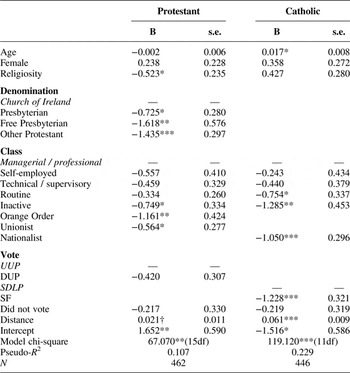
Table 2 presents the findings from the Protestant and Catholic models. It is first worth noting the overall model fit. With four fewer degrees of freedom, the Catholic model explains twice as much variance — if we interpret the pseudo-R 2 in this manner — than the Protestant model. The variables specified in the model explain more of the variation in Catholic attitudes to Orange Order marches than differences among Protestants.
Logistic regression models of Protestant and Catholic attitudes to Orange Order Parades

Note: † p < 0.1, *p < 0.05, **p < .01, ***p < 0.001.
Perhaps more disconcertingly for policy-makers, a small age effect is present in the Catholic community, but what it shows is that older respondents are more likely on average to support parades with agreements than younger respondents. As such, there is scant evidence of generational thawing, as younger Catholics are even less favorably disposed toward Orange parades near “their” areas. Supporters of this approach might laud a refusal to accept marches seen as sectarian; critics will argue these anti-Orange attitudes are themselves sectarian.
Regarding our hypotheses, for Protestants, religiosity has an impact but not in the way we hypothesized, in that those who attend church more than once a month are more likely to support the Orange Order's right to march without restriction than those who practice less frequently. Accordingly, any assumptions that it is a largely secular, irreligious and irreverent “band culture” that is most vigorously asserting Orange parading rights need revision, as the cause of unrestricted Orange marching rights attracts much sympathy from those who are church-going Protestants.
The social class effects we hypothesized for are relatively restricted, with only the economically “inactive” group showing significantly stronger support for the most robust positions of unrestricted marching (Protestants) or banning parades (Catholics) than the managerial/ professional reference. There is nonetheless a working-class effect visible through the routine occupations for Catholics. Thus, our hypothesis that working-class Catholics are most likely to oppose the right of Protestant parades to skirt Nationalist areas is upheld. It is “their” high-density, tightly-knit community areas that the Orange Order marches closest to, amid tension in some locations and the impact is apparent. The lack of clear class effects among Protestants may reflect an enduring cross-class appeal for the Orange Order. While its membership is largely proletarian these days elsewhere, it retains a sizeable, albeit declining, middle-class minority in Northern Ireland reflected in, for example, its sizeable presence among the region's Unionist elected representatives.
With regards to Protestant denomination, our hypothesis is upheld, with all three contrasts with the Church of Ireland more likely to support unrestricted parading and evidence of smaller “fringe” churches, within the “other Protestant category,” also being more strongly in favor of unlimited rights. The tiny Free Presbyterian category shows the strongest effect in favor of non-regulation, even though the Free Presbyterian Church was, until recent years, rather cool toward the Orange Order's less austere Protestantism. The contemporary sympathy toward the Orange Order among Free Presbyterians is noteworthy in that, remarkably given their low overall numbers, they remain the largest single Protestant denomination within the DUP, although their representation is declining (Tonge et al. Reference Tonge, Braniff, Hennessey, McAuley and Whiting2014). Similarly, across the two models, those identifying still with their respective Unionist or Nationalist (sectarian?) labels will be less inclined to agreements on Orange parading than those not identifying with unionism or nationalism. Almost inevitably, members of the Orange Order are more strongly in favor of unrestricted parading than non-members.
However, our party support hypothesis is upheld only on the Nationalist side. UUP supporters and DUP supporters alike are sympathetic to the Orange Order's assertion of parading rights. Being pro-Protestant parades is pervasive beyond political party, perhaps reflecting the historical formal UUP-Orange relationship and the contemporary informal DUP-Orange empathy. Party effects are evident, however, among Catholics. Sinn Féin voters are much more likely than SDLP voters to favor banning parades, independent of the working-class effect which would normally be linked to Sinn Féin. The years of fomenting opposition to Orange parades in Nationalist areas by Sinn Féin may have helped create this alignment. Such opposition was popular among many Catholics and helped Sinn Féin mobilize its support base.
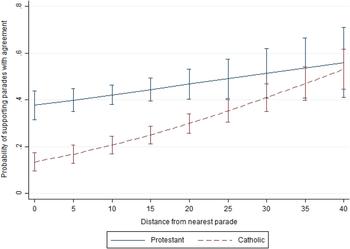
Finally, a distance effect is visible in both models. The further one lives from one of the July 12th parades, the more likely one is to support the consensual routing of parades. The effect is larger for the Catholic community than the Protestant, suggesting that this issue is of much greater salience for those confronted — and seemingly affronted — by the parades than those exercising their right to celebrate “traditional routes.” Those living further away are more inclined toward conciliatory and benign dispositions.
The effects noted above are relative contrasts, as well as being relatively uninterpretable logit coefficients, and do not in themselves indicate the overall propensity of the different groups to support the use of agreements in parading, or the restriction or banning of parades, according to community.
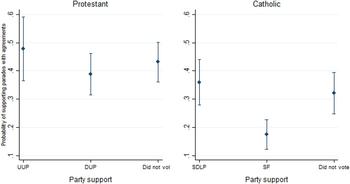
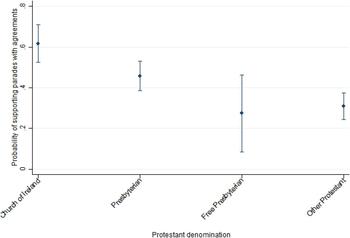
Figures 2, 3, and 4 are fitted probability graphs indicating the probability of supporting prior agreements to Orange parading routes, by distance from the parades, party supported and by Protestant denomination. Overall the Protestant community is much more homogenous, with less of a distance effect than the 30% differential dividing proximate from distant Catholics. We suggest an oppositional effect at work here. Many Protestants regard their parades as a normal, benign part of their tradition and some travel to see and support the parades at the climax of the marching season, diminishing geographical effects. Many Catholics will regard Orange parades less benignly, but it is those living closest to them and potentially most affected who may feel most hostile. There are clear overlaps in party support among Protestants, measured using 2015 vote, in contrast with the strong Sinn Féin support effect for Catholics, which marks backers of that party as strikingly more hostile to Orange parades compared not just to SDLP backers but also non-voters. Among Protestants, there are contrasts in the model between the compromisers belonging to the Church of Ireland, but the outlook of those of other denominations is relatively similar in their probability of opposition to restrictions upon parades.
(Color online) Fitted probability of support for parades with agreement, by distance and religion (with 95% CIs).

(Color online) Fitted probability of support for parades with agreement, by religion and party support (with 95% CIs).

(Color online) Fitted probability of support for parades with agreement, by Protestant denomination (with 95% CIs).

CONCLUSION
Continuing ethno-religious cultural confrontation retains the capacity to destabilize polities attempting to embed peace. The themes of cultural equality, religious freedom and parity of esteem that accompany consociational power-sharing political deals like the one in Northern Ireland are invariably contentious. Peace settlements which legitimize rival identities run the risk of exacerbating, not ameliorating, existing divisions. The contestatory basis of political and religious allegiances means that, within a zero-sum game framework, expressions of allegiance by one side may be seen as threatening by the other. In common with the aftermath of some other consociational peace agreements, Northern Ireland has required an interventionist regulatory agency, in this case the Parades Commission, to help defuse potentially inflammatory demonstrations of one ethnic group's religious, political and cultural identity.
The broader international lesson to be drawn is that the regulation of displays of ethnic identity is not a permanent solution. Rather it constitutes mere sticking-plaster, a holding operation amid a longer-term aspiration for inter-ethnic rapprochement. It represents a literal diversion, a short-term steering of overt ethno-religious displays away from a rival group. The spatial dimension of our research shows that those from the rival group living closest to such displays of cultural religious symbolism tend to most ill-disposed toward demonstrations. Such segregationist mindsets can only be overcome by much greater grassroots efforts to reconcile opposing communities, otherwise displays of ethno-religious solidarity by one group are likely to meet with continuing opposition and hostility.
Identity-based peace deals, such as the 1998 Good Friday Agreement, do not reconcile competing ethno-religious traditions, but instead proclaim their legitimacy while maintaining an apparatus of regulation of their more unsavory and controversial aspects, notably when they stray beyond tight territorial boundaries. The Good Friday Agreement's focus was upon managing divisions over the constitutional future of Northern Ireland within political institutions and promoting the equal legitimacy of the Protestant British Unionist and Catholic Irish Nationalist Republican binary groupings. This concept of parity of esteem and cherishing of diversity is most difficult to embed where expressions of those rival traditions are most strident and seen by some as threatening or insulting to their own tradition.
The Protestant parading tradition offers highly visible expressions of the religious, political and cultural stances of the Protestant British Unionist/Loyalist community. They are viewed as benign and appropriate by supporters but can alienate those in the other, “rival” community. Sectarian divisions over parades in Northern Ireland are not readily ameliorated. The nature of the Northern Ireland conflict has changed, as an “armed struggle” has largely been displaced by cultural battles. Our article has, however, indicated the acute nature of the Protestant versus Catholic binary in terms of attitudes toward Orange parades. Most Protestants want such parades to be permitted whatever route they please, whereas most Catholics desire a ban on all parades skirting Nationalist areas. However, the article has also demonstrated the existence of a sizeable minority within both communities in favor of the compromise of parading in “contested” areas with local agreements.
We find differing attitudinal influences within each community and, while recognizing the importance of the main binary divide, we argue it is also important not to treat the Protestant and Catholic communities as uniform, homogeneous entities. Among Protestants, attitudes toward parades are not conditioned particularly by social class, or party affiliation. Unionist ideological affiliation and Orange Order membership are predictably significant in the assertion of unfettered marching rights. The type of Protestant also matters, as being a Church of Ireland member is associated with moderation compared to other Protestant groups. For Catholics, while opposition to Orange parades is extensive, there are sizeable party cues, with supporters of Sinn Féin, a party with some history of opposition to certain Orange parades, most opposed. Younger Catholics (and especially working-class ones) are also more in favor of an outright ban on Orange parades taking place adjacent to Nationalist areas, an indication to policy-makers that they cannot rely on generational change for this issue to become more amenable to compromise. Finally, distance also matters. The closer Northern Ireland's citizens live to sites of Orange parades, the more divided are the two communities and Catholics living closest to such marches are the least amenable to their staging. As Protestant parades will not vanish anytime soon, much work close to sectarian interfaces among both ethno-religious bases is still required to diminish religious and political antagonisms, otherwise the sites of contested parades may change, but not the actuality.
APPENDIX: VARIABLE DESCRIPTIVES