1. Introduction
1.1. What is Level Stress?
This article aims to provide a phonetic analysis of synchronic level stress as it appears in two North Germanic dialects today. Level stress, described as a pattern of more or less equal stress across a disyllabic domain, is a prosodic pattern found in some Norwegian and Swedish dialects. It appears with disyllabic words that have preserved light root syllables from Old Norse (henceforth ON).Footnote 1 ON examples are koma ‘to come’, sina ‘a sinew’, and s⊘nir ‘sons’. The “root” syllable in these forms is the initial syllable and the one that is expected to carry the primary stress. In North Gudbrandsdal in Norway, these words are today realized as [2kɔ.mɔ], [2sε.nu], and [2sy.ny] respectively, that is, as a complex consisting of two light syllables.Footnote 2 In addition to the condition that the root syllable be light, level stress only occurs in words with tonal accent 2, at least in the dialects discussed in this article.
It cannot be said whether level stress was already a property of Old Norse or arose later. A common assumption is that a root vowel invariably carried stress in Old Norse. We would therefore expect the words cited above as having had stress on the initial syllable, with the final syllable being unstressed. Level stress, however, is described as a pattern of more or less equal stress on both syllables. One of the better dialectological sources, Ekre Reference Ekre1960:11, describes the pattern as “equal stress on both syllables, possibly accompanied by a weak tendency to lengthening and stronger stress on the second syllable under emphasis, especially in sentence final position.”Footnote 3 Similar descriptions are found in, for example, Storm Reference Storm1884:62f. and Horne Reference Horne1917:9 on the North Gudbrandsdal dialect (henceforth NGbr) and in Levander Reference Levander1925:50 on the Älvdalen dialect of Dalarna in Sweden (henceforth Älvd), which is the other variety analyzed in this article.
Another important quality associated with the level stress pattern is perceptual variability: stress is sometimes heard predominantly on the initial syllable, sometimes on both, and in rare cases predominantly on the final syllable. This variability is implied in the description of Ekre Reference Ekre1960 just quoted, and is more clearly stated by Larsen (Reference Larsen1897:41f.): “[in] North Gudbrandsdal […] both syllables are equally short and have an equal amount of stress, in the sense that there sometimes may be a little more [stress] on the first and sometimes a little more on the second [syllable].”
A fundamental problem with the dialectological descriptions reported here is that stress appears as a pre-theoretical concept that is more or less taken for granted. While the descriptions may make sense within a dialectological framework, both the distributional and variable aspects implied by them are difficult to make sense of within contemporary metrical theory on which most current analyses of stress are founded. Metrical theory (Hayes Reference Hayes1995) assumes that stress is a relational property between two syllables, where one must be the head of a foot constituted by the two syllables and thus be the one carrying stress. From a phono-logical point of view, the absolute strong – weak relationship assumed to hold between the two constituents allows neither for the proportional distribution of stress nor for the variability that are implied by the traditional descriptions of level stress cited above.
However, level stress may alternatively be a phonetically induced surface phenomenon, masking a canonical strong – weak relationship in the underlying structure. Unfortunately, few precise phonetic descriptions are available from the traditional, dialectological sources. This in turn makes it difficult to distil from the sources what exactly led the authors to perceive the stress as level.
One reasonable hypothesis might in fact be that the perception of stress as somehow leveled in these forms can be attributed to the fact that the first observers in the final half of the 19th century spoke varieties of Norwegian in which stressed syllables were obligatorily heavy (see Kristoffersen Reference Kristoffersen2000:chapter 5). Filtered through their perceptual categories associated with stress, the light root syllable might emerge as not fully stressed, and the final syllable somewhat more stressed than one following a heavy, fully stressed root syllable. Hence, from this point of view level stress would be nothing but a surface phenomenon with no necessary deeper implications for the phonology.
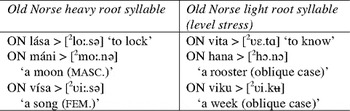
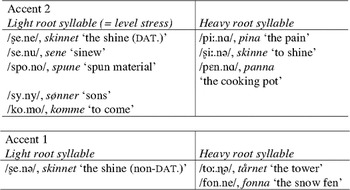
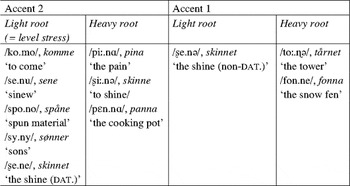
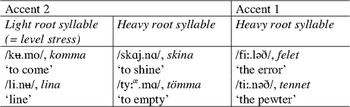
However, diachronic evidence shows that level stress cannot be merely a result of a perceptual confusion void of interesting phonological implications. In level stress words, a final, open syllable has retained its full vowel quality in many dialects. By contrast, in the same dialects unstressed open syllables following heavy, stressed syllables have been reduced to schwa or apocopated.Footnote 4 This has led to a split within major morphological classes such as infinitives and weak (disyllabic) nouns, as shown in table 1 with data from North Gudbrandsdal.Footnote 5
Different development of final vowel in the NGbr dialect depending on quantity of root vowel in Old Norse.

The very fact that the final vowel in the level stress class has retained its full quality, as against the reduction in forms with heavy root syllables, shows that at least diachronically, level stress cannot have been an epiphenomenon without phonological implications. To the extent that vowel reduction targets unstressed syllables, which is a well known process in the Germanic languages, a plausible explanation of the non-reduction after light root syllables might in fact be that some sort of prominence has protected the vowels in the final syllable from under-going reduction in this environment. In addition, as I discuss below, level stress has given rise to other phonological changes that also prove it to be more than an illusion in the ears of nonnative speakers of the dialect.
I stated above that the aim of the article is to provide a phonetic analysis of synchronic level stress as it appears in two North Germanic dialects today. We can now make this aim more precise by stating that such an analysis is necessary if we want to understand how level stress could give rise to these changes. This presupposes that living level stress as it appears in contemporary dialects has retained the phonetic properties that gave rise to these changes some hundred years ago. This of course cannot be taken for granted. However, to the extent that we find properties in the acoustic signal that arguably make the final syllable perceptually prominent in some way—without the expected prominence on the root syllable being eliminated—we can at least argue that we are on the right track toward an explanation of the historical facts as well.
A full explanation must of course also include a phonological analysis of level stress. For space reasons, this will not be attempted in the present article. The (preliminary) goal here is therefore to provide a phonetic grounding for a comprehensive phonological analysis.Footnote 6 This having been said, it is not always easy to hold phonetics and phonology strictly apart, and to the extent that coherence of argument or analysis would seem to demand it, some phonological concepts, such as quantity and syllable weight, will be called upon. In fact, stress is primarily a phonological concept, and when we talk about stress manifestation, a relationship between an abstract phonological level and an observable phonetic level is assumed.
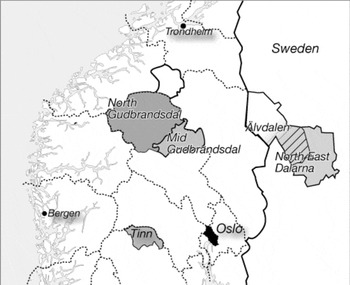
Dialects that manifest living level stress today are all rural. In Norway, level stress is still found in North and Mid Gudbrandsdal, and in Upper East Telemark, with the community of Tinn as central. As for Sweden, the sources are much vaguer with respect to its synchronic, geographical scope. From the testimonies of Levander (Reference Levander1925) and Meyer (Reference Meyer1937), we can without doubt conclude that level stress is or at least until recently has been part of the north eastern dialects of the Dalarna region (see map below). After the term level stress (Swedish jämviktsaksent) was introduced in Levander Reference Levander1909 in his description of the Älvdalen dialect in Dalarna, it has in addition been claimed to be present in a number of northern dialects, and in the Swedish dialects spoken in Finland and formerly spoken in Estonia. For these dialects, however, the authors seem to have deduced the presence of level stress more or less automatically from the fact that light root syllables have been preserved (see comments in Söderström Reference Söderström1972:12f. and Nyström Reference Nyström1991).
Two dialects are discussed, North Gudbrandsdal in Norway,Footnote 7 and that of the Älvdalen parish in the Dalarna region in East Central Sweden. The NGbr region consists of six administrative counties, covering an area of almost 10,000 km2. The population in 2007 was close to 20,000 inhabitants. Älvdalen is located in the northern part of the Dalarna region. The Älvdalen parish corresponds to the striated part of the larger municipality marked as Älvdalen on the map. It covers about 2,500 km2, and had in 2006 a little more than 5,000 inhabitants. The dialects of the other areas named on the map are also mentioned at various points in the article.
1.2. A Short Note on North Germanic Tonal Accents
Since the role of tonal accent is a central concern of this article, a short introductory note on its nature is in place. In most dialects of Norwegian and Swedish, primary stressed syllables are realized by one of two lexically contrastive tonal contours, referred to as accent 1 and accent 2 (Bruce Reference Bruce1977; Bruce & Hermans Reference Bruce, Hermans and Hulst1999; Kristoffersen Reference Kristoffersen2000). The latter in most dialects needs a post-stress syllable in order to materialize; monosyllabic words have in other words always accent 1 in these dialects. Tonal accent in Norwegian and Swedish is diachronically related to Danish st⊘d (see, for example, Basb⊘ll Reference Basb⊘ll1985:2005).
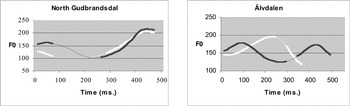
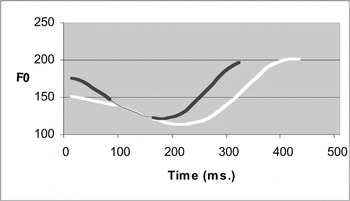
With respect to phonetic realization, it is customary to distinguish between two main dialect groups, those in which accent 2 is characterized by two tonal peaks within its disyllabic domain, as against one in accent 1, and those in which both accent 1 and accent 2 have only one peak (Gårding Reference Gårding1977). The two dialects discussed in this article both belong to the two-peak type. This can be seen from the F0 contours in figure 2 below, representing the VCV part of a disyllabic CVC.CV word (NGbr) or CVV.CV word (Älvd) with initial stress.Footnote 8 The black contours represent accent 2. Vowels are represented by thick lines, consonants with thin. Note that for both dialects, the final part of the accent 2 melody is identical to the accent 1 melody. Note also that while the NGbr contrast is limited to the stressed, initial syllable, both syllables are tonally different in Älvdalen.
1.3. Overview
This article is organized as follows. In section 2, the prosodic conditions required for the level stress prosody to manifest itself are discussed. Section 3 takes up the diachronic, phonological evidence that establishes level stress as something more than a phonetic trompe l'oreille without phonological significance. The general features of stress realization in Norwegian and Swedish constitute the topic of section 4, and in section 5 the empirical foundations of the analysis is presented. Sections 6 through 9 discuss the four stress realization parameters and relate them to the level stress forms. More specifically, section 6 deals with segment duration as realization of quantity contrasts, section 7 with intensity, section 8 with vowel quality as a diagnostic of stress, and section 9 with contrastive tonal accent. Section 10 concludes the article.
2. Prosodic Conditions for Level Stress
Based on the descriptions of level stress in dialectological sources, it is possible to identify the necessary phonological conditions for the prototypical level stress pattern to apply. This list is given in table 2, where “normal stress” refers to the obligatory features of stressed syllables found in non-level stress varieties. The relevant prosodic unit is the prototypical disyllabic CV.CV structure. In order to avoid circularity, I refer to the initial syllable, which normally carries the primary stress, as the root syllable and to the final syllable, which is normally unstressed, simply as the final syllable. We see that the only property that uniquely distinguishes the level stress pattern from the normal one is the weight of the root syllable, heavy in normal stress and light in level stress.
Comparison of prosodic properties of level stress with stress in dialects lacking level stress.

The second property, light final syllable, seems to be common to both types, but we should take note of the claims found in the sources that the final vowel in level stress words tends to lengthen. Hence the question mark in the level stress column. Given the fact that phono-logically long vowels are restricted to stressed syllables in all Norwegian dialects, lengthening might make the final syllable in level stress words appear more stress-like.
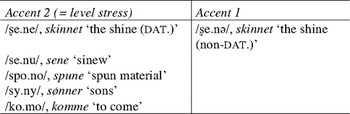
Note further that a light root syllable is only a necessary, not a sufficient condition for the level stress pattern to appear. One other condition must also be met—level stress words must be realized with tonal accent 2. Since accent 2 with very few exceptions appears in all words that were disyllabic in Old Norse, instances of disyllabic accent 1 words with light root syllables are somewhat hard to come by. The most important morphological category where accent 1 is found in polysyllabic words is the combination of a monosyllabic stem with the def. sg. suffix. Old Norse had so-called light, monosyllabic stems of a CV<C> shape, where <C> indicates that the final C is extrametrical. In most level stress dialects, however, these stems have lengthened. The only dialect with accentual contrast where they have more or less systematically survived as light, is NGbr.Footnote 9 Thus, when the def. sg. suffix is added to a stem of this type in NGbr, the extrametrical C will surface as the onset of the final syllable, giving a CV.CV structure with light root syllable and accent 1. An example is the neuter root /nes/ ‘peninsula’. The def. sg. suffix is /-ə/, giving [1nε.sə] ‘the peninsula’.Footnote 10 The dative def. sg. suffix, which triggers accent 2, is /-e/, giving [2nε.se] ‘the peninsula (dat.)’ and a near minimal pair. Speakers of the dialect confirm that only the latter manifests level stress, while the accent 1 form has initial stress.
Such short monosyllabic roots have also been preserved in the Swedish dialects in Finland (Hesselman Reference Hesselman1948:245). But most Finland-Swedish dialects, along with the dialects spoken on the Finnish border in northern Sweden and the Swedish dialects formerly spoken in Estonia, lack the tonal accent contrast. Level stress has been reported for some of these dialects (Söderström Reference Söderström1972:12 f.), but in the absence of an accentual contrast it is not possible to claim that level stress in these dialects is limited to accent 2. However, in both dialects discussed in the present article, the accent 2 condition is met. In addition, the explanation offered for the level stress effect in section 9 below presupposes the accentual contrast.
In summary, the decisive conditions for level stress appear to be a light root syllable and accent 2. The explanation for the level stress effect must therefore be sought in the combination of these two properties. In addition, we must take into consideration the contextual features that are mentioned in the sources, utterance final position and emphasis, which suggests that lengthening of the final vowel may contribute to the level stress effect.Footnote 11
3. Diachronic Evidence
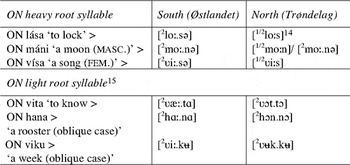
As can be seen in table 1 above, final vowels have developed differently since the Old Norse stage in level stress words and in the corresponding unstressed vowels in disyllabic words with heavy (and fully stressed) root syllables. Data from other dialects show that the level stress prosody must have had a much wider geographical distribution than it has today (see, for example, Geijer Reference Geijer1921 and Riad Reference Riad1998). Its effect in the form of split morphological classes, as shown in table 1, is in fact found in all dialects classified as East Norwegian and in a substantial number of Swedish dialects. Outside the dialects with living level stress, the post-Old Norse quantity shift, the so-called Prokosch's law (see, for example, Riad Reference Riad1992: chapters 5–6), has caused light stressed syllables to expand to heavy, but without concomitant or later elimination of the split in the unstressed vowels.Footnote 12
Table 3 shows the results of this development in two East Norwegian dialects, from regions south and north of the NGbr respectively.Footnote 13 We see that in both dialect groups, the final vowels still differ depending on the weight of the root syllable in Old Norse, despite the fact that the root syllable has later undergone the quantity shift in both groups, instantiated as vowel lengthening in the south and consonant gemination in the north.
Split morphological classes in two varieties of modern East Norwegian.

As mentioned above, a reasonable explanation of this pattern would be that (some degree of) stress on the final syllable after a light root syllable has blocked reduction, provided that absence of stress is a necessary condition for a vowel to reduce. The fact that reduction of unstressed vowels in fact was an active process in the languages, strongly suggests that those vowels that did not undergo reduction in some sense or other were not heard as completely unstressed.Footnote 16
A development supporting this assumption in an even more striking way is that of final main stress that has taken place in Tinn, further south in Norway, and in the Dalarna East Mora dialect spoken immediately southeast of Älvd, within the area marked as grey on the map in figure 1 above. The descendant of ON eta ‘to eat’ in the traditional Tinn dialect of East Telemark is [œ.1toː], while in East Mora, Old Swedish lesa ‘to read’ shows up as [lε.1soː].Footnote 17 In words with etymological heavy root syllables, stress is maintained on the root in these dialects. Here the morphological split is therefore no longer only a split with respect to the quality of the end vowel, but one of stress placement.
Map of the southern and middle part of Norway and Sweden. (Map by K. H. Sj⊘str⊘m, University of Bergen.)

Accentual contrast in North Gudbrandsdal and in Älvdalen. Black lines are accent 2.

Another peculiar property of the level stress class is that the end vowel is often round. This pattern has two sources. One is that the form of the feminine weak nouns seems to originate in the Old Norse singular oblique case forms, which had a round suffix vowel /-u/ as against the /‑a/ in the nominative form. The same seems to hold for the masculine nouns, where the oblique cases in the singular were marked by /-a/, against the /-i/ in the nominative case. The vowel /-a/, which was also the infinitive ending, in many dialects subsequently rounded to /o/ in level stress words only, either depending on the quality of the root vowel, or generally. Finally, vowel harmony developed in level stress words in some dialects, mostly governed by the end vowel. This is called metaphony in Haugen Reference Haugen1976:261f. or vowel levelling in Riad Reference Riad1992:213ff. The effects of a-rounding as well as vowel harmony are most clearly shown in the Tr⊘ndelag examples in table 3.
As already noted, an explanation of these developments lies outside the scope of the present article, since it presupposes a viable phonological analysis of level stress. However, these developments are important in that they establish level stress as an interesting problem also from a phonological point of view. On the one hand, level stress seems to defy a phonological analysis compatible with the conception of prosodic structure in modern phonological theory. On the other, it has had observable phonological consequences diachronically. A comprehensive analysis of the diachronic facts can only be undertaken if we understand the phonetics through which this prosody has been transmitted from one generation to the next since it arose several hundred years ago.
4. Stress Realization in Norwegian and Swedish
Level stress, as it is described in the sources, is clearly a perceptual phenomenon. In order to understand what causes this deviant stress perception, we need to understand how stress in general is phonetically implemented in Norwegian and Swedish. I disregard problems of stress placement in the following and presuppose that stress is invariably assigned to the root syllable in the class of words relevant to the topic of this article. In this section, I briefly describe the phonetic properties that (possibly) contribute to a given syllable being perceived as stressed. A fuller description of each of the properties—duration, intensity, vowel quality, and tonal accent—follows in sections 6 through 9.
The two most important phonetic stress realization parameters in present day Norwegian and Swedish are duration and the pitch excursions associated with tonal accent. In all dialects, except those with synchronic level stress, all stressed syllables are heavy, that is, bimoraic. This phonological requirement is implemented durationally either by vowel length in open syllables or by a consonant following a short vowel (Bruce Reference Bruce1998:24ff.; Kristoffersen Reference Kristoffersen2000:chapter 5). By contrast, unstressed syllables are normally open with a short vowel only in the rime.
As already mentioned in section 1.2, in the majority of dialects syllables carrying primary stress are also characterized by one of two contrasting tonal melodies, usually referred to as (tonal) accent 1 and accent 2 (see, for example, Bruce Reference Bruce1977; Bruce and Hermans Reference Bruce, Hermans and Hulst1999; Kristoffersen Reference Kristoffersen2000:chapter 9; Kristoffersen Reference Kristoffersen2006a). Except for a few dialects, which are not of interest within the present context, accent 2 needs an unstressed syllable following the stressed one. Hence, words with final stress, including monosyllabic words, always have accent 1, and the contrast between accent 1 and 2 is only manifested in polysyllabic words with nonfinal stress.
Two other properties are often invoked in discussions of stress realization, namely, vowel quality and intensity. As in other Germanic languages, long and short vowels are not only distinguished by duration, but also by quality in that non-low long vowels are phonetically slightly more peripheral and higher than their short counterparts. This distinction is often referred to as a difference in tenseness. Since long vowels only occur in stressed syllables, tense vowel quality is a diagnostic of stress, and may contribute to a vowel being perceived as stressed in addition to duration itself.
Finally, higher intensity is generally held to characterize stressed syllables. However, intensity has not been regarded as crucial in stress realization in Germanic languages since at least the 1950s. But both the unusual nature of level stress itself and a renewed interest in intensity as a phonetic corollary of stress during the last decade makes it necessary also to look at possible differences in intensity as potential contributors to the level stress effect.
5. The Corpus
The empirical foundation of the analysis consists of a corpus of scripted recordings with native speakers of the two dialects treated in this article. Recordings of eight male speakers born between 1926 and 1952 make up the NGbr part of the database. Two of them were recorded twice, in 1989 and 1990 respectively, so that there are ten sets of recordings of this dialect. Except for a contrast between /e/ and /ə/ in unstressed syllables, which is only found in the south, there are no dialectal differences within the region that are relevant to the topic of this paper. Three of the speakers come from the northern part of the region, which lacks this contrast.
The database from Älvd consists of recordings of three speakers, two men born in 1921 and a woman born in 1944. They were recorded in 1990. There are several subdialects in Älvdalen. One of the male speakers speaks the variety of the village of Karlsarvet while the other male speaks the Åsen variety. The female speaks the Brunnsberg variety. All these villages lie to the northwest of the main church village, with Åsen as the more peripheral.
For Älvdalen, we also have Ernst A. Meyer's investigations of three Älvdalen speakers, published in Meyer Reference Meyer1937:184ff. Here we find durational data and F0 contours for a limited set of words, level stress words included. The three speakers recorded by Meyer speak yet other dialects, all more central with respect to the church village than Karlsarvet, Brunnsberg, and Åsen.Footnote 18
The recordings of both dialects consist of a sample of target words classified by the weight of the root syllable (heavy vs. light) and tonal accent (1 vs. 2). All words were read in three different carrier phrases, all of which insured that the target words were read with a high degree of sentence stress and therefore tonal accent. In the first type of carrier phrase, the target words were final, while in the two others, they were nonfinal, preceding either a clitic or another accented lexical word. Each sentence was read once by each speaker. A directed table microphone was used in combination with a portable Sony TC-D5M cassette recorder. The speakers were shown each sentence on a separate A4-size card, in order to avoid list intonation.Footnote 19 The recordings were later digitized and split into smaller sound files, each containing one sentence, and then organized into a database.
In order to facilitate segmentation of the initial vowel, all onsets of initial syllables of the target words are voiceless. While this may have raised the F0 level at the beginning of the tonal span across the voiced VCV part of the target words (Maddieson Reference Maddieson, Hardcastle and Laver1997:627f.), this influence is consistent across all tokens and it is therefore unlikely that it has biased the systematic differences we are looking for in any serious way.
My interest in the level stress prosody goes back many years, and other commitments have made it a much lengthier project than originally planned. As the analysis approached conclusions, two serious weaknesses with the database revealed themselves, both connected with the Älvd data. One is the lack of a long reference vowel in section 8, and the other is the absence of monosyllabic tokens, which could have supplied crucial evidence for the final analysis of the Älvd tonal accent system in section 9. None of these shortcomings are devastating as far as I can see, but the conclusions would have been more solid had they not been there. Given the fact that two of the three Älvd speakers have passed away in the meantime, rerecording was not an option.Footnote 20
6. Segment Duration as Realization of Quantity Contrasts
In dialects that have undergone the quantity shift, all stressed syllables are phonologically heavy, that is, bimoraic. In disyllabic CVCV-words with initial stress, this requirement can be implemented phonetically in two different ways (Kristoffersen Reference Kristoffersen, Hulst and Ritter1999; Reference Kristoffersen2000:chapter 5); by vowel length (CVː.CV), which makes the intervocalic consonant an onset of the second syllable, or by consonant gemination (CVCi.CiV), which makes the consonant do double duty, both as a carrier of the second mora of the stressed rime and as onset of the final syllable.
This system implies that the distribution of long and short vowels is predictable from the quantity of the following consonant, and vice versa. These dialects are therefore characterized by a system of syllable quantity, which governs the distribution of long and short consonants with respect to each other in stressed syllables.
By contrast, the fact that NGbr and Älvd have preserved light root syllables means that part of the ON segment based quantity system is still intact in these dialects. Long and short vowels still contrast in stressed syllables, independently of the quantity of the following consonant. The only distributional option that has not been preserved from ON is the combination of two long segments, which would have created trimoraic stressed syllables (CVːC.CV).
Level stress words (as well as accent 1 words with light root syllable) instantiate the minimal combination of short segment types, giving a CV.CV syllable structure. We therefore expect that in these words V1 as well as C and V2 will pattern with the short segments of the words with heavy root syllable with respect to duration.
6.1. North Gudbrandsdal
In order to reduce the possible impact of inherent duration of different intervocalic consonants, only tokens with nasal consonants were used for the measurements of duration. The data set appears in table 4. The duration of the root vowel (henceforth V1), the intervocalic consonant (henceforth C), and the final vowel (henceforth V2) was measured by inspection of spectrograms as well as wave forms by means of the CSL or Praat software.Footnote 21 The end point of utterance final vowels, where vocal cord vibration often dies very slowly away, was identified as the point where modal voicing ends, as evidenced by regular striations in the middle and higher areas of the spectrum in the spectrograms.
NGbr—Words used for measurements of segment duration.

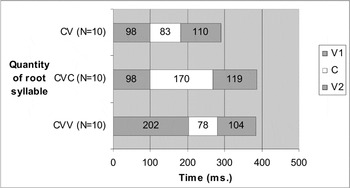
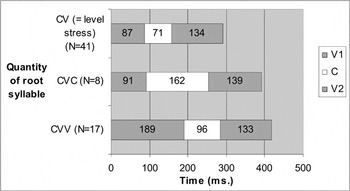
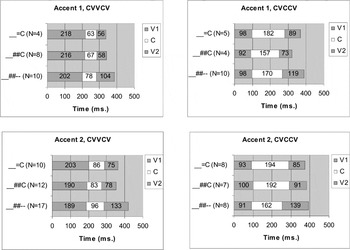
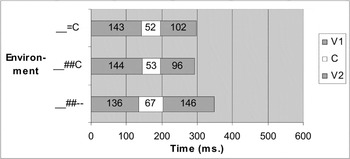
In figures 3 and 4, the results for the two accent types in utterance final position are given. We see that V1 and C in the short CV-type for both accents align with the short vowels and consonants of the two word types with heavy root syllable. We can therefore conclude that V1 in level stress words in figure 4 can be classified as short by durational criteria. Likewise, the intervocalic consonant in level stress words, in parallel with the consonant following long vowels in words with heavy root syllable, constitutes an onset only of the second syllable and not an ambisyllabic geminate as in the CVC-type.
NGbr—Segment duration in accent 1 words with light and heavy root syllables in utterance final position.

NGbr—Segment duration in accent 2 words with light and heavy root syllables in utterance final position.

Note also that V2 is considerably longer than short V1. Since figures 3 and 4 give the results in utterance final position, this may be caused by so-called final lengthening (Nooteboom Reference Nooteboom, Hardcastle and Laver1997). No systematic data exists that documents final lengthening in Norwegian, but Lindblom (Reference Lindblom, Gårding, Bruce and Bannert1978, with references) has documented this effect for Swedish, and since the prosodic systems of Norwegian and Swedish are very similar, we would expect that they are alike with respect to final lengthening as well.
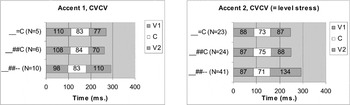
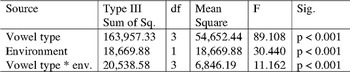
The assumption that the final length is due to final lengthening finds support in comparing the duration of V2 in utterance final position with medial position in level stress words as well as with accent 1 words with short root syllable. The difference between V1 and V2 only emerges in utterance final position in both accent types (see figure 5). In medial position there is no difference between V1 and V2, suggesting that the level stress effect, which according to the sources cited above is especially strong in utterance final position, is in fact reinforced by final lengthening.
However, based on the extra length observed, we cannot conclude that V2 is realized as phonologically long in utterance final position. When we compare it with the durations of the phonologically long vowels in figures 3 and 4, we see that there is a substantial difference between about 200 ms. for the long vowels and about 134 ms. for the utterance final V2 of the level stress words. The hypothesis that final lengthening and not inherent length of V2 in level stress words is involved is further supported when we include the corresponding results for words with heavy root syllable. These are shown in figure 6.
In view of these results, the length difference between V1 and V2 in utterance final position in level stress words cannot be attributed to a difference of phonological length. Both are short vowels, whose different durations are conditioned by environment. For all the types, we see that the duration of V2 is substantially greater in utterance final than in utterance medial position. In addition, we see that there is no difference between V2 in level stress words and in accent 2 words with heavy root syllables. Therefore, it cannot be the absolute length of level stress V2 in utterance final position that contributes to the level stress effect, rather it must be its relative length compared to V1. We shall return to this point below.
NGbr—Segment duration in level stress words in utterance final and utterance medial position.Footnote 22

NGbr—Segment duration in words with heavy root syllable in utterance final and utterance medial position.

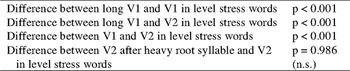
The most important differences that emerge from the results above were tested statistically by means of a two-way ANOVA. The data set consisted of two accent 2 words with intervocalic nasal and long root vowels and two corresponding level stress words, as read by eight speakers both in utterance final and utterance medial position.Footnote 23 The two independent, fixed factors were vowel type (V1 in level stress words, V1 in words with long root vowel, V2 in level stress words, and V2 in words with long root vowel) and environment (utterance final vs. utterance medial). The dependent variable was duration as measured in milliseconds.Footnote 24
As pointed out by a reviewer, ideally accent type (1 vs. 2) and CVC vs. CVV in words with heavy root syllable should also have been included in the test. Unfortunately, these categories had to be excluded due to insufficient amount of data of the relevant type, that is, accent 1 words and words with CVC-root. Neither of these is crucial, however. Since level stress is delimited to accent 2 environments, it is the differences within this category that is of importance, not differences between accent 1 and accent 2. The lack of words with CVC-root means that to the extent that V1 in level stress words emerges as different from V1 in words with long root vowel we cannot test whether it is different or not from the short vowel in words with CVC-root. However, if we assume that the syllabification of level stress words is CV.CV, the crucial question is whether V1 is categorically long or nonlong. Since a canonical stressed open syllable must contain a long vowel, absence of contrastive vowel length implies absence of the durational cue signalling stress. Comparison with CVC-roots is therefore not crucial.
The result of the ANOVA, given in table 5, reveals that both vowel type and environment are significant, and that there is also an interaction effect between the two factors. The latter is probably due to differences with respect to V2 in final vs. medial position; compare the means across all categories in figures 3–6.
NGbr—Result of two-way ANOVA with duration as dependent variable and vowel type and environment as fixed factors.

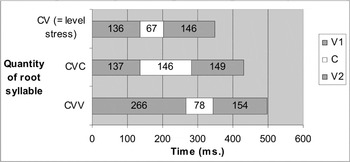
Post hoc comparisons (Tukey) of the vowel categories yielded the results in table 6. From the first two rows in table 6, we see that both vowels of level stress words differ from long vowels. In other words, V2 of level stress words cannot be classified as phonologically long by simple, durational criteria. At the same time, we also see that final vowels in level stress words are significantly longer than root vowels. However, since there is no significant durational difference between V2 in level stress words and words with heavy root syllables, as shown in the fourth row of the table, this difference is not a unique property of level stress. Given the fact that V1 and V2 appear to have the same duration in non-utterance final position, as shown in figure 5, the most plausible interpretation of the results given in table 6 is therefore that the final vowel in level stress words is phonologically short, but subject to general lengthening utterance finally. This relative lengthening compared to V1 may reinforce the level stress effect when the prosodic conditions defined in section 2 are met, but is in itself not enough for the final vowels to be perceived as phonologically long and therefore stressed.
NGbr—Results of statistical testing of durational differences in utterance final position.

6.2. Älvdalen
The data set used for measuring segment duration in Älvd is shown in table 7. Since there are no accent 1 forms with light root syllables in the subvarieties analyzed here, only accent 2 forms have been measured. Due to slightly better data coverage, the intervocalic consonant used for the duration measures is /ɡ/ instead of the nasal used for NGbr. Old Swedish long vowels have diphthongized in Älvd; hence the examples with heavy root syllable and etymological long vowels contain diphthongs. As the amount of data is much more limited, the results can only be used as supporting evidence, and only to the extent that they conform with the results established for NGbr. No statistical tests will be performed.
Älvd – Words used for measurements of segment duration.

In figures 7 and 8, we see that the relative durational differences come quite close to those found in NGbr. Despite the fact that the absolute means are higher with respect to the vowels and shorter with respect to the consonants than those found in the NGbr data, we also find a clear difference between short and long vowels and short and long consonants in Älvd. Furthermore, the vowels and consonants of level stress words also pattern with the short segments in the words with heavy root syllables.
Älvd—Segment duration in accent 2 words with light and heavy root syllables in utterance final position.

Älvd—Segment duration in level stress words in utterance final and utterance medial position.

V1 and C of the level stress words correspond to the short V1 in the heavy CVC type and the short C of the heavy CVV type respectively. The duration of V2 is nearly the same over the three quantity types in utterance final position. The difference between V1 and V2 in level stress words in utterance final position is smaller, and interestingly, V2 is shorter than V1 in utterance medial level stress words, as shown in figure 8. We can therefore conclude that with respect to duration, the relative differences between level stress words and accent 2 words with heavy V1 and initial stress are the same in NGbr and in Älvd. This signifies that in both dialects, a light root syllable generally characterizes level stress, and in both dialects, V2 is longer than V1 in utterance final position, which is one of the prototypical level stress environments. However, in neither dialect does final lengthening warrant an analysis of vowels in utterance final position as phonologically long and therefore by implication stressed.
7. Intensity
Traditionally, intensity has been regarded as the most important diagnostic for phonetic stress. This has also been the case for Norwegian, where stress in the traditional dialectological literature is often referred to as expiratory, see, for example, Storm (Reference Storm1884:37). This term refers at the outset to greater muscular effort being expended on driving the exhalation of air through the oral and nasal cavities during articulation of stressed syllables. Its auditory effect is assumed to be greater loudness or intensity.
However, research on the phonetics of stress realization since the mid twentieth century has led to the view that loudness plays a less significant role in stress realization and perception than formerly believed (Hayes Reference Hayes1995:5ff.; Gussenhoven Reference Gussenhoven2004:12ff.). This might suggest that we could leave intensity out of the investigation. However, in recent years, intensity has enjoyed a certain renaissance as a potentially relevant parameter. Sluijter & van Heuven (Reference Sluijter and Heuven1996) suggest that stressed and unstressed vowels can be distinguished by so-called spectral tilt—unstressed vowels tend to have less intensity in the higher parts of the spectrum than stressed vowels. Others, such as Beckman and Pierrehumbert (Reference Beckman and Pierrehumbert1986) & Gordon (Reference Gordon2002; Reference Gordon, Hayes, Kirchner and Steriade2004) claim that loudness combined with duration renders a more precise measure of phonetic stress than duration alone.
In light of this, and since level stress is so poorly understood, there are good reasons to include measures of intensity, provided that we can find a consistent way to measure it and at the same time be as certain as possible that the measures obtained capture the perceptually relevant properties of the intensity in the signal. An additional factor is that since level stress clearly must be the product of (noncategorical) perception in some sense, it must be the perceived relative intensity between V1 and V2 that is potentially relevant, not the raw acoustic scores per se.
Gordon (Reference Gordon, Hayes, Kirchner and Steriade2004:293) describes a method for measuring what he calls total perceptual energy, defined as “the integration of energy over time in the perceptual domain.” This measure can be obtained by using the Cricket 2.0 software, which has been specially designed for this task by Gordon and his co-workers.Footnote 25 In the introduction to the program in the help files, Cricket is described as “an acoustic analytical tool used to quantify prominence both acoustically (as the integration of intensity over time) and perceptually (as the integration of intensity over time in the auditory domain through the application of a series of filters reflecting well established auditory phenomena).” The software, in other words, measures both acoustic intensity and renders an estimate of perceived intensity. The results of the measurements of the latter are presented in the next subsections.
7.1. North Gudbrandsdal
As shown in table 8, a subset of the data set used for measuring duration was used to measure intensity differences. Only V1 and V2 of level stress words were measured, along with the only word in the database with light root syllable and accent 1. We cannot, in other words, limit ourselves to investigating intensity differences between V1 and V2 in level stress words. Since level stress only appears in accent 2, we must also be able to show that accent 1 and accent 2 are different before we can conclude that different (or identical) levels of intensity contribute to the level stress effect.
NGbr—Words used for measurements of intensity.

Of primary interest here are differences between V1 and V2 for each token. If differences in levels of intensity contribute to the level stress effect, we expect at least the same amount of intensity in V1 and V2 in level stress words. In accent 1 by contrast, we expect V1, that is, the stressed vowel, to have more intensity than V2. However, we also know that level stress is more easily perceived in utterance final than in utterance medial position. We therefore expect that the measures of V2 intensity will be higher in final than in medial position in level stress words. This means that we must control for environment in addition to tonal accent.
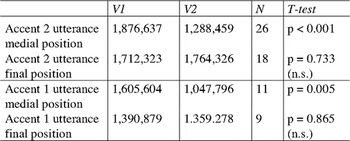
The average values for the perceptual summations are given in table 9, along with the results of a paired-samples t-test for each sub-category.Footnote 26 The results seem very clear. In utterance medial position, where we know from the analysis in section 6.1 above that the duration of V2 is equivalent to or less than that of V1, both accents show significant differences in perceived intensity. This means that perceived intensity may contribute to the initial syllable being heard as stressed independently of duration ratio. This supports the view that intensity is a relevant factor in stress perception, independent of duration.
NGbr—Average perceptual summations across vowel, accent type, and environment in CVCV-words.

In utterance final position, which is where level stress is most likely to appear, we see that no significant differences emerge. The two vowels, in other words, are on the average equal with respect to intensity, despite the fact that V2 has significantly higher duration. This suggests that the increased duration of V2 is counterbalanced by higher perceptual intensity on the root vowel.
What emerges in utterance final position, in other words, is a kind of level stress cum intensity, in that both vowels are perceived as equally loud. However, note that this holds for accent 1 as well as for accent 2. The pattern therefore cannot explain the level stress pattern, which is limited to accent 2. This means that whatever function intensity has as an independent stress realization parameter in the NGbr dialect, it cannot account directly for the level stress pattern.
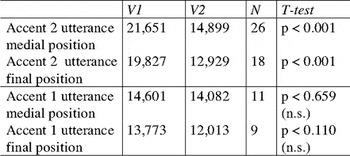
The irrelevance of intensity with respect to the perception of level stress becomes perhaps even clearer if we divide the perceptual summation by the duration of each individual vowel in the data set in order to eliminate the influence of duration. The result is mean intensity per millisecond. The results are as shown in table 10. Here we see that there is a marked difference between the accent types. While V1 has a much higher average intensity than V2 in the accent 2 group, there is no difference between the vowels in accent 1 words. While the reasons for this relationship lies outside the scope of the present article, it clearly supports the conclusion that intensity does not contribute significantly to our understanding of level stress as a feature of words with accent 2 as opposed to words with corresponding prosodic structure with accent 1.
NGbr—Average perceived intensity per millisecond across vowel, accent type, and environment in CVCV-words.

7.2. Älvdalen
For Älvd, we have less data, not only with respect to speakers, but also because words with accent 1 and short root vowels are not present in the database (see discussion in section 2 above). The fact that root vowels in this word type have lengthened in the varieties spoken by the three speakers therefore makes comparison across the two accents impossible. The only thing we can do is to check whether the patterns found for accent 2 in NGbr are the same in Älvd.
The data set used for comparison of intensity were the level stress words /dro.ɡo/, dra ‘to pull’; /sko.ko/, skaka ‘to shake’; /fo.ro/, fara ‘to go’; and /to.ɡo/, taga ‘to take’. As seen in table 11, the results from NGbr with respect to differences between mean perceptual summations are corroborated. For Älvd as well we find that perceived intensity is equal between V1 and V2 in final position, while there is a highly significant difference between the two vowels in medial position, in favor of the root syllable.
Älvd—Average perceptual summations across vowel and environment.

Finally, let us also for Älvd calculate the average perceived intensity per millisecond. The results reproduced in table 12 show that also for this dialect the scores are higher for V1 than for V2. The differences are smaller than those we found for NGbr above, however, and only significant at the p < 0.05 level with respect to utterance medial position.
Älvd—Average perceived intensity per millisecond across vowel, accent type, and environment in CVCV-words.

We can therefore conclude that perceived intensity may be at most a factor contributing to the level stress effect in utterance final position when the other prosodic conditions on level stress are met. However, the fact that there is no difference between accent 1 and 2 in NGbr shows that it cannot be the perceptual property responsible for the level stress effect, at least not in NGbr. For Älvd, we have no direct way to test this, but at least for the level stress words the results support the conclusions reached for NGbr.
8. Vowel Quality as a Diagnostic of Phonological Length
As mentioned above, nonlow short and long vowels in Norwegian and Swedish differ not only in duration, but also in quality. This distinction is often referred to as tenseness vs. laxness, and it manifests itself in short vowels being articulated as somewhat lower and more centralized than the corresponding long vowels. Acoustically the difference in height manifests itself as higher F1 for lax vowels than for the corresponding tense vowels. The difference in backness manifests itself as lower F2 for front vowels and higher F2 for back vowels than for the corresponding tense vowels (Ladefoged and Maddieson Reference Ladefoged1996:302 ff.).
Since long vowels only occur in stressed syllables in Norwegian and Swedish, and tenseness is correlated with phonological length, it is conceivable that tenseness in addition to duration may contribute to long vowels being perceived as stressed. If this is the case, it is at least conceivable that a possible property of V2 that could trigger the level stress effect might be tense vowel quality instead of lax in the final vowel, despite the fact that the vowel appears as durationally short. In this section, then, I therefore compare the first and second formants (F1 and F2) of V1 and V2 in level stress words and for NGbr also compare them to the formant values of a corresponding true long vowel.
What makes such a comparison possible is another development that is characteristic of level stress words, namely, the vowel harmony pattern mentioned in section 3 above. Taking the ON infinitive fara ‘to travel’ as an example, the present day forms in both NGbr and Älvd are [2fɔ.rɔ], phonemically /2foro/. An inspection of the level stress words listed in tables 4 and 7 reveals that in all of them except one, V2 is rounded, and in most of them V1 and V2 have developed into identical vowels, due to harmony.Footnote 27 The fact that V1 and V2 have assimilated makes a direct comparison of their quality possible, both with respect to each other and in the case of NGbr with respect to a long reference vowel. If the quality of V2 then proves to be different from that of V1 and in addition lies closer to the quality of the long vowel, this could be counted as (part of) an explanation of the level stress effect.Footnote 28 In other words, a vowel that by durational criteria is short but in the upper part of the durational range of short vowels and whose quality in addition can be identified with long vowels may cause the listener to perceive it as indeterminate with respect to stress.
8.1. North Gudbrandsdal
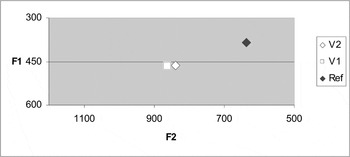
F1 and F2 were measured by means of LPC analysis of 20 ms. around the vowel midpoint.Footnote 29 V1 and V2 of all level stress words in the database with /o/ as V1 and V2 were measured, except those with C = nasal, since possible vowel nasalization may distort spectral analysis (Ladefoged Reference Ladefoged2003:121f.). Tokens from utterance medial as well as utterance final position were included. The words used were /po.so/ [2pɔ.sɔ], pose ‘(paper) bag’; /so.go/ [2sɔ.ɡɔ], sage ‘to saw’, and /sto.ko/ [2stɔ.kɔ], stake ‘stick’. The long stressed vowel in [bə.1ɡoː], begå ‘to commit (for example, suicide)’ was used as reference vowel. Figure 9, which has been formatted to imitate a vowel chart, represents the average over all tokens and speakers. We see that there is virtually no difference between the V1 and V2 means, and that they both show the expected difference with respect to the long vowel along the lax – tense dimension. F1 is higher in the level stress vowels than in the reference vowel, and since we are dealing with back vowels, F2 is as expected higher than F2 of the reference vowel.
NGbr—Average formant values of V1 and V2 in level stress words with [ɔ-ɔ] compared with a long reference vowel.

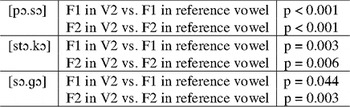
A one-way ANOVA was conducted with word type as independent variable and F1 and F2 in V2 in all four words as the dependent variables. For all the four words, F1 and F2 in both vowels rendered significant differences at the p < 0.05 level. However, since V2 of level stress words is the critical vowel from our perspective, only the results with respect to the difference between this vowel and the reference vowel is included in the table below. For F1, p < 0.001 (F = 8.261; df = 3) and for F2, p < 0.001 (F = 8.703; df = 3).
Post hoc comparisons established that the V2 measures of the three level stress words were all significantly different from the reference vowel with respect to F1 as well as F2, as shown in table 13. We see that all differences are significant at the p < 0.05 level.
NGbr—Results of statistical testing of F1 and F2 differences between V2 of level stress words and V2 of a long reference vowel.

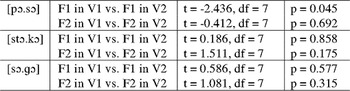
We should also test for differences between V1 and V2 in the level stress words, even if the raw means as displayed in figure 9 suggests that there are no significant differences between the two vowels with respect to formant structure. The data set was split by word by means of the split file function before a paired-samples t-test was run with F1V1/F1V2 and F2V1/F2V2 as the paired factors. The results are given in table 14. We see that there is in fact one significant difference at the 0.05 level, namely, the difference in F1 in the two vowels of /poso/. Here the average of V1 was 440.3 Hz, vs. 487.3 for V2, and p is just below the significance level. Note, however, that V2 has the higher value, and therefore is the more lax of the two. This goes against our hypothesis, which was that the final and presumably stressed vowel of a level stress word might have a tenser, and thereby more “stressed” quality than the root vowel. For all the others, there is no difference between the vowels.
NGbr—Results of statistical testing of F1 and F2 differences between V1 and V2 in level stress words.

8.2. Älvdalen
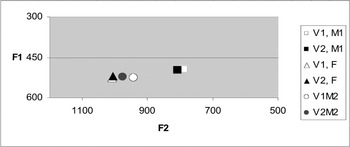
In the Älvd corpus there are four words with vowel levelling in /o-o/: /dro.go/, dra ‘to pull’, /fo.ro/, fara ‘to go’, /sko.ko/, skaka ‘to shake’, and /to.go/, taga ‘to take’.Footnote 30 As there are three instances of each word in the database, there are 12 tokens per speaker.Footnote 31 Unfortunately, the database lacks words that can provide a long reference vowel. This is due to lack of foresight when the reading material was prepared prior to the fieldwork. So in this case we must limit ourselves to compare the qualities of V1 and V2. The results are given for each of the three speakers separately (M stands for “male” and F for “female”). The plots in figure 10 represent the averages over all 12 tokens for each speaker. We see that the results are very similar to those found for NGbr, as there is virtually no difference between V1 and V2 for neither of the speakers.
The analyses in this section have shown that V1 and V2 in level stress words with harmony in /o-o/ do not differ with respect to vowel quality in either of the two dialects. Furthermore, V2 in NGbr differs significantly in quality from a corresponding long vowel. Both V1 and V2 are in other words lax and can therefore be identified with short vowels with respect to quality. This means that the quality of V2 cannot be (part of) the reason why it is perceived as more stressed than V2 in words with heavy and fully stressed root syllable.
Älvd—Average formant values of V1 and V2 in level stress words with [ɔ-ɔ].

9. Tonal Accent
After having reviewed syllable weight as manifested through duration and intensity as well as vowel quality as possible phonetic cues to level stress, we can conclude that neither of these satisfactorily account for the level stress effect alone. This should come as no surprise, given the fact that level stress as already noted at several points only emerges in connection with accent 2. In other words, there must be some property connected with the realization of accent 2, combined with the fact that the two syllables have equal quantity, which triggers the level stress effect. The main goal of this section is therefore to identify these properties. The ultimate goal is to show how the tonal melody of accent 2, but not accent 1, when combined with a light, stressed syllable, can give rise to the following syllable being perceived as stressed without the initial root syllable at the same time being heard as unstressed.
Both Älvd and NGbr belong to the dialect group where accent 2 is realized by two tonal peaks separated by a trough (Gårding Reference Gårding1977). The first peak in both dialects is linked to the stressed syllable, while the two dialects differ with respect to the association of the second peak. In Älvd, the final peak is part of the accentual melody proper and is normally followed by a low boundary tone. Älvd thereby belongs to the same group as Stockholm Swedish with respect to accent 2 (Bruce Reference Bruce1977; Engstrand Reference Engstrand1995; Reference Engstrand1997). In NGbr, by contrast, the second peak is best interpreted as the manifestation of a right edge boundary tone. This classifies NGbr as an East Norwegian type as described and analyzed in Kristoffersen (Reference Kristoffersen2000; Reference Kristoffersen2006a; Reference Kristoffersen, Bruce and Horne2006b; Reference Kristoffersen, Riad and Gussenhoven2007a,Reference Kristoffersenb).
Also with respect to accent 1, NGbr represents the common East Norwegian type with a low tone on the stressed syllable followed by the same boundary H as in accent 2. Älvd signals accent 1 by a rise towards a high tone late in the stressed syllable in monosyllabic and disyllabic domains, followed by a low tone, presumably the same boundary tone as found finally in accent 2. In longer domains, such as trisyllabic words, the peak is delayed until early in the second syllable, with the low tone still on the final syllable.Footnote 32
9.1. North Gudbrandsdal
The data set used for analyzing tonal accent was the same as the set used for measuring duration. It is repeated in table 15. Without making any crucial assumptions with respect to a phonological analysis, we can abbreviate the accentual melodies of NGbr as H(igh)-L(ow)-H(igh) for accent 2 and L(ow)-H(igh) for accent 1. For both accents, the initial tone is linked to the stressed syllable. The L of accent 2 is realized on the poststress syllable, while the final H (henceforth H%) in both accents is realized on the final syllable of the accentual domain. Looking beyond the stressed syllable, however, the complete accent 1 melody in NGbr should also be analyzed as an H-L-H melody, with the initial H associated with a syllable immediately preceding the stressed one in cases where such a syllable is available (Kristoffersen Reference Kristoffersen2006b; Reference Kristoffersen, Riad and Gussenhoven2007a). The result of this can be seen in the following examples as an initial fall in accent 1 words.
NGbr—Words used for analysis of tonal accent.

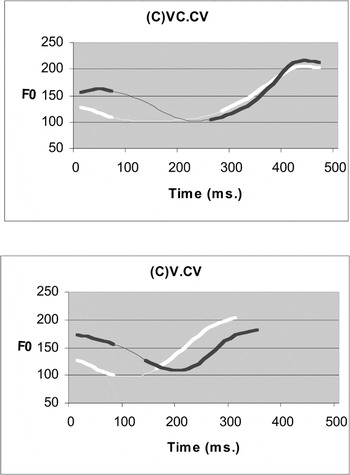
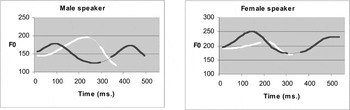
Figure 11 shows a representative pair of contrasts, depicting the accentual melodies across words with heavy root syllable (CVC.CV, left panel) and light root syllable (CV.CV, right panel).Footnote 33 Recall that thick lines represent vowels and thin lines consonants, so that segment boundaries are found where lines change in thickness. In the CVC.CV type the syllable boundary will fall somewhere near the midpoint of the line, while in the CV.CV type the syllable boundary will coincide with the beginning of the trajectory.
NGbr—Accentual melodies across words with heavy and light stressed syllable in utterance final position. Black contour = accent 2, thick line = vowel.

We see that the contrast is realized in the same way irrespective of the weight of the root syllable. We also see that in the level stress word, that is, the black contour in the bottom panel, a greater portion of the contour is realized in the final vowel. In Kristoffersen Reference Kristoffersen2006a, the tonal accent contrast in polysyllabic words in East Norwegian is analyzed phonologically as a contrast between an inert, lexically linked low tone (accent 1) and a free L in other environments, which in polysyllabic words is relegated to the poststress syllable due to the insertion of an H on the stressed syllable driven by markedness considerations. The contrast is thereby conceptualized as a difference in timing of the low tone. In accent 1 it is synchronized with the stressed syllable, while in accent 2 it is postponed to the poststress syllable due to insertion of a high tone on the stressed syllable.
Applying this perspective to the data in figure 11, we see that the relative delay of the F0 minimum is greater in the level stress word than in the word with heavy stressed syllable. In the latter, the trough coincides with the onset of the second syllable, while in the level stress word it is fully contained within the vowel of the same syllable.
At the outset, this can be viewed as an indirect effect of compression due to the fact that the three tonal targets H-L-H must be realized within a more confined temporal span in level stress words. This effect of what is often called tonal crowding can be alleviated in at least two ways. One is to lower mean F0 values for the high tones and heighten the F0 values for the low tone.
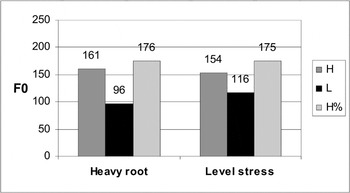
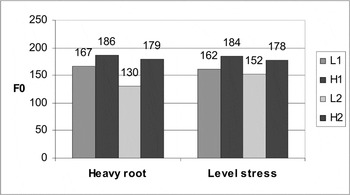
Figure 12 below shows that there is a consistent undershoot with respect to the low tone in level stress words compared to accent 2 words with heavy root syllable, amounting to a 16 Hz. difference between the two groups. At the same time, there is a smaller difference with respect to the initial H, so that the average fall is reduced from 65 Hz. in words with heavy stressed syllable to 38 Hz. in level stress words. However, even if this makes it easier to accommodate the three tones within the shorter CVCV span, the delay of the L with respect to the syllable structure in level stress words remains a striking difference between the two types as shown in the two panels of figure 11. Since there is no obvious reason to believe that the reduced HL fall may influence the perception of stress and stress placement, I now focus on the timing of the L.
NGbr—Average F0 value of each tone in accent 2 in utterance final position.

The observant reader will already have noticed that the tonal contour through the final vowel in level stress words is identical to a full accent 1 contour. In other words, it is possible that the final syllable of level stress words can be perceived as an independent accentual domain, and thereby as an independent stress domain. At the same time, the full disyllabic domain constitutes a wellformed accent 2 domain with initial stress.
Note that also with respect to words with heavy root syllable the final syllable in accent 2 words manifests the LH rise characteristic of accent 1. However, in this case, the fact that the initial syllable is heavy will cause it to be heard as the unequivocally stressed syllable within the disyllabic domain. In the absence of this difference in quantity, however, and with the full LH contour, including the initial fall, being played out within the bounds of the final vowel, the tonal signals may be heard as ambiguous in the sense that it is possible to assign two different analyses to the same structure. One is an accent 2 contour across the two syllables, and therefore stress on the initial root syllable. The other is a prestress H on the first syllable, followed by a final, stressed syllable with accent 1, reinforced by the fact that the complete part of the curve representing the underlying L is contained within the final vowel, fully parallel to what we find in clear cases of monosyllabic accent 1, where the LH-contour also must be contained within one syllable. The cause of the level stress effect on this view is an ambiguous tonal signal combined with the absence of syllable weight as the deciding factor for stress placement. On this account, level stress is not a matter of stress sharing between the two syllables, but one of an inherent perceptual ambiguity between two incompatible interpretations that both the language acquiring child and the speaker of non-level stress dialects are confronted with.Footnote 34 Both syllables lack the property that would have unambiguously identified them as stressed, namely, bimoraicity, while both have tonal properties that associate them with stress.Footnote 35
Lengthening of the final vowel may in such a situation reinforce the propensity to assign an independent accent 1 contour and thereby stress to the final syllable. In fact, several dialectologists, such as Storm (Reference Storm1884:62f.), Horne (Reference Horne1917:9), and Ekre (Reference Ekre1960:9) have noted that lengthening of the final vowel increases the perception of stress on the final syllable.Footnote 36 But the ambiguity will remain only as long as the final vowel is realized as a lengthened short vowel. The moment lengthening brings it into the lower bounds of a long vowel the hypothesis predicts that the word will be interpreted with unambiguous final stress. This is exactly what has happened in the two dialects known to have developed final stress, Tinn in Norway (Skulerud Reference Skulerud1922:133 f.) and East Mora in Sweden (Levander Reference Levander1925:55 f.).Footnote 37
A weakness of this hypothesis so far is that it has been developed from inspection of one single realization of each category, as represented in figure 11. Although I have claimed that these are representative in a way that is relevant to the topic of this paper, this remains to be shown. In order to establish the hypothesis on a more solid footing, we need to test it against a broader and representative set of data to see whether it is corroborated. In other words, we now need to test whether there is a significant difference between accent 2 words with heavy and light root syllable with respect to L-timing. To the extent that we can show that L to a greater degree is contained within the final vowel in level stress words than in words with heavy root syllable, we have established evidence in favor of the hypothesis that the final syllable will be more prone to interpretation as an independent accent 1 domain rather than as the unstressed syllable of a disyllabic accent 2 domain with initial stress. At the same time, it is important to point out that since level stress is a perceptually based concept, it is in principle impossible to measure it directly in the acoustic signal. What we can do is to establish parameters and relationships, which may be used as building blocks for hypotheses that ultimately can be subjected to perception tests.
To state, as I just did, that a tone to a greater or lesser degree is contained within a vowel will perhaps strike some as a somewhat unorthodox way of describing the relationship between a tone and its tone bearing unit, even if we are dealing with phonetic realization and not phonological structure. The basic question, however, is how we can measure the temporal relationship between a tone and the tone bearing unit in the prosodic structure with which the tone is associated. While vowels (and syllables) have extension in time, tonal peaks or troughs are usually seen as basically points in time, which can be related to some point, such as the mid point; or phase, such as the latter half, within the time span of the vowels with which they are synchronized.
This perspective presupposes that it is possible to identify the turning point where, for example, a falling HL turns into a rising LH and relate this to some point relative to the vowel, defined for instance by distance in milliseconds from the vowel onset. However, exact identification of such turning points in F0 scores in recordings not made under optimal conditions may often be problematic. Microprosodic variation due to different kinds of noise in the signal may introduce distortions. In addition, we often find a series of measuring points with almost the same value, also in shorter words such as level stress words, which makes the identification of an exact turning point in time to a certain extent arbitrary.
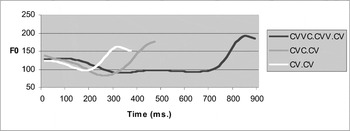
Seen from another perspective, it is well known that tones may spread and associate to a string of consecutive tone bearing units, forming so-called plateaus. Consequently, tones can have extension in time, which in principle can be measured. In East Norwegian, the L-tone of the two accentual melodies is in fact what we may term an emergent plateau tone. In longer domains, such as compounds, the initial H in accent 2 will associate with the stressed syllable of the initial member of the word, and the final H% will associate with the final syllable. The L will associate with all the intervening syllables (Kristoffersen Reference Kristoffersen2000: 247ff.). (In accent 1 the initial L will associate to the stressed syllable and to all subsequent nonfinal syllables in the same way.) As shown in figure 13, which depicts the tonal contours of three accent 2 words of different length as spoken by the same speaker, this is also the case in NGbr.Footnote 38 It is therefore in principle possible to define the L also of a minimal, disyllabic CVCV domain as a minimal plateau. To the extent that it is possible to measure this plateau as an extension in time, this measure can then be related in a precise and nonarbitrary way to the segmental and (indirectly) syllabic sequencing within a given word.
NGbr—Accent 2 words of different length showing corresponding degrees of L-spreading.

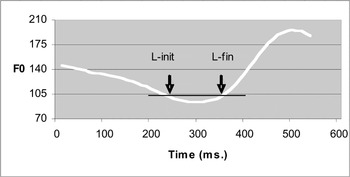
At the outset, measuring the L as an extension in time is fraught with the same difficulties as those connected with measuring the L as an exact point in time. But once we realize that what we need is a consistent relative measure rather than an exact measure, it is possible to overcome these difficulties, at least to an extent where we may be able to learn something substantial about the synchronization of tones and syllables in level stress words compared to other prosodic types. The following method of measurement was therefore adopted. In the smoothed F0 contours of both accent 1 and accent 2 words, the value of the lowest measuring point was identified, and 8% was then added, such that if the lowest value of the F0 contour was for example 100 Hz. the result of adding 8% would be 108 Hz.Footnote 39 If we refer to this lowest Hz.-value plus 8% as the L-ceiling, the L-phase can be defined as the span between the two points where the contour crosses the L-ceiling value, on its way down and on its way up. These points I refer to as L-init and L-fin. The result of this procedure is depicted in figure 14, which shows the contour of an accent 2 word with long vowel.Footnote 40 The horizontal line represents the L-ceiling, and the two crossing points L-init and L-fin.
NGbr—Measurement of the L-phase of an accent 2 contour.

The L-phase can now be related to the segmental string by means of a percentage scale where the V1 onset is 0% and the V2 onset 100%. For any given token, both L-init and L-fin can then be related to the vowel by means of these anchoring points. For any L-init or L-fin, a measure below 100% means that it is located before the V2 onset, while measures above 100% means that it is located within V2. Note again that this procedure does not imply precise claims about any “real” extension of the L-tones. It has been developed in order to make possible a comparison between the relevant subgroups of the relative timing of the accentual contours with respect to the segmental string with which they are associated. At the same time, I think it safe to say that the distance between L-init and L-fin represents approximations of the realization of the underlying L-tone in real time.
Let us now start the analysis by returning to the question of how the three tones of the accent 2 melody can be accommodated within the shorter time span of a level stress word. We can state two hypotheses with respect to the absolute duration of the L-phase. The first is that the L-phase will be shorter in accent 2 words than in accent 1 words, given the fact that there is an initial H in accent 2 that is absent (from the stressed syllable) in accent 1. The second is that the L-phase will be shorter in words with short root syllable than in long, since the total time span available is shorter in the former.
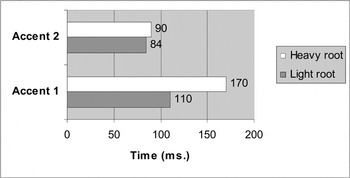
Figure 15 shows that the first hypothesis finds support in the data; the L-phase is longer in accent 1 than in accent 2, although the difference is smaller with respect to the words with short root vowel. This can be attributed to the fact that the second hypothesis—that the L-phase will be shorter in words with short root vowel—is corroborated only with respect to accent 1. While there is a clear difference between the two types in accent 1, the extension of the L-phase in accent 2 is close to constant irrespective of type of root vowel and thereby with respect to quantity type of the root syllable. This suggests that the L-phase is subject to a durational minimum, which in level stress word is secured by undershooting the F0 value of the low tone, as shown in figure 12 above.
NGbr—Mean absolute duration of L-phase in different word types.

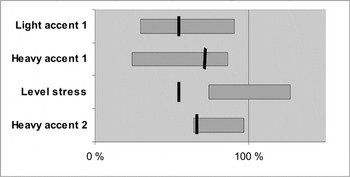
Let us now turn to the timing between segments and the L-phase. Given the constant duration of the L-phase in accent 2 words, we expect that at least the L-fin point will come later with respect to the onset of the final vowel in the level stress type than in words with heavy root syllable. As argued above, this may contribute to the final vowel being heard as accented. As shown in figure 16, this is indeed the case. The horizontal bars depict the distance between the average L-init and L-fin with respect to the four types. The graph shows their relative timing with respect to the starting points of V1 (0 %) and V2 (100 %). The vertical bars represent the syllable boundary, that is, the onset of C in the (C)V.CV and the (C)Vː.CV words.Footnote 41
NGbr—Relative timing of L-phase in utterance final position with respect to vowel onsets (0 and 100 %) and syllable onset (vertical bars).

We see that the level stress type distinguishes itself on two points. First, it is the only one where the complete L-phase is realized within the second syllable, even if the heavy accent 2 type also comes close to this. However, contrary to the type with heavy root syllable, the L-init in level stress words is found well after the onset of the second syllable, so that there is room as well for part of the fall from the initial H within the second syllable. Such a fall can be seen in the level stress contour shown in figure 11, bottom panel. In addition, and perhaps most importantly, the level stress type is the only one where the complete L-phase is contained within the second syllable and where the final, upwards turning point is found within the syllable peak.
We have now established that NGbr accent 2 words with heavy root and level stress words can be distinguished on two points. First, the F0 value of L in the H-L-H melody is truncated in level stress words, and second, the L-phase of level stress words occurs later with respect to the syllable structure than in words with heavy root syllable. The latter can be seen as a consequence of the finding that speakers seem to respect a minimal duration requirement with respect to the L-phase.Footnote 42
These results hold up when tested for statistical significance. The test was made by means of a one-way ANOVA on a balanced sample consisting of 24 accent 2 words with heavy root syllable and 24 level stress words.Footnote 43 Heavy vs. light root syllable represented the dependent variable, while the three independent variables were lowest F0 measure in Hz., absolute duration in milliseconds of the L-phase, and relative timing with respect to V1 onset of L-init and L-fin. As shown in table 16, the test fully supports the results depicted in figure 16. The differences with respect to truncation and timing are all significant at the p < 0.05 level, while no significant difference with respect to absolute duration was found.
NGbr—Results of ANOVA testing differences between accent 2 words with heavy and light root syllable with respect to tonal timing and truncation.

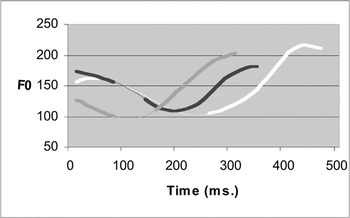
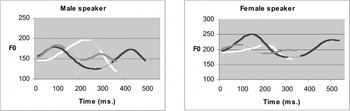
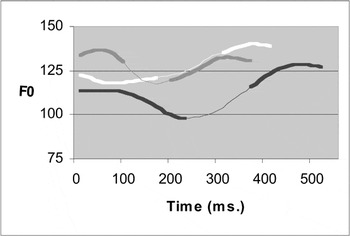
These results support the hypothesis stated above that the level stress effect is a result of the low tone coinciding with the final syllable in a way that invites the listener to interpret it as an accent 1 domain in its own right. The statistically significant differences represented in figure 16, in other words, support the hypothesis that the resemblance between the accent 1 contour and the final part of the accent 2 level stress contour is not coincidental, but indicative of a significant relationship between the final vowel of level stress words and accent 1, on the one hand, and the whole disyllabic level stress complex and accent 2, on the other. Examples of three contour types, heavy accent 2, level stress and light, disyllabic accent 1, are given in figure 17 as illustration of this point. The resemblance between heavy accent 2 and level stress is easy to see, as is the resemblance between the final, vocalic part of the level stress contour and the complete accent 1 contour.
NGbr—Comparison of level stress (black), heavy accent 2 (white) and light, disyllabic accent 1 (grey).

However, even if the second syllable of level stress words meets the tonal requirements of a prototypical accent 1 phrase, the final vowel is not long enough to be perceived as fully stressed in comparison to the initial vowel. Since the two syllables making up a level stress word at the same time meet the tonal requirements of a prototypical accent 2 phrase, without the second vowel being long and therefore unequivocally stressed, the listener is left with an ambiguous signal as to which of the two syllables is the accented and strong one with respect to the other.
Figure 18 illustrates this point by comparing a level stress word with a disyllabic word with final stress, phonological long vowel and accent 1 in utterance final position.Footnote 44 We see that the only difference between the two contours in addition to the expected L-truncation in the level stress word is in the duration of the final vowels. The final vowel in the level stress word is phonologically short (154 ms.), while the final vowel in the word with final stress is phonologically long (264 ms.).
NGbr—Comparison of a level stress word (black line) with a word with full stress on the final syllable (white line).

At this point it could be tempting to conclude that the absence of a bimoraic syllable in level stress words (in combination with the accent 2 melody) is the deciding factor. However, this cannot be the complete truth because NGbr as mentioned in section 2 allows monomoraic CVC and marginally CV stress feet in monosyllabic domains. If such feet are wellformed as monosyllabic words, they should also be wellformed as a full stress foot in final position in longer words. This would imply full stress on the final syllable, not level stress.
The most common is the CVC-type, consisting of a contrastively short vowel plus a contrastively short consonant. This type has survived from Old Norse and constitutes a separate stressable minimal syllable type in addition to CVː and CVCː.Footnote 45 An example of this three-way contrast is CVC /las/, las ‘read (pret.)’ vs. CVː /laː/, la ‘laid (pret.)’ vs. CVCː /lasː/, lass ‘a load’. The two CVC types are distinguished both with respect to duration of the final consonant, as documented in Kristoffersen Reference Kristoffersen1990, as well as in their phonological behavior when a vowel initial suffix is added to a stem belonging to one of these two types.Footnote 46 The final C in CVC stems in such cases resyllabifies, rendering a CV.CV structure with light root syllable, and level stress if the suffix induces accent 2. By contrast, the final C in CVCː stems geminates, rendering a CVC.CV structure with heavy root syllable. Translated into a weight difference, this means that a CVC syllable is monomoraic, while a CVCː syllable is bimoraic. An alternative way of representing this difference would therefore be CV<C> vs. CVC, with the final C in the former being marked as extrametrical.
The fact that a monomoraic CV<C> syllable may constitute a wellformed monosyllabic word would by implication lead us to expect accent 2 words with the structure CV.CV<C> to have final stress instead of level stress. Examples of such words are /so.mor/, sommer ‘summer’ and /go.mol/, gammel ‘old’. However, no source that I have consulted describes words of this type as anything but normal level stress instantiations on par with CV.CV strings. This means that only full bimoraicity in one of the syllables is able to cancel the level stress effect, and that the CV<C> type, despite the fact that it can constitute a common monosyllabic content word on its own, is subminimal in this respect.
One way to solve this apparent mismatch between minimal word requirement and minimal stress foot requirement might be to assume that the requirement of a bimoraic syllable for full stress resolution on the second syllable is an effect of what has been termed “the emergence of the unmarked” within Optimality Theory (see, for example, McCarthy Reference McCarthy2002:129 ff.). Even if a CV<C> syllable may constitute a monosyllabic word on its own, it is all the same revealed as subminimal when it comes to resolving the competition for head status between the two syllables in a level stress word. For this purpose, only the unmarked, bimoraic heavy syllable will do.Footnote 47
9.2. Älvdalen
We now look at to what extent our analysis of the NGbr data can be extended to the Älvdalen variety of level stress. I start the discussion by presenting examples of the Älvd contrast. For reasons already mentioned, and which are made clearer below, I discuss the Karlsarvet/ Brunnsberg and Åsen data separately.
Figure 19 shows sets of representative, contrasting pairs of accentual melodies across words with heavy root syllables, as pronounced in utterance final position by the Karlsarvet/Brunnsberg speakers.Footnote 48 We see that accent 2 also here is the more complex melody, consisting of a rise to an HL fall through the stressed syllable, followed by a rise to another peak in the second syllable. For the present purposes, it therefore looks like the full contour can be described as L-H-L-H, with an H associated with each syllable. In addition we must at least for the male speaker include a final L% boundary tone, so that the full melody is L-H-L-H-(L%). The main difference compared with the NGbr melody is the presence of the flanking L-tones, which are lacking in NGbr. While the NGbr accent 1 is characterized by a rise towards a late H, which corresponds to the final H in the accent 2 melody, we find an H peaking late in the stressed syllable in Älvd, or even early in the final syllable.
Älvd: Karlsarvet/Brunnsberg—Accentual melodies across (C)VːCV words. White contour = accent 1, black contour = accent 2; thick line = vowel.

In figure 20, level stress contours have been added to the contrasting pairs in figure 19.Footnote 49 As in NGbr, we see that the level stress contour is an accent 2 contour, compressed due to the shorter duration of the stressed syllable. We also see that this leads to differences with respect to the alignment between the high tones and the syllables. While the first accent 2 peak comes relatively early in the heavy stressed syllable (black line), it comes late in the root syllable of the level stress word (grey line). With respect to the final syllable of heavy accent 2 as well as level stress, the male speaker shows a centrally located peak. In the speech of the female speaker, the second H tends to come later, and the final fall is not present to the same degree.
Älvd: Karlsarvet/Brunnsberg—Level stress compared with accent 1 and heavy accent 2. Grey contour = level stress, black contour = heavy accent 2 and white contour = accent 1; thick line = vowel.

We saw above that the central property of level stress in NGbr is that the tonal contour of the final syllable of a level stress word may be perceived as an independent accent 1 domain. In order to check whether Karlsarvet/Brunnsberg is like NGbr in this respect, we would need to compare the contours of the final syllable of level stress words to the contour of a prototypical monosyllabic accent 1 word. As mentioned in section 5, the corpus unfortunately does not contain any words of this type. We therefore have to look outside the database for data that can be used for comparison. Meyer (Reference Meyer1937:184 ff.) presents F0 contours for three male Älvdalen speakers, all born in the 1890s and recorded in 1919. For the polysyllabic types, Meyer's data fully agree with the Karlsarvet/ Brunnsberg contours shown in figure 20, so we can be fairly confident that the dialects recorded by Meyer are consistent with those I recorded in Karlsarvet in 1990. When it comes to monosyllabic accent 1 in Meyer, all examples show a centrally located peak.
Given the fact that one of the Karlsarvet/Brunnsberg speakers shows late alignment of the peak in the final syllable, there is no full correspondence between monosyllabic accent 1 and the final syllable of accent 2, as is the case in NGbr. This suggests that the tonal property of the final syllable is less important for the level stress effect than it is in NGbr.
At the same time, note that the tonal contour of monosyllabic words as given by Meyer (Reference Meyer1937) is quite close to the first syllable of accent 2 words. In both, the peak is centrally located. This means that what constitutes an accent 2 word is not the tonal contour of the stressed syllable in isolation, which suggests monosyllabic accent 1, but its continuation into another peak on the following syllable, instead of an intonational closure by an L%, which is what we get in mono- as well as disyllabic accent 1 words.
In disyllabic accent 1 words on the other hand, the (only) H coincides with the final part of the stressed syllable, as shown in figure 20. This means that in Karlsarvet/Brunnsberg, a late peak in the initial syllable of an accent 1 word signals a disyllabic accent 1. A late peak in the stressed syllable will in other words lead to an expectation of a final L% on the next syllable.
In level stress words, the initial peak is also realized late in the initial syllable. There is, in other words, a parallel in timing between level stress and accent 1 that may cause the listener to expect the final fall of accent 1 on the following syllable also in level stress words. Instead, F0 rises to another peak, in conformance with the accent 2 contour. My interpretation of this as the possible trigger of the level stress effect in Älvd is that the ambiguity, or even the perceptual conflict, between accent 1 (triggered by the first syllable) and accent 2 (triggered by the second syllable) is resolved by interpreting both peaks as independent, subminimal accent 1 domains, even if the fit between the prototypical monosyllabic accent 1 domain and two syllables of a level stress word is not perfect with respect to H-timing. The fact that the initial syllable of level stress words by their delayed peak also signals a disyllabic domain, presumably blocks an interpretation where the two syllables unambiguously fall apart into separate prosodic constituents.
This suggests that also in Älvd duration must be the unmarked way of signalling stress. In cases where this ideal is not met and the job of (indirectly) signalling metrical strength is left to tonal features alone, stress perception as a strong/weak relation between the syllables in level stress stems breaks down, and the domain is instead perceived as a string of two subminimal accentual domains with a perceptually confusing relationship to each other due to the conflicting tonal signals emitted by the initial and final syllable.
By contrast, in cases where the root syllable is heavy the perception of a disyllabic stress domain is restored, both due to the very fact that the stressed syllable is heavy and because tonal alignment in the stressed syllable becomes distinctively different from that found in the root syllable of level stress words: In accent 2 words, the peak comes relatively early in the stressed syllable, in level stress it comes late. That quantity is decisive is supported by evidence presented in Nyström (Reference Nyström1991), where it is shown that shortening of disyllabic accent 2 forms due to low intonational prominence leads to vacillation between level stress and accent 2 perception.
Also for Älvd, level stress can therefore be seen to follow from the fact that root syllable is light. However, while the light root syllable in NGbr causes a different timing of the L-phase in the second syllable, the shorter temporal span of the light root syllable in Älvdalen causes the initial HL of the accent 2 melody to coincide with the final part of initial syllable. This makes it sound like the first part of a disyllabic accent 1 contour instead of a prototypical accent 2 contour, which is characterized by an earlier peak. This conflict is resolved by the listener by interpreting each syllable as a potentially independent accentual domain, and by implication also as two independent stress domains.
The hypothesis that there is a difference between early and late alignment of the first HL in words with heavy root syllable, long vowel and accent 2 on the one hand and in level stress words on the other, can be tested quantitatively. For this purpose, the set of words in table 17 was used.
Älvd—Words used for analysis of tonal accent.

Before we look at the timing relations, we should also check for Älvd whether one or several of the tones composing the accent 2 melody are undershot due to the shorter temporal span in level stress words. Recall from figure 12 that in NGbr the L of the accent 2 HLH melody was considerably undershot, probably in order to be able to accommodate the full melody within the shorter time span, and at the same time secure a minimum duration for the L-phase. The Älvd average F0 values for each tone are shown in figure 21. Since there is a consistent rise towards the initial H in Älvd, which is absent in NGbr, the F0 mean for the initial tonal trough, or in the absence of a trough, the F0 value at the vowel onset, has been included as a possible realization of an initial low tone. In order to secure strict comparison with the NGbr results, only the 12 realizations in utterance final position have been included. The means are given across the three speakers.
Älvd—Average F0 value of each tone in accent 2 in utterance final position.

Also for Älvd we see that most of the undershooting takes place with respect to the L between the two high tones. Here we find a difference of 22 Hz., which is almost exactly the same as the 20 Hz. difference found for NGbr. (There is a smaller difference with respect the initial L, but this is reduced to 1 Hz. when the utterance internal readings are included as well.)Footnote 50 Note that the F0 value of the first H, which is of primary interest here because it is the locus of the timing differences that we assume is partly responsible for the level stress effect, remains stable across the two types. This suggests that it is important to maintain the H as a perceptually prominent part of the accent 2 melody, and supports the hypothesis that high tones universally are better signals of prominence than are low tones (de Lacy Reference De Lacy2002). It also makes more precise the claim in Nyström (Reference Nyström1991:230) that the shorter time span of level stress words does not permit as wide rises and falls as those found in (heavy) accent 2 words. Figure 21 suggests that this is limited to the low tone separating the two Hs.
We now turn to the differences with respect to timing. Based on analyses of dialects with similar accentual systems, such as Stockholm Swedish (Bruce Reference Bruce1977; Engstrand Reference Engstrand1995; Reference Engstrand1997) and Stavanger Norwegian (Fintoft Reference Fintoft1970; Hognestad Reference Hognestad, Bruce and Horne2006), I assume that the initial H-tone in Älvd, as in NGbr, is phonologically nonspreading, and therefore not a potential plateau as the L in NGbr analyzed above. This allows for a simpler measurement procedure, since the H-peak can be more easily treated as a point in time and not as a temporal span, even if the same problems in identifying one point as constituting the peak apply here as well.
The timing of this point was measured as the distance in milliseconds between the onset of V1 and the peak. The proportion of this distance with respect to the full duration of the vowel, expressed as a percentage, was then calculated, the hypothesis being that in words with heavy root syllable, the percentage would be significantly lower than in the level stress words.
The results for Karlsarvet/Brunnsberg speakers are shown in table 18. All the 24 realizations of the accent 2 words listed in table 17 are included irrespective of environment, on the assumption stated in note 50 that any distorting intonational influence from the following environment will be felt in final syllable only. However, since the tonal peak in some cases is delayed into the final syllable in accent 1, only the four tokens in utterance final position were used for this type.
Älvd: Karlsarvet/Brunnsberg—Mean timing of first tonal peak with respect to the root vowel in level stress words compared with disyllabic heavy accent 2 and 1.

We see that the hypothesis is borne out. While the peak in heavy accent 2 falls around midway in the long vowel, the average peak in level stress words comes towards the end of the short vowel. A t-test of the difference between level stress and heavy accent 2 renders a p < 0.001.
Let us now turn to the Åsen speaker.Footnote 51 Tonal contours representing the same words as in the graphs for the Karlsarvet/Brunnsberg speakers are given in figure 22. We see that the accent 1 contour has a very different shape from those of Karlsarvet/Brunnsberg. In addition, we note that in the level stress contour the peak is near the middle point of the vowel and not toward the end as in the Karlsarvet/Brunnsberg contours in figure 20. In fact, this set of contours looks much more like the corresponding NGbr contours in figure 17. This raises the question whether the Åsen variety could manifest a NGbr type level stress effect instead. A closer comparison of the Åsen contours with the NGbr ones reveals that this is not plausible. Recall that the property hypothesized to cause the level stress effect in NGbr was the fact that the final vowel on its own described a complete accent 1 contour. This is not the case with respect to the Åsen contour in figure 22. Here the vowel phase is reached after the point where the F0 starts rising, and the vowel contour of the level stress word is therefore quite unlike the initial fall plus rise of the accent 1 contour.
Älvd: Åsen—Level stress compared with accent 1 and heavy accent 2. Grey contour = level stress, black contour = heavy accent 2 and white contour = accent 1. Thick line = vowel.

Table 19 shows the results of the timing measurements for the Åsen speaker. The number of tokens is very small in this case, so a test for significance would not make sense. We see that the level stress peak and the accent peak are somewhat retracted compared to Karlsarvet/ Brunnsberg. Combined with the consistent delay of the H in disyllabic accent 1 into the poststress syllable, this makes the hypothesis offered above of how the level stress effect arises in the Älvd dialect more problematic here. It seems less plausible that the peak in the level stress class will be perceived as the first part of a disyllabic accent 1 contour, given the fact that the H in disyllabic accent 1 aligns with the final vowel in this variety.
Älvd: Åsen—Mean timing of first tonal peak with respect to the root vowel in level stress words compared with disyllabic heavy accent 1 and 2.

At this point I think it would be appropriate to venture an auditory evaluation of the two Älvd varieties. When I listen to the Karlsarvet/Brunnsberg speakers reading a level stress form like /2kʉ.mo/ ‘to come’ in utterance final position, I get a clear impression of two equally prominent syllables. This is not the case with respect to the Åsen speaker. When I hear him reading the same word, it sounds much more like an ordinary accent 2 word to my ears, even if the root vowel is short. I fully realize that the differences between the means in tables 18 and 19 may have predisposed me to hear an auditory contrast that supports these differences.Footnote 52 However, at least for these individual sound files, the differences in hearing correspond to clear quantitative differences. In the Karlsarvet/Brunnsberg readings of /2kʉ.mo/, the H falls at the 92.8% and 112% point respectively, while it peaks as early as at 51.4% in the corresponding reading of the Åsen speaker.
To the extent that this difference in timing can account for the different perceptions with respect to accent 2 or level stress, it supports the hypothesis that tonal timing in the root syllable is crucial, and that a light root syllable in itself is not sufficient, not even when combined with a tonal contour that meets the basic requirements of an accent 2 melody with respect to tonal composition. Level stress perception is dependent on late H-timing in the root syllable. Early timing appears to restore the normal accent 2 perception with stress on the root syllable.
An observation concerning the Finland-Swedish dialect of Snappertuna in Selenius Reference Selenius1972 may be cited in support of this hypothesis. The Snappertuna dialect belongs to the only group of Swedish dialects in Finland that has an accent distinction, West Nyland. It has also, as all the other Finland Swedish dialects, retained light root syllables. As shown on p. 173 in Selenius' book, its accentual melodies lie very close to those of Älvd, but the stylized contours of accent 2 words with light and heavy root syllable published on p. 178, show that the type with light root syllable—the putative level stress type—has its peak at the beginning of the stressed syllable and earlier than in corresponding words with heavy root syllable, where it falls near the midpoint of a long vowel as in Älvd. There is, in other words, the opposite of a peak delay involved here. On the appropriateness of using the term level stress with respect to this system, Selenius (Reference Selenius1972:222) states:Footnote 53
However, in my view the term level stress is unnecessary with respect to the West Nyland dialects, because a certain symmetry characterizes all the West Nyland tonal curves (even the accent 1 curves). From a tonal point of view, words with light root syllable with so-called level stress accent are quite simply accent 2.
This suggests that for Selenius, there is nothing in the words characterized as level stress in other dialects that should warrant their categorization in Snappertuna as something prosodically different from normal accent 2.Footnote 54 To the extent that this has to do with the different timing of the peaks in Snappertuna and Älvdalen, it can be seen as indirect support for the hypothesis proposed here with respect to Älvd level stress, that it is caused by the F0 rise and late peak in the short vowel of the first, light syllable.
Before closing this section, I should briefly mention the possible influence of final lengthening, which appeared to boost the perception of level stress in NGbr. Figure 8 clearly shows that final lengthening is part of the Älvd dialect as well. But no connection between final lengthening and level stress perception is mentioned in the Älvd sources. Neither would it be predicted by the analysis proposed above, which places the locus of the contrast between level stress and heavy accent 2 in the first syllable and not in the second.
10. Conclusion
10.1. The Tonal Nature of Level Stress
In this article, I have reviewed the most important stress realization parameters in Norwegian and Swedish in order to shed light on the phonetic nature of level stress as it is still found in some dialects in disyllabic words composed of two light syllables and accent 2. The combination of two light syllables implies that underlying metrical prominence cannot be signalled by syllable weight in level stress words, although the presence of weight in other prosodic types is a consistent diagnostic of such prominence.
The overall conclusion is that level stress is the result of two factors combined. The first is the absence of a heavy root syllable in level stress words. The second is the fact that the tonal timing of the accent 2 melody differs in words with light root syllable, that is, level stress words, and words with heavy root syllable. More precisely, the first property—the shortness of the light root syllable in level stress words—causes a delay of the melody relative to the following segments compared to the alignment between a word with heavy root syllable and the same melody. This delay invites the listener to interpret the final syllable as a separate accent 1 domain instead of the whole complex as a unitary, disyllabic accent 2 domain. Since tonal accent is a consistent diagnostic of (primary) stress, this by implication invites the listener to hear a stress on the final syllable. However, due to the absence of syllable weight, the result is ambiguity, not full scale stress shift. The possibility of interpreting the two syllables as an accent 2 melody is still present.
Due to different realizations of the accent 2 melody in the two dialects that have been discussed, NGbr and Älvd, the effect caused by this delay is different in the two dialects. In NGbr, the delay may cause the final syllable to be perceived as an independent accentual domain, and therefore as an independently stressed domain. At the same time, the first syllable by itself does not meet any of the accentual criteria for being interpreted as a freestanding prosodic constituent. This means that the principal property of the level stress effect in this dialect is an ambiguity between interpreting the disyllabic domain as a disyllabic accent 2 domain headed by the initial syllable and a subminimal mono-syllabic accent 1 domain on the final syllable preceded by an unstressed syllable.
In Älvd, by contrast, the results are more confusing. The differing timing pattern primarily seems to affect the root syllable. While relatively early timing of the H-peak characterizes monosyllabic accent 1 and (disyllabic) accent 2, level stress and disyllabic accent 1 are characterized by a late peak, in the latter in some cases even coinciding with the final syllable. The hypothesis offered in this article is that late peak in the root vowel of a prototypical level stress word invites the listener to interpret this syllable as accented in analogy with a disyllabic accent 1 word and at the same time different from a disyllabic accent 2 word. When another peak unexpectedly follows on the next syllable, instead of the fall of an accent 1 word, the listener gets confused. On the one hand, the two syllables do not constitute a perfect accent 2 domain on account of the late H in the initial syllable. At the same time, it does not constitute a disyllabic accent 1 domain either, since there is another H on the second syllable. One way to resolve this conflict is to interpret the final syllable as independent with respect to accent, and the whole disyllabic complex as a combination two subminimal accent 1 domains.
The difference between the two dialects can be summarized as in table 20, where tonal domains have been marked informally by means of parentheses. These are not meant to imply claims about underlying metrical structure, even if there is an implicational relationship from tonal accent to primary word stress, as noted in section 4 above.Footnote 55 The common feature is the possibility of interpreting the final syllable as an accentual domain, and thereby a stress domain in its own right in addition to the possibility of interpreting both syllables as forming a disyllabic accent 2 domain. The difference arises with respect to the initial syllable. In NGbr this is reduced to an unaccented, preaccentual syllable on the final stress reading, while in Älvd the interpretation of the final syllable as an accentual domain implies the interpretation of the initial root syllable as a separate domain as well.
Level stress as a result of accentual ambiguity.

For both NGbr and Älvd, these conclusions have been supported by statistical analyses of the differences between the three prosodic types in question, heavy accent 1 and 2 and level stress.
It is important to realize that the conclusions I have reached with respect to what causes the level stress are conjectures from these statistically significant differences; they constitute hypotheses and not proofs. Level stress is a perceptual phenomenon, and firm proofs that the phonetic differences that we have identified in this article really constitute the features that are responsible for the level stress effect can only be established in the perceptual domain by means of perception tests. The hypotheses that have been developed in this article should make a good starting point for the construction of such tests.
At the same time, they will also constitute the raw material for an analysis of the relationship between level stress as conceived of in this article and the metrical structure of the dialects involved. Only within the frameworks of such a comprehensive analysis can we formulate hypotheses about how level stress is preserved and transmitted from one generation to the next in some dialects, while it has been transformed into initial or final stress in others.
10.2. How Unique is North Germanic Level Stress?
Even if level stress is best known from North Germanic, there is evidence for similar phenomena in other languages. In what follows, I briefly summarize those that I am aware of.
Smith & van Leyden (Reference Smith and Leyden2007) argue that level stress can explain certain changes in a now extinct East Frisian dialect, where the root vowel of a set of former CV.CV forms underwent deletion, resulting in CCV-forms, while the root vowel in words with heavy root syllable remained unchanged. In order to explain this development, the authors hypothesize that this dialect at some point had a tonal accent contrast similar to those found in North Germanic dialects. More specifically, spreading of a high tone (H) from the root onto the second syllable in CV.CV words caused the final syllable to be perceived as stressed and the whole word as characterized by level stress. Subsequent replacement of the H on the root syllable with an L due to the Obligatory Contour Principle (referred to as “tonal polarity” by the authors) caused by reinterpretation of the doubly associated H as two independent Hs lead to final stress.
Based on the analysis in Bosch & de Jong Reference Bosch and Jong1997, Smith & van Leyden also point to CVCV words in Scottish Gaelic where the second V is epenthetic, as plausible candidates for level stress status. According to Oftedal (Reference Oftedal1956:27), words of this type in the Leurbost dialect “stress the first and second vowels almost evenly; if one vowel receives a stronger stress it is always the second.” Borgstr⊘m (Reference Borgstr⊘m1940) describes the Bernera dialect in a similar way. Both claim that the initial and final syllable are characterized tonally by a high pitch, unlike words with stressed initial syllable, where only the initial syllable is high. These claims are only partly corroborated by the phonetic analysis of Bosch & de Jong (Reference Bosch and Jong1997) of the more southern Barra dialect. While the initial vowel in CVCV words with non-epenthetic V2 is characterized by an H peak, as expected from the descriptions given by Oftedal and Borgstr⊘m, words with epenthetic V2 show a peak on the second syllable only, instead of a high pitch across both syllables as claimed by Oftedal and Borgstr⊘m. At the same time, the analysis of Bosch and de Jong shows that the epenthetic vowel has durational properties that also suggests that it carries stress.
While the tonal pattern found by Bosch and de Jong is different from those we have found in NGbr and Älvd, it is clear that tonal timing as a central property of the Gaelic pattern makes it very similar to level stress in Norwegian in Swedish. In fact, the Gaelic pattern looks very much like the third phonetic type of level stress that can be posited for North Germanic, which is the single peaked type found in the other dialects of North East Dalarna where level stress was preserved into the 20th century (Levander Reference Levander1925). As I point out in the next section, we still lack trustworthy data on this type, but the F0 tracings published and discussed by Meyer (Reference Meyer1937) leaves no doubt that there are significant similarities between the Gaelic tonal pattern and the one found in, for example, the dialect of Orsa in Dalarna.
At the same time, Bosch & de Jong show that duration also contributes in Gaelic in that the epenthetic vowel is significantly longer than V1. We have seen that this is not the case for at least the two North Germanic dialects we have analyzed in this article. However, this may be seen as a difference of degrees, since increased duration of V2 at least in NGbr seems to reinforce the level stress effect caused by tonal timing.
In addition, Welsh shows properties that may be associated with level stress.Footnote 56 According to Williams (Reference Williams1989), stress is on the penultimate syllable, but ultimas also show properties that are associated with stress. While the stress on the penultima is characterized as relational, depending to a considerable degree on rhythm and isochrony, the ultima is characterized by the acoustical and perceptual salience such as high pitch that is more commonly associated with stress. Williams shows how this makes identification of stressed syllables more difficult in Welsh than in, for example, English. (A referee referred to this phenomenon as “split cue” prominence.)
A similar phenomenon is found in Estonian (and in some Finnish dialects), where V2 in CV.CV feet are longer than V1, even if the initial syllable is the stressed one (Lehiste Reference Lehiste1965, Gordon 1995). Since vowel quantity is only contrastive in the initial (stressed) syllable in Estonian, vowel length might also be interpreted here as a diagnostic of stress. Lehiste (Reference Lehiste1965) notes that the “half-length” of V2 in CV.CV words corresponds to a duration that is intermediate between the typical short and long vowel in a stressed vowel. Since it is full vowel length that sets stressed syllables apart from non-stressed, it follows that V2 does not qualify as stressed with respect to vowel quantity. However, relative to the vowel in the stressed syllable, it appears as more stress-like with respect to duration.
While the Welsh and perhaps also the Estonian data may be appropriately characterized as split cue prominence, since the properties that are associated with stress seem to be distributed over the two syllables in a near complementary fashion, it is not clear whether this applies to the same degree to Germanic level stress and to the corresponding phenomenon reported from Scottish Gaelic. Here, the problems of identifying the stressed syllable seem to derive mainly from absence of certain stress-identifying features, such as duration, and not from complementary distribution of the relevant features among the syllables making up the stress foot. At the same time, the result in both cases is that stress cannot be unequivocally associated with one of the syllables of the foot. From a typological point of view, a sensible approach might therefore be to characterize all the phenomena reviewed in this section, along with level stress of the North Germanic kind, as “ambiguous prominence.” Then we can split this category in two ideal subtypes, “split cue” based prominence (Welsh, Finnish/Estonian) and “poverty of cue” based prominence (Germanic, Scottish Gaelic).
It is also very interesting that based on the sources cited in this section ambiguous prominence appears as an areal phenomenon, found in three different language families in Northern Europe, Celtic, (North- and West-) Germanic and Finnic. But as Smith & van Leyden (Reference Smith and Leyden2007:56) observe of level stress: “if you do not envisage a feature being possible, you are probably not going to spot it.” In this respect, it is perhaps worth noting the fact that Carl Hjalmar Borgstr⊘m and Magne Oftedal, who were the first to note “level stress” in Scottish Gaelic, were both from Norway, where level stress had been a central dialectological concept from as early as the late 19th century.
10.3. Suggestions for Future Research
The use of perception tests is one of the directions that future research on level stress could take. Another important direction is the development of phonological analyses of level stress. A third direction might be the assumed relationship between level stress and accent 2. I have shown that the level stress effect is clearly dependent on the accentual contrast in Älvd and NGbr. To the extent that this is a general feature of level stress, dialects without a tonal contrast should not exhibit level stress effects. But this remains a hypothesis. To the extent that it can be argued that these dialects also exhibit level stress, it would only mean that level stress is not a unitary phenomenon, and that a tonal accent contrast only in a subset of the level stress dialects plays a decisive role. On the one hand, one should therefore take a closer look at the Swedish dialects spoken in Finland and formerly in Estonia where level stress have been claimed to exist without contrastive tonal accent. On the other hand, a closer look at the West Nyland dialect described in Selenius Reference Selenius1972 would be necessary in order to check the hypothesis embodied in the citation above, namely, that the term level stress does not seem appropriate for describing the combination of light root syllable and accent 2 in this dialect. To the extent that this is correct, the combination of light root syllable and accent 2 must be redefined: it is a necessary but not sufficient condition for level stress.
A fourth area that needs to be pursued is how the level stress effect can be accounted for in dialects with single peaked accent 2. As noted in the introduction, North Germanic dialects with a tonal accent contrast can be divided into two main groups, those with two peaks in their accent 2 melody and those with only 1 (Gårding Reference Gårding1977; Bruce and Gårding Reference Bruce, Gårding, Gårding, Bruce and Bannert1978). Both Älvd and NGbr belong to the type with two accent 2 peaks. The rest of the North East Dalarna dialects with level stress enumerated in Levander Reference Levander1925:55f. and analyzed in Meyer Reference Meyer1937 belong to the single peak type. Here the accentual contrast is constituted by a timing difference with respect to the single peak, which comes later in accent 2 than in accent 1. To the extent that accent 1 shows a fall in the first syllable, and accent 2 in level stress words a fall in the second syllable, the analysis of NGbr above can be extended to these dialects. In the absence of a quantitative difference that identifies the root syllables as stressed, the fall in the final syllable may be interpreted as an accent 1 domain in its own right, as suggested by Bye (Reference Bye1996). According to Gunnar Nyström (p.c.), level stress is still alive in some parts of the Mora and Orsa municipalities which border on Älvdalen. Here accent 2 is single peaked. It is therefore still feasible to undertake an investigation of single peaked level stress.
In the meantime, all we have are Ernst A. Meyer's invaluable F0 contours and duration measures of the single peak type from the first half of the 20th century (Meyer Reference Meyer1937:160ff.). These are from the communities Sollerön, Mora, and Orsa. They show peak delay to different degrees, and it is therefore difficult on the basis of Meyer's data to establish a canonical single peak level stress type. Fieldwork before it is too late is clearly needed.