Introduction
Production of new carbon by phytoplankton photosynthesis forms the base of the food chain in most aquatic ecosystems, with production typically following the diel light-dark cycle. High-latitude ecosystems are unique in their seasonal light-dark cycles, leading to continuous phytoplankton primary production during the summer months and lack of photoautotrophic primary production during the polar night (Priscu et al. Reference Priscu, Priscu, Howard-Williams and Vincent1988, Reference Priscu, Wolf and Takacs1999). This bimodality in photoautotrophy leads to a situation where annual respiratory consumption of organic carbon can exceed photoautotrophic organic carbon production (Priscu et al. Reference Priscu, Wolf and Takacs1999). Under these conditions chemolithoautotropic organic carbon production may contribute significantly to ecosystem processes. Lakes Fryxell and Bonney are permanently ice-covered lakes in the McMurdo Dry Valleys, the largest ice-free region of the Antarctic continent. These lakes are characterized by a paucity of metazoans and low light penetration through the c. 4 m thick permanent ice (< 5% incident photosynthetically active radiation (PAR)). Both lakes are meromictic; their water columns are highly chemically stratified, with oxygen over-saturated trophogenic zones underlain by anoxic or suboxic saline layers (Spigel & Priscu Reference Spigel and Priscu1998, Vick & Priscu Reference Vick and Priscu2012) and water temperatures ranging from -5°C to 6°C.
Previous work on the water columns of Lakes Fryxell and Bonney examined the occurrence and expression of carbon fixation genes (Kong et al. Reference Kong, Ream, Priscu and Morgan-Kiss2012), microbial community structure (Vick-Majors et al. Reference Vick-Majors, Priscu and Amaral-Zettler2014, Bowman et al. Reference Bowman, Vick-Majors, Morgan-Kiss, Takacs-Vesbach, Ducklow and Priscu2016), and phytoplankton dynamics (Lizotte et al. Reference Lizotte, Sharp and Priscu1996, Morgan-Kiss et al. Reference Morgan-Kiss, Lizotte, Kong and Priscu2015) during the transitions to and/or from the polar night, when annual photosynthetic primary production ceases or begins. These studies found evidence for diverse inorganic carbon fixation strategies in Lake Fryxell and Lake Bonney, including chemolithoautotrophy, which may supplement a portion of the heterotrophic carbon demand that continues during periods of light limitation (Priscu et al. Reference Priscu, Wolf and Takacs1999, Takacs & Priscu Reference Takacs and Priscu1998, Vick & Priscu Reference Vick and Priscu2012). Other work focused specifically on chemolithoautotrophic processes by estimating rates of ammonia oxidation in Lake Bonney (Priscu et al. Reference Priscu, Downes and McKay1996, Priscu et al. Reference Priscu, Christner, Dore, Westley, Popp, Casciotti and Lyons2008), isolating sulphur-oxidizing chemolithoautotrophic bacteria from Lake Fryxell (Sattley et al. Reference Sattley and Madigan2006) and detecting chemolithoautotrophic carbon-fixation genes (Dolhi et al. Reference Dolhi, Teufel, Kong and Morgan-Kiss2015) and ammonia-oxidizing bacteria in both Lakes Fryxell and Bonney (Voytek et al. Reference Voytek, Priscu and Ward1999). Collectively, these works suggested that chemolithoautotrophic carbon fixation based on redox couples involved in nitrogen and sulphur cycling contributes to the carbon budgets in these lakes.
The rates of inorganic carbon fixation by chemolithoautotrophic populations in the McMurdo Dry Valley lakes, however, remain unknown. Here, we present rates of dissolved inorganic carbon fixation (DIC fixation) determined in the light and the dark from the water columns of Lake Fryxell (FRX) and the east lobe of Lake Bonney (ELB) during two summers (2008–2009 and 2009–2010 (FRX only)), partitioned by cell size fractions and potential metabolic strategies. We also assess the impact of carbon fixed by chemolithoautotrophy on the carbon budgets of both lakes.
Methods
FRX and ELB have been studied since 1993 as part of the McMurdo Long Term Ecological Research programme, and data are available on the project website (MCM LTER; mcmlter.org). We collected water samples using a Niskin bottle, from three depths: directly below the ice covers, at the primary production maxima and at the bottom of the photic zones of each lake (FRX 6, 10, and 12 m, respectively; ELB 6, 13, and 20 m) through holes drilled in the ice covers. All depths are reported from the piezometric water level in the sampling hole. Dissolved oxygen, SO42−, and NH4+ concentrations, reported as averages for the 2008–2009 and 2009–2010 summers, were determined according to the MCM LTER methods. Conductivity was measured with an SBE 25 Sealogger CTD as outlined by Spigel and Priscu (Reference Spigel and Priscu1998), and photosynthetically active radiation was measured with a LI-COR LI-193SA spherical quantum sensor. The data are available at the MCM LTER website (mcmlter.org).
All DIC fixation measurements were conducted in triplicate. During 2008, rates of DIC fixation were determined in 120 ml glass bottles filled with lake water and amended with 14C-bicarbonate. Final 14C-bicarbonate concentrations (FRX 6 m = 0.25 μCi ml−1; FRX 10 m and 12 m = 0.54 μCi ml−1; ELB 6 m = 0.24 μCi ml−1; ELB 13 m and 20 m = 0.75 μCi ml−1) were based on the concentrations of dissolved inorganic carbon at each sample depth (see MCM LTER methods at http://www.montana.edu/priscu/dataproducts.html). Bottles were capped with PTFE-lined screw caps and incubated in the lake at the depth of collection for 24 hours. Following incubation, samples were size-fractionated by filtering onto 3 µm and 0.2 µm polycarbonate filters, acidified with 3N hydrochloric acid and dried at c. 60°C overnight. Radioactivity retained by particulate matter on the filters was measured with a calibrated scintillation counter and converted to rates of DIC fixation according to the MCM LTER methods. Rates of dark DIC fixation (here representative of chemolithoautotrophy, although anapleurotic DIC incorporation cannot be excluded) were determined from incubations conducted in opaque bottles, minus controls killed with trichloroacetic acid (final concentration c. 5%). Photoautotrophic DIC fixation was determined by subtracting opaque bottle activity from that in the light bottles.
In 2009 in FRX, samples amended with 14C-bicarbonate (6 m = 0.26 μCi ml−1; 10 m and 12 m = 0.58 μCi ml−1; 18 m = 0.75 μCi ml−1) were incubated in an environmental chamber (temperature = 2°C; PAR c. 90 μmol photons m−2 s−1). The light treatments were paired with samples treated with 3-(3,4-dichlorophenyl)-1,1-dimethylurea (DCMU; final concentration 8 x 10⁻⁶ mol l−1), an inhibitor of the oxygen-evolving photosystem II, to partition the contributions of anoxygenic (DCMU insensitive) and oxygenic (DCMU sensitive) photosynthesis. The potential contribution of ammonia-oxidizing organisms to dark DIC fixation was estimated via addition of nitrapyrin (C6H3Cl4N; 5 mg l−1 final concentration) to dark bottles. Nitrapyrin is known to inhibit the activity of ammonia-oxidizing archaea and bacteria (e.g. Jäntti et al. Reference Jäntti, Jokinen, Hietanen, Jokinen and Hietanen2013); it may also inhibit the incorporation of bicarbonate by methanotrophic bacteria (Topp and Knowles, Reference Topp and Knowles1982). Another set of dark treatments was amended with NH4Cl (1.8 mmol NH4Cl l−1 final concentration) to determine whether the addition of ammonium stimulated dark DIC fixation. Controls were as described for the 2008 experiments. The entire volume of each experiment was filter concentrated onto 0.2 µm polycarbonate filters and inorganic 14C incorporation (DIC fixation) was determined by standard liquid scintillation spectrometry as described above.
We recalculated existing annual carbon budgets for the trophogenic zones of each lake (Takacs et al. Reference Takacs, Priscu and McKnight2001) to determine the importance of dark DIC fixation relative to other sources of dissolved organic carbon (DOC). The previous carbon budget included as sources phytoplankton extracellular release, DOC inflow from streams, and upward diffusion across the chemocline as potential sources of DOC (Takacs et al. Reference Takacs, Priscu and McKnight2001); we added dark DIC fixation and benthic production. Heterotrophic (bacterial and archaeal) production measurements (BP) are typically only measured during summer in our study lakes, so multiple data points from multiple years were compiled to complete an annual cycle and calculate the sink. Rates of BP were determined previously, via the incorporation of 3H-thymidine into biomass, converted to units of carbon (Takacs & Priscu Reference Takacs and Priscu1998) and compiled for spring (September and October 1995; Takacs & Priscu Reference Takacs and Priscu1998) and summer and autumn (November 2007–April 2008; Vick & Priscu Reference Vick and Priscu2012). Where multiple measurements were made in a single month (February, March, and April 2008), monthly averages were used. Wintertime values, which have never been measured, were estimated by averaging late autumn (April 2008) and early spring (September 1995) values. While these wintertime averages are estimates, we note that excluding them from the budget altogether (setting May–August bacterial C demand to zero) produces bacterial C demands that are 83% and 85% (FRX and ELB, respectively) of those determined with wintertime BP estimates included, and does not change the overall results of the C budget. Because BP data determined during autumn do not suggest a downward trend in BP after that noted at the end of summer (Vick & Priscu Reference Vick and Priscu2012), we suggest that estimating wintertime BP is the best assessment based on current knowledge.
All data were trapezoidally integrated over the depth of the trophogenic zone to yield bacterial production in units of mg C m−2 d−1. Annual rates were determined by multiplying average daily measurements from each month by the number of days in the month and then summing all months in the year. The annual value (mg C m−2) was multiplied by the average area of the trophogenic zone (FRX 6–12 m = 2 624 896 m2 and ELB 6–20 m = 2 422 017 m2; Priscu & Schmok Reference Priscu and Schmok2014), and converted to kg C to yield the trophogenic zone total annual kg C BP. Bacterial respiration (BR) was determined using the bacterial growth efficiency (BGE) values (FRX = 0.22 and ELB = 0.08) reported by Takacs et al. (Reference Takacs, Priscu and McKnight2001) and the relationship BGE = BP/(BP + BR).
Annual planktonic photosynthetic primary production (kg C) was obtained by fitting a hyperbolic tangent model using depth, volume-integrated water-column productivity rates, and 10 m PAR measured at 20-minute intervals throughout the year (Priscu et al. Reference Priscu, Wolf and Takacs1999). The present study used an average value of the production calculated for years with complete PAR records (FRX: 1995, 1998, 1999, 2000, 2001, 2004–2007; ELB: 1998, 2001–2005, 2007). Based on previous studies in ELB, phytoplankton extracellular release (ECR) was estimated to be 30% of photosynthetic primary production (Sharp Reference Sharp1993).
The potential contribution of benthic photosynthetic primary production to FRX and ELB was determined using published model-derived rates of benthic primary production for Lake Hoare, another MCM lake (average = 1.97 g C m−2 yr−1; Moorhead et al. Reference Moorhead, Schmeling and Hawes2005). We multiplied this areal rate by the area of the benthos in the trophogenic zone of each lake (FRX = 7 291 711 m2, ELB = 3 399 580 m2, Priscu & Schmock Reference Priscu and Schmok2014). Although the contribution of benthic phototrophic production to the entire lake is not known, we assumed that 50% of the benthos-fixed carbon is available to the water column. We also note that benthic mat density differs among lakes, so the extrapolation of data from Lake Hoare to FRX and ELB should be interpreted cautiously.
Upward diffusion and stream DOC were modified from Takacs et al. (Reference Takacs, Priscu and McKnight2001) to reflect one calendar year.
Results
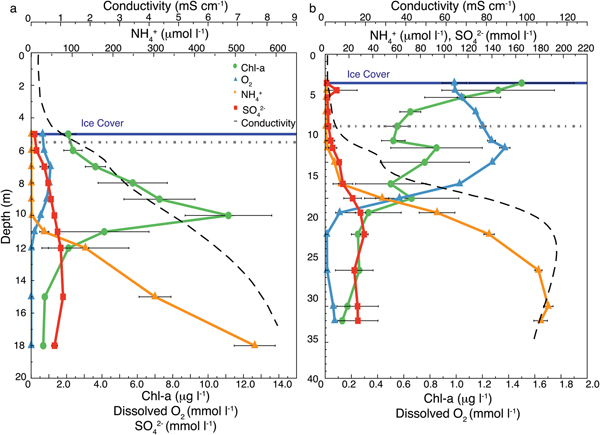
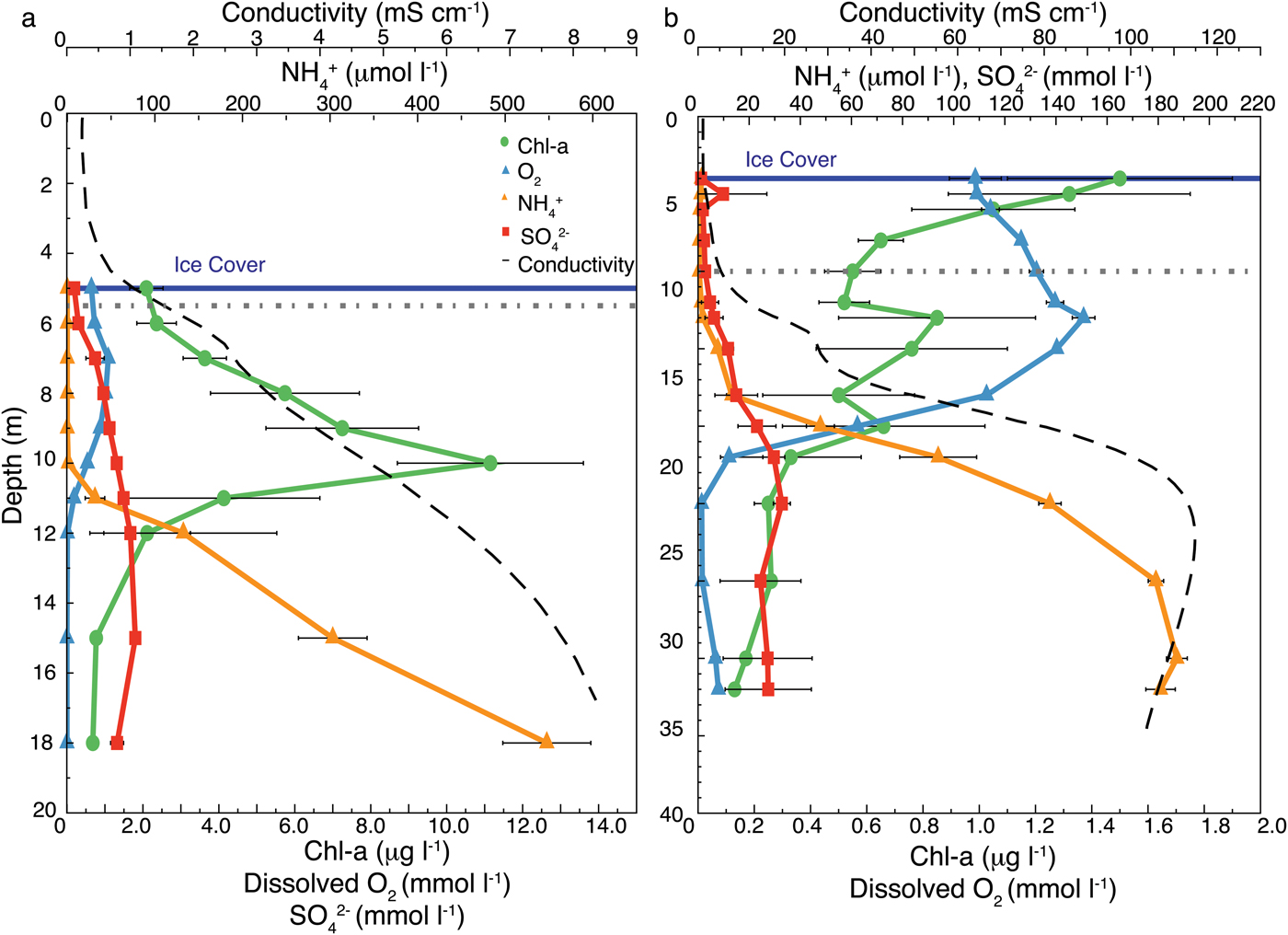
The water columns of both lakes were chemically stratified during the 2008–2009 and 2009–2010 summers (Fig. 1a & b). Chlorophyll-a concentrations were highest at 10 m in FRX and immediately below the ice cover (4.5 m) in ELB, which was also characterized by a deep chlorophyll peak at 12 m. The chlorophyll peak in FRX coincided with decreasing dissolved oxygen concentrations, while in ELB higher concentrations of chlorophyll were associated with higher concentrations of dissolved oxygen. The FRX water column was anoxic from 12 m to depth, while the deeper waters of ELB were characterized by low, but detectable oxygen to the bottom. Both lakes had strong NH4+ gradients, with NH4+ below detection above 10 m in FRX (method detection limit = 0.14 μmol l−1) and close to the detection limit above 12 m in ELB. Concentrations of SO42− were approximately one order of magnitude higher in FRX than ELB, and both lakes had higher concentrations at depth.
Depth profiles of chlorophyll a (chl a), underwater photosynthetically active radiation (UW-PAR), dissolved oxygen, sulphate and ammonium in lakes a. Fryxell, and b. East Lobe Bonney. Error bars indicate the standard deviation of measurements during the 2008–09 and 2009–10 sampling seasons. Chl a, n = 6; dissolved oxygen. n = 2; sulphate, n = 4; ammonium n = 6.
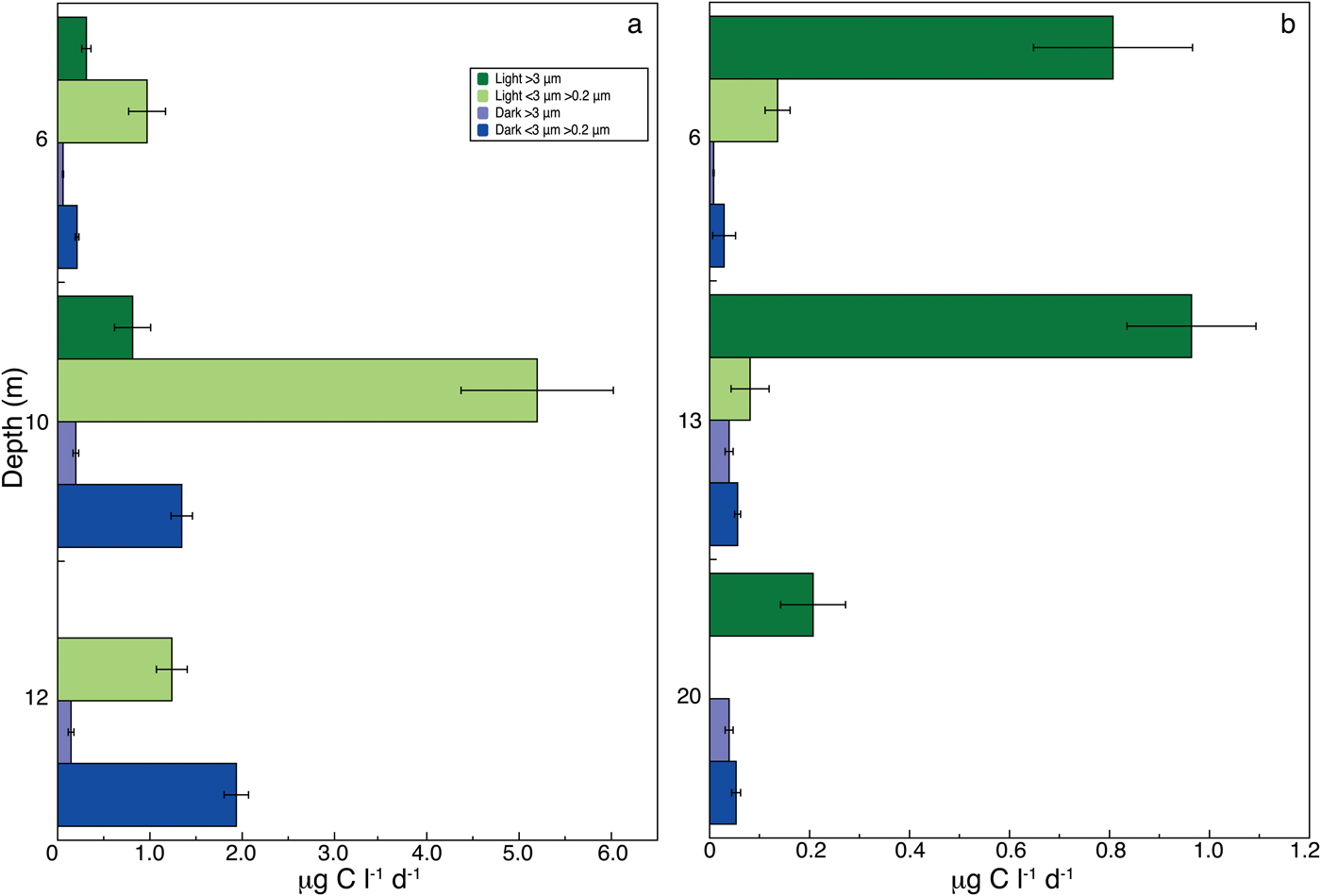
Photoautotrophy was the dominant pathway for water column DIC fixation in the summer at surface and mid-depths in both lakes (6 m and 10 m FRX, 6 m and 12 m ELB), with the highest rates occurring at 10 m FRX sample (Fig. 2). Most photoautotrophic DIC fixation in FRX occurred in the 0.2–3.0 µm size fraction, whereas most DIC fixation in ELB occurred in the > 3 µm size fraction.
Size-fractionated rates of light and dark DIC fixation in lakes a. Fryxell, and b. East Lobe Bonney from the 2008–2009 summer.
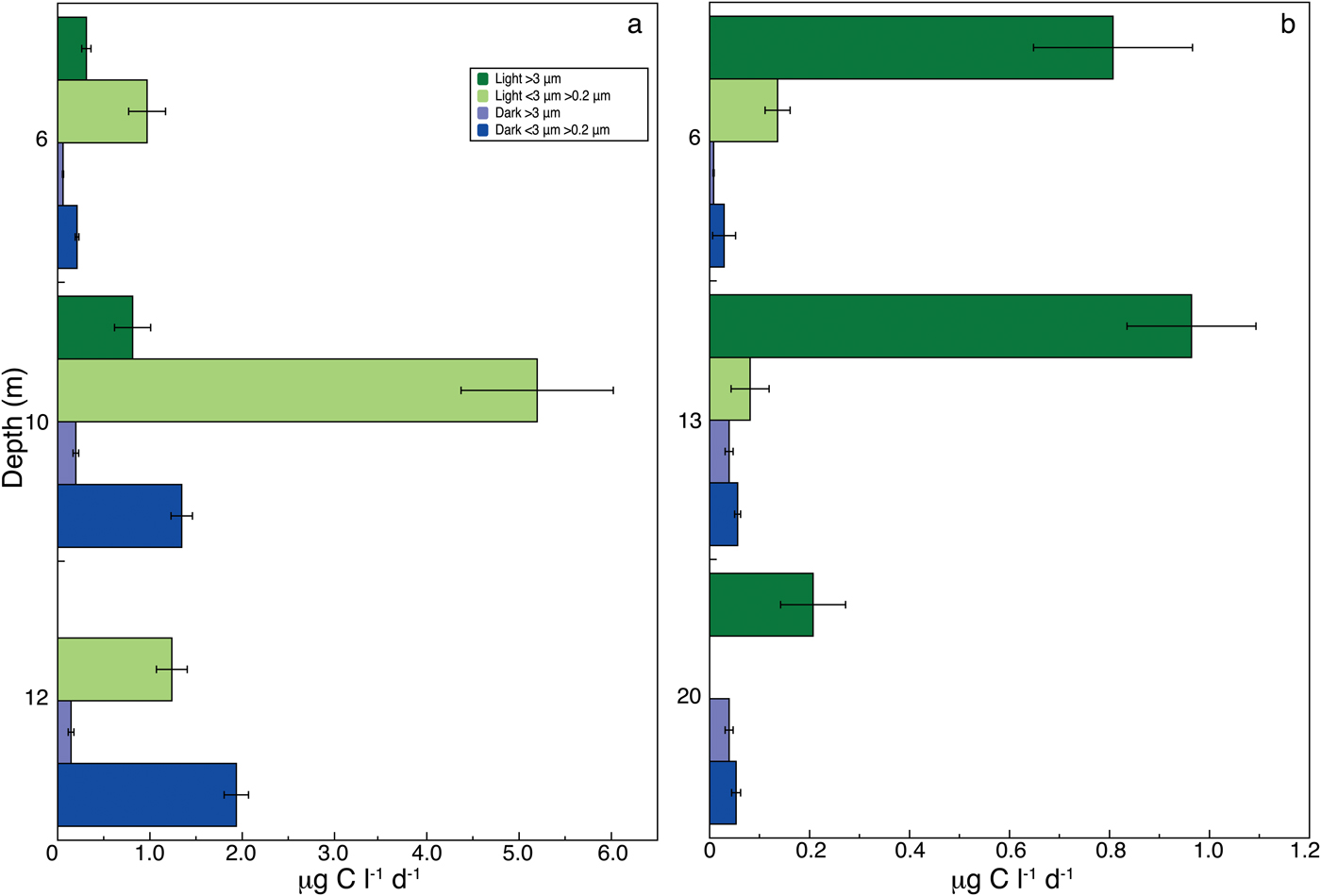
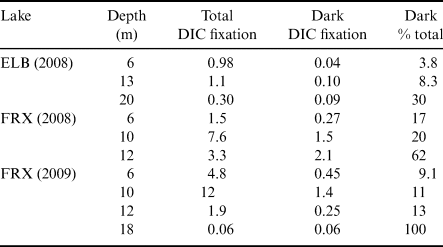
The 0.2–0.3 µm size fraction dominated dark DIC fixation in both lakes and accounted for 9% to 62% of total (sum of light and dark) primary production in FRX, and from 4–30% in ELB (Fig. 2, Table I). The highest rates of dark DIC fixation were associated with the oxyclines (and chemoclines) of both lakes (13 m in ELB, 10 m and 12 m in FRX (Figs 1 & 2)), where dark DIC fixation was equivalent to up to 62% of total DIC fixation. At 18 m in FRX, PAR was not detectable, and DIC fixation was only measurable in the dark and was the lowest of the values measured in either lake (Table I, Fig. 3).
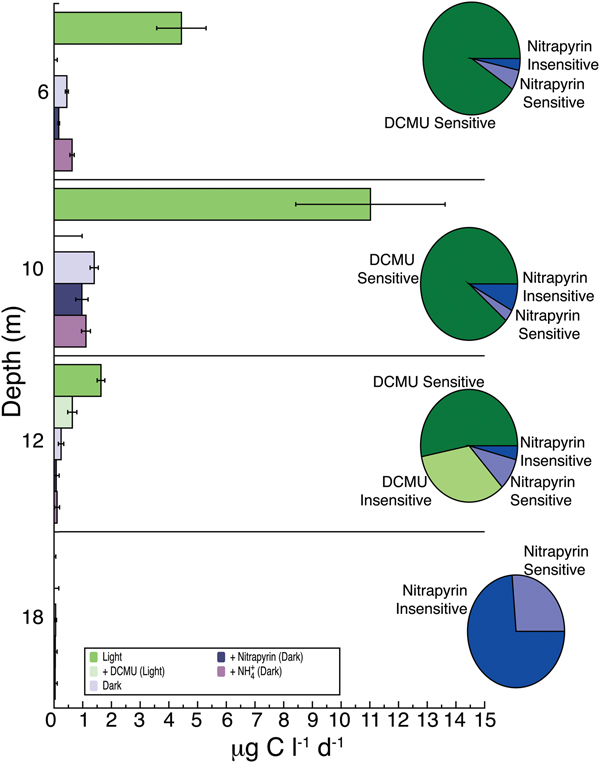
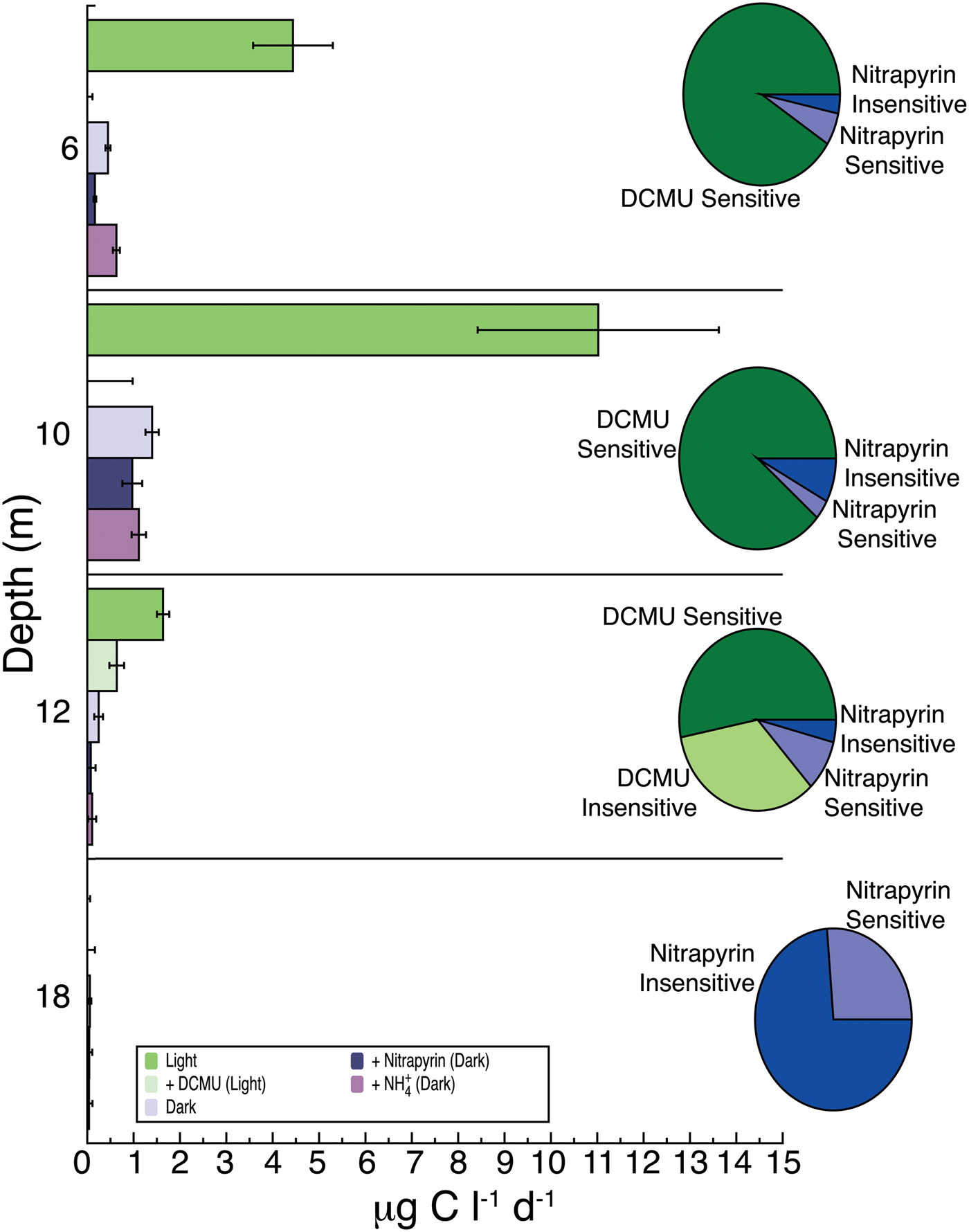
Rates of light and dark DIC fixation in Lake Fryxell during the 2009–2010 summer. DCMU inhibits oxygenic photosynthesis, and nitrapyrin inhibits ammonia oxidation. The effect of nitrapyrin was marginally statistically significant at 12 m (t-test, P = 0.05) and was insignificant at 18 m (t-test, P = 0.37). The pie charts show the relative % of total DIC fixation that was sensitive or insensitive to the tested inhibitors.
Water column dark DIC fixation (μg C l−1 d−1) as a percentage of total DIC fixation (photoautotrophy + chemolithoautotrophy; μg C l−1 d−1). Size fractionated samples (2008) were summed to report total and dark DIC fixation.

In FRX in 2009, light DIC-fixation samples were paired with DCMU-inoculated samples, and dark DIC-fixation incubations were paired with nitrapyrin-inoculated and NH4+-amended samples. Light DIC fixation was completely inhibited by DCMU at 6 m and 10 m, implying that DIC fixation in the light was dominated by oxygenic photosynthesis at those depths (Fig, 3), while at 12 m, 39% of light DIC fixation was insensitive to DCMU, implying a contribution from anoxygenic photosynthesis (Fig. 3). A majority of dark C fixation (63%) at 6 m was sensitive to nitrapyrin (Fig. 3) whereas the proportion was lower at 10 m (30%). The effect of nitrapyrin was greater at 12 m (70% sensitive) and lower at 18 m (26% sensitive) but higher variability between replicates led to only marginal statistical significance at 12 m (nitrapyrin < control; t-test, P = 0.05) and no significant nitrapyrin effect at 18 m (nitrapyrin < control; t-test, P = 0.37). The addition of NH4+ to FRX dark incubations in 2009 resulted in a significant increase (41%; t-test P = 0.03) in dark DIC fixation at 6 m (Fig. 3), where NH4+ concentrations were below detection (Fig. 1); differences were not significant at other depths.
In both FRX and ELB, estimated benthic production was the largest potential source of C, followed by dark DIC fixation (FRX) and extracellular release resulting from planktonic photosynthetic primary production (ELB; Table II). Dark DIC fixation had a greater impact on the estimated C budget for FRX than for ELB, accounting for 34% and 16% of the total estimated C source for FRX and ELB, respectively (Table II). In FRX, dark DIC fixation exceeded the carbon transferred from the DOC pool by bacterial production by 477 kg C yr−1, while in ELB extracellular release of planktonic photosynthetically produced C exceeded bacterial production by 502 kg C yr−1 (Table II). While bacterial production represents a transfer of C from the dissolved to the particulate pool, organic C can also be lost from the system via respiration. Based on estimated rates of bacterial respiration + production (bacterial carbon demand), the planktonic carbon sink exceeded estimated sources in both lakes (FRX production/demand = 0.70; ELB production/demand = 0.44).
Carbon balance for Lake Fryxell and East Lobe Lake Bonney. The balance represents the difference between the sum of photoautotrophic and chemolithoautotrophic inorganic carbon fixation sources minus heterotrophic organic carbon demand.

BCD = bacterial carbon demand = bacterial production + bacterial respiration; Phyto ECR = extracellular release by phytoplankton, total modelled phytoplankton primary production is shown in (); Benthic Prod = benthic production assuming 50% of benthic production is available to the water column, total modelled benthic production is shown in (); Stream DOC = dissolved organic carbon introduced by stream flow; Upward diff = DOC diffusion across the chemocline, Dark DIC = dissolved inorganic carbon fixation in the dark (chemolithoautotrophy). All units are kg C yr−1. Stream DOC and upward diffusion were determined by Takacs et al. (Reference Takacs, Priscu and McKnight2001). Phyto ECR was determined as 30% of photosynthetic primary production, after Sharp (Reference Sharp1993) and Takacs et al. (Reference Takacs, Priscu and McKnight2001). Benthic production was estimated from published rates of modelled benthic production for Lake Hoare (Moorhead et al. Reference Moorhead, Schmeling and Hawes2005) and remains tentative, particularly when applied to lakes in the McMurdo Dry Valleys other than Lake Hoare, where little data exist.
Discussion
Photoautotrophy
Microbial communities in the McMurdo Dry Valley lakes are largely controlled by “bottom-up” factors such as light and nutrient or resource availability (e.g. Lizotte & Priscu Reference Lizotte and Priscu1992, Dore & Priscu Reference Dore and Priscu2001, Vick & Priscu Reference Vick and Priscu2012, Gooseff et al. Reference Gooseff, Barrett, Adams, Doran, Fountain and Lyons2017). Light transmission through the permanent ice cover during summer is between c. 1% and 2% (Roberts et al. Reference Roberts, Priscu, Wolf, Lyons and Laybourn-Parry2004), making light a potentially important bottom-up control. Despite this low light, the planktonic production in the photic zones of both lakes is dominated by photosynthetic DIC fixation. Different groups of organisms are responsible for photosynthetic activity in the two lakes. In the present study, most of the water-column DIC fixation in ELB was associated with the > 0.3 µm size fraction, while most of the DIC fixation in FRX was associated with the 0.2–0.3 µm size fraction. Previous work has shown that planktonic photosynthetic biomass in the ELB water column is dominated by a combination of photosynthetic nanoflagellates (especially cryptophytes; Bielewicz et al. Reference Bielewicz, Bell, Kong, Friedberg, Priscu and Morgan-Kiss2011) and some small chlorophytes (Roberts et al. Reference Roberts, Priscu, Wolf, Lyons and Laybourn-Parry2004), which is consistent with our finding that oxygenic photosynthesis associated with the larger size fraction dominates DIC fixation in ELB.
Photosynthetic biomass in the FRX water column is dominated by photosynthetic nanoflagellates (Roberts et al. Reference Roberts, Priscu, Wolf, Lyons and Laybourn-Parry2004), Chlorella sp., cyanobacteria (Laybourn-Parry et al. Reference Laybourn-Parry, James, McKnight, Priscu, Spaulding and Shiel1997), and anoxygenic phototrophic purple bacteria (Karr et al. Reference Karr, Sattley, Jung, Madigan and Achenbach2003). Photosynthetic cells in the FRX water column tend to be smaller than those of their lower latitude counterparts (Laybourn-Parry et al. Reference Laybourn-Parry, James, McKnight, Priscu, Spaulding and Shiel1997), which is consistent with our finding that a majority of photosynthetic DIC fixation in FRX is associated with the small size fraction. The increase in the proportion of DIC fixation that was insensitive to DCMU at 12 m relative to shallow waters in FRX is consistent with previous work, which found that 63% of photosynthetic activity was insensitive to DCMU in the deeper portion of the euphotic zone (Priscu et al. Reference Priscu, Priscu, Vincent and Howard-Williams1987), and with the presence of anoxygenic phototrophic purple bacteria (mainly Rhodoferax sp. and Rhodobacter sp. See Madigan Reference Madigan, Hunter, Daldal, Thurnauer and Beatty2009), whose photosynthetic activity should not be affected by DCMU. Upper water column (6 m and 10 m) rates of photoautotrophic DIC fixation were higher in our 2009 experiments compared with 2008. Photosynthesis in these lakes is light limited (Lizotte & Priscu Reference Lizotte and Priscu1992), so the discrepancy in rates is probably the result of the higher PAR levels used in the environmental chamber in 2009 compared to the in situ PAR in 2008 (Table I, Fig. 1; Priscu et al. Reference Priscu, Priscu, Vincent and Howard-Williams1987). Overall, the planktonic activity in the euphotic zones of both lakes was dominated by oxygenic photosynthesis which was associated with the larger cell size fraction in ELB and the smaller cell size fraction in FRX.
FRX also hosts benthic photosynthetic mats, which extend to the depth of the oxic–anoxic interface (Jungblut et al. Reference Jungblut, Hawes, Mackey, Krusor, Doran and Sumner2016). Mats are also present in ELB, but have received less study, presumably because the steep sides on the ELB basin are not conducive to extensive mat formation. Models based on the FRX mats suggest that rates of benthic photosynthetic primary production exceed planktonic primary production, so benthic mats may be an important source of organic carbon in the trophogenic zones of the lakes (Hawes et al. Reference Hawes, Moorhead, Sutherland, Schmeling and Schwarx2001). Despite these claims, Parker et al. (Reference Parker, Simmons, Wharton, Seaburg and Love1982) contend that a large portion of these mats lift off the bottom and are removed from the lakes. Clearly, the proportion of benthic produced carbon that is available to the water column has not been quantified, but our estimates of benthic primary production result in a supplement to the FRX water column of 7182 kg C yr−1 (assuming 50% of total benthic production is available to the water column). If this is accurate, benthic production may be the largest source of C to the water column and is similar in magnitude to planktonic photosynthetic primary production, but does not close the deficit imposed by bacterial carbon demand. The situation is similar in ELB, where benthic production is estimated at 3349 kg C yr−1, exceeding phytoplankton ECR but not phytoplankton primary production. These calculations suggest that benthic primary production is probably an important component of the annual carbon budget in the lakes. However, little data exist on the mat-based contribution of carbon to the water column of the lakes in the McMurdo Dry Valleys, particularly ELB. Without such information, the contribution of benthic mats we estimate should be considered tentative.
Chemolithoautotrophy
The detection of dark DIC fixation shows that chemolithoautotrophy may contribute to the total primary production of organic C in both lakes. Genes related to chemoautotrophic carbon fixation were detected in ELB, but at low abundances relative to other lakes in the region (Dolhi et al. Reference Dolhi, Teufel, Kong and Morgan-Kiss2015), implying that chemolithoautotrophic metabolism may be less important in ELB. Of the chemoautotrophic DIC-fixation genes tested for, nifJ, a marker for the reverse-TCA cycle, was the most abundant and peaked at depths of 6 m and 20 m (Dolhi et al. Reference Dolhi, Teufel, Kong and Morgan-Kiss2015). In our study, rates of dark DIC fixation were greatest at 13 m and 20 m with a marginal difference between the two depths (< 1%), while rates at 6 m were 44% of those at 20 m. On average, rates of dark DIC fixation in ELB were 5.5 times lower than rates measured in FRX, which is consistent with the previously described low chemoautotrophic gene abundances in ELB relative to other lakes in the area (Dolhi et al. Reference Dolhi, Teufel, Kong and Morgan-Kiss2015).
In FRX, the highest rates of dark DIC-fixation were measured at 12 m, which corresponded with the bottom of the oxycline. Sulphur-oxidizing bacteria are present in FRX, with the greatest population density occurring at the oxic–anoxic interface, probably supported by the upward diffusion of H2S from the anoxic sediments of the lake (Sattley et al. Reference Sattley and Madigan2006; sulphide is not detectable in ELB, Priscu unpublished data). SO42− concentrations were also greatest from c. 12–15 m in FRX, most likely a result of sulphur-oxidation. Dolhi et al. (Reference Dolhi, Teufel, Kong and Morgan-Kiss2015) showed that chemoautotrophic DIC-fixation genes were most abundant in FRX at depths coincident with our dark DIC-fixation maximum, at the bottom of the oxycline. Together, these data imply that dark DIC fixation at and below the FRX oxycline is the result of chemolithoautotrophic activity, possibly mediated by sulphur-oxidizing chemolithoautotrophic bacteria. The bottom waters of FRX (18 m) were characterized by the lowest rates of dark DIC fixation in that lake, despite the fact that sulphide and methane should be available as electron donors at that depth. It should be noted that the PTFE-lined screw cap bottles used in the incubations may not have been gas-tight, and while the incubations were conducted with no headspace, we cannot discount the presence of atmospheric oxygen in our 18 m incubations. This could have impacted anaerobic organisms present in the anoxic bottom waters of FRX.
To investigate the potential contribution of ammonia oxidation to chemoautotrophic C-fixation in FRX, we conducted dark DIC fixation incubations amended with nitrapyrin. Nitrapyrin inhibits the activity of ammonia-oxidizing microorganisms by stopping the conversion of ammonia to hydroxylamine, the initial step of ammonia oxidation (Jäntti et al. Reference Jäntti, Jokinen, Hietanen, Jokinen and Hietanen2013). Populations of ammonia-oxidizing bacteria are present in the surface waters of FRX and through the oxic–anoxic transition (Voytek et al. Reference Voytek, Priscu and Ward1999). We expected to find an inhibitory effect on dark DIC fixation in response to nitrapyrin exposure at depths where both oxygen and ammonium, which are required by ammonia oxidizers, were present. Dark DIC fixation at 10 m and 6 m decreased by 30% and 63% in the presence of nitrapyrin, consistent with expectations and implying a significant contribution to total dark DIC fixation by ammonia oxidizers. Dark DIC fixation also decreased (70% on average) at the oxic–anoxic interface (12 m). However, variability between replicates was high, making the difference between nitrapyrin-amended and nitrapyrin-free incubations marginally significant (P = 0.05), so we cannot say with certainty that dark DIC fixation at 12 m was inhibited by nitrapyrin. Sulphide, which also inhibits the activity of ammonia oxidizers, is present in the bottom waters of FRX, with measurable concentrations appearing near the bottom of the oxic–anoxic interface and increasing at depth (Sattley et al. Reference Sattley and Madigan2006). At the time of sampling, 12 m marked the transition from oxygenated waters to undetectable oxygen concentrations (Fig. 1), so it is possible that the nitrapyrin, sensitive to dark DIC fixation above 12 m, and perhaps as deep as 12 m, does reflect a contribution from ammonia oxidation. The concentrations of NH4+ in the shallow waters of FRX were at or near the limit of detection (Fig. 1), however, Voytek et al. (Reference Voytek, Priscu and Ward1999) found that the abundances of ammonia oxidizers were greater at lower NH4+ concentrations in FRX, suggesting that ammonia oxidizers are capable of competing for ammonia in the dilute surface waters of the lake. The addition of NH4+ to 6 m water incubations in FRX increased rates of dark DIC fixation (Fig. 3), which could indicate stimulation of ammonia oxidizers using NH4+ to capture energy and/or a metabolic response to NH4+ as a nutrient.
Nitrapyrin may also inhibit the activity of methane-oxidizing bacteria (Topp & Knowles, Reference Topp and Knowles1982), however, methane concentrations in the shallow waters of FRX are low (Karr et al. Reference Karr, Ng, Belchik and Sattley2006), and while methanotrophic bacteria may be present in the oxycline, we know of no studies that have explicitly detected them at near-surface depths. There is evidence for anaerobic methane oxidation in FRX, and methane produced in the anoxic sediments of FRX may be consumed by anaerobic methanotrophy before reaching the top of the oxic–anoxic interface (Karr et al. Reference Karr, Ng, Belchik and Sattley2006, Saxton et al. Reference Saxton, Samarkin, Schutte, Bowles, Madigan and Cadieux2016). Based on available evidence, we conclude that dark DIC fixation in the oxygenated waters of FRX is at least partially attributable to ammonia oxidation.
The contribution of ammonia oxidation to chemoautotrophy across meromictic lakes is variable. For example, in Lake Kivu, a deep (> 70 m), tropical, meromictic lake, chemoautotrophic activity exceeded that measured in our study by an order of magnitude (maximum ~17 µg C l−1 d−1), with no evidence for widespread ammonia oxidation (Morana et al. Reference Morana, Roland, Crowe, Llirós, Borges, Darchambeau and Bouillon2016). The contribution of ammonia oxidation to total inorganic C-fixation was also estimated using an inhibitor-based technique (methyl fluoride) during a period of meromixis in Mono Lake, an alkaline, saline lake in California. In that lake, ammonia oxidation related rates were found to be 1–7% of photosynthetic primary production (Joye et al. Reference Joye, Connell, Miller, Oremland and Jellison1999), compared to 4–10% in FRX. Archaeal ammonia oxidation genes were found to be abundant in the chemoclines of two meromictic lakes in the high Arctic, implying that the process may be important there (Pouliot et al. Reference Pouliot, Galand, Lovejoy and Vincent2009), however, no rate measurements were made. Together, these studies suggest wide variation in the contributions of ammonia oxidation to lake carbon and nitrogen cycles.
Impact of dark DIC-fixation on FRX and ELB carbon budgets
The ratio of organic carbon production (P) to the demand for organic carbon by respiration (R) is an important metric for describing the trophic status of lakes. A P/R > 1 implies a net autotrophic (inorganic carbon consuming) system, while a P/R < 1 implies a net heterotrophic (inorganic carbon producing) system. The extended periods of darkness in these high latitude lakes result in water column P/R ratios < 1 on an annual basis (Priscu et al. Reference Priscu, Wolf and Takacs1999), yielding organic carbon deficits of thousands of kilograms of carbon per year (Takacs et al. Reference Takacs, Priscu and McKnight2001).
We compared annual heterotrophic respiratory carbon demand to the total estimated input of organic carbon in FRX and ELB to determine the degree to which organic carbon sources balance organic carbon demand by heterotrophic bacteria. The total estimated organic carbon source exceeds the demand estimated via bacterial production in both lakes, while respiration exceeds available carbon by an order of magnitude in both lakes. Takacs et al. (Reference Takacs, Priscu and McKnight2001) developed the seminal carbon budget for lakes in the McMurdo Dry Valleys and included inputs of organic carbon from upward diffusion across the chemocline, phytoplankton extracellular release and streamflow. We extended this budget by adding annual estimates for chemoautotrophic carbon production, using our experimental determinations of dark DIC fixation. Our results show that chemoautotrophic carbon production does not balance the carbon budget for either lake. For instance, in FRX the total carbon production (15 042 kg C yr−1) is lower than the bacterial carbon demand of 21 316 kg C yr−1; Table II). However, it is the largest planktonic organic carbon source in FRX (assuming ECR by phytoplankton is the main source of water column photosynthetic carbon) and may be of particular importance during the darkness of winter when photosynthetic primary production is absent. Further work on the contribution of benthic carbon transformation to the overall lake carbon balance is required before unequivocal results regarding their contribution can be made, but estimates indicate they may be important.
Lake ecosystems in the McMurdo Dry Valleys are strongly impacted by the seasonal light–dark cycles. The continuous daylight of summer supports the activity of diverse photosynthetic primary producers, whose activity is down-regulated at the onset of the polar night (Vincent Reference Vincent1981, Lizotte et al. Reference Lizotte, Sharp and Priscu1996, Morgan-Kiss et al. Reference Morgan-Kiss, Lizotte, Kong and Priscu2015). Despite the winter loss of freshly produced photosynthetic carbon, there is evidence that heterotrophic activity continues during the polar night (Takacs & Priscu Reference Takacs and Priscu1998, McKnight et al. Reference McKnight, Howes and Taylor2000, Vick & Priscu Reference Vick and Priscu2012). This temporal displacement of photosynthetic production and heterotrophic demand, combined with a large respiratory demand, results in ratios of production to respiration < 1 (Priscu et al. Reference Priscu, Wolf and Takacs1999). Here, we show that organic carbon production via chemoautotrophy contributes significantly to, but does not balance, the annual sources and sinks of organic carbon in Lakes Fryxell and Bonney.
Acknowledgements
We thank the 2008–09 and 2009–10 McMurdo LTER limnology teams for assistance with sample collection and processing and Alexander Michaud and Pamela Santibañez for comments on the manuscript. This work was funded by NSF grants OPP-1115254, OPP-1340292, and OPP-7460252 to JCP. TJV-M received support from an American Association of University Women Dissertation Fellowship and a Montana Space Grant Consortium Graduate Fellowship. We are also grateful to David Walton, for editorial input, as well as input from Clive Howard-Williams, and that of an anonymous reviewer. We dedicate this paper to D. Walton for his dedication to all fields of Antarctic Science.
Data availability
Data are publicly available at www.mcmlter.org, or by request from the authors.
Author contribution
JCP and TJV-M designed the experiments, TJV-M conducted the experiments and analysed the data. TJV-M and JCP wrote the paper.