Extending the pioneering work of Ed Zigler on the potential of academic contexts to enhance social and emotional development, this study examined a school-based intervention to improve peer relationship quality and psychosocial functioning among marginalized adolescents. A randomized controlled trial was used to assess the impact of the Connection Project, a 12-session, universally targeted, school-based intervention in a sample of 610 high school students. In accord with the intervention theory of change, the program led to significant improvements in peer relationships by the end of the program. At 4-month follow-up, intervention students were not only viewed more positively by their peers but also were more likely to use social supports to cope with stress, to have lower levels of depressive symptoms, and to display higher levels of academic engagement. Results are interpreted as suggesting the potential value in considering the peer environment in secondary schools as a target of intervention.
One of Ed Zigler's seminal contributions, stretching back almost five decades, was the recognition that developmental research needed to both consider the whole person and recognize the broader effects of social context on development (Zigler, Reference Zigler1970, Reference Zigler, Adams and Boardman1971). Zigler was one of the few psychologists, for example, to early on recognize the importance of social–emotional learning in academic contexts (Raver & Zigler, Reference Raver and Zigler1997). Even within cognitively focused arenas, Zigler recognized that social–emotional factors were likely to be among the largest contributors to later life outcomes (Zigler & Styfco, Reference Zigler and Styfco1994). Similarly, Zigler devoted much of his career to addressing the needs of marginalized youth living in environments characterized by poverty and/or racism (Zigler & Muenchow, Reference Zigler and Muenchow1992). The present intervention study, seeking to change the peer environments of marginalized adolescents in schools, derives from and sits squarely on the shoulders of these contributions.
The material adversities faced by youth in marginalized socioeconomic and racial/ethnic groups are many and have been well cataloged (see, e.g., Carter & Reardon, Reference Carter and Reardon2014). Yet, the social processes by which racism and poverty undermine outcomes for these youth may be at least as powerful and far more insidious (Feagin, Reference Feagin2013). Adolescents are biologically wired to turn to peers for support and social connection (Chein, Albert, O'Brien, Uckert, & Steinberg, Reference Chein, Albert, O'Brien, Uckert and Steinberg2011), but marginalized youth are far less likely to be exposed to the types of prosocial peer experiences (e.g., organized teams, summer camps, etc.) that more advantaged youths can often take for granted (White & Gager, Reference White and Gager2007). With little scaffolding and adult guidance, peer relationships, rather than becoming sources of support, can become significant stressors as struggling youth may find themselves turning on one another rather than turning to one another (Bukowski, Santo, Persram, Castellanos, & Lopez, Reference Bukowski, Santo, Persram, Castellanos and Lopez2019; Seidman et al., Reference Seidman, Yoshikawa, Roberts, Chesir–Teran, Allen, Friedman and Aber1998, Reference Seidman, Chesir-Teran, Friedman, Yoshikawa, Allen, Roberts and Aber1999). Walton terms the experience that results from the confluence of these factors belonging uncertainty—the belief that “people like me do not belong here”—and notes that it likely contributes strongly to the achievement problems, lack of engagement, and depressive symptoms often experienced by marginalized youth (Demanet & Van Houtte, Reference Demanet and Van Houtte2014; Moon & Rao, Reference Moon and Rao2010; Saluja et al., Reference Saluja, Iachan, Scheidt, Overpeck, Sun and Giedd2004; Walton & Cohen, Reference Walton and Cohen2007).
We know that humans can function, and even thrive, under a wide range of material conditions, if they have strong social support (Field, Reference Field2002). Yet, humans are also strikingly susceptible to conditions that undermine the quality of their social bonds. In adolescence, lack of social connection and support with adults and peers is one of the strongest proximal correlates of school dropout, risky sexual behavior, and substance use (Crosnoe, Reference Crosnoe2011; Resnick et al., Reference Resnick, Bearman, Blum, Bauman, Harris, Jones and Udry1997; Roseth, Johnson, & Johnson, Reference Roseth, Johnson and Johnson2008; Shochet, Dadds, Ham, & Montague, Reference Shochet, Dadds, Ham and Montague2006). More broadly, the quality of human connections is increasingly being recognized as a key outcome to pursue for its own sake, given extensive links of social relationship quality to both physical and mental well-being across the life span (Farrell, Imami, Stanton, & Slatcher, Reference Farrell, Imami, Stanton and Slatcher2018; Holt-Lunstad, Robles, & Sbarra, Reference Holt-Lunstad, Robles and Sbarra2017). To date, however, relatively little work has been done to address the social experiences of the marginalized adolescents most likely to experience a sense of social exclusion in school.
The present study builds from the primary recommendation from the Centers for Disease Control-sponsored Wingspread Conference to dramatically expand research on approaches that create positive peer support and peer norms (Blum, Reference Blum2005; Wingspread, Reference Wingspread2004). The Wingspread recommendation has led to a great deal of work in the social–emotional learning area in the lower grades. Unfortunately, the vast majority of such programs remain targeted only to younger students (e.g., only 6 of 68 programs in a 2010 meta-analysis of well-evaluated social–emotional learning programs targeted high school students; Durlak, Weissberg, & Pachan, Reference Durlak, Weissberg and Pachan2010). Even those programs that do target adolescents have generally not been as effective as programs targeting younger children (Heckman & Kautz, Reference Heckman and Kautz2013). Moreover, there is now growing evidence that seeking to directly teach social skills to adolescents is likely to fail or even backfire as youths perceive adult guidance as impinging on their autonomy in the peer world (Yeager, Reference Yeager2017). In contrast, much as Zigler (Reference Zigler and Styfco1994) first learned with Head Start's far reaching health and nutritional components, programs that instead seek to change the broader context within which young people live, rather than providing purely didactic information, are far more likely to be successful. For adolescents, the peer world is a central part of that context.
The Connection Project is an in-school, experience-based group intervention designed to change this peer context. The unique feature of this approach is that it does not seek to educate/teach adolescents, but rather to directly begin to alter the often social-Darwinian nature of the adolescent peer context in school. The intervention is intended to not only reduce adolescents’ sense of ongoing status threat with respect to peers (Yeager, Reference Yeager2017) but also change their views of peers as potential sources of social support. From this perspective, the intense motivation and interest that peer relationships engender in adolescence provide a tremendous, and relatively untapped, potential context for positive youth development. Given the centrality of peer experiences to adolescent development, the Connection Project was designed with the premise that changing this peer context from a source of threat to a source of support would in turn lead to broader changes in student engagement in school and ultimately to enhanced psychosocial functioning.
The intervention utilizes an empowerment perspective that suggests the possibility of capitalizing on existing potential within adolescent social relationships. Rather than treat the adolescent peer experience as essentially a “wild card” beyond the range of adult influence, the intervention uses a variety of techniques to gradually establish small peer groups as viable sources of social support. In contrast to the negative effects of a lack of a sense of belonging, support from peers in adolescence has been identified as a primary factor for youth engagement in adaptive social behaviors and ultimately in adjustment to the work force in adulthood (Collins & van Dulmen, Reference Collins, van Dulmen, Huston and Ripke2006; Wentzel, Reference Wentzel1998; Zimmer-Gembeck, Chipuer, Hanisch, Creed, & McGregor, Reference Zimmer-Gembeck, Chipuer, Hanisch, Creed and McGregor2006). One of the strongest findings from the National Longitudinal Study of Adolescent Health, for example, is that the experience of caring and connectedness is critical to youth well-being across domains ranging from emotional health and sexuality to prevention of violence and substance abuse (Resnick et al., Reference Resnick, Bearman, Blum, Bauman, Harris, Jones and Udry1997). Teens who experience more positivity and support in their friendships tend to be more involved in school, to perceive themselves as being more accepted, and may even have higher self-esteem and be less prone to depressive symptoms (Berndt, Reference Berndt2002; Buhrmester, Reference Buhrmester1990).
From this perspective, the change theory of the intervention reflects two distinct elements: the first being to change the nature of youths’ peer relationships such that they become sources of social support, and the second being for these changed relationships to then begin to reduce the demoralization, disengagement, and depressive symptoms that are so prevalent among marginalized youths in school (Demanet & Van Houtte, Reference Demanet and Van Houtte2014; Moon & Rao, Reference Moon and Rao2010; Saluja et al., Reference Saluja, Iachan, Scheidt, Overpeck, Sun and Giedd2004). In this respect, the program builds from the premise that latent capacities for peer social support can be developed and nurtured in marginalized youth so as to develop powerful relationship resources that can enhance their efficacy and functioning. Although this socially focused approach of course cannot address the substantial material and structural disadvantages faced by marginalized youth, considerable evidence suggests that if we can empower youth to address the social mediators of these disadvantages, we can change behavior and enhance key life outcomes (Catalano, Oesterle, Fleming, & Hawkins, Reference Catalano, Oesterle, Fleming and Hawkins2004; Jones, Greenberg, & Crowley, Reference Jones, Greenberg and Crowley2015; Moffitt et al., Reference Moffitt, Arseneault, Belsky, Dickson, Hancox, Harrington and Ross2011).
This randomized controlled study examined the impact of the Connection Project as implemented in secondary schools serving primarily socioeconomically and racially/ethnically marginalized youths. Although serving primarily marginalized youth, the intervention was universal in nature in that students were not selected for participation based on any preexisting characteristics. The study sought to answer five primary questions regarding the effects of the program, both immediately postintervention and at a 4-month follow-up assessment, on the social relationships of participants and on their broader behavior and functioning:
1. Can the intervention alter the quality of teens’ comfort with their classmates both within and outside of the participant group?
2. Can the intervention alter behavior, both as independently observed by peers and in terms of participants’ use of social supports to cope with stress?
3. Can the intervention alter participants’ levels of depressive symptoms and academic engagement?
4. Will changes in levels of depressive symptoms and academic engagement be mediated via teens’ increased use of social supports when coping with stress?
5. Are intervention effects moderated by indicators of student racial/ethnic or socioeconomic marginalization?
Method
Setting characteristics
The intervention took place in four districts in the greater metropolitan area of a midwestern state. The districts involved enroll students primarily from racial/ethnic minority groups (82% African American, 4%; Hispanic, 12%; European American; and 2% from other racial/ethnic groups). The majority of students (approximately 67%) also qualified for free or reduced-price school lunch (a marker of family poverty status).
Sample characteristics
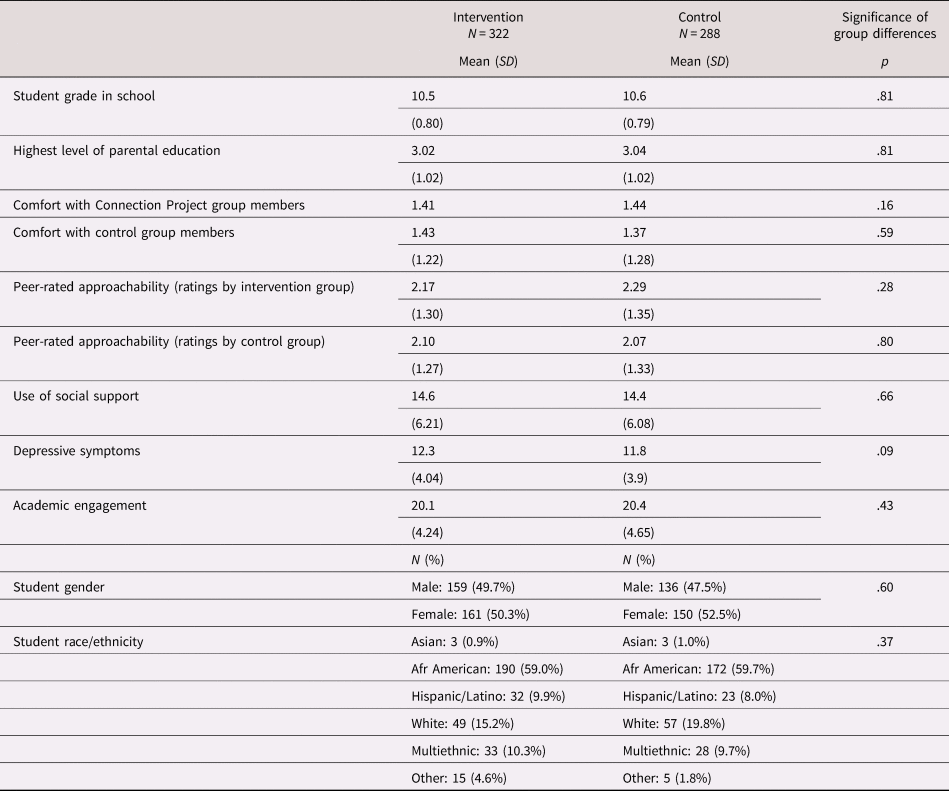
The sample for this study consisted of 610 high school students (295 male, 311 female, 4 unidentified; 362 African American, 106 White, 55 Hispanic/Latino, 6 Asian American, 61 multiethnic, and 20 other). Of note, more than 92% of the participants in this sample either were members of a racial/ethnic minority group or were from families where neither parent was a college graduate, thus indicating that the program was serving almost entirely students from marginalized groups. Full data on student baseline characteristics is presented in Table 1. These data both support the idea that the intervention was being tested in a setting comprising large numbers of economically and racially/ethnically marginalized students and also show that randomization was effective in producing equivalent samples in the intervention and control groups. As shown in Table 1, there were no significant differences between the intervention and control groups on any measures at baseline.
Entry characteristics of intervention and control groups at baseline

Note: Analyses used multilevel models, t tests, and chi-square analyses as appropriate. Significance of group differences for student race/ethnicity was calculated for minority versus nonminority group membership status.
The intervention
The Connection Project consists of 12 45- to 60-min sessions held once per week. For this study, sessions were conducted as a pull-out from a high school health class. Students meet in groups of 5 to 15 students led by two trained facilitators employed by a youth-serving community agency. Facilitators both guide discussions and provide a safe source of support while also themselves modeling appropriate levels of self-disclosure for youth in discussions.
The program is experiential and designed to gradually change youth's ongoing peer relationships. Initially, this change is expected within the program group, but ultimately the program is designed to change youths’ view of the capacity of peer relationships more broadly to be sources of support. It is these future relationships that are then posited as the active ingredient in youths’ lives going forward.
The sessions are organized into three phases: establishing buy-in and a safe peer context, developing/enhancing a sense of social belonging, and consolidating relationships. Each phase uses elements of approaches independently shown to enhance outcomes for marginalized youth. After a brief introduction, for example, Session 1 utilizes a values affirmation activity in which intuitively appealing quotes about the value of friendship and social connection, from sources ranging from Socrates to Lady Gaga to Dr. Martin Luther King Jr., are posted around the room and youth are asked to place stickers on their favorites, and stand by the one they like best. Each youth is then asked to state why he or she picked that particular favorite quote. Helping adolescents identify and enunciate their own prosocial values is increasingly being identified as a powerful lever of change (Cohen, Garcia, Apfel, & Master, Reference Cohen, Garcia, Apfel and Master2006). This approach also starts the process of building a sense of group trust and commonality as students see other students stating that they value connection (Clapp-Smith, Vogelgesang, & Avey, Reference Clapp-Smith, Vogelgesang and Avey2009).
This then feeds into activities designed to gradually enhance youths’ sense of social belonging by letting them see they are not alone in many of the things they think, feel, and experience (Walton & Cohen, Reference Walton and Cohen2007). For example, one session presents youths with a “masks” activity that begins with descriptions of the ways that youths can present a false view of themselves to the world to cover up their real feelings. (e.g., “I act like I don't want to fit in with what other people think is good, but I really do want to fit in,” “I act like everything is great and fine, even when sometimes it really isn't,” etc.). Students anonymously indicate how often they have used each of a list of masks, and overall group results are then tallied and revealed. Students thereby come to see how much they all share the same ways of covering up their feelings. Another session, predicated on the mechanisms of Walton and Cohen's (Reference Walton and Cohen2011) social belonging paradigm, presents students with brief vignettes from older students who describe their own sense of isolation and struggle when they were younger, and how they overcame these. Each of these activities is followed by facilitated discussions, which give students the choice to volunteer information about themselves in line with the activity. Whether or not any specific student chooses to volunteer information, all students hear at least some other students confirming essential elements of the challenging aspects of the adolescent experience.
As a sense of belonging, safety, and trust becomes established, the program offers multiple voluntary opportunities for deeper connection to consolidate relationship gains. A third activity, titled “If you really knew me …,” asks students to anonymously complete prompts such as “If you really knew me, you'd know that one thing I worry most about is ….” These are then collected anonymously and read to the group followed by facilitated discussion.
The final sessions are designed to consolidate developing relationships by employing principles from narrative theory (Pennebaker, Reference Pennebaker2012) in which the process of gradually developing a coherent understanding of life experiences enhances functioning (Pennebaker, Kiecolt-Glaser, & Glaser, Reference Pennebaker, Kiecolt-Glaser and Glaser1988; Pennebaker & Seagal, Reference Pennebaker and Seagal1999). For example, students are asked to recall a defining challenge, problem, or stress they have faced in their lives and how it shaped them—something that others should know about them in order to really understand them. They are then given the opportunity to think about what they have learned from this experience and, if desired, to share this story out loud with the group. The group is given the opportunity to respond in supportive ways. In the atmosphere of safety, belonging, and support that has been created by the final sessions, students often choose to reflect upon and share profound experiences in moving ways, which in turn evoke strong, spontaneous expressions of support from peers. Teens find that they truly are not alone and that others can really get to know and support them in a deep way.
The intervention concludes with a “strengths bombardment” activity in which each student takes a turn as the focal student while group members each offer their assessment of the multiple strengths of the focal student. This activity is designed to further solidify the relationships formed and leave students with the secure base of a positive self-narrative from which to reach out to others and establish and maintain connections with their peers.
Procedure
Recruitment
Students were recruited via in-class presentations with written descriptions of the program and its evaluation sent home to parents. Informed consent from parents and assent from students was obtained prior to randomization. Randomization took place using a random number generator, with randomization blocked by student gender and grade level. In a few cases where only small numbers of students from a given health class signed up for the study, more were assigned to the intervention group than the control group (to keep minimum group size at 5). This assignment was also fully randomized, however. Intervention students then met once a week during the Fall or Spring semester as a pull-out from their regular health class; control students had their health class as usual during these sessions.
Facilitator training
Facilitators were experienced youth group leaders and were trained in a 2-day workshop led by the authors. Weekly or biweekly supervision via video conference was then provided to address unexpected issues that arose and to continue the training process in real time.
Data collection
Measures were obtained at three time points, with intervention and control group data collection occurring at the same time: prior to the beginning of the intervention, in the week immediately following completion of the intervention, and 4 months following completion of the intervention. The first two assessments took place during a session of students’ health class. Because the final assessment occurred after completion of this health class, it took place in other rooms in the school during a student free period.
Session attendance
The median and modal number of sessions attended by participants was 11 out of 12 sessions. Mean was 9.8, SD = 2.7.
Measures
Parental education level
The highest level of education obtained by either parent living in the household was noted by students on a scale ranging from 1 = less than high school to 4 = college graduate or higher.
Comfort with classmates
Students were presented with a list of all of the participating students in their health class. They were asked to rate each student in terms of how comfortable they felt around them, with ratings ranging from 1 = I always keep my guard up to 5 = I'm always open. It was explained to students that “keeping my guard up” meant that the student felt the need to be careful regarding what he or she said and that the student did not feel free to be himself or herself around the named person. Being open was defined as “feeling like you can be yourself and act how you like [around this person].” Students only rated those students who they said they knew. Ratings were tallied separately for comfort with members of the intervention group and with members of the control group.
Peer-rated approachability
Using the same rating scale described above, the mean of all ratings of a student given by the student's peers was created to produce a sociometric score for that student's peer-rated approachability. So as to be able to examine the possibility that students might be rated differently by those in their own group than by those not in their group, ratings were tallied such that a score was obtained for each student's approachability as rated by control group members and for each student's approachability as rated by intervention group members.
Coping via social support
Students reported on their use of social supports in their environment using the 8-item social support scale from the Self-Report Coping Scale (Causey & Dubow, Reference Causey and Dubow1992). Students were asked about their coping approaches via the prompt “When I have a problem, I usually ….” Items then ask about turning to friends, family members, and teachers for help on a 0–4 scale ranging from never to always. Items were summed and averaged to yield a measure of use of social supports to cope. The scale had good internal consistency (Cronbach's α ranged from .86 to .89) and has been previously related to peer ratings of coping styles (Causey & Dubow, Reference Causey and Dubow1992).
Depressive symptoms
Participants reported the degree of their depressive symptoms using the Child Depression Inventory (Kovacs & Beck, Reference Kovacs and Beck1977). This 27-item inventory is based on the Beck Depression Inventory and has been well validated as a measure of depressive symptomatology linked to poor self-esteem, hopelessness, and negative cognitive attributions (Kazdin, Reference Kazdin1990). Internal consistency for this measure was good (Cronbach's α ranged from .82 to .84).
Academic engagement
Students reported on their classroom academic engagement using a 10-item scale that tapped student effort, attention, and persistence while initiating and participating in learning activities (Skinner, Furrer, Marchand, & Kindermann, Reference Skinner, Furrer, Marchand and Kindermann2008; Skinner, Zimmer-Gembeck, & Connell, Reference Skinner, Zimmer-Gembeck and Connell1998). The scale had good internal consistency (Cronbach's α ranged from .69 to .77) and has been repeatedly found to be related to students’ academic achievement (Reyes et al., Reference Reyes, Brackett, Rivers, White and Salovey2012; Skinner et al., Reference Skinner, Furrer, Marchand and Kindermann2008; Skinner & Belmont, Reference Skinner and Belmont1993).
Attrition analyses
Attrition at postintervention assessment
Attrition at the postintervention assessment was slightly higher in the control than in the intervention group (16.7% vs. 13.4%, p < .03). Attrition was also greater for males than for females (17.1% vs. 9.7%, p < .01) and attriting students were likely to have known fewer students in their health class at baseline (M attrit = 2.47, M non-attriting = 2.93, p < .001). There were no other differences between those who did versus did not complete the postintervention assessment on any baseline measures.
Attrition at follow-up assessment
At the 4-month follow-up assessment, there were no differences between the control and intervention groups in level of attrition (24.4% vs. 23.1%, p > .70). Attrition at follow-up was greater for those who knew fewer students in their health class at baseline (M attrit = 1.97, M non-attriting = 2.47, p < .001). There were no other differences in those who did versus did not complete the follow-up assessment on any baseline measures.
These attrition rates at both points fall within the boundaries for acceptable attrition under the What Works Clearinghouse standards (Deke, Wei, & Kautz, Reference Deke, Wei and Kautz2017; Puma, Olsen, Bell, & Price, Reference Puma, Olsen, Bell and Price2009). Analyses were run using all available data using an intent-to-treat approach.
Results
Preliminary analyses
Preliminary analyses considered whether nesting of classrooms within schools might significantly affect results. Hierarchical linear modeling (Raudenbush & Bryk, Reference Raudenbush and Bryk2002) using SAS PROC MIXED (Singer, Reference Singer1998) was first conducted for three-level models to account for the nesting of groups within schools in terms of each outcome examined. Models were conducted examining these scores, both with no additional predictors (unconditional models) and with baseline and demographic measures as predictors (to assess the variance in relative changes over time). Results indicated no significant or near-significant effects for schools in either set of analyses (all ps > .10). Analyses also examined whether intervention effects tested below differed significantly across schools, and no evidence of such differences was detected. Hence, the school level of analysis was not considered further.
Effects of classroom group (i.e., which health class the intervention and control students were part of) were also examined. Classroom group effects were significant and sizable for all of the measures involving student ratings of comfort and approachability regarding other students. These effects were nonsignificant and quite small (intraclass correlations < .05) for all other measures. So as to be maximally conservative, however, classroom group was taken into account in multilevel models for primary analyses below.
Primary analyses
Analytic strategy
Analyses were conducted using hierarchical linear models in which the Level 1 model (Equation 1) specified that student postintervention assessment and follow-up assessment scores on measures were a function of the baseline scores on those measures, gender (male = 0, female = 1), student racial/ethnic minority group membership (0 = majority, 1 = minority), and highest level of parent education achieved.

In the Level 2 model, study condition (the Connection Project intervention = 1, control group= 0) was entered. The magnitude and direction of the coefficient (γ0c) indicates the associations between the outcome measure of interest (accounting for baseline factors) and whether they participated in the Connection Project intervention.

To aid in interpretation, these analyses were conducted on standardized variables. Hypotheses for the study were preregistered at osf.io/57qym.
Question 1: Can the intervention alter the quality of teens’ comfort with their classmates both within and outside of the participant group?
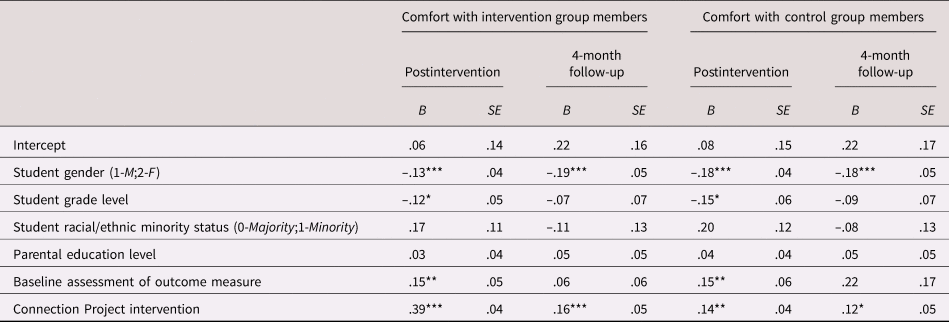
After accounting for baseline levels of each outcome and for demographic characteristics of students, significant effects of the intervention at postintervention assessment were observed for students’ level of comfort around other students. Intervention students displayed higher levels of comfort both with other intervention group students and with control group students (even though the control group students had actually spent more time with one another given the weekly pull out of Connection Project students from their health class). These effects remained significant at 4-month follow-up. Results are presented in Table 2.
Intervention effects on comfort with other students (covarying baseline comfort with other students and demographic and teacher factors)

*p < .05. **p < .01. *** p < .001.
Question 2: Can the intervention alter behavior, both as independently observed by peers and in terms of participants’ use of social supports to cope with stress?
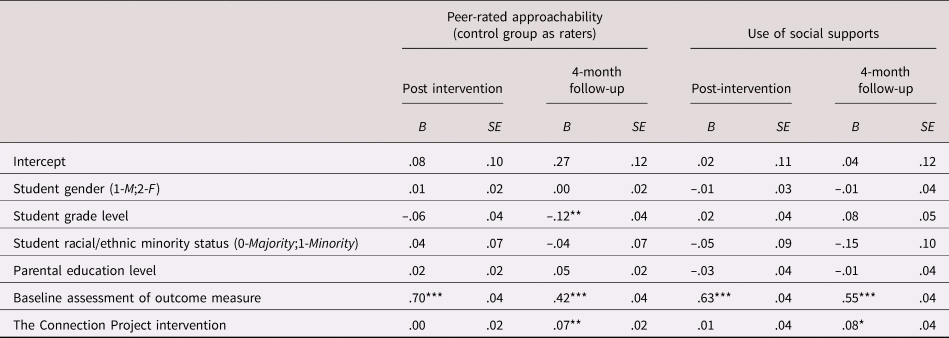
We next examined whether control group students (i.e., who were not part of the intervention) would rate intervention students differently than they would rate other control group students in terms of their approachability (i.e., how comfortable they were around them), thus providing a measure of change in intervention students’ relationships that was not dependent on either self-report or report of other members of the intervention group. Results are presented in Table 3. At the postintervention assessment there was no difference between the groups; however, by the 4-month follow-up assessment, intervention students were rated as significantly more approachable by control group students than control group students were rated by one another.
Intervention effects on sociometric approachability and use of social supports (covarying baseline of each outcome and demographic and teacher factors)

*p < .05. **p ≤.01. ***p < .001.
We next examined whether the intervention would alter students’ use of social supports to cope with stress. After accounting for baseline levels of each outcome and for demographic characteristics of students, no effect of participation on use of social coping approaches was detected at postintervention assessment. At the follow-up assessment, however, intervention students’ use of social coping strategies was significantly greater than that of control group students as shown in Table 3.
Question 3: Can the intervention alter students’ levels of depressive symptoms and academic engagement?
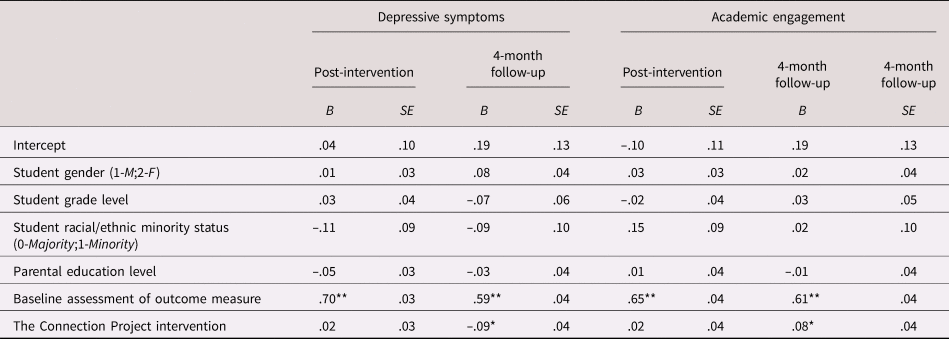
At the postintervention assessment, no significant intervention effects were found for students’ levels of depressive symptoms or academic engagement. Results are presented in Table 4. By the 4-month follow-up assessment, however, significant effects were found with both measures such that intervention participants displayed both lower levels of depressive symptoms and higher levels of academic engagement.
Intervention effects on depressive symptoms and academic engagement (covarying baseline of each outcome and demographic and teacher factors)

*p < .05. **p < .001.
Question 4: Will changes in levels of youth depressive symptoms and academic engagement be mediated via increased use of social supports when coping with stress?
Analyses next assessed whether adolescents’ use social supports to cope with stress might serve as a potential mediator of the relationship between program participation and academic engagement and depressive symptoms at the 4-month follow-up assessment. Use of social supports both at postintervention and follow-up assessments were each considered as potential mediators, with baseline levels of use of social support, demographic factors, and baseline functioning measures included as covariates. These analyses, using a bootstrapping approach (Preacher, Rucker, & Hayes, Reference Preacher, Rucker and Hayes2007) via the Process Macro in SAS (Hayes, Reference Hayes2019), revealed no significant mediation by postintervention use of social supports. However, analyses did reveal mediation via use of social supports at the 4-month follow-up for the intervention effect on both levels of depressive symptoms (βindirect effect = –.01, 95% confidence interval [–.0003, –.035]) and academic engagement (βindirect effect = .01, 95% confidence interval [.00001, .0254]). These findings are consistent with the presence of a pathway by which the intervention led to reduced depressive symptoms and increased engagement by increasing youths’ use of social supports.
Question 5: Are intervention effects moderated by indicators of student racial/ethnic or socioeconomic marginalization?
Although the actual sample breakdown, composed almost entirely of marginalized youth, reduced both the power to detect moderated effects and the applicability of this question in this study, multilevel models were nevertheless examined to determine whether effects of the intervention differed based on students’ baseline demographic characteristics. Moderation was assessed by entering a centered interaction term for each Student Characteristic × Intervention Group into the equations above following entry of all other factors. No moderating effects of parental education level or student racial/ethnic minority status were observed for any of the outcomes assessed. This means that the impact of the intervention did not differ significantly across socioeconomic groups.
Post hoc analyses
Other potential moderating effects
Using the same analytic approach described above, moderation via student grade in school and gender were also examined. One interaction, of Gender × Intervention Status on depressive symptoms at postintervention assessment, was found (β = .09, p = .009). Follow-up analyses conducted separately by gender revealed no significant effects for males or females.
Time course of intervention effects
To further describe the time course of the pattern of results observed and as a robustness check on the findings above, analyses were conducted to determine whether observed effects were consistent with a linear or quadratic trend of increasing impact of the intervention over time. To assess this, linear and quadratic growth curves were examined paralleling the models above, examining each of the behavioral outcome measures over time. For example, the model predicting change in use of social support over time included intervention status, demographic controls, a linear and quadratic effect of TIME (baseline, postintervention, follow-up), and the interaction of TIME and TIME2 with each of these other factors.
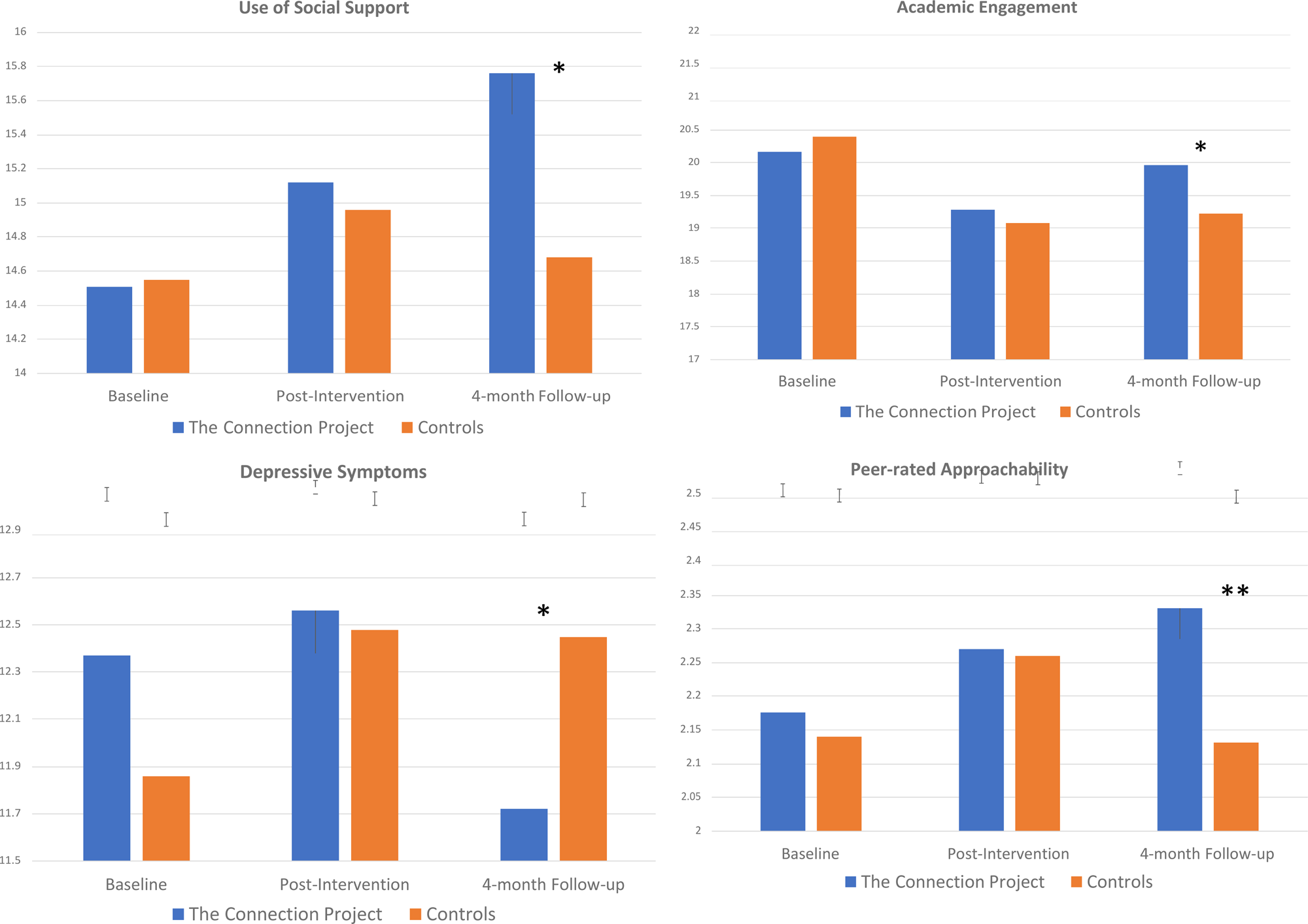
In these models, a significant Time × Intervention effect was found for use of social support (B = .54, SE = .28, p = .05), academic engagement (B = .44, SE = .19, p = .02), and peer-rated approachability (B = .09, SE = .04, p = .04), and a significant quadratic effect was found for TIME2 × Intervention for depressive symptoms (B = –.59, SE = .27, p = .028), indicating that the intervention led to increasing use of social coping behavior, decreasing depressive symptoms, and increasing academic engagement over time. Results are shown in Figure 1, and reflect a generally widening gap from baseline to postintervention to follow-up between intervention and control groups.
All values are adjusted for gender and parent education levels. Postintervention and follow-up measures are also adjusted for baseline levels. *p < .05. **p < .01.

Discussion
This study found that a universal intervention was successful in altering peer experiences in schools that serve primarily racially/ethnically and socioeconomically marginalized students with longer term effects on several key functional outcomes as well. The study builds on the longstanding recognition that the socialization component of settings such as schools, in which youth spend tremendous amounts of time, should be of primary interest to those interested in enhancing developmental outcomes (Zigler & Bishop-Josef, Reference Zigler, Bishop-Josef, Singer, Michnick Golinkoff and Hirsh-Pasek2006). The intervention supported this notion by also showing that the effort to alter the social component of students’ secondary school experience had positive spillover effects on students’ mental health and academic engagement. No moderating effects of student race/ethnicity or parent education levels were found; this may mean either that the intervention was equally effective with the relatively small percentage of nonmarginalized students in schools, or simply that the small percentage of these students in this sample limited power to detect such moderation.
The most immediate impact of the intervention was seen in the way it altered participants’ perceptions of their peers. By the end of the intervention, participants reported that they felt less guarded and more comfortable around their peers in the intervention—a primary goal of the program. More strikingly, however, these effects also generalized such that the intervention also altered participants’ perceptions even of the students who were not in their intervention group (i.e., the control group students), making participants more comfortable around them as well.
Although the intervention changed students’ perceptions of their peers by its conclusion, other effects emerged only over time. At the postintervention assessment, for example, there were no effects for participants’ use of others for social support or for the degree to which non participating teens viewed them as more approachable. By the 4-month follow-up assessment, however, intervention participants behaved in such a way that they were seen to be more approachable by their peers from outside the intervention group. The finding that control group students rated intervention students as more approachable than their fellow control group students was particularly noteworthy given that control group members actually spent more time with one another than with the intervention group members (i.e., during the 1 day each week when the intervention “pull-out” took place and the control group members remained together in regular class). In addition, at follow-up intervention participants also reported that they were more likely to turn to others for social support when stressed. This change in social behavior was viewed as a key intervention target, as it then activates the peer network as a potential context for social support.
Effects on participants’ levels of depressive symptoms and academic engagement also appeared over time. There were no intervention effects at the postintervention assessment, but by the 4-month follow-up assessment, intervention participants displayed lower levels of depressive symptoms and higher levels of academic engagement than control group members. Post hoc trend analyses suggest that this end point was consistent with a growing pattern of gains begun by the postintervention assessment that did not become large enough to be statistically reliable until the 4-month follow-up.
All of these delayed findings were consistent with the logic model of the intervention. As noted previously, the Connection Project was not designed as a social skills intervention, but rather one in which the goal was to gradually change participants’ social relationships. The active ingredient hypothesized to ultimately influence teens’ level of functioning was not the content of the intervention, but the enhanced relationships that it was designed to promote. The operative theory is that these relationships would develop gradually over the course of the intervention to become an increasingly salient source of support, which would then influence students over time as they moved through school. Given that safe, supportive relationships were only getting firmly established by the end of the intervention, it is thus not surprising that it would take some time for these relationships to have observable effects on participant behavior and functioning outside of the intervention group. Modest evidence of such a process in which participants’ use of social support mediated other program effects was found, although this mediated effect was quite small and appeared only in some analyses.
This pattern of growing program impacts over time is also consistent with Yeager and Walton's (Reference Yeager and Walton2011) notion that interventions such as the Connection Project can set in motion recursive processes. In this case, students who develop more positive expectations of others and who are viewed more positively by them would in turn be more likely to form supportive relationships with their peers, which in turn would enhance their expectations and behaviors going forward as part of a virtuous cycle. Regardless of the precise explanation for the delayed impact of the intervention, the findings of growing effects over time are encouraging. For the vast majority of interventions, fade-out of effects is a significant issue; this intervention, in contrast, had the opposite result, at least over a 4-month period.
The finding that a socially oriented program would have effects on academic behavior and mental health is also in keeping with our growing understanding of the central importance of peer relationships in adolescents’ broader lives (Allen, Narr, Kansky, & Szwedo, Reference Allen, Narr, Kansky and Szwedoin press; Allen, Uchino, & Hafen, Reference Allen, Uchino and Hafen2015). To the best of our knowledge, this is the first universally targeted intervention shown to reduce depressive symptoms in adolescents (Stice, Shaw, Bohon, Marti, & Rohde, Reference Stice, Shaw, Bohon, Marti and Rohde2009), a significant finding given the immense individual and societal costs of even sub threshold levels of depressive symptoms (Bertha & Balázs, Reference Bertha and Balázs2013). The link between peer relationship quality and other positive outcomes in this study likely reflects adolescents’ heightened sensitivity to social information (relative to adults), and stronger emotional reactions to such information. This is particularly true in middle to late adolescence (Somerville, Reference Somerville, Jone, Ruberry, Dyke, Glover and Casey2013), suggesting that early high school could prove an ideal time to implement peer interventions so as to establish healthier social and functional trajectories for youth. At this age, teenagers are maximally sensitive to peer information, but are early enough into adolescence to allow time for changes to readily occur and be carried forward.
Findings regarding effects of the intervention on student academic engagement are also consistent with longstanding evidence on the central role of peer relationships to adolescents’ school experiences (Resnick et al., Reference Resnick, Bearman, Blum, Bauman, Harris, Jones and Udry1997). The current findings suggest that targeting these relationships directly may be worthwhile in future efforts to enhance adolescents’ academic experiences. From this perspective, the implications of this study for a broader picture of adolescent development and psychopathology harken back to Zigler's early recognition of the importance of meeting basic needs of children when implementing preventive interventions (Zigler, Plotrkowski, & Collins, Reference Zigler, Piotrkowski and Collins1994). Head Start focused in part on child nutrition, and a nutritional metaphor seems apt here as well. Some adolescents appear psychosocially “poorly nourished,” experiencing mainly stress from peer relations that are becoming developmentally critical, in a way that leaves them susceptible to a wide array of pathological outcomes (Allen, Seitz, & Apfel, Reference Allen, Seitz, Apfel, Phillips, Aber and Jones2007). Addressing these needs may lead to a beneficent process of multifinality (Cicchetti & Toth, Reference Cicchetti and Toth1998), in which multiple outcomes can be addressed via the same intervention.
Several limitations of the study also warrant note. First, the findings were modest in magnitude and replication is clearly warranted prior to generalizing these findings to other populations or settings. Second, significant attrition existed at both time points. At the postintervention assessment, some evidence of differential attrition was also observed, further qualifying the findings. However, it should be noted that at the follow-up assessment at which the most striking findings were obtained, there was no differential attrition and overall levels of attrition still fell within the acceptable range of What Works Clearinghouse guidelines (Deke et al., Reference Deke, Wei and Kautz2017). Third, a number of the outcome measures relied upon adolescent self-report, and the possibility that demand characteristics influenced the results cannot be discounted. One would, however, expect demand characteristics to have had the greatest impact at the postintervention assessment, when participants had been most recently exposed to the intervention; yet, it was at the 4-month follow-up assessment when some of the strongest findings emerged. This slightly reduces, but certainly does not eliminate, concerns about such demand characteristics. Unfortunately, actual academic performance data were not available, and it is unclear if such data will become available in the future, though these would clearly be an important outcome to consider. Future research and replication efforts addressing these limits are warranted, however, as this study clearly suggests the potential of peer-oriented interventions to address a range of needs of marginalized youth in academic settings.
Financial support
This study was supported by grants from the William T. Grant Foundation and the National Institute of Child Health and Human Development (R37HD058305 and R01HD058305).