At Sage Bionetworks, a non-profit biomedical research organization dedicated to exploring open systems and approaches in the sciences, we began actively studying informed consent in 2013, and observed that informed consent in practice has conventionally been implemented primarily as a process that allows extraction of either physical specimens or digital specimens from research study participants. This process often proceeds without structural attempts to understand if the process “works,” that is, whether it creates a participant ready to make an autonomous choice as to whether or not to enroll.Reference Montalvo and Larson1 Informed consent has not been implemented as a relationship, but instead as a single-point transaction that must be completed in order to enroll participants.
As we transition to using electronic methods,2 however, the informed consent process offers a unique opportunity. First, e-consent provides an opportunity to truly inform research participants about clinical protocols. Second, well-structured electronic consent can provide a meaningful choice architectureReference Thaler, Sunstein and Balz3 to support a potential participant's decision making about whether or not to enroll. Third, the electronic interaction can serve as the beginning of an ongoing ethical relationship with study participants. Sage Bionet-works proposes to transform informed consent into an ongoing relationship of trust-based permission, as part of the transformation of clinical research studies into a digital context. We have begun initial work and experimentation to explore the potential ramifications of such a transformation.Reference Doerr, Suver and Wilbanks4
Clinical research structures that developed in late-20th century research primarily took place inside large institutions under standardized funding regimes. However, the traditional institutional research model does not collect data at the price, rate, volume, or granularity now afforded by digital technologies. For example, the Longitudinal and Biomarkers in PD study (LABS-PD), sponsored by the Parkinson Study Group (PSG) and supported by the Parkinson's Disease Foundation (PDF), is a classic traditional study. It has enrolled 600 participants, and study
investigators meet annually in-person with each participant to assess and record progression of motor and nonmotor symptoms and any changes in behavior and cognition. Every six months, the team will conduct phone and mail surveys regarding diagnosis, medications, dyskinesias or dystonia, hallucinations, fatigue, sleep, utilization of health care services, social supports available and the economic impact of Parkinsonism.Reference Ravina5
As a comparison, Sage Bionetworks' mPower study, also of Parkinson's Disease, enrolled 8,000 participants in its first day and uses sensors on mobile phones to gather similar classes of data twice a day, rather than annually.Reference Bot6
Many of the technologies increasingly used in research are owned directly by research participants — mobile devices and wearables, for example. Those technologies allow participants themselves to generate data — GPS activity, information consumption, and so forth. This could mark the beginning of a power shift toward the individual citizen in the research context. At least in theory, the research enterprise cannot access any of this information without explicit permission from the individual.
Many of the technologies increasingly used in research are owned directly by research participants — mobile devices and wearables, for example. Those technologies allow participants themselves to generate data — GPS activity, information consumption, and so forth. This could mark the beginning of a power shift toward the individual citizen in the research context. At least in theory, the research enterprise cannot access any of this information without explicit permission from the individual.
However, these digital technologies have emerged from an economic and cultural context in which the individual is systematically disempowered. These technologies have terms of service and design structures that don't provide rights to self-determination or informed decision-making. They have indeed been successfully designed to be accepted without comprehension, or even being read.Reference Obar and Oeldorf-Hirsch7 They now sit uncomfortably adjacent to the demands of bioethics in clinical trials design.
Those of us testing new forms of technologically mediated clinical studies therefore face a moment of choice: We can either adapt the traditional systems of bioethics and informed consent into this new context, or we face the risk that designs built for obscurity, contracts meant to go unread, become ascendant in clinical research. The volume, velocity, and variety of data that can be made available from digital technologies represent a quantum leap forward in the ability to measure individual health. The question is, what ethics will govern them?
Work at Sage Bionetworks
At Sage Bionetworks, with support from the Electronic Data Methods Forum, the Agency for Health-care Research and Quality, the Helmsley Charitable Trust, and the Robert Wood Johnson Foundation, we have been investigating electronic informed consent since 2013. By electronic informed consent, we mean a consent process that is born digital, designed to be completed by a potential study participant on a phone, tablet, or computer screen, and that assumes no interaction with a clinical research professional before or during the consent “interaction.”
In exploring electronic consent, we began with traditional informed consent, where processes often do not place priority on the goal of making sure the individual is actually informed.Reference Cassileth, Zupkis, Sutton-Smith and March8 Informed consent documents are often written in complex language,Reference Paasche-Orlow, Taylor and Brancati9 and consent interactions are pressed for time. Standardized versions of informed consent documents can often make it difficult to adjust the language to a given study context. Comprehension assessment is rarely recorded as part of informed consent other than in studies attempting to measure understanding of informed consent processes.Reference Flory and Emanuel10
Second, informed consent documents must play multiple roles. In addition to their stated purpose of informing research participants, they must also satisfy extensive regulatory requirements, which can make them extremely difficult to read and lead them to obscure the actual research choices at hand. They are also often used to reduce exposure to liability for research institutions, which has a similar impact on readability and comprehension.
When the informed consent process moves into an electronic context without personal interaction, two additional problems emerge quickly. First, we must consider the cultural context in which we encounter legal choices in a digital economy. We are culturally conditioned to accept legal provisions without reading them; we click “agree” after only a short time using modern internet, mobile phones, and other computerized resources. Simply attempting to read all of the privacy policies and terms of use that govern a typical internet user would occupy so much time that it would approach a part-time job.11 Second, there is some evidence that we physically process text differently on a screen than we do on paper. We appear to skip over screen text in a skimming process, one that can be observed through studying eye gaze fixation or through simple reading speed analysis.Reference Weinreich, Obendorf, Herder and Mayer12
Meaningful electronic informed consent must therefore address both traditional problems and the new problems posed by screens and digital culture. Two themes have emerged in our work on e-consent that serve as boundaries for emerging informed consent processes. First, although the problems we identified in traditional consent were well known, there was a perception by all stakeholders that change was extremely difficult. Analogous to the concept of technical debt13 in software, stakeholders saw too many different elements requiring too many different changes in a system characterized by multiple interactions and rife with unintended consequences. But second, we found broad and deep support for reclaiming the original intent of informed consent — to convey needed information to support reflection on the choice at hand, leading to meaningful and legally effective consent or refusal — and for using technology as part of that reclamation.
We exited the research stage of our consent work at Sage Bionetworks in the middle of 2014. Our first attempt at electronic informed consent built on the idea of information “tiers” to communicate essential clinical concepts to potential study participants, with a quiz at the end to provide a rudimentary assessment of understanding.14
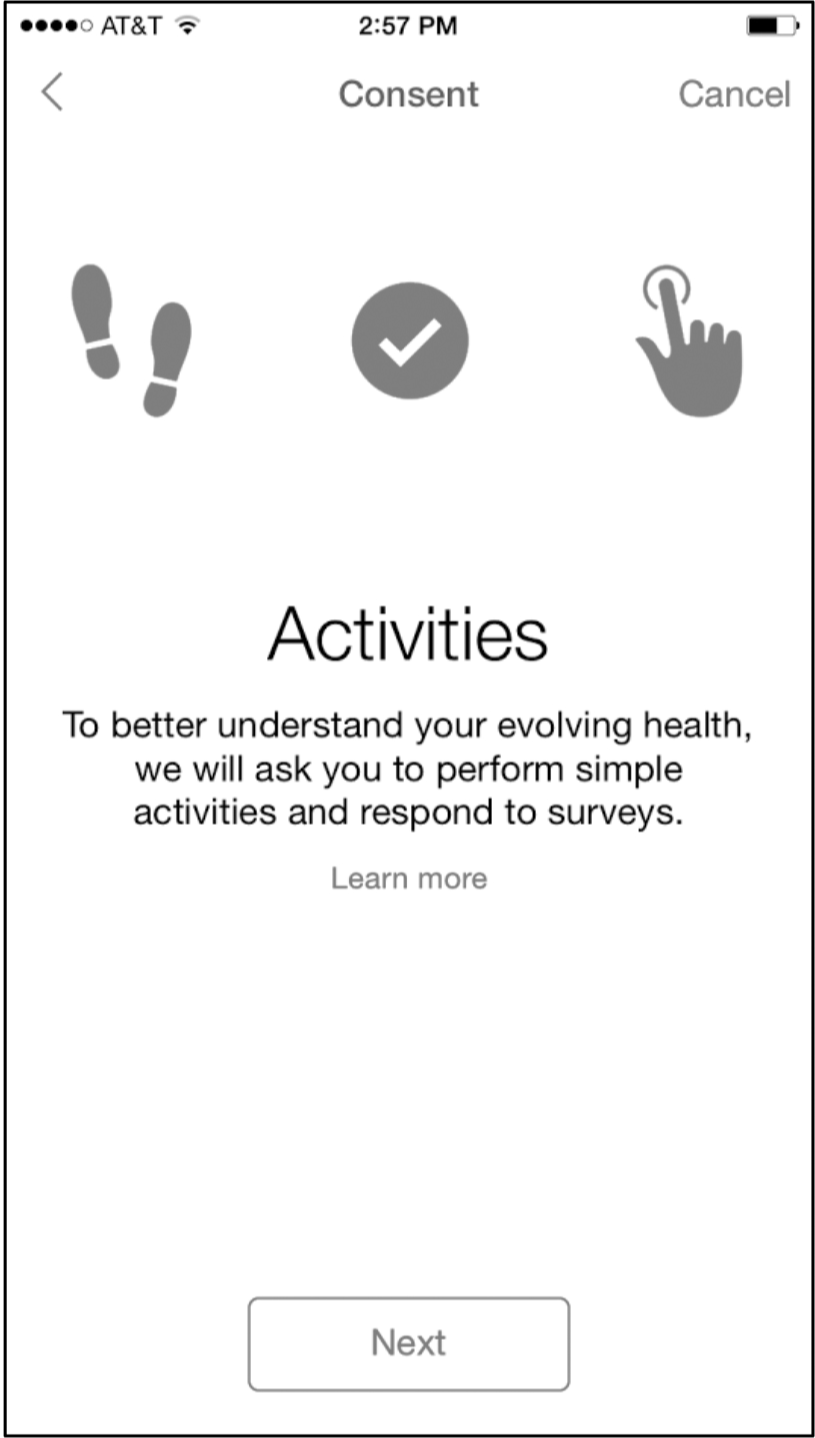
We created these tiers during the clinical protocol design process. We collectively identified the essential clinical concepts that should be understood before making an enrollment choice, then represented them in two tiers: one pictorial-dominant and one text-dominant. The pictorial tier sits at the top level (Figure 1).
Example of “pictorial dominant” screen from a Sage Bionetworks study.

We intentionally structured the screen in an attempt to focus attention through visual saliency:Reference McCay-Peet, Lalmas and Navalpakkam15 a combination of an “on-task” picture, large-font headline, and a sub-headline. We surrounded this trio of elements with lots of white space and a very limited set of actions. Participants can go backwards, cancel out, move forward, or elect to learn more about the presented concept. When electing to learn more, they navigate to the text-dominant tier, where the clinical concept is described in more detail with plain language. On the text-dominant level, the only link is a return to the same clinical concept screen. This ensures a second visual reminder of the concept, to support engagement and retention of information.
To create a relatively consistent experience within a specific informed consent interaction, we elected to use standardized iconography instead of “pictures” — allowing us to create the beginnings of a visual language to describe clinical concepts to potential enrollees (Figure 2).
Example of a standardized iconographic representation of a clinical concept — in this case “data gathering over time” — included in Apple's open source release of ResearchKit.

This is not particularly novel in a design sense. Using abstraction to simplify a complex underlying system sits inside a long tradition in software. The combined collection of visual screens creates a study narrative that can be paged through on a mobile device or computer screen, serving to replicate some of the explanatory interactions from traditional human-mediated consent — a simple “user interface” to the consent form.
This study narrative was submitted to our Institutional Review Board as a fundamental element of informed consent, alongside the more traditional text document. Paired with a short quiz, we built the visual interface and placed it at the beginning of study enrollment inside a mobile application. Only potential participants who completed all stages of the interface and successfully answered every question were presented with an informed consent document to be electronically signed.
However, using iconography or any visual approach to create a “user interface” to the underlying consent document presents a challenge. It is just as possible to use the visual interface to obscure the fundamental concepts of the clinical protocol as it is to use the visual interface to reveal them. And it is very important to understand the semiotics of icon choices — the very choice of visually stimulating images contains an enormous amount of subtext that can affect the participant's perception of a topic.
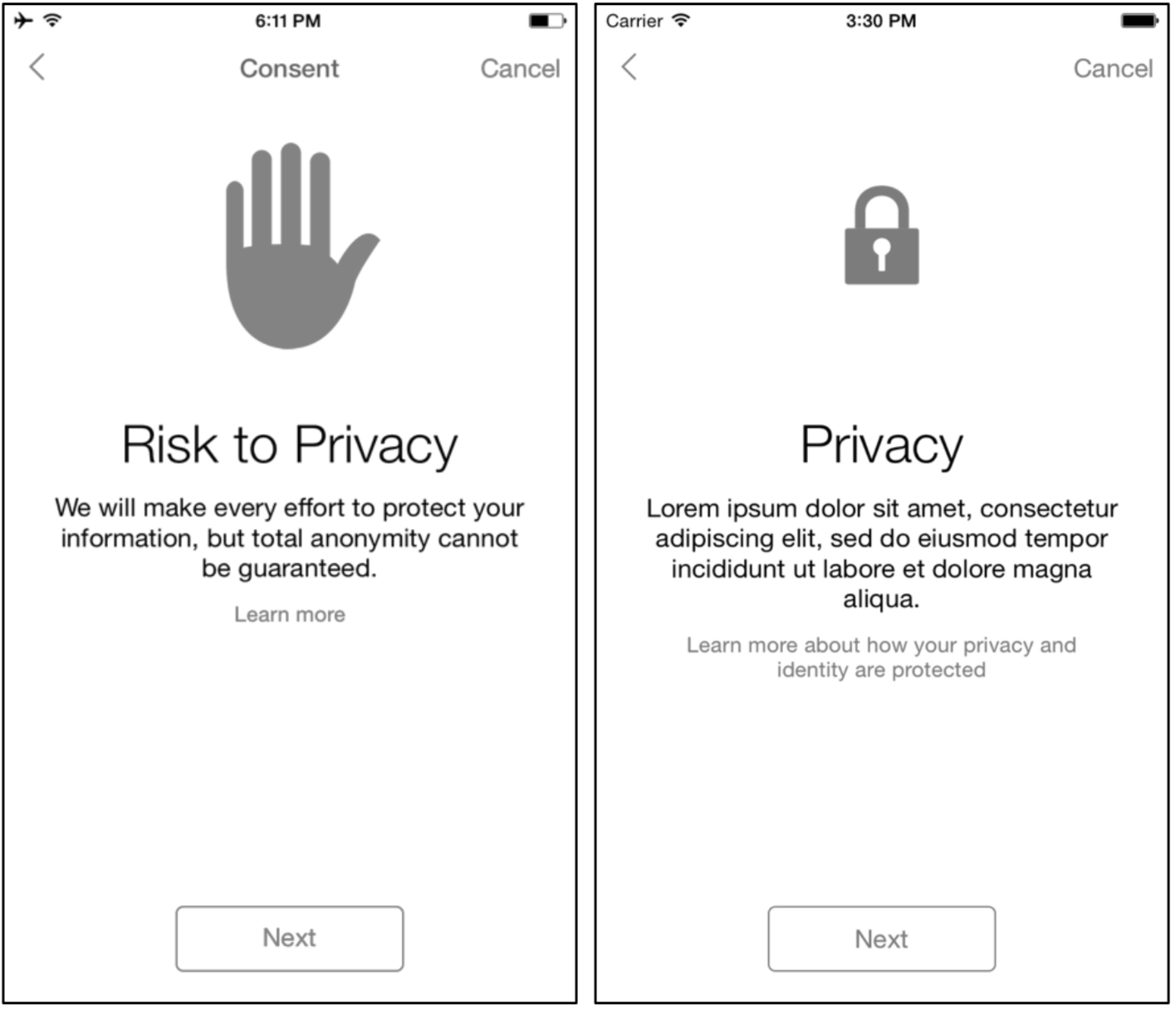
For example, the primary risk in the study we were working on was one of privacy. Although the risk was extremely small, there was a chance that participant privacy could be breached. We had extensive conversations about whether to use an icon of a lock, indicating the efforts we would take to secure the data, or an icon that clearly conveyed risk and arrested the eye to stop and think. In the end, we used a large red outstretched hand, a relatively universal sign to stop, rather than iconography that indicated security. We felt this most accurately communicated what a participant would want to know, even if it wasn't necessarily how the data holders wanted to communicate the concept. And not all others who use these methods agree — the lock is a powerful metaphor for data security (Figure 3).
Example of Sage Bionetworks privacy semiotics versus “default” privacy semiotics.

One interesting development from our research was that all parties involved named the human-to-human interaction in the traditional consent experience as its best feature. However, that is precisely the element that must be removed for scalable electronic informed consent. Human interaction creates space to ask questions, to express doubt, and for the clinical research professional to assess capacity to consent. We did not have an answer for how to recreate the opportunity to ask questions or express doubt. The same cultural conditioning that creates a likelihood of clicking OK on a document without reading also creates and environment in which we are free to delete, withdraw, unsubscribe and more. Our initial formative evaluation of the consent process has indicated a broad spectrum of comprehension of core research concepts for participants,Reference Doerr and Eysenbach16 and we are preparing a set of experiments to explore this more fully.
However, we felt that addressing capacity — through the proxy of assessing the participant's ability to answer questions about the study that a person who had completed the interface should understand — was an essential requirement before we began using the consent interface, even in low-risk observational studies. We thus developed an assessment process, in which we asked a series of binary (yes/no or A/B choice) questions to evaluate participant comprehension. In our initial studies, participants were required to obtain a perfect score on a “summative” assessment to proceed and be offered the opportunity to enroll. In follow-on studies, we have begun experimenting with a “formative” assessment in which every incorrect answer leads to more education and guidance, with a summary score at the end of the assessment. To priori-tize participant autonomy, we will allow participants who do not receive a perfect score to enroll, continue after they are presented with their scores, and have a chance to repeat the consent interfaces as many times as they wish. We developed this formative approach for lower-risk observational studies; it may not be appropriate for higher-risk observational studies and likely isn't appropriate for interventional research.
The results have been striking. More than 100,000 participants have enrolled in Sage-supported studies since March 2015. We also released a set of assets called the “participant-centered consent toolkit” in January 2015.17 Our approach was integrated into Apple's ResearchKit framework, where it supports 33 appsReference Tourraine18 as of May 2017. Notably, the visual approach was adopted and extended by Kaiser Permanente for their ResearchBank project,19 and forms the basis for the National Institutes of Health Precision Medicine Initiative, also known as the “All of Us” (AoU) cohort.20 The AoU cohort program will enroll more than 1 million Americans over 10 years and integrates electronic health records, physical examinations, wearable sensors, participant-provided information, blood and urine specimens, DNA and more, representing the largest and highest impact use of our approach to date.Reference Comstock21
However, we believe that our approach represents only a rudimentary attempt at using interaction design approaches inspired by software to improve the informed consent experience, in person and when digitally mediated. The linear, pictorial, narrative approach appeals most cleanly to a paradigmatic Apple user. We know from informal communications with participants that we need to build out a matrix of different participant personality archetypes, leveraging culturally appropriate consent interactions. We use an inclusive definition of “culturally appropriate” — one that addresses age, economics, gender, ethnicity, identity, and attitudes to research, among other factors. If we do not address the fundamental individuality of participants, we will not succeed in achieving the potential for ethical enrollment into digitally mediated studies.
Future Directions
We have identified a series of design directions for future consent interactions. To begin, we know that we must take the kind of content developed for visual consent and provide it in non-visual delivery vectors. For example, we know that for many individuals communication via SMS and text is preferred over the iPhone-style visual narrative.22 Thus we expect to provide the ability to navigate the content through a participant's native chat application as a participant-configurable preference. Similarly, we also know that many participants prefer a video summary (with no clicking required) all of the relevant information contained in the visual narrative. Thus we also expect to provide the content as a long-form video, with a combination of “talking heads” and animation, for participants who prefer that interaction.
But the most interesting design work revolves around how to move beyond simple pedagogical techniques intended to teach “known knowns,” which is how we have used visual consent to date. Much clinical research involves attempting to understand benefits and harms, or to develop knowledge, and therefore the benefits and harms cannot be “taught” in a traditional sense. Instead, we must explore ways to provoke participant reactions about concepts of uncertainty, emergence, and probability. The linear narrative form, presented in visual or video or text, may not be the best method to provoke those reactions.
One methodology that we are exploring leverages shared decision making techniquesReference Godolphin23 and video, in which we create fictional participant archetypes (known in design as “personas”). We then place those personas into stories that describe a choice to enroll in a study, the outcomes of the study, and whether or not the fictional participant was happy with those outcomes. A participant selects a persona that most matches herself, and is presented that video, but can also select other personas to explore the same decision from multiple perspectives, outcomes, and worldviews.
Another method involves a provocation of the research participant with multiple statements about the research, and then a scoring methodology to reflect back to the participant how their responses might guide their enrollment decision. This is a fascinating process with which to provoke uncertainty and discomfort in participants about emergent research, such as genomic sequencing research or research on variants of uncertain significance (VUSs) in DNA. We do not know the outcomes of such research, so it falls on us to convey that lack of knowledge in a meaningful interaction to a participant. We might write statements such as “I don't mind having 7 vials of blood drawn” or “I think I am unlikely to be a victim of genetic discrimination” and allow participants to rate those statements as being more or less likely to make them want to participate. At the end we might provide a “score” that provides them a sense of how their answers might reflect their risk-benefit perception of the study, and then provoke the participant to ask if they still wish to enroll.
Several potential methodologies come from the world of games. Games are remarkably effective at rapidly orienting their participants to a digital world. One can easily imagine an interactive quiz-based game where wrong answers receive immediate correction and correct answers propel the participant towards a finish line. This would be informed consent as a process in which participants must find their way through a puzzle — one designed to provoke and inform and assess them — and could draw on decades of best practices in participant orientation and guidance. Another way we might learn from games is to explore how role-playing may connect to informed consent. One could imagine orienting a potential research participant to the role of a clinical research professional, scientist, or other stakeholder in clinical research, and then asking them to make decisions within that role. The participant would then receive feedback on the consequences of choices made within those roles, and on the benefits and harms created. The participant would be given time to choose different choices and roles, and to see the differences in outcomes. This approach could create a significantly greater understanding of how research works, and how research design decisions affect the participants.
Several potential methodologies come from the world of games. Games are remarkably effective at rapidly orienting their participants to a digital world. One can easily imagine an interactive quiz-based game where wrong answers receive immediate correction and correct answers propel the participant towards a finish line.
Looming large over any conversation of electronic consent is the technical, cultural, and economic environment implicit in smartphone-enabled studies. This environment is the true context for electronic consent. It defines the way we think about choices in a digital context, not a clinical one. We can install or uninstall apps with little transaction cost, creating an attention economy,Reference Terranova24 where only the best designed or most addictive apps survive. At the same time, our computers and mobile devices emit vast streams of data, buffed and polished by industrial designers and behavioral economists to keep their apps high on the attention scale. Electronic consent needs to be specifically designed for that environment, and not simply act as a blunt translation of the physical process already in place.
One can easily imagine a difficult choice for an investigator between an intentionally frictional consent process yielding a 50% enrollment rate and a frictionless, one-click interaction yielding higher numbers. The incentive structures surrounding that investigator are likely to lead to choosing the frictionless one. More enrollees means more press, more data, perhaps a better paper and more grants, points in the tenure and review process, and other positive imagined outcomes. Another task for us, then, is to build an electronic research culture that self-regulates, that looks for and accepts consent friction as not simply tolerable, but important — a badge to wear with some pride.
In the concept of “cognitive friction”25 we may find some inspiration, and a potential path forward. The term was coined by Allan Cooper to refer to “…the resistance encountered by human intellect when it engages with a complex system of rules that change as the problem permutes.”26 The goal of much modern design to eliminate it. Friction turns away eyeballs, reduces clicks, and slows system adoption, as people's brains resist the complex systems in front of them.
Cognitive friction is therefore, in most technology design, the enemy, primarily because it forces people to think about their actions, rather than having their actions seamlessly suggested to them. But if we think of informed consent as requiring intentional — beneficial — friction, then we have an opportunity to leverage designers as partners.
Interestingly, we see echoes of this in the mainstream design world as well. AirBnB designer Steve Selzer has noted that when design removes friction, it also removes moments for self-reflection.Reference Selzer27 He has even called for designing friction intentionally into systems to help technology users build skills, reflect, think, and interact.
Electronic consent thus sits at a complex control point in the research ecosystem. It represents the front door of a clinical research study, a process developed over decades to treat the participant as a subject — but it must look and feel familiar among online and smartphone experiences designed to be frictionless. It must attempt to educate the human holding the phone about terms and conditions, benefits and risks, even though the rest of that human's experiences attempt to obscure education on precisely those topics.
We have to live in this world, but we must be careful of our place in it. For example, we definitely want to design electronic consent experiences that are culturally relevant, ethically informing, and ideally, engaging. Choice architectures provide a variety of tools for presenting people with choices,Reference Johnson28 and those same tools are clearly in scope in designing consent practices and methods. Similarly, the practice of rapidly testing two interfaces (or messages) against one another at the same time, also known as A/B testing, provides a beneficial path for designing informed consent in which multiple versions of content, design, functionality, and more can be tested to see what works better, for whom, and when.Reference Tang29 A/B testing underpins vast swathes of digital culture, from the way Facebook shows our feed, to which photographs President Obama used in campaign messages, to Wikipedia annual gift campaign designs.
The culture of “nudge” economics and relentless A/B testing can have a downside for electronic informed consent, as these are tools most often used also to maximize engagement numbers. One can easily imagine a difficult choice for an investigator between an intentionally frictional consent process yielding a 50% enrollment rate and a frictionless, one-click interaction yielding higher numbers. The incentive structures surrounding that investigator are likely to lead to choosing the frictionless one. More enrollees means more press, more data, perhaps a better paper and more grants, points in the tenure and review process, and other positive imagined outcomes. Another task for us, then, is to build an electronic research culture that self-regulates, that looks for and accepts consent friction as not simply tolerable, but important — a badge to wear with some pride.
Everything about the friction design process is new, including the workflow. Consent design then requires a budget and design expertise. A final task is thus to ensure a constant flow of methods, templates, tools, heuristics, assets, benchmarks, evidence, and more out to the public commons for openly sharing with others. This allows first-time users to start from a solid floor, and creates familiar elements for ethicists and IRB members to review against baseline implementation. It also creates space for progress as communities take these ideas into their own context, define their own consent interactions and processes, and move into practice.
Conclusion
This moment holds real opportunity for investigators, bioethics, and research oversight. The novelty of electronic consent creates an opening to rethink the way that we design the studies themselves. If we imagine one role of ethics in electronic consent as the search for effective friction, then we can easily see a stake-holder role for ethics in the design process. Being a stakeholder creates an opportunity during study and technology development to look for friction, assess its effectiveness, and bring ethics to bear.
There is a final intriguing possibility for all of this. We know that user retention is the canonical problem for digital technologies. Most applications fail to attract users, and lose the users they do attract very quickly. Early clinical research apps appear to follow a strong pattern of participant attraction and enrollment, but mimic the retention problems of other apps. Analyzing our own work at Sage Bionetworks, we know that we can and must do a better job explaining the studies up front, and that we may do a better job than conventional methods of recruiting and retaining and engaging an informed cohort. The good news is, that is precisely what the science needs as well.
Acknowledgements
This project was supported by grant number U18HS022789 from the Agency for Healthcare Research and Quality. The content is solely the responsibility of the author and does not necessarily represent the official views of the Agency of Healthcare Research and Quality.