


Introduction
Problems of anxiety and depression are very common in the general population (Goldberg and Huxley, Reference Goldberg and Huxley1992). Epidemiological studies in the UK suggest that more than one in six people suffer from an anxiety disorder, depression or mixed anxiety and depression at any one time (Office of National Statistics, 2009) of whom around one-third seek help for mental health problems from their GP (Bebbington et al., Reference Bebbington, Meltzer, Brugha, Farrell, Jenkins, Ceresa and Lewis2003; Office of National Statistics, 2009). In at least half of these cases anxiety and/or depression will be mild or moderate in severity (Kessler et al., Reference Kessler, Berglund, Demler, Jin, Koretz, Merikangas, Rush, Walters and Wang2003).
Psychological therapies such as cognitive behavioural therapies (CBT) are recognized as effective for anxiety and depression (Roth and Fonagy, Reference Roth and Fonagy2005; Department of Health, 2001; National Institute for Clinical Excellence, 2004a, b, 2009). However, for those suffering from anxiety and/or depression in the UK, there is evidence that these have not yet been made routinely available in clinical care (Shafran et al., Reference Shafran, Clark, Fairburn, Arntz, Barlow, Ehlers, Freeston, Garety, Hollon, Ost, Salkovskis, Williams and Wilson2009). The point prevalence for receipt of psychotherapy or counselling was recently measured at just 10% of those with “common mental disorders”, with just 2 in 100 accessing behavioural or cognitive therapies (Office of National Statistics, 2009). Whilst the evidence base is compelling, developing and supporting effective and sustainable models of service implementation for the dissemination of evidence based practices presents a significant challenge (see Andrews and Titov, Reference Andrews and Titov2009; Chorpita and Regan, Reference Chorpita and Regan2009; Tansella and Thonicroft, Reference Tansella and Thonicroft2009).
Around the UK a number of strategies are being employed to expand the availability and increase the accessibility of psychological treatments for anxiety and depression and to extend the reach of evidence based interventions such as CBT. The initiatives are aimed at improving health and well-being, promoting social inclusion and improving economic productivity within the population (Department of Health, 2007, 2008a). This includes a rethinking of both what services offer and how they offer it (Williams and Martinez, Reference Williams and Martinez2008). The Department of Health advises service commissioners that the majority of people seeking support should begin with a “relatively brief low-intensity intervention” (Department of Health, 2008a, p. 22). Recommended low-intensity interventions include supported self-help programs based on CBT principles such as computerized cognitive behavioural therapies (CCBT) for mild-to-moderate depression, phobia and panic (Department of Health, 2007; 2008a; National Institute of Clinical Excellence (NICE), 2006, 2009). As well as meeting the primary needs of service-users and increasing access to evidence based treatments, supported self-help programs can promote mastery, coping, empowerment and learned resourcefulness (Marks, Cavanagh and Gega, Reference Cavanagh, Shapiro, van den Berg, Swain, Proudfoot and Barkham2009; Tung-Hsueh Lui et al., Reference Tung-Hsueh Lui, Wan-Lan, Yi-Hwei, Chiao Han, TzeJing and Hwei Shan2009).
Dedicated Increasing Access to Psychological Therapies (IAPT) services have been piloted and are being rolled out in accord with recent government funded initiatives (e.g. Clark et al., Reference Clark, Layard, Smithies, Richards, Suckling and Wright2009). However, these may have underrepresented the potential for CCBT services (e.g. Clark et al., Reference Clark, Layard, Smithies, Richards, Suckling and Wright2009) in meeting population needs for first line psychological services for common mental health problems. In addition to statutory NHS based services, the role of third sector organizations in delivering services to meet primary population needs is being explored (e.g. Chew and Obsborne, Reference Chew and Obsborne2009).
This paper presents data on the implementation of a CCBT service by Self Help Services, a service user-led, third sector organization that delivers tier 2 services for anxiety and depression in Greater Manchester. Self Help Services was established in 1995, and provides a range of socially inclusive services from accessible community venues. The CCBT clinic was launched in 2007, offering supported CCBT programs including Beating the Blues, Living Life to the Full and FearFighter. Beating the Blues is the most commonly used program for the service and has a demonstrated evidence base of efficacy and effectiveness in NHS services (e.g. Proudfoot et al., Reference Proudfoot, Ryden, Everitt, Shapiro, Goldberg and Mann2004; Cavanagh et al., Reference Cavanagh, Shapiro, van den Berg, Dawson, Barkham and Proudfoot2006, Learmonth, Trosh, Rai, Sewell and Cavanagh, Reference Learmouth, Trosh, Rai, Sewell and Cavanagh2008). This paper reports practice-based evidence on the uptake and outcomes for the Beating the Blues CCBT program, measured using the IAPT Minimum Data Set and Key Performance Indicators in relation to extending access and recovery (Department of Health, 2008b).
Method
Participants
The service received 510 referrals for the Beating the Blues service over a 16-month period (November 2007 – March 2009); 348 referrals (68.0%) were female; 310 referrals (60.5%) were from GPs; 187 (36.7%) were self-referrals; 19 (3.7%) were referred from a Primary Care Mental Health team, and 1 (0.2%) from a psychiatrist.
Measures
The service routinely aimed to complete the measures of the IAPT minimum data set (Department of Health, 2008b).
Patient Health Questionnaire Depression Scale (PHQ-9; Kroenke, Spitzer and Williams, Reference Kroenke, Spitzer and Williams2001) is a 9-item scale, which ranges from 0 to 27, with a recommended cut-off of 10 or above for distinguishing between clinical and non-clinical populations (Department of Health, 2008b). The authors report good internal consistency for the PHQ-9 (r = 0.89), and convergent validity with established measures of depression diagnosis and severity in general population and primary care samples has been reported (Gilbody, Richards and Barkham, Reference Gilbody, Richards and Barkham2007; Martin, Rief, Klaiberg and Braehler, Reference Martin, Rief, Klaiberg and Braehler2006).
Patient Health Questionnaire Generalized Anxiety Disorder Scale (GAD-7; Spitzer, Kroenke, Williams and Lowe, Reference Spitzer, Kroenke, Williams and Lowe2006) is a 7-item scale, which ranges from 0 to 21, with a recommended cut-off of 8 or above for distinguishing between clinical and non-clinical populations (Department of Health, 2009). The authors report good reliability, criterion and construct validity for this anxiety measure.
Clinical Outcomes in Routine Evaluation Outcome Measure (CORE-10; Connell and Barkham, Reference Connell and Barkham2007). The CORE-10 was used as a broad-based symptom measure, which ranges from 0 – 40, with a recommended cut of 10 or above indicating likely clinical caseness. The authors report good internal consistency for this measure, discrimination between clinical and non-clinical populations, convergent validity with measures of anxiety, depression and overall mental health, and sensitivity to treatment-related change (Connell and Barkham, Reference Connell and Barkham2007).
Work and Social Adjustment Scale (WASA; Mundt, Marks, Shear and Greist, Reference Mundt, Marks, Shear and Greist2002) is a 5 item scale used to measure self-reported functioning across the domains of work, home management, social and private leisure, and relationships. An additional item reporting on overall functioning was also included. Adapted scale scores range from 0–48. The authors report that the scale has good internal consistency, convergent validity with depression severity measured by the Hamilton Depression Rating Scale and sensitivity to treatment-related change.
Department of Health (2008b) Self-Report Questionnaire assessed employment, covering type of employment (full-time, part-time, unemployed, student, retired, homemaker), receipt of statutory sick pay and state benefits.
The Patient Experience Questionnaire (Department of Health, 2008b) was used to evaluate service users’ satisfaction with the service offered.
Procedure
The CCBT program, Beating the Blues, is an evidence based computerized cognitive behavioural therapy program for depression and anxiety (Proudfoot et al., Reference Proudfoot, Ryden, Everitt, Shapiro, Goldberg and Mann2004). It comprises a 15-minute introductory video viewed on the computer, followed by eight interactive therapy sessions each normally taken at weekly intervals. Each weekly session lasts about 50 minutes with “homework” projects to complete between the sessions (e.g. problem diaries, thought records, behavioural experiments). Weekly progress reports, including the anxiety and depression ratings, together with problem distress ratings, life events and reported suicidality are generated by the program, and progress and outcomes are reviewed by the service volunteer or service coordinator.
The context: Self-Help Services
Self Help Services is a service user led, third sector organization that delivers a range of socially inclusive services from accessible community venues, including tier 2 services for anxiety and depression, in Greater Manchester. The CCBT programs offered include Beating the Blues, Living Life to the Full and FearFighter. The CCBT service reported in this article is funded by NHS Manchester.
Self Help Services comprises a small staff team and a large, diverse and experienced volunteer team of over 70 individuals. In addition to having personal experience of a mental health problem, many of the volunteers and consultants are also employed within the statutory sector, holding positions such as counsellor, psychologist and mental health practitioner. The ethos of Self Help Services is such that they value highly the experiences of those who have had a mental health difficulty at some point in their lives, believing that such individuals can be empowered to put their experiences to good use by providing accessible self-help initiatives in the community to help others similarly affected.
The CCBT service client experience
Following receipt of a GP- or self-referral form, the Self Help Service coordinator aims to contact the potential service user within 7 days, and invites them to a screening appointment at their local CCBT service location, usually within 7 days. A screening appointment with a service coordinator (paid service worker) usually lasts between 30 and 60 minutes, and includes an assessment of suitability and likely benefit from the program. The session involves completion of the IAPT data set questionnaires, a risk assessment and consideration of exclusion criteria. Where the client may be suitable for the program, to help inform their choice an introduction to the CCBT service is offered and they are invited to watch the introductory video for the Beating the Blues program. If the client accepts the service they are invited to complete a therapeutic contract, outlining what they can expect from the CCBT service, and consent for service evaluation data to be used anonymously for the purposes of audit and research publication.
Service users are then invited to attend their first session of the CCBT program, usually within 7 days of the screening appointment. A routine weekly appointment slot suitable for the service user is allocated for the duration of the program. The service user's GP is also contacted by the service to advise them about the use of the CCBT service. An SMS text appointment reminder is sent to the client on the day of each appointment. If service users do not attend the service, a worker will attempt to contact them by phone.
When the service user attends their first session they are greeted by a service volunteer who guides them through starting up on the program, offers technical support and, during the first appointment, gives some advice about how to get the best out of the program based on local service experience. In subsequent sessions a service volunteer will spend between 0 and 10 minutes at the end of each session checking the progress report, and offering support if the client requests this. The IAPT data set questionnaires are also completed during each session.Footnote 1 If a high level of risk is indicated by the progress report, the service coordinator is available to conduct a full risk assessment and act accordingly. At the end of the program a discharge report is sent to the service user's GP.
The data-collection
Self Help Services have a thoughtfully developed, thorough and well maintained data base tracking clients’ journey through Beating the Blues for referrals from February 2007. The service introduced the IAPT minimum data set in November 2007, and this paper reports on the 16-month referral period from November 2007 – March 2009. Service users provided demographic information at their first session and were asked to complete the PHQ-9 and GAD-7 every session. The CORE-OM, WASA and patient experience questionnaire and employment questionnaires were given at assessment and at the end of the program. Key measurement points for service numbers include referral, service contact, completing baseline assessments, beginning the CCBT program, completing at least two sessions of the CCBT program and completing all 8 sessions of the CCBT program.
Key performance indicators for Increasing Access to Psychological Therapies services include building a workforce of trained practitioners to support low intensity CBT programs and to review progress and outcome, to increase access to psychological therapies and to offer services that move more people to recovery and to ensure equality of access to services and outcomes across gender, age and ethnic group (Department of Health, 2009). Where available, data on each of these themes are reported.
Design
A pragmatic, open trial, pre-post design was used.
Data analytic strategy
Descriptive statistics are presented. Inferential statistics are used to assess statistical and clinical significance of change on key measures, and multivariate statistics to explore any interaction effects of intake variables on completion and outcomes.
Results
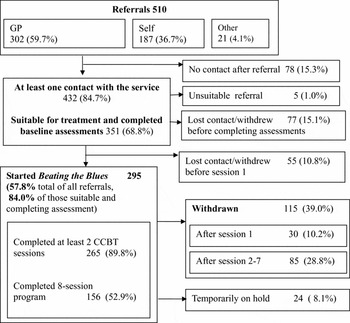
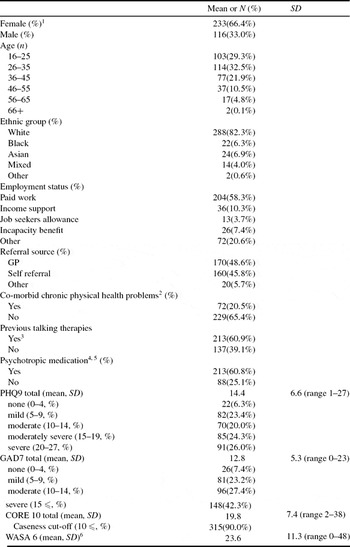
Figure 1 presents the flow of people through the CCBT service during a 16-month referral period (November 2007 - March 2009). Of 510 people with referrals to the service, 386 (75.7%) took up this offer and were assessed for suitability. Three hundred and fifty-one (68.8%) were found suitable for the program, agreed to take part and completed the baseline assessment. The characteristics of this group are reported in Table 1.
Flow diagram for CCBT service from referral to program completion

Intake characteristics for service-users completing baseline assessment (N = 351)

1one missing case for this variable;
252 (14.1%) missing cases for this variable;
3The most common experience of talking therapies was with counselling n = 182;
450 (14.0%) missing cases for this variable;
5Major categories of medication prescribed were antidepressants, tranquilisers and sleeping tablets;
6Adapted 6 item WASA reported in table. When data are transformed proportionate to WASA, 5 item scores for benchmarking purposes (multiplied by 0.83), mean = 19.7, SD = 9.4.
Referral source
A 2 × 2 Chi squared analyses (Pearson's uncorrected) were performed to explore the relationship between referral source and program uptake (X 2 (1, N = 280) = 56.8, p < .001), completion of at least 2 treatment episodes (X 2 (1, N = 254) = 42.1, p < .001) and treatment completion (8 sessions of CCBT, X 2 (1, N = 150) = 19.1, p < .001) comparing GP and self-referred groups. The results indicate that self-referrals are significantly more likely than GP referrals to convert into self-help service users, significantly more likely to complete at least 2 sessions of the CCBT program, and significantly more likely to complete the whole 8-session CCBT program.
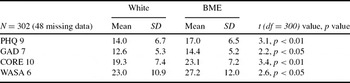
Table 2 presents data on clinical characteristics by ethnicity at assessment, and suggests that at baseline black and minority ethnic (BME) referrals reported higher levels of symptoms, general distress and impairment of functioning than white referrals before starting the CCBT program.
Intake characteristics by ethnicity

2 × 2 Chi Squared tests (Pearson's uncorrected) were performed to explore the relationship between ethnicity and program uptake (X 2 (1, N = 258) = 0.9, p = .4), completion of at least 2 sessions (X 2 (1, N = 233) = 0.1, p = 1) and completing all 8 sessions (X 2 (1, N = 137) = 0.1, p = 1) of the CCBT program, comparing white with black and minority ethnic (BME) referred groups. The results indicated no difference between white and BME groups in their likelihood of starting the CCBT program, completing 2 sessions of the program or completing all 8 sessions following a referral. Nor were any differences found between white and BME in terms of referral source (X 2 (1, N = 330) = 0.7, p = .9) each group being equally likely to be GP or self-referred.
Age
2 × 5 Chi Squared tests (Pearson's uncorrected) were performed to explore the relationship between age and program uptake (X 2 (1, N = 294) = 2.6, p = .8), completion of at least 2 sessions (X 2 (1, 264) = 1.4, p = 0.9) and completing all 8 sessions (X 2 (1, 155) = 1.6, p = .9) of the CCBT program, comparing age groups (16–25, 26–35, 36–45, 46–55, 56–65, 65+). The results indicated that no difference between different age groups in their likelihood of starting the CCBT program, completing 2 sessions of the program or completing all 8 CCBT sessions following a referral.
Gender
2 × 2 Chi Squared tests (Pearson's uncorrected) were performed to explore the relationship between gender and program uptake (X 2 (1, 294) = 3.3, p = 0.1), completion of at least 2 sessions (X 2 (1, 264) = 2.2, p = .2) and completing all 8 sessions (X 2 (1, 155) = 0.2, p = .9) of the CCBT program, comparing female and male referred groups. The results indicated that no difference between males and females in their likelihood of starting the CCBT program, completing 2 sessions of the program or completing all 8 CCBT sessions following a referral.
Medication
2 × 2 Chi Squared tests (Pearson's uncorrected) were performed to explore the relationship between medication status and program uptake (X 2 (1, 295) = 0.1, p = .8), completion of at least 2 sessions (X 2 (1, 265) = 0.4, p = .6) and completing all 8 sessions (X 2 (1, 156) = 0.6, p = .5) of the CCBT program, comparing those reporting having taken psychotropic medication with those not. The results indicated that no difference between those having taken psychotropic medication with those not doing so in their likelihood of starting the CCBT program, completing 2 sessions of the program or completing all 8 CCBT sessions following a referral.
Chronic physical health conditions
2 × 2 Chi Squared tests (Pearson's uncorrected) were performed to explore the relationship between health status and program uptake (X 2 (1, 295) = 0.3, p = .6), completion of at least 2 sessions (X 2 (1, 265) = 0.2, p = .7) and completing all 8 sessions (X 2 (1, 156) = 0.1, p = .8) of the CCBT program, comparing those reporting having a chronic physical health condition with those reporting none. The results indicated no difference between those reporting chronic physical health conditions and those not in their likelihood of starting the CCBT program, completing 2 sessions of the program or completing all 8 CCBT sessions following a referral.
Caseness
Two hundred and forty-six (70.3%) service users providing baseline data met depression caseness criteria (PHQ-9 ≥ 10) and 276 (78.9%) met anxiety caseness criteria (GAD-7 ≥ 8). Overall, 294 (84.0%) service users met either anxiety or depression caseness criteria, and 228 (65.0%) met both. Service users meeting caseness criteria at assessment were more likely to start the CCBT program (253/293, 86%) than those not meeting caseness (40/54; 74%; X 2 (1, 347) = 5.2, p < .05). No difference between those above and below caseness at assessment was found in numbers completing 2 sessions of the program (X 2 (1, 264) = 0.2, p = 0.2) or completing all 8 CCBT sessions (X 2 (1, 156) < 0.1, p = .9) following an uptake.
Clinical characteristics at intake
No differences between those starting the program or not, following baseline assessment, were found in measures of depression (PHQ-9, M = 14.4, SD = 6.4, M = 14.1, SD = 7.8, t(347) = 0.4, p = .7), anxiety (GAD-7, M = 12.9, SD = 5.1, M = 12.4, SD = 6.4, t(347) = 0.6, p = .5), general well being (CORE-OM, M = 19.8, SD = 7.1, M = 19.5, SD = 8.8, t(346) = 0.3, p = .8) or work and social adjustment (WASA-6, M = 24.1, SD = 10.8, M = 21.6, SD = 13.5, t(346) = 1.5, p > .1).
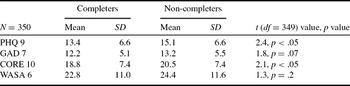
Table 3 explores clinical characteristics by program completion. These data suggest that service users who complete all 8 sessions of the program tended to have lower symptom levels and general distress at intake (small between groups effect sizes Cohen's d = 0.26, 0.19. 0.23 respectively). No differences in self-reported impairment of functioning were found between those completing and not completing the program.
Intake characteristics by program completion

Outcome data analysis
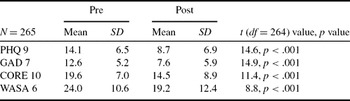
Table 4 presents outcome data for intent to treat analysis of all service users completing baseline assessment and at least two sessions of the CCBT program (N = 265; two or more contacts, in accord with IAPT guidelines about what constitutes a treatment episode). Medium - large, pre - post effect sizes for measures of depression (d = 0.8), anxiety (d = 0.9), CORE-OM (d = 0.6) and WASA (d = 0.4) were found in this intent to treat analysis. At baseline, 226 (85.3%) of this group met caseness criteria for one of (n = 58, 21.9%) or both anxiety and depression (n = 168, 63.4%). Following treatment, 142 (53.6%) no longer met caseness for either depression or anxiety, 41 (15.5%) continued to meet caseness for one, and 82 (30.9%) for both. The shift from 226 people meeting caseness at intake to 123 people meeting caseness at their final measurement indicates a shift of 50.0% cases moving to recovery.
Outcome data for CCBT service: intent to treat analysis (last observation carried forward) for service users attending at least two sessions of the CCBT program

Completer analysis (only those who completed all 8 CCBT sessions) and intent-to-treat analysis for all referral with at least one measurement point were also performed. Larger and smaller treatment effects were measured as would be predicted in using these statistical techniques. For example, a completer recovery rate of 62.2% was measured, whilst intent-to-treat analysis indicated that only 34.7% of those with a baseline measure met criteria for recovery at their final measurement point.
Service user satisfaction
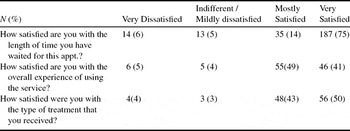
Service users' satisfaction with the service offered was measured using the Patient Experience Questionnaire at assessment (N = 249) and at the end of treatment (N = 112). Table 5 summarizes ratings on this measure. The patient experience data indicate that 89% questionnaire completers were mostly or very satisfied with the length of time waited for appointment. Of people completing post-therapy experience questionnaires, 90% were satisfied with the overall experience of using the service and 93% with the type of treatment they received.
Service user ratings of satisfaction with the CCBT service

Employment questionnaire
Employment data for the sample were incomplete. Pre and post data on the employment questionnaire were available for 107 (40.4 %) of service users who had two or more CCBT sessions. No significant change in employment status was recorded at the final measurement point (58 were full-time employed at baseline, 57 at the final measurement point). One person shifted from receipt of Job Seekers Allowance to full-time employed. Two service users shifted from full-time employment into voluntary/carer/homemaker roles. Three service users shifted from full- to part-time employment, and three shifted from part-time to full-time employment.
Benchmarking of data
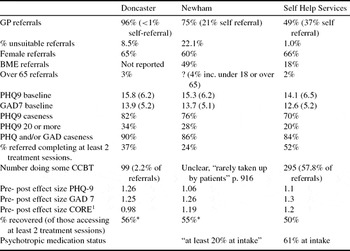
Recent papers have reported on the experience and outcomes of IAPT services offering a suite of low and high intensity services including guided bibliotherapy, guided CCBT and traditional face-to-face CBT within a stepped-care model. Table 6 benchmarks the CCBT self-help clinic data presented here with that reported by Clark et al. (Reference Clark, Layard, Smithies, Richards, Suckling and Wright2009) in their initial evaluation of two IAPT demonstration sites in Doncaster and Newham.
Benchmarking CCBT outcomes in a Self Help Services with IAPT service data

In comparison to these IAPT demonstration sites, the Self Help Services CCBT clinic received more self-referrals and fewer unsuitable referrals, a similar proportion of female/male referrals, and a similar proportion of over 65s. Baseline measures of depression and anxiety were comparable between sites, although the IAPT demonstration sites indicated slightly higher symptom severity. Effect size changes on key outcome measures and recovery rates for those completing at least 2 treatment sessions were comparable between sites. Self Help Services delivered three times as many CCBT treatment episodes as the most CCBT engaged IAPT demonstration site.
Discussion
Summary of findings
This paper reports on practice-based evidence from a 16-month cohort of referrals to a service user-led, third sector CCBT service, designed to offer tier 2 interventions of anxiety and depression in a socially inclusive, widely accessible, low intensity service context.
The Self Help Services CCBT clinic achieved a high throughput of service users, including more than one-third accessing the service via self-referral. Significant levels of symptoms/distress were measured at intake, comparable to reported IAPT services (e.g. Clark et al., Reference Clark, Layard, Smithies, Richards, Suckling and Wright2009) and with no difference between self- and GP referred groups. Openness to self-referral did not appear to inflate the number of unsuitable referrals. Indeed, self-referrals were more likely than GP referrals to engage with and complete the CCBT program and achieved equivalent clinical outcomes. This contrasts with previous research indicating that GP referrals may do best with CCBT therapies (Mataix-Cols, Cameron, Gega, Kenwright and Marks, Reference Mataix-Cols, Cameron, Gega, Kenwright and Marks2006). More than two-thirds of those referred were suitable for therapy and completed baseline assessment and more than half of those referred started the computer therapy program, and completed at least two treatment episodes. This compares favourably with the IAPT services reported by Clark et al. (Reference Clark, Layard, Smithies, Richards, Suckling and Wright2009) and suggests that this kind of third sector self help clinic offers a good match to local needs.
The proportion of BME referrals to the service (18%) suggests a slight under-representation of access in comparison to the Manchester population base (23% Black or Minority Ethnic, mid-2006 count, NHS Manchester and Manchester City Council, 2008). There was evidence of higher levels of symptom severity/distress in BME referrals, but no difference in patterns of accessing the CCBT service or outcomes between white and BME groups. This means that following referral BME individuals were just as likely to start, continue and finish the CCBT program as white referrals, suggesting the service offers a good match to the needs of this group of potential service-users. Referral to the service for BME individuals should be encouraged, and barriers to this (including language, resource and cultural barriers) explored.
Those aged over 65 were significantly under-represented in the service, representing just 2% of the referred individuals, compared to 16% of the local population base. This under representation is mirrored in recent reports of new IAPT services (see Clark et al., Reference Clark, Layard, Smithies, Richards, Suckling and Wright2009), and should be addressed in service development initiatives.
Eighty-four percent of those suitable for treatment and completing the baseline assessment started the CCBT program, 8–9% of whom completed at least two treatment sessions. Fifty-three percent of starters completed all eight sessions of the CCBT program within the study period. For service users completing at least two treatment sessions, 50% moved from caseness to recovery on the Patient Health Questionnaire scales, meeting IAPTs key performance target indicator for tier 2 services. Clinical and statistically significant levels of improvement following use of service in terms of anxiety, depression, general distress (CORE) and WASA-6 was also recorded. Program completers reported higher levels of symptom improvement, whilst intent-to-treat analysis based on all assessed participants indicated lower recovery rates, as would be expected when adopting this analytic strategy. Clinical outcomes for the service are comparable to those reported in other tier 2 services (e.g. Clark et al., Reference Clark, Layard, Smithies, Richards, Suckling and Wright2009), and support the development and delivery of further service user-led, third sector services to support population needs for mental health care.
In this data collection period, the service was not found to have any significant immediate impact on employment status. However, the data collection was incomplete and the final measurement was immediately after the final CCBT session so little change may have been expected possible in such a brief time period. Longer term follow-up tracking both of resilience, future service use and employment status would be informative.
High rates of user satisfaction were found for the CCBT service. In accord with previous research, service engagers report high levels of satisfaction with their service experience and this treatment choice (e.g. Cavanagh et al., Reference Cavanagh, Shapiro, van den Berg, Swain, Proudfoot and Barkham2009). However, data-completeness for satisfaction data is relatively poor, and further research is warranted regarding follow-up of those who do not engage with or disengage from this kind of service in terms of their service experience and preferences (cf. Kaltenthaler, Sutcliffe, Parry, Beverly and Ferriter, Reference Kaltenthaler, Sutcliffe, Parry, Beverly and Ferriter2008).
Limitations of the study
This study reports on practice-based evidence, without control conditions. This is a threat to the internal validity of the study and, as with all uncontrolled studies, interpretation of outcomes is open to alternative explanations of change. However, evidence of relatively low rates of spontaneous remission in treatment seeking populations with chronic anxiety and persistent sub-threshold or mild-moderate depression (see Clark et al., Reference Clark, Layard, Smithies, Richards, Suckling and Wright2009; Posternak and Miller, Reference Posternak and Miller2001), suggests that this kind of CCBT service delivers service-user benefits. However, the sustainability of these benefits remains unclear, and longer-term follow-up data are not presented. Further research presenting longer-term follow-up data for self-help service users, both in terms of clinical and occupational outcomes, would help to inform future practice.
This data set is characterized by relatively good data completion, but higher completeness would be even better (Clark et al., Reference Clark, Layard, Smithies, Richards, Suckling and Wright2009). Recent service strategies are improving data collection completion. Employment data were particularly likely to be missing, which mirrors previously reported IAPT service datasets (e.g. Clark et al. (Reference Clark, Layard, Smithies, Richards, Suckling and Wright2009) report 27% data completeness for service-users accessing at least two treatment sessions in the Doncaster IAPT pilot site). We used “last-observation carried forward (LOCF)” methods for analysis of incomplete data sets reported (except in the case of employment data). This is generally considered to be a relatively conservative approach to dealing with missing data (that is, it underestimates clinical outcomes), but does not tell us what “really happened to the patient” (p. 70, Streiner and Geddes, Reference Streiner and Geddes2001). Improvement in data completeness would improve the reliability of this kind of practice-based evidence.
Conclusion
Developing service pathways that integrate service user-led, third sector services such as this into mental health care pathways to meet local needs for tier two services for anxiety and depression is supported by the present research. Future research directions are also indicated by the present study, including longer term follow-up of clinical and employment outcomes following discharge, and utilization of step-up, step-down, step-sideways and step-out routes connecting third sector services with the NHS, voluntary sector and other statutory sector organizations.
Acknowledgements
Thanks to service staff, volunteers and users who allowed us to collect data for use in anonymized format for publication. The CCBT clinic reported on in this paper is commissioned by NHS Manchester.
Declaration of interest
Kate Cavanagh is a consultant to Ultrasis plc, who market Beating the Blues.



Comments
No Comments have been published for this article.