Sepsis is the focus of hospital performance improvement initiatives and national quality measures, but controversy remains regarding the importance and optimal delivery of bundled care.Reference Klompas and Rhee 1 , Reference Pepper, Jaswal, Sun, Welsh, Natanson and Eichacker 2 Early goal-directed therapy (EGDT) was initially reported in 2001 to significantly lower mortality rates in septic shock, catalyzing the Surviving Sepsis Campaign and EGDT protocols in hospitals around the world.Reference Rivers, Nguyen and Havstad 3 However, 3 subsequent large, multicenter trials conducted from 2008 to 2014 showed no benefit with EGDT versus usual care.Reference Peake, Delaney and Bailey 4 – Reference Mouncey, Osborn and Power 6 The discrepancy may be due to changes in usual care for septic shock over the past two decades.Reference Levy 7 In particular, increasing emphasis on early antibiotic and fluid administration may have made usual care and EGDT more similar over time.
Understanding changes in usual care for septic shock may shed light on the importance of early antibiotic and fluid administration, on the observed declines in septic shock mortality over time, and on how best to improve the quality of sepsis care.Reference Castellanos-Ortega, Suberviola and Garcia-Astudillo 8 , Reference Kadri, Rhee and Strich 9 Therefore, we examined changes in treatment patterns for septic shock in the emergency department (ED) of a large academic hospital.
Methods
We screened all adult patients (≥18 years) admitted to a medical service at Brigham and Women’s Hospital from 2003 to 2013 for possible septic shock based on orders for antibiotics, blood cultures, and vasopressors on admission. We reviewed medical records of patients chosen by a random generator in alternating calendar years to confirm septic shock criteria (at least 15 patients per year), and we assessed changes in care. We defined septic shock as suspected or confirmed infection, ≥2 systemic inflammatory response syndrome criteria, and hypotension (systolic blood pressure <90 mmHg or mean arterial pressure <65 mmHg) while in the ED and vasopressor requirement within 24 hours. We excluded patients transferred from outside hospitals and those for whom the goals of care prohibited aggressive resuscitation. We abstracted time to fluid boluses and intravenous antibiotics relative to onset of hypotension. Interventions given before hypotension were considered zero minutes to care. We examined trends using the Exact Jonkheere-Terpstra test and general linear models using SAS version 9.4 software (SAS Institute, Cary, NC). The Partners Healthcare Institutional Review Board approved this study.
Results
We screened 478 patients with markers of possible septic shock, and we identified 98 patients for inclusion. The mean age of the study participants was 63±1.7 years; 50 of the participants were male. The most common infection sources were pulmonary (43%), genitourinary (28%), and intra-abdominal (11%). Chronic comorbidities were common, including congestive heart failure (21%), cancer (21%), and pulmonary disease (17%). The mean Sequential Organ Failure Assessment score on presentation was 8.5±0.3 and did not significantly change across the study period.
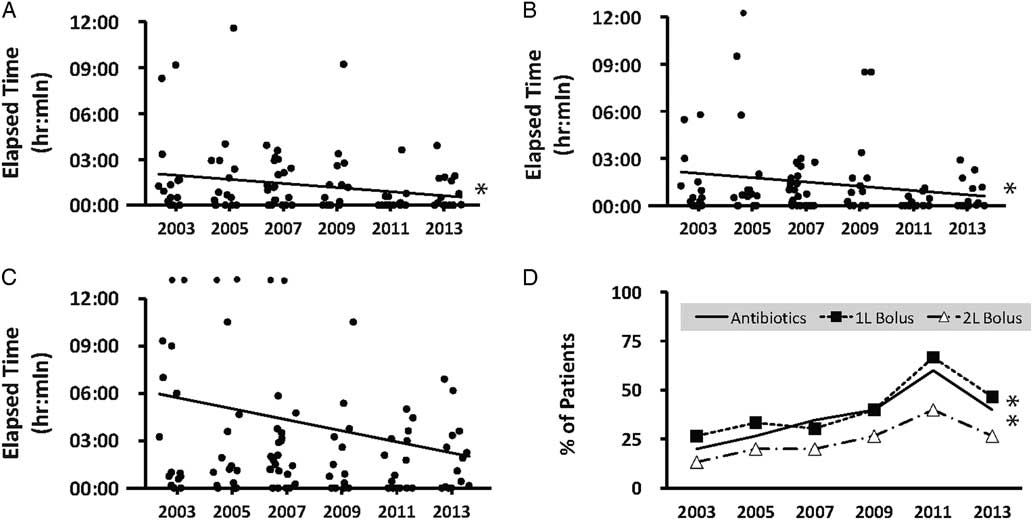
The mean time from hypotension onset to antibiotic administration decreased from 122±44 min in 2003 to 49±17 min in 2013 (P=.02 for trend) (Fig. 1a). The mean time from hypotension onset to 1-L fluid bolus also decreased over the study period (128±54 min in 2003 to 38±14 min in 2013; P=.03) (Fig. 1b). No significant changes occurred in time to completion of 2-L fluids or total volume of fluid administered by 6, 24, and 72 hours (Fig. 1c). Over the study period, the proportion of patients who received antibiotics prior to hypotension onset increased from 20% in 2003 to 40% in 2013 (P=.047), and the proportion of patients who received the first 1-L fluid bolus prior to hypotension onset increased from 27% to 47% (P=.04) (Fig. 1d). The mean hospital length of stay decreased from 11 days in 2003 to 7 days in 2013 (P=.02). The overall in-hospital mortality rate was 21% and did not significantly change during the study period.
Trends in septic shock care, 2003–2013. (A) Time from hypotension onset to initial intravenous antibiotic administration. (B) Time from hypotension onset to completion of 1-L fluid bolus. (C) Time from hypotension onset to completion of 2-L fluid bolus. (D) Percentage of septic shock patients receiving treatment in the emergency department prior to the onset of hypotension. All data points represent individual patients and trend lines represent a linear regression. *Denotes a significant (P<.05) reduction from 2003 to 2013.

Discussion
We detected significant decreases in average time from hypotension onset to fluids and antibiotics in ED patients with septic shock from 2003 to 2013. We also observed more fluids and antibiotics being administered prior to hypotension onset. Our findings suggest that usual care changed substantially between the time when EGDT was first reported to lower mortality and the time that 3 more recent trials reported no mortality benefit with EGDT.Reference Rivers, Nguyen and Havstad 3 – Reference Mouncey, Osborn and Power 6
In our cohort, patients received the first liter of fluids earlier over time, but the total volume administered at 6, 24, or 72 hours did not change significantly, suggesting that most of the practice changes occurred during the very early stages after ED presentation. Most patients in the recent EGDT trials also received antibiotics and fluids early, even before study enrollment.Reference Peake, Delaney and Bailey 4 – Reference Mouncey, Osborn and Power 6 These rapid measures may be partially responsible for the global improvements in septic shock outcomes reported in the recent EGDT trials versus the original 2001 study, as EGDT following early fluids and antibiotics does not appear to confer additional benefit.Reference Castellanos-Ortega, Suberviola and Garcia-Astudillo 8 , Reference Kadri, Rhee and Strich 9
Our study has several limitations. First, the sample size was small. Nonetheless, we detected significant trends. Second, we studied only 1 hospital, which limits the generalizability of our findings. Third, we were unable to ascertain whether the observed trends were already occurring before publication of the first EGDT trial in 2001. Fourth, despite the decreased time to antibiotic and fluid administration, we did not observe a significant improvement in mortality in our cohort. This may be due to our small sample size; other population-level analyses in our study hospital have suggested decreases in septic shock mortality over the same time period.Reference Kadri, Rhee and Strich 9 , Reference Rhee, Kadri and Huang 10 We also only included patients that received vasopressors; thus, we could have missed hypotensive patients in whom the need for vasopressors might have been averted by earlier antibiotics and fluids.
In conclusion, from 2003 to 2013, we observed significant reductions in time to antibiotics and fluids for patients with septic shock in the ED, underscoring the evolution of “usual care” over time. These findings may explain why EGDT is not beneficial in the current era and may help inform ongoing deliberations regarding best practices for sepsis care.
Acknowledgments
We wish to thank Brianna Triplett for her assistance with the initial screening of patients for exclusion criteria.
Financial support
This work was supported in part by the Agency for Healthcare Research and Quality (grant no. K08HS025008 to C.R.) and by the National Institutes of Health (grant no. 1-R01-HL112747-01 to R.M.B). The content of this article is solely the responsibility of the authors and does not necessarily represent the official views of the Agency for Healthcare Research and Quality or the National Institutes of Health.
Conflicts of interest
All authors report no conflicts of interest relevant to this article.