I. INTRODUCTION
The double perovskite structure with formula A2BB′O6, in which A is an alkali, alkaline earth, or rare earth element, consists of a cubic, corner-connected network of BO6 and B′O6 octahedra, where each BO6 octahedron is connected only to B′O6 octahedra. Compared to simple perovskites, this type of connection offers more possibilities for designing new magnetic materials due to the greater variety of magnetic exchange interactions. Recently, double perovskites have been found to show multiferroic behavior. Reference Yáñez-Vilar, Mun, Zapf, Ueland, Gardn, Thompson, Single and Sánchez-Andújar1–Reference Sharma, Saha, Kaushik, Siruguri and Patnaik3 These results encourage us to explore other double perovskites, which may offer us more chances to find applicable multiferroic materials or more deeply understand the mechanism involved.
TbMnO3 is an orthorhombic perovskite manganite with a spiral magnetic structure at room temperature. There are differing views on the mechanism of coupling between ferromagnetic (FM) and ferroelectric in TbMnO3 at low temperature. Kimura et al. proposed that its ferroelectricity is induced by the deformation of the Mn–O–Mn bond. Reference Efremov, Brink and Khomskii4 Other groups have proposed a mechanism based on electronic theory, considering the polarization charge to be caused by spin ordering. Reference Jia, Onoda, Nagaosa and Han5 Dzyaloshinskii and Moriya proposed an alternative model based on the idea that the magnetic field allows the ions to be displaced, causing lattice distortion and consequently electric polarization. Reference Harris6 At the same time, spontaneous polarization accompanied by magneto–elastically induced lattice modulation was observed in rare-earth manganese oxides such as TbMnO3 and DyMnO3. Reference Kimura, Goto, Shintani, Ishizaka, Arima and Tokura7 Efremov et al. confirmed that the coupling between magnetism and charge can also generate ferroelectricity. Reference Hur, Park, Sharma, Ahnl, Guha and Cheong8
The orthohombic TbCoO3 was reported an antiferromagnetic (AFM) ordering with Neel temperature T N = 3.3 K. Reference Knízek, Jirák, Novák and Cruz9 If the Mn was partially substituted by Co, the properties would be different from TbMnO3 and TbCoO3. Cuartero et al. found that Co substitution enhanced the FM correlation, Reference Cuartero, Blasco, García, Lafuerza, Subías, Rodríguez-Velamazán and Ritter10 when the concentration of Co was 50%, that is Tb2MnCoO6, an obvious metamagnetic behavior was observed. Reference Cuartero, Blasco, García, Rodríguez-Velamazán and Ritter11 Normally, the magnetic coupling would affect the electron exchange in multiferroic materials. So studying the electrical transport properties would be useful to understand the physics behind such compound.
In this work, we synthesized double perovskite Tb2MnCoO6 and its simple perovskite counterparts, TbMnO3 and TbCoO3. The crystal structures and the magnetic and electrical transport properties of TbMnO3, Tb2MnCoO6, and TbCoO3 were studied to explore the differences in physics between double perovskite materials and their simple perovskite counterparts.
II. EXPERIMENTAL PROCEDURE
A. Preparation of TbMnO3, Tb2MnCoO6, and TbCoO3 compounds
Polycrystalline TbMnO3, Tb2MnCoO6, and TbCoO3 were synthesized by the solid sintering reaction method. First, stoichiometric amounts of Tb4O7, Co3O4, and MnCO3 powders of high purity (99.99%) were mixed and ground for 1 h, and the mixture was then sintered in a high-temperature furnace (KSL-1700X, Hefei Kejing, Hefei, China) at 1000 °C for 10 h in air. Finally, after cooling the furnace, the powder was ground for 30 min, pressed into pellets, and sintered at 1350 °C for 15 h in air.
B. Characterization
The structures of TbMnO3, Tb2MnCoO6, and TbCoO3 were characterized by x-ray powder diffraction (XRD) with Cu Kα radiation (λ = 1.5406 Å) on a Bruker AXS D8 DISCOVER x-ray diffractometer (Bruker Corporation, Karlsruhe, Germany) at 40 kV and 40 mA. Diffractograms were recorded in a 2θ range from 10° to 120° with scanning steps of 0.02° and an exposure of 4 s per step. The crystal structures of the synthesized products were refined by the Rietveld method using MAUD software. Reference Lutterotti, Matthies, Wenk, Schultz and Richardson12 To determine the composition of the synthesized sample, Fourier transform infrared spectroscopy (FT-IR) spectra were recorded on a Nicolet 5700 instrument (ThermoFisher Scientific, Waltham, Massachusetts) at 4 cm−1 resolution. X-ray photoelectron spectroscopy (XPS) analyses were conducted on the Kratos AXIS Ultra DLD spectrometer (Shimadzu Corporation, Tokyo, Japan) with an Al Kα x-ray source (hv = 1486.6 eV) and a pass energy of 30 eV under ultra-high vacuum. The observed spectra were corrected with the C 1s binding energy value of 284.6 eV. The temperature dependence of the magnetization was measured for 1 T field-cooled (FC) and zero-field-cooled (ZFC) on a MPMS-5 superconducting quantum interference device (SQUID; Quantum Instruments Inc., Hauppauge, New York). The temperature dependence of the resistance of TbMnO3, Tb2MnCoO6, and TbCoO3 was measured by the standard four-probe method using a Keithley 2400 source-meter (Keithley Instruments, Cleveland, Ohio).
III. RESULTS AND DISCUSSION
A. Crystal structure
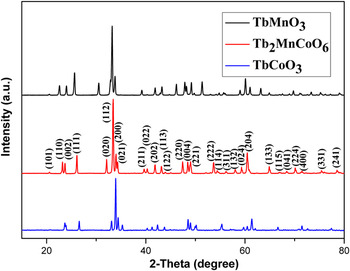
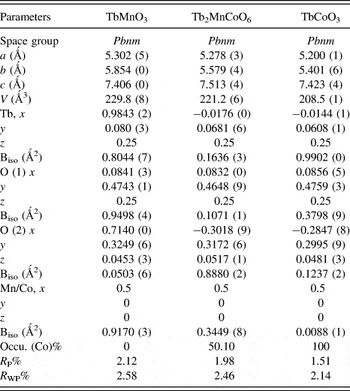
Typical θ–2θ XRD patterns of TbMnO3, Tb2MnCoO6, and TbCoO3 are shown in Fig. 1. Rietveld refinements using the MAUD software were successful using a simple distorted perovskite model (formula ABO3; A = Tb, B = Mn, Co; and A2BB′O6; A = Gd, B = Mn, B′ = Co) with orthorhombic space group Pbnm. Table I shows the structural parameters derived from these refinements for TbMnO3, Tb2MnCoO6, and TbCoO3. All samples were identified as orthorhombic perovskite structures with space group Pbnm (62). The lattice parameters of TbMnO3 were found to be a = 5.302 (5) Å, b = 5.854 (0) Å, and c = 7.406 (0) Å, and the cell volume was V = 229.8 (8) Å3, Z = 4. The lattice parameters of Tb2MnCoO6 were a = 5.278 (3) Å, b = 5.579 (4) Å, c = 7.513 (4) Å with a cell volume V = 221.2 (6) Å3, Z = 2. The lattice parameters of TbCoO3 were a = 5.200 (1) Å, b = 5.401 (6) Å, c = 7.423 (4), V = 208.5 (1) Å3, Z = 4. The changes in lattice parameters confirmed that the Mn atoms have been partially replaced by Co atoms.
XRD patterns of the polycrystalline TbMnO3, Tb2MnCoO6 and TbCoO3.

Structural parameters (space group, lattice parameters, fractional coordinates and isotropic temperature factors), and reliability factors obtained from the Rietveld refinement data for TbMnO3, Tb2MnCoO6, and TbCoO3.

Occu. = Occupy
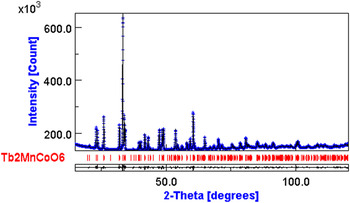
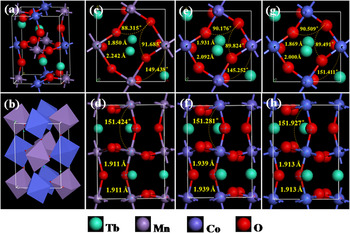
Figure 2 shows the representative Rietveld refinement pattern of Tb2MnCoO6. The reliability factors R P and R WP were 2.12%, 1.98%, 1.51%, and 2.58%, 2.46%, 2.14% for TbMnO3, Tb2MnCoO6, and TbCoO3, respectively (see Table I). Figures 3(a) and 3(b) depict the crystal structure of Tb2MnCoO6. The double perovskite structure with formula A2BB′O6, in which A is an alkali, alkaline earth, or rare earth element, consists of a cubic, corner connected network of BO6 and B′O6 octahedra, where each BO6 octahedron is connected only to B′O6 octahedra. The A-site cation is surrounded by 12 equidistant O2− ions, while the B-site (B′-site) cation constitutes an octahedron structure with O2− ions. Reference Masud, Ghosh, Sannigrahi and Chaudhuri2,Reference Sharma, Saha, Kaushik, Siruguri and Patnaik3 Figure 3 shows the evolution of the bond lengths and bond angles in the BO6 (B′O6) octahedra. Fig. 3(c), 3(e), and 3(g) show the top views of the crystal structures for TbMnO3, Tb2MnCoO6, and TbCoO3, respectively. The most significant change is in the bond lengths. TbMnO3 (TbCoO3) shows a distorted BO6 octahedron with long and short B–O distances in the ab-plane. The substitution of Co for Mn decreases this distortion: the longest B–O bond length decreases, while the shortest one increases, and ultimately, the overall BO6 octahedra tend to be more regular [see Fig. 3(e)]. The side views of these crystal structures show that the bond lengths increase and bond angles decrease slightly along the c-axis with increasing substitution [Figs. 3(d), 3(f), and 3(h)]. These results are in agreement with the variety among a-, b-, and c-lattice parameters (Table I).
Final Rietveld refinement plots of the compound Tb2MnCoO6. The small cross (+) and continuous line correspond to the experimental data and calculated pattern, respectively. The vertical bar (|) indicate the positions of Bragg peaks. The bottom trace depicts the difference curve between the experimental and the calculated patterns.

(a and b) Crystal structure of Tb2MnCoO6. (c, e, and g) and (d, f, and h) Top view and side view of crystal structure for TbMnO3, Tb2MnCoO6, and TbCoO3, respectively.

B. FT-IR and XPS measurements
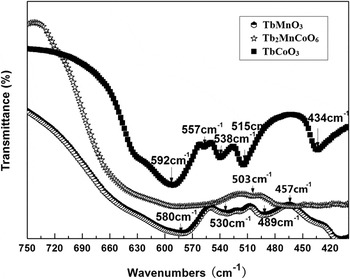
Figure 4 gives the FT-IR spectra of polycrystalline samples of TbMnO3, Tb2MnCoO6, and TbCoO3. The IR spectrum shows an absorption band around ∼580 cm−1 in these samples. The band around 580 cm−1 (in pure TbMnO3) and 592 cm−1 (in pure TbCoO3) can be attributed to the stretching vibration of the Tb–O bond. The band around 530 cm−1 suggests the Mn–O bending vibration, and the 489 cm−1 band corresponds to the MnO6 octahedron stretching vibration in polycrystalline samples of TbMnO3. Reference Sivakumar, Gedanken, Bhattacharya, Brukental, Yeshurun, Zhong, Du, Felner and Nowik13 In comparison with TbMnO3, the absorption peak positions of Tb2MnCoO6 are shifted to longer wavelengths, appearing at 503 and 457 cm−1, respectively. This shift is attributed to the replacement of Mn by Co in the TbMnO3, leading to distortion of the MnO6 octahedra and a change in the lattice constant. The shift to lower frequency can be explained on two grounds: (i) the strength of the coulombic interaction of Co2+ with oxygen is weaker than for Mn3+, and (ii) of the two cations, Co2+ has a larger ionic radius, making the Co–O bond longer than the Mn–O bond. In addition, as the substitution progresses, a negative charge is produced, and oxygen vacancies appear to maintain electrical neutrality. Simultaneously, the distortion of MnO6 decreases with Co substitution, leading to a further reduction in lattice vibration energy. Reference El-Sheikh and Rashad14
FT-IR spectrum of polycrystalline TbMnO3, Tb2MnCoO6, and TbCoO3.

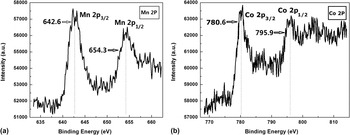
To gain insight into the valence states of Mn and Co in Tb2MnCoO6, XPS measurement was performed. The XPS spectra of Mn 2p and Co 2p for Tb2MnCoO6 are shown in Fig. 5. The Mn 2p region consists of a spin–orbit doublet with Mn 2p1/2 containing of a binding energy of approximately 654.3 eV and Mn 2p3/2 with a binding energy of approximately 642.6 eV [Fig. 5(a)], indicating a mixed-valence manganese system (Mn4+and Mn3+). Reference Cuartero, Blasco, García, Lafuerza, Subías, Rodríguez-Velamazán and Ritter10,Reference Han, Huang, Huang and Goodenough15 The two core peaks at 795.9 and 780.6 eV [Fig. 5(b)] correspond to Co 2p1/2 and Co 2p3/2, respectively, providing evidence for a mixed Co3+/2+ state in Tb2MnCoO6. Reference Li, Xie, Wu, Li and Zhang16,Reference Chen, Zhang and Fu17 Therefore, there is a charge redistribution in double perovskite Tb2MnCoO6, but the ‘formal equilibrium’ Mn3+ + Co3+ ↔ Mn4+ + Co2+ is not completely shifted to the right, giving rise to a mixed valence state of Mn3+/Mn4+ and Co3+/Co2+, as occurs in the LaMn1−x Co x O3 series. Reference Sikora, Kapusta, Knízek, Jirák, Autret, Borowiec, Oates, Procházka, Rybicki and Zajac18
XPS spectra of Mn 2p (a) and Co 2p (b) for Tb2MnCoO6 samples.

C. Magnetic properties
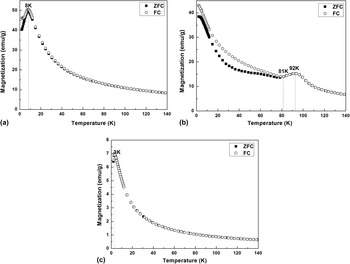
Figure 6 presents the ZFC and FC temperature dependence of direct current (dc) magnetization (magnetization–temperature [M–T]) of the synthesized TbMnO3, Tb2MnCoO6, and TbCoO3. An AFM transition can be observed at ∼8 K (in TbMnO3) and ∼3 K (in TbCoO3) corresponding to the ordering of Tb3+, which is consistent with previous reports. Reference Ikeda and Matsubara19,Reference Pekala, Drozd, Fagnard, Vanderbemden and Ausloos20 Meta-magnetic behavior is observed at ∼92 K in Tb2MnCoO6, which is much higher than for TbMnO3 and TbCoO3. Metamagnetism is related to the strong magnetoelectric effect of the parent compound, TbMnO3. Tb3+ moments are ordered at low temperature coupled to the Mn sublattice. The application of a magnetic field induces a metamagnetic transition in the ordering of Tb moments modifying both the cycloid and the polarization directions. Reference Aliouane, Schmalzl, Senff, Maljuk, Prokes, Braden and Argyriou21 This interesting meta-magnetic behavior in Tb2MnCoO6 is considered to be related to the coexistence of Co and Mn. It is known that the valence of Co ion in TbCoO3 is 3+, and the valence of Mn ion in TbMnO3 is also 3+, but in Tb2MnCoO6, Co3+ and Mn3+ are partially transformed to Co2+ and Mn4+ because the Mn4+–Co2+ coupling is more stable than the Mn3+–Co3+ coupling, which is consistent with the XPS results mentioned above. As a result, both the FM interaction caused by the superexchange Mn4+–O–Co2+ and the double exchange Mn4+–O–Mn3+ and the AFM interaction caused by the superexchanges Co2+–O–Co2+, Mn3+–O–Mn3+, and Mn4+–O–Mn4+ were formed in the Tb2MnCoO6 structure. Similar magnetic transition behavior has been investigated before, e.g., such phenomena have been reported in LaMn x Co1−x O3+δ, and their meta-magnetic behavior was also ascribed to the presence of both Co2+ and Mn4+magnetic ions. Reference Cuartero, Blasco, García, Rodríguez-Velamazán and Ritter11,Reference Cuartero, Blasco, Rodríguez-Velamazán, García, Subías and Ritter22 In addition, the deviation of the ZFC and FC curves was observed in both TbMnO3 and Tb2MnCoO6. Such behavior is normally related to the existence of grain boundaries in the bulk perovskite manganites. Reference Rivadulla, Lopez-Quintela, Hueso, Sande, Rivas and Sanchez23–Reference Zhang, Song, Ma, Yang, Zhao, Dai and Sun25
The FC and ZFC temperature dependence of dc magnetization (M) of (a) TbMnO3, (b) Tb2MnCoO6, and (c) TbCoO3.

D. Electrical transport properties
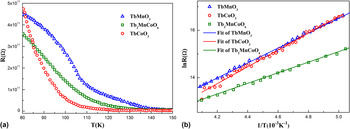
The temperature-dependent electrical transport properties of TbMnO3, Tb2MnCoO6, and TbCoO3 were measured in the temperature range from 80 K to 150 K, and the results are shown in Fig. 7. It was observed that the resistance increased with decreasing temperature, showing a semiconductor-like behavior [see Fig. 7(a)]. Figure 7(b) presents the Arrhenius plots and their linear best fits. The resistance in such materials can be described by the following Eq. (1):
 $$\ln \,R = \ln \,{R_0} + {{{E_{\rm{g}}}} \over {2{k_{\rm{B}}}}}{1 \over T}\quad .$$
where R is resistance (Ω), T is temperature (K), (E g/2) is the activation energy, and k B is the Boltzmann constant. From the slope of the lines in Fig. 6(b) and Eq. (1), we obtained the relationships (2), (3), and (4):
(a) The temperature dependent electrical resistance curves of TbMnO3, Tb2MnCoO6, and TbCoO3, (b) ln R − 1/T and fit curves of TbMnO3, Tb2MnCoO6, and TbCoO3.

For TbMnO3:
 $$\ln \,R = 0.65107 + 3195.64782{1 \over T}\quad .$$
For Tb2MnCoO6:
 $$\ln \,R = 3.89778 + 2261.77562{1 \over T}\quad .$$
For TbCoO3:
 $$\ln \,R = - 1.17304 + 3553.05{1 \over T}\quad .$$
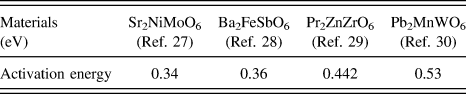
The activation energies for TbMnO3, Tb2MnCoO6, and TbCoO3 are 0.2754, 0.1949, and 0.3062 eV, respectively. The activation energy of TbMnO3 agrees with the value reported in the literature. Reference Chan, Liu, Yang, Li, Lien, Huang and Lee26 The activation energy of Tb2MnCoO6 is lower than TbMnO3 and TbCoO3, indicating that the double perovskite structure is more conductive than its two counterpart single perovskite structures. Similar phenomena can be observed in other double perovskite structures (Table II). Reference Prasatkhetragarn, Kaowphong and Yimnirun27–Reference Orlandi, Righi, Cabassi, Delmonte, Pernechele, Bolzoni, Mezzadri, Solzi, Merlini and Calestani30 As we mentioned above, the coexistence of Co and Mn leads to the generation of Co2+ and Mn4+ (see Fig. 5), which will promote the double exchange behavior between Co ion and Mn ion. Reference Chan, Liu, Yang, Li, Lien, Huang and Lee26 In addition, the Tb2MnCoO6 crystal unit cell owns the smallest Mn–O–Mn (Co) bond angle [see Fig. 3(e)]. This decrease in Mn–O–Mn bond angle is known to strengthen the double exchange interaction, Reference Salamon31 which in turn results in an increase in electron transport ability.
Activation energies of several double perovskite materials from references.

IV. CONCLUSIONS
Single phase double perovskite Tb2MnCoO6 was synthesized by a solid sintering reaction method. The Rietveld refinement results identified all samples as orthorhombic perovskite structures with space group Pbnm (62). The lattice parameters of Tb2MnCoO6 were a = 5.278 (3) Å, b = 5.579 (4) Å, c = 7.513 (4) Å with a cell volume V = 221.2 (6) Å3, Z = 2. Meta-magnetic behavior was observed near 92 K in Tb2MnCoO6. This unusual magnetic feature might be due to the coexistence and competition between the FM and AFM types of order. The magnetism transition temperature of Tb2MnCoO6 is much higher than for TbMnO3 and TbCoO3, which offers a possible way to improve the magnetoelectric coupling temperature in multiferroic materials. Tb2MnCoO6 has lower activation energy, meaning better electron transport ability, than TbMnO3 and TbCoO3, which is caused by the existence of the double exchange interaction in Tb2MnCoO6 double perovskite structure. The results presented here built the relationship between the magnetic properties and electrical transport properties, which will help us to make deep understanding of the magnetoelectric coupling mechanism, and explore the potential applications of double perovskite structured materials in magnetoelectrical devices.
ACKNOWLEDGMENTS
This work was supported by the National Natural Science Foundation of China (Grant Nos. 51202218, 61274017, 61274009, 21274132, and 51572241), Science and Technology Department of Zhejiang Province Foundation (Grant No. 2014C37073), the Program for Changjiang Scholars and Innovative Research Team in University (PCSIRT) (Grant No. IRT13097) and the Department of Education of Zhejiang Province Foundation (Grant No. Y201432023).