INTRODUCTION
Over the last half century, scholars across various fields of study have devoted considerable time and resources to understanding Americans’ beliefs about the causes of racial inequality (Bobo and Hutchings, Reference Bobo and Hutchings1996; Bobo and Kluegel, Reference Bobo and Kluegel1993; Feagin Reference Feagin1975; Hochschild Reference Hochschild1995; Hunt Reference Hunt1996, Reference Hunt2007; Kluegel Reference Kluegel1990; Kluegel and Smith, Reference Kluegel and Smith1986; Marx Reference Marx1967; Pew Research Center 2007; Reynolds and Xian, Reference Reynolds and Xian2014). These studies have greatly enhanced our knowledge of attributions and determinants for why Blacks continue to trail behind Whites across all major socioeconomic spheres. For instance, it is now widely known that racial group membership and class position strongly influence ideological commitments to individualism and structuralism. Such findings suggest that beliefs about the causes of racial inequality are relevant to the wider scholarly debate over “race versus class” in the contemporary United States (Feagin and Sikes, Reference Feagin and Sikes1994; Massey and Denton, Reference Massey and Denton1993; Pattillo-McCoy Reference Pattillo-McCoy1999; Pinkney Reference Pinkney1984; W. Wilson Reference Wilson1978, Reference Wilson1987).
This paper furthers our knowledge of the links between race, class, and attitudes about racial inequality by focusing on affluent Blacks and Whites—or those whom I refer to as socioeconomically “privileged.” More specifically, I aim to determine whether study participants with similarly high levels of socioeconomic attainment report corresponding beliefs about the roots of racial disparities. I accomplish this goal in two ways. First, I scrutinize a range of discrete socioeconomic indicators, which permits isolating results for study participants positioned at some of the highest levels of the American class structure. Second, I assess the most popular combinations of attributions for racial inequality respectively reported by Black and White respondents in the 1985–2012 General Social Surveys. This nuanced approach allows for determining whether a privileged class position drives ideological commitments to select individualistic, structural, and/or various “mixed modes” (Hunt Reference Hunt2007; Kluegel Reference Kluegel1990) of explanation for racial disparities. Results from these contributions indicate that class-based ideological tensions are more prevalent and pronounced among Whites rather than Blacks. Significantly, however, a privileged class position operates similarly in shaping Blacks’ and Whites’ levels of support for particular structural explanations for racial inequality.
Individualism, Structuralism, and the Dominant American Ideology
Americans attribute racial inequality to a range of factors. The most popular of these explanations buttress the dominant American ideology—a widely supported constellation of beliefs that provides a framework for justifying the relationship between individuals and opportunities in society (Feagin Reference Feagin1975; Huber and Form, Reference Huber and Form1973; Hunt Reference Hunt1996, Reference Hunt2004; Kluegel and Smith, Reference Kluegel and Smith1986). For example, the dominant ideology deems that fairness and equality pervade across all levels and spheres of American life. It posits that pathways to achievement are limitless and accessible to nearly everyone regardless of race, class, gender, age, or national origin.
The belief that the American stratification system is open and equitable lays the ideological foundation for individualism—the idea that people are responsible for their own socioeconomic fate by virtue of their work ethic, talents, and choices (Feagin Reference Feagin1975; Huber and Form, Reference Huber and Form1973; Hunt Reference Hunt1996, Reference Hunt2004; Kluegel and Smith, Reference Kluegel and Smith1986). If opportunities are abundant and attainable, then it is believed that individuals must be held accountable for achieving their American Dreams. For instance, common adages such as “the early bird catches the worm” and “plan your work, work your plan” suggest that some people deserve to live affluent lifestyles while others who fall short of their goals only have themselves to blame.
However, some Americans believe that factors beyond a person’s control strongly influence whether he or she will “make it” in life. This idea, which is known as structuralism, asserts that the American social “system”—or the way that our society’s institutions, patterns of relationships, and dynamics of status are organized—limits opportunities for some people while simultaneously expanding them for others (Feagin Reference Feagin1975; Huber and Form, Reference Huber and Form1973; Hunt Reference Hunt1996, Reference Hunt2004; Kluegel and Smith, Reference Kluegel and Smith1986; Robinson Reference Robinson2009). Everyday expressions such as “she was born with a silver spoon in her mouth” or that “he’s a child of privilege” suggest that hard work and personal merit is less central to some people’s success. These sentiments help to explain why structuralists’ argue that individualists “blame the victim” for their circumstances rather than acknowledge that seemingly insurmountable obstacles such as racism, poverty, and sexism stand in people’s path.
Yet, most Americans do not favor structuralism. Moreover, those who do also tend to embrace individualism (Kluegel and Smith, Reference Kluegel and Smith1986; Hunt Reference Hunt2004, Reference Hunt2007). Studies have shown that structural beliefs are typically “compartmentalized” (G. Wilson Reference Wilson1996) or “layered” (Hunt Reference Hunt1996) in a way that complement one’s prevailing commitment to individualism. In short, many Americans believe that people must hurdle barriers beyond their control through hard work and merit.
Blacks’ and Whites’ Beliefs about Racial Inequality
Existing studies have consistently shown that Blacks and Whites report divergent beliefs about the causes of racial inequality. For example, most Whites attribute racial inequality to individualistic factors (Bobo and Hutchings, Reference Bobo and Hutchings1996; Bobo and Kluegel, Reference Bobo, Kluegel, Tuch and Martin1997; Bonilla-Silva Reference Bonilla-Silva2006; Hughes and Tuch, Reference Hughes, Tuch, Sears, Sidanius and Bobo2000; Jackman Reference Jackman1996; Kluegel Reference Kluegel1990; Kluegel and Bobo, Reference Kluegel, Bobo, Sniderman, Tetlock and Carmines1993; Krysan Reference Krysan2000). Comparatively few Whites in today’s world ascribe racial disparities to the historically racist belief in Blacks’ biological inferiority (Bobo et al., Reference Bobo, Kluegel, Smith, Tuch and Martin1997; Schuman and Krysan, Reference Schuman and Krysan1999). Footnote 1 Conversely, strong majorities emphasize motivational individualism—the notion that racial inequality will recede once African Americans decide to work harder to take advantage of opportunities in society (Hunt Reference Hunt2007; Kluegel Reference Kluegel1990).
For instance, up to 60% of White respondents across various surveys Footnote 2 assert that Blacks lack “motivation or will power” (Hochschild Reference Hochschild1995; Hunt Reference Hunt2007; Kluegel Reference Kluegel1990; Sniderman and Piazza, Reference Sniderman and Piazza1993) and that they “don’t try hard enough” to succeed (Hughes Reference Hughes, Tuch and Martin1997; Kinder and Mendelberg, Reference Kinder, Mendelberg, Sears, Sidanius and Bobo2000). Widespread majorities also believe that Blacks are “responsible for their own condition” (Pew Research Center 2007; Schuman and Krysan, Reference Schuman and Krysan1999) and that Blacks’ “problems are brought on by Blacks themselves” (Sigelman and Welch, Reference Sigelman and Welch1991; Walters Reference Walters2003). Less than 45% of sampled Whites attribute racial inequality to structural impediments such as disparities within the American educational system (Hunt Reference Hunt2007; Kluegel Reference Kluegel1990; Sniderman and Piazza, Reference Sniderman and Piazza1993), and no more than 35% endorse “racial discrimination” (Bobo and Kluegel, Reference Bobo and Kluegel1993; Hughes and Tuch, Reference Hughes, Tuch, Sears, Sidanius and Bobo2000; Hunt Reference Hunt2007; Sigelman and Welch, Reference Sigelman and Welch1991). These results are best understood within the context of Whites’ stalwart commitment to the dominant ideology: more than 70% of White respondents across numerous surveys assert that racial conditions have significantly improved (Kluegel and Smith, Reference Kluegel and Smith1982; Pew Research Center 2007; Walters Reference Walters2003), and that Blacks and Whites have equal opportunities for achievement (Hochschild Reference Hochschild1995; Kluegel and Smith, Reference Kluegel and Smith1982; Sears et al., Reference Sears, Hetts, Sidanius, Bobo, Sears, Sidanius and Bobo2000). Footnote 3
However, African Americans’ beliefs sharply contrast with Whites. This is primarily because, save for one notable recent exception (Pew Research Center 2007), results of most studies show that African Americans overwhelmingly attribute racial inequality to structural factors (Cose Reference Cose1993; Dawson Reference Dawson1994, Reference Dawson2001; Gay Reference Gay2004; Sigelman and Welch, Reference Sigelman and Welch1991; Tate Reference Tate1993). For instance, up to 70% of Black respondents across various surveys not only explain racial disparities on the basis that “Whites don’t want Blacks to get ahead” (Hwang et al., Reference Hwang, Fitzpatrick and Helms1998; Sigelman and Welch, Reference Sigelman and Welch1991), but also cite racially-specific structural forms of discrimination (Gurin et al., Reference Gurin, Hatchett and Jackson1989; Hochschild Reference Hochschild1995). Footnote 4
Nevertheless, results of Matthew Hunt’s (Reference Hunt2007) trend analysis show that Blacks’ commitment to structural attributions has meaningfully eroded with the passage of time. For example: in the late 1980’s, 77% of Black respondents attributed racial inequality to “racial discrimination” and 68% cited disparities within the American educational system. However, by the turn of the new millennium, these figures had respectively fallen to 61% and 54%. Moreover, during the same time period, the percentage of Blacks who attributed racial inequality to motivational individualism increased from 36% to 45%. While Blacks’ support for this attribution may continue to grow, at present most African Americans neither believe that racial conditions have significantly improved (Dawson Reference Dawson1994; Pew Research Center 2007) nor that Blacks and Whites have equal opportunities for achievement (Dawson Reference Dawson2001; Hochschild Reference Hochschild1995).
Higher Status Blacks’ and Whites’ Beliefs about Racial Inequality
In addition to interracial differences, studies have shown that socioeconomic variation stimulates intraracial differences in beliefs about racial inequality. For instance, better-educated Whites perceive fewer opportunities for Blacks (Kluegel and Smith, Reference Kluegel and Smith1982; Sigelman and Welch, Reference Sigelman and Welch1991), and more racial discrimination in society than lesser-educated Whites (Hunt Reference Hunt2007; Kluegel Reference Kluegel1990). However, Whites with higher incomes are more strongly committed to individualistic attributions for racial disparities—they are more likely than Whites with lower incomes to agree with the statement “if Blacks would try harder, they could be just as well off as Whites” (Hochschild Reference Hochschild1995). Results from a recent Pew Research Center (2007) poll buttress this finding as 70% of Whites earning at least $75,000 a year believe that “Blacks who can’t get ahead in this country are mostly responsible for their own condition.”
Blacks’ beliefs also splinter by class position. Findings from both national and local area studies indicate that higher status Blacks (broadly defined) are less likely to support attributions consistent with motivational individualism such as African Americans are “lazy,” “give up too easily,” “do not have enough ability,” or “do not try hard enough,” (Grimes et al., Reference Grimes, Jenkins and Reavis1996; Handy Reference Handy1984; Hwang et al., Reference Hwang, Fitzpatrick and Helms1998; Shelton and Wilson, Reference Shelton and Wilson2006). Footnote 5 However, results from other studies show differently. Most importantly, the aforementioned Pew Research Center (2007) poll indicates that a plurality of Blacks with at least a college degree and those earning at least $75,000 a year believes that “Blacks who can’t get ahead in this country are mostly responsible for their own condition.” Another finding from the survey shows that most better-educated and higher-income earning African Americans do not believe that “racial discrimination is the main reason why many Black people can’t get ahead these days.” These results are corroborated by findings from the Houston Area Survey (HAS), which indicate that Blacks with higher incomes are more likely to declare the equality of opportunity in the contemporary United States, and that “problems facing Blacks today are mainly the result of problems within the Black community” rather than “attitudes and inequalities in the larger society” (Shelton and Greene, Reference Shelton and Greene2012).
Nevertheless, we cannot generally conclude that higher status Blacks are less committed to structuralism than lower status Blacks. Ironically, Hunt (Reference Hunt2007) and the Pew Research Center (2007) poll provide strong support for the established finding that higher status Blacks are more “racially conscious” than lower status Blacks (Cose Reference Cose1993; Dawson Reference Dawson1994, Reference Dawson2001; Lacy Reference Lacy2007; Pattillo Reference Pattillo2003). In particular, better-educated Blacks are more likely to attribute racial inequality to “racial discrimination,” as well as the belief that “most Blacks don’t have the chance for education that it takes to rise out of poverty” (Hunt Reference Hunt2007; Sigelman and Welch, Reference Sigelman and Welch1991). Moreover, almost 80% of better-educated and higher-income earning African Americans believe that Blacks are at least “frequently” discriminated against when they “apply for a job” or “try to rent an apartment or find a house” (Pew Research Center 2007). These captivating findings—which often vary across surveys, individual items, and predictors—suggests that an elevated class position can play a profoundly intricate and sometimes dissonant role in shaping African Americans’ explanations for racial disparities.
RESEARCH METHODS
I examine seventeen years of pooled General Social Survey Footnote 6 (GSS) data, which was collected via a multi-stage full probability sampling design that accounts for all U.S. households. Footnote 7 These GSS years were purposefully chosen for two reasons: 1) they include a widely analyzed module that specifically addresses beliefs about the causes of racial inequality (Blacks were first posed these questions in 1985); and 2) aggregating these data files substantially increases the size of the African American sample. This upgrade permits greater generalizability as well as more reliable estimates in testing class effects among Blacks.
African Americans (N = 2614) comprise 13.8% of the total sample size, while Whites (N = 16,332) comprise 86.2%. Respondents with missing data are excluded via listwise deletion. Latinos, Asians, and “others” are omitted from the present study in order to preserve my conceptual and methodological attention to the role that a privileged class position plays in shaping Blacks’ and Whites’ beliefs. Footnote 8 These groups have a long and contentious history dating back nearly four centuries.
Dependent Variables
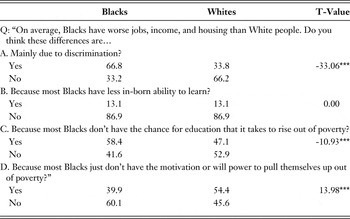
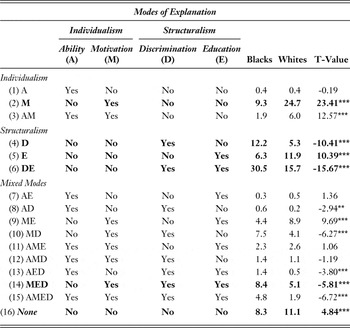
Table 1 presents detailed information including survey questions/statements, answer possibilities, and overall percent distributions by race for beliefs about the causes of racial inequality. Two of the attributions offered to GSS respondents are individualistic in orientation (i.e., Blacks have less in-born ability and lack motivation), and two attributions are structural (i.e., racial discrimination and that Blacks’ don’t have the chance for education). The answer possibilities are not mutually exclusive since study participants could respond “yes” or “no” to each of the four items. This methodology permits sixteen possible combinations of outcomes (see Kluegel [Reference Kluegel1990] and Hunt [Reference Hunt2007] for more information). For example, respondents could recognize a single individualistic or structural attribution while rejecting all others. They could also endorse both of the individualistic attributions while dismissing both of the structural attributions, combine certain individualistic and structural attributions, endorse or reject all explanations offered to study participants. See Table 2 for the complete list of response patterns and percent distributions by race. Due to space constraints, I am unable to display multivariate results for all potential combinations of attributions. The multivariate results presented here concern six of the top eight most popular combinations respectively reported by Black and White respondents.
Survey Questions/Statements, Answer Possibilities, and Overall Percent Distributions by Race for Beliefs about the Causes of Racial Inequality

Notes: ***p<.001; t-values assess differences between Blacks and Whites on the variable overall; (2–tailed tests).
Response Patterns and Percent Distributions by Race for Various Combinations of Attributions for Beliefs about the Causes of Racial Inequality

Notes: ***p<.001; t-values assess differences between Blacks and Whites on the variable overall; (2–tailed tests). Six of the top eight most popular combinations of explanations respectively reported by Black and White respondents appear in bold.
Independent Variables
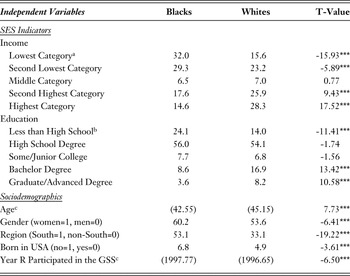
Table 3 presents detailed information for all independent variables including codes and percent distributions by race. The dependent variables are separately regressed on two categories of predictors: (1) socioeconomic indicators, and (2) sociodemographic characteristics. The socioeconomic indicators include measures for total household income and education. My coding scheme for these predictors is pivotal: income and education are examined as a series of dummy variables so as to isolate socioeconomic effects for respondents positioned at some of the highest levels of the American class structure. I did not develop a composite measure for socioeconomic status or examine income and education as continuous variables because studies have shown that these approaches can conceal the class-based nuances of higher status Blacks’ beliefs (Shelton and Emerson, Reference Shelton and Emerson2010; Shelton and Wilson, Reference Shelton and Wilson2009).
Codes and Percent Distributions by Race for all Independent Variables

Notes: **p<.01, ***p<.001; means appear in parentheses; areference category for income; breference category for education; canalyzed as a continuous variable in the multivariate models; (2–tailed tests).
Regarding income, I established cutoff points on the REALINC variable based on poverty level and median household income data to capture the distribution of respondents with incomes in the “lowest category,” “second lowest category,” “middle category,” “second highest category,” and “highest category.” REALINC converts the original income categories into dollar amounts and then adjusts these values to account for inflation across all survey years by using 1986 as the base year for comparison. Consequently, the “lowest income category” captures those respondents who reported a total family income of approximately $11,200 or less. The “second lowest category” denotes those who reported approximately $11,201 to $23,000, while the “middle category” captures those whose income approximates $24,900 (within $1,900 below and $2,100 above this threshold).
Each GSS module contains the exact same codes for the lower and middle areas of the income distribution. However, different codes are used at the higher end of the distribution to account for inflation. The final two income groups, the “second highest category” and the “highest category,” were created by simply dividing the total number of remaining codes in half. Respondents in the former category reported a total family income of approximately $27,001 to $43,500, while those in the latter category reported $43,501 or more.
Education is coded “less than a high school degree,” “high school degree,” “some college,” “college degree,” and “graduate degree.” On the basis of these coding schemes, I view “privileged” respondents as those who have: a) an income in at least the second highest category, or b) at least a college degree.
Analysis Plan
Data for each racial group is analyzed and presented separately; this is the most straightforward method for determining whether a privileged class position operates similarly in shaping Blacks’ and Whites’ beliefs. Logistic regression is the primary multivariate analysis procedure utilized here. However, I also specified nested models with interaction terms in order to test for class-based attitudinal differences across racial groups (notable findings for this procedure appear in bold; full results are available upon request). This is the best method for ascertaining whether class-based attitudinal differences among Blacks, for example, are wider in scope than class-based attitudinal differences among Whites.
Findings Footnote 9
Blacks and Whites sharply differ across most of the predictors and outcomes examined in this study. The overall distribution of responses in Table 1 shows that African Americans are far more likely to attribute racial inequality to structural factors such as “discrimination” and disparities within the American educational system. They are also far less likely to attribute racial inequality to motivational individualism. Lastly, comparatively few respondents ascribe racial disparities to the historically racist belief in Blacks’ supposed biological inferiority.
However, the delimited distribution in Table 2 reveals nuances in Blacks’ and Whites’ beliefs. For instance, Whites are far more likely than Blacks to answer “yes” to motivation but “no” to all other attributions (or M). They are also more likely than Blacks to isolate the impact of inequalities within the American educational system (or E), as well as declare that “none” of the explanations offered to survey participants’ help with explaining racial disparities. In contrast, African Americans are far more likely to simultaneously dismiss individualistic explanations and recognize the combined effects of structuralism (or DE). They are also more likely to isolate the impact of racial discrimination (or D), as well as attribute racial disparities to both motivational individualism and the combined effects of structuralism (or MED). Nevertheless, despite these differences, six of the top eight most popular combinations among Black and White GSS respondents closely correspond with one another (by rank order, not percent; these findings appear in bold). For example, members of both racial groups isolate motivational individualism, emphasize the combined effects of structuralism, and contend that none of the explanations offered to respondents help to explain racial disparities.
Table 3 shows that racial differences extend across the socioeconomic indicators and sociodemographic characteristics. These distinctions closely match those of the larger U.S. population. Footnote 10 On average, Blacks in the sample earn less income, are less educated, younger, more often female, reside in the South, and are more likely to be foreign born due to the recent influx of “new immigrants” from Africa and the Caribbean (Alba and Nee, Reference Alba and Nee2003; Waters and Ueda, Reference Waters and Ueda2007). In fact, the apportion of African Americans across income categories, for example, echoes the established finding that 60% of Blacks occupy the lower levels of the total U.S. income distribution (Farley and Allen, Reference Farley and Allen1987; Webster and Bishaw, Reference Webster and Bishaw2007). This disparity not only reflects enduring inequalities between Blacks and Whites, but also suggests that the 30% of Blacks situated at the higher levels of the income distribution are highly privileged as compared to most other Blacks (Lacy Reference Lacy2007; W. Wilson Reference Wilson1978).
Privileged Blacks’ and Whites’ Beliefs about Racial Inequality
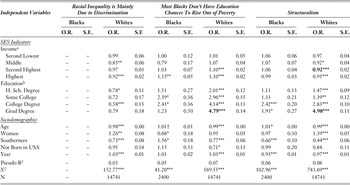
Table 4 displays results from logistic regressions assessing Blacks’ and Whites’ commitments to structural attributions for racial inequality. The multivariate analysis begins with tests of structuralism because: a) few respondents favor response patterns involving Blacks’ supposed biological inferiority, and b) commitments to motivational individualism are often mixed with structuralism (see Table 2). The first set of results examine whether respondents answered “yes” that racial disparities are “mainly due to discrimination,” but “no” to all other explanations. This was the third most popular combination of responses reported by African Americans (N = 318). Importantly, however, the model was statistically non-significant and therefore unable to produce reliable estimates for Blacks. In short, even after accounting for socioeconomic and sociodemographic differences, African Americans report corresponding beliefs about the role that racism plays in explaining why Blacks have “worse jobs, income, and housing” than Whites.
Logistic Regressions Assessing Blacks’ and Whites’ Commitments to Structural Attributions for Racial Inequality

Notes: †p<.10, *p<.05, **p<.01, ***p<.001; aLowest Income Category reference group; bLess than High School Degree reference group; significant differences (p≤.05) between Blacks and Whites with similar levels of socioeconomic attainment appear in bold (2–tailed tests).
Conversely, Whites positioned at some of the highest levels of the American class structure are less likely to isolate and emphasize the effects of racial discrimination. In particular, as compared with respondents situated in the lowest income category, respondents in the highest (OR = 0.92) income category are less likely to solely attribute racial inequality to racial discrimination, holding all other variable constant. Respondents in the middle income category are also less likely to endorse this attribution. Moreover, while Whites with a high school degree are less likely than those who did not complete high school to exclusively attribute racial inequality to racial discrimination, Whites with a college degree (OR = 0.58) are least likely to do so. It must be noted that study participants situated in the middle and second lowest incomes categories, as well as those with a high school degree or some college, often report beliefs that seemingly parallel privileged members of their respective racial groups. These findings are important. However, as shown in this particular model and others soon to be discussed, class effects are more often stronger in magnitude and/or more highly statistically significant among privileged rather than comparatively disadvantaged respondents.
Table 4 also presents results for the likelihood of whether respondents answered “yes” that Blacks “don’t have the chance for education that it takes to rise out of poverty,” but “no” to all other attributions. Blacks in the highest (OR = 1.15) income category are more likely than those situated in the lowest income category to attribute racial inequality solely to disparities within the American educational system, controlling for all other variables. Furthermore, Blacks with a college degree (OR = 2.41) are more likely than Blacks who did not complete high school to support this particular explanation (those with some college do so as well).
However, despite meaningful differences, a privileged class position tends to operate similarly in shaping Blacks’ and Whites’ commitments to this attribution. For instance, Whites in the highest (OR = 1.10) and second highest (OR = 1.10) income categories are more likely than Whites in the lowest income category to exclusively attribute racial inequality to the belief that “Blacks don’t have a chance for education that it takes to rise out of poverty.” Moreover, while Whites across all education levels are more likely to favor this attribution, Whites with a graduate degree (OR = 4.79) and those with a college degree (OR = 4.14) are by far the strongest supporters of this explanation. The race × class interaction terms buttress this finding as the ideological gap between Whites who did not complete high school and those with a graduate degree is wider in scope than that for comparably educated Blacks. Nevertheless, it appears privileged Blacks and Whites—by both income and education—similarly believe that African Americans face difficult circumstances within our nation’s educational system.
Lastly, a privileged class position also shapes Blacks’ and Whites’ commitments to a decidedly structural combination of explanations for racial inequality. The coefficients for Blacks show that respondents with a graduate degree (OR = 1.91) or college degree (OR = 2.42) are more likely to have answered “yes” to the structural attributions for racial inequality but “no” to the individualistic attributions. This result, in tandem with the previous finding for beliefs about disparities within the American educational system, suggests that Blacks with a college degree are particularly committed to exclusively structural explanations for racial inequality.
However, Whites in the highest (OR = 0.95) and second highest (OR = 0.92) income categories are less likely to simultaneously dismiss individualistic explanations and recognize the combined effects of structuralism. Whites in the middle income category are also less likely to favor this response pattern. Significantly, these results reveal the class-based complexity of some privileged Whites’ beliefs: respondents situated in at least the second highest income category endorse a specific structural attribution (i.e., disparities within the American education system) over the compounding effects of decidedly structural factors. However, although White respondents across all education levels are more likely to support this combination of structural explanations, those with a graduate degree (OR = 4.98) or a college degree (OR = 2.83) are especially likely to do so. Consequently, it appears that better-educated Whites—those with a graduate degree in particular—isolate the impact of disparities within the American educational system and recognize its compounding effects along with racial discrimination. Lastly, findings for the race × class interaction terms indicate that class-based attitudinal differences by income and education are significantly wider among Whites rather than Blacks. Nevertheless, a privileged level of educational attainment operates similarly in shaping Blacks’ and Whites’ commitments to this decidedly structural combination of attributions: better-educated Blacks and Whites are more likely to simultaneously reject individualistic explanations and endorse the combined effects of structuralism.
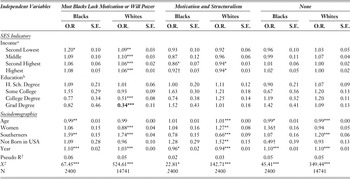
Table 5 displays results from logistic regressions assessing Blacks’ and Whites’ commitments to motivational individualism, as well as other popular combinations of attributions for racial inequality. The first set of results examines whether respondents believe that motivational individualism solely explains racial inequality. Privileged and disadvantaged Blacks do not differ in their commitment to this attribution. However, Whites across all income categories are more likely than those situated in the lowest income category to isolate and emphasize motivational individualism, holding all other variables constant. In contrast, Whites with a graduate degree (OR = 0.34) and those with college degree (OR = 0.51) are far less likely than Whites who did not complete high school to exclusively blame Blacks for racial disparities. The race × class interaction terms bolster this result as the ideological gap between Whites who did not complete high school and those with a graduate degree is significantly wider than that for comparably educated Blacks. Thus, for Whites in particular, the effect of attaining a graduate degree significantly weakens one’s commitment to the belief that motivational individualism solely explains racial inequality.
Logistic Regressions Assessing Blacks’ and Whites’ Commitments to Motivational Individualism, as well as other Popular Combinations of Attributions for Racial Inequality

Notes: †p<.10, *p<.05, **p<.01, ***p<.001; aLowest Income Category reference group; bLess than High School Degree reference group; significant differences (p≤.05) between Blacks and Whites with similar levels of socioeconomic attainment appear in bold (2–tailed tests).
Table 5 also presents results from logistic regressions assessing Blacks’ and Whites’ commitments to the belief that both motivational individualism and structuralism helps to explain racial disparities. To be clear, these respondents answered “no” to the belief that Blacks have “less in-born ability to learn,” but “yes” to motivational individualism as well as both structural items. The coefficients for Blacks indicate that respondents situated in the highest (OR = 0.92) and second highest (OR = 0.86) income categories are less likely than those in the lowest income category to blend motivational individualism with the combined effects of structuralism. These findings parallel those for similarly situated Whites. More specifically, Whites in the highest (OR = 0.94) and second highest (OR = 0.94) income categories are also less likely to endorse this combination of attributions.
Finally, Blacks and Whites positioned at some of the highest levels of the American class structure do not differ in the likelihood of answering “no” to each of the attributions for racial inequality offered to GSS respondents. This is important considering that support for the “none” attribution had sharply increased by the late 1990’s (Hunt Reference Hunt2007). That privileged and disadvantaged respondents—regardless of race—do not differ on this item suggests that its growing appeal is broad-based and “may be rooted in other causes not tapped” (Hunt Reference Hunt2007, p. 405) by items currently comprising the survey.
I conducted separate sub-group analyses for Blacks and Whites across each of the remaining combinations of attributions not displayed in Tables 4 and 5 (please see Table 2 for more information). Footnote 11 Results for this procedure buttress the multivariate results presented here: class-based attitudinal differences are more frequent and stronger in magnitude among Whites rather than Blacks. For instance, among the remaining outcomes, privileged and disadvantaged Blacks only differ across two mixed-modes—AMED (or Ability, Motivation, Education, and Discrimination) and AED. More specifically, respondents situated in at least the second highest income category and those with at least a college degree are less likely to endorse these response patterns.
However, privileged and disadvantaged Whites differ across eight of the remaining outcomes. In general, respondents situated in at least the second highest income category and those with at least a college degree are less likely to favor any combination of mixed-modes involving the historically racist belief that Blacks have “less in-born ability” (or A). However, these same respondents are more likely to favor a combination of attributions that synthesizes motivational individualism with the belief that Blacks “don’t have the chance for education that it takes to rise out of poverty” (or ME). Lastly, findings for the race × class interaction terms indicate that class-based attitudinal differences on these outcomes are wider in scope among Whites rather than Blacks.
Supplementary Results
Some additional multivariate results must be mentioned. Findings displayed in Tables 4 and 5 show that sociodemographic factors strongly influence Blacks’ and Whites’ beliefs about racial inequality. In fact, as with the socioeconomic indicators, intraracial differences are more consistent and stronger in magnitude among Whites rather than Blacks. For instance, White women are far more structural in orientation than White men, and less likely to isolate and emphasize motivational individualism. In contrast, southerners are far less structural in orientation than non-southerners, and far more likely to solely emphasize motivational individualism. Lastly, while older Whites are consistently less structural in orientation than younger whites, the statistical magnitude of these differences is comparatively weak.
Among Blacks, region of residence drives the strongest and most consistent attitudinal differences. While support for structuralism is mixed, Black southerners are far more likely than non-southerners to solely accentuate motivational individualism. Moreover, older Blacks are slightly more structural in orientation than younger Blacks, and slightly less likely to isolate and emphasize motivational individualism.
One final result must be addressed. Multivariate results presented in Tables 4 and 5 indicate that Blacks’ and Whites’ beliefs about the causes of racial inequality have changed with the passage of time. For instance, African Americans are now more likely to attribute racial inequality exclusively to motivational individualism, and less likely to advance a decidedly structural combination of explanations that rejects individualism. They are also more likely to declare that “none” of the attributions offered to GSS respondents help to explain racial inequality. Whites’ beliefs have undergone an even more fundamental transformation. While Whites’ commitment to motivational individualism has also increased, they have become more likely to isolate the effects of racial discrimination, disparities within the American educational system, and endorse the “none” option. They, like African Americans, are also now less likely to simultaneously dismiss motivational individualism and recognize both structural attributions. Taken together, these findings indicate that Blacks’ and Whites’ beliefs about the roots of racial disparities have grown more similar rather than different over the decades.
CONCLUSION
Results of this study indicate that a privileged class position strongly influences beliefs about the causes of racial inequality. Separate tests of the data for Blacks and Whites, as well as combined analyses with race × class interaction terms reveal that in general, class-based attitudinal differences are more prevalent, stronger in magnitude, and wider in scope among Whites rather than Blacks. For instance, privileged and disadvantaged African Americans do not differ in their commitment to the belief that motivational individualism solely explains racial disparities. Conversely, Whites situated at some of the highest levels of the American class structure are sharply divided in their support for this attribution: higher income earners strongly favor this justification while the better educated are less likely to do so.
However, a privileged class position often operates similarly in shaping Blacks’ and Whites’ commitments to select structural attributions. At a minimum, Blacks and Whites with a college degree are twice as likely as members of their respective racial groups who did not complete high school to solely emphasize inequalities within the American educational system, and advance a decidedly structural combination of explanations that rejects individualism. These findings are relevant to a comparable line of research on the role that racial group membership and class position play in shaping levels of support for redistributive policy: better-educated Blacks and Whites are more strongly committed to structuralism, which helps to explain their higher levels of support for certain government-sponsored opportunity-enhancing policies (Bobo and Kluegel, Reference Bobo and Kluegel1993; Shelton and Wilson, Reference Shelton and Wilson2009; Sigelman and Welch, Reference Sigelman and Welch1991; G. Wilson Reference Wilson2001).
Findings from extant studies have also shown that higher levels of income and educational attainment can differentially impact attitudes about inequality. The former’s influence can lead people to reject structuralism and emphasize personal merit, while the latter’s influence can both bolster support for structuralism and temper attention to personal merit (Huber and Form, Reference Huber and Form1973; Hunt Reference Hunt1996, Reference Hunt2004; Kluegel and Smith, Reference Kluegel and Smith1986; Robinson Reference Robinson2009; G. Wilson Reference Wilson1996). Put differently—higher levels of educational attainment tend to liberalize respondents’ beliefs about inequality, while higher levels of income tend to conservatize respondents’ beliefs. Results of this study indicate that these divergent class-based effects are especially pronounced among Whites. In fact, Whites situated in the highest and second highest income categories report the most conservative class-based beliefs about the causes of racial inequality. Conversely, Whites with at least a college degree are among the most liberal—despite their lack of recognition for the independent effects of racial discrimination.
Findings presented here are also relevant to longstanding concerns over higher status Blacks’ devotion to racial solidarity. Privileged Blacks’ heightened commitment to structural attributions for racial disparities undermines classical (Du Bois Reference Du Bois1948; Frazier Reference Frazier1957) and contemporary (Dyson Reference Dyson2005; Tourè 2011) assertions that higher status Blacks have forsaken racial unity in favor of their own personal socioeconomic gain. Despite their affluence, results from pooled GSS data show that these respondents emphasize factors beyond Blacks’ personal and collective control when explaining racial inequality. Nevertheless, there is still cause for concern. Non-published results show that in 1985, no less than 75% of Blacks with at least a college degree advanced a decidedly structural combination of explanations that dismissed individualism. Moreover, none of these well-educated respondents exclusively emphasized motivational individualism. However, by 2012, only 24% of Blacks with a college degree and 39% of Blacks with a graduate degree endorsed the aforementioned decidedly structural combination. Furthermore, at least 17% of members in both stratums isolated the impact of motivational individualism. Consequently, intraracial tensions over higher status Blacks’ dedication to racial uplift will remain a topic of considerable popular and scholarly interest.
Future research in this area must examine a wider range of possible explanations for the causes of racial inequality. As shown here, a growing number of respondents do not attribute racial disparities to either of the outcomes currently offered on the GSS. One set of attributions that have not received enough attention are those that are culturally-based. Findings from qualitative studies by Elijah Anderson (Reference Anderson1999), Karyn Lacy (Reference Lacy2007), Mary Pattillo (Reference Pattillo2003) and Toure’ (2011) reveal some middle-class Blacks’ disdain for the urban Black poor’s involvement in aspects of oppositional culture such as rap music, ebonics, and clothing/fashion styles. Previously discussed quantitative findings from the Houston Area Survey also support this contention, as well as results from the 1997 Survey of Chicago African Americans which showed that 60% of respondents earning at least $75,000 a year believe that the “breakdown of many Black families” was more responsible for problems facing African Americans than “racial discrimination” (Sniderman and Piazza, Reference Sniderman and Piazza2002). Taken together, these results—as well as others—suggest that African Americans distinguish between various specific attributions (e.g., discrimination, family values, motivation, etc.) for racial inequality that operate across various levels of analysis (e.g., structural, cultural, and individualistic).
Finally, future studies must examine data across a wider range of racial and ethnic groups. As our nation’s demography changes, scholars must determine whether privileged Asians’ and Latinos’ commitments to select individualistic, cultural, structural, and/or various mixed modes of explanation parallels that of similarly situated Blacks and Whites. Are Asians and Latinos with at least a college degree strongly committed to a decidedly structural combination of explanations for racial inequality? How does their support (or lack thereof) for motivational individualism compare with that of privileged Blacks and Whites? The answers to these questions, which provide insight on the depth and breadth of class-based attitudinal differences within and across a broad range of majority and minority groups, also provide information critical to solving our nation’s persistent problem of racial inequality.
ACKNOWLEDGMENT
I would like to thank Sarah Spain, Karyn R. Lacy, Amie Nielsen, Ryon Cobb, and several anonymous reviewers for their helpful comments on a previous draft of this manuscript.