Rips et al. state that the principles of higher-order mathematics cannot be acquired without sufficient innate knowledge (e.g., number principles). We suggest that this conclusion only arises given two assumptions about the acquisition of mathematics: (1) “natural numbers” are algorithms and (2) principles of mathematics are processed as propositional representations.
The authors suggest that early quantity representations “are not extendible by ordinary inductive learning to concepts of natural numbers” (target article, sect. 1, para. 2). Yet it is unclear exactly how natural numbers are cognitively instantiated. One possibility is that natural number concepts (NNC) are context-free and algorithmic (i.e., applied appropriately, this concept will output a specific solution). Such concepts would not be learnable by induction and would lead to mathematics errors only when misapplied (demonstrating performance failure rather than lack of competence). This suggestion resembles Rips's (Reference Rips1994) suggestion in logical reasoning (i.e., Natural Logic), that logical inferences are drawn using innate algorithmic logical rules. Natural logic rules return a conclusion when matched to structure extracted from natural language (e.g., “If John mows the lawn, he will get 10 dollars” matches P, Q).
Returning to number, the authors state that understanding the Dedekind-Peano axioms is necessary for natural number and that children are unable to acquire them through experience (see sect. 5.3). This assumption, like natural logic, is an application of the poverty of stimulus argument, and rejects the possibility of learning a set of deterministic rules or concepts by observing specific examples. Stated differently, algorithmic concepts are only possible given a set of examples that exhaustively map the space of possible concepts; thus, induction can only yield probabilistically true concepts (Gold Reference Gold1967). A second possibility is that NNC themselves are not algorithms. Thus, error may arise from conceptual inadequacy (i.e., lack of competence) or misapplication (i.e., performance). If true, then such concepts are learnable through induction, which undermines the argument for innate number knowledge.
Even if we grant that NNC are unlearnable, we contend that algorithmic concepts are unnecessary for mathematical processing. An analogy can be made between this characterization of mathematical concepts and nativist notions of grammatical rules. When the necessity of algorithmic rules is removed from the acquisition of language, it also eliminates the problem of the poverty of the stimulus (cf. Tomasello Reference Tomasello2003). If the end point of language acquisition is not grammar algorithms, but an approximation of the language of other native speakers, then probabilistically true rules can be induced from input that should approximate natural language. Similarly, the assumption of algorithmic NNC seems unrealistic for human performance. Instead, concepts induced from positive evidence (i.e., probabilistically useful concepts) would provide roughly equal explanatory power as natural number algorithms in all but the most abstract cases.
A second, related assumption made by Rips et al. is that there is an unresolved problem in mapping magnitudes to the propositional representations necessary to support natural number inferences. This problem may only occur if it is necessary to use propositional representations for numerical inferences – an assumption which we argue is unnecessary. Humans and nonhuman animals use non-propositional representations of quantity to perform sophisticated computations. For example, rats and pigeons can track the number of events regardless of perceptual modality (Church & Meck Reference Church, Meck, Roitblat, Bever and Terrace1984; Emmerton et al. Reference Emmerton, Lohmann and Niemann1997), and bumblebees and certain birds (e.g., juncos) track means and variance in foraging areas (Shafir et al. Reference Shafir, Wiegmann, Smith and Real1999; Waddington & Gottlieb Reference Waddington and Gottlieb1990), presumably without using propositions.
Two viable candidates for potential non-propositional representations of natural number are distributed representations found in neural networks and mental models. Several of the authors' principles have been demonstrated to emerge from distributed representations. For example, the authors cite a neural network model that initially contained no mathematical principles and no specific number detectors, and that was able to develop the ability to compare numbers (Dehaene & Changeux Reference Dehaene and Changeux1993). This model demonstrated that experience with objects (not numbers) resulted in specific numerosity detectors. A second model, ESpaN (Grossberg & Repin Reference Grossberg and Repin2003), accounts for single- and multiple-number effects by creating associations between spatial number representations (a simulated “Where” stream) with verbal categories for number (a simulated “What” stream). In both models, successor functions emerge from implicit representation in the spatial models mapped onto number functions.
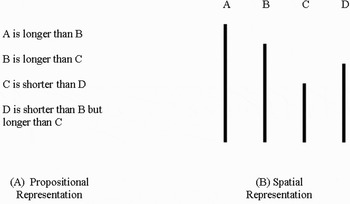
Model-based representations also create different conditions for drawing inferences. Representing transitive relations demonstrate that different formats are related to different levels of processing complexity. Transitive relations represented as propositions require many successive inferential steps to draw a putative conclusion – perhaps more than a child could simultaneously hold in working memory. For example, one must represent the relationship between A and B, and the relationship between B and C, and then one must add an additional representation of the relationship between A and C (see Fig. 1A). If one posits a spatial representation of the premises, then this problem no longer holds (see Fig. 1B). Solving a transitive relation becomes immediately apparent simply by scanning the model of the premises, allowing a solution from direct perception (Morris & Schunn Reference Morris, Schunn, Roberts and Newton2005). Model-based representations make transitive relations obvious because the relations between objects are conveyed in the models themselves, reducing the need for secondary inferential processing (Johnson-Laird Reference Johnson-Laird1983). Model-based representations of magnitudes provide implicit information about relations such as numerical succession, which would be helpful for inducing principles about ordinal – and perhaps even cardinal – relations (see Mix & Sandhofer Reference Mix, Sandhofer and Roberts2007). Although the result of such inductions would be probabilistically true concepts, rather than natural number principles, further experience (e.g., language, formal schooling) would provide additional positive and negative evidence for their veracity.
A comparison of propositional and model-based representations of the same transitive relation.

The quantity system that represents magnitudes such as number and duration is well suited for representing “natural” instances in which quantity distinctions arise. It does not require propositions and may produce given effects directly (as in models) or in the emergence of structure through experience (as in neural networks). In this way, experience with magnitudes would likely produce highly consistent information (e.g., 4 is always larger than 3) that would allow the induction of probabilistic, but not algorithmic, concepts. If the requirement of algorithms is eliminated, instead allowing for probabilistic ally true concepts, the problem of the acquisition of mathematical principles is also eliminated.
ACKNOWLEDGMENT
We thank Vincent Brown for comments on a previous draft.