This paper presents a psychometric analysis of the Lenguaje Oral, Lenguaje Escrito: Evaluación (LolEva) [Oral & Written Language: Assessment] (Mayor, Fernández, Tuñas, Zubiauz, & Durán, Reference Mayor, Fernández, Tuñas, Zubiauz, Durán, Mata, Peixoto, Morgado, Castro and Monteiro2012; Peralbo, Brenlla, García, Barca, & Mayor, Reference Peralbo, Brenlla, García, Barca, Mayor, Mata, Peixoto, Morgado, Castro and Monteiro2012). Taking a psycholinguistic perspective, the test is built on the assumption that an interacting set of regular, continuous processes brings about language comprehension and use, both oral and written. Metalinguistic processes refer to a person’s awareness of the component parts of words, which seems to facilitate initial reading acquisition in languages with transparent as well as non-transparent orthographies (Alegría, Reference Alegría2006; Caravolas, Lervåg, Defior, Málková, & Hulme, Reference Caravolas, Lervåg, Defior, Málková and Hulme2013). Phonological awareness has been defined as consciously knowing that words have several constituent units of sound (Gillam & van Kleecl, Reference Gillam and van Kleeck1996), and being able to reflect on and manipulate the subunits of speech: syllables, intrasyllabic units, and phonemes (Anthony et al., Reference Anthony, Williams, Durán, Gillam, Liang, Aghara and Landry2011; Morais, Reference Morais, Sawyer and Fox1991; Treiman, Reference Treiman, Sawyer and Fox1991). Morais (Reference Morais, Sawyer and Fox1991) put it thusly:
Phonological awareness is a special kind of phonological knowledge. It differs from the phonological knowledge used in comprehending and producing language by the fact that it refers to conscious representations of the phonological properties and constituents of speech. Indeed, this definition is a loose one unless we specify the criteria by which a phonological representation can be said to be conscious. (p. 34)
Not all knowledge can be easily verbalized, so using recognition or free response tasks, for example, is justified. Furthermore, researchers are not in complete agreement about how phonological awareness develops in different languages, and whether the level of PA a person attains in one language can predict his or her PA in a second language.
This study, however, is based on several assumptions with ample empirical support (Alegría, Reference Alegría2006; Brady & Shankweiler, Reference Brady and Shankweiler1991; Defior, Reference Defior1996; Jiménez & Ortiz, Reference Jiménez and Ortiz1995; Stanovich, Reference Stanovich2000):
-
a. In the development of phonological skills, there is a gradual progression beginning with the ability to manipulate words, followed by syllable manipulation, and finally phoneme manipulation.
-
b. The position within the word of the unit being manipulated has an effect according to which it is harder to manipulate units at the end of the word that at the beginning, at least on certain types of tasks.
-
c. The type of syllable structure (CV, VC, CCV, etc.) may influence task complexity.
-
d. Phonological skills can improve with training, even at a very young age.
-
e. Phonological skills predict successful initial reading acquisition.
-
f. There is a reciprocal relationship between phonological awareness and reading.
It has been demonstrated that phonological awareness plays a critical role in learning to read (Bryant & Bradley, Reference Bryant and Bradley1985; Caravolas et al., Reference Caravolas, Lervåg, Defior, Málková and Hulme2013; Carroll, Snowling, Stevenson, & Hulme, Reference Carroll, Snowling, Stevenson and Hulme2003; Márquez & de la Osa, Reference Márquez and de la Osa2003), and PA assessment has become increasingly necessary for professionals who guide and implement clinical and educational interventions. Utilizing standardized tests adapted for Spanish populations, PA assessment has mostly used a paper-and-pencil format. Examples include the Prueba de Segmentación Lingüística (PSL) [Word Segmentation Test] (Jiménez & Ortiz; Reference Jiménez and Ortiz1995), Batería de Evaluación de los Procesos Lectores, Revisada (PROLEC-R) [Battery of Reading Processes Tests, Revised] (Cuetos, Rodríguez, Ruano, & Arribas, Reference Cuetos, Rodríguez, Ruano and Arribas2007), and the Test de Análisis de la LectoEscritura (TALE-2000) [Test of Reading-Writing Analysis] (Toro, Cervera, & Urío, Reference Toro, Cervera and Urio2000). Nevertheless, ICT (Information and Communication Technology) is only just beginning to be used in developing computerized instruments, instruments like the LolEva (the subject of the present study), SICOLE-R-Primaria [SICOLE-R-Primary] (Jiménez et al., Reference Jiménez, Antón, Díaz, Guzmán, Hernández-Valle, Ortiz and Muñetón2007), or the Prueba Informatizada de Habilidades Metafonológicas [Computerized Test of Metaphonological Skills] (Carrillo & Marín, Reference Carrillo and Marín1996). To create this sort of computerized test would help complete the current arsenal of tests for the earliest levels of childhood education, covering a wide time span so that phonological awareness difficulties can be identified at an early age and timely intervention can be applied to facilitate the initial learning-to-read process.
A requirement of any assessment tool is that its psychometric properties guarantee it for use and lend credibility to its results (Muñiz, Reference Muñiz1999). In terms of validity, the abundant literature to date has confirmed the LolEva’s content validity, and its internal structure has emerged from research results. Jiménez and Ortiz (Reference Jiménez and Ortiz1995) posit that a person’s level of phonological awareness can be established according to task difficulty, which varies depending on the linguistic, analytical, and memory aptitude it demands. Similarly, some authors (Leong, Reference Leong, Sawyer and Fox1991; Morais, Reference Morais, Sawyer and Fox1991) draw a distinction between classification and pairing tasks, and segmentation tasks (which require the production or manipulation of isolated elements), arguing that classification tasks are easier. Adams (Reference Adams1990) has proposed as many as five difficulty levels on tasks that measure phonological awareness. In order of difficulty from lowest to highest, the tasks are the following: i. Remember familiar rhymes; ii. Recognize and classify rhyme and alliteration patterns in words; iii. Blend syllables into words, or split one syllable component from the rest (for example, isolate the first phoneme); iv. Word segmentation into phonemes; v. Add, omit, or reverse phonemes, and identify the resulting word or pseudoword.
In their influential study, Anthony et al. (Reference Anthony, Williams, Durán, Gillam, Liang, Aghara and Landry2011) attributed developmental differences between 3 and 6 years of age to the relative influence of task complexity. In their study, items that included the same cognitive operations (addition and omission), or had the same response format (free response or multiple choice) shared a certain amount of variance regardless of the structural segment of the affected word (word, syllable, or phoneme). According to those authors’ data, word structure in Spanish does not seem to impact item difficulty. They posit the following developmental sequence of phonological awareness skills (which they believe are one-dimensional). First, children become able to blend two words to form a new one. Next, they learn to connect syllables and form words on their own. Ultimately, the most developed among them can omit sounds from words to create new words. In their study, multiple-choice addition tasks were easier than free-response addition tasks, which were easier than free-response omission tasks. The same sequence was observed regardless of the structural level of the word analyzed. In other words, good results could be obtained if one assesses level of phonological development by selecting just one word structure (syllable or phoneme), and manipulating only task complexity. In Spanish however, as described above, task difficulty seems to stem from other factors, which the aforementioned study ruled out as discriminant (e.g. the type of segment affected, and its position within the word).
Tasks to evaluate reading processes are based on the psycholinguistic processes they involve: from perceptual, linguistic letter recognition; to dual-route lexical access (direct or phonological); and syntactic and semantic analysis. This series of constituent processes is present in practically every test that measures reading processes, and is a point of reference for the LolEva scale of initial reading competence.
With that in mind, this study’s objective is to determine and evaluate the main psychometric properties of the LolEva and its constituent parts, specifically: to determine the reliability of total and partial scores (by subscale and subsample), conduct item analysis, and identify the underlying factor structure and, comparing it to the one used when the instrument was created, take a measure of construct validity.
Method
Participants
Participants in this study were 341 students, from the first year in Early Childhood Education (ECE) [Educación Infantil] to the second year in Primary Education (PE) [Educación Primaria], from public and state-subsidized schools in A Coruña and Salamanca, Spain. They were all 3 to 8 years old, and both sexes were represented (49.6% girls). No one was repeating a grade. The only exclusion criterion was exhibiting severe developmental alteration that could affect comprehension or task performance, but no such case was found. The children were authorized to participate by their parents through an informed consent procedure.
Materials
The computerized LolEva test was employed, designed to identify difficulties in phonological skills development that can lead to problems learning to read. It can be administered to an age range of 3 to 8 years old, and it consists of two subscales: Phonological Awareness (PA) and Initial Reading Competence (IRC). The first is made up of seven tasks with 10 items each: rhyme identification and identification-addition-omission of syllable or phoneme. On half the latter items, the objective syllable or phoneme is positioned at the beginning of the word, and on the other half, it is at the end. The IRC subscale covers six tasks: reading uppercase and lowercase letters (29 items each), reading simple words (simple grapheme-phoneme agreement), reading complex words (complex grapheme-phoneme agreement; e.g. the Spanish word quien), reading pseudowords (10 items each), and splitting sentences into words (laovejadalana [thesheepgiveswool]) (5 items). On both subscales, the number of correct responses is recorded, and on the IRC, the time elapsed before responding correctly is measured as well. All instructions and examples are provided in audiovisual format, as determined in advance Footnote 1 .
Procedure
The test was administered on an individual basis in classrooms where participants could complete it with no outside interference. The items were presented on a laptop computer (controlled by the test proctor), starting with two examples. Each respondent had to solve at least one sample question on his or her own before the test could be administered. The test took between 40 and 50 minutes to complete. Data collection was carried out during the second semester of the school year in March, April, and May.The data were analyzed using IBM SPSS Statistics 21.
Results
Reliability
To ensure the quality of this measure, we first analyzed the reliability of scores on its subscales, obtaining an alpha coefficient of .94 for PA with all 7 tasks taken into account (Rhyme Recognition, Syllable Identification, Phoneme Identification, Syllable Addition, Phoneme Addition, Syllable Omission, Phoneme Omission), and an alpha coefficient of .96 when the parts corresponding to position (beginning vs. end of word) were considered separately. Scores on the IRC subscale, which included six tasks (Reading Uppercase Letters, Lowercase Letters, Simple words, Complex words, Pseudowords, and Word Separation), had an alpha coefficient of .92. Eliminating any particular item from the set did not produce meaningful differences in the coefficients listed above.
PA Subscale Analysis
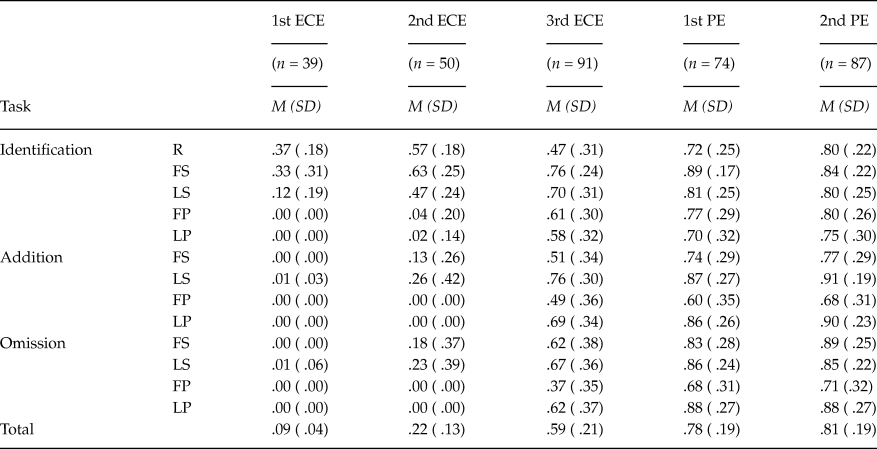
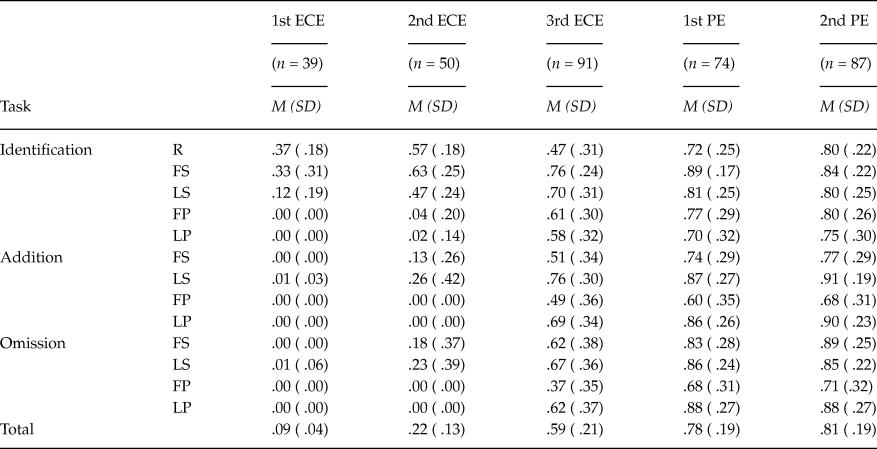
The following data inspection aimed to analyze the relationship between results on this subscale and the Year in School variable (Table 1), because in the developmental range covered by the test, having completed different years in school implies having developed different skills that have bearing on what the test measures.
Average Proportion of Correct Responses on Each of the Test’s Phonological Awareness Tasks in Each School Year
Note: R = rhyme; FS = first syllable; LS = last syllable; FP = first phoneme; LP = last phoneme.
First, a one-way analysis of variance was conducted on total scale scores, with results indicating significant differences and effect size showing that Year in School predicted 70% of variability in PA: F(4, 336) = 191.385, p < .001, η2 p = .695, 1–β = 1.0. However, given the unequal size of year-in-school subsamples, and the inequality of variance, Levène (4.336) = 11.614, p < .001, and bearing in mind that F is especially vulnerable when those two conditions apply (Howell, Reference Howell2013), a robust test of equality of means was conducted. Its results, too, suggest significant differences: Welch (4, 157.662) = 554.676, p < .001.
As Table 1 conveys, participants’ average number of correct responses increased with year in school. To ascertain which specific differences were important, we used the Games-Howell test for multiple comparisons, which is considered to have greater power (smaller confidence intervals) than other tests in cases of unequal samples or variances, and can also control FWER (Cardinal & Aiken, Reference Cardinal and Aitken2006; Kirk, Reference Kirk2013; Zimmerman, Reference Zimmerman2004). Our post-hoc comparison revealed that differences did not occur between all years in school; rather, four subsets were identified: one for each level of ECE, and a single homogenous subgroup combining the two levels of PE. In other words, all differences in means turned out to be statistically significant where p < .001, except for the first and second years of PE: difference = –.32, p = .82.
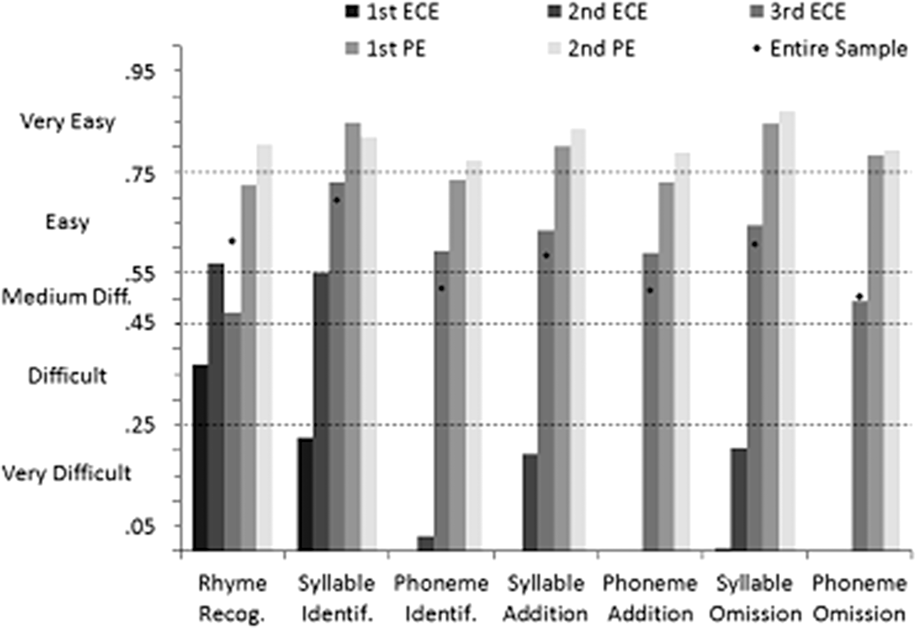
Item Difficulty Indexes (DIs = p-values), too, showed this pattern of similarity and difference between students’ results in different years in school. DIs were calculated according to how they are defined within the psychometrics literature: the proportion of people in the sample who answered correctly. It has been said on numerous occasions that it would be more appropriate to refer to this as an item “easiness” index, because the larger it is, the easier the item. With that in mind, this paper will present DIs using quantitative measures as well as the usual qualitative measures from Classical Test Theory.
As Figure 1 shows, for ECE first-years, all the tasks were either difficult (DI in the second quartile, not counting the interval around Q50: .44 ≥ DI ≥ .25) or very difficult (DI in the first quartile: DI ≤ .25), to the point that they only managed to solve the Rhyme Recognition and Syllable Identification tasks. For ECE second-years, however, those last two tasks were easy (DI in the third quartile not counting the interval around Q50: DI ≥ .55) and the rest were very difficult (DI in the fourth quartile: DI ≥ .75). However, the proportion of students able to solve the tasks rose considerably. For ECE third-years, in contrast, most items were easy, but Rhyme Recognition and Phoneme Omission had medium task difficulty (.54 DI ≥ .45). In contrast to the above, first and second-year PE students scarcely differed from one another, although all subtests were very easy for second-years (DI ≥. 75), and that was not the case for first-years.
The Phonological Awareness Tasks’ Difficulty Indexes.

Regarding item difficulty indexes, we observed that task difficulty generally decreased as year in school progressed, and for all years in school, phoneme-involved tasks were more difficult than syllable-involved tasks.
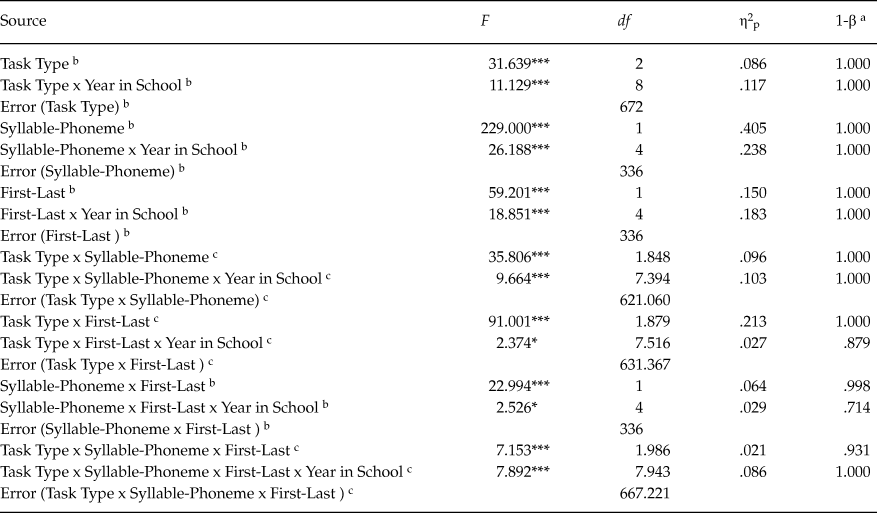
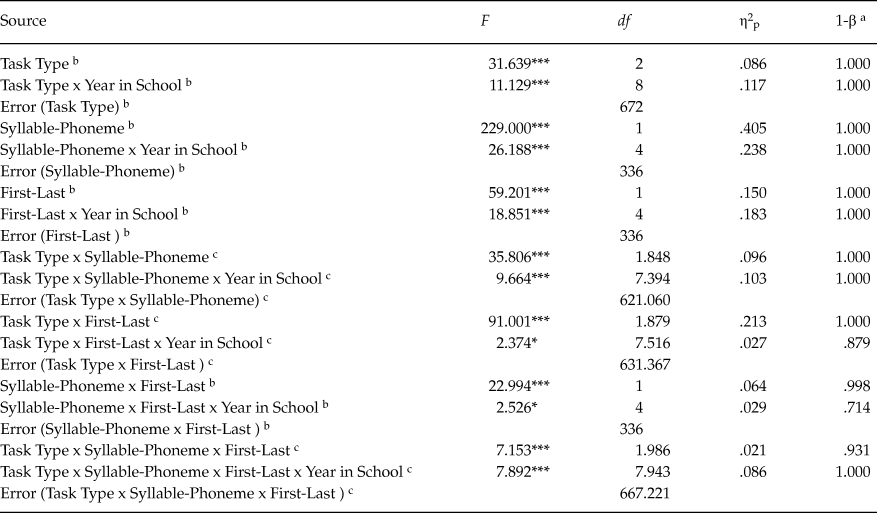
On another note, the test structure enabled us to construct a within-subjects model to analyze task type (identification/addition/omission), objective type (syllable/phoneme), and objective position (beginning/end), and how they relate to the year-in-school variable. Repeated measures analysis revealed significant main effects, significant interaction effects (Table 2), and a significant between-subjects effect of the year-in-school variable (academic level): F(1, 4) = 2073.876, p < .001, η2 p = .708, 1–β = 1.0.
Tests of Within-subjects Effects on the Test’s Phonological Awareness Tasks
a Calculated for alpha = .05.
b Significance of Mauchly’s W > .05 → Sphericity assumption.
c Significance of Mauchly’s W ≤ .05, Epsilon > .70, and n > k + 10 → Huynh-Feldt correction for degrees of freedom (Collier, Baker, Mandeville, & Hayes, 1967; Field, 2005; Maxwell & Delaney, 2004).
* p <.001. **p < .05.
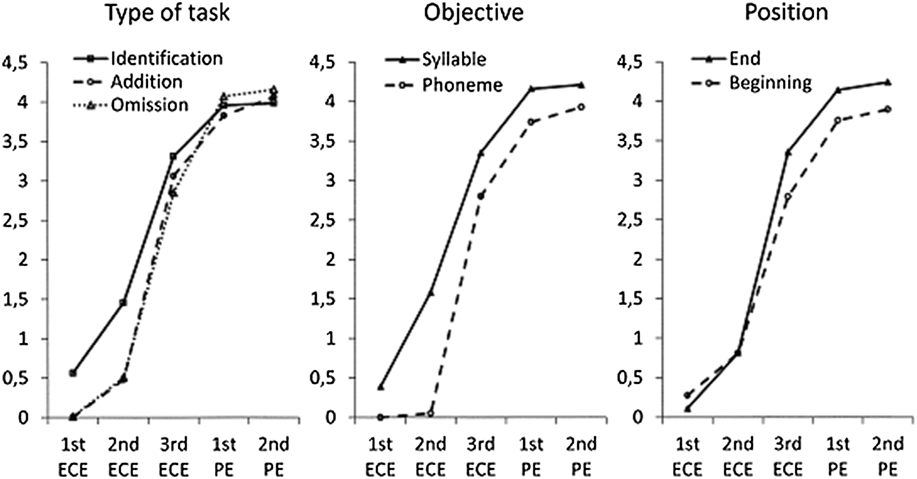
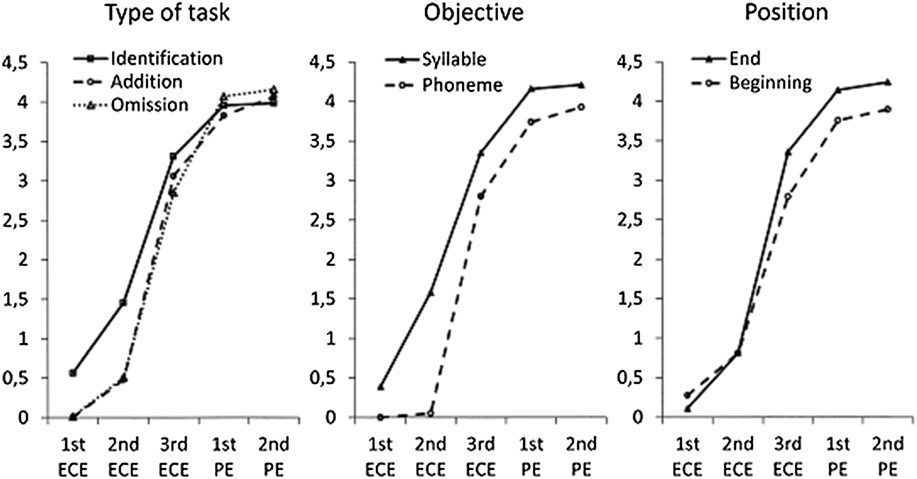
Furthermore, making multiple comparisons and graphically analyzing student profiles, we observed the following main effects (Figure 2): (1) regarding type of task, identification was easier than Addition and Omission, but their difficulty tended to equalize as year in school progressed; (2) about objetive, syllable-related tasks were easier than phoneme-related tasks at all academic levels; (3) regarding objective position, once the ability to solve these tasks had been generally acquired (starting in the third year of ECE), they were easier if the syllable or phoneme was at the end of the word than if it was at the beginning.
The Phonological Awareness Tasks’ Main Effects.
As for the rhyme test, which is purely recognition-based (in the task, neither position nor demand gets manipulated), the only analysis possible was by year in school. In that respect, one-way analysis of variance revealed significant differences, and post-hoc tests yielded the same subgroups as those based on total scores, although the effect size was much smaller in this case: F(1, 4) = 34.370, p < .001, η2 p = .29, 1–β = 1.0.
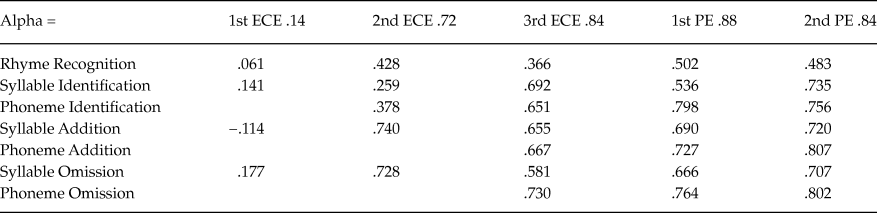
Though difficulty is the most essential component of item analysis for any skills test (Wilson, Reference Wilson2005), item discrimination indexes provide important information by relating each item to the overall test. Corrected item-total correlations (where the item in question’s score is not included in the total score) were computed to measure discriminant power, that is, the ability of each task to differentiate adequately among students with different levels of the construct that the test measures. According to Table 3, except in ECE first-years, practically all the tasks’ indexes reflected high discriminant power (≥ .40). Phoneme Identification in ECE second-years and Rhyme Recognition in ECE third-years did not meet that standard, but had acceptable results nonetheless (.30 ≤ .374 ≤ .39). Conversely, syllable identification had little discriminant power in ECE second-years, and for ECE first-years, discriminant power was low across the board. However, that is not to say the items were not useful in other ways.
Discrimination Indices on the Test’s Phonological Awareness Tasks
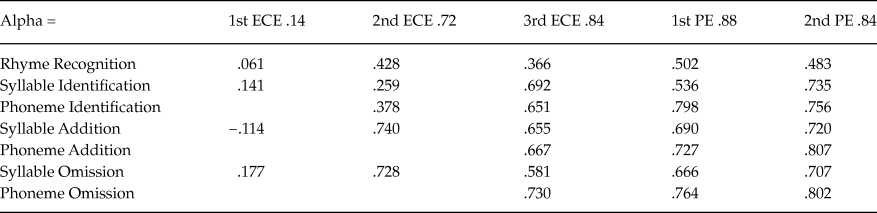
Obviously, by employing smaller, more homogenous samples like the subgroups created by year in school, reliability dropped. Results nonetheless indicated good (ECE second-years) or very good (all other years in school) reliability.
IRC Subscale Analysis
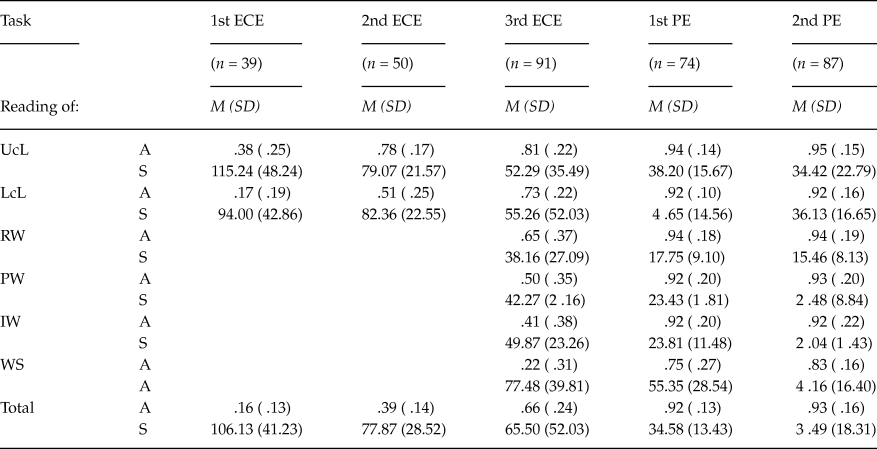
The relationship between total scores on this subscale and academic level appears in Table 4.
Average Proportion of Correct Responses and Time Used (Sec.s) on Each of the Test’s Initial Reading Competence Tasks by Year in School
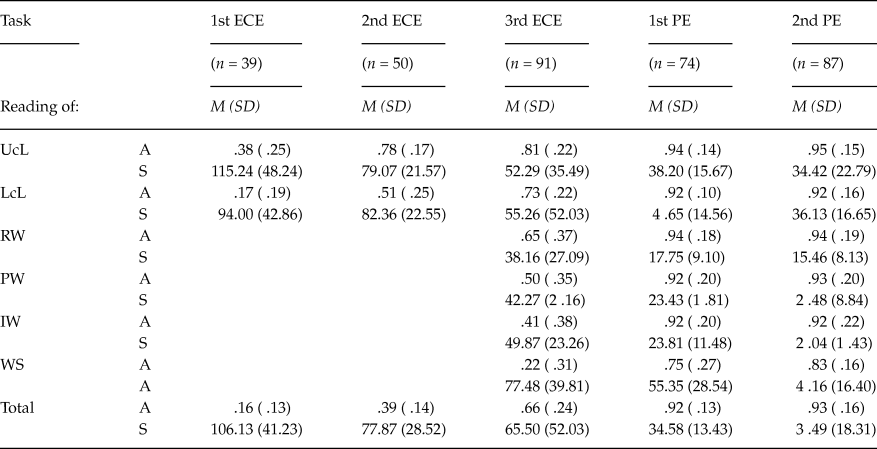
Note: UcL = Uppercase letters; LcL = Lowercase letters; RW = Simple words; PW = Pseudowords; IW = Complex words; WS= Word splitting; A (accuracy) = Proportion of correct responses; S (speed) = Response time, in seconds.
Here, too, analysis of variance revealed significant differences, both in number of correct answers, which increased as schooling progressed , F(4, 336) = 197.897, p < .001, and Welch (5,107.275) = 410.550, p < .001), and task completion time, which decreased as education progressed, F(4, 335) = 47.048, p < .001, and Welch (4, 130.276) = 59.904, p < .001. The effect size was larger in the first case than in the second (η2 p = .702 and η2 p = .360, respectively). In both cases, the power of statistical tests reached 1.0.
On the other hand, post hoc tests indicated the proportion of correct answers was about the same in the PE first- and second-year subsamples. The same was true for PA: all differences in means were found to be statistically significant where p < .001, except between PE first- and second-years (difference = –.004, p = 1.00). Likewise, ECE second- and third-years used about the same amount of time to complete tasks: difference between PE first- and second-years = 4.09, p = .48; difference between ECE second- and third-years = 12.37, p = .36.
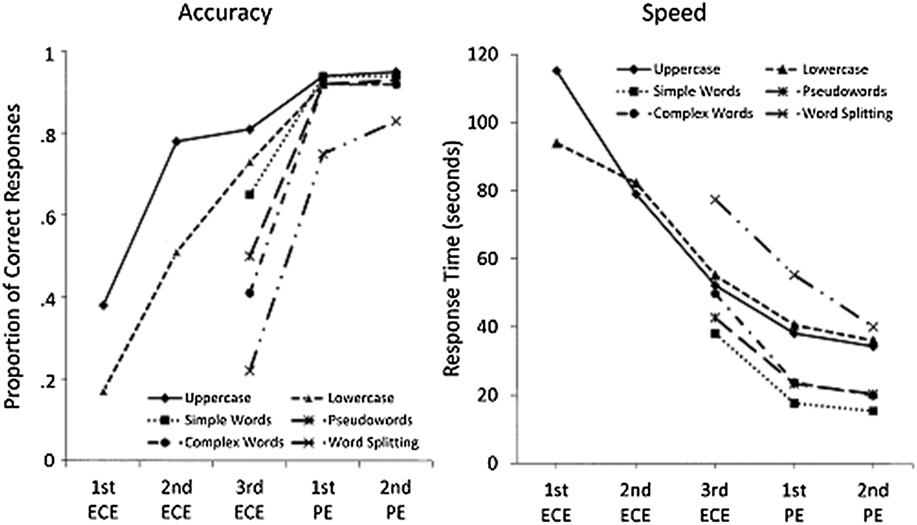
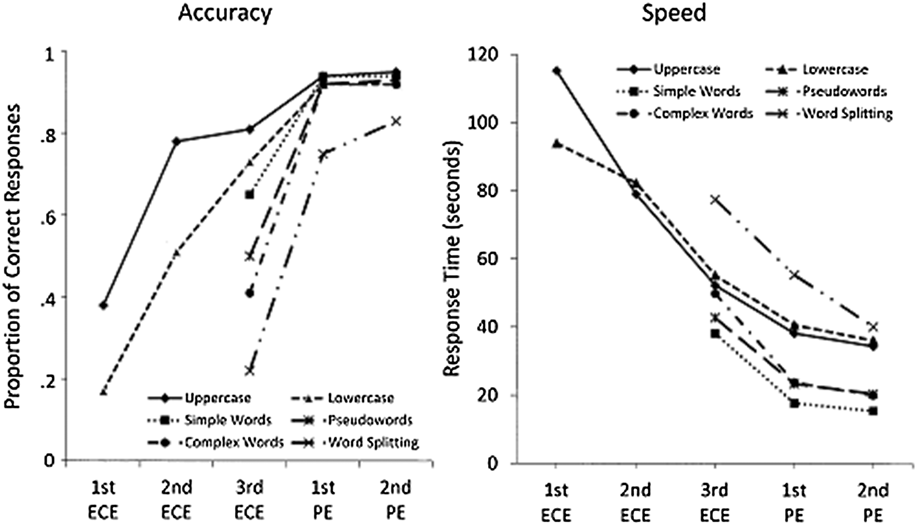
Differences between tasks remained as school went on, but the magnitude of those differences decreased, and different profiles emerged in terms of correct responses and time used. Grouping tasks according to their required skills, three groups emerge (letter reading, word reading, and word separation). Of those, letter reading got the most correct answers, but participants responded fastest on word reading tasks. The word separation task, on the other hand, had the fewest correct answers and took the longest to solve, indicating it was the most difficult at every academic level. Furthermore, we observed that within these groups, response speed was generally slower on tasks requiring higher accuracy (Figure 3).
Speed and Accuracy Response Profiles on Initial Reading Competence Tasks.
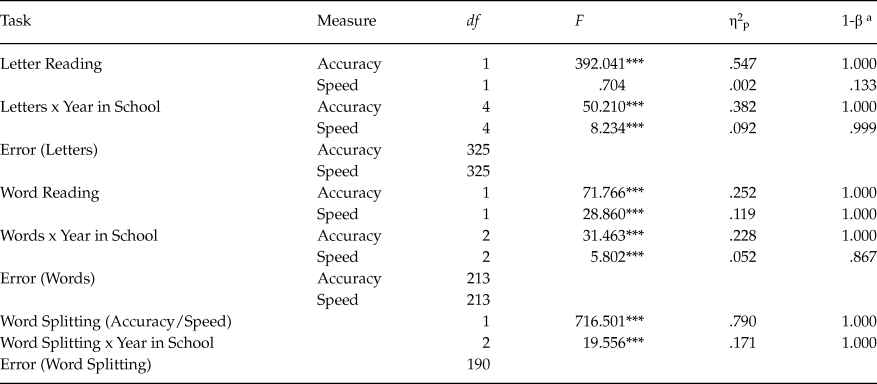
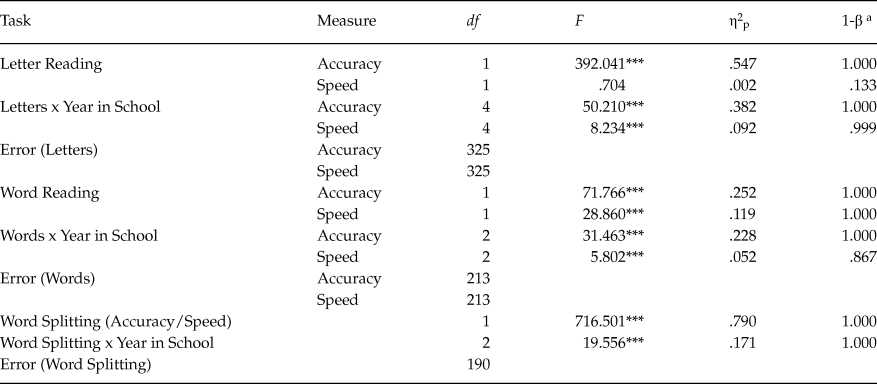
Separately analyzing the three task types, significant differences in accuracy as well as speed became apparent (except for letter reading time), but the differences had a very small effect size (Table 5).
Results of Repeated Measures Analyses by Initial Reading Competence Task Type
a Calculated where alpha = .05
*** p < .001
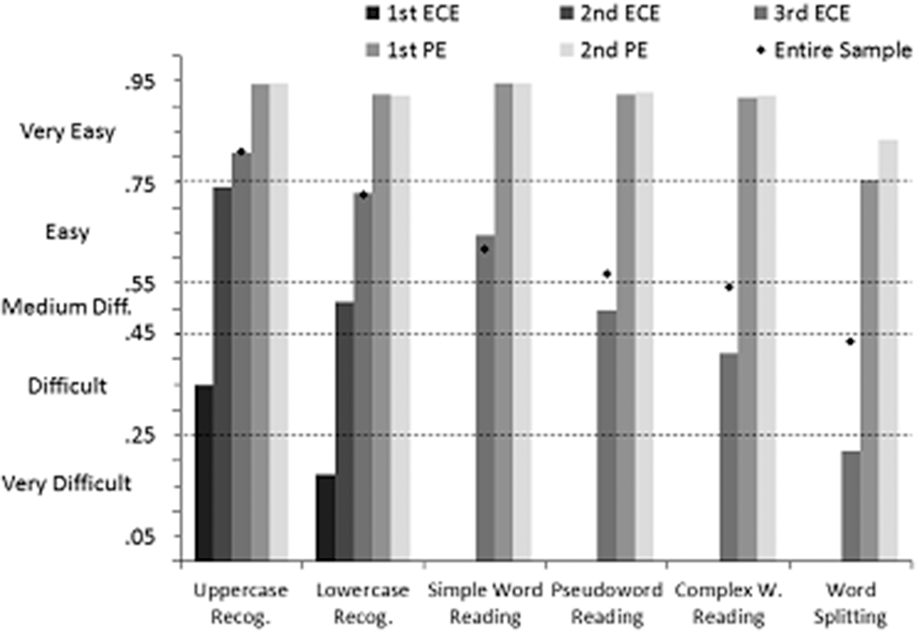
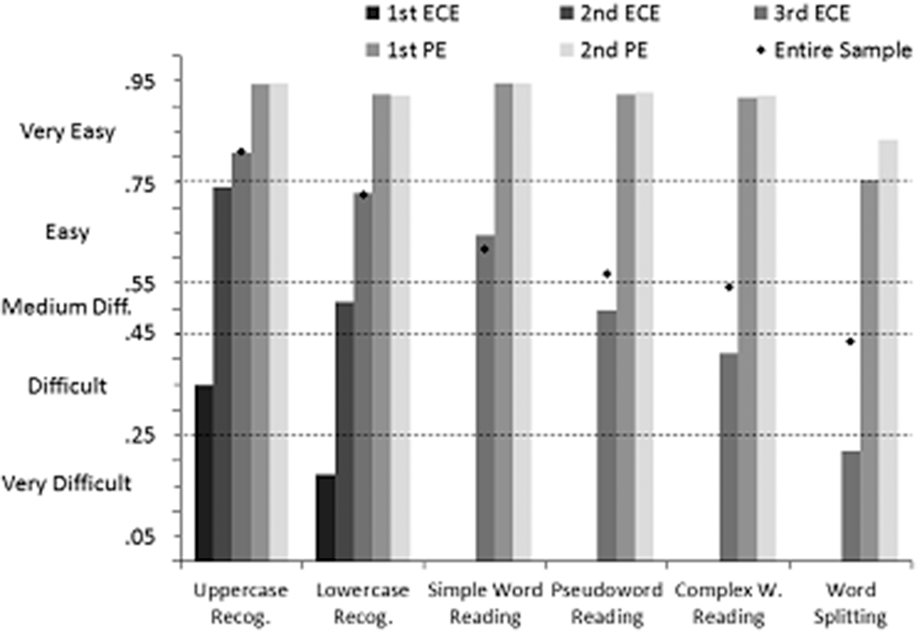
With regard to difficulty indexes at different academic levels, Figure 4 shows that ECE first- and second-years only managed to solve letter identification tasks. The subgroups differed in that for first-years, uppercase letter identification was difficult, and lowercase letter identification was very difficult, while for second-years, the first was easy and the second had medium difficulty. At the other end of the spectrum were PE first- and second-years, for whom all the tasks were very easy, although the Word Separation task was borderline for that category in first-years. The most remarkable data occurred in the ECE third-year subsample, who showed a linear progression in the difficulty of different subtests, from very easy to very difficult.
The Initial Reading Competence Tasks’ Difficulty Indexes.
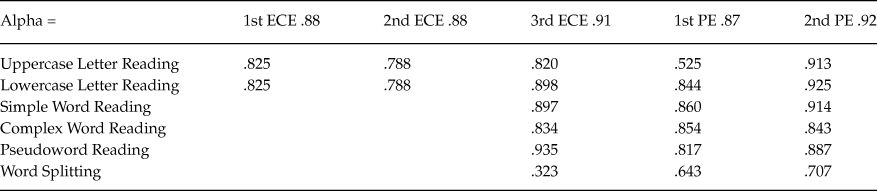
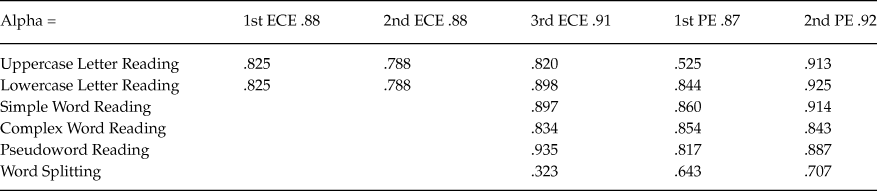
In terms of different tasks’ discriminant capacity (Table 6), they all showed high discriminant power (≥. 40) except Word Separation in ECE third-years. In that case, its discriminant power was acceptable (.30 ≤ .323 ≤ .39). Furthermore, reliability measures were very good in all subgroups.
Discrimination Indices on the Test’s Initial Reading Competence Tasks
Validity
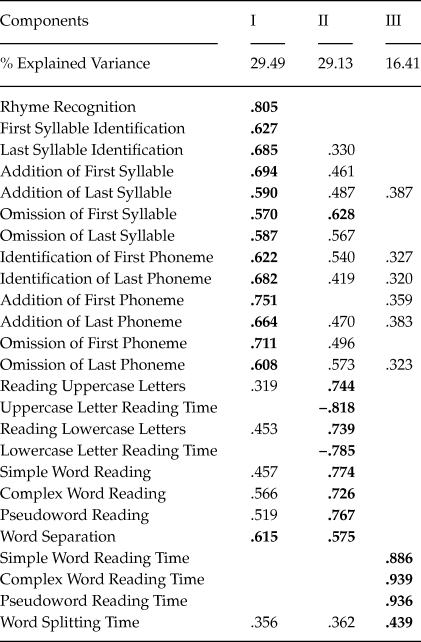
To determine LolEva’s construct validity, Exploratory Factor Analysis was conducted, excluding Confirmatory Factor Analysis for now because as other authors have pointed out (Pérez-Gil, Chacón, & Moreno, Reference Pérez-Gil, Chacón and Moreno2000), it would be redundant. Before proceeding with EFA, we confirmed that the following conditions were met: more than half the correlations between variables were above .30, Bartlett’s test of sphericity allowed us to reject the null hypothesis that the correlation matrix was an identity matrix, χ2 (300) = 10371.73, p < .001, and the Kaiser-Meyer-Olkin measure of sampling adequacy (Kaiser, Reference Kaiser1974) yielded a value that is considered optimal: KMO = .952.
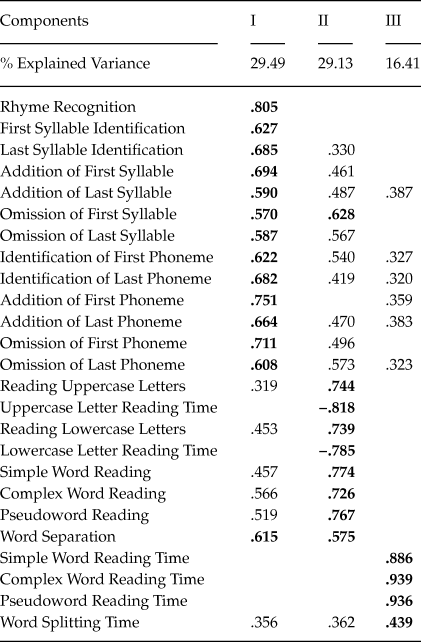
A principal components extraction procedure was carried out, applying the criterion that components with initial eigenvalues > 1 get extracted. Equamax rotation (reducing the number of variables with high loadings on one factor, and the number of factors needed to explain one variable) was later applied. This yielded three factors, each explaining rather similar proportions of total variance, and together explaining 75.03%. The results appear in Table 7 (loadings below 0.30 were eliminated).
Results of Factor Analysis on the LolEva Test with Equamax Rotation
Note: Factor loadings < .30 were excluded.
As the table illustrates, the first factor is basically made up of tasks from the PA subscale. Meanwhile, the IRC subscale comprises factors two and three, the latter including time measures on the reading and word splitting tasks. Upper and lowercase letter reading times are part of the second factor, but their factor loadings were negative.
Discussion
Our analyses have confirmed the test’s high reliability, with alpha values of .94 for PA and .92 for IRC, and a factor structure that explains a high percentage of variance (75%). Furthermore, they show that the tasks utilized, and their respective items, have the psychometric properties needed to statistically guarantee the test and its usefulness as a tool in the early detection of learning difficulties. Scores on this test had comparable if not higher reliability than other similar tools with a pencil-and-paper format (the PROLEC-R by Cuetos et al., Reference Cuetos, Rodríguez, Ruano and Arribas2007; the TALE-2000 by Toro et al., Reference Toro, Cervera and Urio2000; and the PSL by Jiménez & Ortiz, Reference Jiménez and Ortiz1995), apart from the age range covered.
On the other hand, results on the PA and IRC subscales (both in terms of accuracy and speed) suggested a distinct growth process in development between the first year of ECE and the beginning of PE. The way writing is introduced, socially and educationally, seems to influence that development.
In fact, while children in their first year of ECE become able to identify rhyme and recognize syllables, they can only identify uppercase (in the learning-to-read process, those are introduced first, so logically, their outcomes are best) and lowercase letters with difficulty. In the second year of ECE, they can to some extent complete PA tasks (except phoneme addition and omission). At that point they can also recognize upper and lowercase letters, like in the year before, but now with ease. Reading words and sentences is still absent at this stage. Thus, it is the level of difficulty posed by letter reading that differentiates these groups from one another.
In the third year of ECE, there is a qualitative and quantitative jump. Students are able to do all the PA tasks, with different levels of difficulty, and easily or very easily read uppercase letters, lowercase letters, and simple words. They can also read pseudowords of medium difficulty, but words with complex grapheme-phoneme agreement (referred as complex in this paper for the sake of brevity) and splitting sentences into words remain difficult and very difficult for them, respectively. Therefore, during this year in school, lexical access is already possible via both routes – direct or phonological – and they also display the ability to separate words at every level.
Regarding our results pertaining to phonological awareness, the developmental sequence we observed coincides with the levels described in Treiman’s (Reference Treiman, Sawyer and Fox1991) hierarchical model; and the five levels of difficulty Adams (Reference Adams1990) identified on phonological awareness tasks according to linguistic, analytic, and memory demands; and the growing body of data on phonological awareness development (Jiménez & Ortiz, Reference Jiménez and Ortiz1995). Conversely, these results only partially support those of Anthony et al. (2013). They were consistent with those authors’ findings about the unidimensionality of PA, but not about what elements define task complexity and difficulty. Task complexity seems to play an important role in the development of phonological awareness skills. However, a word’s structural complexity, the position and type of segment being manipulated within the word, and response format are all included under the concept of complexity. In this study, PA task complexity or difficulty referred to those two factors interacting in such a way as to impact the expression of a skill that seems to have just one factor. On that point, this study found that skills’ different levels of difficulty matched their order of emergence.
Certain differences between our two studies make it challenging to compare them; task type was not entirely consistent. The present research utilized multiple-choice tasks, or similar, to assess rhyme recognition, beginning and ending syllable recognition, and beginning and ending phoneme recognition. In all other cases (omission and addition), free response tasks were employed. The fact that all PA tasks were grouped into a single factor may support the notion of one-dimensionality these authors suggest, but the influence of developmental sequence seems to include additional factors it interacts with reciprocally (working memory and executive functions, processing speed, bilingual context, etc.). The data presented here can be said to reflect that sort of interaction by showing that with age, free recall tasks have the same level of difficulty as recognition tasks (Identification is easier than Addition and Omission but their difficulty/ease tends to equalize as academic level increases); syllable-involved tasks are easier than phoneme-involved tasks at all academic levels; and finally, once respondents can manipulate syllables as well as phonemes (from the third year of ECE on), it is easier when the segment involved – syllable or phoneme – is at the end of the word than when it is at the beginning. Phonological awareness involves knowledge, capacity for manipulation, supervision, and conscious control (like other aspects of metalanguage), and requires interactive feedback from other top-down and bottom-up processes.
The results of this research, therefore, seem to indicate that although phonological awareness has just one factor, it follows one course or another as a function of other variables (cognitive and contextual) that, while independent, favor or hinder its development with age.
ECE first- and second-year students’ difficulty manipulating the phoneme segments of words, and third-years’ ease in doing so, appear to be the result of not only their levels of metaphonological development, but also their capacity to manage other cognitive-type functions (like executive functions and naming speed) that, while independent of PA, have a well established effect on reading acquisition (Caravolas et al., Reference Caravolas, Lervåg, Defior, Málková and Hulme2013; Mayor et al., Reference Mayor, Fernández, Tuñas, Zubiauz, Durán, Mata, Peixoto, Morgado, Castro and Monteiro2012; Peralbo et al., Reference Peralbo, Brenlla, García, Barca, Mayor, Mata, Peixoto, Morgado, Castro and Monteiro2012). This situation, paired with increasing, more systematic exposure to reading in both school and extracurricular contexts, may explain how ECE third-years could already exhibit the hothouse effect posited by Torgesen and Davis (Reference Torgesen and Davis1996), and Defior (Reference Defior2008), who suggested that “phonological awareness may act like an enzyme that helps establish a more comfortable context for learning written language” (p. 344).
In the present research, the difficulty of reading processes increased much more linearly: uppercase letters, lowercase letters, simple words, pseudowords, complex words, and splitting sentences into words. Furthermore, the more correct responses a student gave, the less reading time they needed. That is essentially consistent with what we know about reading acquisition and the processes it involves (Cuetos, Reference Cuetos2008).
This study had two main limitations. The first has to do with the number of participants in the ECE first-year group. That subsample’s size should be increased in order to corroborate these results which, while theoretically consistent, need more complete empirical validation. The second limitation would also require a considerably larger sample size. Given our interest in determining the role of variables related to social-economic-cultural context in the level and progression of metalinguistic development (family’s level of education, monolingual vs. bilingual context, public or private school, etc.), taking such contextual variables into consideration would help us better understand not only what develops (in which case the psycholinguistic perspective has been predominant), but how it develops (basic knowledge for implementing any educational or clinical approach).
Subsequent studies will allow us to confirm LolEva’s underlying factor structure through Confirmatory Factor Analysis, and to ascertain its concurrent, discriminant, and predictive validity. To do so will require, on the one hand, analyses to examine its relationship with other phonological awareness scales (like the ones highlighted in this paper), and on the other, analyses to identify the profile associated with atypical forms of development, whether the result of learning difficulties or more or less severe developmental disorders.