Introduction
Heart failure is a prevalent disease with significant associated morbidity and mortality. It affects at least 1% of the population,1 with a steep increase to 13.7% of men and 12.5% of women over 75 years of age.2 The National Heart Failure Audit of 2010 suggested that 33% of heart failure patients will die within a year of hospital admission for decompensated disease.1 Early diagnosis and initiation of appropriate treatment in these patients is key to improving outcomes.3 In the past, the diagnosis of heart failure, and identification of those patients at risk of adverse outcomes, has been a challenge based upon clinical assessment and echocardiographic evidence of ventricular dysfunction. B-type natriuretic peptide (BNP) and the inactive N-terminal fragment of the precursor (NT-proBNP) have been identified as useful biochemical markers in the diagnosis of heart failure and as a potential adjunct in disease surveillance.
The aim of this paper is to give a synopsis of the use of natriuretic peptides in the diagnosis of heart failure and their potential in therapeutic monitoring. We will look specifically at some of the issues surrounding the measurement of BNP and NT-proBNP in the older patient, along with interpretation of results.
What are natriuretic peptides?
Secretory granules within the heart were first identified in 1956 by Kisch during the study of guinea-pig myocardium.Reference Kisch4 This research was furthered by de Bold et al. in 1981, who recognized a rapid and potent natriuretic response when injecting extract of atrial myocardium into rats.Reference de Bold, Borenstein, Veress and Sonnenberg5 In 1988, Sudoh et al. identified an amino acid structure within the porcine brain, now recognized as BNP.Reference Sudoh, Kangawa, Minamino and Matsuo6 We now know that BNP is in fact predominantly released from the ventricles in response to increased end diastolic pressure and volume.Reference Doust, Glasziou, Pietrzak and Dobson7 Conditions resulting in ventricular hypertrophy, volume overload or raised haemodynamic pressures such as heart failure lead to an increase in circulating BNP levels. The pro-hormone proBNP is cleaved inside of the cardiac myocyte to produce BNP and the inactive NT-proBNP. BNP has multiple neuro-endocrine effects on the body, including natriuresis, diuresis, vasodilatation and smooth muscle relaxation.8, Reference Clerico, Recchia, Passino and Emdin9
Immunoassays available to measure levels of BNP and NT-proBNP are either laboratory-based or rapid point of care testing. Results from different commercial assays are not interchangeable. This must be taken into consideration when interpreting results.Reference Felker, Petersen and Mark10 BNP has a half-life of 22 minutes,Reference Holmes, Espiner, Richards, Yandle and Frampton11 whereas NT-pro BNP has a half-life of 1–2 hours.Reference Mair, Friedl, Thomas and Puschendorf12 It has been hypothesized that, given the shorter half-life of BNP, it could potentially give a more accurate depiction of current cardiac state.Reference Clerico, Fontana, Zyw, Passino and Emdin13 Conversely, NT-proBNP is deemed more stable with less biological variation.Reference Clerico, Fontana, Zyw, Passino and Emdin13 The Scottish Intercollegiate Guidelines Network (SIGN) looked at 19 observational studies on the use of BNP in the diagnosis of heart failure. It pooled the results and found the overall sensitivity of BNP in the diagnosis of heart failure to be 0.91 (95% confidence interval: 0.90 to 0.93), and its specificity to be 0.73 (95% confidence interval: 0.71 to 0.75). Similar results were found when reviewing NT-proBNP, which demonstrated a sensitivity of 0.91 (95% confidence interval: 0.88 to 0.93) and specificity of 0.76 (95% confidence interval: 0.75 to 0.77).8 Clerico et al. performed a systematic review of data published comparing the diagnostic accuracy of BNP and NT-proBNP in both acute and chronic heart failure, using the online National Library of Medicine to identify studies.Reference Clerico, Recchia, Passino and Emdin9 Overall, it concluded that both BNP and NT-proBNP have a high level of diagnostic accuracy in heart failure with no significant difference between the two markers.Reference Clerico, Fontana, Zyw, Passino and Emdin13
Factors affecting natriuretic peptide levels – potential pitfalls
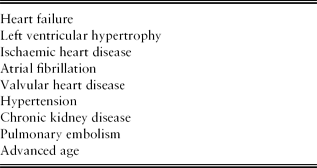
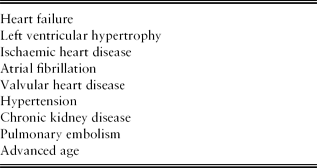
Table 1 summarizes the causes of raised BNP and NT-proBNP. Certain physiological factors may affect circulating BNP and NT-proBNP levels and should be taken into account when interpreting results. This is particularly pertinent in the older population where there is a higher proportion of patients with multiple co-morbidities and polypharmacy. There is an association between increasing age and raised natriuretic peptide levels.Reference Raymond, Groenning, Hildebrandt, Nisson, Baumann, Trawinski and Pedersen14 Aside from heart failure, other cardiac abnormalities may be associated with increased levels of natriuretic peptide, including atrial fibrillation, valvular disease and ischaemic heart disease.Reference Raymond, Groenning, Hildebrandt, Nisson, Baumann, Trawinski and Pedersen14 Additionally, non-cardiac conditions leading to myocardial stress have been shown to raise natriuretic peptide levels. This includes right heart strain secondary to pulmonary embolism, pulmonary hypertension and cor pulmonale.Reference Maisel, Mueller, Adams, Anker, Aspromonte, Cleland, Cohen-Solal, Dahlstrom, DeMaria, Di Somma, Filippatos, Fonarow, Jourdain, Komajda, Liu, McDonagh, McDonald, Mebazaa, Nieminen, Peacock, Tubaro, Valle, Vanderhyden, Yancy, Zannad and Braunwald15
Causes of a raised BNP and NT-proBNP
Drugs that antagonize the renin–angiotensin system will lower serum levels of BNP and NT-proBNP.
Observational studies have shown a link between elevated BNP levels and impaired glomerular filtration rate. Natriuretric peptides are partially excreted by the kidneys, and therefore there is an inversely proportional relationship between eGFR and BNP.Reference Mark, Stewart, Gansevoort, Petrie, McDonagh, Dargie, Rodger and Jardine16 This was supported by van Kimmenade et al.Reference van Kimmenade, Januzzi, Bakker, Houben, Rennenberg, Kroon, Crijns, van Dieijen-Visser, de Leeuw and Pinto17 who found this to be the case in patients with an eGFR of below 30 ml/min/1.73 m2. It has also been hypothesized that, given the strong association between cardiac disease and chronic kidney disease, the high levels of BNP and NT-proBNP may be partly due to increased production from the stressed myocyte. Consequently, raised natriuretic peptide levels in patients with chronic kidney disease should not be entirely discounted and may signify underlying cardiac disease.Reference van Kimmenade, Januzzi, Bakker, Houben, Rennenberg, Kroon, Crijns, van Dieijen-Visser, de Leeuw and Pinto17
Patients with a high BMI have been shown to have lower levels of natriuretic peptides in both acute and chronic heart failure.Reference Krauser, Lloyd-Jones, Chae, Cameron, Anwaruddin, Baggish, Chen, Tung and Januzzi18 This should be taken into consideration when using natriuretic peptides in the diagnosis of heart failure in obese individuals, as their sensitivity may be reduced in this scenario.Reference Krauser, Lloyd-Jones, Chae, Cameron, Anwaruddin, Baggish, Chen, Tung and Januzzi18 The gold standard pharmacological management of heart failure consists of an ACE inhibitor, β-blocker, aldosterone antagonist plus a diuretic. It has been shown that treatment with an ACE inhibitor reduces natriuretic peptide levels;Reference Bettencourt19 therefore a normal natriuretic peptide level from a treated patient does not exclude heart failure and further investigation may be warranted. Surprisingly, treatment with a β-blocker may cause a short-term increase in natriuretic peptide levels.Reference Cowie, Collinson and Dargie20
In summary, in isolation, a moderately raised natriuretic peptide level does not diagnose heart failure. The aforementioned factors should be taken into consideration, and the results interpreted along with clinical assessment and cardiac imaging, most commonly by transthoracic echocardiography.
Indications for BNP assay and current guidelines
The National Institute of Clinical Excellence (NICE) guidelines on chronic heart failure published in August 2010 recommend that, in patients presenting in primary care, serum natriuretic peptides are measured in patients with suspected heart failure, without a history of previous myocardial infarction. Additionally, it states that any patient with a BNP level of above 400 pg/ml or an NT-proBNP level of above 2000 pg/ml should be referred urgently for transthoracic echocardiogram and specialist review within a 2-week time period.3 This reflects the poor prognosis that correlates with high levels of BNP.3 Patients with BNP levels of between 100 and 400 pg/ml or NT-proBNP levels of 400–2000 pg/ml should have transthoracic echocardiogram and specialist review within 6 weeks.3 Patients with a known history of myocardial infarction and suspected heart failure should be referred directly for echocardiogram and clinical assessment within 2 weeks, obviating the need for BNP measurement.3
The current SIGN guidelines concur with NICE, that low BNP levels make heart failure an unlikely cause of symptoms. High levels in the absence of another cause make heart failure the probable diagnosis, whereas intermediate assays require further investigation.8 These guidelines do not specify numerical cut-offs for interpretation of BNP results and suggest that this should be decided locally.8 The 2008 European Society of Cardiology (ESC) guidelines for heart failure again recommend the use of BNP and NT-proBNP in the diagnosis of heart failure.Reference Dickstein, Cohen-Solal, Filippatos, McMurray, Ponikowski, Poole-Wilson, Strömberg, van Veldhuisen, Atar, Hoes, Keren, Mebazaa, Nieminen, Priori and Swedberg21
BNP assay in secondary care can also be useful as a ‘rule out test’ and in identifying high-risk patients. The interpretation of results is more difficult, either due to co-morbidities, or the prescription of drugs acting on the renin–angiotensin system altering BNP levels.
The role of natriuretic peptides in disease surveillance and in guiding therapy
Natriuretic peptides may have a use in disease surveillance and treatment monitoring.Reference Dickstein, Cohen-Solal, Filippatos, McMurray, Ponikowski, Poole-Wilson, Strömberg, van Veldhuisen, Atar, Hoes, Keren, Mebazaa, Nieminen, Priori and Swedberg21 Two large trials have explored the hypothesis that patients are more likely to receive aggressive pharmacological management of their heart failure using a natriuretic peptide guided model.Reference Maisel, Mueller, Adams, Anker, Aspromonte, Cleland, Cohen-Solal, Dahlstrom, DeMaria, Di Somma, Filippatos, Fonarow, Jourdain, Komajda, Liu, McDonagh, McDonald, Mebazaa, Nieminen, Peacock, Tubaro, Valle, Vanderhyden, Yancy, Zannad and Braunwald15 The Trial of Intensified vs. Standard Medical Therapy in Elderly Patients With Congestive Heart Failure (TIME-CHF) randomized trial looked at 18-month outcomes for NT-proBNP-guided vs. symptom-guided heart failure treatment.Reference Pfisterer, Buser, Rickli, Gutmann, Erne, Rickenbacher, Vuillomenet, Jeker, Dubach, Beer, Yoon, Suter, Osterhues, Schieber, Hilti, Schindler and Brunner-La Rocca22 Patients were stratified into either a 60–74 or over-75 years age range. It concluded that, whilst there was an improvement in overall mortality and heart failure events in the 60–74 year age range, this was not the case in the over-75s. In fact, there was no overall improvement in mortality, and a greater rate of adverse effects.Reference Pfisterer, Buser, Rickli, Gutmann, Erne, Rickenbacher, Vuillomenet, Jeker, Dubach, Beer, Yoon, Suter, Osterhues, Schieber, Hilti, Schindler and Brunner-La Rocca22 The BATTLESCARRED trial used a randomized control model to compare intensive standardized clinical management, and NT-proBNP-guided therapy for heart failure. The results were similar, suggesting that natriuretic peptide-guided treatment may well be beneficial in the younger patient, but not in the over-75s, who were less likely to tolerate maximum doses of drugs, and had reduced renal function.Reference Lainchbury, Troughton, Strangman, Frampton, Pilbrow, Yandle, Hamid, Nicholls and Richards23
In summary, current evidence suggests that BNP targeted therapy is not a useful strategy in the over-75 age group and could actually lead to an increased risk of an adverse outcome for the patient.Reference Pfisterer, Buser, Rickli, Gutmann, Erne, Rickenbacher, Vuillomenet, Jeker, Dubach, Beer, Yoon, Suter, Osterhues, Schieber, Hilti, Schindler and Brunner-La Rocca22, Reference Lainchbury, Troughton, Strangman, Frampton, Pilbrow, Yandle, Hamid, Nicholls and Richards23 Consequently, the titration of drugs is a balancing act between achieving recommended target doses and avoiding side-effects, such as bradycardia, hypotension and deteriorating renal function.
What are the potential future uses?
The ESC heart failure guidelines have suggested the potential use of BNP as an aid to hospital discharge decisions and identifying those at high risk of adverse events. One single centre study looked at all admissions with decompensated heart failure to their emergency department over a 5-month period. NT-proBNP was checked within 24 hours of admission and discharge. The patients were then followed up at 6 months. This study concluded that increasing NT-proBNP levels during admission were a strong predictor of hospital admission, or death within 6 months of discharge. Patients with a ≥30% increase proved to have the poorest prognosis.Reference Bettencourt, Azevedo, Pimenta, Friões, Ferreira and Ferreira24 Similar results were found in a study by Logeart et al., with a high level of BNP being a strong predictor of either death or re-admission at 6 months. Reference Logeart, Thabut, Jourdain, Chavelas, Beyne, Beauvais, Bouvier and Solal25
Conclusion
Current evidence suggests that there is a clear role for the measurement of BNP or NT-proBNP in the diagnosis of heart failure in primary care. There is no significant difference between the two tests and either may be used depending on what is available locally.8, Reference Clerico, Fontana, Zyw, Passino and Emdin13 Furthermore, NICE guidelines provide a clear pathway for high-risk patients to be stratified and referred for urgent echocardiogram and specialist assessment.8 Rapid identification of these patients should allow early initiation of heart failure treatment and access to appropriate services. It is hoped that this will lead to an improved quality of life for the patient, with a reduction in heart failure-related morbidity and mortality.
Natriuretic peptide levels can be affected by various factors and this should be taken into consideration when interpreting results. They should be used in conjunction with clinical assessment. This is clearly relevant when using the test in elderly patients as, on the whole, they have a higher level of co-morbidity and polypharmacy. The use of natriuretic peptides in therapeutic monitoring is not currently recommended in the older patient. They are less likely to tolerate maximum drug doses due to a higher rate of impaired renal function, drug interactions and adverse drug reactions.Reference Pfisterer, Buser, Rickli, Gutmann, Erne, Rickenbacher, Vuillomenet, Jeker, Dubach, Beer, Yoon, Suter, Osterhues, Schieber, Hilti, Schindler and Brunner-La Rocca22, Reference Lainchbury, Troughton, Strangman, Frampton, Pilbrow, Yandle, Hamid, Nicholls and Richards23 The use of natriuretic peptides as an adjunct when making discharge decisions shows promise; however, more research is required in this area before it is utilized in clinical practice.Reference Bettencourt, Azevedo, Pimenta, Friões, Ferreira and Ferreira24, Reference Logeart, Thabut, Jourdain, Chavelas, Beyne, Beauvais, Bouvier and Solal25
Conflicts of interest
The authors have no conflicts of interest to declare.