Introduction
Depression is a complex phenotype that involves affective, motivational, cognitive, physical and behavioural symptoms and also complex relationships between genetic and environmental factors (Levinson, Reference Levinson2006).
Adverse childhood experiences have been described as one of the major environmental risk factors for adult depression (Kendler et al. Reference Kendler, Kessler, Neale, Heath and Eaves1993, Reference Kendler, Kuhn and Prescott2004; Kessler & Magee, Reference Kessler and Magee1993). Converging evidence from neurobiology and epidemiology has suggested that early disrupting adverse events during development cause enduring brain dysfunction (Heim & Nemeroff, Reference Heim and Nemeroff2002; Anda et al. Reference Anda, Felitti, Bremner, Walker, Whitfield, Perry, Dube and Giles2006).
Corticolimbic circuits (the hippocampus, neocortex, amygdala, cerebellum and hypothalamus) have emerged as key zones in the modulation of affectivity and emotion. Serotonin (5-HT) has been found to play an important role in these corticolimbic circuits in which serotonin transporter (5-HTT) is involved in the main reuptake mechanism. In addition, abnormalities in 5-HT functionality have classically been implicated in the origin of affective disorders (Owens & Nemeroff, Reference Owens and Nemeroff1998). Similarly, brain-derived neurotrophic factor (BDNF) has a key distribution in cerebral regions involved in emotional and behavioural regulation (Gratacos et al. Reference Gratacos, Gonzalez, Mercader, De Cid, Urretavizcaya and Estivill2007). Evidence suggests that it is crucial for normal adaptive responses to the effects of stress (Duman, Reference Duman2002). It has been suggested that BDNF contributes to the genesis of depressive symptoms because (i) decreased plasma levels of BDNF are found in patients with major depression (Karege et al. Reference Karege, Perret, Bondolfi, Schwald, Bertschy and Aubry2002); (ii) up-regulation of BDNF in the hippocampus is produced after long-term antidepressant administration (Duman, Reference Duman2002); and (iii) there is a down-regulation of BDNF in animal models of stress-induced depression (see review by Angelucci et al. Reference Angelucci, Brene and Mathe2005). There is also recent evidence suggesting that the BDNF and serotonin systems interact with each other to regulate the neural circuits involved in affective behaviours (see review by Martinowich & Lu, Reference Martinowich and Lu2008). That is, activation of 5-HT receptors can induce transcription of the BDNF gene and, conversely, BDNF can stimulate synaptic plasticity of 5-HT neuron axons (Mattson et al. Reference Mattson, Maudsley and Martin2004).
It is interesting to note that the maturation of these areas involved in higher-order functions, such as affective regulation, continues into childhood and adolescence (Lenroot & Giedd, Reference Lenroot and Giedd2006). Thus, these brain areas might still be vulnerable to environmental insults during childhood and early adulthood.
The deleterious impact of early traumatic experiences on adult depressive symptoms and major depression is thought to be moderated by individual genetic variability, specifically in those genes regulating serotonin transmission such as the 5-HTT gene (Caspi et al. Reference Caspi, Sugden, Moffitt, Taylor, Craig, Harrington, McClay, Mill, Martin, Braithwaite and Poulton2003; Kendler et al. Reference Kendler, Kuhn, Vittum, Prescott and Riley2005). In that respect, two studies have reported complex interactions between the 5-HTT gene and the BDNF gene on depression in individuals who had suffered childhood adversity (Kaufman et al. Reference Kaufman, Yang, Douglas-Palumberi, Grasso, Lipschitz, Houshyar, Krystal and Gelernter2006; Wichers et al. Reference Wichers, Kenis, Jacobs, Mengelers, Derom, Vlietinck and Van Os2008). However, neither of these two studies differentiated between types of childhood adversity and their conclusions are restricted to the type of sample used, namely children and female samples respectively.
Recent research highlights the importance of the nature of adverse childhood experiences regarding its interplay with these genetic variants for complex phenotypes such as suicide behaviour and anxiety sensitivity (Gibb et al. Reference Gibb, McGeary, Beevers and Miller2006; Roy et al. Reference Roy, Hu, Janal and Goldman2007; Perroud et al. Reference Perroud, Courtet, Vincze, Jaussent, Jollant, Bellivier, Leboyer, Baud, Buresi and Malafosse2008; Stein et al. Reference Stein, Schork and Gelernter2008). However, none of these studies examined the putative interactions between the 5-HTT and BDNF genes and the effect of the nature of childhood adversity on adult depressive symptoms.
On the basis of this previous research, the aim of the present study was to detect the putative gene×gene×environment interaction (G×G×E) between the 5-HTT gene (5-HTTLPR polymorphism), the BDNF gene (Val66Met polymorphism) and childhood adversity, in relation to the presence of depressive symptoms in adulthood, in a non-clinical adult sample.
Method
Sample
The sample consisted of 534 healthy Spanish individuals who were recruited from the campus of Jaume I University in Castelló (Spain) and from university offices and community technical schools from the metropolitan area of Barcelona (Spain). At the assessment 77% of the participants were students.
Exclusion criteria were the presence of any major medical illness affecting brain function, current substance abuse (alcohol or any illicit drug), neurological conditions, history of head injury and personal history of psychiatric medical treatment. These areas were screened by means of a short interview designed ad hoc for this study. In addition, participants were required to describe themselves as being of Spanish (Caucasian) ancestry to reduce the possibility of confounding by population stratification (Calafell & Bertranpetit, Reference Calafell and Bertranpetit1994; Freedman et al. Reference Freedman, Reich, Penney, McDonald, Mignault, Patterson, Gabriel, Topol, Smoller, Pato, Pato, Petryshen, Kolonel, Lander, Sklar, Henderson, Hirschhorn and Altshuler2004). Trained psychologists carried out the screening for the exclusion criteria.
Ethical approval was obtained from local research ethics committees. All participants provided written informed consent before inclusion in the study.
Measurements
Participants filled in the 13-item depressive scale of the revised version of the Symptom Check List (SCL-90-R; Derogatis & Melisaratos, Reference Derogatis and Melisaratos1983), a validated self-report questionnaire. This scale measures the degree of discomfort associated with each depressive symptom during the past week on a five-point scale ranging from ‘not at all’ to ‘extremely’. A continuous weighted depressive symptoms score (sum of scores on the depression items divided by number of items filled in) was used in the analyses.
Childhood adversity was assessed by the shortened version of the Childhood Trauma Questionnaire (CTQ; Bernstein et al. Reference Bernstein, Stein, Newcomb, Walker, Pogge, Ahluvalia, Stokes, Handelsman, Medrano, Desmond and Zule2003). The CTQ assessed five types of childhood adversity: emotional abuse, physical abuse, sexual abuse, emotional neglect and physical neglect. The reliability and validity of the CTQ have been demonstrated (Bernstein et al. Reference Bernstein, Fink, Handelsman, Foote, Lovejoy, Wenzel, Sapareto and Ruggiero1994, Reference Bernstein, Stein, Newcomb, Walker, Pogge, Ahluvalia, Stokes, Handelsman, Medrano, Desmond and Zule2003). The CTQ consists of 28 items (25 clinical and three validity items). The score for each item ranges from 1 to 5 according to the extent to which subjects agree with the statement. A composite index of total childhood adversity was calculated as the mean score of the five dimensions.
Laboratory methods
Genomic DNA was extracted from saliva samples using the Collection Kit BuccalAmp DNA extraction kit (Epicentre, Barcelona, Spain). The 48-bp insertion/deletion at the 5′ promoter region of the 5-HTT gene (5-HTTLPR polymorphism) was analysed using the protocol described previously (Lesch et al. Reference Lesch, Bengel, Heils, Sabol, Greenberg, Petri, Benjamin, Muller, Hamer and Murphy1996; Heils et al. Reference Heils, Mossner and Lesch1997). The SNP rs6265 (Val66Met) of the BDNF gene was genotyped using Applied Biosystems (AB, Madrid, Spain) TaqMan technology. The AB assay-on-demand service was used to order the probes. Randomized individuals were re-genotyped to confirm the pattern reproducibility.
Statistical analyses
The main effects of each type of adversity and composite index of total childhood adversity on depressive symptoms and of the 5-HTTLPR or Val66Met genotype on depressive symptoms were analysed. In addition, the main effects of the 5-HTTLPR or Val66Met genotype on each type of adversity and total childhood adversity were explored.
Two-way interaction effects between (i) 5-HTTLPR and Val66Met polymorphisms, (ii) 5-HTTLPR and each type of adversity/total childhood adversity and (iii) the Val66Met polymorphism and each type of adversity/total childhood adversity were fitted in models of depressive symptomatology. When the G×E interaction was significant, post-hoc analyses were performed by means of the Stata lincom command to evaluate the dose–response relationship (UCLA: Academic Technology Services, 2008). Differences in slopes between genotypes were tested at the mean (none or minimal severity levels of maltreatment), at one standard deviation (1 s.d.) above the mean (low to moderate severity levels of maltreatment) and at 2 s.d. above the mean (moderate to severe severity levels of maltreatment). Finally, a three-way interaction was performed between the measured polymorphisms and total childhood adversity on depressive symptoms.
All analyses were carried out using linear regression. Effects sizes were calculated and evaluated by the Wald test using the Stata lincom command. All regression analyses were controlled for age and sex. Values for the standardized coefficient (β) are displayed in the results section. Analyses were performed using Stata 9.1 (StataCorp, 2005). Power simulation analysis confirmed that, with an α level of 0.05, in our sample we had sufficient power (>0.90) to detect effect sizes of 0.2.
As the BDNF ‘Met/Met’ group was small (n=29), ‘Met’ carriers (‘Met/Met’+‘Val/Met’) were grouped in subsequent analyses.
Results
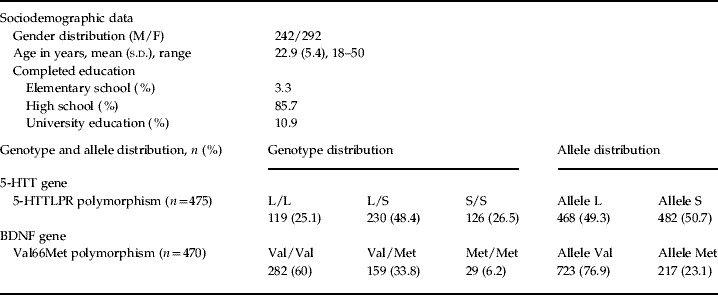
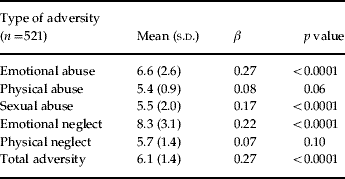
Sociodemographic data and allele/genotype distribution are shown in Table 1. The average score on depressive symptoms was 0.7 (s.d.=0.6, range 0–3.2). A main effect of total childhood adversity on adult depressive symptoms was detected (β=0.27, p<0.001). Specifically, childhood sexual abuse (CSA; β=0.17, p<0.001), childhood emotional abuse (β=0.27, p<0.001) and childhood emotional neglect (β=0.22, p<0.001) are related significantly to depressive symptomatology in adulthood.
Sociodemographic data and genotype/allele distribution for the 5-HTTLPR (5-HTT gene) and Val66Met (BDNF gene) polymorphisms
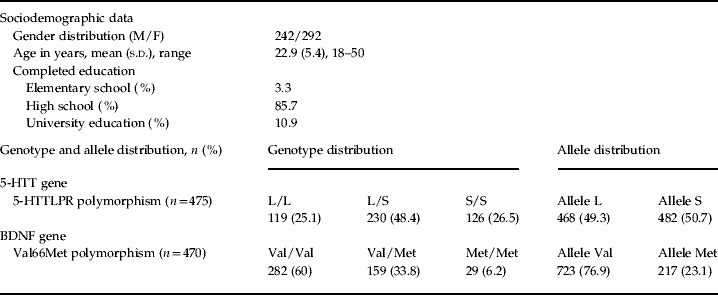
M, Male; F, female; s.d., standard deviation.
Frequencies were found in Hardy–Weinberg equilibrium (5-HTTLPR polymorphism χ2=0.21, df=2, p=0.90; Val66Met polymorphism χ2=0.52, df=2, p=0.77).
No other associations between other types of childhood adversity and depressive symptoms were found (Table 2). No significant associations were found between either 5-HTTLPR or Val66Met genotypes on depressive symptoms. However, an association of the 5-HTTLPR genotype on CSA was found (L/S: β=−0.33, p=0.006; S/S: β=−0.18, p=0.17; using L/L as the reference category). The L/L genotype presented a higher level of CSA compared to the L/S genotype, but compared to the S/S genotype the difference did not reach a significant level.
Mean scores for types of childhood adversity and total childhood adversity
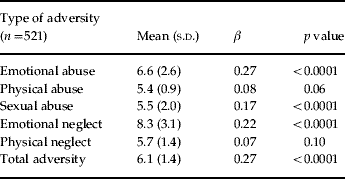
s.d., Standard deviation.
All regressions were adjusted for age and sex.
β(standardized coefficient) was derived from the main effects of total/types of childhood adversities on adult depressive symptoms.
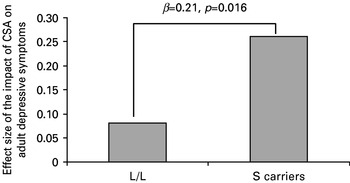
Concerning two-way interactions, a significant G×E interaction was found for 5-HTTLPR genotypes and CSA in the model of depressive symptoms (F=4.36, p<0.0001). In subjects with L/S and S/S genotypes, the effect of CSA on adult depressive symptoms was higher than in L/L subjects (L/S×sexual abuse: β=0.25, p=0.03; S/S×sexual abuse: β=0.18, p=0.07; L/L reference category). When we compared S allele carriers (S/L+S/S) to L/L individuals, we detected a higher effect of CSA on depressive symptoms (β=0.21, p=0.016) (Fig. 1). Post-hoc analysis showed a dose–response relationship between 5-HTTLPR genotypes and CSA for depressive symptoms. That is, the interaction was only significant when the CSA score was above average: the difference in slope between S allele carriers and L/L regression lines reached a significant level at 1 s.d. above the mean (low to moderate severity levels) (β=0.28, t=2.07, p=0.039) and this difference increased at 2 s.d. above the mean (moderate to severe severity levels) (β=0.49, t=2.45, p=0.015).
Effect size of childhood sexual abuse (CSA) on adult depressive symptoms by the 5-HTTLPR genotype: the effect of CSA has a higher impact on adult depressive symptoms in S carriers than in the L/L group (n=452). F=5.80, p<0.0001 (adjusted for age and sex); β=standardized coefficient.

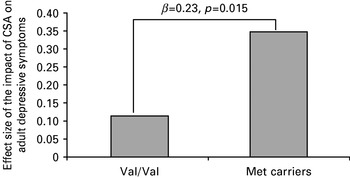
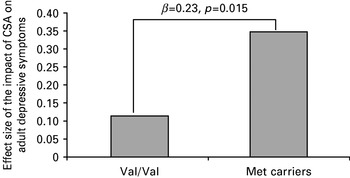
In addition, a two-way interaction with the Val66Met genotype was found (F=5.87, p<0.0001; β=0.23, p=0.015, Val/Val reference category). CSA had a greater effect on adult depressive symptoms in Met carriers than in Val/Val individuals (Fig. 2). Post-hoc analysis also revealed a dose–response relationship, the differences in slope between Met allele carriers and Val/Val was statistically significant only at 1 s.d. above the mean (low to moderate severity levels) (β=0.32, t=2.42, p=0.016), and it increased at 2 s.d. above the mean (moderate to severe severity levels) (β=0.55, t=2.62, p=0.009). No significant G×E interactions were found for the other subdimensions of childhood adversity or on adult depressive symptoms.
The depressogenic effect of childhood sexual abuse (CSA) is moderated by the brain-derived neurotrophic factor (BDNF) genotype: the effect of CSA has a higher impact on adult depressive symptoms in Met carriers than in the Val/Val group (n=456). F=5.87, p<0.0001 (adjusted for age and sex); β=standardized coefficient.
We did not detect a three-way interaction between the 5-HTT gene, the BDNF gene and total childhood adversity on adult depressive symptoms.
Discussion
Our results show that experiences of CSA, emotional abuse and emotional neglect predicted per se the presence of adult depressive symptoms, in accordance with previous clinical and epidemiological reports (Chapman et al. Reference Chapman, Whitfield, Felitti, Dube, Edwards and Anda2004; Anda et al. Reference Anda, Felitti, Bremner, Walker, Whitfield, Perry, Dube and Giles2006).
From the perspective of G×E interaction, our results suggest that genetic variability at the 5-HTT and BNDF genes moderates the effect of childhood adversity on adult depressive symptoms. Specifically, our findings show that CSA impacts more strongly on adult depressive symptomatology in S carriers of the 5-HTTLPR polymorphism (5-HTT gene) than in the LL group, and in Met allele carriers of the Val66Met polymorphism (BDNF gene) compared to the Val/Val group. Moreover, a dose–response relationship was found in both models of G×E on adult depressive symptoms.
These results are consistent with those found in adult psychiatric patients with suicidal behaviour. For example, Gibb et al. (Reference Gibb, McGeary, Beevers and Miller2006) found that the 5-HTTLPR polymorphism moderates the effect of childhood sexual and physical, but not emotional, abuse on suicide attempters. The 5-HTT gene has also been linked to G×E interaction for other types of adversity such as emotional neglect (Roy et al. Reference Roy, Hu, Janal and Goldman2007). Additionally, Perroud et al. (Reference Perroud, Courtet, Vincze, Jaussent, Jollant, Bellivier, Leboyer, Baud, Buresi and Malafosse2008), based on a large sample of suicide attempters genotyped for the BNDF gene, detected a G×E interaction for severity of suicidal attempt in individuals who had experienced CSA.
CSA may differ from other types of childhood adversity on its greater capacity to disrupt the underlying neurobiological structures involved in stress response. In this sense, it has been suggested that CSA increases sensitivity to the depressogenic adult life experiences (Kendler et al. Reference Kendler, Kuhn and Prescott2004). In fact, neurobiological studies have shown (i) dysfunction of the hypothalamic–pituitary–adrenal (HPA) axis in women with a CSA history and (ii) volumetric reductions of the hippocampus and amygdala, the main regulatory mechanisms of the HPA axis, in women who had experienced CSA (Heim & Nemeroff, Reference Heim and Nemeroff2001; Teicher et al. Reference Teicher, Andersen, Polcari, Anderson and Navalta2002; Nemeroff, Reference Nemeroff2004). It is also likely that this dysregulation of the HPA axis may be mediated by the genetic background of the individual such as 5-HTTLPR and Val66Met polymorphisms (Nestler et al. Reference Nestler, Barrot, Dileone, Eisch, Gold and Monteggia2002; Brown & Harris, Reference Brown and Harris2008).
Of note, both polymorphisms of the analysed genes present functional consequences: the S allele of the 5-HTTLPR polymorphism (5-HTT gene) has been related to reduced transcription of the serotonin transporter (Lesch et al. Reference Lesch, Bengel, Heils, Sabol, Greenberg, Petri, Benjamin, Muller, Hamer and Murphy1996) whereas the Met allele of the Val66Met polymorphism (BDNF gene) is reported to affect intracellular processing and secretion of the mature protein (Egan et al. Reference Egan, Kojima, Callicott, Goldberg, Kolachana, Bertolino, Zaitsev, Gold, Goldman, Dean, Lu and Weinberger2003). From a G×E interaction point of view, the S allele has been frequently involved in risk for depressive symptoms and major depression when childhood adversity and recent life events are considered (Caspi et al. Reference Caspi, Sugden, Moffitt, Taylor, Craig, Harrington, McClay, Mill, Martin, Braithwaite and Poulton2003; Kendler et al. Reference Kendler, Kuhn, Vittum, Prescott and Riley2005; Uher & McGuffin, Reference Uher and McGuffin2008). Similarly, interaction between the Met allele of the BNDF polymorphism and childhood adversity was reported by Wichers et al. (Reference Wichers, Kenis, Jacobs, Mengelers, Derom, Vlietinck and Van Os2008).
However, in the above-mentioned study conducted by Perroud et al. (Reference Perroud, Courtet, Vincze, Jaussent, Jollant, Bellivier, Leboyer, Baud, Buresi and Malafosse2008), the risk allele was the Val variant. This inconsistency between the proposed risk alleles of the BDNF Val66Met polymorphism has also been found by a meta-analysis within association genetic studies in several mental disorders (Gratacos et al. Reference Gratacos, Gonzalez, Mercader, De Cid, Urretavizcaya and Estivill2007). Further research is needed to better understand the pathophysiological consequences of this particular functional polymorphism in brain functioning.
Despite recent evidence that serotonin and BDNF systems may be linked at multiple intra- and intercellular levels (Martinowich & Lu, Reference Martinowich and Lu2008), our results did not find a direct interaction between the two polymorphisms explored. A study carried out by Kim et al. (Reference Kim, Stewart, Kim, Yang, Shin, Kim and Yoon2007) in an elderly population with categorical outcome of depression also found no interaction between these two genes. Further research may be needed to elucidate this complex relationship between the BDNF and 5-HT systems in the aetiology of depressive mood.
Unlike previous studies (Kaufman et al. Reference Kaufman, Yang, Douglas-Palumberi, Grasso, Lipschitz, Houshyar, Krystal and Gelernter2006; Wichers et al. Reference Wichers, Kenis, Jacobs, Mengelers, Derom, Vlietinck and Van Os2008) the three-way interaction between the 5-HTTLPR genotype, the Val66Met genotype, and childhood adversity on depressive symptoms was not detected in our sample. However, our study has certain differences that may account for this discrepancy. Our sample, composed of healthy men and women, was collected from the general population whereas Kaufman et al. (Reference Kaufman, Yang, Douglas-Palumberi, Grasso, Lipschitz, Houshyar, Krystal and Gelernter2006) focused their study on children with severe maltreatment histories, and Wichers et al. (Reference Wichers, Kenis, Jacobs, Mengelers, Derom, Vlietinck and Van Os2008) studied only a female sample. Negative results concerning the three-way interaction could also be due to the low frequency of individuals carrying both risk genotypes (SS Met carriers).
As in the study of Wichers et al. (Reference Wichers, Kenis, Jacobs, Mengelers, Derom, Vlietinck and Van Os2008), G×E correlation may play a role in addition to G×E interaction. A main effect of 5-HTTLPR polymorphism on CSA was found; that is, the L/L group showed higher levels of CSA compared to S allele carriers. Of note, despite the L/L group presenting higher levels of CSA, this group presented less severe adult depressive symptoms than the S allele carriers. However, as the G×E interaction analysis was not controlled for G×E correlation between these two variables, caution must be exercised in interpreting the two-way interaction effect (Pak, Reference Pak, MacCabe, O'Daly, Murray, McGuffin and Wright2006).
Although our results replicate previous published findings, there are some limitations that should be mentioned. The cross-sectional nature of our design did not allow causal associations to be tested robustly, although a priori hypotheses were clearly defined and guided all analyses. Although some studies have found high reliability of self-reports of childhood trauma (e.g. Fink et al. Reference Fink, Bernstein, Handelsman, Foote and Lovejoy1995), the retrospective measure of childhood adversity may be influenced by recall bias. It is important to emphasize that different prevalences between each type of childhood adversity in the population may affect the power to detect other G×E interactive effects. In the present sample, following the guidelines for classification of CTQ proposed by Bernstein & Fink (Reference Bernstein and Fink1998), and in agreement with previous European surveys (Finkelhor, Reference Finkelhor1994; May-Chahal & Cawson, Reference May-Chahal and Cawson2005), the prevalence of (i) childhood emotional abuse is 15.5% (n=83); (ii) childhood physical abuse is 4.1% (n=22); (iii) CSA is 9.2% (n=49); (iv) childhood emotional neglect is 27.2% (n=145); and physical neglect is 10.3% (n=55). Therefore, it seems that absence of interactions concerning other types of adversity, except for childhood physical abuse, may not be due to a simple function of low prevalence compared to the prevalence of CSA. Moreover, co-occurrence of CSA with other forms of childhood adversity has been described (Dong et al. Reference Dong, Anda, Dube, Giles and Felitti2003). To elucidate putative confounder effects of other childhood adversities on depressive symptoms, post-hoc analyses were carried out concerning significant results. Either the main effect of childhood adversity on adult depressive symptoms or G×E interactions on depressive symptoms remained significant after controlling for other childhood adversities (data available on request). However, other distal factors such as timing and duration in which CSA occurred, and other early environmental factors such as quality of parental care, may also play a role in determining individual vulnerability to depressive symptomatology during adulthood (Cotter, Reference Cotter1998; Hill et al. Reference Hill, Davis, Byatt, Burnside, Rollinson and Fear2000; McCutcheon et al. Reference McCutcheon, Heath, Nelson, Bucholz, Madden and Martin2008). Other current factors not controlled in the present study, such as medical status, work and social adjustment or quality of life, may influence the mood state of participants at the time of assessment. Finally, the triallelic nature of the 5-HTTLPR polymorphism (S, La and Lg) was not considered. It has been shown that Lg carriers present a similar expression to S carriers, although genotypes carrying Lg are not expected to have high frequencies in Caucasian populations (SLg=0.09, LgLg=0.03) (Hu et al. Reference Hu, Lipsky, Zhu, Akhtar, Taubman, Greenberg, Xu, Arnold, Richter, Kennedy, Murphy and Goldman2006).
Nevertheless, this study contributes to this field in certain unique ways. Depression has been described as a continuous phenotype in the population (Akiskal et al. Reference Akiskal, Judd, Gillin and Lemmi1997), so aetiopathogenic mechanisms should be detectable across a wide range of subclinical and clinical phenotypic variation in non-clinical samples such as the present one. In addition, this study has analysed the impact of both qualitatively distinct forms of childhood adversity and their level of global severity, which has been shown to be relevant when assessing the impact of trauma on health outcomes (Dong et al. Reference Dong, Anda, Felitti, Dube, Williamson, Thompson, Loo and Giles2004).
Acknowledgments
Mari Aguilera thanks the Departament d'Universitats, Recerca i Societat de la Informació (DURSI) de la Generalitat de Catalunya for a predoctoral grant (2004 FI 00673). This study was supported by the Ministerio de Educación y Ciencia (SAF 2005-07852-C02-01); the Ministerio de Sanidad y Consumo (05-317) and Fondos FEDER, Ministerio de Educación y Ciencia (Grant Number: SEJ2005-09307), Instituto de Salud Carlos III, CIBER de Salud Mental (CIBERSAM) and Institut de Biomedicina de la Universitat de Barcelona (IBUB).
Declaration of Interest
None.