INTRODUCTION
Schistosoma mansoni is widespread in Uganda along large lakes and rivers with about four million people infected (Fleming et al. Reference Fleming, Fenwick, Tukahebwa, Lubanga, Namwangye, Zaramba and Kabatereine2009). The Schistosomiasis Control Programme was launched in the country in 2003 with the aim of providing regular anthelmintic treatment to children and adults within communities known or suspected to be at high risk of infection (Kabatereine et al. Reference Kabatereine, Tukahebwa, Kazibwe, Namwangye, Zaramba, Brooker, Stothard, Kamenka, Whawell, Webster and Fenwick2006; Fenwick et al. Reference Fenwick, Webster, Bosgue-Oliva, Blair, Fleming, Zhang, Garba, Stothard, Gabrielli, Clements, Kabatereine, Toure, Dembele, Nyandindi, Mwansa and Koukounari2009; Fleming et al. Reference Fleming, Fenwick, Tukahebwa, Lubanga, Namwangye, Zaramba and Kabatereine2009). The programme targets children aged 5–14 years because the highest prevalence and intensity occurs in this age-group (Kabatereine et al. Reference Kabatereine, Ariho and Christensen1992). In addition, adults of the age of 15 years and above are treated if they are living in high risk areas. Hence, children below the age of five years are left out because it is assumed that their low water contact levels do not put them at risk of infection. However, a number of studies have shown that S. mansoni, as well as S. haematobium, is prevalent in children below five years of age and that the risk of infection starts as early as the age of five months (Woolhouse et al. Reference Woolhouse, Mutapi, Ndhlovu, Chandiwana and Hagan2000; Bosompem et al. Reference Bosompem, Bentum, Otchere, Anyan, Brown, Osada, Takeo, Kojima and Otha2004; Odogwu et al. Reference Odogwu, Ramamurthy, Kabatereine, Kazibwe, Tukahebwa, Webster, Fenwick and Stothard2006; Stothard et al. Reference Stothard, Pleasant, Oguttu, Adriko, Galimaka, Ruggiana, Kazibwe and Kabatereine2008; Ekpo et al. Reference Ekpo, Laja-Deile, Oluwole, Sam-Wobo and Mafiana2010; Garba et al. Reference Garba, Barkiré, Djibo, Lamine, Sofo, Gouvras, Bosqué-Oliva, Webster, Stothard, Utzinger and Fenwick2010; Sousa-Figueiredo et al. Reference Sousa-Figueiredo, Pleasant, Day, Betson, Rollinson, Montresor, Kazibwe, Kabaterine and Stothard2010; Stothard et al. Reference Stothard, Sousa-Figuereido, Betson, Adriko, Arinaitwe, Rowell, Besiyge and Kabatereine2011).
Praziquantel is the drug of choice in the treatment of all schistosomes and extensive clinical trials have been performed with high cure rates and mild adverse drug reactions (Homeida et al. Reference Homeida, Leahy, Copeland, Ali and Harron1994; Kabatereine et al. Reference Kabatereine, Kemijumbi, Ouma, Sturrock, Butterworth, Madsen, Ornbjerg, Dunne and Vennnervald2003; Doenhoff et al. Reference Doenhoff, Hagan, Cioli, Southgate, Pica-Mattoccia, Botros, Coles, Tchuem Tchuenté, Mbaye and Engels2009; Keiser et al. Reference Keiser, N'Guessan, Adoubryn, Silué, Vounatsou, Hatz, Utzinger and N'Goran2010). However, children less than 4 years of age have been excluded from large-scale preventive chemotherapy interventions as information on the safety of praziquantel for these children has been lacking (WHO, 2006). In recent years there has been a debate on the ethical problems of leaving these children untreated (Johansen et al. Reference Johansen, Sacko, Vennervald and Kabatereine2007; Stothard and Gabrielli, Reference Stothard and Gabrielli2007) and a number of studies have contributed to filling the information gap on safety (Odogwu et al. Reference Odogwu, Ramamurthy, Kabatereine, Kazibwe, Tukahebwa, Webster, Fenwick and Stothard2006; Garba et al. Reference Garba, Barkiré, Djibo, Lamine, Sofo, Gouvras, Bosqué-Oliva, Webster, Stothard, Utzinger and Fenwick2010; Sousa-Figueiredo et al. Reference Sousa-Figueiredo, Pleasant, Day, Betson, Rollinson, Montresor, Kazibwe, Kabaterine and Stothard2010). In addition, although mebendazole has been extensively used together with praziquantel against infections with schistosomiasis and soil-transmitted helminthiasis (STH) in school-aged children (Engels et al. Reference Engels, Ndoricimpa and Gryseels1993) no specific acceptability and safety studies have been published on this combination (Olsen, Reference Olsen2007). This is becoming even more relevant since mebendazole is being donated for use against STH in schistosomiasis endemic areas.
To contribute more to the available information, a randomized single-blinded clinical trial was conducted in two fishing communities in Uganda with the objective of determining the acceptability and safety of praziquantel alone and in combination with mebendazole in the treatment of S. mansoni and STH in children aged 1 to 4 years.
MATERIALS AND METHODS
Study area and population
The study was conducted in Mayuge district in eastern Uganda and Nebbi district in north western Uganda in 2008. The two fishing communities, Bwondha community in Mayuge district and Wang-Kado community in Nebbi district, were purposively selected based on their high prevalence of S. mansoni according to earlier studies (Kabatereine et al. Reference Kabatereine, Ariho and Christensen1992; Odogwu et al. Reference Odogwu, Ramamurthy, Kabatereine, Kazibwe, Tukahebwa, Webster, Fenwick and Stothard2006; Sousa-Figueiredo et al. Reference Sousa-Figueiredo, Pleasant, Day, Betson, Rollinson, Montresor, Kazibwe, Kabaterine and Stothard2010). All children aged 1–4 years whose mothers/guardians were willing to bring them for schistosomiasis examination were included.
Study design, treatment method and follow-up
This was a randomized controlled single-blinded clinical trial. The recruited children were weighed (for praziquantel treatment) and randomized into two groups: the test group allocated to praziquantel tablets, 40 mg/kg+mebendazole tablets, 500 mg and the control group allocated to praziquantel tablets, 40 mg/kg. A questionnaire was administered to the mothers of selected children with regard to children's pre-treatment symptoms such as headache, abdominal pain, diarrhoea and fever. After treatment, children were closely monitored for seven days by a paediatrician who was blinded for type of treatment. The adverse drug reactions were recorded using the same questionnaire used for the pre-treatment symptoms.
Inclusion and exclusion criteria
Children who were eligible, willing to participate and whose parents consented were included in the study.
Any child with acute and chronic diseases other than schistosomiasis and STH and those with a history of any serious adverse drug reactions were not included in the study. However, no child met the exclusion criteria.
Data collection methods
A pre-labelled specimen container with a name and the assigned identification number was given to the mother/guardian of each selected child. Instructions were given to the mothers by the PI and the District Vector Control Officer (DVCO) on how to collect the stool into the specimen container. In order to determine the prevalence and intensity of S. mansoni and STH, one stool sample was collected from each selected pupil on two consecutive days. Two slides were prepared from each sample (41·7 mg) using the Kato-Katz technique (WHO, 2004).
Pre-tested questionnaires were used to collect information on adverse drug reactions and serious adverse drug reactions after treatment. Adverse drug reaction is defined as a “response to a drug which is noxious and unintended and which occurs at doses normally used in man for prophylaxis, diagnosis, or therapy of disease or for modification of physiological function” (WHO, 1995). Serious adverse events are defined as “any untoward medical occurrence that at any dose: results in death, is life-threatening, requires inpatient hospitalisation or prolongation of existing hospitalisation, results in persistent or significant disability/incapacity, or is a congenital anomaly/birth defect” (WHO, 1995).
The children were followed on a daily basis for seven days for adverse drug reactions. A paediatrician together with a nurse who was fluent in the local language and in English conducted the interviews. Neither person was aware of which treatment group the children belonged to. Baseline information on all possible relevant symptoms was recorded before treatment (pre-treatment illnesses) to ascertain that all symptoms reported after chemotherapy were due to the treatment.
Data management and analysis
All completed questionnaires were filed and kept by the PI. A data entry template was designed and all data were double entered using Epidata version 3.1. The first data entry was done in the field to ensure that all necessary data had been collected. A back-up was made at each level of data management and kept under a different roof.
Analysis was performed using SPSS PC+Version 11.5. Confidence intervals were calculated using the approximate equations for proportions if these were between 0·1 and 0·9 (Gardner and Altman, Reference Gardner and Altman1989). When proportions were outside this range, confidence intervals were found using statistical tables (Hald, Reference Hald1973). Safety was assessed by comparing adverse drug reactions reported by children in each treatment group. Differences in treatment groups were assessed using χ 2 test and P values below 0·05 were considered significant.
Ethical considerations
The District Education Office, District Health Office, local leaders, teachers and parents were informed about the study in the area. Written and informed assent/consent was sought from the parents/guardians of the selected children and all information was kept confidential. Children were only included if they were willing to participate. All non-selected children in the selected schools were treated after treatment of the study sample. Those who had illnesses unrelated to the study were also attended to and good clinical practice was adhered to. The children were followed carefully by a paediatrician for any adverse drug reaction.
RESULTS
Characteristics of the study population
There were 596 children examined for S. mansoni infection, 335 from Bwondha community (Mayuge) and 261 from Wang-Kado community (Nebbi). Of the total children examined, 54·0% (322) were boys, 39·9% (238) were aged four years, 23·3% (139) were three years old, 24·7% (147) aged two years while 12·1% (72) were one year old.
Prevalence
The overall prevalence of S. mansoni was 21·8% (130/596). Out of 596 children 9·4% (56) had hookworm infection, 1·5% (9) were infected with Ascaris lumbricoides and 1·2% (7) were infected with Trichuris trichiura. There were 10·6% (63) infected with at least one STH. Of the 130 S. mansoni infected children, 48·5% (63) were boys and the age distribution of the infected children is shown in Table 1. The prevalence of S. mansoni in Bwondha community was 17·0% (57/335) while it was 28·0% (73/261) in Wang-Kado community, a statistically significant difference (χ 2=10·32, 95%, P=0·001). There was no significant statistical difference in infection between sex or age between or within the two communities.
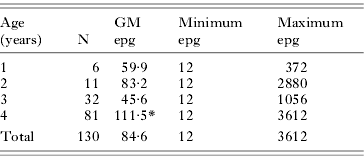
Geometric mean (GM) intensity and minimum and maximum egg counts of S. mansoni by age for the infected children only

* Statistically significantly different (P=0·004) from all other ages.
Intensity of infection
Of the 130 children who were infected with S. mansoni, 19·2% (25) had heavy infections, 20·8% (27) had moderate infections, while 60·0% (78) were lightly infected (WHO, 2002). The geometric mean intensity (GM) of eggs per gram (epg) faeces in the infected children by age is summarized in Table 1. Children at the age of 4 years recorded the highest geometric mean intensity of infection with a statistically significantly difference (Fα=0·05, df=3=4·6; P=0·004) from all other ages.
There was only one child out of the 56 hookworm infected children who had heavy infection, 3·6% (2) had moderate infections, while the rest 94·6% (53) were lightly infected. Out of nine children who were infected with A. lumbricoides only one was moderately infected while the rest had light infections. All children who were infected with T. trichiura had light infections (WHO, 2002).
Safety of praziquantel in combination with mebendazole
Study population
Of the 130 S. mansoni infected children, 82 were enrolled into the study, 36 from Bwondha and 46 from Wang-Kado. Out of the 82, 53·7% (44) were boys while 46·3% (38) were girls.
Infection status of the children
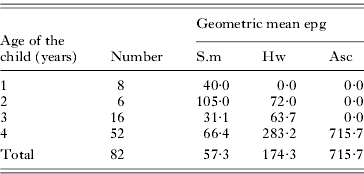
All the children selected were infected with S. mansoni. Of the 82 children, 15·9% (13) were infected with hookworm while 4·9% (4/82) were infected with A. lumbricoides and none was infected with T. trichiura. There were 18·3% (15/82) children who had double infection with S. mansoni and STH. The GM intensity of infection by age is given in Table 2. There was no statistically significant difference in intensity of infection with S. mansoni between sex, age and district.
Geometric mean intensity of infection with S. mansoni (S.m), hookworm (Hw) and Ascaris lumbricoides (Asc) by age for the infected children only

Treatment groups
Fifty percent (41/82) of the children were allocated to praziquantel and mebendazole (test group) and the rest to praziquantel (control group). A total of 95·1% (78) of the children selected were present for treatment, 48·7% (38) in the test group and 51·3% (40) in the control group. The GM epg of infection with S. mansoni was 52·4 and 62·4 epg for the test and control groups, respectively, which was not significantly different.
Treatment method
The drugs were pre-packed for all children according to weight of the child and the treatment group. Praziquantel was given according to weight (40 mg/kg), while one tablet of mebendazole (500 mg) was given to each child in the test group. The packet for each child was given to the mother/guardian who administered the drug in the presence of the paediatrician. Many children, especially those aged three and four, were able to swallow the drugs. Most children aged two years chewed the tablets although some could swallow them in their entirety. Eight children (mostly children of one year of age) had their praziquantel tablets crushed and mixed with juice.
Symptoms reported before treatment
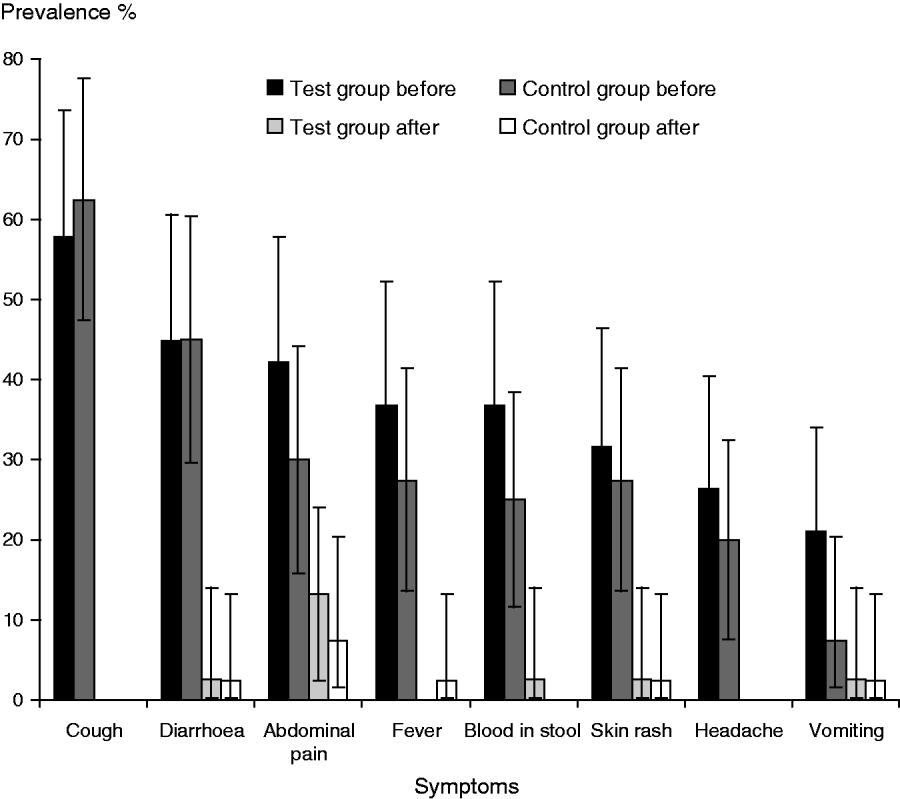
Cough was the most common symptom reported followed by diarrhoea and abdominal pain. Fevers, blood in stool and skin rash were also among the symptoms frequently reported before treatment as shown in Fig. 1. There was no statistically significant difference in reported symptoms between the test and control groups.
Symptoms reported (in % of investigated children with 95% confidence intervals) before and after treatment (on treatment day within 15 minutes) in children below five years of age treated with praziquantel and mebendazole (test group) or praziquantel alone (control group).

Symptoms reported after treatment
No serious adverse event was experienced by the treated children in any of the treatment groups. Only very few adverse drug reactions were reported (Fig. 1) and all were reported on treatment day, within 15 minutes after treatment. All the reactions reported were mild and transient. Abdominal pain was the most commonly reported symptom experienced by eight children, five in the test group and three in the control group. There was no significant difference in any adverse drug reactions between the two groups.
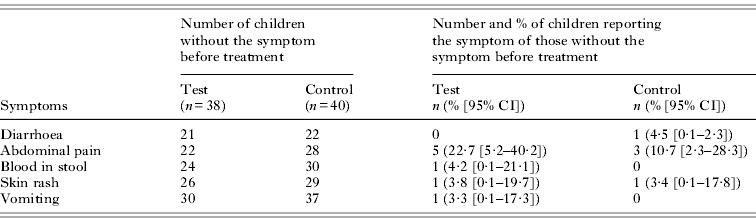
Table 3 shows the number of children reporting a condition after treatment that they did not have before treatment. The 13 conditions experienced were reported by ten children and there was no difference in the reported conditions between the two treatment groups.
Number of children without specific symptoms before treatment, and the number and percentage [95% CI] of these reporting symptoms after treatment in the test group (praziquantel+mebendazole) and in the control group (praziquantel)

Adverse drug reaction attributed to treatment
There were only nine children out of 78 (11·5%) who did not report any symptoms before treatment; three were in the test group and six in the control group. Out of the nine, only two children from the control group developed adverse drug reactions, one had diarrhoea while the other complained of abdominal pain on the treatment day. No adverse drug reactions were reported in the subsequent days after treatment. It was reported that appetite of the treated children improved within the seven days of follow-up.
DISCUSSION
Both the combined therapy (praziquantel and mebendazole) and praziquantel given alone were well tolerated in the children below five years of age. Few mild adverse drug reactions were recorded and all were reported on treatment day within 15 minutes after treatment and had cleared by the end of the treatment day. The number of reactions reported was similar between the two treatment groups, which indicates that the combination of praziquantel and mebendazole was as safe as praziquantel given alone. The results of the current study are in accordance with earlier studies (Odogwu et al. Reference Odogwu, Ramamurthy, Kabatereine, Kazibwe, Tukahebwa, Webster, Fenwick and Stothard2006; Garba et al. Reference Garba, Barkiré, Djibo, Lamine, Sofo, Gouvras, Bosqué-Oliva, Webster, Stothard, Utzinger and Fenwick2010; Sousa-Figueiredo et al. Reference Sousa-Figueiredo, Pleasant, Day, Betson, Rollinson, Montresor, Kazibwe, Kabaterine and Stothard2010) which reported that no serious adverse drug reactions followed treatment with praziquantel and albendazole in small children. In the present study, no serious adverse events were recorded in any child on the day of treatment and seven days following treatment.
Children reported many symptoms before treatment indicating that S. mansoni may give rise to many symptoms and this emphasises the need for recording pre-treatment illnesses in safety studies. A number of children reported a condition after treatment that they did not have before treatment. Of these, abdominal pain was the most commonly reported condition which is in line with other reports on adverse reactions following praziquantel treatment (Kabatereine et al. Reference Kabatereine, Kemijumbi, Ouma, Sturrock, Butterworth, Madsen, Ornbjerg, Dunne and Vennnervald2003; Keiser et al. Reference Keiser, N'Guessan, Adoubryn, Silué, Vounatsou, Hatz, Utzinger and N'Goran2010; Sousa-Figueiredo et al. Reference Sousa-Figueiredo, Pleasant, Day, Betson, Rollinson, Montresor, Kazibwe, Kabaterine and Stothard2010).
The tablets were administered by the mothers in the presence of the paediatrician. The compliance was good and it was observed that mothers handled their children well in the process of swallowing the tablets with liquid. The children swallowed the tablets, chewed them or took them crushed with juice. In a previous study by Odogwu and co-workers (Reference Odogwu, Ramamurthy, Kabatereine, Kazibwe, Tukahebwa, Webster, Fenwick and Stothard2006), the tablets were crushed and mixed in glucose syrup and children were spoon fed; a process which is less appropriate during the implementation of mass drug administration. As the children were treated according to weight, the extended dose pole for children less than 94 cm were not validated (Sousa-Figueiredo et al. Reference Sousa-Figueiredo, Pleasant, Day, Betson, Rollinson, Montresor, Kazibwe, Kabaterine and Stothard2010).
The prevalence of S. mansoni in children below five years of age was significantly higher in Wang-Kado community than in Bwondha community. The overall prevalence of 20% is, however, high in this tender age group and comparable with the 16% prevalence of an earlier study from Lake Victoria using the same diagnostic method (Sousa-Figueiredo et al. Reference Sousa-Figueiredo, Pleasant, Day, Betson, Rollinson, Montresor, Kazibwe, Kabaterine and Stothard2010). We used the two day Kato-Katz technique to detect the infection in these small children but some of them could not provide the second sample. It is thus possible that many positive children were missed since the sensitivity of Kato-Katz is known to be poor especially in light infections (Berhe et al. Reference Berhe, Medhin, Erko, Smith, Gedamu, Bereded, Moore, Habte, Redda, Gebre-Michael and Gundersen2004). As indicated by De Vlas and co-workers (Reference De Vlas, Gryseels, van Oortmarssen, Polderman and Habbema1993), a prevalence of 20% and a geometric mean egg load of 80 may result from a true prevalence of 40%. It is thus possible that the real prevalence in children below five years of age in the present study could be 40%. This was also observed in two earlier studies from Lake Victoria in Uganda. Children with a S. mansoni egg positive prevalence of 7% using the Kato-Katz technique had a prevalence of 45% diagnosed with a more sensitive method, the detection of urine-circulating cathodic antigen (CCA) (Odogwu et al. Reference Odogwu, Ramamurthy, Kabatereine, Kazibwe, Tukahebwa, Webster, Fenwick and Stothard2006) and in another study, two days Kato-Katz gave a prevalence of 16·0%, while the CCA gave 52·3% (Sousa-Figueiredo et al. Reference Sousa-Figueiredo, Pleasant, Day, Betson, Rollinson, Montresor, Kazibwe, Kabaterine and Stothard2010).
This study found that 40% of the infected children had more than 100 eggs per gram faeces. Six children aged one year were infected with S. mansoni and two of them were moderately infected. This may well have important health consequences as these children will have to wait for four years before they can get treated in school and during these years, it is likely that the children are repeatedly exposed to S. mansoni with the risk of developing significant morbidity.
Offering treatment against schistosomiasis to children below the age of five years in high-risk areas like landing and fishing communities can be of great importance in averting morbidity at an early stage. Furthermore, as earlier mass sensitization has emphasized that children below the age of five years are not supposed to be treated with PZQ, a revised health education is needed on the importance of treatment of children in this age group. Children in the present study were given a sweet after treatment to motivate them. This is, however, not feasible during mass drug administration. Alternative formulations of oral dosing of infants/preschoolers are in need of exploration and refinement for large-scale control interventions.
ACKNOWLEDGEMENTS
We are grateful for the cooperation of the mothers in Bwondha and Wang-kado communities in Mayuge and Nebbi districts, respectively. We recognize the efforts of the field team, technicians, Vector Control officers, nurses and the drivers. We also extend our sincere appreciation to Dr. Florence Tugumisirize, the Pediatrician who accepted to work with us amidst her busy schedule. We can not forget the district officials and local leaders who worked with us to the end of the study.
FINANCIAL SUPPORT
This work was supported by DBL-Centre for Health Research and Development, Faculty of Life Sciences, University of Copenhagen.
AUTHORS' CONTRIBUTIONS
All authors planned the study and designed the protocol. HN (the Principal Investigator) conducted the field study and managed and collected the data. HN carried out the analyses and interpretation of the data and prepared the first draft of the manuscript. All authors were involved in preparing subsequent drafts and read and approved the final manuscript. HN is guarantor of the paper.
CONFLICTS OF INTEREST STATEMENT
The authors have no conflicts of interest concerning the work reported in this paper.
ETHICAL APPROVAL
Permission to conduct the study was obtained from the Uganda National Council for Science and Technology (Ref.: HS 295, date: 3 July 2007). The Danish National Committee on Biomedical Research Ethics also recommended the study (Ref.: 2006-7041-90/hah, date: 6 October 2006).