This paper aims to reconstruct some of the regulations surrounding traditional warfare as it was practiced across Indigenous (Aboriginal) Australia (including Tasmania). To maintain the study's focus, the conflict customs of the Torres Strait will not be included, having generally more in common with Melanesian warfare. Today, Indigenous Australians for the most part prefer to call themselves “people” or “First Nations” of various language groups; indeed, the names of Indigenous peoples, such as Arunta and Kurnai, usually translate to “people” in their own language.Footnote 1 Thus, as far as possible, the names of local groups will be used. “Traditional” is here used to describe practices at or before the time of European contact. The focus will be on armed inter-tribal conflicts that early literature refers to as “raids” and “battles”.
Traditional Indigenous Australian warfare ceased over a century ago, and oral accounts detailing specifics are now rare. Moreover, such stories remain the cultural property of specific communities, fragmented across nodes and networks.Footnote 2 For this reason, we will instead mostly examine the written record. Fortunately, explorers and early settlers offered numerous observations. Of course, their accounts manifest nineteenth-century biases and ignorance. This detriment is somewhat softened by the authors’ reliance on Indigenous informants to explain much of what they were witnessing.
This underlines the importance of correctly interpreting Indigenous warfare. Thus, the first section of this paper is necessarily a discussion of previous studies and of what “war” is, and seeks to dispel a line of academic thinking that warfare did not occur in pre-contact Australia. It then addresses the specific prohibitions applied to regulated warfare, before finally addressing through concluding remarks some lessons that can be applied to modern warfare and geopolitics.
Indigenous warfare: A history of arguments
Whether collective armed conflicts occurred within forager societies, and particularly in pre-contact Australia, became “one of the most disputed topics of social anthropology for decades”.Footnote 3 There has been deliberate avoidance of the topic. Military historian John Connor points out that Peter Turbet's study of traditional Aboriginal society of the Sydney region makes no mention of warfare,Footnote 4 even though almost half his section on artefacts is devoted to weapons. Likewise for the same region, Michael Martin's On Darug Land asserted that “traditional Indigenous society was not an internally hostile one”.Footnote 5 In fact, Martin's illustration of a Darug man brings the reader's attention to the woven possum-hair belt and headband that he wears, but ignores the club, spear and shield that he is carrying.Footnote 6
The seeds of this confusion began when early observers (peaking during the 1880s–1930s) laced their analyses with social Darwinist theory, wherein Indigenous Australians were always cast as “primitive war-mongering savages”.Footnote 7 Some of these early studies included Roderick Flanagan's The Aborigines of Australia (published as a book posthumously)Footnote 8 and John Wilhelm von Blandowski's Australien in 142 photographischen Abbildungen nach zehnjahrigen Erfahrungen (1862).Footnote 9 Blandowski and Flanagan detailed phases of Australian collective engagements (battles) and the protocols involved. Other early contributions were Gerald Wheeler's The Tribe and Intertribal Relations in Australia Footnote 10 and Herbert Basedow's The Australian Aboriginal.Footnote 11 Their works offered penetrating but brief chapters on warfare that identified the cause and process of raids, and the nature of weaponry. In 1931, Lloyd Warner added Black Civilization, wherein he noted that “warfare is one of the most important social activities of the Murngin people and surrounding tribes”.Footnote 12
This perspective shifted when, in 1964, Ronald and Catherine Berndt's The World of the First Australians – based on their Northern Territory fieldwork – depicted societies in which authority was principally totemic and ceremonial, and fighting was small-scale and internal.Footnote 13 The Berndts’ findings were part of a global trend of scepticism towards nineteenth-century observations and a more positive image of Indigenous peoples. In 1965, US anthropologists Keith and Charlotte Otterbein conducted intercultural surveys and found relatively little evidence of warfare in hunter-gatherer groups. They proposed that all hunter-gatherer conflicts be classed as internal “feuding”.Footnote 14 Likewise in 1970, Richard Gould opined that Western Desert groups (Watjarri, Wawula, Tjupany and Badimaya peoples) only engaged in judicial and revenge expeditions:
[They] lack any kind of organized warfare, although small war parties organized along kin lines sometimes travel long distances to fight over issues like an elopement or the violation of a sacred site. These parties travel openly and are called warmala as opposed to the revenge expedition, or tjinakarpil, which travels under cover of night and employs sorcery.Footnote 15
This perspective gained added support when, in 1971, Tasaday “hunter-gatherers” were discovered in the Philippines jungles. The fact that the Tasaday appeared ignorant of warfare inspired many researchers to argue that all hunter-gatherers were primarily pacifists.Footnote 16
Soon a deluge of historians dismissed the extent or even existence of Indigenous Australian warfare. In 1975, Malcolm Prentis declared Indigenous Australian groups capable of only small, local hostilities.Footnote 17 Heather Goodall posited that traditional Indigenous warfare was “highly ritualized”,Footnote 18 whilst Henry Reynolds claimed inter-tribal warfare was “intermittent”Footnote 19 and environmental historian Tim Flannery suggested that the El Niño effect forced Indigenous groups to cooperate and minimize warfare.Footnote 20
By the late 1970s, however, holes began to appear in the image of the “peaceful forager”. Richard Alexander began contending that since the Palaeolithic Age, hunter-gatherers everywhere relied on “multi-male bands” to defend themselves from the “predatory effect” of other groups.Footnote 21 In the late 1980s, the “gentle Tasaday” were revealed to be a hoax.Footnote 22 Concurrently, new studies on hunter-gatherer groups found evidence of considerable internal and inter-group violence.Footnote 23 Meanwhile, Frontier Wars studies highlighted the existence of Indigenous war tactics – for instance, Eric Willmot's popular historical novel Pemulwuy.Footnote 24
Even so, the notion that Indigenous Australian groups only practiced extremely “limited” warfare persisted for the next three decades. Partly this built on cross-cultural analyses by anthropologists such as Douglas Fry and Patrik Söderberg. Well into the twenty-first century, their work perpetuated Otterbien's findings of limited and rather family-driven fatalities in forager conflicts.Footnote 25
Thus, for the Oxford Companion to Australian Military History, Peter Dennis wrote that “the egalitarian, non-cohesive nature” of Indigenous Australian society precluded complex military strategy.Footnote 26 Meanwhile, military historian Jeffrey Grey concluded that Indigenous Australian peoples could not organize anything akin to a battle.Footnote 27 Even Richard Broome, whose work long formed the basis of current perceptions of Indigenous Australian society, argued that pre-settlement conflict “was more often related to domestic violence, social feuding and the practice of tribal criminal law than to war as such”.Footnote 28
Yet, if recourse is taken to Carl von Clausewitz's classic definition of war – that war is “an act of force to compel our enemy to do our will”Footnote 29 – we find that Indigenous Australian warfare fits easily within that framework. Clausewitz held that war is the continuation “of political intercourse” (des politischen Verkehrs) “with the intermixing of other means” (mit Einmischung anderer Mittel).Footnote 30 John Keegan has pointed out that “political intercourse” with “intermixing” implies “the existence of states, of state interests and of rational calculation about how they may be achieved”.Footnote 31 Problematically for this definition, Indigenous Australia was never State-organized. Rather, it was comprised of networks of small, inter-independent peoples to which individuals were aligned, and by which they were divided, through complex self-identification: totemic, kin and other ties. This meant that Indigenous Australian politics worked rather differently from those of large nation-States. Nevertheless, we can identify Clausewitz's “political intercourse” within the protocols surrounding access to and use of Indigenous groups’ lands and resources. Indigenous Australian societies certainly contested violations of those rights. Further, as Connor emphasized, the very tenacity of Indigenous Australian resistance during European settlement (as well as Indigenous groups’ modern struggle for land rights) demonstrates that Indigenous Australians understood defiance and conflict, and used this to advance the interests of their societies.Footnote 32
In summary, acceptance of intra-Indigenous Australian warfare has been slow and highly politicized. Connor's application of Clausewitz's framework to the Australian situation changed this narrative in the early 2000s. He composed the first detailed, modern military assessment of Indigenous Australian warfare. It distinguished four main types of traditional Indigenous Australian warfare: formal battles, ritual trials, raids for women and revenge attacks.Footnote 33
Another advancement followed in 2009 when Peter Sutton produced The Politics of Suffering. In this, he conceded that neither the “simplistic … racist” image of the nineteenth century nor the “idealised and romanticized” interpretation of Indigenous violence sufficed.Footnote 34 Although Sutton found no evidence for “large-scale organized warfare”, he did, from the works of Stanner, Warner and his own collection of early encounter stories,Footnote 35 discern large-scale fights, pitched battles, skirmishes and peace-making ceremonies (makarrata, one of the three terms in the title of this paper).Footnote 36 By this time, archaeologists were weighing in on the debate, notably Nick Thorpe and Mark Allen.Footnote 37 The latter demonstrated that archaeological and ethnographic evidence – globally, but especially in Australia – indicated the existence of complex and large-scale military engagements within hunter-gatherer societies.Footnote 38
Further evidence along these lines was collated by Christophe Darmangeat. He analyzed hundreds of early accounts of intra-Indigenous conflicts, developed an extensive database and published the first comprehensive examination of Indigenous Australian warfare in over a century, entitled Justice and Warfare in Aboriginal Australia. Darmangeat concluded that frequent and large-scale conflict was indisputable. He considered conflicts to be primarily a means of dispensing justice, even though he had already carefully distinguished between group-to-group confrontations and actions more classically considered judicial in nature such as duels and ordeals.Footnote 39
Types of conflicts
Despite the quarrels of the past, we have finally – partly through Darmangeat's work – arrived at a basic idea of the two main types of inter-tribal confrontation that occurred in Indigenous Australia. The most common, devastating warfare seems to have been stealth attacks – raids or kanudaitji (secret or revenge expeditions), for instance in the Western Deserts.Footnote 40 These were usually small parties of men, but sometimes scores or more, who would sneak deep into enemy territories to commit assassinations or theft (usually of women).Footnote 41 In contrast to raids there existed what we can call open, regulated battles (some prefer the word “tournaments”), which were much more formalized and lengthy events, involving anywhere from 60 to over 1,500 combatants, drawn from several allied groups.
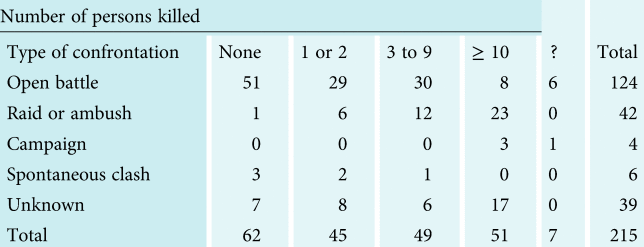
This concurs with Christophe Darmangeat's analysis of hundreds of early accounts of intra-Indigenous collective conflicts in pre-settlement Australia,Footnote 42 from which he deduced two basic types of collective armed conflict: open battles (forming half of all recorded conflicts) and ambushes or raids (about a quarter of known conflicts). Alongside these he also included two further categories: campaigns and spontaneous clashes. Using this framework, Darmangeat found that fatalities were highest during raids (55% involved ten or more deaths), whereas open battles were generally less lethal. According to his findings, 64% of open battles ended with less than three deaths each, despite usually involving hundreds of combatants. Table 1 expands on this more fully.
Number of persons killed in intra-Indigenous conflicts

Causes of war
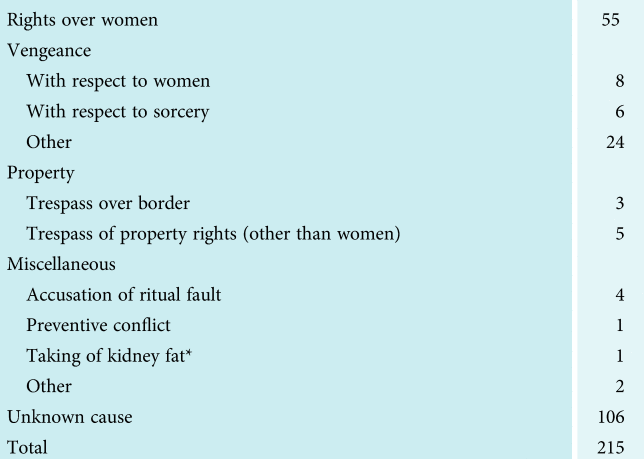
Darmangeat cross-examined 215 instances of collective armed conflict in pre-settlement Australia and was thereby able to analyze the usual causes of such conflict (see Table 2). Almost half of the incidents identified by Darmangeat had no known or stated cause; this means that any supposition about motivation in these cases must be viewed with caution.
Causes of conflicts

*Kidney fat from deceased humans was believed to have magical properties.
Nevertheless, of the remainder, Darmangeat noted that despite early literature advocating that the normal casus bello was violation of territory, disputes over women constituted two thirds of known conflicts, and vengeance about a third.Footnote 43 Territorial (trespass) disagreements represented a mere tenth of known causes for conflict, even if we include rights over resources. We will examine each of these motives in turn.
Most early accounts agree that the majority of Indigenous conflicts erupted as a result of disputes concerning women. Often, as observed of the Tiwi peoples of Melville Island in the Northern Territory, this was due to a woman eloping with a man who was not her husband, after which the husband and his friends would declare war on the group to which the eloping couple had fled, or otherwise attempt a “recovery raid”.Footnote 44 Other cases evolved from the deliberate theft of women (on account of local shortages, when elders accrued a large number). For instance, a man called Waipuldanya recalled that around 1910 there was a surprise raid in which many women were taken.Footnote 45
Vengeance attacks were Indigenous punishment for breaking tribal laws or, in other cases, punishment for sorcery. Sorcery, usually by persons of another group, was often deemed responsible for seemingly natural deaths.
Conflicts arising from trespass imply that some disputes were territorial. This is surprising, as early observers – for example, at King George Sound, Western Australia – found that Indigenous groups “do not seem to covet the territories of their neighbours”.Footnote 46 Peter Gardner determined that Indigenous Australian territories are usually of near-equal size (relevant to available resources), suggesting that no particular group had integrated and assumed dominance over another.Footnote 47 But such an interpretation is both static and condescending. It fails to consider a view of Indigenous territorial organization that allows for Indigenous colonization of the continent, or variation in population size and disposition changing with climate and shifting resource distribution over the millennia.
It is clear that some version of trespass (in the sense of deliberate and unlawful incursions into another's territory) occurred frequently and was the source of disputes across most regions, whether raiding for game, women or some other treasured item.Footnote 48 This was because certain natural resources occurred in greater abundance within certain tribal territories, prompting jealousies and economic inequality.Footnote 49 For instance, relations between the Kukabrak and the Lower Kaurna peoples of South Australia were often strained because “the Kukabrak believed them to monopolise the red ochre deposits”.Footnote 50 Alfred Howitt witnessed the Dieri people near Lake Eyre make secret, long-distance expeditions to raid red ochre mines, suffering “dangers” and “battles” as they passed through many hostile territories to bring back large “cakes” of the material.Footnote 51 Such expeditions comprised “companies of picked men, [who] came prepared to fight their way”.Footnote 52 The fact that these expeditions were “often bloody” is corroborated by Herbert Basebow and Daisy Bates.Footnote 53
Equally, nineteenth-century claims of groups conquering and annexing lands are rarely accepted as accurate today, although both Alfred Howitt and Gerald Wheeler were convinced that Indigenous groups experienced growth and decay, and that the Dieri and Pegullobutra had stories of being evicted from their former homelands.Footnote 54 Some arguments have been made that increased population and the ensuing pressure on resources resulted in an increase in conflict and territorial conquest.Footnote 55 There were certainly oral traditions of pre-contact evictions and near-evictions. For example, from Stradbroke Island and parts of the Sunshine Coast in Queensland,Footnote 56 there were very early reports of Kalkadoon (Mount Isa, Queensland) and Iningai (Longreach, Queensland) peoples “invading” neighbouring territories: “the warrior tribes seize the best country and force the weaker clans to take the worse”.Footnote 57 Reports of such conquests even appear in the writings of ethnographers such as Walter Roth.Footnote 58 For the Cooper/Eyre Basin, Daisy Bates claimed that circumcised tribes incorporated or exterminated uncircumcised groups.Footnote 59
The nature of these reports suggests that “invasions” were probably sustained, successful raids that weakened and depleted the group being harassed. In this regard, it is significant that aggressors were reported making other groups “extinct” by controlling their resources.Footnote 60 The Nuenonne people of Tasmania reportedly used warfare to force the Lairmairrener people “to give up their hunting ground for the common good”.Footnote 61 This suggests that annexation of part of a neighbour's land was not a completely foreign concept, and could be enshrined in customary law.
Prohibited actions in Indigenous warfare
This study goes a step beyond Darmangeat's work, by reconstructing some of the rules under which these conflicts operated – specifically, the types of conduct they prohibited. There were, of course, some regional particularities.
In Arnhem Land, Warner found a distinction between the milwerangel (the second of the three terms in the title of this paper) and the ganygarr.Footnote 62 The milwerangel was a pre-arranged pitched battle that involved a number of clans; the ganygarr, by contrast, was larger, more regional, and somewhat chaotic, being built up over long periods of feuding. The latter involved specially decorated symbolic spears, less restrictions and a corresponding higher death toll than the milwerangel.Footnote 63 The full protocols of Indigenous warfare are sadly not recorded by most ethnographers; this has meant that we have had to reconstruct them from events and actions witnessed by onlookers. Here we list evidence of ten probable or known prohibitions.
Attacking people with status
From various records, it appears that only individuals who had equal levels of initiation could fight one another. At Moreton Bay (Queensland) around 1830, a Quandamooka youth named Paapoonyia dared to challenge a renowned Yaggara elder and warrior named Mulrobin. His act earned him instant disapproval:
[Mulrobin was] annoyed at what I have no doubt he considered the presumption of a boy, [and] attacked Papoonya with great violence …. The grim warrior looked with scorn and contempt on the beardless youth, and would fain have left him, to join his retreating friends.Footnote 64
Later, Mulrobin was challenged by yet another youth – this time a Dalla (Jinnaburra) man – when trying to recover his young wife. On this occasion, to end the embarrassing situation, a suitably seasoned warrior rose up and offered to take the youth's place:
An old and chosen warrior of the tribe then challenged Molroober [Mulrobin], telling him that the young man [the Dalla youth] who had stolen his gin [woman] was not strong enough to fight him but that he would fight for him.Footnote 65
This suggests that Indigenous society was not devoid of ranking and its associated protocols. Anyone's socio-ceremonial status (level of initiation) was instantly apparent to others. Others simply had to note the nature and number of one's cicatrization marks, which were scarred into males during initiation.Footnote 66
It seems these initiatory levels held military significance. To have cicatrization indicated that one was “allowed to rank amongst the warriors”.Footnote 67 This meant being permitted to carry and use real weapons. For the Sydney area, a youth would be given a kummel (possum-skin belt), and “into it is thrust a wooden sword, a weapon which he as a warrior is expected to use”.Footnote 68 In northwestern Queensland, the initiate was presented with a spear and told:
Look here you and altogether, we make it you fighting man now… here spear and altogether belonga to you. Baal [never] you lose him…Footnote 69
Prior to this, youths carried humiliating pretend items – “little spears … small shield”.Footnote 70 Indeed, amongst the Jinnaburra (Southern Queensland):
The young boys were not allowed before initiation to use the ordinary real weapons of the adult, but had to practice with a makeshift one, and the why and how of their manufacture was the last lesson taught them.Footnote 71
After initiation, for example, in Gatton (Queensland), youths were also advised of their military duties:
[They] were further addressed by the assembled sages of the tribe, who harangued them regarding the great courage and prowess of their forefathers, in whose footsteps they were commanded to unfalteringly follow, and to remain steadfast and true to the glorious traditions of the tribe, and urged further that they were now called upon to conform to all the conditions of the tribal code, and to aid and assist by example and counsel to carry on the good government of the tribe, and to be ready at all times to repel attempted aggression from the surrounding tribes (“Whapahs”) with the sacrifice of their lives if need be. To all of these obligations they pledged themselves to remain steadfastly true.Footnote 72
The initiates’ adherence to these “tribal codes” and to their vows of bravery was then tested with an open tournament-battle involving initiates, after which they were permitted to wear some specified item, such as a headband: “[A]lways after kippa- [initiate-]making, the blacks had a great fight … [and each was given] a snake-throttle tied round his forehead.”Footnote 73
Levels higher than this main initiation varied from region to region, and seem to have been acquired within warrior lodges – for instance, the Eagle Star group, in the Cooper Basin, allowed particular persons to own “the bamboo spear”, “the keeba stick” and other military insignia.Footnote 74
Equity in damages (“payback”) and substitution
Payback was a notion that underwrote Indigenous warfare. It related to legitimacy and justice, or junkarti (the third of the three terms in the title of this paper; literally “straight” in Lardil), and provided an exact, tit-for-tat reciprocity for past actions.Footnote 75 As Tyson Yunkaporta, an Apalech man, explains, the rules of engagement were that cuts could only be inflicted on the arms, back or shoulders. But these cuts, at the end of sparring, had to be replicated on one another. This meant that no one could walk away holding a grudge.Footnote 76 In similar fashion, on the Gulf of Carpenteria, if a wife saw her husband being hit in a duel, she could hit his opponent, and the opponent's wife could likewise hit the other husband, but neither man could hit the women.Footnote 77
Junkarti ensured equity and helped curb the violence and brutality of warfare, as few persons cared to endure more than a few blows or cuts in payback for what they had inflicted – let alone be killed for killing an opponent. In some cases, instead of death, the “killing party” negotiated a deal with the accused or his group once they had successfully ambushed him, extorting a significant exchange or substitute from the accused, such as in property. In other cases, the older brother or father of the accused was killed in substitution, either offering themselves or being negotiated.Footnote 78 Similarly, raiders might attack and kill the first person of another group that they encountered:
Revenge is not necessarily individual. The wrongdoing of one tribesman might have to be suffered for by another … of the same blood. This blood revenge, which is of course practiced by even the most civilized nations, is often the cause of the death of an innocent white man who happens to be travelling through the tribal ground.Footnote 79
As Indigenous society believed blame could be shared by everyone and anyone in a group, both sides would be satisfied with this outcome.
Avoiding unnecessary wounding or killing
Another often-described prohibition pertained to superfluous injury and death. It may seem contradictory to speak of a military practice wherein killing was deliberately limited, but in fact modern warfare similarly seeks to minimize the amount of loss, even amongst the enemy. However, for Indigenous groups, part of the rationale was that a great deal of natural death was blamed on sorcery, as it was common to conduct or commission sorcery against foes and rivals. Consequently, even “natural” death was considered suspicious and was usually – sooner or later – attributed to the sorcery or ill will of a supposed foe. This, then, had to be atoned for by raiding an enemy group or challenging that group to a battle. If the challenged tribe came through the battle unharmed, it was viewed as exonerating their guilt over the natural death: “[The accused] must come through it absolutely unharmed before [they] will be exonerated from all blame in connection with the death of [the victim].”Footnote 80
At any rate, battles, raids and duels were intended more as a form of cathartic venting rather than a field of slaughter. In South Australia, an Indigenous Australian informant described what he considered a recent “glorious” (successful) battle. He defined it as successful because “nobody tumble down, only big one yabber [talk]. … My king … say ‘don't throw spears, only yabber.’”Footnote 81
Even when battles involved very large numbers of warriors, they generally resulted in flesh wounds and very few, if any, deaths – although there were some very violent exceptions, depending on the intensity of the dispute. Raids were more usually fatal, and highly unpredictable (indeed, it was expected that women and children would suffer), but often only the targets were slain.Footnote 82
There were several checks and balances that helped minimize damage. One was that even if one's opponent was slain “legally” – that is, during the regulated battle – there could still be furious retributions:
If one is severely wounded [in battle], blood revenge seems … to rest on [the one who caused the other to be severely wounded] until either he is killed in consequence of it, or he pacifies the friends and relatives of the fallen one by gifts.Footnote 83
Thus, victory was always a mixed blessing: one gained status as a fighter, but left the field as a marked man.
Perhaps for this reason, the first sign of blood was often sufficient for the blood-causing side to declare victory: as one observer noted, “in tribal fights as soon as a black on either side was wounded, his side began a retreat”.Footnote 84 A shout would then go around the battlefield and all would temporarily quit fighting to discuss the implications of the casualty's fall. This would often take the battle off into a new direction.Footnote 85 There were specific shouts passed around a battlefield if anyone had fallen (often “blood”, indicating a wounding), enabling hostilities to halt quickly. There were also hand signals for this purpose, even if there had been no injuries:
Should two be playing or fighting, and one wished to quit, he placed his arm straight out from the shoulder, palm down to indicate that the fight was over, as he had acknowledged defeat. Should a male aborigine approach a strange camp and wish to enter, he would give the same sign whilst standing still. Should a dhumka, messenger, approach a strange camp, he gave the same sign, whilst running or walking.Footnote 86
Avoiding attacks on certain parts of the body
Another unique restriction would appear to be with respect to certain parts of the body being sacrosanct. In aiming to mitigate attacks on certain parts of the body, it is recounted that
[a]mong other rules was that which prohibited the intentional hitting of an adversary on the shoulders or breast so that the identification scars thereon should be defaced. … In a kin-bumbe [fight for women], … back slashing … is permissible.Footnote 87
Ensuring the opponent is aware and fully engaged
A settler who witnessed many open battles on Bundjalung Country found that it was considered a huge breach of tribal law if a warrior simply rushed up and deliberately (rather than accidently) killed his foe:
No man was permitted willfully to slay an enemy! Chivalry to the utmost point of madness, if you like. Should a Warrior rush on an opponent and slay him, he, the slayer, was put to death by his own men.Footnote 88
According to Fred Watson, this was because one of the main rules was that “no man should be attacked unaware”.Footnote 89 Watson found that “violation of this code was punishment by death at the hands of the onlookers”.Footnote 90 A similar example from Cairns, on Yindinjdji land, shows that this meant fighting had to be mutual and during a sequence of assigned “moves”:
[There were] elements of chivalry – an old fashioned virtue, but an admirable one. At any time during the approach, any one or all of those approaching enemies could have been killed, by spear, or nulla-nulla. But such a thing was not thought of; their custom – their “scrap of paper” – was honoured.Footnote 91
Ensuring equity in weaponry and numbers
Battles and subsequent one-on-one duels were regulated to ensure equality. In some cases, this meant postponing battles until both sides had sufficient weapons or numbers, even if these had to be drawn from allied groups. For instance, in Cape York, Queensland, whenever one group had too few fighters, “embassies [would] go round the neighbouring tribes, soliciting alliances”.Footnote 92
Similarly, both sides had to use comparable weapons. In one instance on Gumbainggir Country,
without warning, onlookers were startled by the sight of crimson streams cascading down the Yulgilbai champion's back! Comrades rushed in and separated the antagonists, and it was found that Grafton Tommy had a short stabbing knife concealed in his thick mat of hair, and had reached over and stabbed his opponent thrice in the back.Footnote 93
The observer noted that this incident was deemed “a treacherous act, and quite outside Indigenous codes of the game”.Footnote 94
Fighting on behalf of one's guests
In some regions, it was against protocol for a visitor to fight on behalf of his host group. The hosts themselves had to fight, even if it was their guests who had created the problem. Continuing with the Moreton Bay example given earlier, Paapoonyia (although himself a Stradbroke man) upbraided the Pine Rivers clan for allowing their “foreign” (“Bunya Bunya” – Jinnaburra) guest to fight Mulrobin (a South Brisbane headman) on their land, although the cause of Mulrobin's grievance was the theft of one of his people's women by the other clan (the “Bribies” – the Joondoonbarri) that the Pine River clan were hosting:
Paapoonyia, who had stood by the side of Molroober during the struggle, placed himself before his friend, and upbraided the Pine River tribe for permitting a tockeroo or strange black to fight for them, and told them that they were all women.Footnote 95
Protecting and honouring non-combatant elders
Although elders were the highest military and civil authority in Indigenous Australian society, they were protected from violence in regulated battles and greatly honoured. Observers of the Eora and Dharug peoples of Sydney noted that “great deference is paid to old men”.Footnote 96
Senior elders were beyond the age of fighting in raids or battles, but continued to take part in duels against rival peers if such were called for. They often formulated the overall military strategy of the group, directed military manoeuvres during battles and decided the activities of warrior leaders and henchmen during daily life. From base camps, they overlooked the battlefield, monitored the conflict, issued commands and encouragement, and served as “home defence” for the camp. For example, during a battle at Fairy Mount near Lismore, New South Wales,
[h]undreds of Logan warriors streamed down the river. … Two aged reservists were Smashum and Sandy, who paced importantly about the background. … The old chaps’ idea was to bluff the enemy with [their] artillery if they charged.Footnote 97
Likewise in northwestern Queensland, as many as sixty old men were witnessed “yelling, dancing, and encouraging the combatants by voice and gesture”.Footnote 98
Protecting ammunition-gatherers
In most battles, women, children and sometimes elders assisted warriors by recovering spears and other thrown implements and passing these to their fighters for them to continue their attacks. This was a respected task but sometimes occurred in areas of the thickest fighting. There were rules around the treatment of these vital individuals:
We found out that it was the rule in such a fight for the enemy to be most careful not to throw a spear so as to endanger a picker-up of spears being hit, hence their [the ammunition-gatherers’] deliberate calm way of passing through a flight of spears without fear.Footnote 99
Shielding women and children
During initiation, a warrior was instructed that it was his duty to “protect the women, children and camp”.Footnote 100 If a camp was attacked or a group was ambushed whilst out travelling or hunting and gathering, men formed a human (armed) shield between themselves and the attacker, in order to allow women, children and the elderly to flee into the surrounding bush.
Warriors were especially bound to protect and fight on behalf of female relatives. A good example of this is the same Paapoonyia mentioned above, rushing to protect his sister during a battle north of Brisbane on Yuggera Country in the 1820s:
His sister Putchinba, who was particularly active in annoying the fugitives [i.e., defeated warriors, now fleeing], at length attracted the attention of one of them, who turned on her with the most deadly intentions. The pretty maiden defended herself admirably, but must soon have fallen a victim to her temerity, when I called Papoonya's attention to her dangerous situation. He bounded like a kangaroo to the rescue, and placing himself before his sister, upbraided the warrior for thus fighting with a wyah gin [young girl], and challenged him to fight.Footnote 101
Amongst the Tiwis of Melville Island, if an older woman was accidently injured (such as when picking up spears), her son would be obliged to set out a fresh challenge and demand retribution from the enemy through a fight.Footnote 102
Protecting and assisting the wounded and deceased
A major protocol concerned casualties, including fatalities. Women and elderly men were usually poised to deal immediately with casualties, as witnessed during a conflict on Gumbainggir Country at Coffs Harbour, New South Wales:
There were dozens lying about the ground in various attitudes. A great many had to be carried off to the different camps. The carriers made rough stretchers of saplings to carry those who could not walk and the wounded were attended to by old abos and lubras, who seemed to be experts at fixing up spear wounds and broken heads.Footnote 103
Otherwise “a sheet of bark [or] sometimes … bandages … of bark”Footnote 104 could be applied. The nurses were mostly women and sometimes male elders who were “experts at fixing”.Footnote 105
Significantly, many tournament/battle grounds were situated adjacent to “recuperation” or “health” camps which had a stock of springs, clays and herbs used in treatment. These were places where warriors stayed even long afterwards whilst they healed.
It was also forbidden to harm an already wounded person, or to follow up the wounding with more devastating attacks. Women and other warriors were directly involved in halting any malicious re-engagements:
[I]f a man was beaten down these women gathered about him, “protecting” him with their sticks and harassing the enemy to such a degree that he was often glad to beat a retreat.Footnote 106
Equally,
[a]s soon as one falls or is severely wounded, his friends direct their spears at the same time against the one, who caused the wounds and the latter unable to avoid so many spears at once either flees immediately or often falls in consequence of such a general attack.Footnote 107
Opponents would not only return the bodies of their enemies, but would help treat one another's wounds.Footnote 108 Indeed, on Melville Island, Hard observed that if it was a major elder who was wounded, the two feuding sides immediately buried their differences in order to assist him. Moreover, thereafter “both war parties felt compelled to support him or revenge his wound”.Footnote 109
The bodies of the deceased were treated according to the circumstance. Regulated battles saw a great many funerary protocols being followed, whereas a sudden and violent raid could see a site being completely abandoned for decades on end, being now considered hexed (poisoned) country. In that case, “they do not bury the dead, but leave them on the field”.Footnote 110 Many sites of the Australian Frontier Wars epoch were of this type.
Conclusion
The gap between studies of military history and military strategy is ever widening, and it may be claimed that there are no lessons to be taken from Australia's pre-settlement history. However, whilst there have been many debates as to whether or not Indigenous Australian peoples had the concept of “war”, such debates are somewhat redundant in an era that recognizes a spectrum of conflict. Indigenous Australian peoples clearly demonstrated a profound and amazing ability to successfully manoeuvre between concurrent states of cooperation, competition and conflict with neighbouring peoples. Particular methods of conflict and competition evolved to reflect the fact that different groups might jump across the spectrum at any one point in time – they might cooperate over water rights while competing for land resources and conflicting over marriage rights. Specifically, a pre-settlement restriction on warfare was a prohibition against seeking to kill whilst in conflict; there is quite clear evidence that pitched, regulated battles of thousands of warriors would cease the moment that an injury occurred. Further, in a custom unique to history, there is evidence that Indigenous Australian peoples at the conclusion of a battle or duel would replicate the wounds inflicted on each other – if you stabbed someone in the leg, you yourself would be stabbed by them in the same spot, to the same depth.
Perhaps one of the most telling traditions that restricted the excesses of war in Indigenous Australia was the custom that, at the conclusion of a regulated battle, there was no bitterness. Except for long-standing feuds, which could fester for decades, it was observed that Indigenous Australian conflicts ended on a note of complete forgiveness and goodwill. A police officer who witnessed a battle in far north Queensland was astounded at the wholehearted manner in which animosities were dropped:
I could not refrain from wondering at the entire absence of any ill-feeling or animosity among these people. They had been only a few minutes previously emulating each other in inflicting severe wounds and hurts, nay, even in slaughtering their enemies, and yet, here they were laughing, chatting, and feasting, with every manifestation of goodwill and reciprocal friendship. That the battle … had been fought in downright earnest was only too apparent. But it had not left a vestige of that acrimony which we should have looked for from a like contest between civilised people.Footnote 111
This is all to say that there are many lessons to be taken from Australia's pre-settlement history, which can add to the depth of international humanitarian law. It can provide analogies to Australia's current geopolitical situation, in a highly connected and interrelated world (just as Australia was for Indigenous Australian peoples prior to settlement). The rise of globalism and interconnectivity has seen academic and professional commentary turn away from binary concepts such as “peace” and “war”, instead recognizing a spectrum of cooperation, competition and conflict.Footnote 112 The Indigenous Australian laws of war evolved to recognize the need for a fluid transition across this spectrum, concurrently cooperating over land management, competing over resources and, per Darmangeat's dataset, conflicting over rights to women.
The cultural prohibitions and norms surrounding wounding and payback demonstrate the clearest examples of restrictions, at the conflict end of the spectrum, that allowed for cooperation and competition to resume without ill will. Indeed, it is arguable that as nations move towards persistent interference operations, aided by the ubiquity of cyberspace, adopting a “no grudge” approach to unfriendly, but not illegal, conduct might allow nations to more flexibly evolve to the new spectrum.Footnote 113