The need to involve patients in health technology assessments (HTA) as well as the importance of this have been widely recognized (Reference Hailey D1–Reference Gagnon, Desmartis and Lepage-Savary3). Patients’ expectations and experiences of the benefits and harmful effects of their medications complement the views of healthcare professionals and researchers (Reference Entwistle, Renfrew, Yearley, Forrester and Lamont4). Only the patients know what it is like to live with the disease and use the pharmaceuticals. Many countries, therefore, either have or are developing their HTA practices to become more patient-focused (Reference Hailey D1;Reference Gagnon, Desmartis and Lepage-Savary3;Reference Hansen, Lee and van Randwijk5–Reference Gagnon, Gagnon and St-Pierre7). Patient involvement has also been highlighted at European Union level by the European Network for Health Technology Assessment (EUnetHTA), providing the HTA Core Model to conduct assessments (i.e., to produce HTA information) (8).
In Finland, the health and medicines policies emphasize consumer and patient orientation (9;10). Pharmaceutical sector stakeholders are encouraged to develop pharmaceutical services to respond to consumers’ needs. This also requires patients to be consulted in the HTAs of pharmaceuticals. The Finnish Medicines Agency (Fimea) conducts and compiles HTAs on pharmaceuticals (11). Additionally, Fimea is mandated to co-ordinate national co-operation between different stakeholders in this field. Fimea recently published a national recommendation for the assessment of the therapeutic and economic value of pharmaceuticals (12).
According to a recent review on international practices, there are no consistent methods for involving patients in HTAs (Reference Gagnon, Desmartis and Lepage-Savary3). Internationally, individual patients or their representatives have participated at different stages of HTA processes or the patients’ views have been obtained through individual studies or primary research during the assessment process (Reference Gagnon, Desmartis and Lepage-Savary3;Reference Hansen, Lee and van Randwijk5;8;Reference Oliver, Milne and Bradburn13;14). Both qualitative and quantitative methods have been used, though qualitative methods are more commonly used to explore patient perspectives (Reference Facey K and Gracia2;Reference Gagnon, Desmartis and Lepage-Savary3;Reference Gagnon, Gagnon and St-Pierre7;Reference Hansen and Lee15). Most of the previously published articles and the current EUnetHTA Core Model do not describe the methods used in detail (8;Reference Lee, Skött and Hansen16;Reference Staniszewska, Brett, Mockford and Barber17). More elaborated descriptions are needed so that good practices can be learned from other countries and methods for integrating the patient perspective into the HTA processes can be developed (Reference Bowman-Busato18).
The aim of this study is to describe the process of developing the recommendation and method for integrating the patient perspective into HTAs of pharmaceuticals in Finland.
METHODS
Process of Developing the Recommendation
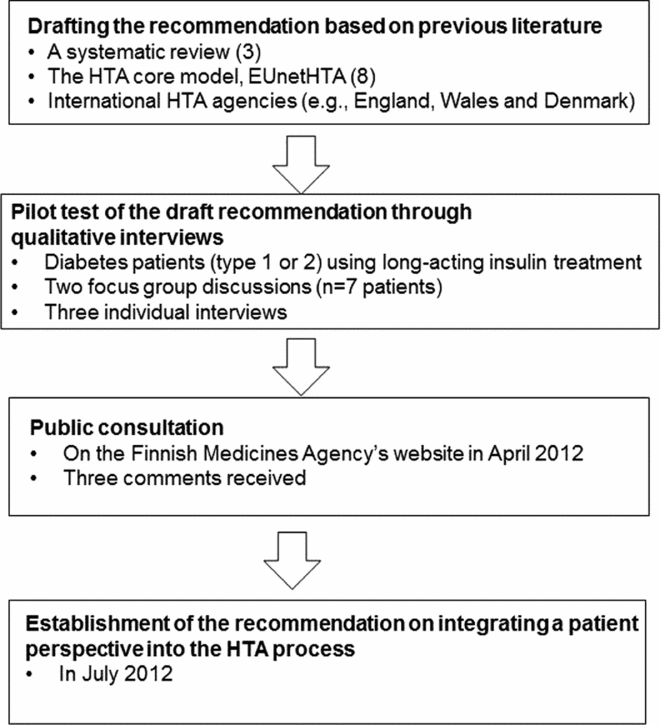
The development of the recommendation included the following steps (Figure 1): (i) drafting the recommendation and planning the assessment method on the basis of the previous literature on international recommendations and experiences of patient and public involvement in the HTA process, (ii) pilot testing the method and recommendation through qualitative interviews, and (iii) public consultation of the draft recommendation.
Process of developing the recommendation on integrating a patient perspective into the HTA process of pharmaceuticals.

Drafting the Recommendation Based on Previous Literature
A recent systematic review of international practices of patient or public involvement in HTAs was identified and used as one of the key sources in developing the draft recommendation (Reference Gagnon, Desmartis and Lepage-Savary3). This review by Gagnon et al. (Reference Gagnon, Desmartis and Lepage-Savary3) was complemented with the HTA core model developed by EUnetHTA and recommendations and practices of selected European HTA agencies (e.g., England, Wales, and Denmark) (Reference Gagnon, Desmartis and Lepage-Savary3;8;14;19;Reference Kristensen and Sigmund20).
In an analogy with the HTA processes in the literature, qualitative interviews were chosen as a method for hearing patients (Reference Gagnon, Desmartis and Lepage-Savary3;Reference Gagnon, Gagnon and St-Pierre7). The selection of this method was supported by the consultation of the project group responsible for developing the national recommendation for the assessment of the therapeutic and economic value of pharmaceuticals (12). Furthermore, previous literature suggested that qualitative methods are the methods of choice when aiming to understand patients’ views and experiences (Reference Britten, Jones, Murphy and Stacy21;Reference Silverman22). Instructions for conducting qualitative theme interviews were based on the literature on qualitative research methodology (Reference Silverman22;Reference Elo and Kyngäs23). The interview guide was primarily based on guides by NICE and the EUnetHTA Core Model (8;19). It included the patients’ expectations and experiences of: (i) the benefits, (ii) the harmful effects of their medication, (iii) differences between the assessed medicines they had used, and (iv) what was important to them in medicine information. The interview guide was tested and minor modifications were made, including putting more emphasis in questions related to medicine use, follow-up, and adherence.
Pilot Testing the Draft Recommendation
Two focus group discussions (n = Reference Gagnon, Desmartis and Lepage-Savary3 and n = Reference Entwistle, Renfrew, Yearley, Forrester and Lamont4) and three individual interviews among diabetes patients (type Reference Hailey D1 or Reference Facey K and Gracia2) using long-acting insulin treatment were conducted to test the method and the interview guide. This patient group was chosen because the pilot test was integrated into Fimea's assessment of the therapeutic and economic value of insulin glargine and insulin detemir in the treatment of type 1 and type 2 diabetes compared with NPH (Neutral Protamine Hagedorn) insulin. The report of this assessment was published in early 2013 (Reference Oravilahti, Kastarinen and Enlund24).
The inclusion criteria for participants were: (i) age 18 years or older; (ii) diagnosis of type 1 or type 2 diabetes, and (iii) use of NPH insulin or long-acting insulin analogies (insulin glargine or detemir). Healthcare professionals were excluded. To achieve a cross-section of participants, people were recruited by means of different channels: a letter with the assistance of patient organizations, diabetes specialist nurses, pharmacies, and diabetes-specific discussion forum in the Internet. The interview guide was finalized according to the experiences from the pilot test.
One of the researchers, a pharmacist (J.K.), conducted the interviews and focus group discussions. The interviews lasted from 30 to 65 minutes, and the focus group discussion from 65 to 90 minutes. The interviews and focus group discussion were conducted in the premises that were the most suitable and convenient for the participants (e.g., at the university, patient's home, health center, community pharmacy).
Public Consultation
The draft recommendation was opened for public consultation in April 2012 after the pilot testing. Public consultations were asked by means of Fimea's official Web site as a normal public consultation process of Fimea. The consultation was available for 2 weeks. In addition, medical press was informed about the possibility. Furthermore, the persons participating in the preparation of the national recommendation for the assessment of the therapeutic and economic value of pharmaceuticals (12) were informed of the public consultation. Recommendation was finalized according to comments from different stakeholders: pharmaceutical industry (n = Reference Hailey D1) and patient and consumer organizations (n = Reference Facey K and Gracia2).
RESULTS
Patient Involvement in the HTA Process
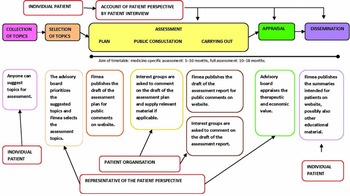
Patients can be involved at many stages of Fimea's HTA process (Figure 2). Qualitative interviews play a central role, and it is recommended that they be conducted at the beginning of the assessments to gain information, particularly on patient preferences and values, including positive and negative outcomes important to patients in the use of the pharmaceuticals under the assessment. The aim of the patient interviews is to ensure that all aspects relevant to the users of the assessed medicines are included in the assessment. The information received from patients can influence the planning and conducting of the assessment (especially regarding ethical and social aspects of the use of the medicine), the position statement concerning this and the dissemination of the corresponding results and findings. In addition to qualitative interviews, individual patients or their representatives also have other opportunities to participate in an HTA process (Figure 2). For example, they can suggest a topic for an HTA, comment on publicly available preliminary documents and receive information about the results of the assessment on Fimea's website.
Recommended stages of integrating a patient perspective into the health technology assessment process of pharmaceuticals (29).

Conducting Qualitative Interviews
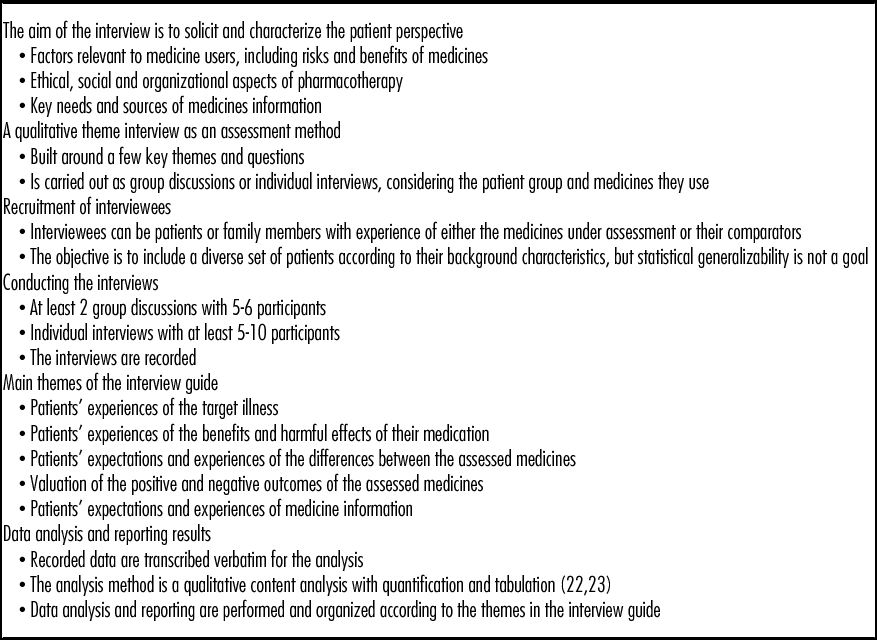
The final recommendation includes step-by-step instructions on how to conduct qualitative interviews to explore the patient perspective in the assessment of the therapeutic and economic value of pharmaceuticals and corresponding medicines information (Table 1). All necessary steps to conduct a qualitative interview, such as method, sample selection, patient recruitment, implementation of the interviews, analysis of the data and reporting results, have been described. The qualitative interviews can be conducted either as focus group discussions or individual interviews, depending on the disease and the assessed medicines. The benefits and disadvantages of both methods are described in the recommendation to facilitate the choice of the method of the interview.
Recommended Steps for Conducting Qualitative Interviews as Part of the HTAs of pharmaceuticals (29)

The final interview guide in the recommendation includes the following main themes: (i) patients’ experiences of living with the disease, (ii) patients’ experiences of the benefits and (iii) harmful effects related to their medication and how important these are to them, (iv) patients’ expectations and experiences of the differences between the assessed medicines, (v) positive and negative outcomes important to patients and 6) patients’ needs concerning medicines information. These main themes need to be modified according to the pharmaceutical product under assessment. The key is to explore patients’ experiences of benefits and adverse effects of the treatments under assessment, and the positive and negative effects the treatments have on their major life areas.
Experiences from the Pilot Test of the Recommendation
The pilot test was important in finalizing the recommendation. Better understanding was gained of the time frame needed for patient recruitment, qualitative patient interviews and data analyses. The interview guide was also revised to be less ambiguous and more patient friendly. Some of the questions in the interview guide were revised to assure face validity because they were not easily understood or appropriate to this particular patient group. Based on the pilot test, the importance of collaboration with patient organizations, general practitioners and pharmacists was recognized in identifying and recruiting eligible individuals to the patient interviews.
The results from the interviews in the pilot test were used by Fimea in processing the HTA assessment of long-acting insulin treatments (Reference Oravilahti, Kastarinen and Enlund24). The pilot test indicated that the patient interviews are useful in conducting HTA assessments. The results complemented the information obtained from other sources concerning ethical, social and organizational aspects and made it possible to confirm that the Finnish patients’ views were in line with the literature. The patient interviews also provided views on how patients want to obtain information about the results of the assessment and how, where, and when they want to receive medicine information.
Effects of the Public Consultation
The 2-week public consultation yielded three comments on the draft recommendation. Based on the comments received, the aims of the qualitative methods were emphasized and a more elaborated description was added of how to use the results of the qualitative interviews in an assessment process. Some details were also added, including that a clinical physician may be consulted in planning and conducting the recruitment.
DISCUSSION
The interview method was pilot tested during Fimea's HTA assessment on long-acting insulin analogues compared with NPH insulin in type 1 and 2 diabetes (Reference Oravilahti, Kastarinen and Enlund24). The information obtained in the interview study was analogous and compatible with information concerning patient expectations found in the literature (Reference Peyrot, Rubin and Lauritzen25–Reference Brod, Kongso, Lessard and Christensen27); it also gave additional and deeper insight into the patients’ views. Furthermore, the interview study provided the assessment group with a better and up to date understanding of aspects important to patients in the Finnish treatment context.
Our study suggests that patient interviews provide researchers and assessment groups with patients’ views, not merely regarding clinical effectiveness and safety of pharmaceuticals but also concerning clinical treatment pathways and medicines information as part of pharmacotherapy. In the long term, the information received from patients affects the quality of medicines information if it concerns experiences of everyday use of the pharmaceutical products. The information completes the clinical trials and pharmacovigilance surveillance data collected by authorities. In particular it extends the understanding of the positive and negative effects of the treatments on the patient's major life areas (e.g., daily routines, work, leisure time, social life).
According to the definitions in previous articles, patients should be involved in HTAs on three levels: information, consultation and participation (Reference Gagnon, Desmartis and Lepage-Savary3;Reference Gauvin, Abelson and Giacomini28). In Fimea's HTA recommendation, the patient perspective is integrated at several stages (Figure 2) (29). We considered a qualitative theme interview as an appropriate method to gain a deeper understanding of the patients’ expectations and experiences of the medicines (Reference Britten, Jones, Murphy and Stacy21;Reference Silverman22). Both of the methods tested, focus group discussion and individual interview, proved suitable, but in the focus group discussions, in particular, the support from the group helped the patients to remember the essential aspects of pharmacotherapy.
For the individual interviews, recruitment was easier than for the focus group discussions. Individual interviews should also be considered if the pharmacotherapy to be assessed and its target group have sensitive features (e.g., a mental health condition). In general, recruiting patients was challenging and time-consuming regardless of the interview method used. Thus, the number of participants in the interviews and focus group discussions was eventually lower than it was guided in the recommendation based on the qualitative research methodology literature. The most difficult part was to find patients who had experience of several treatments for the same condition (e.g., different long-acting insulin treatments). However, these kinds of patients are needed so that patient-centered comparative information about positive and negative effects of the different treatments on the same disease are obtained.
It turned out to be nearly impossible to organize a group of 5–6 young or working diabetes patients to meet at the same time and place. There are diseases which are common in all age groups and diseases which are more common, for example, among elderly persons. It is important to get perspectives from all relevant age groups of a specific disease. In this study, it was important to get also younger working-age diabetics participating in the interviews. However, it turned out to be very challenging to recruit especially those diabetics who have young children to participate, for obvious time constraint reasons. We believe that this will be the case also with other working-age patients and medicine users.
Our study indicates that the interview study should be conducted before drafting the final assessment plan. The rationale behind this is that all aspects relevant to patients would be identified and, therefore, also assessed during the HTA process. In addition to patient interviews, other methods can be used to investigate the patient perspective, including their involvement at different stages of HTA processes and a literature review. It is important to compare the results obtained from qualitative interview studies with other sources of information to obtain a wide view of the subject. This will also facilitate the assessment of the transferability of the results (Reference Silverman22).
Our findings are in accordance with the previous findings that patients’ experiences cannot be seen as an isolated aspect in health technology assessments, because the patient perspective is relevant and even pivotal in many domains, like the social, ethical and organizational domains (8). Patients are the most essential stakeholders in the process because they have unique knowledge and experience of using pharmaceuticals. Furthermore, the results of the assessments can affect patients’ lives directly. Their views and values, including the importance of outcomes, may differ from those of clinicians or researchers so it is crucial that their perspective is taken into account.
The final recommendation for integrating the patient perspective into HTAs was published in July 2012 (29). Only after several HTA processes could the feasibility and impact of patient involvement be evaluated. According to the forthcoming experiences, it will be possible to consider at which stages the patient involvement is most beneficial and how it has affected the assessments and therapeutic recommendations. The sample size in this study—as is usual in qualitative studies—is small, and especially, the number of responses to the public consultation was low. Thus, this recommendation will be updated in 2015 according to the experience and feedback gained.
CONCLUSION
Qualitative interviews (focus group discussions or individual interviews) seem to be suitable methods for integrating the patient perspective into health technology assessments of pharmaceuticals. Patients will be involved in multiple stages of Fimea's HTA process, starting from the beginning of the assessment. The recommendation, published in July 2012, includes step-by-step instructions on how to assess the patient perspective, and it will act as a tool to gain information, particularly on patient preferences and values, including positive and negative outcomes important to patients, and on ethical and social aspects of the medicine's use. It presents a new, more patient-oriented course of action in Finnish health care.
CONTACT INFORMATION
Jenni Kleme, M.Sc (Pharm.), Researcher, University of Helsinki, Division of Pharmacology and Pharmacotherapy
Marika Pohjanoksa-Mäntylä, PhD, Senior Lecturer, University of Helsinki, Division of Pharmacology and Pharmaco-therapy
Marja Airaksinen, PhD, Professor, University of Helsinki, Division of Pharmacology and Pharmacotherapy
Hannes Enlund, PhD, Head of Research, Finnish Medicines Agency
Helena Kastarinen, MD, PhD, Research Physician, Finnish Medicines Agency
Piia Peura, M.Sc (Pharm.), Pharmacoeconomist, Finnish Medicines Agency
Katri Hämeen-Anttila, PhD, Development Manager, Finnish Medicines Agency
CONFLICTS OF INTEREST
Jenni Kleme and Marika Pohjanoksa-Mäntylä report no conflicts of interest. Marja Airaksinen reports being a board member of University Pharmacy, University of Helsinki. Hannes Enlund, Helena Kastarinen, Piia Peura and Katri Hämeen-Anttila report being employed by the Finnish Medicines Agency, which is responsible for conducting health technology assessments of pharmaceuticals in Finland.