INTRODUCTION
Population density of most marine invertebrates is maintained by sexually produced progeny generated through broadcast spawning and development of planktonic larvae. In contrast, fissiparous echinoderms also maintain their populations through various methods of asexual reproduction (Conand, Reference Conand1996; Mladenov, Reference Mladenov1996; Uthicke, Reference Uthicke1997, Reference Uthicke2001a). Fissiparous echinoderms are typically first asexual reproducers that undergo several rounds of splitting and regeneration, followed by cessation of this activity and growth to the larger sexual phase which loses the ability for clonal propagation (Mladenov, Reference Mladenov1996). The mechanism underlying the switch between reproductive modes is not known (Mladenov, Reference Mladenov1996). Many species of tropical aspidochirotid holothuroids are conspicuous asexual reproducers propagating through transverse fission as well as by broadcast spawning (Conand, Reference Conand1996; Uthicke, Reference Uthicke1997, Reference Uthicke2001a; Dissanayake & Steffanson, Reference Dissanayake and Steffanson2010). Following severance of body parts, regeneration to form whole new individuals occurs.
Aspidochirotid holothuroids are conspicuous and ecologically important members of tropical benthic communities where they play important ecological roles in bioturbation, sediment dynamics and nutrient cycling (Uthicke, Reference Uthicke1999, Reference Uthicke2001b, c; Mangion et al., Reference Mangion, Taddei, Frouin, Conand, Heinzeller and Neblisick2004). These echinoderms are also likely to play an important function in coral reef resilience in the face of stress from climate change (Schneider et al., Reference Schneider, Silverman, Woolsey, Eriksson, Byrne and Caldeira2012). There has been considerable interest in the unusual bimodal reproductive plasticity of aspidochirotids (Conand, Reference Conand1996; Uthicke, Reference Uthicke2001a). Populations of superabundant tropical species appear to be maintained by a combination of asexual and sexual reproduction (Ebert, Reference Ebert1978; Chao et al., Reference Chao, Chen and Alexander1993; Conand, Reference Conand1996; Uthicke, Reference Uthicke2001a; Lee et al., Reference Lee, Byrne and Uthicke2008a). Due to widespread dispersal of larvae away from the natal reef, it is suggested that fissiparous holothuroids evolved asexual reproduction as a mechanism to facilitate maintenance of high local population abundances (Uthicke, Reference Uthicke2001a; Skillings et al., Reference Skillings, Bird and Toonen2010). There are perceived drawbacks to increased prevalence of asexual reproduction in that some sexually produced genotypes may get excessively cloned, resulting in reduced population genetic diversity (Uthicke, Reference Uthicke2001a).
Currently nine species of aspidochirotids are known to be fissiparous, including the species investigated here, Holothuria (Halodeima) atra (Jäger, 1883) (Uthicke, Reference Uthicke2001a; Lee et al., Reference Lee, Byrne and Uthicke2008a). This species is one of the most prevalent sea cucumbers in the Indo-Pacific (Rowe & Gates, Reference Rowe, Gates and Wells1995). For populations of H. atra, propagation by asexual reproduction appears to be greater than that by sexual reproduction (Ebert, Reference Ebert1978; Harriott, Reference Harriott1982; Uthicke, Reference Uthicke1997, Reference Uthicke, Mooi and Telford1998, Reference Uthicke1999, Reference Uthicke2001a). Holothuria atra exists in two size morphs, a small form that reproduces by asexual and sexual means and a large morph that only reproduces sexually (Chao et al., Reference Chao, Chen and Alexander1993; Lee et al., Reference Lee, Byrne and Uthicke2008b). The small form is common in intertidal and shallow water habitats throughout the broad distribution of H. atra while the large form is more common in deeper water areas (Chao et al., Reference Chao, Chen and Alexander1993; Lee et al., Reference Lee, Byrne and Uthicke2008b). Although there was some doubt as to whether these two morphs are the same species, it was confirmed they are the same species in recent molecular barcode taxonomy (Uthicke et al., Reference Uthicke, Byrne and Conand2010). The two forms are suggested to be phenotypic ecotypes with the small fissiparous form characteristic of intertidal habitats exposed to more stressful fluctuating environmental conditions while the large morph is adapted to more stable conditions in the subtidal (Ebert, Reference Ebert1978; Chao et al., Reference Chao, Chen and Alexander1993, Reference Chao, Chen and Alexander1994; Conand, Reference Conand1996; Uthicke et al., Reference Uthicke, Benzie and Ballment1998; Uthicke, Reference Uthicke2001a; Lee et al., Reference Lee, Byrne and Uthicke2008b). This suggestion is supported by experiments where the small morph individuals transform to the large form following transfer from intertidal to subtidal habitats (Chao et al., Reference Chao, Chen and Alexander1994; Lee et al., Reference Lee, Byrne and Uthicke2008b).
Here we investigated the population and reproductive biology of H. atra at three sites in the Capricorn Bunker Group, Southern Great Barrier Reef, in population surveys taken over 5 years. These surveys were used to document the density of this species over time and address the hypothesis that fission plays a major role in population maintenance. Previous studies highlight the importance of fission in populations over the wide distribution of H. atra (e.g. Reunion, Australia, Taiwan, Marshall Islands, Papua New Guinea and New Caledonia) (Ebert, Reference Ebert1978; Harriott, Reference Harriott1982; Conand, Reference Conand1989, Reference Conand1996, Reference Conand2004; Conand & De Ridder, Reference Conand, De Ridder, De Ridder, Dubois, Lahaye and Jangoux1990; Chao et al., Reference Chao, Chen and Alexander1993, Reference Chao, Chen and Alexander1994; Uthicke, Reference Uthicke1997, Reference Uthicke2001a; Uthicke & Benzie, Reference Uthicke and Benzie2000; Uthicke et al., Reference Uthicke, Conand and Benzie2001). In parallel we investigated reproduction in the two morphs of H. atra to provide a comparative assessment of the reproductive biology of the two adult phases that are characteristic of the species throughout its Indo-Pacific distribution (Conand, Reference Conand1996; Uthicke, Reference Uthicke2001a; Lee et al., Reference Lee, Byrne and Uthicke2008b).
MATERIALS AND METHODS
Study area and field surveys
Surveys of two intertidal populations (OT, One Tree; TT, Two Tree) of H. atra at One Tree Island (23°30′S 152°05′E) and one population (HI) at Heron Island (23°26′S 151°54′E) were conducted over 5 years from 2006–2011 with 3–4 surveys per annum. Although permanent transect markers were not deployed, the surveys involved the same area as guided by local landmarks. All transects were aligned parallel to the shore. At One Tree Reef the surveys were placed along the shore at the inflow into the lagoon (OT) and near the navigation entrance (TT) (University of Sydney, One Tree Island Research Station: http://sydney.edu.au/science/biology/research/oti/). At Heron Reef the surveys were placed along the beach rock platform on the western side of Heron Island. For each survey, all H. atra were counted in 50 × 2 m transects (N = 3–4) and scored as a whole specimen or fission product (anterior or posterior portion). The rubble was also searched carefully for small individuals that might indicate the presence of recruitment through larval settlement. Transects were used to determine density. Due to the opportunistic nature of the sampling, the number of transects differed among sites and years (OT and TT: 2006: April, May, June and October; 2007: March, June and September; 2008: January, May, July and November; 2009: January, May, July, November and December; 2010: May and October; 2011: January and February) (HI: 2005: August, October and November; 2006: April, May, July and October; 2007: May and November; 2008: May, July and November; 2009: January, May and November; 2010, May). To display trends on an annual basis the data for all sites were combined per month.
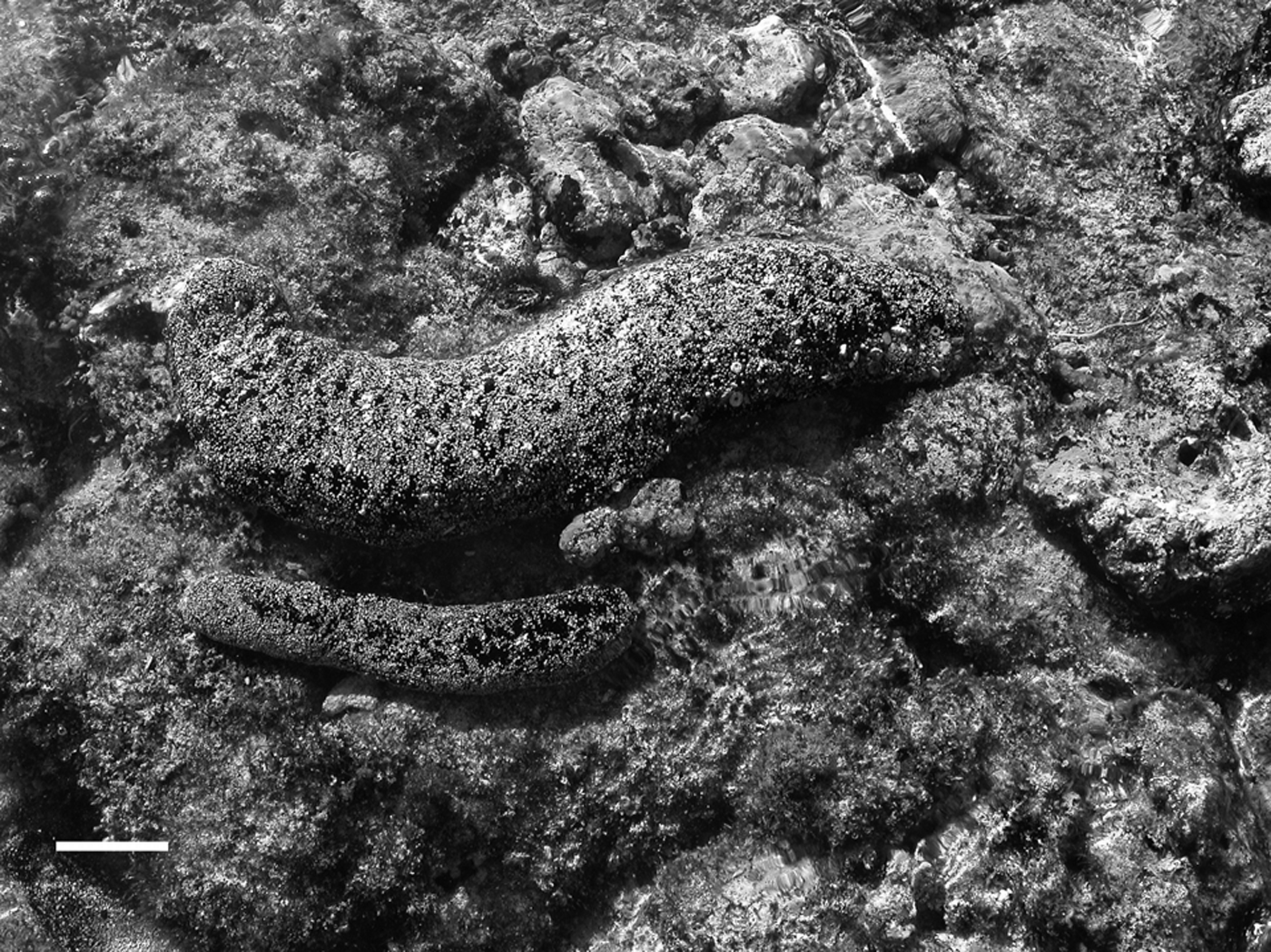
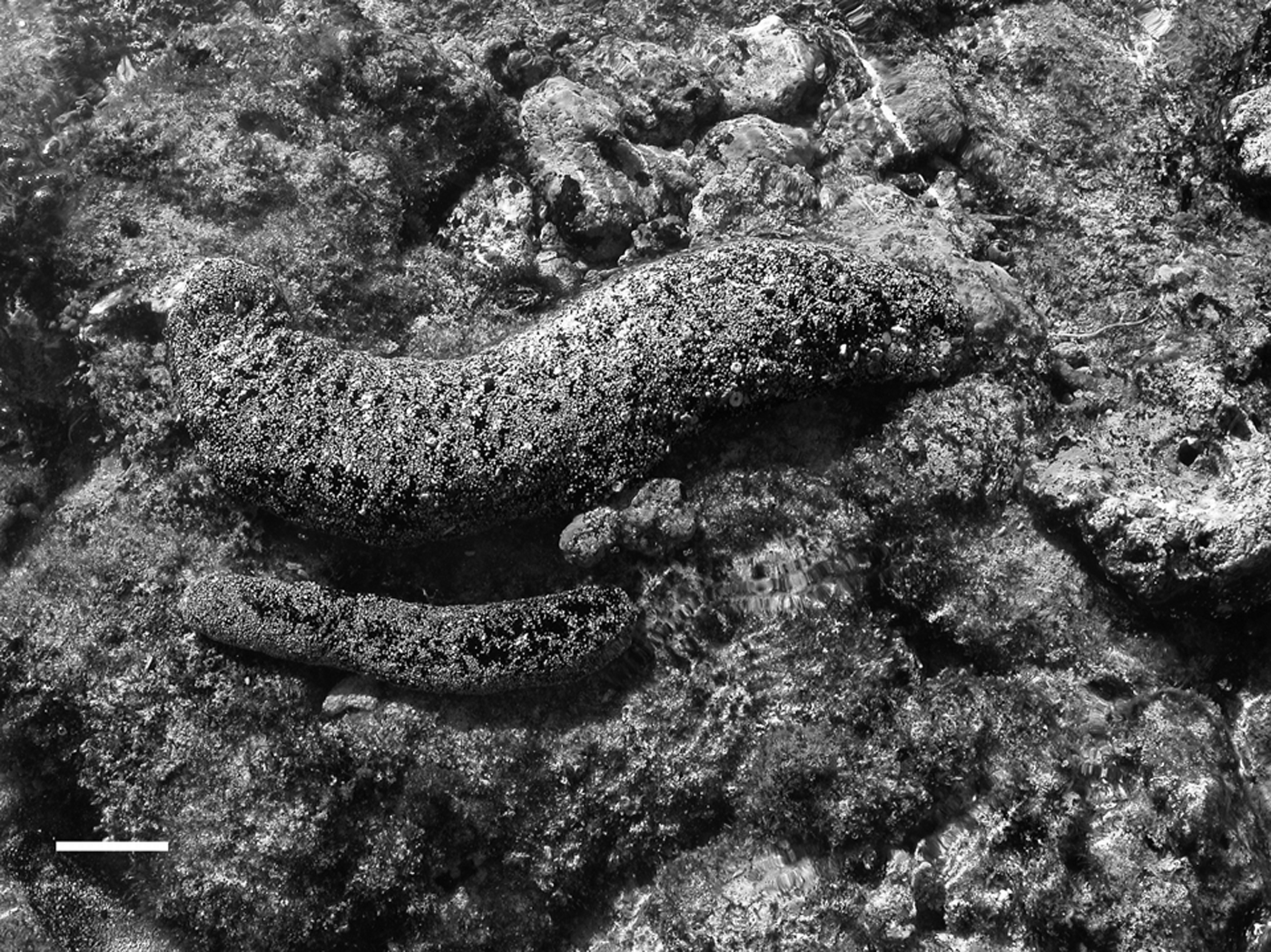
Sexual reproduction of the small and large morphotypes of H. atra (Figure 1) was investigated at One Tree Island. For this study 8–10 small (100–150 mm contracted length) H. atra were collected from the intertidal area (0–1 m depth) in 6 sample months (April, May, June, August, October and November). From the adjacent lagoon (2–4 m depth) 8–10 large (250–400 mm contracted length) H. atra were collected in 5 sample months (February, May, September, October and November) to determine the GI. The gonads were removed and weighed (GW) (to the nearest 0.1 g), and the remaining body wall was weighed (BW) (to the nearest g). The condition of the gonad tubules and the presence of advanced gametes (abundant fully grown eggs, tubules packed with sperm), as described elsewhere (Ramofafia et al., Reference Ramofafia, Byrne and Batteglene2003) was noted for each specimen. Due to permit limitations these samples were taken over several years.
Small and large morphotypes of Holothuria atra placed side by side on the reef flat at One Tree Lagoon at low tide. Scale bar = 50 mm.
Statistics
For comparison of density of fission products of H. atra among the three sites the density data were sorted and pooled by summer season (November–April) and winter season (May–October) and analysed using one-way analysis of variance (ANOVA) with site as fixed factor. Data were log-transformed to fulfil requirements of homogeneity of variance as determined using Bartlett's test. To determine if there were any trends in density and fission over time for the region data from all transects from all months across the three sites were combined for statistical analyses. We tested for difference in total density between months of the year, and density of fission products between the months of the year, using a one-way ANOVA with month as fixed factor. Data were log-transformed to fulfil requirements of homogeneity of variance as determined using Bartlett's test. Tukey's honestly significant difference (HSD) post-hoc test was used to determine the months that differed. Pearson's product moment correlation (Pearson's r) was used to test for correlation between the total number of H. atra per transect and the number of fission products counted in the same transect.
RESULTS
Density and asexual reproduction
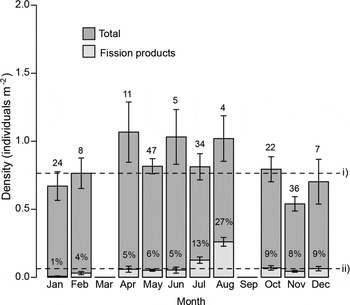
There was no difference in density of fission products between the three sites during winter (F1,2 = 1.95, P = 0.15) or summer (F1,2 = 0.35, P = 0.71). Over 5 years the density of Holothuria atra, merged for months, fluctuated around a mean of 0.77 ind. m−2 (SE = 0.033) (Figure 2, upper dashed line). Total density fluctuated between months of the year (F1,11 = 3.32, P < 0.00). The Tukey's HSD test showed that the pairwise difference was between November and July (P = 0.02), indicating that overall population density did not vary significantly throughout most of the year despite the potential increase that might be expected from fission followed by regeneration.
The density of Holothuria atra in transects taken over 5 years merged for months in data for three populations merged: (i) the upper dotted line indicates mean density (0.77 ind. m−2) of total sampled populations; and (ii) the lower dotted line indicates mean density (0.06 ind. m−2) of fission products. The percentage of fission products is also indicated. Bars are mean with SE.

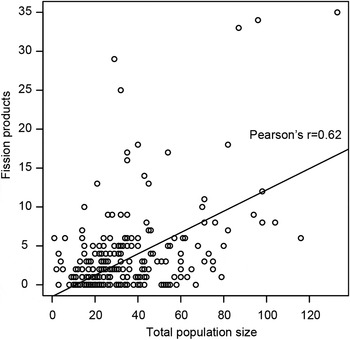
A low incidence of fission was evident year-round with a mean of 0.06 fission products m−2 (SE = 0.01) (Figure 2, lower dashed line). Fission products ranged from 1–27% of the total population size over months of the year (Figure 2). In July, the density of fission products was double that of the year-round mean with 13% fission products in the populations and in August four times that of the year-round mean with 27% of fission products present. There were significant differences in the density of fission products between months (F1,12 = 7.28, P < 0.00) (Figure 2). The Tukey's HSD test indicated that August had the highest density of fission products compared to other months (P = 0.03–P < 0.00) and that none of the other months differed. There was a positive correlation between the total number of H. atra and fission products in transects (Pearson's r = 0.62, t = 11.83, df = 220, P < 0.00) (Figure 3).
Relationship between the total number of Holothuria atra and fission products in all transects over 5 years.

Sexual reproduction
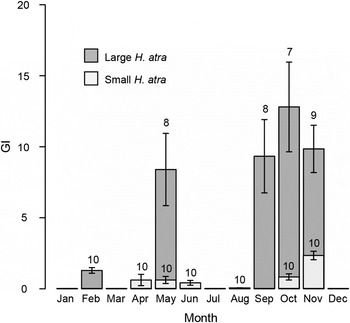
The GI of the small morph of H. atra was low (0.04–0.6%) across all sample times (Figure 4). In the samples collected in April, May and June, approximately half of the specimens had no identifiable gonad or one that was a minute extension from the gonad basis. In August virtually none of the specimens had a gonad. Specimens sampled in October all had gonads in the advanced stage of gametogenesis. At this time the gonad tubules were packed with eggs or sperm.
Gonad index (GI) for the total sampled populations merged for months depicting both large and small morphs. Bars are mean with SE.

In contrast, the large morph of H. atra had conspicuous gonads in all months sampled. The GI ranged from 1.3–12.9% (Figure 4). Specimens examined in May, September and October were mature with gonad tubules filled with fully developed eggs or sperm. All the specimens examined in February had small gonads in a post-spawned condition. The gonad tubules of these specimens had a shrunken appearance and often had the brown coloration.
DISCUSSION
Population density of Holothuria atra in the Southern Great Barrier Reef (GBR) was remarkably stable over 5 years, similar to that noted for populations of this species in several locations in the western Indian Ocean and Pacific Ocean (Ebert, Reference Ebert1978; Harriott, Reference Harriot1980, Reference Harriott1982; Conand, Reference Conand1989; Chao et al., Reference Chao, Chen and Alexander1994; Uthicke, Reference Uthicke2001a; Ramofafia et al., Reference Ramofafia, Byrne and Batteglene2003; Lee et al., Reference Lee, Byrne and Uthicke2008b). Although our analysis indicated a difference in population density between the months of November and July, over the year the density was relatively stable. Overall, the population density fluctuated around the value 0.8 ind. m−2. Similar densities (~≤ 1 ind. m−2) are reported for other H. atra populations on the GBR and elsewhere (Hammond et al., Reference Hammond, Birtles and Reichelt1985; Chao et al., Reference Chao, Chen and Alexander1993; Uthicke, Reference Uthicke, David, Guille, Feral and Roux1994; Conand, Reference Conand1996; Klinger & Johnson, Reference Klinger, Johnson, Mooi and Telford1998), with occasional reports of higher densities (3–5 ind. m−2) (Mangion et al., Reference Mangion, Taddei, Frouin, Conand, Heinzeller and Neblisick2004; Conand, Reference Conand, Toral-Granda, Lovatelli and Vasconcellos2008; Kinch et al., Reference Kinch, Purcell, Uthicke, Friedman, Toral-Granda, Lovatelli and Vasconcellos2008).
Fission activity of H. atra increased in winter, as observed elsewhere in the region where fission products are 16–26% of the population during this season (Harriott, Reference Harriot1980, Reference Harriott1985; Uthicke, Reference Uthicke1997; Lee et al., Reference Lee, Byrne and Uthicke2008b). The highest number of fission products coincided with annual sea surface temperature minima (NOAA, 2011). It appears that for the GBR, cooler temperatures are associated with enhanced fission rates. Higher levels of asexual reproduction in winter were not associated with significantly higher population densities, although higher densities immediately following periods of enhanced clonal reproduction in H. atra have been observed (Chao et al., Reference Chao, Chen and Alexander1993; Uthicke, Reference Uthicke, David, Guille, Feral and Roux1994, Reference Uthicke1997). We might have seen a fleeting increase in population density if we had sampled in September, following the period of highest fission rates. Over the long term however, as seen over 5 years in this study and 8 years at Reunion, fission is not associated with an increase in population density of H. atra (Conand, Reference Conand1996, Reference Conand2004; Uthicke, Reference Uthicke2001a).
Although fission was not associated with an increase in population density, there was a positive correlation between the number of fission products present and total population size across surveys. Fission occurs year-round in H. atra and thus has an underlying influence on population dynamics, even at the lower rate seen in some months (Conand, Reference Conand2004). The stability of the H. atra populations at One Tree and Heron Reef may be due to a relatively steady input of asexually produced individuals, supporting the hypothesis that population stability is due to asexual reproduction (Ebert, Reference Ebert1978; Chao et al., Reference Chao, Chen and Alexander1994; Uthicke, Reference Uthicke2001a). Although it appears that asexual reproduction plays a major role in H. atra population dynamics, the relationship is not a clear one. Despite the underlying presence of fission in H. atra with periods of enhanced activity, there was no change in population density. Inherent in this observation is that fission products must suffer post-split mortality, as has been observed in nature (Harriott, Reference Harriott1982; Conand, Reference Conand1996; Lee et al., Reference Lee, Byrne and Uthicke2008b). Why this clonal species severs its body with the outcome of death of one half is not known.
Although we did not see marked population increase due to fission, neither did we see a marked decline in population density as one would expect from species where population regulation relies on recruitment through larval settlement (Uthicke et al., Reference Uthicke, Schaffelke and Byrne2009). Over 5 years we did not see any evidence of recruitment by sexually produced propagules, although genetic evidence indicates that sexual reproduction does contribute to population genetic structure (Uthicke et al., Reference Uthicke, Benzie and Ballment1998). Newly recruited juvenile H. atra resulting from larval settlement were also not observed in previous studies, despite concerted searching efforts (Chao et al., Reference Chao, Chen and Alexander1993), although the recruitment habitat may be different from the adult habitat. Overall it appears that mortality of sexual recruits of H. atra must be high (Uthicke et al., Reference Uthicke, Conand and Benzie2001).
It seems that asexual reproduction in H. atra must play an important role in compensating for rates of mortality and emigration (Ebert, 1983; Uthicke, Reference Uthicke2001a; Lee et al., Reference Lee, Byrne and Uthicke2008b). Considering the absence of sexually produced juveniles, asexual reproduction also plays an important role in buffering population fluctuation from the vagaries of recruitment by sexually derived propagules (Uthicke, Reference Uthicke2001a; Conand, Reference Conand2004; Uthicke et al., Reference Uthicke, Schaffelke and Byrne2009). According to the model of Uthicke Reference Uthicke(2001a), the ‘steady state’ in density of H. atra populations indicates the presence of a feedback mechanism between clonal propagation and mortality/emigration that balances density around a mean appropriate to the carrying capacity of the environment.
The most common form of H. atra is the small morph that is clonal and is also capable of sexual reproduction (Ebert, Reference Ebert1978; Harriott, Reference Harriott1982; Uthicke, Reference Uthicke1997, Reference Uthicke, Mooi and Telford1998, Reference Uthicke2001a). Examination of gonads of the small and large morphs indicated a difference in reproductive pattern. The great disparity in gonad production relative to body size (i.e. gonad index) of the small and large morphs of H. atra and absence of gonads for part of the year in the small morph is also noted for populations of this species in Taiwan (Chao et al., Reference Chao, Chen and Alexander1993) and reflects the general relationship between gonad growth rate and body size in holothuroids and other echinoderms (Conand, Reference Conand1993; Marsh & Watts, Reference Marsh, Watts and Lawrence2007). Clearly clonality comes at a significant cost to the capacity to reproduce sexually (Chao et al., Reference Chao, Chen and Alexander1993). The GI of the small morph increased slightly in summer indicating spawning in summer, corresponding to the major breeding period reported for H. atra in the region (Harriott, Reference Harriott1985). In comparison, the GI of the large morph was also high in mid-winter indicating greater, more prolonged spawning activity in these individuals.
The change to the large morph requires cessation of fission and significant growth. Once the individual has switched to the large sexual morph they lose the ability to clone (Chao et al., Reference Chao, Chen and Alexander1993). The mechanisms underlying this switch from the small to large morph in H. atra is not known, but translocation studies suggest that this requires a habitat comparatively more sheltered or benign than the intertidal. These areas are typically occupied by the large morph and may have higher levels of food (Chao et al., Reference Chao, Chen and Alexander1994; Lee et al., Reference Lee, Byrne and Uthicke2008b). The reproductive switch (asexual to sexual) in fissiparous echinoderms is suggested to be regulated by a combination of abiotic and biotic factors (Mladenov, Reference Mladenov1996; Uthicke, Reference Uthicke1997, Reference Uthicke2001a). The conceptual model of Uthicke Reference Uthicke(2001a) predicts that five factors (high mortality, low habitat stability, small optimum individual size, high food availability and low larval supply) promote asexual reproduction. With the exception of food availability, the translocation study of Lee et al. Reference Lee, Byrne and Uthicke(2008b) supported this suggestion. Rather than promoting fission, higher food availability (through decreased population density) stimulates growth, cessation of fission and a switch to the large sexual morph. The mechanisms underlying the reproductive plasticity of fissiparous holothuroids remains a key area of research, especially as the ecosystem impacts of the removal of these ecologically important animals from coral reef ecosystems due to widespread overfishing are not known (Purcell, Reference Purcell2010; Purcell et al., Reference Purcell, Mercier, Conand, Hamel, Toral-Granda, Lovatelli and Uthicke2011).
ACKNOWLEDGEMENTS
We thank the many people who assisted with field collections and the staff of One Tree Island Research Station, a facility of the University of Sydney. This is contribution Number 68 of the Sydney Institute of Marine Science.