In late 2016, the controversial rapper/singer, songwriter, and provocateuse Azealia Banks shared a video of herself on Instagram in safety goggles and a respirator mask, cleaning out a small room that had accumulated what she called “three years’ worth of brujería.” High-profile denunciations of her “witchcraft” poured in, as celebrity gossip blogs drew fevered attention to the bloodstains streaking the once-white walls of Banks's closet. Although a handful of hot takes sought to situate her as a practitioner of Black Atlantic religions, even staunch defenders pathologized her admission of having performed animal sacrifice as a sure sign of mental illness.Footnote 1 Obviously, the logic went, nobody in their right mind would admit to killing chickens as a pastime, much less at the behest of voodoo gods. Throughout the ensuing social-media maelstrom, Banks remained unrepentant. To one pop star's pointed objection, she tweeted, “HAVE SOME FUCKING RESPECT FOR MY FUCKING TRADITIONAL AFRICAN RELIGION YOU POMPOUS WHITE BITCH” (Ivey Reference Ivey2016).
At the conclusion of the video, Banks signed off, “Real witches do real things,” before cutting to the shriek of her sandblaster at work (Stutz Reference Stutz2016). The blue headwrap Banks wore may well have been chosen to project an aura of authenticity for her audience of rabid stans and feral haters alike, evoking the image of New Orleans “voodoo queen” Marie Laveau, incarnated with iconic levels of camp by Angela Bassett on the FX Channel television series American Horror Story: Coven. Having spoken out on cultural appropriation, colorism, capitalism, slavery, misogynoir, and the politics of respectability, Banks's brand was realness, even if it meant that she found herself apologizing for homophobic, transgender-exclusionary, ableist, and anti-immigrant remarks (prompting observers to point out the double standards that exist for Black women in the public eye).Footnote 2 By “real,” Banks meant unvarnished yet efficacious, and her publicity stunt was of a piece with her strident advocacy for Afro-Diasporic religions.
A few months prior to the Instagram clip, Banks had discoursed on two different Afro-Cuban religions, Palo Mayombe and regla de ocha (also called Lucumí or Santería), in a lengthy April 2016 Periscope video, then in a detailed Facebook post in July of that year. Both the Periscope video and Facebook post are noteworthy for Banks's evident reliance on her own praxis as well as on theory gleaned from the scholarship on Black Atlantic traditions. Taken together, the post, videos, interviews, and dozens of tweets in the same vein constitute a philosophical intervention in current debates on the prospect of decolonizing African American futures. At the time, Banks's rhetorical mode was assumed to be narrative—“attention whoring”—rather than explanatory and persuasive, due largely to her informal style of argumentation, reliance on anecdotal examples, and the youth-driven, accessible media platforms she selected to disseminate her knowledge.Footnote 3 Banks offered a disquisition on Black Atlantic traditions that did not register—then or since—as an intellectual exercise, much less one of enduring profundity.
Although many practitioners might wish otherwise, Banks is the most (in)famous, vocal, and visible proponent of Black Atlantic traditions in recent times. For this reason alone, a critical reckoning is well overdue.Footnote 4 I begin here by tracing the arc of Banks's engagement with a range of Afro-Diasporic religions as a trajectory from vamp to bruja [witch]/santera to mayombera. A review of Banks's public statements reveals her growing commitment to championing Black Atlantic traditions and urging other African Americans to do the same. I argue that the release of Lemonade by superstar singer-songwriter Beyoncé in 2016 catalyzed Banks's advocacy for Kongo-inspired Palo Mayombe, long overshadowed by Yorùbá-based regla de ocha in both the academic literature and popular press. I further demonstrate that Banks's espousal of Palo Mayombe has been bound up with her identity as a Womanist and #liquoricebitch: dark-skinned, cisgender femme fatale (Volkert Reference Volkert2015).Footnote 5 More than a political program, however, Banks's discursive constructions amount to a Black Atlantic metaphysics. In her endorsement of Afro-Diasporic religions, Banks emerges as a metaphysician, aspiring to repair Black bodies by re-membering Palo Mayombe and other Kongo traditions, despite her missteps and self-reflexive disclosures of ongoing affliction.
In keeping with contemporary scholarship on Black Atlantic religious ontologies, I seek to affirm that Banks's metaphysics has been hiding in plain sight (Matory Reference Matory and Csordas2009; Holbraad Reference Holbraad2012; Beliso-De Jesús Reference Beliso-De Jesús2015; Pérez Reference Pérez2015). If she is nobody's idea of a public intellectual, the concept itself is at fault for calling to mind middle-aged, cisgender men from elite institutions with elbow patches, graying temples, and bylines on newspaper op-ed pages. In contrast to the disciplinary gatekeeping that has sought to confine philosophy, critical theory, and social criticism to the Ivory Tower, #YungRapunxel has abetted its escape, walking in the fugitive footsteps of prominent Black feminists using social-networking and micro-blogging websites to broadcast their learned opinions (Boylorn Reference Boylorn2013; Peebz Reference Peebz2017). My objective here is not to defend Banks nor to fact-check her representations of Black Atlantic traditions, as if any errors could invalidate her status as a practitioner. Instead, my aim is to explore her incitement to religious revolt as a rallying cry for what might be dubbed Brujx Womanism: Conjure Feminism chopped, screwed, and broken at the crossroads.
From Vamp to Bruja/Santera
When Azealia Banks burst onto the music scene in 2011, she was barely out of high school. Her virtuosic gift for alliteration, symbolism, and sophisticated asides complemented her preternaturally assured stage presence, arresting sartorial style, and signature hip-length hair extensions. Her free 2012 mixtape Fantasea was drenched in an Afro-futurist aquatic “seapunk” aesthetic that had captured the imaginations of young Black and Afro-Latinx bloggers on such platforms as Tumblr and Twitter (see Banks Reference Banks2017). Black feminist scholar Omise'eke Natasha Tinsley envisions Banks on her Mermaid Ball Tour during this period as the Vodou spirit (lwa) Lasirenn, due in part to Banks's experimentation with mind-bending psychedelic drugs and MDMA: “‘Ezili of the waters,’ the Haitian mermaid who lives and sings in rivers, lakes, and oceans . . . Lwa of the watery unconscious, she's also the lwa of altered consciousness.” While busy equipping her Black, Latinx, and LGBTQ fanbase “with tools for surviving the everyday,” Banks had not yet imparted the “esoteric revelations” for which she would become notorious (Tinsley Reference Tinsley2018a, 140, 147).Footnote 6
Banks did not announce her relationship with Afro-Diasporic religions at the dawn of her career, electing instead to identify as a vamp and bruja (Latinx witch) before publicizing her affinity with the West African deities called orishas. In August 2012, she dove into a feud with fellow Harlem rapper Jim Jones after disputing his claim to have popularized the term vamp with his song “Vamp Life.” On Twitter, Banks posted a faux dictionary entry that was meant to act as a self-definition: “VAMP: a very sexually/financially powerful woman who is usually characterized by a penchant for dark things; nighttime, witchcraft, . . . Etc.”Footnote 7 The resulting diss track “Succubi” departed from Banks's previous work by layering eerily foreboding sonic textures over the beat-skipping, slowed-down, warped, “chopped-and-screwed” sound she had dubbed “witch hop” earlier that year (Banks Reference Banks2016c). In “Succubi,” Banks raps to Jones, “Ain't no bitch better been birthed/the luxury witch . . . I get spooky as hell/ You local fucker/ I'm kooky with spells.”
In the lyrics and primarily black-and-white visuals of the April 2013 video for “Yung Rapunxel,” Banks leaned further into the witch-hop aesthetic. The product of a collaboration with white producer/cinematographer Lil Internet, the song assaults the targets of its shouted lyrics, punctuating them with the sound of gunshots. Banks asks, “Who's cooler than this witch? . . . Show me which [n-word] out, tryna risk they all with the witch AB?” “Creepy,” “freaky,” and “terrifying,” the video caught the attention of numerous music journalists and bloggers (Minsker Reference Minsker2013). In its most topical scenes, Banks battles tear gas and police officers in riot gear, mirroring the mobilizations of activist movements against police brutality and racial profiling; Black Lives Matter would be co-founded that summer by Patrisse Cullors, Alicia Garza, and Opal Tometi.
Commentators imputed the video's imagery—such as the owl flying out of Banks's third eye—to Freemasonry and the modern-day Illuminati secret society. Conspiracy-themed Pinterest account We The Programs described it as “bursting at the seams with occult symbolism including depictions of Baphomet, The Owl Of Minerva/Athena, Moloch, the Triple Moons of the Pagan Triple Goddess, the Kabbalistic Hamsa Hand and the Eye Of Providence.”Footnote 8 The video also smacks of Black Atlantic religious symbolism, from the Latin American and Caribbean Mano Ponderosa (the Omnipotent Right Hand of God, as shown in popular Roman Catholic chromolithographs) to ocular imagery meant to repel mal de ojo (the evil eye). Banks's appearance brings to mind photographer Leah Gordon's portraits of Lanse Kòd (“lasso throwing”) revelers at the Carnaval de Jacmel, blackened head to toe by a mixture of charcoal, sugar-cane syrup, and raw rum to represent the enslaved peoples brought to Saint-Domingue before the Haitian Revolution of 1791 (Torres Avilés Reference Avilés and Francheska2011). The mechanical bull Banks straddles evokes the taurine god Moloch no more than the fierce Vodou spirit Bosou, “associated with lightning, fertility, and protection from harm,” especially of the most vulnerable (Polk Reference Polk1997).
Soon after the release of “Yung Rapunxel,” Banks would be moved to mention one Afro-Diasporic religion in particular. Banks tells listeners to “work from the roost like Santería” in her October 2013 remix of Britney Spears's “Work Bitch.” Sometime that year, Banks changed her Twitter handle to “Bruja del Bloque,” joining generations of Latinx religious specialists intent on reclaiming the nomenclature of brujería and witchcraft (Romberg Reference Romberg2016). This moniker conjured the image of a Nuyorican, ‘round the way witch—burning seven-day pillar candles picked up at the street-corner bodega—yet she did not divulge her affiliation with Lucumí until April 17 and 18, 2014, when she posted two tweets declaring her intention to get initiated (Queen Punt Reference Punt2014):
I'm going to Cuba in June to Crown! I'm gonna be an official witch !!! #SANTERA (7:25pm)
So far I've received my Elekes, My warriors, and my Olokun, and I feel my Head Negressness being even more affirmed. I make the saint in June (2:39pm)
Only one website archived the tweets, replete with the Afro-Cuban language of ordination into the Lucumí priesthood (“crowning,” “making saint [santo]”), sacred necklaces (elekes) as a rite of passage, and the various orishas to whom Banks referred. It was around this time that Banks tweeted, “The Fantasea Mixtape was a COMPLETE tribute to Yemaya,” a maternal, marine orisha depicted among Afro-Cuban practitioners as an unambiguously Black, dark-skinned mermaid; wielder of witchcraft-medicine (àjẹ́ in the Yorùbá context); and muy muertera (one who works with the spirits of the dead) (Washington Reference Washington2005; Pérez Reference Pérez, Otero and Falola2013a).Footnote 9
The November 7 release of “Gimme a Chance,” the second song on Banks's debut album Broke with Expensive Taste, reinforced her ties to Lucumí.Footnote 10 On “Gimme a Chance,” she refers to herself as “superb witch in demand,” but two-thirds of the way through the song, it transforms into a merengue, and Banks starts singing in Spanish. She proclaims, “Todo mi vida [he] cambiado, estoy mejor cada día/ Lamento informarte, no funcionó la brujería! (All my life I've changed, I'm better every day/ I'm sorry to tell you, the brujería didn't work!).” She attributes her newfound happiness to a sense of confidence and self-mastery: “En control me quedé. Estoy en cargo de todo:/ Mi vida, mi suerte—como dicen, aché! (I stayed in control. I'm responsible for everything:/ My life, my luck—as they say, aché!). Although her fluency in Spanish impressed listeners, the mention of having overcome a hex did not occasion commentary, nor did the introduction to her lexicon of the term aché—the Yorùbá concept (àṣẹ) of the immanent and primordial power to make things happen, as understood by practitioners of Lucumí.
Banks invoked the tradition more explicitly in the song's final lines, a sample of a masculine newscaster voice that resembles narration from a documentary: “Mujer hermosa Yemayá/ Madre de los siete mares, madre de los Orishas/ Te pido [que] bendigas esta música y la hagas santa” (Beautiful woman Yemayá, mother of the seven seas, mother of the Orishas/ I ask you to bless this music and make it sacred).Footnote 11 Perhaps emboldened by the album's favorable reception, Banks declared via tweet on January 8, 2015, “I'm really a witch.” Despite her 2014 tweets about Lucumí initiation, most of the think pieces spawned by her statement presumed that she was a neopagan or Goddess feminist, adept in European magick and steeped in New Age practices (Doyle Reference Doyle2015; James Reference James2015; Shoup Reference Shoup2015). Banks retweeted an extensively circulated article from The Guardian, “Season of the Witch: Why Young Women are Flocking to the Ancient Craft,” only to comment below the link, “cute . . . But I'm not a Wiccan witch” (Lesley Reference Lesley2015).
Alleged to have “brought witchcraft back into the mainstream,” Banks expanded on her announcement in a string of now-deleted tweets on January 10, 2015, of which these are representative:
But really, its all about magic. The most magical people are the ones who have to deal with oppression, because the non-magical are jealous.
That's why Jews and Blacks have been persecuted over and over again throughout history. because they have the most magic.
Aryans have no magic, and they are mad about it.
So all I'm trying to say is that black people are naturally born SEERS, DIVINERS, WITCHES AND WIZARDS.
we have REAL supernatural powers, and the sooner we ALL learn to cultivate them and access the [sic] them, the sooner we can REALLY fix shit.
Two days later, she enumerated the applications to which magic should be put:
Seriously, once all YALL black people learn how to kill + sicken people without actually touching them the sooner we really get from under . . . Whiteys foot. . . . Yall [n-word] think I'm playing.
I'm tired of seeing black mothers crying on the news because they feel hurt and helpless. When in reality THEY ARE NOT
I don't give a fuck if yall think I'm crazy, I know what I'm talking about,
Crazy? No. . . . Wildin’ ? Yes.
But they are WILDING out on US, DAILY.
It's time to make them Pay. (Doyle Reference Doyle2015)
Underscoring the disproportionate effect on Black women of police brutality, the New Jim Crow, and the carceral state, Banks cast the cultivation of African Americans’ innate magic as pivotal to their historical progress. She correctly anticipated a backlash, including accusations of ignorance, mental illness, and racism against white people. The three tweets concerning Black mothers and “wilding”—in the senses of going insane as well as carrying out acts of extreme violence—supplied crucial context for her statements, but they were preserved by just one website: the neo-Nazi organ The Daily Stormer (Stenson Reference Stenson2015). Uppermost in Banks's mind was the extrajudicial killing of Black people by police officers and armed white supremacists able to wield “Stand Your Ground” defenses in courts of law. Banks had previously backed financial restitution via reparations for slavery, yet the imperative to “kill + sicken” added undeniable gravity, if not gravitas, to her modest proposals. According to Banks, if magic had been Black people's curse, it was also their birthright, and awaited rediscovery to rectify the sociopolitical order.
From Bruja/Santera to Mayombera
Later in 2015 Banks dropped several hints—some playful, others poignant—about the role that Afro-Diasporic religions had played for her. Banks was featured on the April 2015 cover of Playboy and granted a typically unsparing interview, containing this exchange:
[Interviewer]: You said black people aren't supposed to be Christians. What religion do you identify with?
Banks: I don't want to say, but I'll tell you about one form of the religion. It's called 21 Divisions. When they brought the slaves over to the Caribbean, they syncretized all their African gods with Catholic saints. So in 21 Divisions there are black gods and goddesses, and my mother practiced that when I was little. Whenever problems happened, we turned to 21 Divisions to fix it. It's funny, because my friends on the block in Harlem, their mothers would be like, “Oh, you fucking with that witchcraft. You working roots.” You can cleanse people with root work or do bad things to them. But 21 Divisions is celestial. (Tannenbaum Reference Tannenbaum2015)
By introducing la Veintiuna División, also called Dominican Vudú, Banks elected to shed light on one of the least-documented Black Atlantic traditions. Evidence of her relationship with it was written on her body, under her left arm to be precise: a tattoo of the classic “Mami Wata” snake charmer image that represents the Vudú spirit “Santa Marta la Dominadora” (inked in a circle around the image).Footnote 12 Called Filomena Lubana, Gunguna, Guede Liá, Aida Wedo, or Marinette, Marta la Dominadora numbers among the fierce misterios (“mysteries”) of the Haitian and Dominican Guedé spirit family, associated with cemeteries and the dead.Footnote 13
In social-media posts and interviews, Banks would go on to discuss the impact of growing up in a Dominican neighborhood, but she framed 21 Divisions here as one branch of an overarching Black Atlantic ur-religion, the matrix from which her own unspecified tradition sprang.Footnote 14 This enabled her to stress the moral equivalence, for the African American adults in her childhood, between Afro-Diasporic traditions that originated outside the United States and “working roots” in keeping with Black North American precedents. Banks maintained that, despite her neighbors’ familiarity with rootwork (and presumably conjure/hoodoo), they misunderstood the difference between witchcraft and religion to their own detriment. She then conveyed her understanding of rootwork as this-worldly and amoral—because it may heal or harm—in contrast to the moral, more otherworldly 21 Divisions. Although one may disagree conceptually and ethnographically with the hierarchical nature of this distinction, its assertion by Banks presages the metaphysics that she would later elaborate.
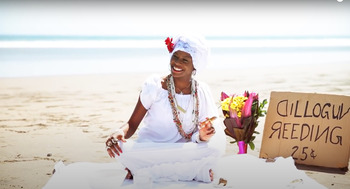
Throughout 2015, it was reasonable to assume that she still saw herself as a santera, and to interpret her artistic and intellectual output through a “Yorùbá-Atlantic” prism (Alantara Reference Alantara2015; Apter Reference Apter2018). But Banks conveyed some misgivings about Lucumí and the integrity of its initiates in the December 2015 video for the 2013 single “Count Contessa.” The music was prefaced with a short skit in which Azealia plays herself as a minidress-clad holidaymaker as well as a beachside fortuneteller.Footnote 15 Sporting long red fingernails, big silver hoop earrings, a red flower in her white headwrap, and a white dress under a dozen colorful beaded necklaces (along with a diamond cross and gold “BOSS” nameplate), her fortune-telling doppelgänger resembles the heavily photographed, Black, cigar-smoking “santeras” of Havana whose smiling visages had become familiar sights on Tumblr and Pinterest (see Fig. 1). Swigging dark liquor from a bottle marked XXX, Banks's santera hawks her services in a Jamaican accent next to a sign advertising, “DILLOGUN REEDING [sic] 25¢.” With sunglasses perched to resemble devil horns on her head, Banks the holidaymaker pleads, “Will I ever find true love?” and the Banks diviner responds, “Eleguá say, ‘Yes, you will find true love!’”Footnote 16 Banks's costumed comedic turn rested on in-group references to diloggún, Lucumí's sixteen-cowry divination system, and to the orisha Eleguá, divine “owner” of this oracular form.
Azealia Banks as a fraudulent fortunetelling “santera” in the video for Count Contessa.

Banks name-checked another Afro-Diasporic religion three months later. In an interview with Broadly Meets posted on YouTube on March 24, 2016, Banks responded to a question about whether she practices witchcraft by smirking and nodding (Banks Reference Banks2016a). When prompted to confide her favorite spell, she described a purification ritual common to many African, Caribbean, and Latin American folk traditions that involves breaking an egg at a crossroads (Chevannes Reference Chevannes1994, 114; Ephirim-Donkor Reference Ephirim-Donkor2017, 237). Banks added, “My mother practiced what you would call, like, Espiritismo: white table magic, prayers for the ancestors and prayers to saints and cleansing and praying for protection and all type of shit like that. . . . My mother used to be doing all kind of like, you know, candles and crazy shit.”Footnote 17 Espiritismo de mesa is a Caribbean tradition of Spiritism that derives in part from the writings of nineteenth-century French polymath Allan Kardec and entails the maintenance of a tabletop shrine (bóveda) covered with a white cloth, to communicate with ethnically differentiated “spirit guides.” Few casual viewers may have grasped Banks's citation of Espiritismo, but it had clearly become important for her to name the traditions that shaped her religious subjectivity.
In April 2016, Beyoncé's visual album Lemonade was released, launching dozens of articles and blog-posts concerning the possible influence of conjure, witchcraft, and Lucumí—particularly of the orisha Oshún—on the film's imagery.Footnote 18 Often depicted as a light-skinned woman of mixed race (mulata) among Afro-Cuban practitioners, Oshún governs wealth, reproductive and hematic health, sweet water, sensual pleasure, and intelligence. Changó, owner of the sacred bàtá drums, is her regal, righteous, yet inconstant husband, mirroring both the strengths and flaws of Beyoncé's husband Jay-Z.Footnote 19 Having apparently glimpsed a preview of Lemonade, Banks went for Beyoncé's jugular on April 20, saying, “Jesus Christ is your one and only savior. Oshun doesn't recognize you. She doesn't know you nor does she like you (8:49 PM) . . . BECAUSE, ur a fake ass bitch. Use as many dark skinned girls in ur videos as props as you want. Oshun still knows u ain't shit (8:47 PM).”
These “vagueing” subtweets went unreported for the most part. Three days later, when Lemonade became available on the subscription-based streaming service Tidal (co-owned by Beyoncé and Jay-Z), Banks had a change of heart:
Definitely eating my words. This great I'm so happy and enchanted. OSHUN VS CHANGO.
OSHUN WINS!!!!!!!
This is amazing look at fucking oshun in the mother fucking flesh! OMG WITCHcraft all over this slalbfflsnwbwkdkxnxFootnote 20
THIS is going to [do] big things for the black people and get them out of the church. This is incredible
Ugh looking at this just makes me feel so powerful and BLACK AND evil CHOLA WENGUE AND OSHUN NEEDS TO BE FED RIGHT NOW (6:19 PM)
By professing to sense the hunger of Chola Wengue and Oshún, Banks was telegraphing more than her admiration for Beyoncé's incarnation of the orisha. She was touting her own religious expertise. Chola Wengue (also spelled Guengue, Awenge, Wenge, or Nkengu) is one of the mpungus, or personified natural forces, of the Kongo-inspired Afro-Cuban traditions collectively called reglas de congo. As does Oshún, Mama Chola governs lakes and rivers, but she embodies a less domesticated, more volatile energy, with roots in Central Africa (not West Africa, where the orishas originated). Much as the consecrated objects of the orishas dwell in vessels called soperas, tinajas, or bateas, the materials that comprise the personhood and agency of mpungus live in cauldrons called prendas, enquisos, or ngangas. Anthropologist Todd Ramón Ochoa writes that in his ethnographic community of Palo Monte practitioners, “as Mama Chola would be used to address issues of love, sex, and desire, [her prenda] was obligated to contain [sticks from the plants called] paramí [‘For Me’] and vence batalla [‘Conquer in Battle’]” and to accept sacrifices of yellow chickens (Ochoa Reference Ochoa2010, 174).
Banks would soon change her mind about Lemonade once again, using her critique as a vehicle to display her mastery of Afro-Cuban religious discourses. Beyoncé's allusions to orisha worship would serve as the catalyst for Banks's public embrace of Palo Mayombe and full-throated endorsement of Kongo-inspired traditions more generally over Yorùbá-based Lucumí. On April 25, Banks unleashed a long sequence of tweets accusing Beyoncé of treachery, theft, and more, including the following:
The oshun tribute was cute, very cute. But you were just trying to be Americas most convincing white woman, what happened ? (2:04 PM)
This heartbroken black female narrative you keep trying to push is the Antithesis of what feminism is (8:25 PM)
*rolls eyes* Yemaya would never.Footnote 21
Because [Beyoncé's] not a “sister” she's a poacher. She's a thief. Sisters don't steal, sisters share. (8:57 PM)
I've been pumping African traditional religions/witchcraft for a LONG time. She was just singing “Jesus say yes” (9:03 PM)
You trying to embody oshun as a prop for ur personal gain. Let us see you. Show us ur tools and ur soperas ur prendas whatever. I need to [see] (9:10 PM)
In this context, “tools” refers to the sacred implements (also called herramientas) that adorn soperas and prendas.
In the coda to her “Twitter dissertation,” Banks pulled rank on Beyoncé by asserting the superiority of Yemayá over Oshún, sometimes cast in Lucumí myths (pataki) as Yemayá's younger sister:
Baby, all of oshuns blessing come from Yemaya, as the river flows OUT of the sea. NO ONE is richer than YEMAYA.Footnote 22
Predictably, most online compilations of Banks's tweets left out those regarding “African traditional religions/witchcraft.” Although her remarks may seem disjointed—even unhinged—Banks was making an argument with identifiable rhetorical features. I quote these tweets at length to show her insistence on conjoining religious and political accountability through an exercise of “negative epideixis,” sustained condemnation equivalent to a withering “read” in the Black and Latinx LGBTQ discursive tradition (Johnson Reference Johnson1995; Johnson Reference Johnson2011, 163).Footnote 23 Banks rebukes Beyoncé as immoral for misusing “dark skinned girls in ur videos as props,” a complaint echoed in the charge of “trying to embody oshun as a prop.” Banks admonishes Beyoncé for abandoning “big things for the [B]lack people” in favor of increased album sales and artistic recognition, bought at the price of dark-skinned women's erasure. Banks juxtaposes Beyoncé's flimsy posturing against her own firm claim to know that “Yemaya would never.” Most damningly, she insinuates that Beyoncé was—at best—reworking themes on which Banks had been playing virtuosic variations for the previous five years. Mobilizing specialized vocabulary, her demand to see Beyoncé's sacred tools, Lucumí soperas, and Palo prendas was meant to signal that she was far better acquainted with “African traditional religions/witchcraft” than Beyoncé would ever be.
The Metaphysics of Palo Monte Vs. Regla Ocha
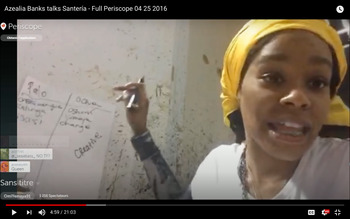
Sensing the need to establish her religious authority in order to legitimate her critique, Banks (Reference Banks2016b) recorded a twenty-one-minute Periscope video on April 27, 2016.Footnote 24 Dressed to project maximum credibility, Banks wears little to no makeup; Palo beads called collares de bandera falling diagonally across her chest; a gold necklace with an anchor pendant; a yellow headscarf; and a T-shirt that reads, “STOLEN FROM AFRICA” (see Fig. 2). Behind her looms a cruciform Palo firma or cosmogram, drawn in white to activate Kongo forces.Footnote 25 At the left side of the screen sits Chola Wengue, embodied by a yellow pot encircled with metal chains and sprouting the feathers, bones, “daggers and everything” characteristic of prendas. To a soundtrack of liturgical chants for the mpungus, Banks introduces her “witch cave” and “two of the main African traditional religions that have traveled with us from the motherland to the Americas.” She stipulates, “this is specifically for Black people, I hope you guys are online, especially my Black girls.”
Azealia Banks wearing a "Stolen from Africa" T-shirt and the consecrated Palo beaded necklaces called collares de bandera. Periscope video posted on YouTube, April 2016.

Banks observes that, in contrast to the ubiquity of orishas in popular culture, “nobody ever talks about Palo Mayombe . . . I've been initiated for the last four years of my life and I love it.” She differentiates Palo from regla ocha both geographically and metaphysically, describing regla ocha as a Yorùbá-derived tradition of Nigerian origin, “a more celestial religion” concerned with orishas anthropomorphized as saintly persons, in contrast to Palo's focus on “natural force[s] of energy.” In hopes of simplifying their intricacies, she uses a piece of paper taped to the wall to make a table of correspondences labeled “Palo/Ocha,” similar to those found in ethnographic texts that cross-index mpungus with orishas (see Fig. 3). “The difference between Chola Wengue and Oshún, it's like night and day,” Banks says, situating them at conflicting ends of a binary: “one [regla ocha] is for creativity and one [Palo] is for destruction.” Banks states that good may be done with Palo through mechanisms of elimination, offering the example of a sick person in search of healing. The palera “will take sickness away,” whereas the santera will “bring them health.”
Banks creating a table of correspondences comparing Palo [Mayombe] to [regla] ocha. Periscope video posted on YouTube, April 2016.

Undoubtedly impressed, one viewer marvels, “yaaass bitch got a chart” via a comment visible on the left-hand side of the screen. Others exclaim via chat, “BITCH WE IN SCHOOL,” “EDUCATE USSS,” and “OPEN A UNIVERSITY!” Having passed over all previous chat messages, Banks alights on the question, “can you be scratched if your [sic] gay?” and repeats it aloud. Getting “scratched” refers to being initiated in the reglas de congo, and Banks explains that this is not the case for Palo Mayombe, purportedly to the extent that gay men may not even enter mayomberos’ homes. She then suggests as alternatives other, less restrictive Afro-Cuban mpungu-based Kongo traditions such as Palo Monte and Palo Kimbisa.Footnote 26 Already on the topic of gender and sexuality, Banks segues into the limitations on women assembling prendas and performing rituals while menstruating. She notes that whereas lesbians may be “scratched” in initiation, all menstruating women must avoid prendas, “with good reason, because these are blood-hungry vessels.” “You can't come near them while you're bleeding,” Banks warns, “because they'll attach to you and eat you.”Footnote 27 Although this statement elicited a stream of disparaging chat comments, it expresses a participatory metaphysics in which neither the feeding of spirits nor their hunger are figures of speech, but everyday realities for practitioners (Viveiros de Castro Reference de Castro2014; Pérez Reference Pérez2016).
Banks then discloses the experiences that led her to Palo Mayombe, often described derisively and inaccurately as “the dark side of Santería.” She confesses that “me and my sister used to do, like, Espiritismo, build our little altars, and do our little candles, Santa Marta or whatever,” clearly judging “white table magic” and 21 Divisions to have less potency (and Africanity) than Palo Mayombe. Banks says that a witch sought out by an ex-lover summoned Santa Marta to hex her, and both he and his next girlfriend put spells on her. Her personal and professional problems mounted as a direct result: “I couldn't find myself, I couldn't find my mind, I couldn't find anything.” Banks received a divination from a gay santero, and he removed the hexes using Palo ritual technologies, before giving her several “bootleg” ritual objects in preparation for what she thought would be initiation into Palo and regla ocha in Cuba.Footnote 28 Scammed by this “Hollywood santero,” she distanced herself from regla ocha, but decided to resume studying Palo with her current mentor, a senior male priest within the reglas de congo (a tata nganga).
Banks's relationship with Afro-Cuban religions is too detailed to transcribe fully here, but her unapologetic apologia pro vita sua (autobiographical justification for her conduct) exemplifies a Black Atlantic religious subjectivity wrought in experiential consultation with elders and with ethnographic studies. She recounts her history with Palo Mayombe using the genre of the initiation story, in which priests of Afro-Diasporic religions frame ordination as an “unchosen choice,” carried out to save themselves or family members from affliction, without any preexisting desire to affiliate with the tradition in question (Pérez Reference Pérez2013b). Having adopted this speech genre, narrators tend to blame their own naïveté and ignorance of ritual protocols for their swindling by fraudsters. Followers of Afro-Cuban religions also attest to feeling—as Banks does—too burdened with the pressure to learn about a tradition to commit completely, while conceding that any delay in commitment (usually to Lucumí in particular) will prolong their suffering.Footnote 29 Although Palo Mayombe and Lucumí remain separate and discrete ritual orthodoxies, they are interdependent in the lives of practitioners active in both. Banks's account manifests this common pattern.
Having presented her initiation story, Banks revisits her critique of Beyoncé. With evident discomfort, pausing often, and enunciating with uncommon care, she broaches the subject by saying, “Everyone wants to talk about Oshún trying to come for Yemayá.” Whether her hesitation derived from intimidation by the Beyhive—“Queen B's” most ardent fans—or due to a chastening by her PR team, she never mentions Beyoncé's name:
African traditional religion is not something to be played with, you know . . . And I think that if [exploiting it is] what you want to do—that's what you want to do—you owe it to Oshún to bring her real elements and real lights and real stories to the public, so it's not just you wearing Oshún's dress.Footnote 30
Later Banks zooms out onto the larger ethical terrain:
I just wanted you guys to know that it's not . . . just a fashion thing. It's not something that you just put on . . . like, santera chic or whatever . . . mayombera chic or whatever . . . it's a real lifestyle. And it's a real way of being. And I think that now in today's age, there's no need to hide any of that.
Echoing the sentiments voiced in her Playboy interview and elsewhere, Banks proceeds to expound on the empowering potential of Black Atlantic religions:
That comes to just Black people and their spirituality. Like, lots of Christian-born folks will be like, oh, you know, “That's that devil shit, that's that whatever, that's that nasty shit.” It's not actually nasty, it's not actually bad. These are our original energies. This is how we grew our cities, grew our old economies and our old towns and stuff like that. This is what we believed in. And I truly believe that the reason for, I guess, Black people's global inadequacy is we are not related under our true gods.
And [I] truly, truly, truly, truly, truly, honestly believe that the sooner we get in touch with our original powers, is the sooner the tables will start to turn, you know. Because now, in this point in time, we're convinced otherwise.
She transitions from this entreaty to locating the demonization of dark skin as central to Christian racial metaphysics:
I think that Christianity comes in between the man and himself. Any man and himself—whether it be a white man, a Black man, an Asian man, whatever—I feel like Christianity seeks to put a block in between the soul and the self . . . Especially by putting this image, these images of these white people, in all types of stuff. And you know, [in Christian iconography] San Miguel is stepping on the head of the fucking devil and the devil's body is black and his face is black, and all kind of shit like that. It sends a message. It sends a real message . . . Some people receive the message subconsciously, some people receive the message consciously, but it's still programming, and it's still messaging.Footnote 31
Banks continues, “I urge every African American woman especially not to be afraid of so-called voodoo.” In conclusion, Banks reminds her audience,
I just want every Black woman or every Black person to just feel and know their power, and know about, you know, the difference between the orishas or/and, like, the way the mpungus work, and how the energies work together on a metaphysical level and on a celestial level, you know. And from the dirt and from the sky, we should know how our energies work and how our spirits group together, and where our ancestors live and how to communicate with them. So history doesn't keep repeating itself.
One might dispute her elucidation of energies, spirits, ancestors, and human communication with them, but it cannot be said that Banks failed to deliver a metaphysical lesson “from the dirt and from the sky.”
On July 15, Banks (Reference Banks2016d) posted a 702-word status update on Facebook titled, “Why I think African Americans should consider getting initiated in Palo Mayombe before being Initiated into Regla de ocha, and how African traditional religious systems don't really work for white folk.” Reiterating some of the points made via Periscope, Banks writes:
Palo Mayombe is an African traditional religion that focuses on the mystery of the wind and the mountains. Owing its origins to the People of the Congo, palo Mayombe is largely considered to be a WARRIORS craft, where as Regla De Ocha or Santeria (which has its roots in Nigeria) is more celestial as the Orishas are considered to be actual deities . . .
Orisha = Personified Deity
Mpung[u] = Raw hot forces of nature.
After propounding dubious historical origins for the practice of using human skulls in Palo Mayombe, Banks asks:
Why should we be working with mpung[u]s instead of orishas right now? Because in palo Mayombe, there is no such thing as good or evil. It's simply cause and effect. Nfumbes [spirits of the dead] and Mpung[u]s don't have the same sort of enlightened cognitive consciousness the orishas do. Palo works FAST and is VERY direct. And palo acts on the souls, wills, and bodies of MUNDELE's (white people) with extreme efficiency and ease. (Banks Reference Banks2016d)
To the rhetorical query, “Why don't these systems of magic work as efficiently for white folk as they do for [B]lack people?” Banks furnishes an answer rife with sociobiological determinism (Keel Reference Keel2018). Instead of relying on “Science”—the term used in the Anglophone Caribbean to denote Black Atlantic ritual technologies—Banks entertains speculation on the evolutionary development of cerebral cortexes that recalls nineteenth-century phrenology. In support of her conjectures, she name-drops not only the bestselling author and physiologist Jared Diamond, but also antisemitic professional conspiracy theorist and Holocaust denier David Icke.Footnote 32 Reminiscent of the Nation of Islam's foundational myth of Yacub, Banks's pseudoscientific theory betrays a desperation to ground her metaphysics in an “endarkened epistemology” and find corroborating sources with academic credentials, however compromised (Dillard Reference Dillard2000). Saying, “Our magick is old and set on an ancient clock, before logic and rationalization,” Banks typologizes Wicca, Satanism, and Freemasonry as recent “white neo-cortex religions” that “don't really have much of what I would call ‘fuerza’ [power].”
Banks ends her post with an exhortation:
Black folk need to protect themselves in EVERY aspect. We should be exercising our second amendment rights [to bear arms], (physically) pooling out [sic] money and resources into black owned businesses and institutions, (financially) all the while denouncing all ties to the Christian church and redeveloping our God-given magical abilities (spiritually). (Banks Reference Banks2016d)Footnote 33
Satisfied that she answered her own questions, she signs off “BRUJADELBLOQUE.”
A Black Atlantic Metaphysics
She listens to the audiobook of Ralph Waldo Emerson's Self-Reliance constantly, and wakes up every night at 3 a.m. to drink red wine and work on her latest passion project: a book that will tell “the fable of Azealia Banks” . . . Banks reads from the opening chapter to her story: “Once upon a time there was a container and the container was filled with space. Inside the space was white light and dark matter . . .” She reads for a half-hour, telling a metaphysical allegory that reveals her frustration with race relations in America. (Syme Reference Syme2015, 35–36)
Like the credentialed luminaries and organic intellectuals of Black Twitter, Banks has availed herself of the communicative channels at her disposal to marshal fundamental concepts and (re)define reality. Asking “what if” African Americans were “convinced otherwise,” Banks defends Afro-Diasporic religions by exposing the consequences of Black acquiescence to white-supremacist Christian metaphysics. Banks beseeches Black people collectively as a counterpublic deciding between a future that replicates the past (“hurt and helpless”) and a futurity that ruptures centuries-old systems of domination. Banks attempts to bolster her believability as a practitioner with her audience and highlights Palo Mayombe's expediency (its “extreme efficiency and ease”) in bringing about its happy results. Appealing both to reason and raw sentiment, she runs through a gamut of emotion—rage, joy, pride, disgust, shame—to present freedom as the outcome of an affectively transformative pedagogical process to unlearn anti-Blackness.
The biggest obstacle to an analysis of Banks's musings as metaphysical is the supposition that metaphysics exists on some rarefied plane, above the petty concerns of race/ethnicity, gender/sexuality, and class (Díaz-León Reference Díaz-León2018). Yet this has never been the case, according to no less an authority than Jacques Derrida:
What is metaphysics? A white mythology which assembles and reflects Western culture: the white man takes his own mythology (that is, Indo-European mythology), his logos—that is, the mythos of his idiom, for the universal form of that which it is still his inescapable desire to call Reason. (Derrida Reference Derrida and Moore1974, 11)
Given this eviscerating appraisal of the Western metaphysical tradition and that of African and Black American philosophers (among others), it may be tempting to approach Banks's lucubrations as theological, especially given her repeated affirmation of Womanism as a spiritually inflected movement and social theory “created by black women FOR black women.”Footnote 34 Yet Banks has not limited her scrutiny to one religion and its doctrines; she has set herself the task of putting forth “informed theory about the workings of the entire world” (Coleman Reference Coleman2008, 43).
It is chiefly Banks's refusal to denature her metaphysics—to excise her persona from her prescriptions and “tentative formulations of the ultimate generalities”—that has led detractors to postulate an incommensurability between her “metaphysical babble” and philosophical thought proper (Whitehead, quoted in Coleman Reference Coleman2008, 43; Luciano Reference Luciano2015). Banks does not subscribe to the notion that philosophy traffics solely in abstractions. She nevertheless stakes out fixed positions on the nature of existence (that magic exists as a species of universal substance, a nonphysical property of physical organisms, and Black people “have REAL supernatural powers”) and ventures stringent formulations of “the good” (namely, “the sooner we ALL learn to cultivate [REAL supernatural powers] and access . . . them, the sooner we can REALLY fix shit”). Banks conceptualizes categories of being (“[B]lack people are naturally born SEERS, DIVINERS, WITCHES AND WIZARDS”) and the relation of mind to body (like the feasibility of using supernatural power to “kill + sicken people without actually touching them”). Her assertions concerning Black Atlantic traditions all address the fundamental metaphysical questions, “What is the nature of freedom? Is one ever really free?” (Mitchell Reference Mitchell2002, 88).
If one were to accept Banks's treatises as predicated on a metaphysics, would it correctly be deemed a Black Atlantic one? That is, would her metaphysics be intelligible to fellow initiates in traditions such as Palo Mayombe? In stark contrast to Beyoncé's celebration by Lucumí practitioners, Banks has been defended by only one Black American initiate of Nigerian-based Yorùbá traditional religion (Isese) via YouTube and a handful of priests from different Afro-Cuban traditions on social media (Alafia 2017; Iriseinthelight quoted in L 2016).Footnote 35 The comparative lack of support may derive not only from colorism and/or racism among fellow practitioners, but also from their dissatisfaction with Banks's defiance of religious norms. On her Periscope video, Banks invited criticism by flouting the convention among paleros of keeping prendas outside the home, in one's backyard or a garden shed (or in a basement, as a last resort). Subscribing to an “indigenous Afro-Cuban historiography and social analysis” (Palmié Reference Palmié2002, 191; italics in the original), practitioners have customarily mandated the domestic separation of prendas from their owners; paleros have been adamant that since the average home cannot accommodate prendas’ concentrated potency, living under the same roof with them engenders affliction.Footnote 36
After the Periscope video surfaced, a consensus coalesced that Banks had shown and said too much in her quest to verify her authenticity. She alienated coreligionists and prospective supporters by flaunting her prenda, illuminating the limits of transparency in traditions that depend on an economy of ritual secrecy (paradigmatically secured through visual concealment) and authority, acquired through initiatory seniority.Footnote 37 The Instagram video with which this article began plunged Banks further into disrepute by violating an unarticulated prohibition on the dissemination of scenes of sacrifice and its entailments.Footnote 38 Her unrepentant approach to the “real things” expected of practitioners—including the disposal of sacrificial remains—hails these traditions as unglamorous yet ontologically and materially transformative. But after exhibiting Chola Wengue and airing her dirty (and bloodstained) laundry, Banks was construed as sabotaging the historical project of achieving respectability for Black Atlantic traditions (Pérez Reference Pérez2016).
Although Banks's cohabitation with a prenda is inadvisable and she occasionally flubs her facts, her command of Black Atlantic traditions is in agreement with the ethnographic and historical scholarship, including my own.Footnote 39 The Afro-Diasporic speech genre of “unchosen choice” communicates that mpungus, orishas, lwas, and other spirits choose their servants; humans cannot choose whom to serve. Banks requires no further proof of Black Atlantic religious subjectivity beyond internalization of “unchosen choice” as a narrative modality and the performance of ritual micropractices such as feeding Chola Wengue (Pérez Reference Pérez2016). The aspect of Banks's involvement in Black Atlantic traditions that veers most sharply from precedent is, ironically, her impassioned campaign on their behalf. Practitioners have never proselytized, and the divination verses of at least two different oracular systems dictate that many people are better off outside the religion in question.Footnote 40 Particularly for Afro-Cuban elders, Banks's crusade would seem too propagandistic, too evangelical—too Christian, in a word—to be representative. Yet a metaphysician is not a confessional theologian, bound to the tenets of a single denomination, especially in traditions that have no creeds.
Brujx Womanism
I am a womanist. Please leave me out of your feminist articles and feminist discussions.
Thanks. Xx-AB
— azealiabanks (@AZEALIABANKS) (Volkert Reference Volkert2015)The theoretical orientation of Banks's metaphysics may best be designated Brujx Womanism. As media scholar Allissa V. Richardson writes, “The Internet rebooted visible, collective womanism in two phases”: the rise of Black women bloggers, followed by the rise of Black Twitter (Richardson Reference Richardson2019, 197).Footnote 41 Along with a surprising number of age-mates, Banks rejects modern liberal feminism as irrecuperable in view of its anti-Black origins and posits Black Feminism—notwithstanding its complex hip-hop, ratchet, and crunk instantiations—as the province of “lightblack women” (Cooper Reference Cooper2012; Boylorn Reference Boylorn2013).Footnote 42 Colorism is so central to her critique of feminism that it lies at the root of her antagonism with Beyoncé, despite Banks's ostensibly ad feminam attacks. Rather than fake, for Banks Beyoncé's feminism is in line with this movement's history as “a white woman's invention.”Footnote 43 Although a self-avowed feminist, Beyoncé not only declines to credit the dark-skinned African American artists and theorists from whom she borrows her aesthetics and mythos, Banks argues.Footnote 44 Beyoncé profits from the privileging of light skin—stemming from Christian metaphysics and its inculcation of the devil's (B)lackness—even when embracing “witchcraft.”
Eighteen years ago, Chicana “CuranderaScholarActivist” and writer Irene Lara coined the phrase “bruja positionality” (Lara Reference Lara2003). As Lara observed, “indigenous, Black, and racially mixed ‘Latina’ women have born[e] the brunt” of the culturally pervasive “good curandera [healer]/bad bruja [witch] dichotomy” (Lara Reference Lara2005, 14). Lara theorized:
As a practice of what Gloria Anzaldúa might call “spiritual activism,” a bruja positionality is built on healing the internalized beliefs that demonize la Bruja and the transgressive spirituality and sexuality that she represents. (13)
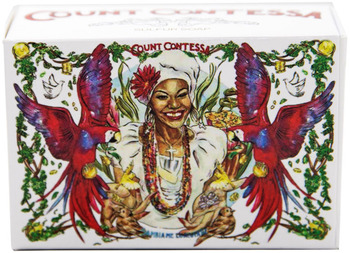
Symbolized by the Kongo spirit Chola Wengue, Banks's bruja positionality combines with Womanism to provide the theoretical scaffolding for her Black Atlantic metaphysics (see Fig. 4). Rendering “bruja” as brujx here updates Lara's concept for the present moment; modeled on the neologism of Latinx, the #brujx hashtag gained currency in 2013 on social media as a gender-neutral alternative to brujo/a.Footnote 45 It recognizes the significant number of LGBTQ, nonbinary, and gender-nonconforming Black and Latinx practicing Afro-Diasporic religions as well as solitary forms of witchcraft (Ramirez Reference Ramirez2018).
“Count Contessa (Sulfur Bar)” Soap, designed to resemble similar products sold in the Latinx religious supply called botánicas and sold on Banks’ online storefront https://www.cheapyxo.com (accessed January 21, 2020).

In 2017, Xicanista, writer, and performance artist Andie Flores coined “bruja feminism” (Flores Reference Flores2017), and the term was quickly disseminated via social media, along with its nonbinary counterpart, “brujx feminism.”Footnote 46 As a conceptual schema, Brujx Womanism may clarify and lend coherence to a range of as yet unnamed positionalities.Footnote 47 To highlight the distinctiveness of Brujx Womanism as a theoretical framework, it may be instructive to compare it with Conjure Feminism, as preliminarily delineated by literary and media scholars Kinitra D. Brooks and Kameelah L. Martin:
an occult black womanhood that incorporates and valorizes black feminist manifestations of spirituality, the power of the erotic, other ways of knowing, and wherein the authentic selves of black women (in all of her myriad manifestations) lies the source of #blackgirlmagic. (Brooks and Martin Reference Brooks, Martin, Brooks and Martin2019, 206; italics in the original)
Conjure feminism pays homage to an autochthonous Black North American tradition of “working roots” and “doctoring” indebted to West and Central African ethnopharmacopeias, folklores, and ritual knowledges (Chireau Reference Chireau2003). By contrast, Banks's Brujx Womanism implores Black women to reconsider “so-called voodoo,” preferably transnational Afro-Cuban initiatory traditions with historically verifiable lineages and rule-bound disciplinary repertoires. In her interviews, writings, and recordings, Banks challenges isolated individuals glancing at smartphones and laptop screens to see themselves as a members of a Volk—not just persons but a people. She announces to this Volk that African “nations” (Yorùbá, Kongo, Ewe-Fon, and more) survived the Middle Passage and prevail in West Indian and circum-Caribbean religions as ritual orthodoxies (nachons in Haiti, nações in Brazil, and reglas in Cuba and elsewhere). These alone hold the “original energies” that can assist in “redeveloping [Black folks’] God-given magical abilities,” Banks believes (Reference Banks2016b).
To realize the promise of Brujx Womanism, its limitations must be addressed, either through Banks's artistry or within the context of what Crunk feminist scholar and critical autoethnographer Robin M. Boylorn calls “Blackgirl autoethnography” (Boylorn Reference Boylorn2016). The shortcomings of Banks's approach to brujería and other brujxs must be tackled, starting with the alienation of her LGBTQ, nonbinary, and gender-nonconforming Black and Latinx former fanbase. Another misstep is Banks's demarcation of Afro-Diasporic religions as “specifically for Black people.” Historical evidence attests to their weaponization within the context of slave revolts, rebellions, and conspiracies in Cuba, Jamaica, St. John Island, Guyana, and elsewhere (most famously in the Vodou ritual said to have sparked the Haitian Revolution). Traditions from Candomblé to conjure have acted as formidable “weapons of the weak” against anti-Black terror for numberless people of African descent whose names have been lost to history (Scott Reference Scott1985; Harding Reference Harding2000; Chireau Reference Chireau2003). Yet Banks has never acknowledged the history of interracial collaboration within Lucumí and the reglas de congo, with people of indigenous, Asian, and European descent becoming initiated at pivotal stages in these religions’ development, leading to their demographic spread among practitioners with diverse phenotypes and racial/ethnic subject positions. Banks has not reconciled herself to “the fact, so deeply puzzling from a North American perspective, that ‘Africanity’ and ‘[B]lackness’ often do not, and simply need not coincide” in Afro-Cuban religions (Palmié Reference Palmié2013, 27; italics in the original).
Although Banks's “strategic essentialism” succeeds in amplifying her critique of “mundeles” (white people) by reifying racial difference, advancing misinformation about Afro-Cuban religions does a disservice to the very youth she seeks to edify (Spivak Reference Spivak1987). Banks also indulges in two further strains of ideological essentialism. She has consistently entertained what might be neologized as an Afro-Arielismo, in which the magical power of afrodescendientes compensates for their subjugation (Reid Reference Reid1978). This discourse did not originate with her; it supplies the logic for the taxonomy of spirits in Espiritismo, 21 Divisions, Palo Mayombe, Umbanda, and other Black Atlantic traditions in which “the structurally inferior [are] the morally and ritually superior, and secular weakness [is] sacred power” (Warden Reference Warden2006, 111).
The post-Enlightenment chronotope of Black people as simultaneously less and more than human is an artifact of colonization:
Those groups within colonial society who occupied the lowest rungs of the social hierarchy because of their alleged “wildness,” or proximity to nature, and their “savagery” . . . were often believed likely by the elite classes to possess extraordinary powers to harm, heal, and significantly alter the course of misery and affliction. (Routon Reference Routon2008, 638)
This biopolitics is still with us. 2014 saw the publication of “the first systematic empirical investigation into superhumanization, the attribution of supernatural, extrasensory, and magical mental and physical qualities to humans” (Waytz, Hoffman, and Trawalter Reference Waytz, Hoffman and Trawalter2014). The five psychological studies conducted “support the hypothesis that White Americans superhumanize Black people relative to White people.” Widely excerpted online in 2014, the findings of these studies may have spurred Banks to link Black people's magic to their oppression and emancipation (as in the tweet, “The most magical people are the ones who have to deal with oppression, because the non-magical are jealous”).Footnote 48 Unfortunately, unmoored from the actual practice of Black Atlantic traditions, superhumanization merely reinforces stereotypes and fosters anti-Black discrimination.Footnote 49
Banks's essentializing racial (super)naturalism is but one symptom of her metaphysical dualism. The contraries embedded in her writings and recordings may be rendered as a chain of analogies:
Black Atlantic religions/witchcraft : Christianity ::
Natural : Celestial
Blackness : Whiteness
Palo : Ocha
Kongo : Yorùbá
Yemayá : Oshún
Mama Chola : Oshún
Dark-skinned women : “Lightblack” women
Black Atlantic traditions teem with dichotomies, glimpsed vividly in the characterization of ritual “nations” as polarized in terms of their affective racial/ethnic, gendered/sexual class valences. Practitioners classify many Black Atlantic traditions (including Afro-Cuban regla ocha and the reglas de congo, Brazilian Candomblé and Macumba/Quimbanda, and Haitian Vodou's Rada and Petwo/Bizango nations) according to a series of nested oppositions: female normative/masculine; cool/hot; reproductive/transformative; authoritative/powerful; slow/quick; high and ancestral/low and young; martial/regal; and African/creole (Apter Reference Apter2002; Clark Reference Clark2005). Although the first term in each case is normatively privileged by practitioners, they approach the conflicting ends of the binaries as sitting in productive tension with each other. These traditions are complementary in practice, though initiates separate the rituals associated with them spatially and temporally. By contrast, Banks too often absolutizes divergent phenomena as functional opposites—strong versus weak—thereby squandering the dialectical plasticity of the religions at the nexus of her inquiries.
Brujx Womanism is thus at a crossroads, a turning point that has been key to Kongo-inspired cosmologies in the Americas as the liminal intersection between the realms of the living and the dead, the future and the past, “a radial point of African cultural improvisation that has profoundly seeded African Atlantic creative expression and cultural production” (Johnson Reference Johnson2019; Gaskins Reference Gaskins2016, 30). “The sign of the four moments of the sun,” the crossroads as a ritually inscribed cosmogram “is the Kongo emblem of spiritual continuity and renaissance par excellence” (Thompson Reference Thompson and Cornet1981, 28). Until further metaphysical tracts materialize, Banks's Brujx Womanism may contribute to the conceptualization of Conjure Feminism in four crucial respects. First, Banks's account of her path to Palo Mayombe illustrates the appeal of Kongo traditions for African Americans and proposes a de-centering of the “Yorùbá-Atlantic” spiritualities that, post-Lemonade, have become emblematic of Black reconnection to Africa (Adegoke Reference Adegoke2016). Second, her gendered and racialized promotion of the reglas de congo over and against orisha worship reveals that Afro-Cuban religions warrant an intersectional approach to grasp their historical vitality as provisional configurations of Blackness (Hall Reference Hall and Appignanesi1987; Crenshaw Reference Crenshaw1991). Third, Banks's dealings with Espiritismo, 21 Divisions, and Lucumí do more than demystify the everyday labor of religious comparison performed by ordinary people as they survey rival moral-ethical systems. Her relationships with them epitomize Black and Latinx women's historical experiences of “religious coexistence and dual or multiple religious allegiance” that stand to enrich Conjure Feminism (Hucks Reference Hucks2001, 90).
Last, in modeling her own deference to Palo Mayombe's gendered/sexual ritual restrictions concerning menstruating women and the exclusion of homosexual men from initiation, Banks extends the reach of Conjure Feminism beyond the ancestral resources lauded as “female normative” and “gay-friendly” (Clark Reference Clark2005). Prescribing Kongo “medicine for a nightmare,” she recommends hierarchical “warrior” traditions that manipulate fiery, ruthlessly transformative powers as the only ones tough enough to finish off the Black American Horror Story, and with it “the Negro, as black being . . . a nothing, a formless form, that epistemology cannot accommodate—nor can ontometaphysics” (Warren Reference Warren2018, 35).Footnote 50 Banks's obedience to strict religious disciplines in the unironic hope of getting free invites dialogue on the “politics of piety” with Black women devoted to negotiating such heteronormative and patriarchal yet counter-hegemonic religions as Jamaican Rastafari, the Black Hebrew Israelite movement, and the Nation of Islam (Mahmood Reference Mahmood2005). For the sake of Banks's place in this conversation, one might be forgiven for praying—lighting “candles and crazy shit” if need be—Metaphysician, heal thyself.
Acknowledgments
I would like to thank the guest editors, Kinitra Brooks, Kameelah L. Martin, and LaKisha Simmons, for inclusion in this special issue. I am also grateful to Sarah LaChance Adams, Caroline Lundquist, and Julie Perkins at Hypatia, and to the anonymous reviewers of this article for their valuable suggestions and insightful comments on earlier drafts.
Elizabeth Pérez is an Associate Professor of Religious Studies at the University of California, Santa Barbara. Her first book, Religion in the Kitchen: Cooking, Talking, and the Making of Black Atlantic Traditions (New York University Press, Reference Pérez2016), won the 2017 Clifford Geertz Prize in the Anthropology of Religion. It also received Honorable Mention for the Caribbean Studies Association's 2019 Barbara T. Christian Literary Award. Pérez has published on Afro-Diasporic religions in several edited volumes and journals, most recently in Material Religion. Her next research project examines the challenges experienced by transgender people as vital religious actors in the contemporary United States. eperez@religion.ucsb.edu