


Introduction
The outcome for children treated for anxiety disorders is highly variable. James, Soler and Wetherall (Reference James, Soler and Wetherall2006), in a recent Cochrane review of trials for child anxiety disorders, concluded that around half of children with anxiety disorder who were treated with CBT remit, but the range in remission rates reported is substantial (Cartwright-Hatton, Roberts, Chitsabean, Fothergill and Harrington, Reference Cartwright-Hatton, Roberts, Chitsabean, Fothergill and Harrington2004; Compton et al., Reference Compton, March, Brent, Albano, Weering and Curry2004). The factors responsible for this variability are uncertain; there has been little research into predictive factors and the findings are inconsistent (Southam-Gerrow, Kendall and Weersing, Reference Southam-Gerow, Kendall and Weersing2001). This inconsistency appears to be a function of differences in treatments delivered and variation in assessments procedures, as well as variability in patient populations. One prognostic factor, amongst others, likely to be important is maternal emotional disturbance (Crawford and Manassis, Reference Crawford and Manassis2001; Southam-Gerow et al., Reference Southam-Gerow, Kendall and Weersing2001). Anxiety disorder amongst the mothers of anxious children is significantly raised above the base rate (Last, Hersen, Kazdin, Francis and Grubb, Reference Last, Hersen, Kazdin, Francis and Grubb1987; Last, Hersen, Kazdin, Orvaschel and Perrin, Reference Last, Hersen, Kazdin, Orvaschel and Perrin1991); indeed, a recent bottom up family history study found that two-thirds of the mothers of children presenting for treatment of an anxiety disorder themselves had a current anxiety disorder, and that there was no raised rate of current disorder amongst fathers (Cooper, Fearn, Willetts, Seabrook and Parkinson, Reference Cooper, Fearn, Willetts, Seabrook and Parkinson2006). Indeed, there are suggestions within the literature that providing treatment for maternal anxiety may well improve the outcome of child anxiety (Windheuser, Reference Windheuser1977; Cobham, Dadds and Spence, Reference Cobham, Dadds and Spence1998), although this remains to be demonstrated in systematic research.
There seem to be two ways in which maternal anxiety could interfere with child response to treatment. First, there is evidence to suggest that maternal anxiety is associated with patterns of parenting that are themselves anxio-genic (Wood, McLeod, Sigman, Hwang and Chu, Reference Wood, McLeod, Sigman, Hwang and Chu2003); so an anxious mother's over-controlling parenting style, for example, could militate against a treatment aimed at promoting her child's autonomy. Second, treatments commonly require the mother to provide support and encouragement of child exposure to feared stimuli (e.g. Dadds and Barrett, Reference Dadds and Barrett2001) and the mother's own anxiety may interfere with this requirement. For example, a mother with social phobia may well experience difficulties in encouraging her socially anxious child to engage in more social activities.
The clinical implications of maternal anxiety predicting child treatment response are considerable. Indeed, were this to be confirmed, it would suggest a wholly novel management strategy for child anxiety disorder that presents in the context of maternal anxiety. Before proposing such radical change to clinical practice it is important that the association between maternal anxiety and child outcome be confirmed. In this preliminary investigation, the outcome of a group of children treated in a routine child and adolescent mental health (CAMH) service for an anxiety disorder was therefore examined in relation to the level and nature of maternal anxiety disorder.
Method
A sample for the current study was derived from a consecutive series of 67 children referred to a CAMH service with a primary clinical diagnosis of an anxiety disorder. Their mental state was systematically assessed using the ADIS-C/P (Silverman and Albano, Reference Silverman and Albano1996) with diagnoses based on information from both the mother and the child. The children also completed three questionnaires: State-Trait Anxiety Inventory-A Trait (Spielberger, Reference Spielberger1973), the Social Anxiety Scale for Children – child version (LaGreca, Kraslow Dandes, Wick, Shaw and Stone, Reference LaGreca, Dandes, Wick, Shaw and Stone1988), and the Penn State Worry Questionnaire for children (Chorpita, Tracey, Brown, Collica and Barlow, Reference Chorpita, Tracey, Brown, Collica and Barlow1997). In addition, the mental state of the mothers of these children was independently assessed using the SCID (First, Spitzer, Gibbon and Williams, Reference First, Spitzer, Gibbon and Williams1995). Mothers also completed the State-Trait Anxiety Inventory-A Trait (Spielberger, Gorsuch and Lushene, Reference Spielberger, Gorsuch and Lushene1983), the Social Phobia Scale and the Social Interaction Anxiety Scale (Mattick and Clarke, Reference Mattick and Clark1998), and the Penn State Worry Questionnaire (Meyer, Miller, Metzger and Borkovec, Reference Meyer, Miller, Metzger and Borkovec1990).
An assessment of the reliability of the mental state assessments of the mothers was made by a second assessor making diagnoses based on 15% of the taped SCID interviews. Kappas were 1.00 for all current diagnoses (apart from dysthymia and agoraphobia without panic, which were incalculable because there were no instances), and ranged from 0.82 to 1.00 for past disorders. A similar assessment was made for the child diagnoses, and reliability was found to be equally good (i.e. Kappas from 0.84 to 1.00).
The children were managed within the general CAMH service. Half (n = 34) were provided with individual or group CBT, while the others received a range of treatments, principally parental advice or psychiatric review. There was no relation between the form of treatment delivered and the level or nature of anxiety in either the children or the mothers. Efforts were made to reassess these children using the same measures of child anxiety (ADIS- C/P, STAIC, SASC-c; PSWQ-c). Assessments were completed on 55 of the patients. The remainder were either not contactable or were unwilling to comply with reassessment. The report below concerns these 55 children and their mothers.
Results
The mothers
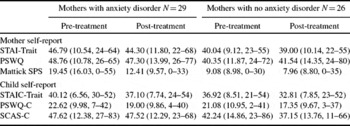
Twenty-nine of the 55 mothers (55%) were found at the initial assessment to have a current anxiety disorder and 42 (76%) had a life-time anxiety disorder. Most had a single current anxiety disorder, the most common being specific phobia (44%), social phobia (25.5%) and GAD (20%). Life-time rates for these disorders were 47%, 40%, and 31% respectively. A few mothers were receiving either counselling or medication, but since this was not related to child outcome, it was not considered further. As shown in Table 1 there was no significant change over the two assessment points in levels of anxiety on any of the measures for either the mothers with an anxiety disorder or the mothers free from anxiety disorder, except on one dimension: social anxiety (SPS) fell significantly for mothers with an anxiety disorder (t(25) = 2.07, p = .05).
Questionnaire scores of mothers and children before and after child treatment

The children
The children ranged from 6 to 15 years old; 54.5% were girls. All of them presented with two or more anxiety disorders. The most common of these were GAD (67%), social phobia (49%), separation anxiety disorder (47%), and specific phobia (47%). The mean anxiety scores before treatment for those whose mothers had an anxiety disorder did not differ from the scores of those whose mothers were free from anxiety disorder on any of the questionnaire measures (see Table 1).
Prediction of child outcome
Preliminary analysis revealed that length of time since initiation of treatment, method of treatment, presence of other axis I disorders in the child, and child age and gender were all unrelated to either child's diagnostic status at follow-up or their scores on the follow-up questionnaires (although those who received CBT did somewhat better). These factors were therefore ignored in subsequent analyses.
Association between (non-specific) maternal anxiety disorder and child treatment outcome
Fourteen (25.5%) of the children were free from a DSM-IV anxiety disorder following treatment; and although more than twice as many children whose mother did not have an anxiety disorder were themselves free of anxiety following treatment than were children whose mothers did have an anxiety disorder, this was not a significant difference (33% and 15% respectively; χ2 = 2.20, df = 1, p = .14). As can be seen from Table 1, the children of the mothers who were free from an anxiety disorder experienced a significant reduction following treatment on all three continuous measures of anxiety (Trait t(24) = 2.75, p = .01; PSWQ t(25) = 2.29, p = .03; SASC t(24) = 2.25, p = .03). In contrast, the children whose mothers had an anxiety disorder did not evidence a reliable reduction in level of trait anxiety (t(24) = 1.98, p = .06), worry (t(25) = 1.57, p = .13), or social anxiety (t(25) = .25, p = .80).
Association between specific maternal anxiety disorder and child treatment outcome
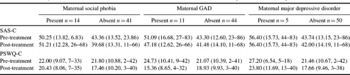
To explore further the relation between child outcome and specific maternal anxiety disorders, analyses of variance were conducted to examine the association between the presence of maternal diagnoses of Social Phobia or GAD (the most common maternal disorders, apart from Specific Phobia) and related child questionnaire measures (SAS-C and PSWQ-C) at follow-up, covarying the child's response on that same questionnaire measure at the intake assessment. Analyses were also conducted in relation to presence of a maternal diagnosis of major depressive disorder (present in 9.1%). Scores on the PSWQ-C at the follow-up assessment tended to be associated with a maternal diagnosis of GAD (F(1) = 3.29, p = .08), but not Social Phobia (F(1) = .52, p = .48) or Depression (F(1) = .85, p = .36), with children of mothers with GAD showing particular improvement on the PSWQ-C. Indeed, the degree of improvement on the PSWQ-C did not differ for the children of mothers with GAD and the children of non-anxious mothers (F(1) = 1.85, p = .18). In contrast, there was a trend towards the presence of a history of maternal Social Phobia to be associated with higher scores on the SASC at the follow-up assessment (F(1) = 3.72, p = .06) but not GAD (F(1) = .20, p = .66) or Depression (F(1) = .19, p = 0.66).
Correlations were also run, for the group as a whole, between the level of maternal anxiety and the level of child anxiety at follow-up. This was done for the corresponding measures (e.g. maternal PSWQ with child PSWQ), partialling out the child's pre-treatment score. Whilst neither the level of general (trait) anxiety or worry (PSWQ) in the mother were predictive of the level of general (trait) anxiety (r (46) = 0.07, p = .63) and worry (PSWQ: r (48) = −.03, p = .82) in the child, the child's level of social anxiety following treatment was significantly predicted by the mothers' pre-treatment score on both the SPS (r(47) = .36, p = .01) and the PSWQ (r(47) = 0.30, p = .03). The latter association ceased to be significant when account was taken of maternal SPS scores (r(46) = .20, p = .17); on the other hand, when PSWQ scores were controlled for, the association between change in child SASC and maternal SPS remained significant (r(46) = .29, p = .05). The association between maternal worry scores and child anxiety score post-treatment, therefore, appears to be due to the overlap with measures of maternal social anxiety.
Questionnaire scores before and after treatment of children of mothers with social phobia, GAD, and depressive disorder

Discussion
The implications for the outcome of children with anxiety disorders of the high rate of maternal anxiety has not received adequate attention in the research literature. The current preliminary study addressed this question by making systematic assessment of maternal anxiety and relating this to the child's response to treatment, in a sample of anxious children referred to a local CAMH service. The notable finding to emerge from the current study was that child response to treatment for anxiety was related to both the presence and nature of maternal anxiety. Thus, children whose mothers were anxious did less well in treatment as a group than children whose mothers were free of anxiety; however, in contrast to children whose mothers had GAD, who did as well in treatment as children whose mothers were free from anxiety, children of mothers with social phobia responded particularly poorly.
The current study must be regarded as preliminary as it had several limitations, and only tentative conclusions can be drawn from it. This was a small clinic sample of anxious children who received a variety of interventions in a non-specialist NHS setting; and the clinical improvement in these children was far less favourable than obtained in the CBT trials. It is possible that where better clinical results are obtained, the association between maternal disorder and child outcome found in the current sample might well be attenuated. It is important that the critical analyses be repeated on a larger sample of children where a standard treatment is delivered and a better clinical response obtained.
It is worth noting that the important finding emerged from the current study because a systematic diagnostic assessment was made of the mothers; had a general measure of maternal anxiety been used, with no regard to the specific form of the anxiety, the impact of maternal anxiety on child outcome would have been much less clear. This may account for the fact that several other studies that have not taken account of diagnostic specificity have not found an association between maternal anxiety and child treatment outcome (e.g. Rapee, Reference Rapee2000).
Assuming that the findings of the current study are robust, there are at least three important questions that arise. First, what is it about social phobia that militates against treatment effectiveness? One possible answer, as suggested earlier, is that maternal social phobia specifically interferes with the therapeutic strategies proposed in treatment. For example, those with social phobia, however well motivated, are likely to find that their own anxiety disorder impairs their ability to assist their child in the therapeutic process, either due to difficulties in engaging in treatment or due to an association between maternal social anxiety and “anxio-genic” parenting behaviours. Potential parenting behaviours that are commonly associated with child anxiety include modelling of fearful responses and an over-involved style (e.g. Wood et al., Reference Wood, McLeod, Sigman, Hwang and Chu2003). Indeed maternal social phobia has been found to be associated with increased fear expression and a lack of encouragement to the child in novel social situations (Murray, Cooper, Creswell, Schofield and Sack, Reference Murray, Cooper, Creswell, Schofield and Sack2007). Whether maternal social phobia is specifically related to maternal over-involvement has not to date been established but clearly warrants further research, as does the association between these parenting behaviours and child treatment outcome.
The second question is whether other maternal anxiety disorders have a similar adverse impact on child response to treatment. For example, maternal agoraphobia and, possibly, panic disorder might interfere with a mother's ability to assist her child in treatment in much the same way as we have suggested that social phobia does. The third question concerns the extent to which child response to treatment is improved by treating the maternal anxiety disorder. If the association is genetically based, treating maternal anxiety could be expected to have no impact on child outcome. If, however, the process by which maternal anxiety impedes child therapeutic progress is as we have suggested above, treatment of the maternal anxiety could provide the means to making the mother a more effective ally in the therapeutic process and thereby improve child response to treatment. All of these questions are in need of empirical examination.



Comments
No Comments have been published for this article.