




No CrossRef data available.
Article contents
Interdependencies among interparental discord and parenting practices: The role of adult vulnerability and relationship perturbations
Published online by Cambridge University Press: 01 September 2004
Abstract
We examined the nature and directionality of associations between interparental discord and parenting practices in a sample of 227 mothers and fathers of kindergarten children over two measurement waves spaced 1 year apart. Cross-lagged models indicated that associations between interparental discord and maternal and paternal parenting practices (i.e., acceptance, discipline) were generally negligible with one exception: interparental discord at Time 1 predicted decreases in maternal acceptance from Time 1 to Time 2. However, consistent with the family systems conceptualization of the family as an open system, prospective associations among interparental and parent–child subsystems varied significantly as a function of parental depressive symptoms, interparental relationship insecurity, and child-rearing disagreements. The moderating role of adult characteristics commonly varied across the type of adult vulnerability (e.g., depressive symptoms, interparental relationship insecurity, child-rearing disagreements), dimension of parenting practices (e.g., maternal and paternal acceptance and inconsistent discipline), and the directionality of the paths between interparental and parent–child subsystems.This research was supported by the National Institute of Mental Health (Project R01 MH 57318) awarded to Patrick T. Davies and E. Mark Cummings. Melissa L. Sturge–Apple was supported by a postdoctoral National Research Service Award from the National Institute of Mental Health (F32 MH 66596). The authors are grateful to the children, parents, teachers, and school administrators who participated in this project. Gratitude is also expressed to the staff who assisted with the project, including Courtney Forbes, Marcie Goeke–Morey, Amy Keller, Michelle Sutton, and the graduate and undergraduate students at the University of Rochester and the University of Notre Dame.
Information
- Type
- Research Article
- Information
- Copyright
- © 2004 Cambridge University Press
Parents who experience high levels of interparental discord have been repeatedly shown to exhibit parenting difficulties in the form of diminished warmth and acceptance, heightened rejection and disengagement, and the use of poor disciplinary strategies. For example, the results of a meta-analysis of 68 studies indicated that the relationship between interparental and parent–child relationships was positive and moderate in magnitude (Erel & Burman, 1995). However, important unresolved questions remain about the nature of the interplay between interparental discord and parenting difficulties. Although the concurrent associations between marital discord and parenting difficulties are well established, the predominant reliance on cross-sectional designs cannot delineate the pattern of directionality between interparental discord and parenting practices over time. Few studies have systematically examined whether the association between interparental discord and parenting difficulties is a product of the impact of interparental discord on parenting, the effects of parenting difficulties on interparental relations, or some common third variable (e.g., parent depressive symptoms). Moreover, the meta-analysis by Erel and Burman (1995) indicated that there was substantial heterogeneity in the magnitude and consistency of associations between interparental and parent–child relations across studies. Therefore, identifying the sources of heterogeneity in links between interparental and parenting difficulties remains an important undertaking. Guided by family systems theory, the primary objectives of this study are to identify (a) the nature of directionality in pathways between interparental discord and parenting difficulties over time and (b) the adult attributes and relationship characteristics that serve as sources of heterogeneity in moderating the relationship between interparental discord and parenting difficulties.
The utility of family systems theory in elucidating interplay between interparental discord and parenting difficulties is illustrated by the principle of interdependency (Cox & Paley, 1997; Minuchin, 1985; O'Connor, Hetherington, & Clingempeel, 1997). According to this principle, functioning in any one relationship (e.g., interparental) is regulated by properties of relationships in other family subsystems (e.g., parent–child). Reflecting the operation of interdependency, patterns of influence among family subsystems are postulated to be reciprocal in nature. Thus, interparental functioning is postulated to engender changes in properties of the parent–child subsystem (e.g., parenting) while parenting and parent–child relations are also proposed to impact the quality of interparental relations (Cox, Paley, & Harter, 2001).
Although interdependency among family subsystems is a basic assumption of family systems theory, the interplay between interparental and parent–child relationships may assume multiple forms and patterns (O'Connor et al., 1997). Some conceptual models inspired by family systems theory have hypothesized that difficulties in one relationship proliferate into other family relationships. For example, the spillover hypothesis proffers that adult frustration, distress, and preoccupation resulting from repeated experiences with interparental discord are likely to directly undermine parental caregiving abilities (e.g., Engfer, 1988; Erel & Burman, 1995; Floyd, Gilliom, & Costigan, 1998). Likewise, it is also possible that parenting difficulties may adversely affect the quality of the interparental relationship. For example, stressful transitions in parenting (e.g., the birth of a child) have been associated with declines in the interparental relationship quality (e.g., Belsky & Pensky, 1991).
Conversely, other models derived from family systems theory propose negative associations between functioning in the interparental and parent–child relationships. According to the compensatory hypothesis, interparental discord may foster greater parental warmth as parents attempt to fulfill lingering intimacy needs in the parent–child relationship through triangulation or consciously attempt to offset child vulnerability to family adversity by increasing the harmony in other family relationships (e.g., Cox et al., 2001; Engfer, 1988; Belsky, Youngblade, Rovine, & Volling, 1991). Concepts of “detouring” or “scapegoating” in family systems theory further illustrate that child-rearing practices may actually serve a stabilizing function for the family by distracting parents from more serious adult relationship problems to child-rearing issues in the parent–child subsystem (Buchanan & Waizenhofer, 2001; Grych, 2002; Kerig, 1995; Minuchin, 1974). A resulting hypothesis is that parenting difficulties may be associated with declines in interparental difficulties over time as parents increasingly divert concerns to child-rearing issues.
Given the diversity of predictions generated from family systems theory regarding associations between interparental discord and parenting, the first aim of this study was to examine the nature and magnitude of prospective associations between interparental discord and parenting quality over the course of 1 year. Research provides little guidance in formulating specific hypotheses about the existence or nature of interdependencies between interparental and parenting difficulties. For example, quantitative and qualitative literature reviews indicate that research most consistently demonstrates positive associations between interparental and parent–child relationship quality. However, illustrating heterogeneity in associations between interparental and parenting quality, an appreciable minority of studies found that greater interparental difficulties were associated with more positive parenting practices (Erel & Burman, 1995; Grych, 2002). The predominant reliance on cross-sectional designs has further limited progress in delineating of the nature of reciprocal relations between these family subsystems.
The limited number of studies designed to directly examine associations between interparental discord and parenting difficulties over time have also yielded inconsistent results. For example, in support of the spillover hypothesis, analysis of daily family observations and diary records has shown that the probability of parent–child tension increases significantly following the occurrence of interparental conflict (Almeida, Wethington, & Chandler, 1999; Christensen & Margolin, 1988). Supporting a reciprocal effects model, Almeida and colleagues (1999) further reported that father–child tension significantly increased the likelihood of interparental difficulties on subsequent days. Although these results delineate the interplay between interparental and parent–child subsystems in the course of daily interactions, the processes associated with short-term reciprocal influences among family subsystems may not necessarily shape forms of interdependency over the cumulative course of longer time periods. For example, proliferation of negative affect from one family subsystem to another may be particularly pronounced over relatively brief temporal periods (e.g., minutes, hours) as parents contend with the very challenging task of containing contemporaneous distress, hostility, and frustration to a single family subsystem (Almeida et al., 1999). However, over longer time spans (e.g., months, years), parents may be more successful in regulating negative affect in one family relationship (Cox et al., 2001). Thus, it is unclear whether negative spillover is a prominent process over the course of a year.
To our knowledge, only one study has explicitly examined bidirectional associations between changes in interparental and parenting difficulties over relatively long time periods (e.g., months or years). Counter to the results of the short-term sequential studies, the cross-lagged panel design conducted by Floyd and colleagues (1998) generally yielded negligible prospective associations between marital quality and negative parent–child interactions. Given the inconsistencies and limitations in the literature, no specific hypotheses are formulated regarding the prospective associations between interparental and parenting problems.
Heterogeneity in interdependencies among these family subsystems raises another key question: how can we reconcile the different hypotheses and data generated from the family systems literature? According to family systems theory, the family unit is an open system in which family perturbations and stressors (e.g., parent psychopathology, relationship disturbances, disruptive family events) may provoke subsequent reorganizations in family functioning and function as architects of interdependencies between family subsystems (Grych, 2002; Minuchin, 1985; O'Connor et al., 1997). Thus, interrelationships among interparental and parent–child relations may vary depending on other properties of the family system. Consistent with this assumption, identifying family processes that may moderate the links between interparental discord and parenting practices is an important research direction (Erel & Burman, 1995; Grych, 2002). However, beyond examining parent and child gender as moderators (Cummings & O'Reilly, 1997; Davies & Lindsay, 2001; Jouriles & Norwood, 1995; McHale, 1995; Thompson & Walker, 1989), little is known about the specific family vulnerabilities that serve as sources of heterogeneity in associations among family subsystems (Grych, 2002).
If the nature of the marital relationship is a core element to healthy family functioning as family systems theorists commonly postulate, then it follows that preexisting adult characteristics and relational functioning may hold one key to understanding the nature and magnitude of interrelationships among marital and parent–child subsystems (Minuchin, 1985). Accordingly, the second objective of this paper is to examine possible adult psychological and relational vulnerabilities that might serve to alter the nature and magnitude of pathways between interparental and parent–child relationship functioning. Guided by risk and potentiating models of developmental psychopathology and the conceptual focus on family systems theory (Cummings, Davies, & Campbell, 2000), we examine three types of adult psychological and relational risk factors as moderators: (a) maternal and paternal depressive symptoms, (b) maternal and paternal representations of the interparental relationship insecurity, and (c) child-rearing disagreements.
Precisely how adult characteristics and relational functioning alter pathways between interparental and parent–child relations is not well understood. Risk and potentiator models in developmental psychopathology have postulated that the transmission of disturbances across relationships or family members may be disproportionately greater in the context of other maladaptive family characteristics (Cicchetti & Rogosch, 1996; Cicchetti & Toth, 1995; Cummings et al., 2000). Applying this conceptualization to our family systems framework, it is plausible that difficulties regulating and containing discord across interparental and parental contexts are amplified for parents who are already experiencing psychosocial vulnerabilities characterized by elevated levels of depressive symptoms, insecure representations of interparental relations, and child-rearing disagreements. In support of this hypothesis, Margolin, Gordis, and Oliver (2004) found that the paternal violence in the marital relationship potentiated the concurrent link between marital hostility and paternal and maternal parenting difficulties. In addition, negative marital reciprocity was associated with negative mother–child interactions over an 18- to 24-month period only for mothers who were experiencing low levels of marital satisfaction (Floyd et al., 1998). Thus, adult relationship characteristics may serve to potentiate interdependencies between marital and parent–child subsystems.
Other models of developmental psychopathology caution against assuming that inherently negative characteristics necessarily have potentiating effects that are fixed across multiple contexts (Cummings et al., 2000; Toth & Cicchetti, 1996; Trickett, Aber, Carlson, & Cicchetti, 1991). Within some contexts, transmission of distress across family relationships or subsystems may actually be diluted under adverse psychosocial conditions (e.g., Davies & Windle, 2001). For example, a recent paper identified a significant interaction between prenatal measures marital conflict and hostile adult personality characteristics in models predicting parental use of physical punishment when children were 2 and 5 years old (Kanoy, Ulku–Steiner, Cox, & Burchinal, 2003). Although conventional statistical procedures were not used to identify the locus of the interaction (e.g., Holmbeck, 2002), visual inspection of the graphical plot suggests that interparental conflict predicted greater parental physical punishment at low, rather than high, levels of hostile adult personality characteristics. Likewise, while Floyd and colleagues (1998) found that marital difficulties predicted parenting difficulties for mothers experiencing low levels of marital satisfaction, an opposite pattern of findings emerged for fathers in which marital negativity was associated with more negative father–child interactions at higher, rather than lower, levels of marital satisfaction. Thus, one possible interpretation is that the robust nature of adult personality characteristics (e.g., hostility, dysphoria) and relationship properties (e.g., satisfaction) as risk factors may dilute or override the spillover of stress from one family subsystem (e.g., interparental discord) to another (e.g., parenting practices; Floyd et al., 1998).
Although depressive symptoms, interparental relationship insecurity, and child-rearing difficulties are similarly classified as preexisting perturbations in family systems theory, differences in the origins, mechanisms, and sequelae of these different types of psychosocial vulnerabilities raise the possibility that they may alter interdependencies among family subsystems in distinct ways. For example, because child-rearing disagreements have been regarded as signs of fundamental boundary disturbances and accompanying dysfunction in the transmission of psychosocial resources across family relationships (e.g., Fish, Belsky, & Youngblade, 1991; McHale, 1995), they may be especially likely to engender greater interdependencies in disturbances across family subsystems. In contrast, even though parental depressive symptomatology has been identified as a risk or potentiating factor in models of developmental psychopathology (see review by Goodman & Gotlib, 1999), wide variability exists in the way parents express and manage symptoms. Consequently, many parents experiencing significant levels of depressive symptoms may exhibit little or no disruption in parenting or spousal roles (Cummings & Davies, 1999). Thus, parents experiencing heightened levels of depressive symptoms may not necessarily be more vulnerable to difficulties managing roles in specific family subsystems (e.g., parent–child, interparental) even in the face of distress in other family subsystems. However, given the inconsistencies and complexities in the small corpus of literature, no formal hypotheses are offered regarding the moderating effects of adult attributes and relationship characteristics in pathways between interparental and parent–child relations.
Figure 1 provides an overview of the pathways among family subsystems tested in this study. First, to overcome the limitations associated with the predominant use of cross-sectional designs, the current study specifically utilizes a multiinformant, prospective design to examine the bidirectional linkages between interparental discord and parenting practices and the three adult characteristics as moderators of the associations. We specifically conducted a series of cross-lagged, autoregressive models to examine whether (a) Time 1 interparental discord was associated with subsequent parenting practices at Time 2 (i.e., 1 year later) after controlling for Time 1 parenting practices (i.e., Path A), and (b) Time 1 parenting practices were associated Time 2 interparental discord after controlling for Time 1 (i.e., Path B). To further elucidate these interdependencies, we examined whether parental depressive symptoms, parental insecure representations of the interparental relationship, and child-rearing disagreements alter the nature or magnitude of associations between interparental discord and parenting over time (i.e., Path C in Figure 1). Because some empirical findings suggest that interdependencies among family subsystems vary as a function the parent gender and the specific parenting dimensions (Floyd et al., 1998), we examined the generalizability or specificity of paths in Figure 1 across two primary dimensions of maternal and paternal parenting (i.e., parental acceptance, discipline).

The proposed bidirectional pathways between interparental discord and parenting practices in the context of adult attributes and relationship characteristics over two waves.
The current study specifically examined the interplay among interparental and parent–child subsystems in a sample of families with kindergarten children. Developmental models of family process have postulated that parenting practices and interparental relationship quality are relatively dynamic processes during the early school years. For example, parents must balance displays acceptance with new challenges of controlling or managing their children in a way that promotes stage-salient tasks such as self-confidence, peer relations, social cooperation, and adaptation to extrafamilial contexts (Cummings et al., 2000; Shaw & Bell, 1993). Likewise, interparental relations appear to be most discordant during the child-rearing years, reaching a peak between early childhood and preadolescence (Cummings & Davies, 1994). Thus, potential plasticity in the organization of family processes during the school-age period may amplify the reciprocal interplay between interparental discord and child-rearing practices.
Method
Participants
The data for this study were drawn from a larger, prospective project designed to assess linkages between family relationships and children's coping and adjustment. The original pool of participants consisted of 236 mothers, fathers, and children who were recruited through local school districts and community centers in a moderate-sized metropolitan area in the Northeast and a small city in the Midwest. Interested families were included in the project if they met the following eligibility criteria: (a) the family had a child in kindergarten, (b) the kindergarten child lived with two primary caregivers for at least 3 years, and (c) the primary caregivers and children were fluent in English. The retention rate from the first to second measurement occasion was 95%, resulting in a sample of 227 families for the prospective analyses conducted in this study. The average age of the children at Wave 1 was 6.0 years (SD = 0.48); 55% of the sample consisted of girls (n = 125); and 45% consisted of boys (n = 102).
Demographic data (i.e., median family income, ethnicity, education levels) reflected that the participating families were relatively representative of the households in the counties from which our sample was drawn (i.e., St. Joseph County, IN, Monroe County, NY). Median family income fell between a range of $40,000 and $54,000, with 13% of the sample reporting household income below $23,000. The average number of years of education completed by mothers and fathers was 14.54 (SD = 2.33) and 14.68 (SD = 2.69), respectively. A large proportion of the sample was White (77.3%), followed by smaller percentages of Black (15.9%), Hispanic (4.0%), Asian American (1.1%), Native American (0.2%), and other racial (1.5%) families. Families were together for at least 3 years prior to data collection, with an average of 5.47 years (SD = 1.18). Children lived with their biological mother in the majority of cases (95.2%), with the remainder of the sample living with either an adoptive mother (2.6%) or a stepmother or female guardian (2.2%). In addition, children lived with their biological father in the majority of cases (87.7%), with the remainder of the sample living with either an adoptive father (3.5%) or a stepfather or male guardian (8.8%). Analyses revealed no differences between the families in the present sample (n = 227) and the remaining families (n = 9) who were not included in the analyses along the sociodemographic (e.g., race, age, family income) and family (e.g., interparental discord, parenting) variables used in this study.
Procedure
Data on family variables for this study were collected at the two research sites during two measurement occasions spaced 1 year apart. Mothers and fathers independently completed survey assessments of interparental discord and parenting difficulties at Times 1 and 2. Mother and father survey assessments of adult attributes and relational characteristics were also obtained at Time 1.
Measures
Interparental discord
Interparental discord was assessed by maternal and paternal reports on multiple measures of interparental problems. First, mothers and fathers each completed the O'Leary–Porter Scale (OPS; Porter & O'Leary, 1980) to assess the frequency of interparental hostility. Each item (e.g., “How often do you and/or your partner display verbal hostility [e.g., raised voices, criticism, etc.] in front of your child”) is rated on a scale of 0 (never) to 4 (very often). Test–retest reliability, internal consistency, and the concurrent validity of the OPS are well documented (e.g., Grych, Seid, & Fincham, 1992; Porter & O'Leary, 1980). Internal consistency coefficients for the OPS in this sample were satisfactory (αs = .81 and .78 at Wave 1 and .78 and .79 at Wave 2 for mothers and fathers, respectively).
Second, mothers and fathers completed the Collaboration and Resolution scales from the Conflict and Problem Solving Scales (CPS; Kerig, 1996) to assess the degree to which they cooperated and worked toward resolving differences during interparental conflicts. In completing the Collaboration scale, each parent reported on their own and their partner's collaborative and cooperative behaviors during interparental conflicts. Each of the 13 items (e.g., “Listen to the other's point of view”) is rated on a scale of 0 (never) to 3 (often). For the Resolution scale, parents responded to 13 items assessing the frequency of different relational outcomes of interparental conflict (e.g., “We feel that we have resolved it, or come to an understanding,” “We feel closer to one another than before the fight”) by selecting response alternatives ranging from 0 (never) to 3 (usually). Internal consistency, test–retest reliability, and various forms of validity are well established (Kerig, 1996, 1998). In the present sample, the CPS scales yielded acceptable internal consistency, with α ranging from .71 to .87. To obtain indices of interparental discord, the CPS measures were rescaled to indicate that higher scores reflect greater difficulties in collaborating and resolving interparental conflicts.
Mother and father ratings of the three dimensions of interparental discord evidenced significant interrelations at Time 1 (rs = .22–.65) and at Time 2 (rs = .22–.63). Therefore, the scales were standardized and summed to form a comprehensive composite of interparental discord. The six scales comprising the composite evidenced satisfactory reliability at Time 1 (α = .77) and at Time 2 (α = .72).
Parental acceptance
Maternal and paternal reports on the 20-item Acceptance Scale of the Parental Acceptance and Rejection Questionnaire (PARQ; Rohner, 1990) were used to assess parental acceptance. Mothers and fathers completed the 20 items to assess their own and their partner's warmth and acceptance of the child. Items were rated on 5-point Likert scales ranging from 1 = never to 5 = always (e.g., “You make your child feel wanted or needed”). The psychometric properties of the PARQ Acceptance Scale are well established (e.g., Rohner, 1990). Internal consistency coefficients in this sample were satisfactory at Time 1 (αs = .89–.93) and Time 2 (αs = .90–.94). Given the significant intercorrelations between self and partners' reports of paternal and maternal acceptance at each measurement occasion (rs = .21–.31), these reports were standardized and summed to form composites of maternal and paternal acceptance at each time point.
Inconsistent discipline
Mother's and father's reports of their own and their partner's inconsistency in discipline with their child were measured using the Inconsistent Discipline scale from the Alabama Parenting Questionnaire (APQ; Shelton, Frick, & Wootton, 1996; Wootton, Frick, Shelton, & Silverthorn, 1997). The six items on the Inconsistent Discipline scale (e.g., “You threaten to punish your child and then do not actually punish him/her”) are rated by parents along response scales ranging from 1 (never) to 5 (always). The validity and reliability of the Inconsistent Discipline scale is supported by previous research (e.g., Shelton et al., 1996; Wootton et al., 1997). Internal consistency coefficients in this sample were satisfactory at Time 1 (αs = .65–.72) and at Time 2 (αs = .69–.74). Given significant intercorrelations between self and partners' reports of maternal and paternal inconsistent discipline at each time point (rs = .24–.38), multiple informant reports were standardized and summed together to form composites of maternal and paternal inconsistent discipline at each measurement occasion.
Moderators.
Parent depressive symptoms. Mothers and fathers reported on their depressive symptoms at Time 1 using the Center for Epidemiological Studies—Depression Scale (CES-D; Radloff, 1977). The CES-D is a 20-item self-report measure designed to assess depressive symptoms, especially depressive mood, in community samples. For each item, mothers and fathers used a 4-point response format ranging from 0 (rarely or none of the time) to 3 (most of the time) to indicate the way they felt or behaved during the past week. The CES-D has well-established psychometric properties, including internal consistency, test–retest reliability, and convergent validity with clinical and self-reports of depression (Radloff, 1977; Weissman, Sholomskas, Pottenger, Prusoff, & Locke, 1977). Internal consistency coefficients for the CES-D in this sample were satisfactory for mothers (α = .87) and fathers (α = .86).
Interparental relationship insecurity. To assess insecurity in the interparental relationship, mothers and fathers completed the Attachment Style questionnaire (AS; Becker, Billings, Eveleth, & Gilbert, 1997). The development of the AS consisted of adapting selective items from established adult attachment questionnaires (i.e., Bartholomew & Horowitz, 1991; Collins & Read, 1990; Hazan & Shaver, 1987; Mikulincer, Florian, & Tolmacz, 1990). The AS contains 19 items that assess three scales including (a) Preoccupied Attachment (e.g., “I often want to get closer to my partner than s/he wants to get to me”), (b) Fearful Attachment (e.g., “I am not sure that I can always depend on my partner to be there when I need him/her”), and (c) Secure Attachment (e.g., “I find it relatively easy to get close to my partner”). Items were rated on a 7-point scale ranging from 1 (strongly disagree) to 7 (strongly agree). Internal consistency coefficients among three AS scales in this sample were satisfactory for mothers (αs = .76–.83) and fathers (αs = .73–.85). To provide a more comprehensive assessment of insecurity, each of the AS scales were standardized and summed together to form composite measures of maternal and paternal insecurity in the interparental relationship. The Secure scale was rescaled prior to aggregation so that high scores reflected greater insecurity. Internal consistency among the three scales comprising the maternal and paternal insecurity composites were .80 and .79 (rs among subscales = .49–.72 for mothers and .47–.72 for fathers).
Child-rearing disagreements. Mothers and fathers completed an abbreviated version of the Child Rearing Disagreements Scale (CRD; Jouriles, Murphy, Farris, Smith, Richters, & Waters, 1991). The abbreviated CRD scale contains eight items assessing the frequency of interparental disagreements over child-rearing issues (e.g., “being too tough in disciplining our child”). Items are rated using a scale ranging from 1 (never) to 6 (daily). The original CRD has adequate internal consistency and the validity of the measure is supported by its associations with marital discord and child behavior problems. Internal consistency coefficients for the CRD scale in this sample were satisfactory (αs = .79 and .75 for mothers and fathers, respectively). Mother and father reports on the abbreviated CRD were standardized and summed to form a single measure in light of their substantial empirical overlap (r = .39, p < .001).
Results
Descriptive analyses
Table 1 shows the means, standard deviation, and correlations for the main variables in the study across the two time periods for the entire sample. Because many of the main variables are composites, examining the levels of risk and discord in the sample are difficult. Therefore, to provide more descriptive data on the degree of risk in this sample, we provide a more detailed examination of levels of family problems at the scale and item levels. Mean levels of mother and father reports on the OPS (scale M = 11.89, SD = 5.48 and scale M = 12.01, SD = 5.14, respectively) were comparable to or higher than OPS means obtained in other community samples (e.g., Davies & Windle, 1997; El-Sheikh, Harger, & Whitson, 2001; Kerig, 1995). Analysis of the item frequencies on the CRD indicated that 18% of the mothers and/or fathers reported experiencing “almost daily” disagreements for at least one of the eight topics on the scale. Moreover, 52% of fathers and 37% of mothers reported experiencing clinically significant levels of marital distress according to the clinical cutpoint of 100 on the Short Marital Adjustment Test (Locke & Wallace, 1959). These proportions of relationship distress exceeded distress rates found in other community samples (e.g., El-Sheikh, 1997) and approached percentages of marital distress reported in clinic families (e.g., 52%; Mahoney, Jouriles, & Scavone, 1997). Finally, levels of maternal and paternal depressive symptoms on the CES-D (M = 8.63, SD = 7.76 and M = 8.39, SD = 7.56) were similar to levels of depressive symptoms in representative community samples (Radloff, 1977), with 13% of the parents reporting clinical significant levels of depressive symptoms according to the CES-D cutoff score (i.e., 16). Thus, attesting to the presence of some risk in this sample, an appreciable minority of parents appear to be experiencing significant difficulties in adjustment and family relationships.
Associations among study measures

Examination of the correlations in Table 1 also provides a basis for formulating the analysis plan. In support of retaining parental acceptance and inconsistent discipline as separate dimensions in analyses, associations between parental acceptance and inconsistent discipline were weak to modest in magnitude within and across time points for both mothers (mean r = .17) and fathers (mean r = .09). Likewise, intercorrelations between the five moderator variables were modest to moderate in magnitude (mean r = .36). Thus, we retained them as separate variables in the moderator analyses.
Tests of reciprocal effects between interparental discord and parenting
To address our first aim of examining the nature and directionality of associations between interparental and parent–child subsystems, we used cross-lagged effect models over the two time points. In this model, hierarchical multiple regression models were conducted to examine associations between (a) interparental discord at Time 1 and each form of maternal and paternal parenting at Time 2 after controlling for the specific parenting variable at Time 1 and (b) each form of maternal and paternal parenting at Time 1 and interparental discord at Time 2 after controlling for Time 1 interparental discord. Child gender was entered as a covariate in these models. The results of these analyses are shown in path model form in Figure 2. Interparental discord at Time 1 predicted decreases in maternal acceptance at Time 2 after controlling for maternal acceptance at Time 1 (β = −.13, p < .05). However, interparental discord at Time 1 failed to significantly predict subsequent changes in maternal inconsistent discipline and paternal acceptance and inconsistent discipline in the cross-lagged models. Likewise, maternal or paternal parenting practices at Time 1 were not significant predictors of changes in interparental discord for any of the models.

Cross-lagged path models examining the reciprocal associations between interparental discord and maternal and paternal parenting practices over two waves. *p < .05. [dagger]p < .10.
Moderators of prospective associations between interparental discord and parenting
Although prospective associations between interparental discord and parenting practices were nonsignificant for most analyses, it is possible that interdependencies among these family subsystems may only exist under specific types of family conditions (Erel & Burman, 1995). Therefore, our second aim was to identify moderators of prospective associations between interparental discord and parenting practices. To address this aim, we conducted a series of hierarchical multiple regression models to examine whether adult intrapersonal and relational characteristics (i.e., parental depressive symptoms, parental security in the interparental relationship, child-rearing disagreements) moderated prospective linkages between interparental discord and parenting practices. Following recommendations in earlier research (e.g., Curran & Chassin, 1996), separate regression analyses for each outcome were specified for the combination of each moderator and predictor to increase the power to detect moderator effects, reduce problems with multicollinearity, and retain the distinct nature of each moderator. Prior to running each regression, all covariates and predictor variables were centered to avoid problems with multicollinearity (Aiken & West, 1991).
Significant interactions were clarified by plotting regression slopes at high (1 SD) and low (−1 SD) levels of the moderator. However, simply plotting the regression slopes does not definitively identify the locus of the interaction (Holmbeck, 2002). Therefore, post hoc statistical tests (i.e., simple slope analyses) were also conducted to examine whether the regression slopes representing associations between the predictor and outcome were significantly different from 0 at high (1 SD) and low (−1 SD) levels of the three moderators (Aiken & West, 1991; Holmbeck, 2002). Given our aim of parsimoniously identifying moderators of associations between interparental and parent–child subsystems, we did not conduct alternative post hoc tests of whether the proposed predictor (i.e., interparental discord or parenting) moderates the link between the proposed moderator (i.e., parent depressive symptoms, insecurity, child-rearing disagreements).
Adult moderators of interparental discord in the prediction of parenting
In models predicting changes in each of the parenting practices for mothers and fathers, Time 1 parenting and child gender were entered as covariates in Step 1 of the regression models followed by the main effects of interparental discord and the specific moderator in Step 2. Finally, we entered the interaction term between interparental discord and the specific moderator in Step 3. This hierarchical procedure specifically examines whether the interaction predicts significant changes in Time 2 parenting after statistically controlling for T1 parenting, child gender, and the main effects of the predictor and moderator.
Mothers
The results of the six regression models predicting maternal parenting practices are shown in Table 2. Although the maternal depressive symptoms, relationship insecurity, and child-rearing disagreements failed to moderate associations between interparental discord and maternal inconsistent discipline, the three adult characteristics were significant moderators in the prediction of maternal acceptance. Post hoc statistical tests indicated that the association between interparental discord and subsequent maternal acceptance was significantly different from 0 at high, rather than low, levels of maternal depressive symptoms (β = −.24, p < .01 vs. β = .00, p = .96), relationship insecurity (β = −.14, p < .05 vs. β = .13, p = .11), and child-rearing disagreements (β = −.24, p < .01 vs. β = .02, p = .74). The graphical plots in Figure 3 specifically indicate that subsequent decreases in maternal acceptance over 1 year were predicted by interparental discord only for mothers experiencing high levels of depressive symptoms, insecurity in their romantic relationship with the father, and child-rearing disagreements.
Hierarchical multiple regression models examining the moderating role of adult characteristics in associations between interparental discord and maternal parenting practices


Graphical plots of the moderating roles of maternal depressive symptoms, relationship insecurity, and child-rearing disagreements in associations between interparental discord and subsequent changes in maternal acceptance.
Fathers
Table 3 shows the results of the six regression models examining the interplay between interparental discord and the three paternal moderators in predicting subsequent paternal parenting practices. The interaction between paternal depressive symptoms and interparental discord predicted changes in paternal acceptance and inconsistent discipline. Running counter to findings on maternal acceptance, simple slope analyses indicated that the association between interparental discord and reductions in paternal acceptance was significant at low levels of paternal depressive symptoms (β = −.19, p < .01) rather than high levels of depressive symptoms (β = −.03, p = .63). Figure 4 provides a visual illustration of the nature of this interaction. Post hoc probing for the significant interaction predicting inconsistent discipline indicated that associations between interparental discord and paternal discipline were nonsignificant at both high and low levels of paternal depressive symptoms.
Hierarchical multiple regression models examining the moderating role of adult characteristics in associations between interparental discord and changes in paternal parenting practices


Graphical plots of the moderating roles of paternal depressive symptoms and child-rearing disagreements in associations between interparental discord and subsequent changes in paternal acceptance.
The results in Table 3 also show that the interaction between interparental discord and child-rearing disagreements was significantly associated with changes in paternal acceptance and inconsistent discipline. Post hoc tests revealed that interparental conflict was associated with significant reductions in paternal acceptance at high levels of child-rearing disagreements (β = −.17, p < .01) but not low levels of child-rearing disagreements (β = .06, p = .39; see Figure 4 for graphical plot). Consistent with the post hoc results for depressive symptoms, results of the simple slope analyses indicated that associations between interparental discord and inconsistent discipline were not significantly different from 0 at either high or low levels of child-rearing disagreements.
The interaction between interparental discord and paternal insecurity was not significantly associated with changes in paternal acceptance or inconsistent discipline. Therefore, no post hoc tests were conducted for these analyses.
Adult moderators of parenting practices in the prediction of interparental discord
Interaction tests for the prediction of interparental discord followed the same format as the models predicting parenting practices. To predict changes in interparental discord, Time 1 interparental discord and child gender were entered as covariates in Step 1 of the regression models followed by the main effects of interparental discord and the specific moderator in Step 2. Finally, we entered the interaction between the specific parenting practice (i.e., parental acceptance or inconsistent discipline) and the proposed moderator in Step 3. Thus, a significant interaction at Step 3 indicates that the interaction between parenting and the specific moderator is significantly associated with changes in interparental discord over the subsequent year.
Mothers
Tests of the interactions between maternal parenting practice (i.e., acceptance, inconsistent discipline) and adult characteristics (i.e., maternal depressive symptoms, maternal insecurity, child-rearing disagreements) in predicting changes in interparental discord are presented in Table 4. No significant interactions were found for any of the six regression models.
Hierarchical multiple regression models examining the moderating role of adult characteristics in associations between maternal parenting practices and changes in interparental discord

Fathers
Table 5 presents the results of the regression models examining interactions between the two paternal parenting practices and the three adult characteristics in predicting changes in interparental discord. In contrast to the results for maternal parenting practices, interactions between paternal parenting practices and the adult characteristics were significant for four of the six models. Simple slope analyses were conducted to examine whether significant interactions between each parenting dimension and paternal depressive symptoms were attributable to the moderating role of depressive symptoms. Although the results indicated that inconsistent discipline failed to predict significant changes in interparental discord at high or low levels of paternal depressive symptoms, greater acceptance was associated significant decreases in interparental discord over the subsequent year at low (β = −.18, p < .01) rather than high (β = −.02, p = .70) levels of paternal depressive symptoms. The graphical plot for this interaction is presented in Figure 5. A similar moderating effect was revealed for follow-up tests of the significant interaction between paternal acceptance and paternal relationship insecurity. Paternal acceptance was a significant predictor of subsequent declines in interparental discord at low (β = −.16, p < .05), but not high (β = .02, p = .76), levels of paternal insecurity in the interparental relationship (see Figure 5 for graphical plot). Finally, simple slope analyses of the significant interaction between paternal inconsistent discipline and child-rearing disagreements indicated that child-rearing disagreements moderated parenting in a different way than paternal relationship insecurity or depressive symptoms. Inconsistent discipline was specifically associated with subsequent decreases in interparental discord at high (β = −.11, p < .05), rather than low (β = .01, p = .87), levels of child-rearing disagreements (see Figure 5 for graphical plot).
Hierarchical multiple regression models examining the moderating role of adult characteristics in associations between paternal parenting practices and changes in interparental discord


Graphical plots of the moderating roles of paternal depressive symptoms, insecurity in the interparental relationship, and child-rearing disagreements in associations between paternal parenting practices and subsequent changes in interparental discord.
Discussion
Although research has authoritatively demonstrated concurrent associations between interparental discord and difficulties in the parent–child subsystem (Erel & Burman, 1995), few studies have specifically addressed how the relationship among these family subsystems evolves over relatively lengthy time periods (see Floyd et al., 1998, for an exception). Therefore, a principal aim of this study was to examine the nature and directionality of the relationship between interparental discord and parenting difficulties over the course of 1 year in a sample of families with early school-age children. According to family systems theory, the interparental subsystem affects and is affected by the parent–child subsystem through transactional feedback loops of influence over time (Grych, 2002; Minuchin, 1985). In partial support of this hypothesis, interparental discord predicted increases in parental difficulties in one of the four cross-lagged effect models. Interparental discord specifically predicted declines in acceptance for mothers. However, running counter to hypotheses, maternal and paternal parenting dimensions (i.e., acceptance, inconsistent discipline) did not significantly predict changes in interparental discord.
Several explanations may account for the mixed support for the hypothesized interdependency between family subsystems. At a methodological level, using autoregressive or cross-lagged models to examine interdependencies between family subsystems provides a relatively rigorous, conservative estimate of bidirectionality (e.g., Davies, Dumenci, & Windle, 1999; Floyd et al., 1998). Nevertheless, the trade-off is that these models may yield inaccurate estimates of prospective associations between interparental discord and parenting practices, especially when the stability of family variables over time is high (Bradbury, Cohan, & Karney, 1998; Cummings et al., 2000). Thus, the failure to identify reciprocal effects may be partially attributable to the relatively low statistical power of cross-lagged designs. However, interparental discord was associated with declines in maternal acceptance despite the fact that the autoregressive path between Time 1 and Time 2 evidenced high stability (α = .73) relative to the autoregressive paths in the other nonsignificant models (mean α = .70). Accordingly, it is possible that the conservative nature of the analytic design offset all but the most robust paths between interparental discord and parenting. Consistent with this interpretation, the interparental relationship is conceptualized as the cornerstone of family functioning in family systems theory (Erel & Burman, 1995; Lindahl, Clements, & Markman, 1997). Thus, the prospective association between the interparental and parent–child subsystem may be the only pathway that remains robust in conservative analytic models.
The negligible reciprocal paths may also be result of considerable heterogeneity in the nature of the interplay between these interparental and parent–child subsystems across different families. Reciprocal paths among the family subsystems may specifically be pronounced under some family circumstances but nonsignificant or opposite in direction under other family circumstances (Erel & Burman, 1995; Grych, 2002). In support of this thesis, a primary assumption of family systems theory and models of developmental psychopathology is that the interdependencies among family relationships occur in an open system (Cicchetti & Rogosch, 1996; Minuchin, 1985; Richters, 1997). In this open system, various intrafamilial and extrafamilial perturbations may act as moderators in altering the nature or magnitude of paths between interparental and parent–child relationships. Thus, another principal aim of this study was to examine whether prospective associations between interparental discord and parenting dimensions varied significantly as a function of parental depressive symptoms, insecurity in the interparental relationship, and child-rearing disagreements.
Consistent with the conceptualization of the family unit as an open system, our findings supported the hypothesis that paths between interparental discord and parental child-rearing may be particularly pronounced under specific family circumstances. For mothers, the power of interparental discord to predict subsequent changes in parenting varied significantly as a function of maternal depressive symptoms, maternal insecurity in the interparental relationship, and child-rearing disagreements. Interparental discord was a particularly robust predictor of subsequent decreases in maternal acceptance for mothers experiencing stressors characterized by high levels of depressive symptomatology, insecurity in the interparental relationship, and child-rearing disagreements. Conversely, interparental discord was a negligible predictor of maternal parenting for mothers who experienced low levels of intrapersonal and relational problems. Interpreted within potentiating and protective models of developmental psychopathology (e.g., Cicchetti & Rogosch, 1996), these findings support the hypothesis that maternal depressive symptoms, intimate relationship insecurity, and child-rearing disagreements are adult perturbations that amplify the deleterious impact of interparental discord on maternal acceptance. In further integrating developmental psychopathology models with family systems theory (Cicchetti & Howes, 1991; O'Connor, Hetherington, & Reiss, 1998), the findings suggest that the transmission of distress and disturbance from the interparental relationship to parent–child relations is not uniform across families. Thus, it is possible that experiencing mental health difficulties and relationship burdens may sensitize mothers to interparental strife. The resulting difficulties in regulating negative affect and appraisals from adverse interparental interactions may, in turn, undermine the ability of these mothers to respond to their children in warm, supportive ways. In accordance with this interpretation, studies have shown that interparental discord predicted greater maternal negative affect in parent–child interactions only for mothers who experienced physical aggression (Margolin et al., 2004) and low levels of satisfaction (Floyd et al., 1998) in the interparental relationship.
Although our analysis of family perturbations elucidated the conditions under which interparental discord predicted maternal parenting practices, they did not inform an understanding of the impact maternal parenting practices have on interparental discord. Maternal acceptance and inconsistent discipline specifically failed to predict changes in interparental discord over the subsequent year at different levels of maternal depressive symptoms, maternal insecurity in the interparental relationship, or child-rearing disagreements. Thus, the moderator analyses only partly supported the hypothesis that interdependencies among interparental and mother–child subsystems may vary significantly as a function of adult psychosocial liabilities. Although the relatively conservative nature of our analytic models may have diluted our power to identify reciprocal effects, there may also be conceptual explanations for these findings. On the one hand, the results may reflect that the dynamics of the interparental relationship are relatively resistant to the influence of other family subsystems by middle childhood. Thus, if the interparental relationship is the psychosocial “hub” of the family unit as family systems theory postulates, parental intimate relations may influence the operation of other family subsystems without being affected by parenting processes. On the other hand, interdependency among these family subsystems may emerge if a wider net was cast to assess other familial (e.g., child psychopathology, family-level processes) or extrafamilial (e.g., community violence, neighborhood quality) moderators or other parameters of the parent–child (e.g., attachment security) and interparental relationship.
The moderator analyses for fathers provided stronger support for the hypothesis that reciprocal transactions among family subsystems emerge under specific family conditions. Consistent with the pattern of moderating effects for mothers, interparental discord predicted subsequent decreases in paternal acceptance only when fathers were experiencing high levels of interparental disagreements about child-rearing issues. Thus, as with mothers, proliferation of distress from the interparental to father–child subsystem may be particularly likely to occur in the context of other perturbations in the marriage. However, unlike the findings for mothers, the pattern of moderating effects across the different types of perturbations was not uniform for fathers. Running counter to the conceptualization of adult depressive symptoms as a risk or potentiating factor, interparental discord was specifically associated with decreases in paternal acceptance at low, but not high, levels of paternal depressive symptoms. One possible explanation for this finding is that the deleterious impact of family stressors such as depressive symptoms on father acceptance may override or reduce the relevance of negative spillover across the family subsystems (Lindahl et al., 1997). Consistent with this interpretation, Floyd et al. (1998) reported that negative marital reciprocity was associated with subsequent increases in negative father–child behaviors only for fathers who were high in marital satisfaction (also see Kanoy et al., 2003). However, the overriding hypothesis cannot fully explain our findings because fathers' with higher depressive symptoms did not experience significant decreases in parental acceptance over time (i.e., nonsignificant main effect of paternal depressive symptoms). Thus, these findings should be interpreted with caution until further research is conducted.
Supporting a reciprocal relationship between family subsystems, paternal acceptance was also significantly associated with changes in interparental discord under specific family circumstances. Declines in interparental discord over time were predicted by paternal acceptance only when fathers experienced low levels of depressive symptoms and high levels of security in the interparental relationship. Although our analyses were focused on understanding the conditions that promote negative spillover, the broad value of these findings is that they also elucidate the mechanisms and conditions underlying the strengthening of family systems over time. The childhood years are commonly regarded as very distressing for marriages (Cummings & Davies, 1994), but a hopeful message of these findings is that improvements in interparental relationship quality during the stressful elementary school years are possible when fathers exhibit high levels of parental acceptance and healthy psychosocial functioning.
In the aggregate, the results of this study also raise the possibility that interdependencies among interparental and parent–child subsystems may vary across specific parenting practices. Spillover effects were relatively consistent in both cross-lagged and moderator analyses when parental acceptance was used as an index of parent–child relations. Conversely, virtually no evidence was found for transmission of difficulties across family subsystems for models involving parental inconsistent discipline. In the only instance in which significant associations between interparental discord and inconsistent discipline were found, the nature of findings was counterintuitive: decreases in interparental discord were predicted by higher levels of inconsistent paternal discipline only in the presence of high levels of child-rearing disagreements. Why might interdependencies among interparental and parent–child subsystems be more consistent for dimensions of parental acceptance? If the organization of the relationships hinges largely on emotional climate in the family system as some theoretical models have proposed, then it follows that affective spillover will be progressively stronger as parenting characteristics increasingly reflect underlying emotional processes (Davies & Cummings, 1994). Accordingly, expressions of acceptance, acceptance, and support in parent–child relations may be more inextricably tied to parental abilities to regulate and organize negative and positive affect than enforcing guidelines of conduct through consistent discipline. Alternatively, it is possible that differences in the interplay between family subsystems across parenting practices may result from variations in psychometric properties of the parenting measures. Consistent with this interpretation, the parental acceptance measure had a larger number of items and higher internal consistencies than the parental inconsistent discipline measure.
The findings of this study should be interpreted in the context of several limitations. First, the results from our relatively representative community sample may not necessarily apply to at-risk or clinical families. Given that observations and principles of family systems theory have been derived largely from families in clinical and therapeutic settings (Haley, 1976; Minuchin & Fishman, 1981), it is possible that interdependencies among family subsystems and the moderating role of family perturbations may be more pronounced in samples experiencing greater adversity. Additional research is needed to examine the specificity and generalizability of the family pathways identified in this paper.
Second, although multiple informants were used to assess the majority of the key constructs in the paper, future multimethod research designs (e.g., observations, interviews) may help to further clarify the nature of pathways among interparental and parent–child subsystems (e.g., Floyd et al., 1998). For example, even though controlling for earlier levels of interparental discord and parenting practices in our autoregressive models substantially reduces common method and source variance (Steinberg, Lamborn, Darling, Mounts, & Dornbusch, 1994), observational assessments of family functioning may help to offset additional limitations associated with the use of survey data (Cummings et al., 2000; Margolin et al., 2004).
Third, our methodological design constitutes only a narrow sampling of the possible strategies for capturing change in family processes. Thus, although our use of autoregressive models provides a rigorous strategy for unraveling dynamic change and directionality in family processes, different methods of analyzing of change or the use of different time lags may yield different findings. Inaccurate estimates of associations among family processes may result from the use of autoregressive model if the time lags between measurement occasions are short or the temporal stability of family variables is high (Bradbury et al., 1998; Cummings et al., 2000). Furthermore, the conceptual aim of examining the role of preexisting adult vulnerabilities in family processes and the analytic goal of maximizing parsimony guided our decision to assess adult vulnerabilities at a single time point predating our measurement of change in family process. However, different hypotheses and findings may be obtained if more dynamic models were developed to capture fluctuations in adult vulnerabilities during the course of changes in interparental discord and parenting practices. Finally, even though our use of repeated measures within a longitudinal design is an important step in elucidating interdependencies among family subsystems, it does not rule out the possibility that “third” variables are accounting for the pathways between interparental discord and parenting practices (e.g., Cummings et al., 2000; Glenn, 1998).
Fourth, consistent with findings from other autoregressive and moderator analyses in field research (Davies et al., 1999; McClelland & Judd, 1993), effect sizes for predictors and moderators were generally small in magnitude (r2 = .01–.02). Moderate correlations among our predictors and moderators may also constrain the joint distribution of predictors and moderators, thereby reducing the robustness and generalizability of the findings. Thus, our discussion of reciprocality among family processes and the moderating role of adult characteristics should be interpreted with caution until findings are replicated.
In conclusion, our results suggest that interdependencies among interparental and parent–child subsystems partially depended on the nature of the psychological and interpersonal vulnerabilities of mothers and fathers. Consistent with models of developmental psychopathology, some parental attributes served as perturbations that potentiated prospective associations between interparental discord and parenting practices. However, the moderating effects of these attributes were not uniform, with variations occurring as a function of the directionality of the paths among the subsystems, the gender of the parent, and the specific parenting practice.
At a broader level, this study also has implications for expanding models of developmental psychopathology. Forms of psychosocial vulnerabilities like depressive symptoms and relationship insecurity have commonly been conceptualized as causes or sequelae of subsequent mental health difficulties in models of developmental psychopathology. Conversely, our study highlights the utility of broadening transactional approaches by considering these vulnerabilities as moderators that serve to regulate the interplay between family subsystems. Furthermore, as the contents of this special issue illustrate, different configurations of interrelationships among interparental and parent–child subsystems, which underlie individual differences in adult psychosocial vulnerability, are associated with patterns of child maladjustment illustrate (e.g., Belsky & Fearon, 2004; Davies, Cummings, & Winter, 2004; El-Sheikh & Elmore–Staton, 2004; Grych, Raynor, & Fosco, 2004). Thus, delineating perturbations that regulate the interplay between family relationships also has broader, albeit more distal, implications for understanding child vulnerability and resilience.
References
REFERENCES
Aiken, L. S., &
West, S. G.
(1991).
Multiple regression: Testing and interpreting interactions.
London:
Sage.
Almeida, D. M.,
Wethington, E., &
Chandler, A. L.
(1999).
Daily transmission of tensions between marital dyads and
parent–child dyads.
Journal of Marriage & the Family
61,
49–61.Google Scholar
Bartholomew, K., &
Horowitz, L.
(1991).
Attachment styles among young adults: A test of a four-category
model.
Journal of Personality and Social Psychology
61,
226–244.Google Scholar
Becker, T. E.,
Billings, R. S.,
Eveleth, D. M., &
Gilbert, N. W.
(1997).
Validity of scores on three attachment style scales: Exploratory
and confirmatory evidence.
Educational & Psychological Measurement
57,
477–493.Google Scholar
Belsky, J., &
Fearon, R. M. P.
(2004).
Exploring marriage–parenting typologies: Their contextual
antecedents and developmental sequelae.
Development and Psychopathology
16,
501–524.Google Scholar
Belsky, J., &
Pensky, E.
(1991).
Marital change across the transition to parenthood.
Marriage & Family Review
12,
133–156.Google Scholar
Belsky, J.,
Youngblade, L.,
Rovine, M., &
Volling, B.
(1991).
Patterns of marital change and parent–child interaction.
Journal of Marriage and the Family
53,
487–498.Google Scholar
Bradbury, T. N.,
Cohan, C. L., &
Karney, B. R.
(1998).
Optimizing longitudinal research for understanding and preventing
marital dysfunction. In
T. N. Bradbury (Ed.),
The developmental course of marital dysfunction (pp.
279–311).
New York:
Cambridge University Press.
Buchanan, C. M., &
Waizenhofer, R.
(2001).
The impact of interparental conflict on adolescent children:
Considerations of family systems and family structure. In
A. Booth &
A. C. Crouter (Eds.),
Couples in conflict (pp.
149–160).
Mahwah, NJ:
Erlbaum.
Christensen, A., &
Margolin, G.
(1988).
Conflict and alliance in distressed and nondistressed families. In
R. A. Hinde &
J. Stevenson–Hinde (Eds.),
Relationships within families: Mutual influences (pp.
263–282).
Oxford:
Clarendon.
Cicchetti, D., &
Howes, P. W.
(1991).
Developmental psychopathology in the context of the family:
Illustrations from the study of child maltreatment.
Canadian Journal of Behavioural Science
23,
257–281.Google Scholar
Cicchetti, D., &
Rogosch, F. A.
(1996).
Equifinality and multifinality in developmental psychopathology.
Development and Psychopathology
8,
597–600.Google Scholar
Cicchetti, D., &
Toth, S. L.
(1995).
A developmental psychopathology perspective on child abuse and
neglect.
Journal of the American Academy of Child and Adolescent Psychiatry
34,
541–565.Google Scholar
Collins, N. L., &
Read, S. J.
(1990).
Adult attachment, working models, and relationship quality in
dating couples.
Journal of Personality and Social Psychology
58,
644–663.Google Scholar
Cox, M.,
Paley, B., &
Harter, K.
(2001).
Interparental conflict and parent–child relationships. In
J. H. Grych &
F. D. Fincham (Eds.),
Interparental conflict and child development (pp.
249–272).
New York:
Cambridge University Press.
Cox, M. J., &
Paley, B.
(1997).
Families as systems.
Annual Review of Psychology
48,
243–267.Google Scholar
Cummings, E. M., &
Davies, P.
(1994).
Children and marital conflict: The impact of family and dispute
resolution.
New York:
Guilford Press.
Cummings, E. M., &
Davies, P. T.
(1999).
Depressed parents and family functioning: Interpersonal effects
and children's functioning and development. In
T. J. Joiner &
J. C. Coyne (Eds.),
The interactional nature of depression: Advances in interpersonal
approaches (pp.
299–327).
Washington, DC:
American Psychological Association.
Cummings, E. M.,
Davies, P., &
Campbell, S. B.
(2000).
Developmental psychopathology and family process: Theory, research,
and clinical implications.
New York:
Guilford Press.
Cummings, E. M., &
O'Reilly, A. W.
(1997).
Fathers in family context: Effects of marital quality on child
adjustment. In
M. E. Lamb (Ed.),
The role of the father in child development (pp.
49–65).
New York:
Wiley.
Curran, P. J., &
Chassin, L.
(1996).
A longitudinal study of parenting as a protective factor for
children of alcoholics.
Journal of Studies on Alcohol
57,
305–313.Google Scholar
Davies, P. T., &
Cummings, E. M.
(1994).
Marital conflict and child adjustment: An emotional security
hypothesis.
Psychological Bulletin
116,
387–411.Google Scholar
Davies, P. T.,
Cummings, E. M., &
Winter, M. A.
(2004).
Pathways between profiles of family functioning, child security in
the interparental subsystem, and child psychological problems.
Development and Psychopathology
16,
525–550.Google Scholar
Davies, P. T.,
Dumenci, L., &
Windle, M.
(1999).
The interplay between maternal depressive symptoms and marital
distress in the prediction of adolescent adjustment.
Journal of Marriage & the Family
61,
238–254.Google Scholar
Davies, P. T., &
Lindsay, L.
(2001).
Does gender moderate the effects of conflict on children? In
J. H. Grych &
F. D. Fincham (Eds.),
Child development and interparental conflict (pp.
64–97).
New York:
Cambridge University Press.
Davies, P. T., &
Windle, M.
(1997).
Gender-specific pathways between maternal depressive symptoms,
family discord, and adolescent adjustment.
Developmental Psychology
33,
657–668.Google Scholar
Davies, P. T., &
Windle, M.
(2001).
Interparental discord and adolescent adjustment trajectories: The
potentiating and protective role of intrapersonal attributes.
Child Development
72,
1163–1178.Google Scholar
El-Sheikh, M.
(1997).
Children's responses to adult–adult and
mother–child arguments: The role of parental marital conflict and
distress.
Journal of Family Psychology
11,
165–175.Google Scholar
El-Sheikh, M., &
Elmore–Staton, L.
(2004).
The marital conflict–child adjustment link:
Parent–child conflict, perceived attachments, and parental
depression as potentiators and mitigators of risk.
Development and Psychopathology
16,
631–648.Google Scholar
El-Sheikh, M.,
Harger, J., &
Whitson, S. M.
(2001).
Exposure to interparental conflict and children's adjustment
and physical health: The moderating role of vagal tone.
Child Development
72,
1617–1636.Google Scholar
Engfer, A.
(1988).
The interrelatedness of marriage and the mother–child
relationship. In
R. Hinde &
J. Stevenson–Hinde (Eds.),
Relationships within families: Mutual influences (pp.
83–103).
New York:
Oxford University Press.
Erel, O., &
Burman, B.
(1995).
Interrelatedness of marital relations and parent–child
relations: A meta-analytic review.
Psychological Bulletin
118,
108–132.Google Scholar
Fish, M.,
Belsky, J., &
Youngblade, L.
(1991).
Developmental antecedents and measurement of intergenerational
boundary violation in a nonclinic sample.
Journal of Family Psychology
4,
278–297.Google Scholar
Floyd, F.,
Gilliom, L. A., &
Costigan, C. L.
(1998).
Marriage and the parenting alliance: Longitudinal prediction of
change in parenting perceptions and behaviors.
Child Development
69,
1461–1479.Google Scholar
Glenn, N. D.
(1998).
Problems and prospects in longitudinal research on marriage: A
sociologist's perspective. In
T. N. Bradbury (Ed.),
The developmental course of marital dysfunction (pp.
427–440).
Cambridge:
Cambridge Univesity Press.
Goodman, S. H., &
Gotlib, I. H.
(1999).
Risk for psychopathology in the children of depressed mothers: A
developmental model for understanding mechanisms of transmission.
Psychological Review
106,
458–490.Google Scholar
Grych, J. H.
(2002).
Marital relationships and parenting. In
M. H. Bornstein (Ed.),
Handbook of parenting
(2nd ed., pp.
203–225).
Mahwah, NJ:
Erlbaum.
Grych, J. H.,
Raynor, S. R., &
Fosco, G. M.
(2004).
Family processes that shape the impact of interparental conflict on
adolescents.
Development and Psychopathology
16,
649–666.Google Scholar
Grych, J. H.,
Seid, M., &
Fincham, F. D.
(1992).
Assessing marital conflict from the child's perspective: The
Children's Perception of Interparental Conflict Scale.
Child Development
63,
558–572.Google Scholar
Haley, J.
(1976).
Problem-solving therapy.
San Francisco, CA:
Jossey–Bass.
Hazan, C., &
Shaver, P.
(1987).
Romantic love conceptualized as an attachment process.
Journal of Personality & Social Psychology
52,
511–524.Google Scholar
Holmbeck, G. N.
(2002).
Post-hoc probing of significant moderational and mediational
effects in studies of pediatric populations.
Journal of Pediatric Psychology
27,
87–96.Google Scholar
Jouriles, E.,
Murphy, C.,
Farris, A.,
Smith, D.,
Richters, J., &
Waters, D.
(1991).
Marital adjustment, parental disagreements about child rearing, and
behavior problems in boys: Increasing the specificity of marital
assessment.
Child Development
62,
1424–1433.Google Scholar
Jouriles, E., &
Norwood, W. D.
(1995).
Physical aggression towards boys and girls in families
characterized by the battering of women.
Journal of Family Psychology
9,
69–78.Google Scholar
Kanoy, K.,
Ulku–Steiner, B.,
Cox, M., &
Burchinal, M.
(2003).
Marital relationship and individual psychological characteristics
that predict physical punishment of children.
Journal of Family Psychology
17,
20–28.Google Scholar
Kerig, P. K.
(1995).
Triangles in the family circle: Effects of family structure on
marriage, parenting, and child adjustment.
Journal of Family Psychology
9,
28–43.Google Scholar
Kerig, P. K.
(1996).
Assessing the links between interparental conflict and adjustment:
The conflict and problem-solving scales.
Journal of Family Psychology
10,
454–473.Google Scholar
Kerig, P. K.
(1998).
Moderators and mediators of the effects of interparental conflict
on children's adjustment.
Journal of Abnormal Child Psychology
26,
199–212.Google Scholar
Lindahl, K. M.,
Clements, M., &
Markman, H.
(1997).
Predicting marital and parent functioning in dyads and triads: A
longitudinal investigation of marital processes.
Journal of Family Psychology
11,
139–151.Google Scholar
Locke, H. J., &
Wallace, K. M.
(1959).
Short marital-adjustment and prediction tests: Their reliability
and validity.
Marriage and Family Living
21,
251–255.Google Scholar
Mahoney, A.,
Jouriles, E. N., &
Scavone, J.
(1997).
Marital adjustment, marital discord over childrearing, and child
behavior problems: Moderating effects of child age.
Journal of Clinical Child Psychology,
26,
415–423.Google Scholar
Margolin, G.,
Gordis, E. B., &
Oliver, P. H.
(2004).
Linkages across marital, parent–child, and triadic
interactions: Family systems perspectives.
Development and Psychopathology
16,
753–772.Google Scholar
McClelland, G. H., &
Judd, C. M.
(1993).
Statistical difficulties of detecting interactions and moderator
effects.
Psychological Bulletin
114,
376–390.Google Scholar
McHale, J. P.
(1995).
Coparenting and triadic interactions during infancy: The roles of
marital distress and child gender.
Developmental Psychology
31,
85–996.Google Scholar
Mikulincer, M.,
Florian, V., &
Tolmacz, R.
(1990).
Attachment styles and fear of personal death: A case study of
affect regulation.
Journal of Personality & Social Psychology
58,
273–280.Google Scholar
Minuchin, P.
(1985).
Families and individual development: Provocations from the field of
family therapy.
Child Development
56,
289–302.Google Scholar
Minuchin, S.
(1974).
Families and family therapy.
Cambridge, MA:
Harvard University Press.
Minuchin, S., &
Fishman, H. C.
(1981).
Family therapy techniques.
Cambridge, MA:
Harvard University Press.
O'Connor, T. G.,
Hetherington, E. M., &
Clingempeel, W. G.
(1997).
Systems and bidirectional influences in families.
Journal of Social & Personal Relationships
14,
491–504.Google Scholar
O'Connor, T. G.,
Hetherington, E. M., &
Reiss, D.
(1998).
Family systems and adolescent development: Shared and nonshared
risk and protective factors in nondivorced and remarried families.
Development and Psychopathology
10,
353–375.Google Scholar
Porter, B., &
O'Leary, K. D.
(1980).
Marital discord and childhood behavior problems.
Journal of Abnormal Child Psychology
8,
287–295.Google Scholar
Radloff, L. S.
(1977).
The CES-D Scale: A self-report depression scale for research in the
general population.
Applied Psychological Measurement
1,
385–401.Google Scholar
Rohner, R. P.
(1990).
Handbook for the study of parental acceptance and rejection.
Storrs, CT:
University of Connecticut, Center for the Study of Parental
Acceptance and Rejection.
Richters, J. E.
(1997).
The Hubble hypothesis and the developmentalist's dilemma.
Development and Psychopathology
9,
193–229.Google Scholar
Shaw, D. S., &
Bell, R. Q.
(1993).
Developmental theories of parental contributors to antisocial
behavior.
Journal of Abnormal Child Psychology,
21,
493–518.Google Scholar
Shelton, K. K.,
Frick, P. J., &
Wootton, J.
(1996).
Assessment of parenting practices in families of elementary
school-age children.
Journal of Clinical Child Psychology
25,
317–329.Google Scholar
Steinberg, L.,
Lamborn, S. D.,
Darling, N.,
Mounts, N. S., &
Dornbusch, S. M.
(1994).
Over-time changes in adjustment and competence among adolescents
from authoritative, authoritarian, indulgent, and neglectful
families.
Child Development
65,
754–770.Google Scholar
Thompson, E., &
Walker, A.
(1989).
Gender in families: Women and men in marriage, work, and
parenthood.
Journal of Marriage and the Family
51,
845–872.Google Scholar
Toth, S. L., &
Cicchetti, D.
(1996).
The impact of relatedness with mother on school functioning in
maltreated children.
Journal of School Psychology
34,
247–266.Google Scholar
Trickett, P. K.,
Aber, J. L.,
Carlson, V., &
Cicchetti, D.
(1991).
Relationship of socioeconomic status to the etiology and
developmental sequelae of physical child abuse.
Developmental Psychology
27,
148–158.Google Scholar
Weissman, M. M.,
Sholomskas, D.,
Pottenger, M.,
Prusoff, B. A., &
Locke, B. Z.
(1977).
Assessing depressive symptoms in five psychiatric populations: A
validation study.
American Journal of Epidemiology
106,
203–214.Google Scholar
Wootton, J. M.,
Frick, P. J.,
Shelton, K. K., &
Silverthorn, P.
(1997).
Ineffective parenting and childhood conduct problems: The
moderating role of callous-unemotional traits.
Journal of Consulting & Clinical Psychology
65,
301–308.Google Scholar
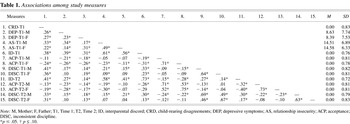
Associations among study measures

Cross-lagged path models examining the reciprocal associations between interparental discord and maternal and paternal parenting practices over two waves. *p < .05. [dagger]p < .10.

Hierarchical multiple regression models examining the moderating role of adult characteristics in associations between interparental discord and maternal parenting practices

Graphical plots of the moderating roles of maternal depressive symptoms, relationship insecurity, and child-rearing disagreements in associations between interparental discord and subsequent changes in maternal acceptance.
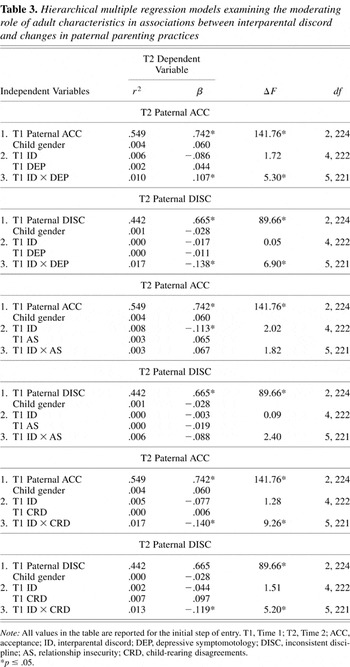
Hierarchical multiple regression models examining the moderating role of adult characteristics in associations between interparental discord and changes in paternal parenting practices

Graphical plots of the moderating roles of paternal depressive symptoms and child-rearing disagreements in associations between interparental discord and subsequent changes in paternal acceptance.
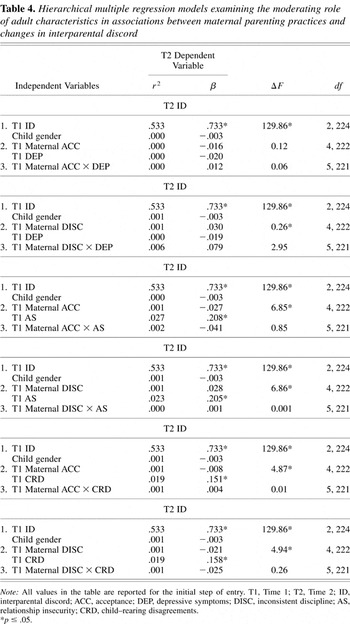
Hierarchical multiple regression models examining the moderating role of adult characteristics in associations between maternal parenting practices and changes in interparental discord
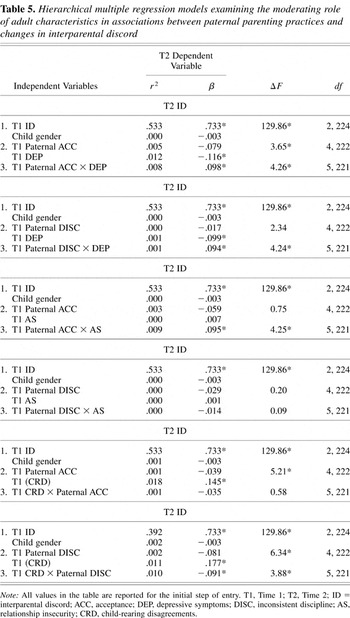
Hierarchical multiple regression models examining the moderating role of adult characteristics in associations between paternal parenting practices and changes in interparental discord

Graphical plots of the moderating roles of paternal depressive symptoms, insecurity in the interparental relationship, and child-rearing disagreements in associations between paternal parenting practices and subsequent changes in interparental discord.
 You have
Access
- 32
- Cited by