Introduction
With the rapidly aging population and associated increased rates of dementia, interventions aimed at decreasing the social and financial costs of declining cognitive function are irrefutably worth pursuing (Naismith et al., Reference Naismith, Glozier, Burke, Carter, Scott and Hickie2009b). While cholinesterase inhibitors offer symptomatic treatment, they are indicated only for some patients with clear neurodegenerative disease and do not alter the disease course. An alternative approach is early intervention, through selective prevention programs directed at “at risk” groups to reduce the social, financial and medical burden of cognitive decline and ultimately reduce the incidence of dementia. Such programs should target prevention of cognitive decline and promote neuroplasticity. One potential method in this regard is cognitive training (CT). This paper will discuss some of the key findings in studies utilizing CT programs and evaluate the evidence for their efficacy within a novel framework – i.e. at different stages of a prevention hierarchy – and, in particular, suggest that CT may be employed as a “preventive” technique (Mahncke et al., Reference Mahncke, Bronstone and Merzenich2006a; Naismith et al., Reference Naismith, Glozier, Burke, Carter, Scott and Hickie2009b) for cognitive decline in “at risk” groups. Throughout this paper, the term “prevention” is used to refer to the capacity of CT to ameliorate or delay cognitive decline by slowing the progression of neurobiological changes contributing to cognitive decline and/or dementia. By contrast, “protection” may be achieved through increased cognitive reserve. Both mechanisms may act through promoting neuroplasticity.
Cognitive remediation and cognitive training
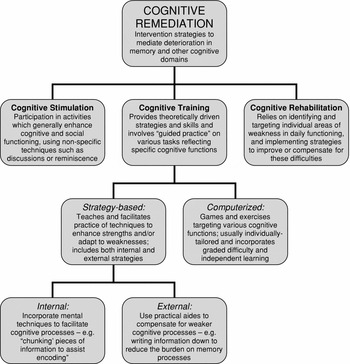
Cognitive remediation refers to behavioral interventions aimed at improving cognition in individuals who have experienced a decline in cognitive functioning, or enhancing and extending functioning in those who are cognitively intact (Medalia and Richardson, Reference Medalia and Richardson2005; Acevedo and Loewenstein, Reference Acevedo and Loewenstein2007). These interventions may be administered in individual or group formats over several sessions, and involve a range of activities including general mental activity, guided practice on cognitively demanding tasks, strategy use and computerized exercises. The literature uses many terms to describe cognitive remediation techniques, such as cognitive stimulation, cognitive rehabilitation and cognitive training, all of which differ in their approach (Belleville, Reference Belleville2008; see Figure 1). This review focuses on cognitive training (CT), referring to programs which enhance cognition by providing theoretically-driven strategies and skills, usually involving “guided practice” on various tasks reflecting different cognitive functions. CT techniques are categorized as compensatory or restorative (Sitzer et al., Reference Sitzer, Twamley and Jeste2006). Compensatory tactics aim to develop new ways of performing tasks, bypassing deficient cognitive processes and teaching alternative approaches to achieving goals. Both internal (e.g. categorizing, visualizing or paraphrasing information during learning) and external (e.g. using calendars or environmental cues) techniques are encouraged. Restorative methods, however, aim to improve functioning in specific domains, thus recovering impaired skills. Examples include spaced retrieval, repeated attention and memory tasks, vanishing cues and errorless learning. As shown in Figure 1, CT may be strategy-based, following a compensatory approach and incorporating both internal and external techniques to strengthen intact cognitive functions and adapt to areas of weakness or decline. CT may also be computer-based, utilizing exercises which typically incorporate multiple cognitive skills and allow for graded difficulty and independence on learning tasks (e.g. CogPack (Sartory et al., Reference Sartory, Zorn, Groetzinger and Windgassen2005) and NEAR (Medalia and Freilich, Reference Medalia and Freilich2008)).
Cognitive remediation terminology.
Sources: Medalia and Richardson, Reference Medalia and Richardson2005; Sitzer et al., Reference Sitzer, Twamley and Jeste2006; Acevedo and Loewenstein, Reference Acevedo and Loewenstein2007; Belleville, Reference Belleville2008; Clare and Woods, Reference Clare and Woods2008.

CT as a preventive technique
Thal (Reference Thal2006) describes a three-tiered prevention hierarchy for Alzheimer's disease (AD) (see Table 1) in explaining the role of prevention programs. We suggest that CT has the ability to target each of these stages in different populations. For example, CT may act as a primary preventive tool for healthy older adults, reducing the incidence of disease by delaying cognitive decline or perhaps building cognitive reserve (Valenzuela, Reference Valenzuela2008). In “at risk” groups such as individuals with mild cognitive impairment (MCI) who have a higher risk of conversion to dementia (Petersen and Morris, Reference Petersen and Morris2005), CT is more appropriate as a secondary preventive technique, potentially delaying the conversion of pre-clinical disease to the clinical stages. Further, CT may act as a tertiary prevention strategy for those individuals with established dementia, such as AD, aiming to reduce disability and disease progression. Investigation of the efficacy of CT in each of these populations allows for clarification of its value at each stage of this prevention hierarchy.
Stages of a prevention hierarchy for dementia (Thal, Reference Thal2006)

Methods
Having established likely populations matching each level of prevention, this review sought to focus on secondary prevention areas. For primary and tertiary levels, evidence for CT in healthy older adults and AD respectively has been systematically reviewed elsewhere (Sitzer et al., Reference Sitzer, Twamley and Jeste2006; Clare and Woods, Reference Clare and Woods2008; Valenzuela and Sachdev, Reference Valenzuela and Sachdev2009) and therefore has not been reviewed in depth. Findings have been generally positive in healthy older adults, though inconsistent in AD. Given the inherent nature of “at risk” populations as targets for early intervention, this review will focus on CT as a secondary prevention technique. To our knowledge, nine studies have been published investigating the efficacy of CT in MCI. Seven of these were reviewed by Belleville (Reference Belleville2008) with a further two studies published last year (Kinsella et al., Reference Kinsella2009; Kurz et al., Reference Kurz, Pohl, Ramsenthaler and Sorg2009). Additionally, one recent study (Naismith et al., Reference Naismith2009a) examined CT in those with late-life depression, a group also considered to be at risk of cognitive decline and in whom early intervention for cognitive decline may be beneficial (Naismith et al., Reference Naismith, Glozier, Burke, Carter, Scott and Hickie2009b).
Results and discussion
Effectiveness of CT as primary prevention tool
Research in healthy older adults suggests that CT offers considerable promise as a preventive technique. While studies have employed a variety of training programs and targeted a range of cognitive domains, results have generally indicated improvement or delayed decline following strategy-based or computer-based training. Specifically, Valenzuela and Sachdev (Reference Valenzuela and Sachdev2009) recently conducted a meta-analysis of seven randomized controlled trials and demonstrated large effect sizes (cumulative weighted mean difference effect size = 1.07) indicating improvement across cognitive outcomes including memory, processing speed, working memory and instrumental activities of daily living following CT. A seminal study in this area was the ACTIVE study (Advanced CT for Independent and Vital Elderly; Ball et al., Reference Ball2002). This study implemented strategy-based memory, reasoning or speed-of-processing training versus a no-contact control condition in 2832 adults (mean age = 74 years), over ten 60-minute sessions, and demonstrated significant improvement from baseline in the targeted cognitive ability for each intervention group. Longitudinal analysis also indicated sustainability over two years (particularly when booster training sessions were included after 11 months) and at five-year follow-up, where effects were maintained in each targeted domain. However, transfer of effects was limited, with reasoning training alone associated with less difficulty in self-reported functional outcomes compared to controls (Willis et al., Reference Willis2006). Similar positive findings were recently demonstrated by Stuss et al. (Reference Stuss2007) who, utilizing a randomized crossover design, provided 49 participants (mean age = 79 years) with strategy-based memory skills, goal management and psychosocial training over 12 weeks. Neuropsychological testing following CT demonstrated significant benefits in all domains, which also generalized to functional improvements in simulated real life tasks and performance on non-trained cognitive functions (results reported by Winocur et al., Reference Winocur2007). Furthermore, benefits were sustained at six-month follow-up (though not all participants were tested at this time).
Encouraging results have also been shown for computer-based CT. The IMPACT study conducted by Smith et al. (Reference Smith2009) included 487 healthy older adults (mean age = 75.3 years), randomly assigned either to CT, targeting improved speed and accuracy of auditory information processing, or to an active control group, with activities carried out five days per week for eight weeks. Follow-up testing revealed significantly greater improvement in the intervention group on both trained and untrained tasks (suggesting generalization) measuring memory and attention. Though well controlled and using a large sample size, it is unclear whether effects were sustainable over time. Notably, this study also explored the mechanisms underlying CT effects by designing and testing a computer-based intervention specifically centered on the principles of positive neuroplasticity, whereby plastic brain changes are purported to mediate improvement through intensive learning and practice. Few human-based studies, however, have specifically addressed underlying mechanisms, despite data supporting the notion of neuroplasticity.
Generally positive findings in healthy older adults have suggested that CT programs represent a viable preventive strategy against cognitive decline in later life. However, broad conclusions are limited by vast differences in methodological rigor, study design and nature of each CT program as demonstrated even in the abovementioned trials. Many other studies are not as well controlled, include small sample sizes and differ in factors such as group-based versus individual; and home-based versus on-site training, or inclusion of homework assignments. Furthermore these individuals, in meeting fairly rigorous inclusion criteria, may be more resilient at baseline than the average “healthy” older adult and therefore less likely to experience noticeable functional decline in a given time period. Accounting for this and for slower rates of cognitive decline in non-demented older adults necessitates longer observation periods (e.g. five to seven years; Mueller et al., Reference Mueller2005) in order to make definitive statements regarding the preventive capacity of CT, particularly if it is to be employed as a primary prevention strategy.
Evidence for CT as a secondary prevention tool
As a secondary prevention tool, CT could be used to prevent conversion of mild cognitive impairment to clinical dementia. This is particularly important for groups who have a higher risk of developing dementia, such as those with MCI. This group are by definition “functional”, yet have observable deficits on neuropsychological testing and are thus considered to be at risk (Petersen et al., Reference Petersen2001).
A recent review (Belleville, Reference Belleville2008) reported that six out of seven studies demonstrated cognitive improvements following CT. These studies differed in that their training programs varied, they incorporated computerized exercises and/or strategies, they were conducted over differential time periods and they targeted various cognitive domains (though all included memory). Samples included community-dwelling participants and individuals living in geriatric residential facilities. For example, Talassi et al. (Reference Talassi, Guerreschi, Feriani, Fedi, Bianchetti and Trabucchi2007) recently showed that a computer-based program targeting a range of cognitive functions (along with occupational therapy and behavior training) resulted in significant improvement in visuospatial perception and visual recall in community-dwelling MCI participants (mean age = 76 years), compared with a control group receiving only occupational therapy and behavior training. Similarly, Belleville et al. (Reference Belleville, Gilbert, Fontaine, Gagnon, Menard and Gauthier2006) demonstrated significantly improved performance on objective memory measures in MCI participants (mean age = 62 years) following eight weeks of strategy-based memory training including pre-training in executive control and cognitive speed. This program also included homework and guidance in using the strategies in real-life situations. No improvements were seen in controls who did not receive the intervention.
Several of these studies also demonstrated evidence for long-term maintenance of cognitive improvements for older individuals with MCI following CT. Gunther and colleagues (Reference Gunther, Schafer, Holzner and Kemmler2003) reported maintenance of improvements in verbal memory at five months following computer-based training. Likewise, individualized computer-based training for eight weeks employed by Cipriani et al. (Reference Cipriani, Bianchetti and Trabucchi2006) resulted in a significant improvement in behavioral memory at three-month follow-up. Rozzini et al. (Reference Rozzini, Costardi, Chilovi, Franzoni, Trabucchi and Padovani2007) presented evidence for maintenance of training effects after 12 months in association with cholinesterase inhibitor treatment; in this study, 15 older adults with MCI taking cholinesterase inhibitors underwent 60 sessions of computerized training in attention, memory, abstract reasoning, language and visuospatial skills. At one-year follow-up, trained participants demonstrated improvements in unrelated memory and reasoning tasks, as well as a decrease in depressive symptoms. Conversely, MCI participants who had received cholinesterase inhibitors alone (i.e. no CT) showed a decrease in depressive symptoms but no change on neuropsychological testing.
A limitation of the studies conducted with MCI participants, however, is the diverse range of methodologies. This was noted by Belleville (Reference Belleville2008) who included the findings of Olazaran et al. (Reference Olazaran2004) as cumulative evidence for the efficacy of CT in MCI, but acknowledged that this program did not include memory training strategies per se but rather “general” cognitive activity (i.e. cognitive stimulation).
There has been one known negative study in this area (Rapp et al., Reference Rapp, Brenes and Marsh2002) which utilized a strategy-based memory training program in community-dwelling MCI participants over a six-week period and did not demonstrate improvement in objective memory tests despite subjective improvement in memory reported by participants. It has been suggested that negative results may be due to a combination of small sample size and sub-optimal intervention (Belleville, Reference Belleville2008).
Since the time of Belleville's review, two studies have also demonstrated evidence for improvement in cognition following strategy-based CT. Kurz et al. (Reference Kurz, Pohl, Ramsenthaler and Sorg2009) reported significant improvement in episodic memory and informant-rated activities of daily living, and decreased depressive symptoms in MCI participants (mean age = 70 years) compared with waitlist controls. This followed an intensive four-week group program, which included strategy-based memory training as well as practical problem-solving, self-assertiveness training, relaxation techniques, stress management, and motor exercises. However, the authors acknowledge limitations including an inability to determine the relative contribution of each intervention component to the outcome, and a lack of long-term follow-up to clarify sustainability of effects. Kinsella et al. (Reference Kinsella2009) demonstrated improved performance on objective measures of prospective memory in 22 participants with amnestic MCI (mean age = 79 years), following five weekly sessions of memory and problem-solving strategy training and practice. Additionally, participants and their family-members who also took part in training reported increased knowledge and use of memory strategies at two-week follow-up compared to waitlist controls.
Of the seven studies described above as demonstrating cognitive improvements following CT in MCI, two were randomized controlled trials (Rozzini et al., Reference Rozzini, Costardi, Chilovi, Franzoni, Trabucchi and Padovani2007; Kinsella et al., Reference Kinsella2009). All included some standard of control except for Gunther et al. (Reference Gunther, Schafer, Holzner and Kemmler2003), who argued that within a residential setting, control participants not allowed to partake in computer activities might feel devalued. However, the range of conditions included as control must be considered – for example, some studies used a non-intervention group whilst others used an active control group without the critical CT element. Cipriani et al. (Reference Cipriani, Bianchetti and Trabucchi2006) included participants with a different diagnosis (AD) as a control, and both Talassi et al. (Reference Talassi, Guerreschi, Feriani, Fedi, Bianchetti and Trabucchi2007) and Belleville et al. (Reference Belleville, Gilbert, Fontaine, Gagnon, Menard and Gauthier2006) included control groups of approximately one-third the sample size of their treatment groups. Thus, whilst these findings are encouraging in suggesting that different CT programs conducted in both residential facilities and community settings may be valuable secondary prevention tools (insofar as they improve cognitive functioning in this “at risk” group), methodological variability suggests that further randomized, controlled trials are warranted. Furthermore, as with healthy populations, slower rates of decline in individuals without dementia necessitate longer observation periods to truly clarify prevention (Mueller et al., Reference Mueller2005). Additionally, given the contribution of multiple factors to MCI (e.g. vascular risk factors, psychiatric status, genetics, hormonal changes and cholinesterase inhibitor medication (Gauthier et al., Reference Gauthier2006)), CT may be more efficacious in combination with psychoeducation aimed at controlling risk factors for cognitive decline(Naismith et al., Reference Naismith, Glozier, Burke, Carter, Scott and Hickie2009b).
In terms of underlying mechanisms, preliminary evidence suggests that CT in MCI may be associated with other probes reflective of brain function, thus supporting the notion of neuroplasticity. For instance, in patients with MCI, Belleville et al. (Reference Belleville, Chertkow and Gauthier2007) reported CT-associated increased neural activity (increased amplitude of the P2 component related to active retrieval of information) seen in event-related potential (ERP) measures. However, a general dearth of reference to imaging data in the literature limits knowledge of the extent or mechanisms of glial-neuronal changes occurring with CT.
An additional consideration within this body of research is the concentration on the classical definition of MCI as an amnestic syndrome, whereby diagnosis emphasizes memory loss through the presence of subjective complaint and impairment on objective testing (Petersen et al., Reference Petersen2001). However, conceptual development of MCI has indicated the importance of other subtypes such as non-amnestic MCI (Gauthier et al., Reference Gauthier2006; Petersen et al., Reference Petersen2001; Petersen and Morris, Reference Petersen and Morris2005). Whilst the prognostic pathway of non-amnestic MCI is yet to be clarified, it is reasonable to hypothesize that CT programs incorporating multiple cognitive domains may similarly improve cognition in individuals with this non-amnestic subtype.
Generally positive findings despite vast methodological and program differences suggest that CT represents a promising tool that may be effective as a selective secondary preventive technique in individuals “at risk” for cognitive decline. Nonetheless, further research incorporating tighter methodological control and extending the observation period would help to clarify this proposal.
Opportunity to develop CT in other “at risk” groups: late life depression
While depression is associated with a range of cognitive impairments, changes in processing speed, memory and executive functions are more pronounced in older people, particularly in those with later ages of illness onset and/or cerebrovascular disease. Cognitive deficits in late-life depression are likely to reflect structural and/or functional changes in fronto-subcortical networks (Naismith et al., Reference Naismith2003; Reference Naismith, Hickie, Ward, Scott and Little2006; Hickie et al., Reference Hickie2005). Unfortunately, cognitive deficits often remain despite adequate resolution of depressive symptoms (Butters et al., Reference Butters2000). Depression has been recognized internationally as a prodromal feature for cognitive decline (Steffens et al., Reference Steffens2007), with more severe symptoms representing a greater risk for MCI (Barnes et al., Reference Barnes, Alexopoulos, Lopez, Williamson and Yaffe2006). Indeed, 60% of individuals with late-life depression meet criteria for MCI. The combination of depression and MCI is associated with a twofold risk of developing AD with an earlier age of onset (Modrego and Ferrandez, Reference Modrego and Ferrandez2004). This is likely associated with the high rates of cerebrovascular disease. Additionally, depression itself presents an independent risk factor for cognitive decline. Possible mechanisms include the down-regulation of the hypothalamic-pituitary-adrenocortical axis, neurotoxic effects of glucocorticoids and reduced expression of brain-derived neurotrophic factor (BDNF) (Hickie et al., Reference Hickie2005; Duman and Monteggia, Reference Duman and Monteggia2006). BDNF is a neurotrophin that promotes neuronal differentiation, growth and survival and is decreased in persons with depression and during exposure to stress. It plays a role in use-dependent plasticity mechanisms such as long-term potentiation and is critical in cognitive processes such as learning, memory and executive functions (Shimizu et al., Reference Shimizu2003).
Given the increased risk for cognitive decline associated with depression, it is very possible that CT again represents a viable secondary prevention tool in this “at risk” group. Unfortunately, this group has largely been overlooked in CT literature. Whilst some studies have measured depressive symptoms in general terms using self-report measures and reported a decrease following CT (e.g. Rozzini et al., Reference Rozzini, Costardi, Chilovi, Franzoni, Trabucchi and Padovani2007; Talassi et al., Reference Talassi, Guerreschi, Feriani, Fedi, Bianchetti and Trabucchi2007; Kurz et al., Reference Kurz, Pohl, Ramsenthaler and Sorg2009), many have directly excluded individuals with a current psychiatric disorder or lifetime psychiatric history (e.g. Rozzini et al., Reference Rozzini, Costardi, Chilovi, Franzoni, Trabucchi and Padovani2007; Stuss et al., Reference Stuss2007; Kinsella et al., Reference Kinsella2009; Smith et al., Reference Smith2009). We have recently examined the efficacy of CT in late-life depression using a combined psychoeducation and computer-based training program (Naismith et al., Reference Naismith2009a). In this study, a ten-week course of CT was associated with significant improvements in both verbal and visual memory. To our knowledge, this is the first study evaluating the effects of CT in an older depressed sample (i.e. >60 years), though three studies have shown positive effects in younger samples with a lifetime history of major depressive disorder. One study (Elgamal et al., Reference Elgamal, McKinnon, Ramakrishnan, Joffe and MacQueen2007) showed that ten weeks of computerized CT given to euthymic patients was associated with improvements in memory, attention, executive functioning and psychomotor speed. The effect was unrelated to improvements in mood symptoms over the ten-week training period. Additionally, Alvarez and colleagues (Reference Alvarez, Cortes Sotres, Ortiz Leon, Estrella and Sanchez Sosa2008) demonstrated a reduction in depressive symptoms and improvement on cognitive measures in university students with major depressive disorder following twice-weekly computer-based CT, both alone and in conjunction with antidepressant medication. More recently, Naismith et al. (Reference Naismith, Redoblado-Hodge, Lewis, Scott and Hickie2009c) reported greater improvements on objective memory tests following ten weeks of twice-weekly CT using the Neuropsychological Educational Approach to Cognitive Remediation (NEAR) approach (Medalia and Freilich, Reference Medalia and Freilich2008) in participants with a lifetime diagnosis of major depressive disorder.
These studies provide preliminary yet encouraging results and suggest that therapies targeting neuroplastic processes in this “at risk” group warrant further development and research. Additionally, such programs may be best delivered in conjunction with other mediators of mood and cognition (Naismith et al., Reference Naismith, Glozier, Burke, Carter, Scott and Hickie2009b) such as sleep-wake cycle, depression and anxiety management social networks, physical comorbidities, underlying cerebrovascular disease, limited mobility and access to community resources.
Effectiveness of CT as a tertiary prevention tool
Investigation of CT in populations with established dementia may aim to determine whether CT can be used as a tertiary intervention to prevent further decline. Overall, the literature is disparate regarding the capacity of CT to improve cognition in AD. A recent review by Clare and Woods (Reference Clare and Woods2008) reported a lack of evidence for the efficacy of CT in early-stage AD. However, the authors note considerable methodological limitations amongst the nine included studies (e.g. small samples, insufficient frequency, intensity and duration of treatment) and variability in patient groups (e.g. age, MMSE), interventions and outcome measures, which may have contributed to trivial results. Additional confounders among studies were the inclusion of mixed-diagnosis patient groups, concomitant use of cholinesterase inhibitors and non-specific interventions. Other reviews and non-randomized trials have reported promising results for strategy-based (de Vreese et al., Reference de Vreese, Neri, Fioravanti, Belloi and Zanetti2001) and computerized CT programs targeting several cognitive domains (Cipriani et al., Reference Cipriani, Bianchetti and Trabucchi2006) in early-stage AD, in conjunction with cholinesterase inhibitor treatment. Additionally, when considered across the range of disease severity, a meta-analysis of nineteen controlled studies reported generally positive effects for CT (Sitzer et al., Reference Sitzer, Twamley and Jeste2006). Despite clear heterogeneity in procedures and methodologies (e.g. differences in sample characteristics and CT programs), Sitzer and colleagues concluded that CT can indeed improve cognitive functioning in mild to moderate AD. Whilst this is encouraging, this review also included several non-randomized studies and intervention programs comprising cognitive stimulation rather than CT as more rigorously defined (see Figure 1).
Such disparate findings may reflect the possibility that CT programs as tertiary prevention tools are delivered “too late” in individuals with established, progressive, dementia. It is possible that the capacity to benefit from CT may also depend on the underlying etiology. For example, due to its more predictable progressive course and/or a higher burden of pathology resulting in less opportunity for plasticity, patients with AD may benefit to a lesser extent, or less consistently, than healthy older adults or those with MCI. Indeed, in many neurological and medical intervention studies of older adults with pre-existing cognitive impairment, effects have generally been limited. For instance, there is little evidence to support the use of folate supplementation in people with dementia, and many cardiovascular interventions show limited effects on cognition (see review by Naismith et al., Reference Naismith, Glozier, Burke, Carter, Scott and Hickie2009b). Perhaps, then, the value of CT lies less in tertiary prevention and more in primary and secondary prevention stages.
Limitations of cognitive training research
Though evidence for the efficacy of CT in healthy and clinical populations is promising, few studies are well controlled, many include small samples and investigations have generally employed diverse methodologies, with varying treatment times and outcome measures. Differences in the design of CT programs may be understandable insofar as they follow differing theoretical approaches; however, they add to the complexity of synthesizing findings from an already heterogeneous field. Such differences have been noted in many recent review papers (Medalia and Richardson, Reference Medalia and Richardson2005; Sitzer et al., Reference Sitzer, Twamley and Jeste2006; Belleville, Reference Belleville2008; Clare and Woods, Reference Clare and Woods2008).
Few studies have incorporated performance-based functional outcome measures (i.e. IADLs) and of those that have, findings are mixed. For example, though the ACTIVE study (Ball et al., Reference Ball2002) reported no impact of training on IADLs on initial testing, an effect was seen at five-year follow-up in one training group (Willis et al., Reference Willis2006). Additionally, speed-of-processing training has been associated with improved performance on timed IADLs (Edwards et al., Reference Edwards, Wadley, Myers, Roenker, Cissell and Ball2002), with faster performance on both trained and untrained tasks (Zanetti et al., Reference Zanetti, Binetti, Magni, Rozzini, Bianchetti and Trabucchi1997). Talassi et al. (Reference Talassi, Guerreschi, Feriani, Fedi, Bianchetti and Trabucchi2007) reported significant improvement on a physical performance test following computerized CT within a cognitive rehabilitation program, but no concurrent change on an IADL measure. The inconsistency in findings is compounded by the argument that these IADLs are simplistic in comparison to more cognitively demanding tasks faced by independent older adults in a more technologically dependent world (such as interacting with automated, menu-based telephone systems and the internet (Acevedo and Loewenstein, Reference Acevedo and Loewenstein2007). As such, the ecological validity of CT effects should be addressed more uniformly, with the inclusion of measurement tools commensurate with real-life situations such as tasks requiring organization of simulated car-pools, as used by Levine et al. (Reference Levine2007), or coin sorting and compiling bills as described by Manly et al. (Reference Manly, Hawkins, Evans, Woldt and Robertson2002).
Whilst CT in younger populations with schizophrenia has shown generalization and sustainability of improvements (see McGurk et al., Reference McGurk, Twamley, Sitzer, McHugo and Mueser2007 for review), these issues have not been widely addressed in older groups. Again, studies that have explored generalization have returned both positive (e.g. Mahncke et al., Reference Mahncke2006b; Winocur et al., Reference Winocur2007; Smith et al., Reference Smith2009) and negative (e.g. Edwards et al., Reference Edwards, Wadley, Myers, Roenker, Cissell and Ball2002; Acevedo and Loewenstein, Reference Acevedo and Loewenstein2007) results, indicating a need for further consideration of this issue.
Though still a lesser focus of existing research, some studies have addressed the issue of sustainability, with some positive findings. As described above, sustained improvements have been reported in healthy older adults for as long as five years (Oswald et al., Reference Oswald, Gunzelmann, Rupprecht and Hagen2006; Willis et al., Reference Willis2006), and at least one year in MCI (Rozzini et al., Reference Rozzini, Costardi, Chilovi, Franzoni, Trabucchi and Padovani2007). As reviewed by Sitzer et al. (Reference Sitzer, Twamley and Jeste2006), improvements following training in AD may be maintained for four-and-a-half-months (on average); however, given the progressive nature of the disease, maintenance of cognitive gains over time is difficult to ascertain. Nonetheless, some longitudinal studies have indicated that CT may slow the rate of decline. Notably, several studies have reported enhanced maintenance of CT effects with adjunct therapy, such as physical therapy (Oswald et al., Reference Oswald, Gunzelmann, Rupprecht and Hagen2006), booster sessions following program cessation (Ball et al., Reference Ball2002) and cholinesterase inhibitor treatment (Cipriani et al., Reference Cipriani, Bianchetti and Trabucchi2006; Rozzini et al., Reference Rozzini, Costardi, Chilovi, Franzoni, Trabucchi and Padovani2007). Again, differences in study methodologies, populations and CT parameters preclude any definitive conclusions regarding sustainability. These encouraging results, however, suggest a need for clearer delineation of those factors comprising a CT program (such as type, duration, intensity and adjunct therapies) which are most effective for long-term gain within each population.
A further limitation which has not been widely discussed is the dearth of investigation into underlying neural changes occurring with CT. Incorporation of imaging data with CT will also help to delineate the mechanisms of change. Particularly given recent interest in the potential for neuroplasticity in the aging brain, it is as important to investigate evidence for CT efficacy as it is to explore how these changes occur. Fortunately, advances in physiological and functional imaging techniques such as functional magnetic resonance imaging, spectroscopy, positron emission tomography (PET) and ERP readily afford this opportunity (Valenzuela and Sachdev, Reference Valenzuela and Sachdev2006; Belleville et al., Reference Belleville, Chertkow and Gauthier2007; Valenzuela et al., Reference Valenzuela, Breakspear and Sachdev2007) though have not, as yet, been capitalized on in this area. We thus propose the need for further discussion of, and focus on, the underlying mechanisms of CT.
Cognitive activity protects against decline
Considerable epidemiological evidence suggests that there is a dose-dependent relationship between cognitive activity (e.g. education, occupation complexity) and dementia risk; see review by Valenzuela and Sachdev, Reference Valenzuela and Sachdev2009). This protective effect or “cognitive reserve” appears to be underpinned by promotion or maintenance of brain structures. At a cellular level, cognitive activity likely influences spine density, synaptogenesis and vascular supply to the brain. It likely promotes glial and metabolic activity, trophic factors (e.g. BDNF) and hippocampal neurogenesis. Indeed, in older people, higher mental activity levels have been associated with lower rates of hippocampal atrophy over a three-year period (Valenzuela et al., Reference Valenzuela, Sachdev, Wen, Chen and Brodaty2008). CT programs represent an opportunity for individuals to increase their cognitive activity during training and following cessation of the program by incorporating strategies and skills into everyday life.
Mechanisms of neuroplasticity
“Neuroplasticity” refers to the ability of the brain to undergo structural and functional change in response to internal and external stimuli. For decades, animal research has shown that cognitive activity contributes to dendritic arborisation, increased synaptogenesis and brain plasticity (Turkstra et al., Reference Turkstra, Holland and Bays2003). More recently, investigators have applied these principles to healthy and clinical populations and the field of neuroplasticity has received renewed interest (Fuchs et al., Reference Fuchs, Czeh, Kole, Michaelis and Lucassen2004; Strangman et al., Reference Strangman2005; Kelly et al., Reference Kelly, Foxe and Garavan2006; Mahncke et al., Reference Mahncke, Bronstone and Merzenich2006a).
The traditional view of the brain as a “static” structure has been recently revised on the basis of numerous studies which show that neuronal connections and circuits undergo continual modification and reorganization (Fuchs et al., Reference Fuchs, Czeh, Kole, Michaelis and Lucassen2004). Using terminology conceptualized independently of CT, the mechanisms of neuroplasticity for rehabilitation may be either restorative (i.e. reorganization of existing networks) or compensatory (engagement of other cognitive abilities or networks) (Strangman et al., Reference Strangman2005). Neuroplasticity is also believed to be bidirectional. That is, the same mechanisms and plasticity processes can either degrade (i.e. negative plasticity) or strengthen (i.e. positive plasticity) cognitive functioning. Such “negative” plasticity may be involved in age-related cognitive decline (Mahncke et al., Reference Mahncke, Bronstone and Merzenich2006a) and depression (Fuchs et al., Reference Fuchs, Czeh, Kole, Michaelis and Lucassen2004). By contrast, processes that strengthen brain function can be conceptualized as being “positive” plasticity and can provide a foundation for therapy. In this sense, therapies could theoretically target sensory, cognitive, motor and mood systems in aging (Mahncke et al., Reference Mahncke, Bronstone and Merzenich2006a). From the cognitive standpoint, it is possible that the efficacy of CT in preventing cognitive decline lies in its facilitation of “positive plasticity”.
CT as a promoter of neuroplasticity
In terms of underlying neuroplasticity, further corroborative evidence from employing other neurobiological assessment techniques is needed to determine the therapeutic mechanism of action for CT. As the animal literature has demonstrated increased synaptogenesis, dendritic arborisation and neurogenesis, it is reasonable to speculate that such processes are operative. However, this has not been demonstrated empirically in humans and only a few studies in healthy older adults and MCI have shown concomitant effects on brain physiology (Valenzuela et al., Reference Valenzuela2003; Reference Valenzuela, Breakspear and Sachdev2007; Belleville et al., Reference Belleville, Chertkow and Gauthier2007) or structure (Valenzuela and Sachdev, Reference Valenzuela and Sachdev2006). Further structural and functional imaging studies may help to delineate the specific effects on functional neuronal networks, neurochemistry and glial cell function and may help to determine if mechanisms are restorative or compensatory, or whether there are pre-existing predictors or mediators of CT effectiveness. Additionally, longer observation periods will clarify the stability of improvements seen following CT and indicate whether such effects are due to neuroplastic changes.
Summary and conclusions: CT as a preventive technique for cognitive decline
Key points
▪ Epidemiological and case control data support the effectiveness of cognitive training (CT) programs in healthy elderly and “at risk” older individuals, suggesting utility as a primary and secondary prevention tool.
▪ Findings are mixed for Alzheimer's disease.
▪ CT has not been widely investigated as a preventive tool in older people with depression, thus overlooking a further group at risk of cognitive decline.
▪ Though the mechanisms of effectiveness are unclear, CT may promote neuroplasticity.
▪ Further studies are needed to address methodological limitations, define mechanisms of neuroplasticity and to determine mediators of efficacy, generalization and sustainability.
Despite mixed findings in AD, studies of healthy older adults and MCI largely suggest that CT can be implemented as an early intervention technique. Whilst further neurobiological research in humans is required to ascertain whether the underlying mechanism is neuroplasticity (Naismith et al., Reference Naismith, Glozier, Burke, Carter, Scott and Hickie2009b; Valenzuela and Sachdev, Reference Valenzuela and Sachdev2009), data suggest that CT represents a promising selective prevention technique for older adults at risk of cognitive decline. Though as yet CT has not been widely investigated in older adults with depression, future studies on programs incorporating CT and other indicated prevention programs are warranted to determine the clinical and scientific utility of CT as an early intervention and non-pharmacological treatment strategy in this “at risk” group.
As the increasing aging population presents with age- or disease-related cognitive decline, early intervention and prevention strategies targeting neuroplasticity are likely to gain increasing interest and demand. CT programs offer promise for these groups for several reasons. They are easily implemented across a variety of settings, including aged-care facilities, community centers or individual homes by facilitators who require relatively uncomplicated training. They engage participants and therefore offer an enjoyable experience. Training can be conducted in one-on-one or group settings, with the latter offering the additional benefit of social interaction. Additionally, data suggest that older adults are increasingly opting for non-pharmacological forms of therapy for psychological and cognitive difficulties (Jorm et al., Reference Jorm, Korten, Jacomb, Christensen, Rodgers and Pollitt1997). As shown in other areas of psychiatry, it is likely that combined pharmacological and non-pharmacological approaches may be optimal. Ideally, such programs would be implemented early (e.g. from age 50 years onwards), and now require empirical examination.
In addition to cognitive improvements observed on neuropsychological testing, some preliminary data from imaging and ERP studies suggest that CT promotes neuroplasticity. However, as discussed, a number of limitations within the existing literature are evident. These methodological constraints (such as limited sample sizes and varied outcome measures) need to be addressed in future investigations. A general lack of performance-based functional outcome measures commensurate with real-world tasks has hindered the generalization of cognitive improvement (observed on testing) to functional efficacy. Additionally, issues including the generalization and sustainability of improvements following CT and underlying mechanisms using imaging data have not been widely addressed and require further investigation. Resolution of limitations and further research as posited above will help to further delineate the preventive and neuroprotective utility of CT.
Conflict of interest
None.
Description of authors' roles
L. Mowszowski was primarily responsible for the integration of literature and the formulation and structure in writing the paper. Associate Professor S. L. Naismith provided guidance and assistance regarding conceptual development and edited several drafts of the paper. Dr. J. Batchelor reviewed the paper and provided input regarding content.
Acknowledgments
Associate Professor Naismith is supported by NHMRC Clinical Research Fellowship, No.402864