- MPC
Milk Protein Concentrate
- SMP
Skim Milk Powder
- WP
Whey Powder
- WPC
Whey Protein concentrate
- WPI
Whey Protein Isolate
- MC
Micellar Casein
- NaCn
Sodium Caseinates
- CaCn
Calcium Caseinate
Yogurt is a very popular fermented dairy product widely consumed all over the world (Lucey & Singh, Reference Lucey and Singh1998; Verman & Sutherland, Reference Verman and Sutherland2004; Peng et al. Reference Peng, Serra, Horne and Lucey2009). Three major types are found: drinking, set and stirred yogurt. The typical yogurt manufacturing process changes milk properties in an irreversible way and consists of different processing steps (Fig. 1). First, the milk base fat content is standardised to the desired level by mixing cream and skim milk powder (Sodini & Béal, Reference Sodini and Béal2003; Lee & Lucey, Reference Lee and Lucey2010). Afterward, the non-fat total solid content is traditionally increased to achieve a protein concentration between 40–50 g/kg (Sodini et al. Reference Sodini, Montella and Tong2005). Fortification of the milk base is one of the most important steps that enhances functional and nutritional properties and prevents textural defects such as poor gel firmness and syneresis as assessed by sensory evaluations and instrumental measurements (Dave & Shah, Reference Dave and Shah1998; Schkoda et al. Reference Schkoda, Hechler and Hinrichs2001; Sodini & Béal, Reference Sodini and Béal2003; Séverin & Wenshui, Reference Séverin and Wenshui2005; Marafon et al. Reference Marafon, Sumi, Granato, Alcantara, Tamine and Nogueira de Oliveira2011). Dry matter fortification can be achieved by either concentration process (evaporation under vacuum) followed by membrane processing (ultrafiltration or reverses osmosis) or by the addition of dairy ingredients including skim milk powder (SMP), whey proteins, caseins and caseinates (Tamime & Robinson, Reference Tamime and Robinson2000; Sodini & Béal, Reference Sodini and Béal2003; Damin et al. Reference Damin, Alcântara, Nunes and Oliveira2009; Peng et al. Reference Peng, Serra, Horne and Lucey2009). The fortified milk is then homogenised at 10–20 and 5 MPa at first and second stage respectively with a temperature ranging between 55 and 65 °C (Lee & Lucey, Reference Lee and Lucey2010). This processing step generates fat globules with new surface layer formed by the caseins and whey proteins thus increasing the number of possible structure-binding components in yogurt products (Lee & Lucey, Reference Lee and Lucey2010). The milk base is subsequently submitted to a drastic heat treatment. In fact, it is usually heated at 85 °C for 30 min, at 90–95 °C for 5–10 min or at 115 °C for 3 s (Sodini & Béal, Reference Sodini and Béal2003). Heat treatment causes whey protein denaturation and complex formation (whey protein–whey protein or whey protein–casein micelles) through disulphide bonding, which initiates gelation (Ozer et al. Reference Ozer, Robinson, Grandison and Bell1998; Vasbinder et al. Reference Vasbinder, van Mil, Bot and de Kruif2001; Reference Vasbinder, van de Velde and de Kruif2004; Lakemonda & van Vliet, Reference Lakemonda Catriona and van Vliet2007; Lee & Lucey, Reference Lee and Lucey2010; Matumoto-Pintro et al. Reference Matumoto-Pintro, Rabiey, Robitaille and Britten2011). Subsequently, the milk base is cooled to the incubation temperature (40–45 °C) (Sodini & Béal, Reference Sodini and Béal2003) prior to inoculation with a mixture of two homofermentative bacterial cultures: Streptococcus thermophilus and Lactobacillus delbrueckii subs. bulgaricus (Tamime et al. Reference Tamime, Kalab and Davies1984; Tamime & Robinson, Reference Tamime and Robinson2000; Damin et al. Reference Damin, Alcântara, Nunes and Oliveira2009; Peng et al. Reference Peng, Serra, Horne and Lucey2009) which convert lactose to lactic acid. The AFNOR standards define for yogurt ‘appellation’ a minimum level of 10 million living microorganism per gram of product at the time of consumption. Throughout fermentation growth of Strep. thermophilus is stimulated by Lactobacilli proteolytic activity, Lb. bulgaricus releases formic acid and CO2. In the final count Strep. thermophilus is dominant over Lb. bulgaricus (Birollo et al. Reference Birollo, Reinheimer and Vinderola2000; Oliviera et al. Reference Oliveira, Sodini, Remeuf and Corrieu2001; Sodini & Béal, Reference Sodini and Béal2003; Damin et al. Reference Damin, Alcântara, Nunes and Oliveira2009). As the pH of the milk base drops (from 6·7 to 4·6, which usually takes 2 to 6 h) the net negative charge on the casein micelles decreases, the rate of solubilised colloidal calcium phosphate increases leading to the removal of the ‘hairy’ layer of k-casein (De Brandere & De Baerdemader, Reference De Brabandere and De Baerdemaeker1999; Vasbinder & de Kruif, Reference Vasbinder and de Kruif2003; Lee & Lucey, Reference Lee and Lucey2010). This results in decreases in electrostatic repulsion and steric stabilisation and increases in casein–casein interactions leading to the formation of a three-dimensional network consisting of casein clusters, chains and strands (Fig. 2) (Ozer et al. Reference Ozer, Robinson, Grandison and Bell1998; Lee & Lucey, Reference Lee and Lucey2010; Marafon et al. Reference Marafon, Sumi, Granato, Alcantara, Tamine and Nogueira de Oliveira2011; Patel, Reference Patel2011). Finally, fruits, flavouring ingredients, thickeners and stabilisers (where regulations permit) are added before blast chilling and cold storage. The primary aim of stabiliser addition is their ability to form linkage with protein particles resulting in viscosity and texture enhancement as well as mouth feel improvement (Everett & McLeod, Reference Everett and McLeod2005; Ares et al. Reference Ares, Gonçalvez, Pérez, Reolon, Segura, Lema and Gambaro2007). It is important to note that set and stirred yogurt are formed during incubation in retail pots and large fermentation tanks respectively. The latter being usually disrupted by agitation (stirring) and pumped through a screen (Sodini & Béal, Reference Sodini and Béal2003; Lee & Lucey, Reference Lee and Lucey2010). It is obvious from the previous description that yogurt manufacture and properties are primary dependant on the level, nature and relative proportion of milk proteins. Indeed, methods of milk enrichment affect yogurt mix composition and impart the buffering capacity, the extent of protein interactions, the length of fermentation as well as the microstructure and hence the resulting textural and sensorial properties of the coagulum. These latter attributes are determinant features, defining yogurt quality and consumer acceptability (Kristo et al. Reference Kristo, Biliaderis and Tzanetakis2003; Soukoulis et al. Reference Soukoulis, Panagiotidis, Koureli and Tzia2007; Lee & Lucey, Reference Lee and Lucey2010). In this review, the effects of milk fortification with various dairy ingredients on gel formation as well on physical and sensorial properties of yogurt products are described and discussed.
Main processing steps of the two majors yogurt types: set and stirred yogurt (adapted from Sodini & Béal, Reference Sodini and Béal2003; Lee & Lucey, Reference Lee and Lucey2010; Pesic et al. Reference Pesic, Barac, Stanojevic, Ristic, Macej and Vrvic2012; Berton-Carabin et al. Reference Berton-Carabin, Elias and Coupland2013). Confocal scanning electron microscopy images are taken from Corredig et al. (Reference Corredig, Sharafbafi and Kristo2011).

Typical pH profiles during the fermentation process of yogurt (adapted from De Brandere & De Baerdemader, Reference De Brabandere and De Baerdemaeker1999).
Textural properties of yogurt gels
Yogurt is organised as a concentrated dispersion of protein particles, aggregates, chains and clusters (Tamime et al. Reference Tamime, Kalab and Davies1984; Sodini et al. Reference Sodini, Remeuf, Haddad and Corrieu2004; Lee & Lucey, Reference Lee and Lucey2010). Yogurt texture defines the disposition of the different part of the system and represents the rheological, microstructural and sensorial properties assigned by mechanical, visual and instrumental attributes (Sodini et al. Reference Sodini, Remeuf, Haddad and Corrieu2004). Yogurt textural characteristics are affected by several parameters such as temperature and time of heat treatment, type and amount of starter bacteria, temperature of fermentation, storage conditions and more particularly protein composition of the milk base (Lucey et al. Reference Lucey, Tamehana, Singh and Muuro1998; Kristo et al. Reference Kristo, Biliaderis and Tzanetakis2003; Marafon et al. Reference Marafon, Sumi, Granato, Alcantara, Tamine and Nogueira de Oliveira2011). Indeed, protein bonds formation and rearrangements as well as protein interactions with other compounds (i.e. flavour compounds) by reversible and irreversible bindings define the gel network and determine the yogurt aroma (characterised by the presence of specific carbonyl compounds) and consumer acceptance (Tamime & Robinson, Reference Tamime and Robinson2000; Guichard, Reference Guichard2002; Lucey, Reference Lucey2004; Isleten & Karagul-Yuceer, Reference Isleten and Karagul-Yuceer2006; Saint-Eve et al. Reference Saint-Eve, Lévy, Martin and Souchon2006).
Yogurt gel network can be assessed by a wide range of non-Newtonian effect such as shear-thinning, yield stress and thixotropic flow behaviours, visual observation of microstructure, physical (water holding capacity and syneresis) and sensorial attributes (thickness, smoothness or lumpiness, graininess, and flavour) (Tamime et al. Reference Tamime, Kalab and Davies1984; Gastaldi et al. Reference Gastaldi, Lagaude, Marchesseau and Torodo De la Fuente1997; Lucey et al. Reference Lucey, Teo, Munro and Singh1997; Remeuf et al. Reference Remeuf, Mohammed, Sodini and Tissier2003; Sodini et al. Reference Sodini, Remeuf, Haddad and Corrieu2004; Damin et al. Reference Damin, Alcântara, Nunes and Oliveira2009; Lee & Lucey, Reference Lee and Lucey2010).
Effect of dairy powders addition on yogurt textural properties
Addition of milk powder
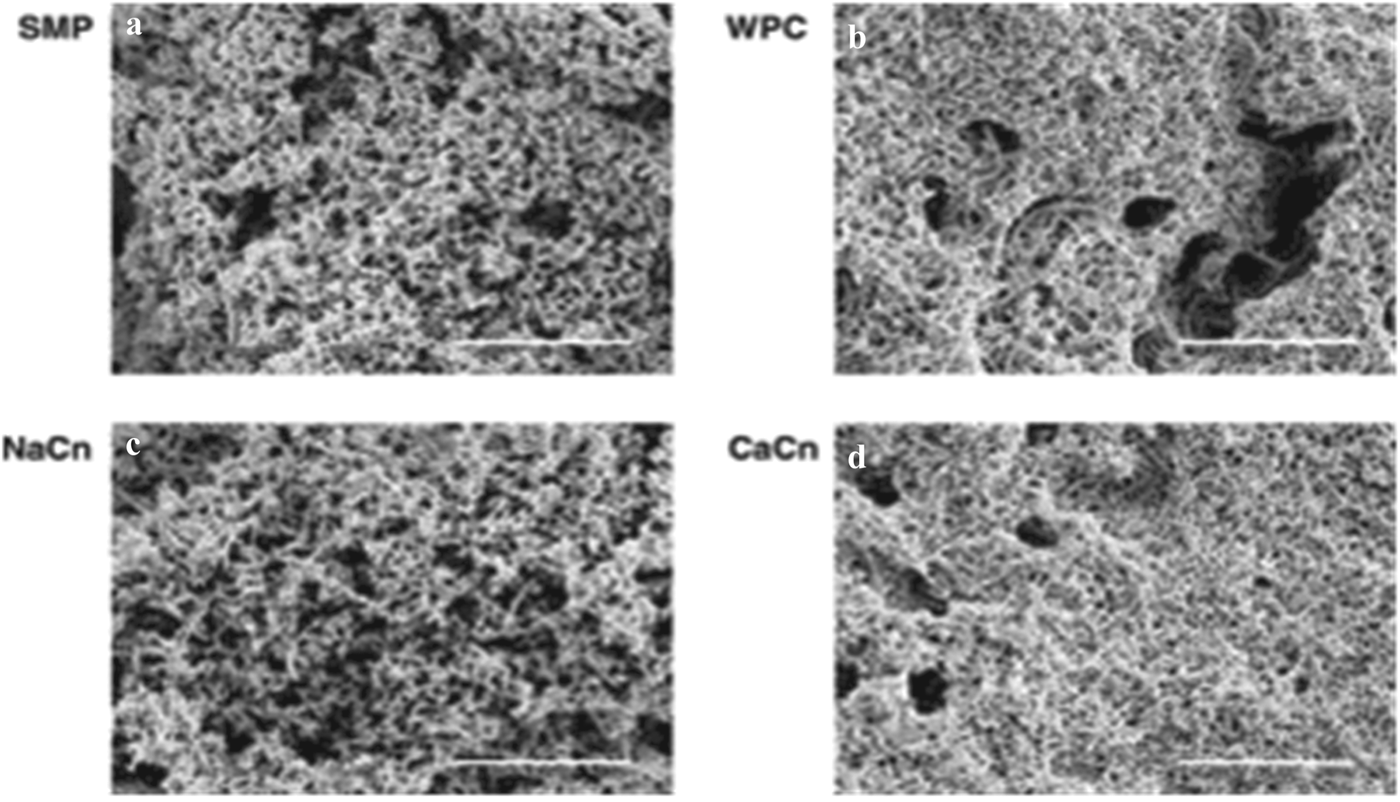
The use of SMP to fortify yogurt is preferable to whole milk powder, the latter being involved in oxidised flavour (Tamime & Robinson, Reference Tamime and Robinson2007). The addition of SMP for fortification purposes appears to be by far the most common practice in yogurt industry (Lucey & Singh, Reference Lucey and Singh1998; Sodini & Béal, Reference Sodini and Béal2003; Soukoulis et al. Reference Soukoulis, Panagiotidis, Koureli and Tzia2007; Damin et al. Reference Damin, Alcântara, Nunes and Oliveira2009; Peng et al. Reference Peng, Serra, Horne and Lucey2009) and is considered as the standard process for yogurt preparation (Remeuf et al. Reference Remeuf, Mohammed, Sodini and Tissier2003; Damin et al. Reference Damin, Alcântara, Nunes and Oliveira2009). Addition rates of SMP in the yogurt mix ranges from as slight as 1% to as high as 6% with a recommended level of 3–4% (Tamime & Robinson, Reference Tamime and Robinson2007). In general, addition of 2% of SMP is considered appropriate for improving yogurt textural quality (Tamime & Robinson, Reference Tamime and Robinson2007; Soukoulis et al. Reference Soukoulis, Panagiotidis, Koureli and Tzia2007). The addition of important amounts of SMP exceeding 6% w/w engenders a powdery taste in yogurt products (Tamime & Robinson, Reference Tamime and Robinson2000). Addition of SMP has produced good quality yogurt and assisted in increasing yogurt viscosity and gel strength when compared with yogurt produced without fortification (Tamime & Robinson, Reference Tamime and Robinson2000; Peng et al. Reference Peng, Serra, Horne and Lucey2009; Patel, Reference Patel2011). Indeed, addition of 1, 2 and 3% of SMP has increased yogurt viscosity by 22, 43 and 70% respectively (Patel, Reference Patel2011). Furthermore the use of SMP for dry matter fortification seems to not affect the pH profile and development during yogurt fermentation (the sigmoidal pH decrease has occurred from the beginning of the fermentation) despite the remarkable increase in buffering capacity near the pH vicinity of 5·8 to 4·1 (De Brabandere & De Baerdemaecher, Reference De Brabandere and De Baerdemaeker1999; Peng et al. Reference Peng, Serra, Horne and Lucey2009). Enrichment of yogurt mix with SMP has led to a very low graininess, lumpiness and important water holding capacity in yogurts (Remeuf et al. Reference Remeuf, Mohammed, Sodini and Tissier2003; Isleten & Karagul-Yuceer, Reference Isleten and Karagul-Yuceer2006). Further, SMP fortified yogurts display an irregular gel organisation with short and individualised casein filaments in addition to marked micelles fusion and numerous pores heterogeneous in size with a considerable amount (up to 50%) of small pores (Fig. 3) (Modler & Kalab, Reference Modler and Kalab1983; Guzmán-González et al. Reference Guzmán-González, Morais, Ramos and Amigo1999; Remeuf et al. Reference Remeuf, Mohammed, Sodini and Tissier2003; Damin et al. Reference Damin, Alcântara, Nunes and Oliveira2009). Finally, yogurts prepared from SMP have been characterised as having a marked fermented, cereal-type flavour and astringency as assessed by sensory evaluations (Isleten & Karagul-Yuceer, Reference Isleten and Karagul-Yuceer2006). SMP-fortified products have also been distinguished by their rich mineral composition (in calcium, magnesium, copper, zinc, potassium and manganese) as well as their tyrosine content (Isleten & Karagul-Yuceer, Reference Isleten and Karagul-Yuceer2008).
Microstructure of yogurt prepared with milk fortified with skim milk powder (a), sodium caseinates (b), whey protein concentrates (c) and calcium caseinates (d) by Remeuf et al. (Reference Remeuf, Mohammed, Sodini and Tissier2003).
In conclusion, standardisation of the total solid content of the milk base with SMP and the specifications of the SMP used seem to be insufficient to produce yogurt of consistent physical attributes over the season. Moreover, the potential development of excess acidity of the final product, a consequent of the high lactose content of the powder, remains the limiting factor for the use of SMP (Tamime & Robinson, Reference Tamime and Robinson2007; Patel, Reference Patel2011). Excessive acidification below the pH of 4 might enhance whey separation and gel defects in the final products (Jaros & Rohm, Reference Jaros and Rohm2003).
Addition of whey powder
Whey proteins are the class of milk proteins that remains soluble after rennet or acid precipitation (Considine et al. Reference Considine, Noisuwan, Hemar, Wilkinson, Bronlund and Kasapis2011). They are a by-product from cheese industry, processed generally by ultrafiltration and spray drying (González-Martínez et al. Reference González-Martínez, Becerra, Cháfer, Albors, Carot and Chiralt2002; Sodini et al. Reference Sodini, Montella and Tong2005). These globular structured proteins are of many types: whey protein concentrates (WPC), whey protein isolates (WPI) and whey protein hydrolysates (WPH). Their characteristics differ regarding the processing conditions practiced before drying such as demineralisation, lactose removal, whey protein concentration or straightforward drying (Boudier & Schuck, Reference Boudier and Schuck2010). The addition of whey proteins to fortify yogurt mixes has gained interest because of their nutritional and functional attributes (Séverin & Wenshui, Reference Séverin and Wenshui2005; Sodini et al. Reference Sodini, Montella and Tong2005; Isleten & Karagul-Yuceer, Reference Isleten and Karagul-Yuceer2006). Indeed, whey proteins are valuable dairy ingredients with their high protein (branched amino-acids), mineral (calcium, potassium) content (Ha & Zemel, Reference Ha and Zemel2003; Séverin & Wenshui, Reference Séverin and Wenshui2005; Sodini et al. Reference Sodini, Montella and Tong2005), functional properties of emulsification, water-holding, foaming, thickening and gelling characteristics (González-Martínez et al. Reference González-Martínez, Becerra, Cháfer, Albors, Carot and Chiralt2002). Moreover, whey protein may form a tightly-packed viscoelastic structure at their interfaces, hence favouring long term stability (Tamime & Robinson, Reference Tamime and Robinson2000).
Whey protein powder was used to fortify yogurt mixes at levels ranging between 0·6 to 4% w/w (considered as an upper limit) (Tamime & Robinson, Reference Tamime and Robinson2007; Lee & Lucey, Reference Lee and Lucey2010). However the recommended level of whey protein addition to dairy products is around 1 to 2% w/w since higher levels may impart an undesirable whey flavour as well as under some conditions a grainy texture (González-Martínez et al. Reference González-Martínez, Becerra, Cháfer, Albors, Carot and Chiralt2002; Lucey & Singh, Reference Lucey and Singh1998; Tamime & Robinson, Reference Tamime and Robinson2000). Addition of WPC to milk bases seems to be a more popular practice than WPI addition even though these latter powders contain higher whey protein content and branched-amino acids (>90 vs. 60–85%) and relatively lower concentration of lactose and minerals (Considine et al. Reference Considine, Noisuwan, Hemar, Wilkinson, Bronlund and Kasapis2011). The effect of replacement of SMP by whey proteins on physical and textural properties of yogurts have been studied by many authors (Modler & Kalab, Reference Modler and Kalab1983; Lucey et al. Reference Lucey, Munro and Singh1999; Guzmán-González et al. Reference Guzmán-González, Morais, Ramos and Amigo1999; González-Martínez et al. Reference González-Martínez, Becerra, Cháfer, Albors, Carot and Chiralt2002; Puvanenthiran et al. Reference Puvanenthiran, Williams and Augustin2002; Remeuf et al. Reference Remeuf, Mohammed, Sodini and Tissier2003; Sodini et al. Reference Sodini, Montella and Tong2005; Amatayakul et al. Reference Amatayakul, Sherkat and Shah2006; Herrero & Requena, Reference Herrero and Requena2006; Aziznia et al. Reference Aziznia, Khosrowshahi, Madadlou and Rahimi2008; Damin et al. Reference Damin, Alcântara, Nunes and Oliveira2009) and a range of inconsistent effects have been reported. First, according to González-Martínez et al. (Reference González-Martínez, Becerra, Cháfer, Albors, Carot and Chiralt2002). yogurt samples fortified with WP showed a slower decrease in pH values in the first fermentation stage. This behaviour can be attributed to the lower lactose concentration in WP fortified yogurts (Penna et al. Reference Penna, Baruffaldi and Oliveira1997). While Penna et al. (Reference Penna, Baruffaldi and Oliveira1997), Lee & Lucey (Reference Lee and Lucey2010), Lucey et al. (Reference Lucey, Teo, Munro and Singh1997), Soukoulis et al. (Reference Soukoulis, Panagiotidis, Koureli and Tzia2007), found a reduction in acidification/gelation time for yogurt mix supplemented with WPC, an opposite effect was reported by Puvanenthiran et al. (Reference Puvanenthiran, Williams and Augustin2002) and Damin et al. (Reference Damin, Alcântara, Nunes and Oliveira2009). For their part, Isleten & Karagul-Yuceer (Reference Isleten and Karagul-Yuceer2006) reported that milk fortification with WP isolates did not affect fermentation time (t pH4·7). A similar tendency was observed by Marafon et al. (Reference Marafon, Sumi, Granato, Alcantara, Tamine and Nogueira de Oliveira2011) in WPC fortified probiotic yogurt. The observed decrease in fermentation in yogurt mix fortified with WPC can be explained by WPC susceptibility to heat coagulation (Thomopoulos et al. Reference Thomopoulos, Tzia and Milkas1993; Shaker et al. Reference Shaker, Abu-Jdayil, Jumah and Ibrahim2001) related to their high calcium content, making the solution unstable (Lee & Lucey, Reference Lee and Lucey2010). In contrast, the observed increase in fermentation time has been explained by an increase in buffering capacity of the mix when the casein to whey ratio is altered (Puvanenthiran et al. Reference Puvanenthiran, Williams and Augustin2002). To continue, addition of WPC to yogurt mix seems to sustain a constant cell count of the typical starter culture (Strep. thermophilus and Lb. bulgaricus) in the inoculum with the dominance of Strep. thermophilus strain over Lb. bulgaricus (Lucey et al. Reference Lucey, Tamehana, Singh and Muuro1998; Birollo et al. Reference Birollo, Reinheimer and Vinderola2000; Oliveira et al. Reference Oliveira, Sodini, Remeuf and Corrieu2001; Isleten & Karagul-Yuceer, Reference Isleten and Karagul-Yuceer2008; Damin et al. Reference Damin, Alcântara, Nunes and Oliveira2009). Nevertheless, and according to McComas & Gilliland (Reference McComas and Gilliland2003) and Tamime & Robinson (Reference Tamime and Robinson2007), an enhanced growth of some probiotic species (Lb. acidophilus and Bifidobacterium longum) was observed in yogurt with mix supplemented with WPC. Whereas in some studies WP addition favoured yogurt viscosity, firmness and gel strength (G′) and reduced syneresis (Lucey et al. Reference Lucey, Munro and Singh1999; Bhullar et al. Reference Bhullar, Uddin and Shah2002; Haque & Ji, Reference Haque and JI2003; Remeuf et al. Reference Remeuf, Mohammed, Sodini and Tissier2003; Isleten & Karagul-Yuceer, Reference Isleten and Karagul-Yuceer2006; Tamime & Robinson, Reference Tamime and Robinson2007; Lee & Lucey, Reference Lee and Lucey2010, it seems in others insufficient to improve yogurt quality profile (Guzmán-González et al. Reference Guzmán-González, Morais, Ramos and Amigo1999; González-Martínez et al. Reference González-Martínez, Becerra, Cháfer, Albors, Carot and Chiralt2002; Sodini et al. Reference Sodini, Montella and Tong2005). Many mechanisms may be put forward to explain these inconsistencies. Heat treatment of yogurt mix fortified with WP leads to a high level of cross-linking within the gel network, explaining the observed increase in yogurt viscosity and water holding capacity (Remeuf et al. Reference Remeuf, Mohammed, Sodini and Tissier2003). As the casein to whey ratio decreases, the gel network becomes finer, the cross-link denser and pores smaller resulting in a decreased amount of syneresis (Puvanenthiran et al. Reference Puvanenthiran, Williams and Augustin2002). On the other hand, some authors have reported that interactions between serum proteins and k-caseins, make micelles less sensitive to the pH decrease enhancing their solvatation rather than their aggregation and contributing to weaker gels (Oldifield et al. Reference Oldfield, Singh, Taylor and Pearce2000; González-Martínez et al. Reference González-Martínez, Becerra, Cháfer, Albors, Carot and Chiralt2002). Some researchers believe that the more open gel structure formed with low casein content will make the aggregate network more sensitive to syneresis (González-Martínez et al. Reference González-Martínez, Becerra, Cháfer, Albors, Carot and Chiralt2002).
Besides, the replacement of SMP by WPC imparted yogurt's microstructure (Fig. 3). Some studies describe a WPC-enriched matrix as a very fine network containing a lot of very small pores (Remeuf et al. Reference Remeuf, Mohammed, Sodini and Tissier2003; Saint-Eve et al. Reference Saint-Eve, Lévy, Martin and Souchon2006) and where casein micelles appear as individual (not fused) entities and casein micelle chains are less apparent (Tamime & Robinson, Reference Tamime and Robinson2000; Remeuf et al. Reference Remeuf, Mohammed, Sodini and Tissier2003). Others described it as a more compact flocculated protein matrix with more obvious micelle chains (Modler & Kalab Reference Modler and Kalab1983) and larger pore and whey protein aggregates (Krzeminski et al. Reference Krzeminski, Groayhable and Hinrichs2011). These different microstructure observations can be explained with respect to WPC isolation method: ultrafiltration and ion exchange (representing an individual micelle structure delimited by flocculated proteins) or electrodialyses (compact flocculated matrix with apparent micelle chains) (Modler & Kalab, Reference Modler and Kalab1983).
Finally, WPC-fortified yogurts are characterised by limited acetaldehyde content according to Isleten & Karagul-Yuceer, (Reference Isleten and Karagul-Yuceer2008) and important acetaldehyde content according to Tamime & Robinson (Reference Tamime and Robinson2007), a subtle fermented and creamy flavour, a pronounced whey flavour and an appreciable sweetness (Isleten & karagul-Yuceer, Reference Isleten and Karagul-Yuceer2006). In addition, WPC-enriched yogurts are distinguished by a homogeneous fluid, a soft gel exempt of lumps and a yellowish aspect (González-Martínez et al. Reference González-Martínez, Becerra, Cháfer, Albors, Carot and Chiralt2002). In terms of consumer acceptance, the data is also conflicting: WPC fortified products were preferred by panellist in some studies and rejected in others (González-Martínez et al. Reference González-Martínez, Becerra, Cháfer, Albors, Carot and Chiralt2002; Isleten & Karagul-Yuceer, Reference Isleten and Karagul-Yuceer2006).
Two main conclusions can be drawn from what was previously reported. These apparent contradictions in the literature are primary due to the different methods used to determine the physical and rheological properties of yogurts in these studies and to the variation in functional properties of WPC. For instance, the increase and decrease in fermentation time may be explained by the demineralised whey fraction; fermentation time being reduced in line with increases in demineralised whey (González-Martínez et al. Reference González-Martínez, Becerra, Cháfer, Albors, Carot and Chiralt2002). The degree of whey protein denaturation, the level of non-protein nitrogen in WPC (Sodini et al. Reference Sodini, Montella and Tong2005) as well as the casein to whey ratio (Puvanenthiran et al. Reference Puvanenthiran, Williams and Augustin2002) can explain some inconsistencies between studies. As a final point, WPC fortification of the milk base appears very suitable for drinking yogurt production (Ozen & Kilic, Reference Ozen and Kilic2009).
Addition of casein powder
Caseins are the most important class of proteins in bovine milk (Walstra et al. Reference Walstra, Geurts, Noomem, Jellema and Van Boekel1999; Hussain et al. Reference Hussain, Gaiani and Scher2012). They are recognised for their binding, foaming, gel forming, thickening and emulsifying capacities (Walstra et al. Reference Walstra, Geurts, Noomem, Jellema and Van Boekel1999). This later property is mainly due to its high proline content (Chen, Reference Chen and Gennadios2002; Khwaldia et al. Reference Khwaldia, Banon, Desobry and Hardy2004). Micellar caseins (or native phosphocaseins) are prepared by microfiltration (to reduce whey protein concentration) and have undergone extensive diafiltration (Peng et al. Reference Peng, Serra, Horne and Lucey2009). For their part, caseinates are obtained by skim milk acidification to pH 4·6 (leading thus to casein precipitation) followed by water washing (to remove the soluble components) and final pH neutralisation (Fabra et al. Reference Fabra, Talens and Chiralt2010). Regarding the alkali used to adjust the pH, the recovered caseinate fraction is termed sodium (NaCn), calcium (CaCn), magnesium (MgCn) or potassium caseinate (KCn) when NaOH, CaOH, MgOH or KOH are respectively used (Fabra et al. Reference Fabra, Talens and Chiralt2010). Among these, NaCn and CaCn are the most commonly used in dairy industries. Nevertheless, due to variations in their aggregates state, CaCn have less emulsifying abilities than NaCn, ultimately limiting their use in dairy applications (Fabra et al. Reference Fabra, Talens and Chiralt2010). Addition rate of MC and caseinate in yogurt mix is between 1 to 2% w/w. Higher amounts of caseinate addition impart uncontrolled thickening (Tamime & Robinson, Reference Tamime and Robinson2000). The addition of MC to yogurt mix greatly increases the buffering capacity around pH 5 during acidification consistent with high concentration of total calcium and insoluble calcium content (Peng et al. Reference Peng, Serra, Horne and Lucey2009). In contrast, addition of sodium caseinates considerably decreased the buffering capacity in the vicinity of pH 5 during acidification. Addition of NaCn might have solubilised some of the colloidal calcium phosphate from the casein micelles in milk. Indeed, it has been reported that NaCl addition to milk can lead to exchange of colloidal calcium by sodium (Peng et al. Reference Peng, Serra, Horne and Lucey2009). The increased buffering capacity in MC fortified yogurt justifies the different observed pH profiles and the slow rate of decrease in pH close to 5. This is probably accountable for the longer fermentation time (Peng et al. Reference Peng, Serra, Horne and Lucey2009). Fermentation time (t pH4·5) was decreased in yogurt mix enriched with NaCn according to Damin et al. (Reference Damin, Alcântara, Nunes and Oliveira2009). However, Isleten & Karagul-Yuceer (Reference Isleten and Karagul-Yuceer2006) and Peng et al. (Reference Peng, Serra, Horne and Lucey2009) reported a constant fermentation time for yogurt supplemented with different dairy powders (SMP, WPC and NaCn). Furthermore, yogurt fortification with NaCn does not seem to affect the ultimate bacterial counts of yogurt cultures (Damin et al. Reference Damin, Alcântara, Nunes and Oliveira2009; Marafon et al. Reference Marafon, Sumi, Granato, Alcantara, Tamine and Nogueira de Oliveira2011). In terms of rheology, MC fortified yogurt displayed the lowest G′ and yield stress values (Peng et al. Reference Peng, Serra, Horne and Lucey2009). Contrarily, acid-induced gels made from NaCn had the maximal loss tangent, yield stress and G′ values (Damin et al. Reference Damin, Alcântara, Nunes and Oliveira2009; Peng et al. Reference Peng, Serra, Horne and Lucey2009). In fact, many authors reported that yogurt fortification with NaCn resulted in higher viscosity, firmness and stronger networks and less syneresis than yogurt fortified with different types of milk protein ingredients (Rohm, Reference Rohm1993; Guzmán-González et al. Reference Guzmán-González, Morais and Amigo2000; Remeuf et al. Reference Remeuf, Mohammed, Sodini and Tissier2003; Isleten & Karagul-Yuceer, Reference Isleten and Karagul-Yuceer2006; Damin et al. Reference Damin, Alcântara, Nunes and Oliveira2009; Peng et al. Reference Peng, Serra, Horne and Lucey2009). The slow solubilisation during fermentation process of high amounts of CCP, may have contributed to the decrease in G′’ values. Tamime et al. (Reference Tamime, Kalab and Davies1984) have concluded that NaCn fortification of the milk base is the most effective means of increasing yogurt firmness. This latter finding is believed to be caused by the partial removal of CCP (subsequent to NaCn addition) affecting the internal structure of caseins micelle, increasing their mobility, contact area and thus the elastic modulus (Peng et al. Reference Peng, Serra, Horne and Lucey2009). The structure of yogurt enriched with casein-based ingredients differs from that fortified with other milk proteins ingredients (Fig. 3). To our knowledge, the microstructure of yogurt made with MC has not been assessed. Nonetheless, Peng et al. (Reference Peng, Serra, Horne and Lucey2009) reported the highest permeability values for yogurt supplemented with MC. Once again, this could be related to the extended time at pH values near 5 which allowed particle rearrangement after gelation. High permeability value reflects inhomogenities in gel network and implies a coarse gel with larger pores (Lucey et al. Reference Lucey, Teo, Munro and Singh1997; Peng et al. Reference Peng, Serra, Horne and Lucey2009). The milk supplementation with NaCn seems to impact severely on yogurt microstructure (Modler & Kalab, Reference Modler and Kalab1983). NaCn fortified yogurts have fewer pores and exhibit a relatively coarse and loose structure with the largest casein micelles and extensive micelle clusters (Tamime et al. Reference Tamime, Kalab and Davies1984; Tamime & Robinson, Reference Tamime and Robinson2000; Remeuf et al. Reference Remeuf, Mohammed, Sodini and Tissier2003; Damin et al. Reference Damin, Alcântara, Nunes and Oliveira2009). Some authors reported that CaCn fortified yogurts showed a dense, more compact and finely performed microstructure comparable with that of yogurt prepared with WPC (Remeuf et al. Reference Remeuf, Mohammed, Sodini and Tissier2003; Akalain et al. Reference Akalain, Unal, Dinkci and Hayaloglu2008).
Finally, NaCn fortified yogurts are characterised by a poor content of some minerals such as copper, magnesium, potassium and iron. However, they present a considerable content of calcium, sodium and zinc (Guzmán-González et al. Reference Guzmán-González, Morais and Amigo2000; Isleten & Karagul-Yuceer, Reference Isleten and Karagul-Yuceer2006; Peng et al. Reference Peng, Serra, Horne and Lucey2009). They are also characterised by a flat lumpiness, an important acetaldehyde amount, a pronounced animal like, cereal and cardboard flavour, a marked aftertaste, an astringency taste and finally, a poor sweetness flavour (Lucey et al. Reference Lucey, Tamehana, Singh and Muuro1998; Isleten & Karagul-Yuceer, Reference Isleten and Karagul-Yuceer2006). In terms of consumer acceptance, while some panellist in some studies preferred NaCn fortified yogurts (Isleten & Karagul-Yuceer, Reference Isleten and Karagul-Yuceer2008), others reject it and found it unacceptable (Tamime et al. Reference Tamime, Kalab and Davies1984).
In conclusion, the difference effect on yogurt products between MC and NaCn could be explained by the very different physicochemical properties of both powders as well as the micellar state of casein in these powders and the non-micellar soluble form of caseins present in NaCn.
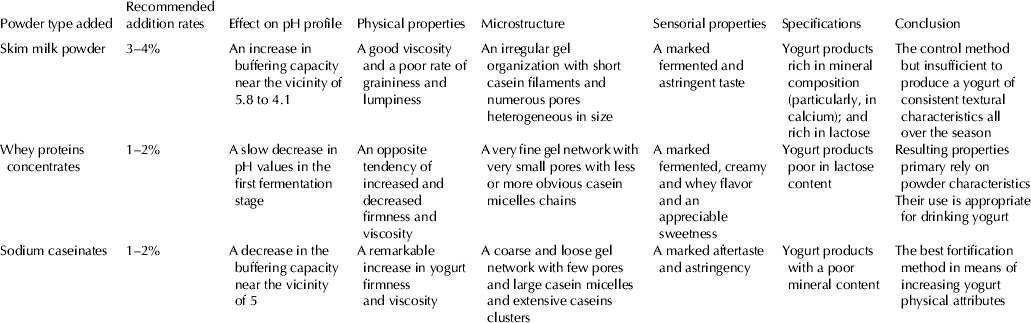
The Table 1 recapitulates the most common dairy powder listed above and used in yogurt formulation as well as their influence on product textural attributes.
Summary of the three most common dairy powders added in yogurt formulation and their main influences on products textural properties from Guzman-Gonzalez et al. Reference Guzmán-González, Morais, Ramos and Amigo1999; Gonzalez-Martinez et al. Reference González-Martínez, Becerra, Cháfer, Albors, Carot and Chiralt2002; Remeuf et al. Reference Remeuf, Mohammed, Sodini and Tissier2003; Isleten & Karagul-Yuceer, Reference Isleten and Karagul-Yuceer2006; Tamine & Robinson, Reference Tamime and Robinson2007; Isleten & Karagul-Yuceer, Reference Isleten and Karagul-Yuceer2008; Damin et al. Reference Damin, Alcântara, Nunes and Oliveira2009; Peng et al. Reference Peng, Serra, Horne and Lucey2009)
Addition of other dairy ingredients and protein blends
The addition of other dairy ingredients (than WP, casein and caseinates) has been reported during yogurt manufacture in some instance. The addition of milk protein hydrolysates (in the range of 0·3–0·5 g/100 g) (casein and whey) reduced the fermentation time, increased yogurt viscosity, decreased yogurt graininess and syneresis and resulted in a more open gel microstructure with fewer branched proteins (Sodini & Beal, Reference Sodini and Béal2003; Zhao et al. Reference Zhao, Wang, Zhao, Jiang and Chun2006; Tamime & Robinson, Reference Tamime and Robinson2007).The addition of casein hydrolysates stimulated the growth of Strep. thermophilus (Tamime & Robinson, Reference Tamime and Robinson2007) and enhanced the cell counts of probiotic microorganisms in yogurt (Oliveira et al. Reference Oliveira, Fernandes, Neto, Fonseca, Silva and Balian2002; Sodini et al. Reference Sodini, Lucas, Oliveira, Remeuf and Corrieu2002; McComas & Gilliland, Reference McComas and Gilliland2003; Lucas et al. Reference Lucas, Sodini, Monnet, Jolivet and Corrieu2004; Tamime & Robinson, Reference Tamime and Robinson2007). Furthermore, milk protein concentrates and isolates have been added to increase the protein content of yogurt mix (Chandan & Shahani, Reference Chandan and Shahani1995) and produced firm yogurts (Tamime & Robinson, Reference Tamime and Robinson2007). Addition of MPC improved viscosity and gel strength up to 100 and 50% respectively when comparing with SMP-fortified yogurts (Patel, Reference Patel2011). Fresh buttermilk powder was used up to 50% as a replacement of SMP in yogurt manufacture and produced an acceptable soft and smooth textured yogurt. The use of fresh buttermilk powder concentrated by ultrafiltration has also been reported in the literature. The yogurt products obtained present a denser matrix and a lower syneresis, but an impaired flavour and aroma (Sodini et al. Reference Sodini, Morin, Olabi and Jiménez-Flores2006; Tamime & Robinson, Reference Tamime and Robinson2007; Lee & Lucey, Reference Lee and Lucey2010).
Blends of different type of milk protein (such as SMP and sweet whey powder in a ratio of 75 : 25; whey and casein in a 1 : 1 ratio; CaCn and WP in a ratio of 1 : 1; SMP and WPC in a ratio of 1·5 : 0·5; and finally blends of NaCn and CaCn) have been used in yogurt manufacture and resulted in an overall good quality product in terms of sensory and texture profiles as well as extent of syneresis (González-Martínez et al. Reference González-Martínez, Becerra, Cháfer, Albors, Carot and Chiralt2002; Augustin et al. Reference Augustin, Cheng, Glagovskaia, Clarke and Lawrence2003; Tamime & Robinson, Reference Tamime and Robinson2007).
Conclusion
Miscellaneous dairy ingredients can be added to the yogurt milk bases for fortification purposes. These methods of milk protein enrichment will not have the same consequences on the protein and mineral composition of the milk base, the length of fermentation process, extent of proteins interactions and the microstructure of the coagulum. Fortification with SMP seems insufficient to produce yogurts of consistent physical properties over the entire season. Addition of WPC seems to be highly dependent on the specifications of the powders employed and appears definitely appropriate for drinking yogurt production. Addition of NaCn seems to be the most effective means of increasing yogurt textural characteristics. Lastly, using blends of different dairy ingredients in a proper ratio appears as a useful and interesting perspective for yogurt mix fortification.