Implications
The study tested the use of milk replacer (MR) containing probiotic cells as a feeding strategy able to reduce the negative effects of artificial rearing system on both the immune status of lamb and on the nutritional features of lamb meat. Lactobacillus acidophilus enhanced immune-regulatory functions, whereas Bifidobacterium animalis subsp. lactis and Bifidobacterium longum subsp. longum improved the humoral response in lambs. Meat from lamb fed MR containing probiotics showed an improved fatty acid profile for human diet in terms of higher conjugated 18:2n-6 content and lower saturated fatty acid content.
Introduction
In specialized dairy sheep flocks, lambs are separated at an early age from their dams and fed commercial milk replacer (MR) to increase the volume of milk destined for the production of cheese (Maiorano et al., Reference Maiorano, Ciarlariello, Cianciullo, Roychoudhury and Manchisi2009). Artificial rearing can result in altered endocrine and immune response, increased morbidity and poor production performance of lambs, because of the reduced ability of young animals to cope with emotional and nutritional stress arising from dietary change and separation from the ewe (Napolitano et al., Reference Napolitano, Marino, De Rosa, Capparelli and Bordi1995; Sevi et al., Reference Sevi, Napolitano, Casamassima, Annicchiarico, Quarantelli and De Paola1999).
From a dietetic point of view, artificial rearing can also lead to a less favorable profile of intramuscular fatty acid in lamb meat when compared with dam suckling. Indeed, evidence exists that milk source is a major factor affecting nutritional characteristics of meat in unweaned lambs because of differences in composition between ewe milk and MR (Napolitano et al., Reference Napolitano, Cifuni, Pacelli, Riviezzi and Girolami2002).
The use of MR containing microbial cells could represent a suitable feeding strategy to reduce negative effects of artificial rearing system on both immune status and on nutritional feature of lamb meat. In fact, microbial feed additives facilitate the establishment and maintenance of suitable microbial flora in the gastrointestinal tract (Agarwal et al., Reference Agarwal, Kamra, Chaudhary, Agarwal, Sahoo and Pathak2002). Probiotics can be defined as dietary supplements containing living microbes that are able to persist in, or transiently colonize, the intestinal lumen and have a beneficial influence on host physiology. Lactobacillus acidophilus, Streptococcus faecium, Lactobacillus casei, Lactobacillus fermentum and Lactobacillus plantarum are probiotics commonly fed to livestock, with the claim of enhancing animal performance including weight gain, feed efficiency, digestion and health (Lema et al., Reference Lema, Williams and Rao2001). Beneficial effects of probiotics are also ascribed to the prevention of pathogen proliferation, neutralization of enterotoxins produced in situ, modulation of bacterial enzyme activity, enhancement of the small intestine digestive ability and exertion of adjuvant effects on the immune system (Cruywagen et al., Reference Cruywagen, Jordaan and Venter1996; Sauter et al., Reference Sauter, Allenspach, Gaschen, Gröne, Ontsouka and Blum2005; Scharek et al., Reference Scharek, Guth, Reiter, Weyrauch K, Taras, Schwerk, Schierack, Schmidt, Wieler and Tedin2005; Anadón et al., Reference Anadón, Martínez-Larrañaga and Aranzazu Martínez2006).
Therefore, this study was undertaken to assess the effect of MR containing L. acidophilus and a mix of Bifidobacterium animalis subsp. lactis and Bifidobacterium longum subsp. longum on lamb immune response and on lamb meat quality, with particular respect to fatty acid profile of lamb meat.
Material and methods
Experimental design
The study lasted for 6 weeks and was conducted at the Segezia research station of the Agricultural Research Council (CRA-ZOE; Segezia, Foggia, Italy). A total of 40 male Comisana lambs were divided into four groups of 10 each, which were balanced for body weight (4.1 ± 0.1 kg) and type of birth (single or twin). All procedures were conducted in accordance with the guidelines of the Council Directive Communities 86/609/EEC of 24 November 1986 on the protection of animals used for experimental and other scientific purposes. Animals were subjected to one of four different feeding regimes: maternal milk (MM), MR, MR with L. acidophilus supplementation (MRL) and MR with a mix (1 : 1) of B. animalis subsp. lactis and B. longum subsp. longum supplementation (MRB). Probiotic strains were supplied by Mediterranea Biotecnologie (Termoli, Italy). The MM lambs were maintained with their dams throughout the study in a 3 m × 8 m straw-bedded pen, whereas the artificially reared lambs were maintained with their dams for 24 h to suck maternal colostrum. Subsequently, lambs were separated from their dams and housed in three different straw-bedded pens (3 m × 8 m) in the same building according to their feeding treatment.
Artificially reared lambs received a commercial MR (SIVAM, Milano, Italy) that was analyzed in accordance with the Association of Official Analytical Chemists (AOAC, 1990) standards, and had the following chemical composition: 47.9 g/kg crude protein, 45.1 g/kg fat, 2.3 g/kg neutral detergent fiber and 12.9 g/kg ash. Viable cells of each microorganism were added to the MR at a concentration of 7 log10 cfu/ml of milk. MR was administered three times a day (0700, 1200 and 1600 h) using graduated bottles provided with latex teats (one bottle for each individual lamb). Milk supplemented with probiotics was incubated at 37°C for 1 h before feeding the lambs, in order to ensure microbial viability. Samples of MR with added probiotics were analyzed three times a week during the whole trial on maltose MRS and cysteine MRS (Oxoid, Milan, Italy) for L. acidophilus and a mix of B. animalis subsp. lactis and B. longum subsp. longum, respectively. L. acidophilus and B. animalis subsp. lactis and B. longum subsp. longum reported counts of 7 ± 0.30 log10 cfu/ml in MR given to MRL and MRB, respectively. For the determination of milk fatty acids, lipids were extracted using the method described by Bligh and Dyer (Reference Bligh and Dyer1959). Gas chromatograph analysis was carried out as described for meat, although the temperature program for the column was different: 10 min at 100°C and a subsequent increase to 240°C at 3.5°C/min. Identification of fatty acids was carried out as described for meat. The CV for all fatty acids was on average 1.9% for intraassay and 3.8% for interassay.
Leptin and cholesterol levels in blood of lambs
Blood samples were collected from the lambs at 41 days of age and transported at 4°C to the laboratory, then centrifuged at 3000×g for 15 min at room temperature and the serum aliquots stored at −20°C before analyses. Serum leptin concentration was measured using an enzyme immunoassay kit by Spibio (Montigny le Bretonneux, France). The sensitivity of the assay was 50 pg/ml.
The determination of serum levels of cholesterol was carried out using a quantitative colorimetric determination kit by Bioassay Systems (Gentaur, Milano, Italy). The intra- and interassay CVs were 6.4% and 10.8%, respectively; the detection limit was 5 mg/dl.
Immune response
At 3, 21 and 41 days of age, in vivo skin test was performed by administering a phytohemagglutinin (PHA) injection, a mitogen able to induce a local lymphocyte T-cell response. A measure of 500 μg of PHA (Sigma-Aldrich, Milan, Italy) was dissolved in 500 μl of sterile saline solution (Bieffe Medital SpA, Grosotto, Sondrio, Italy) and injected intradermally into the center of two 2-cm-wide circles stamped on shaved skin in the upper side of each shoulder. Skin thickness (mm) was determined using a caliper before and 24 h after PHA injection.
The concentration of immunoglobulin (Ig)G anti-ovalbumin (OVA) at 11, 22, 31 and 41 days was determined by an enzyme-linked immunosorbent assay (ELISA) test as previously described by Sevi et al. (Reference Sevi, Caroprese, Annicchiarico, Albenzio, Taibi and Muscio2003). Plasma samples were read against a standard curve obtained using scalar dilution of ovine IgG (Sigma-Aldrich), according to Caroprese et al. (Reference Caroprese, Marzano, Entrican, Wattegeder, Albenzio and Sevi2009). Data were expressed as mg of anti-OVA IgG mg/ml.
Levels of interleukin (IL)-1β, IL-6 and IL-10 in plasma of lambs were determined at 4, 11, 22, 31 and 41 days of age by an indirect sandwich ELISA test according to Caroprese et al. (Reference Caroprese, Albenzio, Annicchiarico and Sevi2006 and Reference Caroprese, Marzano, Entrican, Wattegeder, Albenzio and Sevi2009). Plasma samples were read against a standard curve obtained using scalar dilution of recombinant ovine IL-1β and IL-6 (Centre for Animal Biotechnology, CAB-School of Veterinary Science, The University of Melbourne, Australia). Recombinant ovine IL-10 was provided by the Biotechnology and Biological Sciences Research Council/Rural and Environment Research and Analysis Directorate (BBSRC/RERAD; Edinburgh, Scotland, Immunological Toolbox). Data on IL-10 were expressed as biological units/ml as described by Kwong et al. (Reference Kwong, Hope, Thom, Sopp, Duggan, Bembridge and Howard2002).
Lamb slaughter and meat analyses
On the morning of slaughtering, after 12 h of fasting, animals were transported to a commercial slaughter facility. Lambs were slaughtered according to the European Union rule no. 119/1993. M. longissimus dorsi (from the seventh thoracic to the first lumbar vertebrae) was collected from the right side of each carcass. Samples were vacuum packaged and stored at −20°C until analyses. Each sample of muscle was thawed and ground using a food processor (Ultra-Turrax, T18 Basic, Steroglass, Perugia, Italy) for 120 s at 15 000×g under refrigerated conditions. Moisture, protein and lipid contents in each sample were determined according to AOAC methods (1995).
Meat intramuscular fat was extracted according to the method described by Folch et al. (Reference Folch, Lees and Stanley1957). Gas chromatograph analysis was performed using an Agilent 6890N instrument equipped with a CP-Sil 88 fused-silica capillary column (length 100 m, internal diameter 0.25 mm, film thickness 0.25 μm; Supelco, Italy) as described by Marino et al. (Reference Marino, Albenzio, Annicchiarico, Caroprese, Muscio, Santillo and Sevi2008). Briefly, helium flow rate was 0.7 ml/min; Flame Ionization Detector at 260°C; split–splitless injector at 220°C with an injection rate of 120 ml/min and an injection volume of 1 μl. The temperature program of the column was as follows: 4 min at 140°C and a subsequent increase to 220°C at 4°C/min. Individual Fatty Acid Methyl Esters peaks were identified by comparing their retention times with those of standards (Sigma-Aldrich). Fatty acids were expressed as a percentage of the total methylated fatty acids. The CV for all fatty acids was on average 1.5% for intraassay and 3.1% for interassay.
Meat levels of cholesterol were determined using a quantitative colorimetric kit (BioVision, California, USA). Samples were read using a UV–Vis spectrophotometer (Lambda 25, PerkinElmer Inc., Waltham, MA, USA) at 570 nm. Samples were read against a standard curve obtained using scalar dilution of cholesterol standard. The intra- and interassay coefficients of variation were 5.8% and 9.8%, respectively.
Statistical analysis
All the variables were tested for normal distribution using the Shapiro–Wilk test (Shapiro and Wilk, Reference Shapiro and Wilk1965) and transformed to the logarithm form to normalize their frequency distribution, when necessary.
Data on immune response were processed by analysis of variance for repeated measures of SAS (1999).
The following model was used (equation 1):

where μ is the overall mean, α is the effect of feeding regime (i = 1 to 4), β is the individual animal variation within feeding regime, γ is the effect of day of sampling, αγ is the interaction of feeding regime × day of sampling and ε is the error. For humoral response, and cell-mediated immune response measures at the beginning of the experiments were used as covariates.
Data on chemical composition and fatty acid profile of milk and lamb meat were processed by analysis of variance using the following model (equation 2):

where μ is the overall mean, α is the effect of feeding regime (i = 1 to 4 ), β is individual animal variation within feeding regime and ε is the error. When significant effects were found (at P < 0.05), the Student's t-test was used to locate significant differences between means.
Results
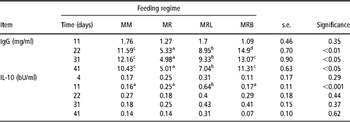
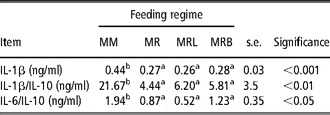
Lambs fed MR containing a mix of B. animalis subsp. lactis and B. longum subsp. longum showed the highest in vivo cellular immune response to PHA (3.83 ± 0.30 mm v. 2.48 ± 0.30, 2.75 ± 0.30 and 2.34 ± 0.30 in MRB, MM, MR and MRL, respectively; P < 0.05) at 41 days of age. The antibody titers to OVA and IL-10 content detected in blood of lambs subjected to different feeding regimes is reported in Table 1. The effect of treatment on humoral immunity evidenced that MR lambs showed the lowest antibody response to OVA, MRL showed intermediate levels and MM and MRB showed the highest values during the trial. At day 11 of the trial, MRL displayed the highest value of IL-10, whereas differences disappeared among groups subsequently. Mean values of pro-inflammatory cytokines IL-1β and the ratio IL-1β/IL-10 and IL-6/IL-10 are reported in Table 2. Mean value of IL-1β was influenced by the feeding regime, being the highest in lambs receiving MM. No differences (P = 0.46) were detected in IL-6 among groups during the trial. The ratio of IL-1β/IL-10 and IL-6/IL-10 was the highest in lambs fed MM. Leptin and cholesterol levels in lamb serum and cholesterol level in meat of lambs subjected to different feeding regimes at 41 days of age are reported in Table 3. No differences were found in blood leptin content among the tested feeding regimes. Cholesterol in blood was lower in MRL, intermediate in MRB and higher in MM and MR lambs. Cholesterol in meat was not different among treatments; however, this parameter tended to be lower in the meat from lambs fed MR supplemented with probiotics.
Least squared means of antibody titers to OVA and IL-10 content detected in blood of lambs subjected to different feeding regimes

OVA = ovalbumin; IL = interleukin; MM = maternal milk; MR = milk replacer; MRL = milk replacer supplemented with Lactobacillus acidophilus; MRB = milk replacer supplemented with a mix of Bifidobacterium animalis subsp. lactis and Bifidobacterium longum subsp. longum; Ig = immunoglobulin.
a,b,c,dMean values followed by different letters were significantly different (P < 0.05).
Mean values of IL-1β, IL-1β/IL-10 and IL-6/IL-10 ratios in blood of lambs subjected to different feeding regimes

IL = interleukin; MM = maternal milk; MR = milk replacer; MRL = milk replacer supplemented with Lactobacillus acidophilus; MRB = milk replacer supplemented with a mix of Bifidobacterium animalis subsp. lactis and Bifidobacterium longum subsp. longum.
a,bMean values followed by different letters were significantly different (P < 0.05).
Leptin and cholesterol detected in serum, and cholesterol detected in meat of lambs subjected to different feeding regimes at 41 days of age

MM = maternal milk; MR = milk replacer; MRL = milk replacer supplemented with Lactobacillus acidophilus; MRB = milk replacer supplemented with a mix of Bifidobacterium animalis subsp. lactis and Bifidobacterium longum subsp. longum.
a,bMean values followed by different letters were significantly different (P < 0.05).
The chemical composition of meat was not affected by the feeding regime. Mean values of fat, protein and moisture were 4.1 ± 0.4%, 20.24 ± 0.30% and 74.58 ± 0.45%, respectively, in lamb meat.
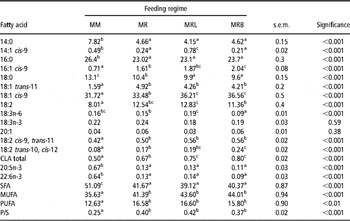
Fatty acid composition of meat in lambs subjected to different feeding regimes is reported in Table 4. Higher contents of fatty acids, 14:0, 16:0 and 18:0, were found in the meat of lamb fed ewe milk compared with those receiving MR. MR was characterized by higher levels (P < 0.001) of trans-11 18:1, cis-9 18:1 and 18:2n-6 than ewe milk (data not shown). Accordingly, trans-11 18:1 and 18:2n-6 were 2.8 and 1.5 times higher, respectively, in the meat of artificially reared lambs than in the meat of dam-suckled lambs. Furthermore, total conjugated linoleic acid (CLA) was the lowest in MM, intermediate in MR and the highest in MRL and MRB meat. A major content of eicosapentaenoic acid and docosahexaenoic acid was found in meat from MM lambs, being fivefold higher than those found in artificially reared lambs. Overall, fatty acid profile was different depending on the feeding regimes, showing the highest level of saturated fatty acid (SFA) in MM, intermediate level in MR and the lowest level in MRL and MRB. Higher levels of unsaturated fatty acids were found in meat from lambs fed MR with and without probiotics.
Fatty acid composition (g/100 g total fatty acids) of meat in lambs subjected to different feeding regimes

MM = maternal milk; MR = milk replacer; MRL = milk replacer supplemented with Lactobacillus acidophilus; MRB = milk replacer supplemented with a mix of Bifidobacterium animalis subsp. lactis and Bifidobacterium longum subsp. longum; CLA = conjugated linoleic acid; SFA = saturated fatty acid; MUFA = mono unsaturated fatty acid; PUFA = polyunsaturated fatty acid; P/S = low ratio of PUFAs to SFAs.
a,b,cMean values followed by different letters were significantly different (P < 0.05).
.
Discussion
Separation from the mother and the transition from feeding on MM to MR represent critical events in the early stages of lambs’ life, thus resulting in altered endocrine and immune response, increased morbidity and poor production performance of lambs (Sevi et al., Reference Sevi, Napolitano, Casamassima, Annicchiarico, Quarantelli and De Paola1999; Napolitano et al., Reference Napolitano, Caroprese, Girolami, Marino, Muscio and Sevi2006). Dietary probiotic supplements lead to bacterial colonization of the gut enhancing digestive ability and systemic immune system. In particular, oral delivery of different strains of Lactobacillus spp. has been shown to confer an increased ability to the splenic lymphocytes to proliferate in response to T- and B-cell mitogenic stimulation (Gill and Cross, Reference Gill and Cross2002). Sevi et al. (Reference Sevi, Napolitano, Casamassima, Annicchiarico, Quarantelli and De Paola1999) and Napolitano et al. (Reference Napolitano, Cifuni, Pacelli, Riviezzi and Girolami2002) found a reduced cell-mediated response in artificially reared lambs compared with mother-suckling lambs. In this study, the results of lymphocyte responsiveness to stimuli suggest the role of bifidobacteria in sustaining cell-mediated and humoral immunity in artificially reared lambs.
Secretion of IL-10 may provide an important regulatory function for the control of immune inflammatory status. The peak value of IL-10 in MRL lambs at day 11 could be interpreted as an enhanced immune-regulatory function because of the presence of L. acidophilus. The upregulation of IL-10 leads to a decrease in pro-inflammatory/regulatory cytokines ratio. In the long term, upregulation of IL-10 may reduce inflammatory process and help to reestablish a normal immune balance (Sherman and Kalman, Reference Sherman and Kalman2004). Probiotics can exert their immune-modulatory function by acting on IL-10 secretion with a species-specific action (Niers et al., Reference Niers, Timmerman, Rijkers, Van Bleek, Van Uden, Knol, Kapsenberg, Kimpen and Hoekstra2005). Higher IL-10 levels were found in cells of the large intestine of mice fed viable L. acidophilus CRL 730, compared with unfed control group, also showing a dose-dependent effect (Galdeano and Perdigón, Reference Galdeano and Perdigón2004).
Feeding regime affected the IL-1β/IL-10 and IL-6/IL-10 ratios, with the highest levels being found in MM lambs, showing that, in lambs fed MM, the regulatory process by IL-10 was less active than in the other groups. Such ratios reflect the balance or imbalance of the immune profile that eventually influences intestinal inflammation in the gastrointestinal tract (Sauter et al., Reference Sauter, Allenspach, Gaschen, Gröne, Ontsouka and Blum2005). A possible explanation for this result could be ascribed to a major exposure of MM lambs to environmental microorganisms, because of the restraint in the pen together with their dams.
Delavaud et al. (Reference Delavaud, Bocquier, Chilliard, Keisler, Gertler and Kann2000) reported that plasma leptin content is positively correlated with the body fat in ewes. The lack of differences in serum leptin content among groups probably was a consequence of the low fat depots owing to the young age of lambs. Data from in vitro studies show that some strains of L. acidophilus and B. longum subsp. longum can take up cholesterol into their cellular membrane (Pereira and Gibson, Reference Pereira and Gibson2002) and make it unavailable for absorption into the blood stream. In the present trial, serum cholesterol was affected by probiotic supplementation: the addition of L. acidophilus to MR caused halving of the cholesterol concentration with respect to that found in lambs fed MM and MR without probiotic supplementation. The extent of plasma cholesterol reduction, in the present trial, was 25% higher than that reported by Lubbadeh et al. (Reference Lubbadeh, Haddadin, Al-Tamimi and Robinson1999) in Awassi lambs. This result could be attributed to the different ways of probiotic supplementation. The administration of viable microbial cells instead of enteric capsules of freeze-dried culture could result in a more rapid and effective colonization of the gastrointestinal tract, which in turn play a role in controlling serum cholesterol. It was reported that L. acidophilus was capable of breaking down cholesterol molecule (Lys and Gilliland, Reference Lys and Gilliland1994). In addition, the use of bifidobacteria caused a slight reduction, although not significant, in the serum cholesterol levels of MRB lambs with respect to MM and MR without probiotic supplementation. In previous study, Lubbadeh et al. (Reference Lubbadeh, Haddadin, Al-Tamimi and Robinson1999) found that dietary supplementation of L. acidophilus led to a reduction of 20% in meat cholesterol content of lambs slaughtered at 120 days compared with the control. In this study, differences in blood cholesterol did not lead to differences in cholesterol content in lamb meat, although MRL and MRB lambs tended to have lower levels in their meat than lambs from the other groups.
Intramuscular fatty acid composition in ruminants is influenced by biohydrogenation in the rumen; nevertheless, meat fatty acid composition of suckling lambs mainly reflects the composition of the milk they consume (Zygoyiannis et al., Reference Zygoyiannis, Kufidis, Katsaounis and Phillips1992; Velasco et al., Reference Velasco, Caneque, Perez, Lauzurica, Diaz, Huidobro, Manzanares and Gonzalez2001). The supplementation of CLA itself, or its precursor trans-11 18:1, is effective in elevating the CLA content in meat (Schmid et al., Reference Schmid, Collomb, Sieber and Bee2006). Higher levels of trans-11 18:1 in MR could be responsible for higher CLA content in the meat of artificially reared lambs compared with dam-suckled lambs. Moreover, the highest total CLA content found in MRL and MRB could be explained by the metabolic pattern associated with probiotics, which leads to the production of CLA. Several studies have investigated the bioproduction of CLA by various lactobacilli and bifidobacteria (Alonso et al., Reference Alonso, Cuesta and Gilliland2003; Coakley et al., Reference Coakley, Ross, Nordgren, Fitzgerald, Devery and Stanton2003).
Lamb meat is valuable from a nutritional point of view for its high CLA content, which can exert positive effects on human health (Schmid et al., Reference Schmid, Collomb, Sieber and Bee2006). The proportion of SFA and unsaturated fatty acid in meat obtained from lambs subjected to different regimes highlights a better fatty acid profile in meat obtained from artificially reared lambs from a nutritional and health-promoting point of view. In particular, unsaturated fatty acids are considered hypolipidemic as they reduce both plasma cholesterol and triglycerides, and a low intake of saturated fat and an increased polyunsaturated to SFA ratio are associated with a lower risk of human coronary heart disease (Oriani et al., Reference Oriani, Maiorano, Filetti, Di Cesare, Manchisi and Salvatori2005).
Conclusions
The addition of L. acidophilus and a mix of B. animalis subsp. lactis and B. longum subsp. longum to MR played a role in modulating the immune functions in lambs. In particular, L. acidophilus enhanced immune-regulatory functions, whereas B. animalis subsp. lactis and B. longum subsp. longum improved the humoral response in lambs. Meat from artificially reared lamb fed MR containing probiotics showed an improved fatty acid profile for human diet, in terms of higher CLA and lower SFA content.