





Introduction
Cancer remains one of the leading causes of morbidity and mortality worldwide, accounting for nearly 10 million deaths annually according to the World Health Organization (Sung et al. Reference Sung, Ferlay and Siegel2021; World Health Organization 2023). Cancer is a chronic condition requiring long-term management due to advances in early diagnosis and therapeutic strategies that have improved survival rates (Allemani et al. Reference Allemani, Matsuda and Di Carlo2018). As survival improves, attention has been directed toward patient-reported outcomes, which are recognized as essential components of comprehensive oncology care (Basch et al. Reference Basch, Deal and Dueck2017). Among the subjective outcomes, treatment satisfaction represents an important construct reflecting patients’ evaluation of treatment effectiveness, tolerability, convenience, and interaction with healthcare providers (Atkinson et al. Reference Atkinson, Sinha and Hass2004). Higher treatment satisfaction has been associated with better adherence, improved engagement in care, and more favorable clinical outcomes (DiMatteo Reference DiMatteo2004; Barbosa et al. Reference Barbosa, Balp and Kulich2012). In oncology settings, where treatments are often prolonged and associated with significant physical and psychological burden, dissatisfaction may negatively influence adherence and overall well-being (Linden et al. Reference Linden, Vodermaier and Mackenzie2012). Furthermore, treatment satisfaction has been shown to correlate positively with quality of life and perceived social support, and negatively with anxiety and depressive symptoms (Nakie et al. Reference Nakie, Melkam and Takelle2024). For these reasons, assessment of subjective views of patients on their treatment satisfaction is useful and relevant.
From a theoretical perspective, treatment satisfaction can be understood within patient-centered care (Edgman-levitan and Schoenbaum Reference Edgman-levitan and Schoenbaum2021) and cognitive appraisal frameworks (Folkman Reference Folkman2020), which posit that patients evaluate medical treatment not only based on clinical effectiveness but also through subjective interpretations of symptom burden, emotional response, and alignment with personal and social expectations (Laferton et al. Reference Laferton, Kube and Salzmann2017). These processes are likely to vary across cultural contexts, where beliefs about illness, authority of medical professionals, family involvement, and expression of distress shape how treatment is perceived and evaluated (Khashaba et al. Reference Khashaba, Brett and Warner2025).
Several instruments have been developed to assess treatment satisfaction in oncology, including the Treatment Satisfaction Questionnaire for Medication (TSQM), the Cancer Therapy Satisfaction Questionnaire (CTSQ), and the Patient Satisfaction with Cancer Care (PSCC). While these instruments contribute meaningfully to the assessment of patient experience, certain limitations remain. The TSQM, although psychometrically robust, was designed as a general measure of medication satisfaction across chronic conditions and does not specifically address cancer-related treatment complexity (Atkinson et al. Reference Atkinson, Sinha and Hass2004). The CTSQ was developed to evaluate patients’ expectations, feelings about side effects, and satisfaction with cancer therapy; however, it includes multiple conceptual domains that extend beyond global treatment satisfaction and may reflect emotional appraisal rather than pure satisfaction with treatment itself (Abetz et al. Reference Abetz, Coombs and Keininger2005). Similarly, the PSCC primarily assesses satisfaction with cancer care delivery processes, including coordination and communication within healthcare systems, rather than direct evaluation of treatment effectiveness or tolerability (Jean-pierre et al. Reference Jean-pierre, Fiscella and Griggs2010). Consequently, these instruments may emphasize healthcare service experience or multidimensional perceptions rather than a concise assessment of overall treatment satisfaction.
A measure that addresses these limitations is the Functional Assessment of Chronic Illness Therapy–Treatment Satisfaction (FACIT-TS) Questionnaire, which was developed within the FACIT measurement system – a well-established framework widely implemented in oncology research and clinical trials (Cella et al. Reference Cella, Tulsky and Gray1993). The FACIT system was designed to provide standardized, patient-centered assessments across chronic illnesses, with particular emphasis on cancer-related outcomes (Webster et al. Reference Webster, Cella and Yost2003). In this context, the FACIT-TS was developed to offer a concise and clinically applicable measure of treatment satisfaction tailored to chronic and cancer-related therapies. Unlike broader service-based instruments, it focuses directly on patients’ evaluation of treatment effectiveness and tolerability, while maintaining conceptual alignment with quality-of-life domains and symptom burden measures within the FACIT framework (Cella et al. Reference Cella, Tulsky and Gray1993). The scale is brief and easily administered, which enhances feasibility in routine oncology settings and large-scale research studies (Webster et al. Reference Webster, Cella and Yost2003). Previous work has demonstrated that FACIT-based instruments generally exhibit strong psychometric performance across diverse cancer populations, including adequate internal consistency, construct validity, and sensitivity to clinical outcomes (Cella et al. Reference Cella, Tulsky and Gray1993). To date, validation of the FACIT-TS Scale has been reported in Serbian populations, based on samples of patients with cancer, where the instrument demonstrated a unidimensional factor structure, satisfactory reliability, and adequate construct validity, with significant correlations observed between treatment satisfaction and related patient-reported outcomes (Radovic et al. Reference Radovic, Krdzic and Jovanovic2023). However, cross-cultural validation of the FACIT-TS in Arabic-speaking populations remains limited, which may restrict its applicability in non-Western contexts.
Cross-cultural validation is essential to ensure conceptual equivalence and avoid measurement bias when adapting patient-reported outcome (PRO) instruments to new linguistic and cultural contexts (Beaton et al. Reference Beaton, Bombardier and Guillemin2000). The absence of validated Arabic instruments assessing treatment satisfaction limits comprehensive clinical assessment and restricts research comparability across populations. Arabic is spoken by more than 400 million individuals worldwide (United Nations), and the burden of cancer is increasing in Middle Eastern and North African countries (Hofmarcher et al. Reference Hofmarcher, Manzano Garcia and Wilking2023). Given the increasing cancer burden in Arabic-speaking countries, the absence of validated Arabic instruments assessing treatment satisfaction represents a significant methodological gap. Importantly, Arabic-speaking populations are not culturally homogeneous; differences in healthcare systems, socioeconomic conditions, dialects, and cultural norms regarding illness disclosure and emotional expression may influence how patients interpret and respond to treatment satisfaction items, further justifying the need for context-specific validation (Al-huseini and Arafat Reference Al-huseini and Arafat2025).
Therefore, the objective of this study was to examine the psychometric properties of the FACIT-TS in Arabic and to assess factors associated with TS scores. We hypothesized that the Arabic FACIT-TS would demonstrate a unidimensional structure, satisfactory internal consistency, positive correlations with quality of life and social support, negative correlations with psychological distress, and measurement invariance across gender. These hypotheses were derived from (1) the original theoretical model of the FACIT system, which conceptualizes treatment satisfaction as a unidimensional patient-reported evaluation embedded within broader quality-of-life constructs (Cella et al. Reference Cella, Tulsky and Gray1993; Webster et al. Reference Webster, Cella and Yost2003), and (2) empirical evidence from prior validation studies in non-Arabic populations, which consistently reported associations with psychosocial functioning indicators and structural stability across demographic groups (Webster et al. Reference Webster, Cella and Yost2003; Radovic et al. Reference Radovic, Krdzic and Jovanovic2023).
Method
Study design and participants
This study is a cross-sectional questionnaire that was conducted from February to July 2025. Patients with a confirmed cancer diagnosis across Lebanon were contacted using convenience and snowball sampling techniques to answer a confidential online survey. Recruitment was based on a clinical rather than a community level. Participants were recruited via a network of patients, advocacy groups, and through messaging services and were asked to send the survey link to other members who are eligible to participate in the study. Although recruitment targeted patients from different regions in Lebanon, the nonprobabilistic nature of the sampling strategy may limit the representativeness of the sample and increase the risk of selection bias, particularly toward participants with greater digital access and engagement. The inclusion criteria were the following: (1) adult patients (≥18 years old) with a confirmed diagnosis of cancer (solid or hematologic), (2) patients currently undergoing or who had previously undergone cancer treatment, (3) Lebanese, and residing in Lebanon. The exclusion criteria were as follows: Patients under 18 years old. Participants were sent an online Google Forms link of the survey through messaging apps. It was clarified to the partakers that participation in this study is entirely voluntary and anonymous. The participants were not offered any monetary compensation. Accordingly, the findings should be interpreted within the Lebanese oncology context and not assumed to be representative of all Arabic-speaking oncology populations.
Ethical approval
The study was approved by the ethical committee of the Notre Dame des Secours – University Hospital. Participants provided electronic informed consent prior to the start of the survey; submission of the form was considered documentation of consent, per ethics committee approval. All methods were performed in line with the relevant guidelines and regulations.
Minimal sample size calculation
A minimum sample of 180 participants was deemed adequate to run the confirmatory factor analysis (CFA) following Monte Carlo simulations using different seed values and factor loadings (Marcoulides and Chin Reference Marcoulides and Chin2013).
Questionnaire
Consent to participate in the survey was requested in the first question. The initial section of the survey included data related to variables linked to the aim of this study. The questionnaire was administered in Arabic. It was filled out anonymously and took participants around 10–15 minutes to complete.
Demographic and clinical data
The variables assessed consisted of age, gender, marital status, education level, work status, monthly salary, cancer type diagnosis, years since the diagnosis, disease stage, current type of treatment (chemotherapy or immunotherapy), health insurance type, side effects, and other comorbidities.
Treatment satisfaction, financial toxicity, and quality of life were assessed using the FACIT-TS measurement system.
Functional Assessment of Chronic Illness Therapy–Treatment Satisfaction–General (FACIT-TS-G)
Treatment satisfaction was assessed using the 8-item FACIT-TS-G, which evaluates patients’ satisfaction with their current treatment. Items are rated on a 5-point Likert scale ranging from 1, indicating “very dissatisfied” to 5, indicating “very satisfied”; for example, one item asked, “I am satisfied with the effectiveness of my current treatment.” The FACIT measures have showcased strong psychometric properties, including internal consistency reliability and construct validity across diverse cancer populations (Webster et al. Reference Webster, Cella and Yost2003). The Arabic version of the FACIT-TS-G used in this study was obtained from the official FACIT translation database.
Quality of life was assessed using the Functional Assessment of Cancer Therapy–General 7-item version (FACT-G7), an instrument developed within the FACIT measurement system to evaluate overall well-being in patients with cancer. The scale includes 7 items covering physical, emotional, and functional aspects of quality of life. Each item is rated on a Likert scale, with higher scores indicating better quality of life. The FACT-G7 has been shown to be a reliable and valid measure in oncology populations, demonstrating good internal consistency and construct validity across different clinical settings. The Arabic version of both scales was obtained from the official FACIT measurement system website.
Psychological distress was evaluated using the Patient Health Questionnaire-4 (PHQ-4) (Kroenke et al. Reference Kroenke, Spitzer and Williams2009), a brief screening tool. Each of the 4 items is rated on a 4-point Likert scale ranging from 0 (not at all) to 3 (nearly every day). An example item includes, “Feeling nervous, anxious, or on edge.” The scores for all items are summed, with higher total scores indicating greater psychological distress. The PHQ-4 is a screening tool that combines the 2-item Generalized Anxiety Disorder scale and the 2-item Patient Health Questionnaire depression scale. The PHQ-4 has been validated as a reliable and efficient tool for assessing symptoms of anxiety and depression in both clinical and research settings. The Arabic-validated version of the PHQ-4 was used in this study (Obeid et al. Reference Obeid, Hemade and Malaeb2024) (Cronbach’s α in this study = 0.89).
Social support was measured using the Multidimensional Scale of Perceived Social Support (MSPSS) (Zimet et al. Reference Zimet, Powell and Farley1990). This 12-item instrument evaluates perceived emotional support from family, friends, and significant others. Items are scored on a 7-point Likert scale (1 = very strongly disagree, 7 = very strongly agree). The Arabic-validated version of the MSPSS was used in this study (Fekih-romdhane et al. Reference Fekih-romdhane, Fawaz and Hallit2023) (Cronbach’s α in this study = 0.98).
Statistical analysis
Data analyses were conducted using the R software (Jorgensen et al. Reference Jorgensen, Pornprasertmanit and Schoemann2025; Rosseel Reference Rosseel2012). Because the FACIT-TS-G items are ordinal and exhibited nonnormal distributions, CFA was performed using the weighted least squares mean- and variance-adjusted estimator (Li Reference Li2016). Model fit was evaluated using multiple indices, including the Comparative Fit Index (CFI) and Tucker–Lewis Index (TLI), with values ≥0.90 indicating excellent fit, and the Root Mean Square Error of Approximation (RMSEA) and Standardized Root Mean Square Residual (SRMR), with values ≤0.08 considered acceptable (Byrne Reference Byrne2013). Internal consistency was assessed using McDonald’s ω and Cronbach’s α coefficients, with values higher than 0.70 reflecting adequate internal consistency (Nunnally and Bernstein Reference Nunnally and Bernstein1994). Convergent validity was evaluated by calculating the average variance extracted (AVE) (Malhotra et al. Reference Malhotra, Hall and Shaw2006). Measurement invariance across gender was examined sequentially at the configural, metric, scalar, and strict levels by comparing changes in CFI, RMSEA, and SRMR, with established cutoffs used to determine invariance (Chen Reference Chen2007). Group differences in FACIT-TS-G scores were examined using the independent-samples t test due to normal score distributions as verified by skewness and kurtosis values varying between −1 and +1 (Hair et al. Reference Hair, Hult and Ringle2021). Criterion validity was assessed using Pearson correlation coefficients. Statistical significance was set at p < 0.05.
Results
Participants’ characteristics are summarized in Table 1. In total, 308 participants completed the questionnaire, with 58.4% females and a mean age of 47.92 years. The full description of the sample is in Table 1.
Sociodemographic and other characteristics of participants (N = 308)

Table 1 Long description
Counts with percentages are reported for gender, marital status, and education level, and mean with standard deviation is reported for age and five scale measures. Gender included 128 males at 41.6 percent and 180 females at 58.4 percent. Marital status included 117 single, divorced, or widowed at 38.0 percent and 191 married or in a relationship at 62.0 percent. Education level included 43 primary at 14.0 percent, 60 complementary at 19.5 percent, 61 secondary at 19.8 percent, and 144 university at 46.8 percent. Mean age in years was 47.92 with a standard deviation of 17.88. Household Crowding Index in person per room was 1.16 with a standard deviation of 0.69, treatment satisfaction was 13.85 with a standard deviation of 5.04, quality of life was 14.15 with a standard deviation of 3.97, psychological distress was 6.00 with a standard deviation of 3.25, and social support was 58.15 with a standard deviation of 20.34.
Confirmatory factor analysis (CFA)
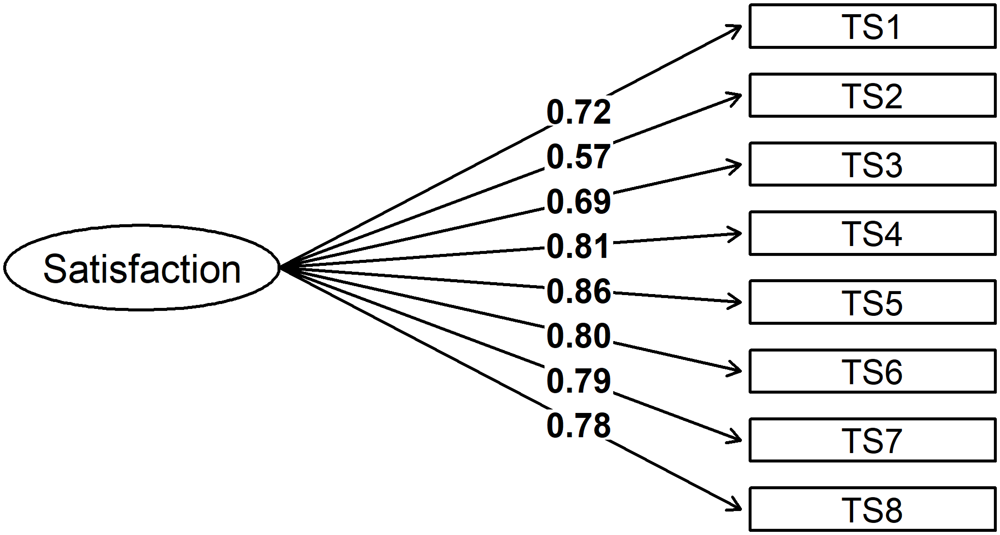
The fit indices of the 1-factor model were acceptable (X 2 (20) = 47.86, p < 0.001; RMSEA = 0.067 (90% CI 0.043, 0.092), SRMR = 0.048, CFI = 0.995, TLI = 0.993). Standardized factor loadings were also good (Figure 1). Cronbach’s α and McDonald’s ω were both 0.87, indicating high internal consistency in the present sample. The AVE value (= 0.57) was satisfactory.
Standardized loading factors deriving from the CFA of the 1-factor model of the FACIT-TS Scale in Arabic.

Gender invariance
Measurement invariance was supported across genders at all levels (Table 2). No difference in TS scores was found between males (mean = 13.74, SD = 5.18) and females (mean = 13.92, SD = 4.95), t(306) = −0.31, p = 0.758, Cohen’s d = 0.036.
Measurement invariance of the 1-factor model of the FACIT-TS Scale in Arabic across sexes

Table 2 Long description
Measurement invariance results are listed for four models, with fit indices CFI, RMSEA, and SRMR, plus a model comparison column and change values for CFI, RMSEA, and SRMR between nested models. Configural model fit is CFI 0.994, RMSEA 0.076, and SRMR 0.058, with no comparison values shown. Metric model fit is CFI 0.992, RMSEA 0.083, and SRMR 0.065; the comparison, Configural vs metric, reports changes of 0.002 for CFI, 0.007 for RMSEA, and 0.007 for SRMR. Scalar model fit is CFI 0.996, RMSEA 0.056, and SRMR 0.058; the comparison, Metric vs scalar, reports changes of 0.004 for CFI, 0.027 for RMSEA, and 0.007 for SRMR. Strict model fit is CFI 0.994, RMSEA 0.060, and SRMR 0.065; the comparison, Scalar vs strict, reports changes of 0.002 for CFI, 0.004 for RMSEA, and 0.007 for SRMR.
CFI = Comparative Fit Index; RMSEA = Root Mean Square Error of Approximation; SRMR = Standardized Root Mean Square Residual. Measurement invariance was evaluated using changes in fit indices between nested models.
Criterion validity
Higher TS scores were significantly associated with better quality of life, lower psychological distress, and greater perceived social support (Table 3).
Correlation matrix

Table 3 Long description
Pearson correlation coefficients are listed for treatment satisfaction, quality of life, psychological distress, and social support, with ones on the diagonal. Treatment satisfaction correlates 0.16 with two asterisks with quality of life, minus 0.27 with three asterisks with psychological distress, and 0.28 with three asterisks with social support. Quality of life correlates 0.18 with two asterisks with psychological distress and 0.32 with three asterisks with social support. Psychological distress correlates minus 0.04 with social support. Asterisks mark statistical significance levels noted in the surrounding text.
** p < 0.01; ***p < 0.001. Numbers in the table refer to Pearson correlation coefficients (r).
Discussion
The present study aimed to validate the Arabic version of the FACIT-TS among patients with cancer. Overall, the findings supported its psychometric robustness. The CFA supported a unidimensional structure with satisfactory fit indices, consistent with recommended model fit thresholds in structural equation modeling (Byrne Reference Byrne2013). The scale demonstrated good internal consistency, exceeding recommended reliability standards (Nunnally and Bernstein Reference Nunnally and Bernstein1994). Measurement invariance across gender was evidenced using established invariance testing procedures (Chen Reference Chen2007). Furthermore, TS scores were positively associated with quality of life and social support, and negatively associated with psychological distress, supporting criterion-related validity.
The CFA results confirmed the 1-factor structure of the Arabic FACIT-TS, consistent with the theoretical conceptualization of treatment satisfaction as a global construct reflecting patients’ overall evaluation of their treatment experience (Atkinson et al. Reference Atkinson, Sinha and Hass2004). Standardized factor loadings were adequate, indicating meaningful contribution of each item to the latent construct (Kline Reference Kline2023). These findings are consistent with the structure of the original instrument developed within the FACIT framework (Cella et al. Reference Cella, Tulsky and Gray1993). A similar unidimensional structure was also reported in the Serbian validation of the FACIT-TS, which demonstrated satisfactory psychometric performance in Serbian-speaking patients with cancer (Radovic et al. Reference Radovic, Krdzic and Jovanovic2023). The consistency of factorial structure across different linguistic and cultural contexts suggests that treatment satisfaction, as measured by the FACIT-TS, represents a stable construct that can be reliably assessed across populations. This supports the cross-cultural structural validity of the scale within the Lebanese oncology context and further reinforces the applicability of the Arabic version in similar Arabic-speaking clinical settings.
Internal reliability of the Arabic FACIT-TS was satisfactory, with Cronbach’s α and McDonald’s ω exceeding the recommended cutoff of 0.70 (Nunnally and Bernstein Reference Nunnally and Bernstein1994), indicating adequate homogeneity among the items and suggesting that the scale consistently measures treatment satisfaction in this population. These findings are consistent with the reliability reported for the original FACIT-TS developed within the FACIT framework (Cella et al. Reference Cella, Tulsky and Gray1993). Similar reliability levels were also observed in the Serbian validation of the FACIT-TS, which demonstrated satisfactory psychometric properties among Serbian-speaking patients with cancer (Radovic et al. Reference Radovic, Krdzic and Jovanovic2023). The consistency of reliability indices across studies further supports the stability of the construct and the reliability of the Arabic FACIT-TS in assessing treatment satisfaction among patients with cancer.
Measurement invariance across sex was supported at configural, metric, scalar, and strict levels following recommended procedures for multigroup CFA (Chen Reference Chen2007). This indicates that the construct of treatment satisfaction is interpreted similarly by male and female patients, allowing meaningful comparisons between groups. To our knowledge, measurement invariance has not been systematically evaluated in previous validations of the FACIT-TS, including the Serbian validation, highlighting an additional methodological strength of the present study. Furthermore, no significant difference in TS scores was observed between male and female patients in our sample. This finding suggests that treatment satisfaction may be perceived similarly across sexes in this population. Establishing invariance is essential in psychometric validation to ensure that observed differences are not attributable to measurement bias (Putnick and Bornstein Reference Putnick and Bornstein2016).
Concurrent validity was supported through expected patterns of correlations with relevant variables. First, higher treatment satisfaction was associated with better quality of life. Similar findings have been reported in oncology research, where higher treatment satisfaction has been associated with improved quality of life among patients with cancer (DiMatteo Reference DiMatteo2004; Barbosa et al. Reference Barbosa, Balp and Kulich2012). This association may be explained by the fact that patients who perceive their treatment as effective and manageable often experience better symptom control and higher confidence in their care, which may contribute to improved quality of life. Second, treatment satisfaction was negatively associated with psychological distress. This finding is consistent with studies examining psychological outcomes in oncology populations. For instance, Linden et al. (Reference Linden, Vodermaier and Mackenzie2012) reported a high prevalence of anxiety and depression among patients with cancer, which was associated with poorer perceptions of health and treatment experiences. Similarly, Zheng et al. (Reference Zheng, Sun and Zhang2019) found that psychological distress is common among cancer patients and may negatively influence patients’ perceptions of their illness and treatment. Patients experiencing higher levels of distress may therefore perceive treatment side effects more negatively or feel less optimistic about treatment effectiveness, which may contribute to lower satisfaction levels. Third, treatment satisfaction was positively associated with perceived social support. This finding is consistent with the meta-analysis conducted by Pinquart and Duberstein (Reference Pinquart and Duberstein2010), which demonstrated that stronger social support is associated with better psychological adjustment among patients with cancer. Social support may help patients cope with the emotional and physical burden of cancer treatment by providing reassurance, encouragement, and practical assistance, which may ultimately contribute to more positive treatment experiences and higher satisfaction with care. Taken together, these findings support the construct validity of the Arabic FACIT-TS and highlight the multifactorial nature of treatment satisfaction among patients with cancer.
Practical implications
Arabic-speaking populations represent a substantial proportion of the global cancer burden (Sung et al. Reference Sung, Ferlay and Siegel2021). The availability of a validated Arabic version of the FACIT-TS addresses an important gap in oncology research and clinical practice. The Arabic FACIT-TS is brief and aligned with established quality-of-life frameworks within oncology (Cella et al. Reference Cella, Tulsky and Gray1993), making it suitable for both routine clinical use and research settings. In supportive oncology care, routine assessment of treatment satisfaction may help clinicians identify patients experiencing difficulties related to treatment tolerability, unmet supportive care needs, psychological distress, or reduced engagement with care, which may otherwise remain under-detected during standard medical consultations. Its use may facilitate more systematic assessment of patients’ treatment experiences and contribute to more patient-centered oncology care within Lebanese oncology settings and potentially in similar Arabic-speaking clinical contexts following further validation studies. From a research perspective, the availability of a validated Arabic instrument allows its use in future studies assessing treatment satisfaction and its associated factors in oncology populations. It also enables cross-sectional comparisons and may support longitudinal research examining treatment satisfaction over time. However, given that the present findings were derived from a convenience sample recruited in Lebanon, further validation across different Arab countries and healthcare systems remains necessary before broader generalization to Arabic-speaking oncology populations can be assumed.
Strengths and limitations
This study has several strengths. It included an adequate sample size for CFA, consistent with recommendations for structural equation modeling. Appropriate estimation methods for ordinal data were employed. Multiple aspects of validity were examined, including structural validity, internal consistency, measurement invariance, and criterion-related validity, consistent with contemporary psychometric validation standards. In addition, the study addresses an important gap in supportive oncology care by providing an Arabic-language measure of treatment satisfaction that may facilitate more systematic assessment of patient-reported experiences in clinical and research settings where such tools remain limited. The brief and clinically applicable nature of the FACIT-TS may support its integration into routine supportive care assessment, potentially helping clinicians identify patients experiencing dissatisfaction with treatment and related psychosocial burden.
At the same time, this study has several limitations that should be considered when interpreting the findings. First, the cross-sectional design does not allow assessment of temporal stability or causal relationships between treatment satisfaction and the associated variables. Second, test–retest reliability was not evaluated, which would have allowed further assessment of the scale’s stability over time. Third, the use of an online survey may limit the generalizability of the findings to patients with lower digital literacy or limited internet access. Moreover, participants were recruited using convenience sampling within Lebanon, which limits the representativeness of the sample and restricts the generalizability of the findings to broader Arabic-speaking oncology populations. Although Arabic is a shared language, Arabic-speaking populations differ substantially in sociocultural norms, healthcare systems, dialects, and patient-provider communication practices, all of which may influence perceptions of treatment satisfaction and interpretation of questionnaire items. Therefore, the findings should be interpreted specifically within the Lebanese oncology context rather than generalized to all Arabic-speaking populations. Finally, the sample was limited to patients with cancer within a specific context, and future studies should examine the performance of the Arabic FACIT-TS in other clinical settings and across different Arabic-speaking populations using more diverse and representative sampling strategies, including clinical recruitment across multiple Arab countries and healthcare settings.
Conclusion
In conclusion, the Arabic version of the FACIT-TS demonstrated satisfactory psychometric properties among patients with cancer. The scale showed a 1-factor structure, good internal consistency, measurement invariance across sex, and appropriate concurrent validity. These findings suggest that the Arabic FACIT-TS is a reliable and valid instrument for assessing treatment satisfaction among Lebanese patients with cancer, with potential applicability in similar Arabic-speaking oncology settings pending further validation. The availability of this tool may facilitate the integration of patient-reported outcomes into clinical practice and support future research examining treatment experiences among patients with cancer.
Data availability statement
All data generated or analyzed during this study are not publicly available. The dataset supporting the conclusions is available upon request to the corresponding author (S.H.).
Acknowledgments
The authors would like to thank all patients who participated in this study.
Author contributions
S.H., C.M., and A.H. involved in the study design. C.J. wrote the manuscript; P.J. and M.F. were responsible for the data collection. N.K. and S.H. involved in data analysis and interpretation. P.J., A.H., S.O., F.F.-R., and S.H. revised the paper for intellectual content and supervised the work. All authors approved its final version. S.H. and F.F.-R. are the last coauthors.
Funding
None.
Competing interests
None to declare.
Ethical approval
The Ethics and Research Committee of the Notre-Dame des Secours University Hospital approved the study protocol. All methods were performed in accordance with the relevant guidelines and regulations (Declaration of Helsinki).
Ethics and consents
Submitting the form online was considered equivalent to obtaining a written informed consent.



 Open access

