What we know:
Chylothorax is an uncommon post-operative complication following cardiac surgery in infants with congenital heart disease.
Management of chylothorax includes restriction of long chain fatty acids.
The recommended duration of treatment is from 2 to 6 weeks.
What this study adds:
There are no prospective randomised studies evaluating the efficacy of duration of treatment or amount of long chain fatty acids restriction.
International practice varies considerably.
The majority of survey participants identified a randomised controlled study as the preferred methodology to test the efficacy of dietary management of chylothorax.
Introduction
Chylothorax following cardiac surgery for congenital heart disease (CHD) is thought to occur from trauma to the thoracic lymph duct, increased intrathoracic venous pressure, or central venous thrombosis, all of which lead to the accumulation of chyle within the pleural cavity.Reference Zuluaga 1 , Reference Haines, Walsh, Fletcher and Davis 2 A diagnosis of chyle leak is made by biochemical analysis of the pleural fluid using the following criteria: triglyceride content ≥1.1 mmol/L, total cell count ≥1000 cells μ/L, and lymphocyte predominance ≥80%.Reference Haines, Walsh, Fletcher and Davis 2 In addition, conservative management and restriction of long chain triglyceride may also be commenced in children (with or without pleural drains) when physicians suspect chylothorax.Reference Zuluaga 1 , Reference Mery, Moffett and Khan 3 , Reference Soto-Martinez and Massie 4 Chyle is composed of lymphocytes, immunoglobulin, enzymes, triglycerides, cholesterol, and fat-soluble vitamins, and chyle loss is associated with significant respiratory, nutritional, immunologic, hematologic, and metabolic morbidity.Reference Zuluaga 1 , Reference Mery, Moffett and Khan 3 , Reference Nair, Petko and Hayward 5
Although chylothorax is an uncommon complication with a reported incidence of 3.2–3.7%,Reference Haines, Walsh, Fletcher and Davis 2 , Reference Mery, Moffett and Khan 3 there is a significant associated morbidity with longer hospital stay, in-hospital mortality, and higher costs. Duration of inpatient admission for children with chylothorax varies considerably, ranging from 4 to 365 days (median 29 days, IQR 27; 44.23), with most (52.3%) staying between 11 and 40 days.Reference Haines, Walsh, Fletcher and Davis 2 , Reference Mery, Moffett and Khan 3
Despite significant morbidity and mortality associated with chylothorax, there is limited prospective evidence to support current clinical practice. As a result, there is disparate nutritional practice both in diet composition (e.g. amount of long chain fat permissible) and duration of treatment that ranges from 2 to 6 weeks or longer.Reference Mery, Moffett and Khan 3 , Reference Soto-Martinez and Massie 4 , Reference Kreutzer and Kreutzer 6 – Reference Yeh, Brown and Kellogg 8 Common management approaches, based on published retrospective algorithms or individual physician preference,Reference Mery, Moffett and Khan 3 , Reference Soto-Martinez and Massie 4 , Reference Kreutzer and Kreutzer 6 , Reference Panthongviriyakul and Bines 7 are a low long chain fat and high medium chain triglycerides diet with intercostal pleural catheter followed by a period of nil by mouth for example 7 to 10 days, as well as the administration of parenteral nutrition and octreotide or somatostatin therapy.Reference Soto-Martinez and Massie 4 , Reference Yeh, Brown and Kellogg 8 The evidence base to support these approaches is poor due to small case study sample sizes and retrospective data sampling techniques.Reference Haines, Walsh, Fletcher and Davis 2 , Reference Mery, Moffett and Khan 3 The effect of this restriction on overall nutritional status and longer-term outcome is unknown,Reference Haines, Walsh, Fletcher and Davis 2 , Reference Kreutzer and Kreutzer 6 , Reference Panthongviriyakul and Bines 7 although many infants experience poor growth whilst on a high medium chain triglyceride diet.Reference Wright 9 – Reference Drewniak, Waterhouse, Lyon and Fenton 11 The lack of scientific consensus and variation in practice by health-care professionals mean it is unlikely that best patient health outcomes are consistently achieved.Reference Steven and Carey 12
The aim of this survey was to characterise variations in practice in the management of chylothorax and identify areas for future research. We hypothesised that considerable variation in the conservative management of chylothorax exists with practice guided by clinician preference and experience rather than evidence-based guidelines.
Methods
This was an international descriptive, observational, cross-sectional survey of nutrition practices for the management of chylothorax by health-care professionals working in paediatric intensive care and cardiology units. The survey was developed by two researchers (AD/LM) with the aim of capturing nutrition practices for the management of chylothorax. Question design was informed by current available evidence and known clinical practice variations. The survey was piloted by independent clinicians at Glasgow Children’s Hospital, Bristol Children’s Hospital, Great Ormond Street Hospital for Sick Children, and the Queensland Children’s Hospital. Data from these tests were not included in the final analysis and survey results. The final survey consisted of a 126 item, online questionnaire covering five domains: i) respondent demographics, ii) chylothorax diagnosis, iii) conservative dietary management strategies and treatment duration, iv) optimal management, and v) future research. Identical surveys were created and distributed via a proprietary online platform hosted by the University of Southampton (iSurvey: https://www.isurvey.soton.ac.uk/) and Survey Monkey (Supplementary file: Survey questions).
A non-randomised convenience sample of health-care professionals practising in paediatric intensive care and cardiology units was targeted with the objective of obtaining a response from at least one dietitian or other health-care professional per cardiac surgical centre from Australia, Brazil, Canada, Middle East, New Zealand, and the United States of America. A URL link within a generic e-mail was sent to participants inviting them to complete the survey. This included the American Pediatric Dietitian Cardiology group, the European Society of Neonatal and Paediatric Intensive Care (Metabolism, Endocrine, Nutrition Group members), the Association for Dietitians South Africa, all members of an Australian and New Zealand paediatric intensive care interest group and the British Dietetic Association Paediatric Group and Paediatric Intensive Care and Cardiology Interest Group representing each of the surgical cardiac centres in Australia, New Zealand, and the United Kingdom. Secondary snowball sampling was sought with paediatric dietitians, nurses, and physicians known to the authors working in the Middle East and Brazil. These direct recruits were invited to share the link with other health-care professionals working with children who had chylothorax. In New Zealand, the survey link was also circulated once via a monthly electronic newsletter sent to all Dietitians New Zealand members. An e-mail reminder was sent after 3 weeks to all groups identified above, with the survey links open for a 2-month period. Completion of the survey was voluntary, and all participants provided consent by checking an agreement box on the introductory page on the iSurvey, whereas on Survey Monkey implied consent from participants was assumed upon completion and submission of the survey.
NHS Health Research Authority waived the need for consent. The project was registered as a service evaluation (SEV/0037) with the University Southampton NHS Foundation Trust. The Children’s Health Queensland Hospital and Health Service Human Research Ethics Committee (EC00175) granted an ethics exemption approval for the Australian and New Zealand survey.
Data was exported from Survey Monkey and iSurvey in a CSV file format into Microsoft Excel (Washington, DC) and then directly into IBM SPSS v24 (IBM Corp, Armonk, NY) for analysis.
Statistical analysis was completed using SPSS version 24. Categorical data are described as frequencies and percentages. Each positive (yes) response was counted n = 1 and expressed as percentages. For questions where multiple boxes could be checked, responses were ranked accordingly. Chi-square tests were used to determine differences between categorical variables, and statistical significance was taken as a p value of less than 0.05.
Results
Domain 1: Respondent demographics
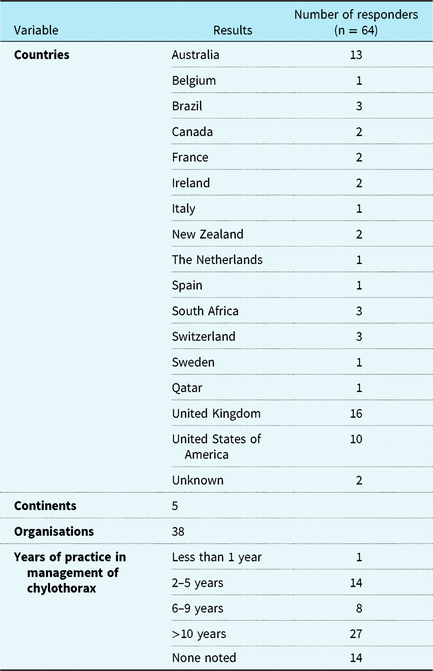
In all, sixty-four respondents completed all the data fields of 126 items contained in the survey representing 38 organisations in 16 countries on five continents and three health-care professions namely dietitians (80%), physicians (19%), and nurses (1%), which formed one health professional group for analysis. Dietitians representing all cardiac surgical centres in Australia, Ireland, New Zealand, and the United Kingdom responded to the survey. Responses from countries were grouped into four regions: Australia/New Zealand (n = 15), Europe (n = 28) (Belgium, England, France, Ireland, Italy, The Netherlands, Spain, Sweden, Switzerland, Scotland), North America (n = 13) (United States of America and Canada), and Others group (n = 9) (Brazil, Qatar, South Africa, and unknown) (Table 1). A total of 365 individuals accessed the survey (14 using Survey Monkey and 350 using iSurvey). Of these, 300 were excluded due to no response to any item, and it was not possible to ascertain why respondents chose not to complete the survey.
Country and health-care professionals’ demographics.

The remaining four domains focused on clinical practice and direction for future research, for which all respondents completed the survey questions. Respondents were able to select answers within each question and where more than one answer could be selected the results are reported as n = (%).
Domain 2: Chylothorax management and diagnosis
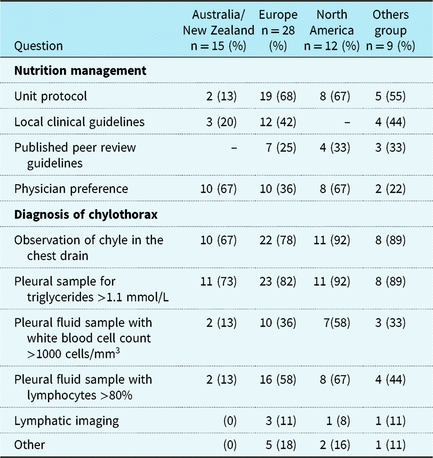
There were variations between centres relating to the tools used to diagnose and guide management of chylothorax. In Australia/New Zealand, management was most commonly directed by physician preference (67%), whereas in Europe (67%), United States of America (67%), and Others group (55%), unit protocols were used (χ 2 = 141; p < 0.0001) (Table 2).
Management and diagnosis of chylothorax (>1 answer possible).

Chylothorax was diagnosed using the following criteria:
Observation of chyle in the chest drain (67%) in Australia/New Zealand compared with (78%) in Europe;
Pleural fluid sample for triglycerides >1.1 mmol/L (73%) in Australia/New Zealand and (78%) in Europe;
Pleural fluid sample with white blood cell count >1000 cells/mm3 (13%) in Australia/New Zealand and (36%) in Europe; and
pleural fluid sample with lymphocytes >80% with (13%) in Australia/New Zealand and (58%) in Europe (χ 2 = 36.2; p = 0.0003) (Table 2). Other reported methods of diagnosis included a chylous sample with increased chest drain output >20 ml/kg when on full feeds, opaque fluid with chylomicrons present and a chest drain output >2 ml/kg/hour.
Domain 3: Conservative dietary management strategies
Long chain triglyceride restriction
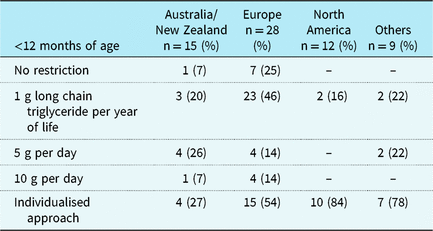
Variation in long chain triglyceride restriction for all age categories was reported with most respondents indicating they adopted an individual approach. Dietitians in Australia/New Zealand, United Kingdom, and Ireland were the only ones to follow the rule “1 g of long chain triglyceride per year of life with a maximum of 4–5 g of long chain triglyceride”. There were statistically significant regional differences in Chi-square results (χ 2 = 115.7; p < 0.00001) (Table 3), with a considerable variation in the amount of long chain triglyceride provided with about 7 and 25% of respondents in Australia/New Zealand and Europe reporting not restricting long chain triglyceride in infants. Respondents in North America and Others group were more likely to adopt an individualised approach to long chain triglyceride restriction. Free text comments included “Don’t count grams long chain triglyceride just change to skimmed breast milk or low-fat formula” and “calculate and provide within <10% kcal from fat”. There was a similar pattern reported for children aged between 1 and 5 years. Fat restriction was liberalised in older children.
What is the most common daily long chain triglyceride fat allowance for infants <12 months of age? (>1 response).

First line nutrition treatment for chylothorax
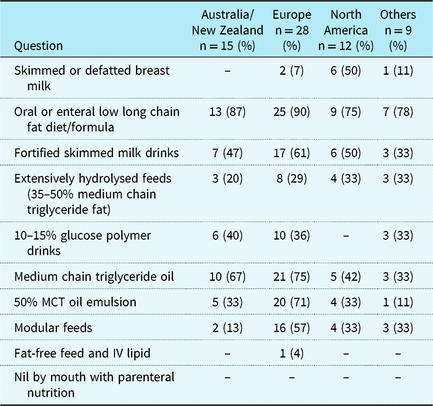
Overall the most commonly used nutrition supplement identified by respondents was a high medium chain triglyceride feed (>80%) with 87% in Australia/New Zealand 90% in Europe, 75% in North America (added to defatted breast milk) and 78% in Others group. Defatted or skimmed breast milk was most commonly used in North America (50%) but less commonly in other regions with 7% in Europe and 11% in Others group. Modular additions including medium chain triglyceride oils are frequently used. One United Kingdom centre reported continuing with the infant’s usual feed for 7 days, only changing to a low long chain triglyceride/high medium chain triglyceride diet if chest drain output remains at >20 ml/kg/day after 7 days. Free text comments identified alternate approaches including “oral or enteral low long chain triglyceride formula for 48 hours. If chest tube output <5 ml/kg to continue, if >5 ml/kg nil by mouth and parenteral nutrition for 5–7 days” and “parenteral nutrition for 3 days followed by 3 days fat free enteral nutrition followed by medium chain triglycerides for 6 days”.
It was also noted that responses were not consistent between colleagues replying from within the same organization. There were statistically significant regional differences for the use of enteral nutrition support following initial diagnosis with Chi-square value at χ 2 = 104.4; p < 0.0001 (Table 4).
First-line nutrition management (>1 answer possible).

MCT = medium chain triglycerides
Domain 4: Duration of dietary treatment
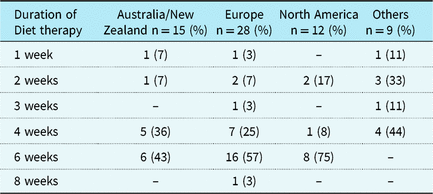
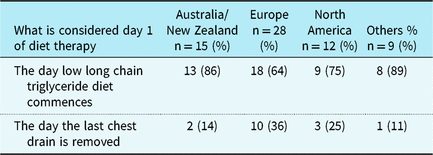
The duration of diet therapy varied: In Australia/New Zealand, therapy ranged from 4 (36%) to 6 weeks (43%) and was similar to Europe with 4 weeks (25%) and 6 weeks (57%). This is compared to the majority of respondents from North America (75%) who recommend a 6-week period of long chain triglyceride dietary restriction and Others group (44%) who restrict long chain triglyceride for 4 weeks. There were statistically significant regional differences with Chi-square value of χ 2 = 155.5; p < 0.00001. Day 1 of diet therapy also varied with 86% of Australian/New Zealand, 75% of North American, and 89% of Others group respondents considering the first day of the treatment period as the date from which diet therapy commenced. This was different in Europe with only 64% of respondents considering this as the first day, whereas 36% reported the duration of restriction commencing from the day the last chest drain was removed. There were statistically significant regional differences in Chi-square test results (χ 2 = 23.1; p = 0.0001) (Tables 5a, 5b).
Duration of diet therapy (>1 answer possible).

What is considered day 1 of diet therapy?

Reintroduction of long chain fats
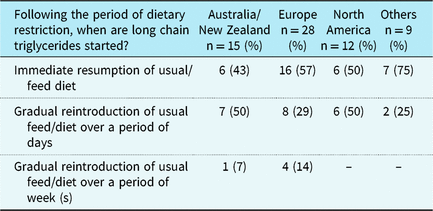
There were different approaches to the reintroduction of long chain triglyceride into the diet following the completion of the prescribed course. In Australia/New Zealand there was almost an equal split between health-care professionals who recommended an immediate resumption of the usual diet (43%) and those who recommended a gradual reintroduction over several days (50%), whereas 7% recommended reintroduction over several weeks, up to 1 month. This was similar in North America with a 50:50 split between immediate and gradual resumption over a few days. In Others group, the most common practice was immediate resumption of usual feed (75%), with a minority (25%) recommending resumption over a few days. In Europe, 57% of health-care professionals recommended an immediate resumption of the diet, followed by 29% recommending gradual reintroduction over several days and 14% over the course of a few weeks. There were statistically significant regional differences in Chi-square test (χ 2 = 43.5; p < 0.00001) (Table 6).
Reintroduction of long chain triglycerides into the diet (>1 answer possible).

Fatty acid supplementation
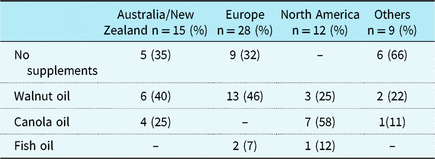
The supplementation of essential fatty acids varied overall, with no supplementation given by 30 to 66% of respondents. In North America canola oil was the most common supplement used by 58% of respondents; in Australia/New Zealand and Europe, walnut oil was the most common supplement with 40 and 46% respectively. There were statistically significant regional differences in Chi-square test values (χ 2 = 215.4; p < 0.00001) (Table 7).
Fatty acid supplementation (>1 answer possible).

Barriers to managing chylothorax
There were many identified barriers to managing chylothorax with free text comments indicating a number of ways in which variation in nutritional practice could be reduced including improving feed tolerance and palatability of low long chain triglyceride diet, patient compliance – particularly amongst older children who do not follow a low-fat diet – and developing other feed options with a more appropriate energy density, to eliminate concentration or dilution of formula.
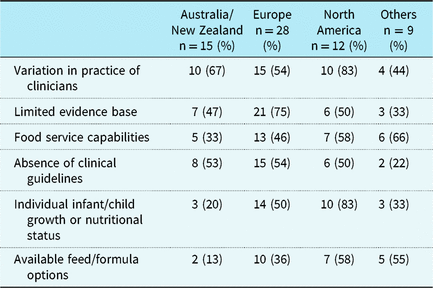
Respondents were asked to indicate other relevant barriers influencing diet management within their organisation. For health-care professionals in North America, the biggest identified barrier to successful therapy was variation in practice of clinicians (83%) and an individual child’s growth (83%); in Australia/New Zealand it was variation in practice of clinicians (67%), whereas in Europe it was the limited evidence base (75%), and finally for the Others group, the most important barrier was food service capabilities (66%). These regional differences were statistically significant in Chi-square results (χ 2 = 72.4; p < 0.00001) (Table 8).
Listed barriers to managing chylothorax (>1 answer possible).

Domain 5: Future research
The final survey domain offered two questions focused on future research. Respondents could select multiple options from a list, followed by a free text box to provide information on how they thought chylothorax should be managed.
What should we do to reduce variation in practice with regard to nutritional management of chylothorax?
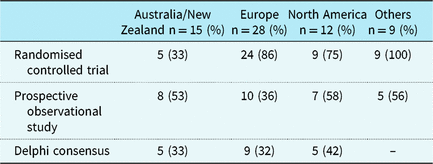
A randomised controlled trial was the most commonly chosen response to reduce variation of practice in North America (75%), Europe (86%), and Others group (100%) compared to 33% in Australia/New Zealand who preferred this research design. There were statistically significant regional differences with regard to preferred research design with Chi-square value of χ 2 = 67.1; p = <0.00001 (Table 9).
What should we do to reduce variation in practice with regards to nutritional management of chylothorax? (>1 answer per question).

How do you think chylothorax should be managed?
This question allowed for free text responses, which were grouped into four main themes (Table 10).
Duration of treatment: A period of observation on a normal diet for up to 7 to 10 days and only intervening if drain output is not reducing once on full feeds and a shorter duration of the treatment period to 2 weeks.
Dietary restriction: Less restricted long chain triglyceride intake and the use of modified maternal breast milk or nil by mouth with a period of parenteral nutrition
Research equipoise: Regarding randomisation to higher long chain triglyceride intake versus low long chain triglyceride intake of 1 g/day
Variation in practice: Reducing physician variation and considered differentiated management strategies depending on aetiology of the chylous effusion
Free text comments provided by respondents.

Discussion
Other case series have examined the nutritional management practices of infants with chylothorax,Reference Haines, Walsh, Fletcher and Davis 2 , Reference Mery, Moffett and Khan 3 , Reference Panthongviriyakul and Bines 7 , Reference Christofe, Pessotti, Paiva and Jatene 13 as well as epidemiological studies considering the incidence and complication rates.Reference Haines, Walsh, Fletcher and Davis 2 , Reference Mery, Moffett and Khan 3 , Reference Buckley, Graham and Gaies 14 To our knowledge this is the first study to examine health-care professional practice relating to the diagnosis and management of chylothorax, common barriers to management, and future research opportunities. The results of this survey suggest wide variation with respect to conservative management including total dietary long chain fat allowance and duration of dietary treatment. In this survey, chylothorax was most commonly diagnosed through observation of chyle in the chest drains (81%) and the presence of triglycerides >1.1 mmol/L in pleural fluid. Other methods of diagnosing chylothorax included the presence of chylomicrons or cholesterol in the fluid and the presence of opaque liquid. A retrospective review of adults with chylothorax described the physical characteristics of pleural fluid, of which the effusions were most commonly exudative in 86% and transudative in 14% of patients and only had a milky appearance in 44%.Reference Maldonado, Hawkins, Daniels, Doerr, Decker and Ryu 15 , Reference Rajdev, Avula and Sharma 16 In 14% of patients, the pleural triglyceride value was less than 110 mg/dl. As such the use of appearance and triglyceride content may miss those children with a chylous effusion particularly in those who are on minimal amounts of enteral feeds post-operatively.Reference Maldonado, Hawkins, Daniels, Doerr, Decker and Ryu 15 The presence of cholesterol in pleural fluid was also used by some participants as part of the diagnostic criteria, although this is more commonly associated with exudative effusions in adults as a result of constrictive lung disease.Reference Huggins 17 When fluid chemistries are not measured or evaluated when infants are on full standard or breast milk feeds, there is a potential for both under and over-reporting incidence particularly, resulting in the treatment of non-chylous leaks or overly conservative management of asymptomatic patients.Reference Justice, Buckley and Floh 18 Variation in clinical practice is further compounded by a lack of consensus-based expert guidelines as seen in other clinical conditions such as intestinal failure where consensus guidelines guide the provision of parenteral nutrition,Reference Mihatsch, Braegger and Bronsky 19 providing an opportunity to benchmark clinical practice against predefined standards.Reference Neelis, de Koning and Van Winckel 20
A diet high in medium chain triglycerides was first proposed as the primary treatment for chylothorax in 1964,Reference Hashim, Roholt and Babayan 21 and further refined in 1987 with recommendations to give no more than 1 g long chain triglyceride per year of life up to a maximum of 4–5 g long chain triglycerides per day for 6 weeks.Reference Francis 22 These recommendations continue to be followed with 78 to 90% of respondents using high medium chain triglyceride oral or enteral feeds as the first-line nutrition management. However, for infants undergoing this therapy; promotion and protection of breastfeeding,Reference Fogg, DellaValle and Buckley 23 , Reference Marino, Kidd and Davies 24 as well as growth, may be negatively impacted.Reference Wright 9 These results are in contrast to those reported by Mery et al, who completed a large multi-institutional database and reported that parenteral nutrition was used as the first-line nutrition management in 56%, followed by high medium chain triglycerides feed in 1.7% and octreotide in 16% of children.Reference Mery, Moffett and Khan 3 Although, the survey did not include questions about secondary management or free text comments from respondents to capture the use of parenteral nutrition along with a period of nil by mouth.
The caloric density of medium chain triglycerides is 8.1 kcal/g and of long chain triglyceride is 9.3 kcal/g,Reference Whyte, Campbell and Stanhope 25 although it has been suggested that medium chain triglycerides have significantly lower calorific value of 6.8 kcal/g versus the 8.1 kcal/g gross energy value.Reference Traul, Driedger, Ingle and Nakhasi 26 In animal studies in which rats were fed a diet containing 45% medium chain triglycerides,Reference Geliebter, Torbay and Bracco 27 28% slower weight gain with lesser fat deposits was observed in animals that were fed medium chain triglycerides compared to those animals which were fed long chair triglycerides.Reference Geliebter, Torbay and Bracco 27 , Reference Crozier, Bois-Joyeux and Chanez 28 In addition, pre-term infants given an infant formula containing 37% medium chain triglycerides and 63% long chain triglyceride compared to standard infant formula were shown to consume more feed and have an increased metabolic rate, skin temperature, and sleep duration, although there was no significant difference in weight gain.Reference Telliez, Bach, Leke, Chardon and Libert 29 Infants with chylothorax who were managed with medium chain triglyceride formula have been reported to have poorer growth associated with the use of high medium chain triglyceride diets although the causality has not been established.Reference Wright 9
International and local guidance recommends that breast milk is the preferred choice of feed for infants, with the World Health Organisation recommending that mothers exclusively breast-feed for the first 6 months of life aiming to reduce morbidity and mortality amongst infants and mothers.Reference Koletzko, Poindexter and Uauy 30 – 32 Reflecting this guidance, 50% of respondents in the North America group used defatted breast milk to which an infant feed with high medium chain triglycerides had been added. In a small prospective study, Kocel et alReference Kocel, Russell and O’Connor 10 examined the use of defatted maternal breast milk with medium chain triglyceride formula added compared to a medium chain triglyceride formula for the management of chylothorax. Although both approaches were associated with a reduction in chyle output from chest drain, growth was poor despite the calculated intake of macronutrients being adequate,Reference Kocel, Russell and O’Connor 10 suggesting energy intake was insufficient. Infants with CHD are particularly vulnerable to the risk of malnutrition.Reference Marino and Magee 33 , Reference Toole, Toole, Kyle, Cabrera, Orellana and Coss-Bu 34 The results from the survey would suggest a preference for the use of maternal breast milk, potentially without any modification particularly as breast milk contains 8 to 10% of medium chain triglycerides.Reference Mazzocchi, D’Oria and De Cosmi 35 The implication for practice suggests that there may be a need to investigate the minimum amount of long chain triglycerides restriction required for symptom resolution in order to better promote and protect breastfeeding, particularly as this patient population is vulnerable to pre-morbid malnutrition and growth restrictionReference Toole, Toole, Kyle, Cabrera, Orellana and Coss-Bu 34 , Reference Vaidyanathan, Nair and Sundaram 36 with poor weight gain post surgery associated with increased risk of mortality.Reference Eskedal, Hagemo and Seem 37 , Reference Mitting, Marino, Macrae, Shastri, Meyer and Pathan 38
There was significant regional variation evident in the reported degree of dietary restriction of long chain triglycerides with 46% of health-care professionals in Europe restricting long chain triglycerides to 1 g per year of life compared to 84% of respondents in North America, who were more likely to use an individualised approach. Some respondents also reported continuing with the infants’ usual feed, for example breast milk or infant formula and only implementing fat restriction if output remained >20 ml/kg.Reference Smith, Holmes and Corno 39 Many respondents also identified that it is usually not possible to achieve the stringent long chain triglyceride restriction of 1 g long chain triglyceride per day per year of life, even when using a low long chain triglyceride infant formula (e.g. ≥80% medium chain triglyceride content), suggesting there may be a potential to liberalise this recommendation thereby improving weight gain without compromising dietary therapy, particularly in infants who are also eating complementary food.
The optimal amount of long chain triglyceride fat restriction and percentage of medium chain triglyceride required has never been prospectively studied in a large cohort, and as such the current standard of care is untested in a randomised controlled trial.Reference Zuluaga 1 This is also true of the duration of treatment, with recommendations in the literature of 2 to 6 weeksReference Kreutzer and Kreutzer 6 , Reference Steven and Carey 12 , Reference Justice, Buckley and Floh 18 reflected in the regional variation in dietary restriction reported by health-care professionals ranging from 2 to 6 weeks of treatment. Given the difficulty of dietary adherence, absence of evidence and known impact on risk of infection, malnutrition, and prolonging hospital stay, these results suggest that a shorter diet treatment duration may be clinically acceptable. Yeh et al propose that if a period of nil by mouth, parenteral nutrition, and octreotide do not result in symptom resolution, there should be a low threshold for early surgical intervention which may be of equal benefit in achieving drainage resolution.Reference Yeh, Brown and Kellogg 8 However, a reduction in the time of dietary treatment, the amount of long chain triglycerides restriction, or earlier surgical intervention require further testing in a randomised controlled study.
Essential fatty acid deficiency is associated with immunological dysfunction, cell membrane and skin changes, and poor growth.Reference Pettei, Daftary and Levine 40 Petteri et al reported an association between deficiency of essential fatty acid and growth restriction and found infants fed with medium chain triglyceride feed >85% were at risk of essential fatty acid deficiency, particularly linoleic acid. In addition, serum mead acid levels – a biomarker for level for an insufficient essential fatty acid intake – have been found to be significantly increased in infants on a high medium chain triglyceride diet, with up to 21% of the fatty acid profile being represented by mead acid.Reference Paassilta, Kuusela, Korppi, Lemponen, Kaila and Nikkari 41 Despite the potential for such deficiencies, 30% of health-care professionals in this survey identified no routine fatty acid supplementation during diet therapy. Where fatty acid supplements were provided the most common sources of essential fats administered were walnut oil (30%), canola oil (16%), fish oil (8%), arachidonic acid and docosahexaenoic acid (8%), and intravenous lipid (8%) – all of which contain different fatty acid profiles. To prevent essential fatty acid deficiency, it is recommended that 1% of energy intake should come from linoleic acid (C18:2) and at least 0.2% of energy from α-linolenic acid (C18:3).Reference Lapillonne, Mis and Goulet 42 The implication for practice is that essential fatty acid supplementation will be required if enteral intake is insufficient to meet these requirements.
There are a number of limitations to this study. Firstly there were a large number of respondents who viewed but chose not to complete the survey(s). This may be explained by the survey dissemination method whereby the survey link may have been shared with professionals who were not directly involved in the care of this patient group and therefore chose not to complete the survey. However, this cannot be assumed. As such the views and reported dietary management of chylothorax may not be wholly representative.
Secondly, we are unable to describe the response rate to this survey as a proportion of all cardiac centres in the countries from which we have received survey replies. While all cardiac centres from Australia/New Zealand, Ireland and the United Kingdom are represented in the results, this cannot be said for other regions, and therefore collated responses may not provide a complete overview of dietary management practices in these regions. However, we would hypothesise that the proven variation evident from this survey in clinical practice both within and between regions is unlikely to become more homogenous with a greater number of responses.
Further limitations to this work include the inability to differentiate between the pathophysiology of chylothorax, for example iatrogenic during surgery or as a result of high intra-thoracic pressures. Survey respondents were also not able to stratify their responses, for example first-line management of enteral nutrition and subsequent treatment involving a multi-modal approach before resolution is achieved, for example nil by mouth and pharmacological or surgical management, particularly those with high versus low output or those with refractory chylothorax. All of these factors will need to be addressed in a future randomised controlled trial to better understand which patients may benefit from potentially no dietary restriction compared to those who may require earlier surgical intervention or a period of nil by mouth and parenteral nutrition.
Another limitation is the paucity of high-quality evidence to inform and guide best practice against which the results of this survey may be benchmarked. Furthermore, this survey did not explore patient outcomes or complications. Consequently, whilst the survey results provide insight as to how the contributing respondents conservatively manage children with chylothorax it is not possible to use these results to conclude what may be considered true best practice.
This survey is the first to map the nutritional management of paediatric chylothorax on an international scale and provides clear focus for future research examining the optimal levels of long chain triglyceride restriction and medium chain triglyceride supplementation and the ideal duration of diet therapy required to manage chyle leaks and to support adequate growth and development. Furthermore, these should be coupled with qualitative studies considering the impact of a restrictive diet therapy on parental and patient’s quality of life and ease of dietary adherence.
Conclusion
The dietary management of chylothorax varies between countries, particularly with respect to treatment duration and total long chain fat restriction. The level of long chain triglyceride restriction required to reduce chylous output should be prospectively tested as higher daily amounts may be just as effective in reducing chylous losses as well as in reducing the risk of essential fatty acid deficiency and poor growth. Future research should include a multi-centre randomised controlled trial which revisits the duration and degree of dietary restriction in order to reduce morbidity, the burden of treatment and poor growth, although research equipoise may be difficult to achieve.
Author ORCIDs
L. V. Marino 0000-0002-1257-121X
Supplementary material
To view supplementary material for this article, please visit https://doi.org/10.1017/S1047951119001525
Acknowledgements
To all dietitians and HCP who generously gave their time to answer the questionnaire.
Competing Interests
None
Contributors Statement
Authors made the following contribution to the manuscript: (1) Luise V. Marino, Annabel Doolan, and Jemma Woodgate formulated the original idea and wrote the survey; Luise V. Marino and Annabel Doolan analysed the data and collated the findings, (2) Luise V. Marino, Annabel Doolan, and Kristie Bell drafted the manuscript. All authors provided final approval of the version to be submitted.
Funding
This report is an independent research arising from an Integrated Clinical Academic Clinical Lectureship, Luise Marino – ICA-CL-2016-02-001 supported by the National Institute for Health Research and Health Education England. The views expressed in this publication are those of the author(s) and not necessarily those of the NHS, the National Institute for Health Research, Health Education England, or the Department of Health and Social Care. This report is an independent research arising from a Queensland Health Study, Education and Research Trust Account Grant awarded to Annabel Doolan, Senior Paediatric Dietitian, Children’s Health Queensland Australia.