Within recent years, business ethics scholars have returned to the topic of human dignity (see Pirson, Goodpaster, & Dierksmeier, Reference Pirson, Goodpaster and Dierksmeier2016), with an interest in generating new avenues for normative and empirical inquiry. Discussing human dignity in relation to the context of business, Pirson et al. (Reference Pirson, Goodpaster and Dierksmeier2016) emphasized two distinct ways of understanding human dignity: inherent and contingent (or earned) dignity. Inherent dignity is universal and is reflective of “every human being’s essential worth” (Margolis, Reference Margolis2001: 441). Contingent human dignity emphasizes respect that is earned through self-development and leading a purposive and good life. Pirson et al. (Reference Pirson, Goodpaster and Dierksmeier2016: 466) suggested that “inherent human dignity is most salient when vulnerabilities (physical, psychological, social, economic) call for protection (in the persons of employees, managers, customers, and other human stakeholders); while contingent dignity is most salient when the self-esteem or self-respect of persons in a business context need to be promoted.”
The importance of human dignity in business ethics scholarship is reflected in three primary streams of work. A number of writers emphasize the foundational importance of human dignity, “supporting a different normative paradigm of business practice” (Pirson et al., Reference Pirson, Goodpaster and Dierksmeier2016: 471). Bowie (Reference Bowie1998) and Margolis (Reference Margolis1998), for example, argue for putting human dignity at the core of economic activity in a way that would redefine market relationships and reorient business ethics scholarship. Business ethics scholars have also explored the importance of human dignity in relation to human rights considerations. From this perspective organizations have duties to protect human dignity, for example, by developing global and local labor standards that uphold and reinforce the rights of workers (Arnold & Bowie, Reference Arnold and Bowie2003; 2007; Hartman, Shaw, & Stevenson, Reference Hartman, Shaw and Stevenson2003). A third stream of work has a pragmatic orientation, and emphasizes the importance of developing organizational practices, policies, and a culture that supports a context emphasizing individual and corporate responsibility, and where “dignity is at center stage” (Margolis, Reference Margolis2001).
A perspective that builds on this literature and has potential for advancing business ethics scholarship on human dignity, particularly with respect to considerations of the protection of human rights and the organization of business practices, is stakeholder capability enhancement (Westermann-Behaylo, Van Buren, & Berman, Reference Westermann-Behaylo, Van Buren and Berman2016). Westermann-Behaylo et al. (Reference Westermann-Behaylo, Van Buren and Berman2016: 530) define stakeholder capability enhancement as “the ways in which firms enhance the capabilities of their stakeholders to achieve the kind of lives people have reason to value.”
A major strength of stakeholder capability enhancement is the incorporation of insights from the three domains of business ethics research emphasizing human dignity noted above. Stakeholder capability enhancement integrates the human capability approach (e.g., Nussbaum Reference Nussbaum2011; Robeyns, Reference Robeyns2003, Reference Robeyns and Zalta2016; Sen, Reference Sen1985, Reference Sen1999), which emphasizes the importance of broad capabilities and human rights fundamental to human well-being and living lives of human dignity (e.g., education, work), with value creation stakeholder management theory and convergent stakeholder theory (e.g., Freeman, Harrison, Wicks, Palmer, & DeColle, Reference Freeman, Harrison, Wicks, Parmar and DeColle2010; Jones & Wicks, Reference Jones and Wicks1999). Stakeholder capability enhancement is a pragmatic perspective as well, encouraging organizational efforts by firms to advance capabilities and promote human dignity, while being sensitive to the concerns of stakeholders, whose dignity may be threatened by existing firm strategies, practices, and policies. Finally, this perspective expands the scope of previous writing in the business ethics literature by drawing attention to the firm’s relationship with a full range of stakeholders, including employees, suppliers, customers, and communities, and by considering how actions taken to enhance stakeholder capabilities and promote human dignity for one stakeholder can advance capabilities and dignity for other stakeholders.
I focus on a particular segment of stakeholders based in communities that represent an important social and moral challenge for business and society with regard to dignity considerations—ex-offenders released from incarceration and reentering communities. Jonson and Cullen (Reference Jonson and Cullen2015) estimate that prisons in the US release six hundred thousand individuals from incarceration each year. Criminal justice reform efforts at the federal and state levels are moving in the direction of releasing more prisoners, particularly those incarcerated for drug-related and non-violent crimes (Mauer, Reference Mauer2011). Many of these ex-offenders seek out employment after serving their periods of incarceration as a way to sustain themselves and their families and regain their dignity and self-respect.
However, many ex-offenders are unable to find work due to hiring practices adopted by employers. These practices include asking applicants on job applications to indicate if they have a criminal record, and conducting criminal background checks that may rely on inaccurate information. Many employers eliminate applicants with prior criminal records without consideration of the applicants’ fit between their experience and skills and the job qualifications (Holzer, Raphael, & Stoll, Reference Holzer, Raphael and Stoll2004; Lageson, Vuolo, & Uggen, Reference Lageson, Vuolo and Uggen2015; Petersen, Reference Petersen2016).
As I discuss in detail below, closing off employment opportunities for ex-offenders undermines a capability central to human dignity—that is, work. While groups that possess visible (e.g., physical disabilities) and invisible (e.g., mental illness) stigmas also suffer from discrimination that can limit employment opportunities (Ragins, Reference Ragins2008), the loss of dignity and opportunity for ex-offenders who cannot get jobs has broad and serious consequences for community-based stakeholders who extend beyond ex-offenders (e.g., families, residents). This is due in great part to the risks of repeat offending by individuals released from incarceration and the destructive effects of crime on communities (Bushway, Stoll, & Welman, Reference Bushway, Stoll and Welman2007; Holzer et al., Reference Holzer, Raphael and Stoll2004). Employers, such as Target, Home Depot, and Koch Industries, among others, have taken note of these issues and as discussed in greater depth below, have advocated for legislation to increase employment opportunities for ex-offenders.
In this article, I contribute in three primary ways to the business ethics literature. First, I apply stakeholder capability enhancement to a set of issues and an underexplored context with respect to the topic of human dignity that opens up new areas of normative inquiry and empirical research for business ethics scholars. I specifically direct attention to a stakeholder group less emphasized in business ethics scholarship, community-based ex-offenders. The emphasis for business ethics scholars writing on the topic of human dignity, and management researchers applying the human capabilities approach to the workplace (Subramanian, Verd, Vero, & Zimmerman, Reference Subramanian, Verd, Vero and Zimmerman2013), has been to focus on employees in the workplace as the primary stakeholder group (Pirson et al., Reference Pirson, Goodpaster and Dierksmeier2016). It is critical however, to explore issues of human dignity in relation to other stakeholders, such as suppliers, customers, and members of communities. This is particularly true to the extent that organizational strategies, products, and practices may undermine their dignity.
Second, I emphasize the importance of providing opportunities for work as an important focus for the enhancement of stakeholder capabilities. As I discuss in more depth below, work is central to the promotion of human dignity (Sison, Ferrero, & Guitain, Reference Sison, Feffero and Guitian2016). For community-based ex-offenders in particular, one of their most critical needs is work. Many ex-offenders, after serving their periods of incarceration, seek out employment with firms as a way to sustain themselves and their families, and to regain their dignity and self-respect. However, as noted above, ex-offenders face significant barriers in finding employment due to firm human-resource practices and policies related to the hiring of ex-offenders. These hiring practices reinforce the social stigma associated with having a criminal record (Maruna, Reference Maruna2001) and violate important normative considerations, in particular the human dignity of ex-offenders by virtue of closing off opportunities to develop their capabilities through meaningful work (Robeyns, Reference Robeyns2003; Sison, et al., Reference Sison, Feffero and Guitian2016). Moreover, these hiring practices create negative externalities (Westermann-Behaylo et al., Reference Westermann-Behaylo, Van Buren and Berman2016) in the communities where ex-offenders live and firms conduct business, such as greater social costs and higher levels of recidivism, weakening stakeholder capabilities and eroding the dignity of other community-based stakeholders, such as the families of ex-offenders and residents in the community. I argue for changes in firm hiring practices and stakeholder engagement strategies that balance important rights and responsibilities for employers with those of ex-offenders.
Third, I make an important theoretical contribution to the business ethics literature by developing a third pathway for enhancing stakeholder capabilities and promoting human dignity that complements the two pathways initially elaborated by Westermann-Behaylo et al. (Reference Westermann-Behaylo, Van Buren and Berman2016). This third pathway extends stakeholder capability enhancement beyond a focal firm-stakeholder network to multiple firm-stakeholder networks at the institutional field level. I explore each of these pathways for enhancing stakeholder capabilities, focusing on the context of employer hiring of ex-offenders.
I begin below with an overview of stakeholder capability enhancement (Westermann-Behaylo et al., Reference Westermann-Behaylo, Van Buren and Berman2016). I follow this discussion by considering the importance of work as a critical stakeholder capability that promotes human dignity, noting the challenges ex-offenders face in finding employment, particularly in the aftermath of incarceration. I then extend stakeholder capability enhancement to the specific context of firm hiring practices and community-based ex-offenders as described above. I close the article by presenting a number of directions that have the potential to advance the emerging literatures on stakeholder capability enhancement and human dignity, particularly with respect to ex-offenders and other stakeholders.
STAKEHOLDER CAPABILITY ENHANCEMENT
The normative foundation for stakeholder capability enhancement is the human capability approach. Sen (Reference Sen1985, Reference Sen1999) and Nussbaum (Reference Nussbaum2011) developed the human capability approach as an alternative perspective to traditional welfare economics that defined appropriate ends as economic and material affluence. Sen (Reference Sen1985) specifically defined a capability as “the ability or freedom to choose to be or do something that a person has reason to value” (in Westermann-Behaylo et al., Reference Westermann-Behaylo, Van Buren and Berman2016: 531). Further, as Robeyns (Reference Robeyns and Zalta2016) points out in clarifying Sen’s elaboration of capabilities, “For Sen, capabilities as freedoms refer to the presence of valuable options or alternatives, in the sense of opportunities that do not exist only formally or legally but are also effectively available to the agent.”
Sen drew attention to the role of institutions, such as government and business, in determining which capabilities are accessible to individuals in society. He distinguished capabilities from “functionings,” which are “the specific beings and doings that an individual chooses to achieve” (Westermann-Behaylo et al., Reference Westermann-Behaylo, Van Buren and Berman2016: 530). Institutions, such as universities and government, are critical in making capabilities available to individuals (e.g., access to affordable higher education), while individual functionings are more about choices individuals make with respect to capabilities (e.g., deciding to pursue a college degree). Robeyns (Reference Robeyns and Zalta2016) noted that the capability approach is an important normative framework that can be employed to evaluate a variety of social policies, practices, and institutions with respect to how well they fulfill important capabilities such as providing opportunities for education and encouraging the development of supportive social relationships.
While both Sen (Reference Sen1985) and Nussbaum (Reference Nussbaum2006) argued that human capabilities expand choice and autonomy, Nussbaum clarified the fundamental importance of capabilities in reinforcing human dignity. She identified ten core capabilities necessary for living a life of dignity with respect to individual freedom and self-determination: life; bodily integrity; bodily health; senses, imagination, and thought; practical reason; emotions; affiliation; other species; play; and control over environment (Nussbaum, Reference Nussbaum2006: 76–78).
Westermann-Behaylo et al. (Reference Westermann-Behaylo, Van Buren and Berman2016) extended these fundamental ideas associated with the human capabilities approach to the business context, focusing attention on enhancing stakeholder capabilities as a way to advance human dignity with regard to firm-stakeholder relationships. Westermann-Behaylo et al. (Reference Westermann-Behaylo, Van Buren and Berman2016) were particularly interested in the ways the firm influences stakeholder capabilities and human dignity, and the implications of these effects (positive and negative) for the firm and stakeholders in its network. They developed a conceptual model of how firms can affect stakeholder capabilities and dignity that emphasized two primary pathways.
One pathway is direct and occurs through the positive effects firms have on particular stakeholders that are a function of important attributes of the firm: its enterprise strategy; policies, practices, and processes; and products or services. For example, firms can offer customers products made with healthy ingredients that are produced in organic/sustainable ways and that promote bodily health (Nussbaum, Reference Nussbaum2006).
A second pathway is through the positive reinforcement of mutual stakeholder capabilities within the stakeholder network. For example, the enhancement of customer capabilities to promote bodily health through the consumption of healthy products featuring sustainably grown ingredients can expand suppliers’ capabilities to protect nature and the environment. Stakeholder capabilities and dignity can also be advanced in stakeholder networks when stakeholders (such as the customers noted above) reciprocate actions taken by the firm and other stakeholders in ways that reward fairness, and punish unfairness (e.g., customers purchasing products that promote bodily health and praising firms on the internet.) Westermann-Behaylo et al. (Reference Westermann-Behaylo, Van Buren and Berman2016: 549) further suggest that these stakeholder network effects have implications for firm outcomes:
When firms promote human dignity by increasing the capabilities of individual stakeholders through their strategies, policies, and products, the resulting stakeholder network effects will reward the firms (and by extension, their stakeholders) with higher cooperative value creation.
Below I extend stakeholder capability enhancement to the context of work and the hiring of ex-offenders, first emphasizing the two pathways for stakeholder capability enhancement noted above, and then developing a third pathway that extends stakeholder capability enhancement in directions beyond those considered by Westermann-Behaylo et al. (Reference Westermann-Behaylo, Van Buren and Berman2016).
WORK, HUMAN DIGNITY, AND HIRING EX-OFFENDERS
Implicit in the literature focusing on business ethics and human dignity is the fundamental relationship between human dignity and a core human capability, work (Robeyns, Reference Robeyns2003). Sison et al. (Reference Sison, Feffero and Guitian2016) elaborated on this essential relationship between human dignity and work. They emphasized the convergence of secular and religious (specifically Catholic Social Teaching) definitions of dignity that emphasize “the intrinsic worth or value of every human being that distinguishes him from any other creature” (Sison et al., Reference Sison, Feffero and Guitian2016: 506). Sison et al. (Reference Sison, Feffero and Guitian2016: 512) extended their arguments further by highlighting the importance of work “as a channel through which human dignity is brought to plenitude.” Work is critical with respect to both inherent dignity and contingent dignity, providing a vehicle for meeting basic economic needs, as well as opening up opportunities for personal fulfillment through skill development, learning, and pursuing excellence and virtue. It is through work that individuals contribute to the common good and “achieve fulfillment as a human being…Work is a good thing for man—a good thing for humanity” (Sison et al., Reference Sison, Feffero and Guitian2016: 515).
Sison et al. (Reference Sison, Feffero and Guitian2016) acknowledged important challenges to rights to work and opportunities to fulfill dignity, for example by the effects of globalization (Subramanian et al., Reference Subramanian, Verd, Vero and Zimmerman2013). An important challenge raised by Sison et al. (Reference Sison, Feffero and Guitian2016: 519) is the threat presented by discrimination, stigma, and bias for groups “in risk of exclusion, such as young people, women, immigrants, agricultural workers and marginalized groups (the disabled, ex-convicts, the illiterate and so forth).” For members of these groups, exclusion from work threatens their well-being and human dignity (Chui & Cheng, Reference Chui and Cheng2015; Maruna, Lebel, Mitchell, & Naples, Reference Maruna, Lebel, Mitchell and Naples2004).
For ex-offenders, finding meaningful work and staying employed is particularly critical for the restoration of their dignity. The experience of incarceration can be demeaning and erode the dignity of inmates in ways that can be deep and enduring (Maruna, Reference Maruna2001; Maruna et al., Reference Maruna, Lebel, Mitchell and Naples2004). Employment helps ex-offenders regain respect and self-esteem (Maruna, Reference Maruna2001; Maruna et al., Reference Maruna, Lebel, Mitchell and Naples2004). Having a job affirms, for ex-offenders and others, that they are a “person of good moral standing” (Maruna et al., Reference Maruna, Lebel, Mitchell and Naples2004: 275). Finally, steady employment significantly reduces rates of recidivism for ex-offenders and facilitates their social reintegration into communities (Bushway et al., Reference Bushway, Stoll and Welman2007; Maruna, Reference Maruna2001; Visher & Kachnowski, Reference Visher, Kachnowski, Bushway, Stoll and Welman2007; Visher, Debus-Sherril, & Yahner, Reference Visher, Debus-Sherrill and Yahner2011).
A lack of job opportunities and barriers to finding work, on the other hand, greatly hinders ex-offender community reintegration (Moore, Stuewig, & Tangney, Reference Moore, Stuewig and Tangney2016) and leads to higher rates of criminal recidivism. For many ex-prisoners, the mark of being a convict endures long after they have served their sentences. The stigma of stereotyping, labeling, discrimination, status loss, and separation (Link & Phelan, Reference Link and Phelan2001) felt by ex-prisoners is experienced as a form of “invisible punishment” that is likely to hamper their successful reentry into society (Chui & Cheng, Reference Chui and Cheng2015: 671). Over half of all prisoners return to prison within three years of their release (Bushway et al., Reference Bushway, Stoll and Welman2007; Maruna et al., Reference Maruna, Lebel, Mitchell and Naples2004).
Despite the high personal and social costs associated with the failure of ex-offenders to find employment, firms are reluctant for a variety of reasons to hire ex-offenders following release from incarceration. Organizations will generally avoid associating with stigmatized individuals and organizations (Kulik, Bainbridge, & Cregan, Reference Kulik, Bainbridge and Cregan2008; Ragins, Reference Ragins2008). Having a criminal record and spending time in incarceration are highly stigmatized characteristics, particularly in the workplace context (Maruna, Reference Maruna2001; Pager, Reference Pager2003, Reference Pager2007). Giguere and Dundes (Reference Giguere and Dundes2002) found that 82 percent of employers they surveyed were concerned with ex-offenders interacting with customers, and 81 percent expressed concerns with ex-offenders interacting with employees. The stigma of a criminal record also influences how hiring managers make decisions in evaluating the backgrounds of ex-offenders and those without criminal records. In a series of studies, Pager (Reference Pager2003, Reference Pager2007) found that hiring managers evaluating applicants for job openings discriminated against those with criminal records.
EMPLOYER HIRING PRACTICES AND EX-OFFENDERS: NORMATIVE CONSIDERATIONS
The concerns of firms in hiring ex-offenders have led to the creation of hiring practices that historically have represented a barrier for ex-offenders seeking employment. One practice is to include in job applications a question asking individuals to indicate if they have a felony criminal record. Firms can use this information to eliminate ex-offenders from further consideration for jobs, based on their self-disclosed criminal record (Lageson et al., Reference Lageson, Vuolo and Uggen2015; Petersen, Reference Petersen2016). A second practice relates to the use of information obtained through criminal background checks. Even if firms do not immediately exclude ex-offenders from consideration for jobs based on the job application question, information obtained through criminal background checks can be used as a reason to eliminate potentially qualified ex-offenders from further consideration (Petersen, Reference Petersen2016).
There are legal and normative justifications that support the use of these hiring practices. Raphael (Reference Raphael2011) draws attention to legal considerations and constraints on hiring certain types of ex-offenders into occupations that might require professional licensing (e.g., health care roles), or where the nature of the crime represents a direct job-related concern (e.g., individuals who have committed fraud working in financial institutions, or individuals convicted of crimes involving children working as a childcare employee.) Firms are also concerned, from a legal perspective, about being held responsible under the doctrine of negligent hiring for potential crimes committed by employees, particularly crimes of violence and theft (Fahey, Roberts, & Engel, Reference Fahey, Roberts and Engel2006; Williams, Reference Williams2007). Title VII and EEOC regulations do allow employers to exclude from consideration specific offenders as noted above, although employers are encouraged to evaluate criminal records and take into account factors such as the nature of the crime in determining whether to hire an ex-offender (Williams, Reference Williams2007).
Employer rights are also relevant considerations. Lam and Harcourt (Reference Lam and Harcourt2003) emphasize the rights of employers, particularly property rights considerations, in determining the best use of labor and capital, “employers, under the property rights arguments, should be able to enter into a legal employment contract with any job applicant without external interference” (Lam & Harcourt, Reference Lam and Harcourt2003: 238). Lam and Harcourt (Reference Lam and Harcourt2003: 239) emphasize safety and damage concerns as key issues as well, noting:
Since many ex-offenders are people who have been found guilty of damaging persons or property, arguably, employers should have the right not to hire them. In hiring ex-offenders, employers may unnecessarily increase employee and customer exposure to potential harm and provide opportunities for ex-offenders to commit criminal offenses under their roof.
Portillo and Block (Reference Portillo and Block2012) also support the rights of employers to screen out ex-offenders from consideration for job opportunities and justify their arguments drawing on property rights and employer autonomy considerations. They suggest that employers have a legitimate right to discriminate: “Discrimination is nothing more than the employer, or anyone else, acting on a preference, at least in terms of violating the legitimate negative rights of anyone else” (Portillo & Block, Reference Portillo and Block2012: 216).
While there are normative grounds supporting employers’ use of these hiring practices, these practices may violate the rights and dignity of community-based ex-offenders and other stakeholders. Lam and Harcourt (Reference Lam and Harcourt2003: 241) suggest that the widespread practice of employers asking ex-offenders about criminal records at the time of application, and using this information to screen-out applicants violates their privacy rights given that “job applicants are generally not required to disclose personal information that is not relevant to the job, such as age, marital status, and health history.” Once applicants indicate that they have a felony criminal record, many firms eliminate these applicants from consideration, disregarding them as individuals and failing to honor their particularity by taking into account an applicant’s fit between their experience, skills, and the job qualifications (Holzer et al., Reference Holzer, Raphael, Stoll, Bushway, Stoll and Welman2007; Lageson et al., Reference Lageson, Vuolo and Uggen2015; Petersen, Reference Petersen2016).
Inquiries into applicants’ criminal backgrounds also undermine their dignity by placing ex-offenders in a psychologically vulnerable position with regard to revealing or not revealing information about prior criminal records (Lam & Harcourt, Reference Lam and Harcourt2003). If ex-offenders volunteer information about their criminal background, employers are not likely to consider these applications. On the other hand, if they fail to initially disclose their criminal record and later on employers discover this information through a criminal background check, employers can interpret this as misrepresentation/deception and a flaw in the character of the applicant. Ex-offenders confronting this dilemma face a situation that can invoke a sense of hopelessness and despair:
Every time I filled out an application and ran across that section about felony convictions, it made me feel sick inside. I felt like getting up and walking out on the spot. What was the use? I know what they were going to do (McCall, 1994: 234, quoted in Maruna et al., Reference Maruna, Lebel, Mitchell and Naples2004: 273).
Should ex-offenders reveal that they have a criminal background and remain in consideration for a given job opportunity, different dignity-related issues arise with respect to conducting criminal background checks. The screening of applicants with criminal records, often by small private companies, does not provide uniformly reliable information (Lam & Harcourt, Reference Lam and Harcourt2003; Petersen, Reference Petersen2016; Williams, Reference Williams2007). Nevertheless, firms use information obtained through criminal background checks as a primary basis to assess the character and trustworthiness of ex-offenders, in most instances eliminating ex-offenders without full consideration of other relevant information particular to that individual, e.g., classes taken in prison, or participation in reentry programs (Holzer et al., Reference Holzer, Raphael, Stoll, Bushway, Stoll and Welman2007; Petersen, Reference Petersen2016; Raphael, Reference Raphael2011; Williams, Reference Williams2007). Holzer et al. (Reference Holzer, Raphael and Stoll2004: 42) write, “Over 70 percent of employers who checked for criminal background did so before hiring, that is, before most ex-offenders had any chance to demonstrate their ability to successfully hold the jobs for which they were applying.”
These hiring practices reinforce the social stigma and self-stigma associated with having a criminal record (Chui & Cheng, Reference Chui and Cheng2015; Hlavaka, Wheelock, & Crossyleon, Reference Hlavaka, Wheelock and Cossyleon2015). Chui & Cheng (Reference Chui and Cheng2015: 673) point out that there are important negative consequences associated with self-stigma including lower self-esteem, weaker social unity, and poorer health (2015: 673). The erosion of capabilities and loss of dignity for ex-offenders when they are not able to find a job reinforces a kind of self-fulfilling prophecy for ex-offenders and contributes to a cycle of recidivism and economic insecurity, further undermining their dignity (Maruna et al., Reference Maruna, Lebel, Mitchell and Naples2004).
Finally, hiring practices that exclude ex-offenders from opportunities to work violate a central principle of human dignity—respect for each human being. Sison et al. (Reference Sison, Feffero and Guitian2016: 508) argue that honoring dignity in the person involves treating each person with respect “regardless of what happens to a person or what he does, despite intellectual or moral errors.” These hiring practices therefore are inconsistent with stakeholder capabilities enhancement and its normative claims to uphold individual human dignity and honor stakeholder differences in regard to “the particularity of stakeholders and their needs” (Westermann-Behaylo et al., Reference Westermann-Behaylo, Van Buren and Berman2016: 534). When firm hiring practices have the effect of categorizing and stigmatizing ex-offenders, these practices fail to treat each person as “an individual with a concrete history, identity, and affect-emotional constitution,” one who “feels recognized and confirmed as a concrete, individual being with specific needs, talents, and capacities” (Behabib, 1986: 411 quoted in Westermann-Behaylo et al., Reference Westermann-Behaylo, Van Buren and Berman2016: 541).
The erosion of capabilities and dignity for ex-offenders also has important implications for other community-based stakeholders. Bushway et al. (Reference Bushway, Stoll and Welman2007: 55) write:
The vast majority of prisoners return to their home communities and so face the same gloomy socioeconomic conditions as when they left, although the cumulative toll of mass incarceration may cause further socioeconomic disadvantage and disorganization. What’s more, these individuals return with prison experience, which can weaken if not dissolve attachments to families, social networks, and the formal labor market.
Ultimately, firms serving these communities, particularly in inner cities, may be compelled to take action that further weakens community stakeholder capabilities. Bushway et al. (Reference Bushway, Stoll and Welman2007: 56) argue that “inner-city employers may actually face diminished labor supplies and a less hospitable business climate, factors that can reinforce a decision to relocate to suburban or rural areas and diminish the total quantity and quality of jobs available in these neighborhoods.” Economic insecurity, social instability, and fears about personal safety all represent threats to the enhancement of stakeholder capabilities and promotion of human dignity in these communities.
PATHWAYS FOR ENHANCING EX-OFFENDER AND COMMUNITY-BASED STAKEHOLDER CAPABILITIES
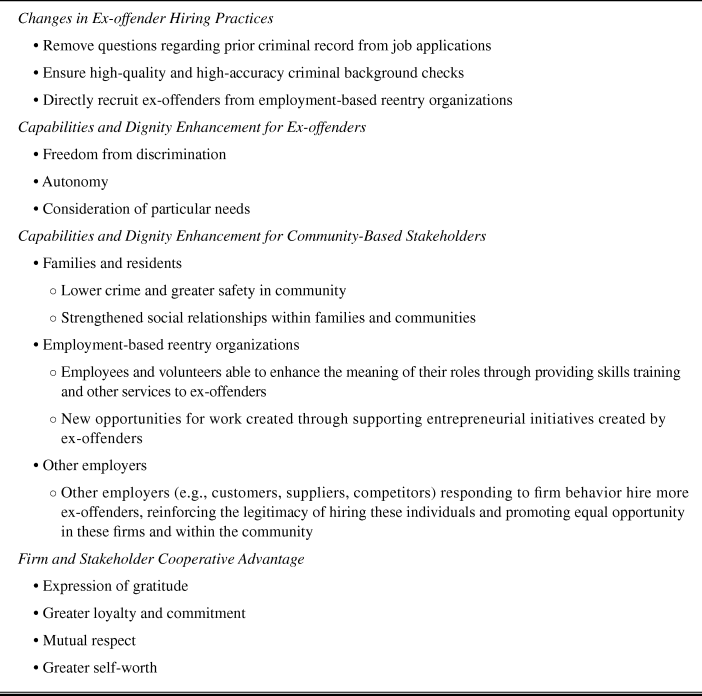
In light of these normative considerations and the effects of firm policies, practices, and strategies on stakeholder capabilities and dignity, I offer below a number of potential changes in employer hiring practices that open up an initial pathway for enhancing the capabilities of community-based ex-offenders, while upholding important employer rights and responsibilities. This discussion provides a foundation for the further theoretical development of the stakeholder capability enhancement perspective. I then highlight how these changes in hiring practices lead into a second pathway for enhancing stakeholder capabilities and promoting human dignity through their effects on community-based stakeholders. These stakeholders include families and residents, employment based reentry organizations providing job and life skills training for ex-offenders, and other employers within the community (e.g., customers, suppliers, competitors) that may learn about and adopt hiring practices that create more work opportunities for community-based ex-offenders. Following Westermann-Behaylo et al. (Reference Westermann-Behaylo, Van Buren and Berman2016), these stakeholder network effects can in turn positively influence firm-stakeholder cooperative advantage. Finally, as noted above, I develop a new third pathway that extends the enhancement of stakeholder capabilities and the promotion of human dignity beyond a given firm-stakeholder network to the institutional field level and multiple firm-stakeholder networks. Figure 1 highlights these three pathways and Table 1 summarizes the components of this expanded model, discussed in more detail below.
Pathways for Enhancing Ex-offender and Community-Based Stakeholder Capabilities and Dignity
Note. Adapted from Westermann-Behaylo et al. (Reference Westermann-Behaylo, Van Buren and Berman2016: 538).

Summary of Figure 1 Model Components

Changes in Firm Hiring Practices and Recruitment Strategies and the Enhancement of Work Opportunities for Ex-offenders
Figure 1 highlights an initial pathway (Stakeholder Capabilities Pathway 1) for enhancing work opportunities for ex-offenders, specifically through changes in firm hiring practices and recruitment strategies. One critical change employers can make to existing practices is to remove questions from job applications that ask individuals to indicate if they have a criminal record and if so, the nature of the criminal offense(s) (Lageson et al., Reference Lageson, Vuolo and Uggen2015). This change would still give ex-offenders an opportunity to disclose their criminal record in applying for the position, for example during the interview process. However, it would lessen the likelihood that firms would categorically exclude ex-offenders from consideration for employment because of their criminal record. This change would reinforce their dignity by providing individual ex-offenders with greater autonomy and choice regarding the disclosure of criminal records. Each ex-offender would have a greater opportunity to share their particular story and circumstances through a kind of “stakeholder dialogue” that Westermann-Behaylo et al. (Reference Westermann-Behaylo, Van Buren and Berman2016: 542) argue is “particularly essential for the most vulnerable stakeholders…whose fundamental dignity may be most at risk.”
There is some evidence that this kind of voluntary disclosure and dialogue between firms and ex-offenders can work in favor of the ex-offenders. Lageson et al. (Reference Lageson, Vuolo and Uggen2015) note that managers might view the disclosure of a criminal record in ways that do not focus only on social stigma. They write, “When an offense was reported on a job application, hiring managers often described seeking other traits to balance it against, or even using the criminal record as a barometer of the candidate’s honesty and humility in making a mistake in the past” (Lageson et al., Reference Lageson, Vuolo and Uggen2015: 93). These managers viewed the candidate’s disclosure of a criminal record as one piece of information, along with other background information, that helped these managers assess the candidate’s character, arguing in some cases that, “A little more on the honest side almost helps them out a little” (Lageson et al., Reference Lageson, Vuolo and Uggen2015). When ex-offenders take the opportunity to voluntarily disclose details of their criminal record and express remorse for their crimes, they demonstrate their humility and humanity and increase the willingness of managers to hire them (Ali, Lyons, & Ryan, 2017). This change in practice would not preclude an employer conducting background checks for the legal and normative reasons noted above, and therefore would maintain an important balance between protecting legitimate employer concerns regarding property rights and the safety of stakeholders, and upholding the dignity and individuality of ex-offenders.
An additional change with the potential to promote greater dignity for ex-offenders is for firms to revise practices related to the use of information obtained from criminal background checks. Having organizational policies in place, for example, policies explicitly prohibiting discrimination against ex-offenders through the use of criminal records (Demuijnck, Reference Demuijnck2008), would demonstrate the organization’s commitment to treating ex-offenders seeking job opportunities fairly and respectfully. Lageson et al. (Reference Lageson, Vuolo and Uggen2015: 198), for example, found in their research that in the absence of formal policies guiding the use of criminal records, and in a legal environment where there is considerable ambiguity, managers tend to rely on criminal records to “make moral and practical decisions regarding an applicant’s honesty, trustworthiness, and work ethic.” Managers might better assess these characteristics on an individual basis through the interview process in which each ex-offender would have an opportunity to offer additional information relevant to assessing that particular ex-offender’s criminal record. Changes in the use of criminal background checks, such as those noted above, would therefore promote dignity by treating each ex-offender with greater respect and ensuring greater quality and accuracy of information provided on criminal background reports.
As with proposals for revising job applications, it is important to consider employer concerns. Changes in how criminal records are used would still provide employers with the ability to learn more about an individual’s criminal record, and with the autonomy to determine whether the individual poses a risk to the safety and property of stakeholders and the firm. Employers could evaluate a candidate’s criminal record before extending an offer of employment to the candidate. Carefully reviewing criminal records in ways that consider the nature of each individual’s crime and particular situation would maintain the individuality and particularity of each candidate, while balancing legitimate employer rights to know more about the nature of the crimes committed by an individual before making a hiring decision.
In addition to the proposed changes in hiring practices discussed above, employers can look beyond traditional sources of employee recruitment and hiring to consider recruiting ex-offenders directly from novel sources such as employment-based reentry organizations operating in communities close to firms and ex-offenders. Major federal legislative initiatives like the Second Chance Act have provided significant funding to support the creation of organizations that focus on the reentry/reintegration of prisoners released from incarceration (Green, Reference Green2015). Employment-based reentry organizations such as the Center for Employment Opportunities (CEO), Re-Integration of Offenders (RIO), Fortune Society, and Pioneer Human Services work to advance the capabilities of ex-offenders. They provide ex-offenders, post-incarceration, with a range of transition skills (e.g., technical skills, job search skills, and life skills) related to securing a job and reintegrating into the community.
Along with explicit skills training, employment-based reentry organizations work with ex-offenders to restore their dignity through one-on-one mentoring that helps ex-offenders develop positive work and life habits, and builds their confidence and self-esteem. Most employment-based reentry organizations have adopted strategies for working with ex-offenders that emphasize addressing them as individuals, understanding their particular needs (e.g., employment, social support) and risks (e.g., addictions, severity of criminal record), and developing reintegration plans that take into account individual needs and risks considerations and the nature of potential employment opportunities (Lutman et al., Reference Lutman, Lynch and Monk-Turner2015).
There are other employment-based reentry organizations, such as The Last Mile in California and CORCAN in Canada, that work directly with individuals while incarcerated to enhance their capabilities. A number of these organizations provide mentoring and training in manufacturing, service, and technology-based skills (e.g., coding and web developments for The Last Mile participants), and connect inmates with potential employers in communities ready to hire them upon release from incarceration. Some employers may see the hiring of ex-offenders into virtual work roles where ex-offenders can work independently (e.g., coding and web development) as a strategy for providing ex-offenders with employment opportunities, while minimizing perceived risks through more limited contact with coworkers and customers.
Other organizations, such as Defy Ventures and the Prisoner Entrepreneurship Program, work with incarcerated individuals to develop their entrepreneurial skills and creativity with the ultimate goal of increasing the employability of these individuals and nurturing start-up enterprises led by ex-offenders once they are released from incarceration. Employers who partner with such organizations as The Last Mile, CORCAN, Defy Ventures, and the Prisoner Entrepreneurship Program are able to enhance the capabilities of community-based ex-offenders through hiring ex-offenders directly and providing resources (e.g., financial support, executive mentors) critical to the success of new start-up organizations created by ex-offenders.
Research (e.g., Gill & Wilson, Reference Gill and Wilson2017; Wiegand, Sussell, Valentine, & Henderson, Reference Wiegand, Sussell, Valentine and Henderson2015) suggests that in comparison with other ex-offenders who have not participated in employment-based reentry programs, ex-offenders who have received services from these programs have lower rates of recidivism and better job training and employment prospects. In working directly with employment-based reentry organizations and developing relationships with them, firms may be able to foster the kind of firm-stakeholder dialogue that can help clarify the firm’s and a particular ex-offender’s hiring needs and preferences, and promote dignity, while also protecting the rights of employers with respect to people and property.
Table 1 summarizes these proposed changes in employer hiring practices and recruitment strategies.
Implications of Enhancing Ex-offender Work Opportunities for Community-Based Stakeholder Capabilities and Firm-Stakeholder Cooperative Advantage
Beyond the enhancement of stakeholder capabilities for ex-offenders, there are important implications for community-based stakeholders. A second pathway for enhancing ex-offender, as well as community-based stakeholder, capabilities is through the dynamics of stakeholder network effects (see Figure 1, Stakeholder Capabilities Pathway 2). Westermann-Behaylo et al. (Reference Westermann-Behaylo, Van Buren and Berman2016) suggest that changes made by the firm to enhance stakeholder capabilities for one stakeholder, can go beyond a given dyadic firm-stakeholder relationship and more broadly influence the capabilities and dignity of other stakeholders within the firm-stakeholder network. In the context of employer hiring of ex-offenders, I focus on three key community-based stakeholders: families and residents, employment-based reentry organizations, and other firms (e.g., customers, suppliers, and competitors), who I argue can become potential employers of ex-offenders in the community. I discuss the nature of these stakeholder network effects below and summarize them in Table 1.
Families and Residents
To the extent that changes in firm hiring practices and recruitment strategies open up more employment opportunities for ex-offenders in the community, there may be important effects on the families of ex-offenders and residents of communities where ex-offenders live and work. These stakeholders are better able to enhance important capabilities and live their lives with dignity. More job opportunities for ex-offenders lower the likelihood of recidivism in these communities (Western, Reference Western2007), promoting safety as a key capability that enhances the quality of life for residents in these communities (Robeyns, Reference Robeyns2003; Westermann-Behaylo et al., Reference Westermann-Behaylo, Van Buren and Berman2016).
Employment also reduces family material hardship and can provide the means for ex-offenders to buy a car, start families, and purchase homes in the local community (Western, Reference Western2007), all of which can strengthen social relationships within these communities and enhance affiliation capabilities (Robeyns, Reference Robeyns2003; Westermann-Behaylo et al., Reference Westermann-Behaylo, Van Buren and Berman2016) for residents and families (Western, Reference Western2007). The opportunity for ex-offenders to work strengthens family stability as well, promoting dignity for parents and children by better ensuring that parents do not return to prison and children are able to live with one or both parents (Raphael, Reference Raphael2011).
Employment-Based Reentry Organizations
Employment-based reentry programs, which partner with firms to open up employment opportunities for ex-offenders, may also enhance their capabilities in important ways. When employers engage with these organizations to recruit and hire ex-offenders, they expand the capabilities of employment-based reentry programs and the employees within these organizations, specifically with respect to imagination, thought, and emotions (Westermann, Behaylo et al., 2016). For those employees working within employment reentry organizations, helping ex-offenders secure work and reintegrate into society can fulfill personal values and goals and be an important source of meaning and dignity in their lives. Through working with ex-offenders and engaging in dialogue and interaction with them, employees can advance their own dignity through the work of helping ex-offenders affirm their dignity.
Employer involvement with reentry programs also opens up new imaginative possibilities for employees and volunteers to rethink and expand existing services and create new opportunities for individuals with criminal records. The Last Mile, for example, has since 2010 worked directly with incarcerated individuals to provide intensive six-month entrepreneurial training in creating businesses that combine a social cause with a technology component. The Last Mile, Defy Ventures, and the Prison Entrepreneurship Program have leveraged direct (e.g., hiring of trainees, providing direct financial support) and indirect (e.g., encouraging employees of technology companies to become mentors) resources to build on the unique interests and creativity of ex-offenders and help them create start-up businesses in the community.
A number of the entrepreneurs trained by these employment-based reentry organizations have been able to further expand stakeholder network effects and promote stakeholder capabilities and human dignity within communities, specifically through hiring other community-based ex-offenders. Defy Ventures, since its founding in 2010, has launched over 165 businesses and created 350 new employment opportunities for ex-offenders,Footnote 1 while the Prison Entrepreneurship Program has supported the creation of 200 new businesses since 2004 with six of these businesses generating over $1 million in gross annual revenues.Footnote 2
Other Employers
Another potentially important stakeholder network effect involves the diffusion of changes in ex-offender hiring practices among other employers in the community who are part of a firm’s stakeholder network (e.g., customers, suppliers, competitors). An important influence on the behavior of organizations, particularly in responding to situations where there may be normative uncertainty and controversy, is for organizations to look to how other similar organizations (e.g., in the same industry, similar location, close network ties) have responded. Institutional theorists and researchers have documented how mimetic forces, as reflected in prior patterns of behavior and decisions taken by organizations, have legitimated a wide range of programs, policies, and practices and influenced their subsequent adoption by other organizations (e.g., Chuang, Church, & Ophir 2011; Davis & Greve, 1995; Kraatz & Moore, 2008; Scott, 2013).
Chuang et al. (2011) specifically focused on a controversial and stigmatized practice among certain audiences, the adoption of same-sex partner benefits by Fortune 500 organizations. Chuang et al. (2011) noted that uncertainty around societal expectations and potential social sanctions related to the adoption of same-sex partner benefits shaped an institutional context where mimetic forces played a significant role in influencing firm behavior. Their empirical findings showed that Fortune 500 companies were more likely to adopt same-sex partner benefits when other Fortune 500 companies in close proximity had adopted these benefits. Chuang et al. (2011) argued that proximity to other firms facilitates the transfer of information and knowledge regarding these practices, an important consideration for community-based employers and the of diffusion ex-offender hiring practices, such as those described above.
These institutional dynamics may be particularly relevant in the context of employer hiring of ex-offenders and magnify stakeholder effects in the community. Given the stigma associated with hiring ex-offenders, when a firm changes its hiring practices and recruitment strategies, these changes may play an important role in legitimating the practice of hiring ex-offenders for other employers in a firm’s stakeholder network. As changes in hiring practices and recruitment strategies diffuse among competitors, customers, and suppliers in the stakeholder network, for example, this diffusion to potential employers can further expand and enhance the capabilities of ex-offenders, provide more work opportunities in the community, and reinforce the stakeholder network effects in the community.
Effects on Firm-Stakeholder Cooperative Advantage
Enhancing the capabilities of stakeholders and promoting human dignity through the two pathways highlighted above and shown in Figure 1 also has the potential for positively influencing cooperative advantage by benefiting hiring firms and stakeholders in a variety of ways. Westermann-Behaylo et al. (Reference Westermann-Behaylo, Van Buren and Berman2016) define cooperative advantage in terms of the value that firms and stakeholders jointly create as an outcome of the enhancement of stakeholder capabilities. Westermann-Behaylo et al. (Reference Westermann-Behaylo, Van Buren and Berman2016: 549) argue, “When firms promote human dignity by increasing the capabilities of individual stakeholders through their strategies, policies, and products, the resulting stakeholder network effects will reward the firms (and by extension their stakeholders) with higher cooperative value creation.” When firms pursue strategies and adopt policies that have a negative impact on stakeholder capabilities, for example, offering employees low wages that may harm employees, their families, and communities, cooperative advantage may be weakened (Westermann-Behaylo et al., Reference Westermann-Behaylo, Van Buren and Berman2016). Given that there is very limited empirical research on the relationship between ex-offender hiring and firm outcomes (an area I suggest below for further development), I draw on two studies that offer important insight into this relationship. I summarize the outcomes discussed below in Table 1.
Lutman et al. (Reference Lutman, Lynch and Monk-Turner2015) found in a series of case studies that a key motivation for employers hiring individuals with criminal backgrounds is the recognition of these individuals as assets to their businesses. Firms interviewed by these researchers emphasized that they viewed the majority of ex-offenders they had hired as, “a ready, willing, and skilled pool of workers who were grateful to get the chance to work” (Lutman et al., Reference Lutman, Lynch and Monk-Turner2015: 67). Underscoring the ways in which stakeholder reciprocity can operate when firms treat stakeholders with fairness and dignity (Westermann-Behaylo et al., Reference Westermann-Behaylo, Van Buren and Berman2016), Lutman et al. (Reference Lutman, Lynch and Monk-Turner2015) found that the gratitude of ex-offender hires was expressed in many instances through greater loyalty and commitment to the organization and a strong work ethic. They further noted that in some cases ex-offenders were hired directly by customers/clients of these businesses who were impressed with the ex-offenders’ work ethic.
A more recent, in-depth qualitative study of female inmates working for a large business-to-business marketing company, Televerde, focused on the importance of respect and its relationship to identity change and positive individual and organizational outcomes (Rogers, Corley, & Ashcroft, Reference Rogers, Corley and Ashforth2017.) Televerde hires female inmates to work in call centers located in state prisons around the US. Rogers et al. (Reference Rogers, Corley and Ashforth2017: 221) noted that Televerde, in contrast with many organizations, views female inmates “as valuable individuals deserving of a chance to be successful members of the world, a positive approach that results not only in a dramatically lower recidivism rate for the employees, but also industry-leading performance for the organization.” Televerde’s performance is reflected in the quality of its partnerships in such industries as technology, healthcare, manufacturing, venture capital, and financial services. These partnerships over time have helped clients, such as Avaya, DELL, Oracle, and SAP and others, increase their revenue by $8 billion.Footnote 3
Rogers et al. (Reference Rogers, Corley and Ashforth2017) found that at the heart of these positive outcomes for Televerde and its stakeholders is respect and dignity, the sense of worth as a human being that inmates talked about while working as employees for Televerde. This respect came from peers, managers, clients, and prospects and it played a central role in the process of identity change for these inmates as they moved from prisoner to employee, someone with the “chance to be something different” (Rogers et al., Reference Rogers, Corley and Ashforth2017: 231). This shift in identity and respect occurred early in the hiring and training process and was associated with a number of important outcomes of benefit to inmates employed by Televerde, including higher levels of job satisfaction, greater engagement with their work, a greater sense of self-efficacy, and stronger motivation to perform well.
The innovative research undertaken by Rogers et al. (Reference Rogers, Corley and Ashforth2017) highlights the importance of work and a sense of self-worth that comes through respectful workplace relationships and honoring individual dignity, even within a prison setting. Looking beyond the prison setting to traditional organizations and employers, one can argue that the relationships that develop between ex-offender hires and others, whether managers, co-workers, or external clients/customers, may serve as a reflective “looking glass” (Maruna et al., Reference Maruna, Lebel, Mitchell and Naples2004: 271). Rogers et al. (Reference Rogers, Corley and Ashforth2017: 260) suggest that managers, through their interactions with employees (e.g., providing feedback, coaching), play an important role in “conveying respect and subsequently shaping employees’ sense of self.” Developing close, meaningful, and personal relationships with employees provides them with the opportunity to see themselves through the eyes and actions of others, facilitates communication of “respect cues” (Rogers et al., Reference Rogers, Corley and Ashforth2017: 260), and helps employees gain a greater sense of dignity, self-respect, and self-confidence. Rogers et al. (Reference Rogers, Corley and Ashforth2017: 241) noted the importance of interaction with a wide range of stakeholders (e.g., Televerde employees within the prison and corporate offices, Televerde clients) in reinforcing the dignity of the inmates hired by Televerde:
Each interaction could potentially serve as a trigger for the validation cycle, with new hires enacting an identity (claiming the identity) and others responding positively to the enactment, thus conveying particularized respect, which was internalized by new hires as a social cue that they were enacting the identity appropriately (inferred granting of the identity).
Expanding Stakeholder Capability Enhancement to Multiple Firm-Stakeholder Networks
While I have focused on the firm-stakeholder network and the two primary pathways of stakeholder capability enhancement elaborated by Westermann-Behaylo et al. (Reference Westermann-Behaylo, Van Buren and Berman2016), stakeholder capability enhancement and the promotion of dignity for ex-offenders and other stakeholders can potentially open up a third pathway, not considered by Westermann-Behaylo et al. (Reference Westermann-Behaylo, Van Buren and Berman2016). Stakeholder Capabilities Pathway 3, as depicted in Figure 1, connects the dynamics within the single firm–stakeholder network explored by Westermann-Behaylo et al. (Reference Westermann-Behaylo, Van Buren and Berman2016) to multiple firm–stakeholder networks at the institutional field level. Scott (Reference Scott2014: 106) defines an institutional field as “a collection of diverse, interdependent organizations that participate in a common meaning system,” which can include exchange partners, members of professions, and organizations involved in various social movements (Zietsma, Groenewegen, Logue, & Hinings, Reference Zietsma, Groenewegen, Logue and Hinings2017). The development of a third pathway represents an important theoretical extension of the stakeholder capability enhancement framework and opens up possibilities for understanding the role of stakeholder capability enhancement in institutional development and change (Zietsma et al., Reference Zietsma, Groenewegen, Logue and Hinings2017). I focus below on two general processes associated with this third pathway—institutional diffusion and moral imagination—and examine them in the context of employer hiring of ex-offenders.
I noted how institutional processes and dynamics within a single firm-stakeholder network influence the adoption of ex-offender hiring practices and the enhancement of stakeholder capabilities within this network. Institutional processes can also influence the behavior of other firm-stakeholder networks at the institutional field level (e.g. Davis & Greve, Reference Davis and Greve1997; Scott, Reference Scott2014). Organizations attend to what other organizations are doing and adopt practices or structures, for example, “with the aim of gaining legitimacy or technical advantages (Zietszma et al., 2011: 398).” To the extent that changes in practices and processes enhance cooperative firm-stakeholder advantage as highlighted in Figure 1, other firms and stakeholders within the institutional field may learn of these advantages and adopt these practices and processes. At a certain point, there may be a critical mass of firms hiring ex-offenders, which furthers the process of institutionalization and stakeholder capability enhancement within other firm-stakeholder networks.
The diffusion of organizational practices and processes, particularly to the extent they diverge from existing practices and processes, has implications for institutional change by opening up a number of “pathways of change” (Zietzma et al., 2011: 2017) within institutional fields. The adoption of less established, and potentially contested, practices and processes may initially challenge the legitimacy of prevailing practices and processes. However, over time, as more firms adopt the newer practices and processes, legitimacy increases, motivating various actors, including firms and stakeholders, to mobilize support and resources for legislation and regulation that promote institutional change and the enhancement of stakeholder capabilities within the institutional field (Chuang et al., 2011; Zietzsma et al., 2011).
Another complementary mechanism that can expand stakeholder capability enhancement for ex-offenders and other stakeholders at the institutional level is moral imagination. Moral imagination operates at multiple levels—individual, organizational, and field—and involves challenging prevailing scripts and mindsets, creating new scripts and models, and exploring new possibilities for advancing ethical aims and values (Werhance, 2002). Moral imagination is consistent with stakeholder capability enhancement in that it represents a way of thinking that expands “understanding of various stakeholders’ perspectives, and inquiry into which stakeholders have not been considered” (Hargrave, 2008: 88), and recognizes the importance of social context and the particularity of situations and individuals (Werhane, Reference Werhane1999, Reference Werhane2002).
Arnold and Hartman suggest that, “moral imagination allows one to conceive of the moral relationships that should be in place within the system” (Arnold & Hartman, Reference Arnold and Hartman2003: 431, italics in the original). For example, they examined the role of moral imagination in prompting Nike and adidas-Solomon AG to expand “the boundaries of morally relevant stakeholders to include contractors and factory workers” (450). Through a process of what Arnold and Hartman label “corrective moral imagination,” Nike and adidas-Solomon AG revised practices and policies to better recognize the importance of factory workers and their families and their treatment in offshore countries and factories. Other firms in the apparel and footwear industries, inspired by the actions of Nike and adidas-Solomon AG, changed their practices and policies with respect to their suppliers.
Hargrave (Reference Hargrave2009) notes that moral imagination can extend beyond a particular individual or firm and lead to institutional change. Drawing on another important stream of work within institutional theory, Hargrave emphasizes the importance of institutional work and collective action that involves “the purposive action of individuals and organizations aimed at creating, maintaining and disrupting institutions” (Lawrence & Suddaby, Reference Lawrence, Suddaby, Clegg, Hardy, Lawrence and Nord2006: 2). From this perspective, moral imagination “is a dialectical social process as well as an individual cognitive one” (Hargrave, Reference Hargrave2009: 90). It is through this social process, as reflected in efforts by actors in a given field to build coalitions and mobilize support for “morally imaginative new arrangements” that both “pragmatism and imagination” are linked to institutional change (Hargrave, Reference Hargrave2009: 91).
In the context of employer hiring of ex-offenders, institutional processes and moral imagination may both play an important role in extending ex-offender hiring practices to firms and stakeholders beyond a particular firm-stakeholder network through the third pathway for stakeholder capability enhancement presented in Figure 1. With regard to institutional processes, the diffusion of ex-offender hiring practices to other firms and their stakeholders within the institutional field can take place in a number of ways. Firms within close geographical proximity to a focal firm that has adopted ex-offender hiring practices may become aware of important benefits/advantages and, for reasons noted above, adopt these practices. Similarly, interorganizational and professional relationships between a focal firm, its stakeholders, and other firms and stakeholders (e.g., industry associations, human resource management networks) may provide avenues for communicating the benefits and advantages of adopting ex-offender hiring practices at the institutional field level.
As diffusion advances at the field level, the “motivation and capacity” of employers is likely to increase as they develop a better understanding of what constitutes best practices and strategies for hiring ex-offenders, and gain a greater appreciation of the potential benefits of hiring ex-offenders (Chuang et al., 2011:193). The enhancement of stakeholder capabilities for ex-offenders across multiple employers within an institutional field, in turn, can promote the capabilities of community-based families, residents, and employment-based reentry organizations beyond a particular individual firm-stakeholder network.
The processes of corrective and collective moral imagination (Arnold & Hartman, Reference Arnold and Hartman2003; Werhane, Reference Werhane2002) can also advance the enhancement of ex-offender and other community-based stakeholders at the institutional field level. As firms in other communities, networks, and industries learn about changes in ex-offender hiring practices and the implications for ex-offender and stakeholder capability enhancement and firm-stakeholder cooperative advantage, they may question their own hiring practices. The process of reimagining and reconsidering existing hiring practices and relationships with ex-offenders and community-based stakeholders may ultimately motivate firms at the field level to change their practices in ways that honor the human dignity of ex-offenders and other stakeholders, while upholding critical employer rights.
Moral imagination may also inspire some employers and stakeholders to challenge prevailing narratives and mindsets associated with hiring individuals with a criminal record and through collective action, prompt these organizations to engage in social and political action with the intent to influence other firms and stakeholders in the field (Hargrave, Reference Hargrave2009). For example, Dave’s Killer Bread, a Pacific Northwest baked goods company that is a leader in the employment of ex-offenders, has brought together organizations from a variety of sectors (for-profit, nonprofit, government) through organizing a series of “Second Chance Summit” conferences. The focus of these conferences is for organizations and ex-offenders to share their experiences and to discuss different ways of developing partnerships to encourage greater hiring of ex-offenders and strengthening local communities. Internationally, the Employers Forum for Reducing Reoffending (EFFRR), an organization comprised of local, national, and international employers in the United Kingdom, such as Cisco, Marks & Spencer, and DHL, works to provide a variety of sustainable opportunities and support services to specific individuals with criminal records, and advocates for increasing employment opportunities and skills development for ex-offenders.
The arguments presented above and summarized in Figure 1 and Table 1 provide a foundation for future research. They highlight three important pathways for enhancing stakeholder capabilities, promoting dignity, and advancing firm-stakeholder cooperative advantage at multiple levels. I elaborate a number of promising directions for this research below, with an emphasis on further development of these pathways in the context of employer hiring of ex-offenders.
FUTURE RESEARCH DIRECTIONS
One direction researchers might pursue is to explore important antecedents to firms taking action to enhance stakeholder capabilities through the primary mechanisms outlined by Westermann-Behaylo et al. (Reference Westermann-Behaylo, Van Buren and Berman2016) (e.g., firm strategy, practices, products). With regard to employer hiring of ex-offenders, this might involve directing empirical attention to considerations likely to motivate firms to revise hiring practices in ways that enhance the capabilities of community-based ex-offenders in securing employment. While a full elaboration of these potential factors is beyond the scope of this article, I try below to highlight representative antecedents at the individual and organizational levels.
At the individual level, it may be critical to consider the role of leaders and the influence of leader attributes, such as moral courage. Hannah, Avolio, and Walumbwa (2012) define moral courage as acting in conformity with one’s principles despite danger and adversity that threatens these principles. As noted earlier, an important motivation for employers not considering hiring ex-offenders is to avoid negative perceptions from various stakeholders including customers, employees, and the public. Moral courage may therefore have a significant influence in motivating and sustaining leader commitment to changing hiring practices despite the costs and perceived danger of negative stakeholder perceptions and actions.
Organizational values and culture, among other organizational level considerations, represent potentially rich areas of empirical focus. Employers may be more likely to revise practices related to hiring ex-offenders when these actions represent an enactment of organizational values and identity, for example, values that promote organizational forgiveness (Fehr & Gelfand, Reference Fehr and Gelfand2012). A strong forgiveness climate, grounded in principles of restorative justice that emphasize redemption and reintegration in the aftermath of transgressions (Goodstein, Butterfield, Pfarrer, & Wicks, Reference Goodstein, Butterfield, Pfarrer and Wicks2014), may support the hiring and integration of ex-offenders (Fehr & Gelfand, Reference Fehr and Gelfand2012). Leaders play an important role here as well, in reinforcing values of forgiveness and the importance of redemption and giving transgressors second-chances, organizational values that align with hiring practices that are more open to hiring ex-offenders.
A second empirical direction to pursue is to examine factors that may influence whether changes in firm hiring practices intended to open up more opportunities for ex-offenders do increase the number of ex-offenders hired by firms. Jones Young and Powell (2014) draw attention to the critical role that hiring managers may play in regard to this key area of focus. Their conceptual model identifies relevant considerations likely to influence hiring manager evaluations and decisions with respect to ex-offenders, for example, characteristics of the crime. Jones Young and Powell (2014) argue that serious crimes (e.g., personal assaults) are likely to represent a barrier to hiring ex-offenders. Individual-level considerations potentially influencing managerial hiring of ex-offenders include characteristics of the offender (e.g., race, gender), hiring manager perceptions of the warmth and competence of the ex-offender, and characteristics of the hiring manager (e.g., exposure to ex-offenders, demographic similarity to ex-offenders). In addition, Jones Young and Powell (2014) emphasize the importance of organizational values and culture (e.g., values that promote organizational diversity).
Other factors may play an important role as well in a hiring manager’s decision to hire ex-offenders, including the role of trust and perceptions of ex-offender character on the part of the organization and its hiring managers. Holzer, Raphael, and Stoll (Reference Holzer, Raphael and Stoll2004: 41) write that “for employers, a criminal history may signal an untrustworthy employee who may break rules, steal, or deal poorly with customers.” Ali et al. (2017) note that impression management strategies, in particular, the use of an apology and acknowledgment of crimes committed, may communicate an ex-offender’s remorse to hiring managers and increase the likelihood of hiring ex-offenders.
A third area of empirical focus is to study the dynamics of mutual advantage associated with enhancing stakeholder capability, in particular, drawing attention to how actions taken to enhance ex-offender capabilities affect shared value, both positively and negatively, for other community-based stakeholders and firms. As noted above, empirical research on the outcomes of ex-offender hiring by firms is quite limited. A critical consideration for both firms and ex-offenders is turnover. The importance of work for ex-offenders and gaining a greater sense of dignity depends, in important ways, on securing a job and maintaining employment. Ex-offenders face important external challenges, such as barriers to finding stable housing, transportation difficulties, and the risks of recidivism (Bushway et al., Reference Bushway, Stoll and Welman2007). Some ex-offenders may not be able to manage the greater autonomy and freedom following release from incarceration (Western, 2015). These challenges represent important threats to job continuity and tenure for ex-offenders and have the potential to weaken firm-stakeholder cooperative advantage by increasing rates of absenteeism and turnover in firms, as well as negatively affecting communities. Alternatively, efforts taken by firms, for example, providing ex-offenders with flexibility on the job to meet needs like fulfilling mandatory meetings with parole officers, can potentially reduce absenteeism and turnover, and allow ex-offenders to take advantage of this flexibility and autonomy and maintain employment.
Researchers might also build on Westermann-Behaylo et al. (Reference Westermann-Behaylo, Van Buren and Berman2016) and study stakeholder reciprocity effects associated with the hiring of ex-offenders. For example, a key issue is how employees respond to firm hiring of ex-offenders. The management literature on stigma in organizations (e.g., Kulik et al., Reference Kulik, Bainbridge and Cregan2008; Ragins, Reference Ragins2008) underscores the potential for employees to react negatively to the hiring of ex-offenders. However, there may be situations where the hiring of ex-offenders in an organization elicits a positive employee response, for example, in organizations with a strong forgiveness climate, where employees may view the hiring of ex-offenders as an enactment of organizational values and identity (Fehr & Gelfand, Reference Fehr and Gelfand2012.) Other community stakeholders, including customers, may also respond positively or negatively to the hiring of ex-offenders, depending perhaps on many of the same individual variables that Jones Young and Powell (2014) identify as relevant for hiring managers (e.g., exposure to ex-offenders, demographic similarity).
Considering a third pathway and the role of institutional processes and moral imagination in the enhancement of capabilities for ex-offenders and other stakeholders opens up a variety of research possibilities and questions. For example, are firms involved in various forms of advocacy, including conferences and forums such as those noted above, more likely to influence and inspire other firms connected in networks through geographical proximity, similar industries, or other interorganizational relationships to undertake changes in hiring practices that expand work opportunities for ex-offenders? Major companies such as Bed Bath & Beyond, Home Depot, Target, and Walmart, among others, have supported changes in “ban the box” legislation, passed by thirty-one states, and taken steps to eliminate questions asking about criminal backgrounds from their employment applications in all stores throughout the United States (Rodriquez & Christman, Reference Rodriquez and Christman2015). These laws prohibit employers from asking questions on job applications that require individuals to disclose information about criminal backgrounds (Rodriquez & Christman, Reference Rodriquez and Christman2015). Researchers might explore to what extent these broad advocacy efforts by organizations within institutional fields have been a catalyst for moral imagination with respect to (1) greater hiring of ex-offenders by these firms in multiple communities, and (2) greater hiring of ex-offenders among key stakeholders in their networks, such as major suppliers.
Another potentially important topic to examine is the relationship between the institutionalization of ex-offender hiring practices and stigma at the organizational and field levels. In the absence of broad acceptance of employer hiring of ex-offenders, it may be difficult for an organization to hire ex-offenders due to the threat of core stigma (Hudson, 2009). Hudson (2009: 253) distinguishes event-stigma, which may result from a discrete event such as a bankruptcy or corporate environmental accident, from core-stigma, which is associated with an organization’s core attributes (e.g., customers, products, internal practices and processes). As Hudson (2009: 254) further notes, “Being core-stigmatized indicates there is something about the organization or set of organizations—some core attribute, some element, or core trait—that others in the environment deem incompatible with ordinary standards of organizational accounts.” Employers may be reluctant to hire ex-offenders for fear that negative public attitudes towards ex-offenders may be extended more broadly to the organization as a whole and lead to core-stigmatization of the organization.
However, there is also the potential for institutional change to alter the influence of stigma on employer hiring of ex-offenders. Zietzsma et al. (2011: 418) suggests that there may be a tipping point in the transition from an established institutional set of norms and practices to a more contested field where deinstitutionalization (Oliver, 1992) of existing norms, practices, and attitudes may take place. Chuang et al. (2011:194) note that “as the number of organizations adopting the material practices of an emerging institution increases, the institution is on its path to institutionalization. At the same time the prevailing institution begins its decline.” Chuang et al. (2011) found evidence of this pattern of institutionalization and deinstitutionalization in their study of evolution and growth of employer-provided same-sex partner health care benefits.
To the extent that the pathways developed above lead to a greater diffusion of hiring practices and strategies supporting employer hiring of ex-offenders, one might expect the stigma associated with being an ex-offender to decline. Extending this argument further, there may be a point where the deinstitutionalization of prevailing norms and practices and the institutionalization of new norms and practices influences a kind of institutional shift where what was once stigmatized, the hiring of ex-offenders by organizations, becomes increasingly legitimized and seen as legitimate and valued behavior by organizations. Thus, in some situations, for example, when firms adopt controversial practices and policies, there might be a paradox for stakeholder capability enhancement. In order for these organizations and their stakeholders to reap the benefits of stakeholder capability enhancement, particularly for those organizations more actively and self-consciously working as social change agents, it might be necessary for them initially to incur costs (e.g., reputation) until institutionalization within a field creates a more favorable context for adopting these practices and policies.
Finally, researchers might build on this article and apply the insights of stakeholder capability enhancement to other contexts that involve other firm attributes, other stakeholders, and other capabilities. For example, researchers might apply stakeholder capability enhancement to an important on-going challenge for organizations, the protection of customer data. Breaches of personal data, as witnessed in the recent cases of Equifax and Facebook, as well as within the health care sector, represent a threat to customer capabilities with regard to control over their environment (Nussbaum, Reference Nussbaum2006; Westermann-Behaylo et al., Reference Westermann-Behaylo, Van Buren and Berman2016). The loss of control over personal data compromises their dignity by placing these customers in positions of vulnerability (Pirson et al., Reference Pirson, Goodpaster and Dierksmeier2016). How are firms like Equifax and Facebook responding to this threat, i.e., changing policies, practices, and systems in ways that provide customers with more control and protection over their personal data? What implications do these changes have for advancing the capabilities of other stakeholders, for example influencing the thoughts and emotions held by employees with respect to their identities as a Facebook employee or an Equifax employee? There are clearly many other possibilities for business ethics and management scholars to pursue in understanding where and how firms can enhance stakeholder capabilities, promote human dignity, and positively influence firm-stakeholder cooperative advantage at multiple levels.
CONCLUSION
In their theoretical article, Westermann-Behaylo et al. (Reference Westermann-Behaylo, Van Buren and Berman2016) opened up an important domain for business ethics scholars to explore through developing a conceptual model of stakeholder capability enhancement. I have aimed to contribute to the business ethics literature by expanding their general model of stakeholder capability enhancement and applying this model to the context of employer hiring of ex-offenders. In the interactions between the focal firm and its network of stakeholders, I highlighted important normative considerations for the firm (e.g., rights to protect property and persons), ex-offenders (e.g., the importance of work with respect to human dignity), and other community-based stakeholders (e.g., how employment of ex-offenders benefits families and residents). These normative considerations motivated a set of recommendations for changes in firm hiring practices and stakeholder engagement strategies (e.g., developing partnerships with employment-based reentry organizations) that provide an initial pathway for enhancing the capabilities of ex-offenders and promoting their dignity through providing greater opportunities for work. I then discussed how creating greater employment opportunities for ex-offenders has the potential to open up a second pathway for enhancing the capabilities and promoting the dignity of other community-based stakeholders (e.g., enhancing the well-being and safety of families and residents) and positively influencing firm-stakeholder cooperative advantage.
Beyond these contributions, I expanded the conceptual model of Westermann-Behaylo et al. (Reference Westermann-Behaylo, Van Buren and Berman2016) theoretically by defining a third pathway that extends stakeholder capability enhancement and the promotion of human dignity beyond a focal firm–stakeholder network to multiple firm–stakeholder networks at the institutional field level. I noted the importance of institutional processes and moral imagination as critical mechanisms for the diffusion and adoption of practices and policies by firms and stakeholders. I then turned, once again, to the context of employer hiring of ex-offenders and explored the importance of institutional influences (e.g., the adoption of ex-offender hiring practices by employers) and moral imagination (e.g., advocacy efforts by employers) for expanding ex-offender and stakeholder capabilities to multiple communities and firm-stakeholder networks within a given institutional field.
Finally, I suggested a variety of possibilities for pursuing research related to the relationships and multiple pathways for stakeholder capability enhancement presented in Figure 1 and summarized in Table 1. I encourage business ethics and management scholars to direct greater attention to the promise and challenges of stakeholder capability enhancement and the promotion of human dignity, in relation to employer hiring of ex-offenders and in other contexts.