Introduction
Eupeodes corollae F. (Diptera: Syrphidae) is a medium-sized European syrphid fly with a black and yellow marking on the abdomen. The larval stages of E. corollae are the aphid-specific biological control agents (Rotheray and Gilbert, Reference Rotheray and Gilbert2011; Dunn et al., Reference Dunn, Lequerica, Reid and Latty2020; Moerkens et al., Reference Moerkens, Boonen, Wäckers and Pekas2021) which feed on a wide range of aphid species, Aphis pomi De Geer (Jalilian et al., Reference Jalilian, Karimpour, Aramideh and Gilasian2016) as well as Aphis craccivora Koch (Zheng et al., Reference Zheng, Liu, Wang, Wu, Chen, Deng, Chen, Li and Pu2019), A. craccivora Koch and Myzus persicae Sulzer (Jiang et al., Reference Jiang, Li, He and Wu2022). The E. corollae larvae consume 64.7 aphids per day, which can reduce the aphid population to 74.80% (Yang et al., Reference Yang, Li, Gao, Hui and Lin1989). During lifetime, its larvae consume an average of 307.7 aphids with a developmental period of 7.9 days (Zheng et al., Reference Zheng, Liu, Wang, Wu, Chen, Deng, Chen, Li and Pu2019) and can consume more than 400 aphids during their development (Liu et al., Reference Liu, Cui, Gao, Wang, Cheng and Liu2005). Yuan et al. (Reference Yuan, Gao, Wu, Zhang, Li, Xiao Y and Wu2022) reported E. corollae as the sole feeder of aphids in comparative genomic analysis with the other aphidophagous natural enemies. In the mid hills of Himachal Pradesh, India, the larval stages of E. corollae are known to predate the cabbage aphid, Brevicorynae brassicae (Linnaeus) (Sharma et al., Reference Sharma, Bhalla, Verma and Chauhan1994; Sharma and Bhalla, Reference Sharma and Bhalla1995). However, the effectiveness of potential predators depends upon predator–prey interaction (van Leeuwen et al., Reference van Leeuwen, Jansen and Bright2007). To describe the relation of predators with prey density, Solomon (Reference Solomon1948) proposed functional and numerical responses. The functional response is the number of prey successfully attacked per predator as a function of prey density (Murdoch and Briggs, Reference Murdoch and Briggs1996). Holling (Reference Holling1965) describes the three types of functional response curve by plotting prey consumption against the varying density of prey offered. The functional response represents a type I response (increasing linear relationship), type II (decelerating curve) and a sigmoidal relationship (type III). The parameters of the functional response described the steepness of the increase in predation with increasing prey density, and handling time helps to estimate the satiation threshold (Pervez and Omkar, Reference Pervez and Omkar2005). In India, there are only a few reports regarding the developmental biology and feeding potential of E. corollae (Sharma and Bhalla, Reference Sharma and Bhalla1995; Jalilian et al., Reference Jalilian, Karimpour, Aramideh and Gilasian2017). The cabbage aphid is a regular and most destructive pest of cruciferous crops (Mahmoud and Osman, Reference Mahmoud and Osman2015) and with their parthenogenetic and high reproduction rate causes serious threat to cruciferous crops (Jahan et al., Reference Jahan, Abbasipour, Askarianzadeh, Hassanshahi and Saeedizadeh2014). However, there is no information regarding the predatory potential parameters and effect of prey density on the behaviour of E. corollae against the cabbage aphid, B. brassicae. Therefore, this study was conducted to evaluate the feeding potential and functional response of E. corollae against the B. brassicae.
Material and methods
Maintenance of host insect and predator culture
The cabbage aphid, B. brassicae and syrphid fly, E. corollae (Diptera: Syrphidae) were reared for one generation under the laboratory condition at constant temperature (2525 ± 0.5°C), 70 ± 5% relative humidity and 14L:10D photoperiod at the Department of Entomology, Dr Yaswant Singh Parmar University of Horticulture and Forestry, Nauni, Solan (HP), India (30.85°; 77.16°E). For the initial culture, the fecund female adults of the E. corollae were collected from the aphid infested plants of a cruciferous crop and each female was enclosed separately in the rearing cage (45 × 45 × 45 cm) in the laboratory at 25 ± 2°C and 60–70% relative humidity for one generation on the cabbage aphid, B. brassicae before starting the experiments.
Feeding potential and host kill parameters
Feeding potential of different developmental stages of E. corollae was studied against B. brassicae. Newly hatched larvae of E. corollae of the same age were shifted individually to the Petri plate (10 cm) containing a counted number of aphids of equal age (2nd or 3rd instar). The aphids of equal age were selected carefully from the cauliflower leaves under the stereo zoom binocular microscope. The base of the Petri plate was covered with moist blotting paper. The data on aphid consumption by the E. corollae larvae were recorded every 24 h till they entered the next stage. Each treatment was replicated ten times, and observed daily until the pupation. The Petri plates were cleaned daily with 70% ethanol to maintain the hygiene conditions and food was changed daily. The data on daily survival and prey consumption of each larval stage were analysed using the Consume-MS Chart (Chi, Reference Chi2020) and host kill parameters of the predator were calculated as per van Lenteren et al. (Reference van Lenteren, Bueno, Burgio, Lanzoni, Montes, Silva, de Jong and Hemerik2019).
cxj = mean consumption rate of an individual of age x and stage j
sxj = probability that a newly laid egg can survive to age x and stage j.
1. Age-specific predation rate (kx): It is defined as the number of hosts killed by the predators of individuals at age x and was calculated as follow:
$$k_x = \displaystyle{{\mathop \sum \nolimits_{\,j = 1}^m s_{xj}c_{xj}} \over {\mathop \sum \nolimits_{\,j = 1}^m s_{xj}}}$$
2. Age specific net predation rate (qx): When the age-specific survival rate lx, which is the number of individuals, those survive to age x, was taken consideration, the net age-specific predation rate was calculated as:
$$q_x = k_xl_x$$3. Net predation rate (C 0): It is the number of hosts killed by a predator from the birth to age x and it was calculated as follow:
$$C_0 = \mathop \sum \limits_{x = 0}^\infty \mathop \sum \limits_{\,j = 1}^{\rm \beta } s_{xj} c _{xj}$$4. Transformation rate (Qp): It is the mean number of prey a predator needs to kill to produce one offspring. It was calculated as:
$$Q_p = \displaystyle{{C_0} \over {R_0}}$$5. Stable host kill rate (φ): It is the proportion of individuals belonging to age x and stage j in stable age distribution (axj).
$$\varphi = \mathop \sum \limits_{x = 0}^\infty a_{xj}c_{xj}$$6. Finite kill rate (ω): To assess the host killing potential, the finite host killing rate (ω) was calculated as follows:
$${\rm \omega } = {\rm \lambda \varphi }$$


Functional response of E. corollae
Functional response of each larval stage of E. corollae to varying densities of cabbage aphid, B. brassicae was studied. The same age, cabbage aphids (3rd instar) were provided in the Petri plate on the 5 cm leaf disk of cauliflower placed on the moist blotting paper. The different densities of cabbage aphid, replicated ten times were offered to each individual of different larval stages of E. corollae in the Petri plates. The offered prey densities in the study were 3, 5, 10, 15, 20, 25, 30 aphids for the first instar; 5, 10, 15, 20, 25, 30, 35 for the second instar and 10, 20, 30, 40, 50, 60, 70 aphids for the third instar of E. corollae. The Petri plates were placed in the incubator at 25°C and 70% relative humidity. The observations on aphids consumed by the E. corollae were recorded after 24 h.
The data generated on functional response were analysed using the predation data for 24 h. A logistic regression between the proportion of prey consumed and prey density offered was fitted to determine the shape (e.g. type II or type III) of functional response:

where Na = number of prey eaten; N = initial number of prey; p 0 = intercept; p 1 = linear coefficient; p 2 = quadratic coefficient; p 3 = cubic coefficient.
A true type I functional response is possible only when handling time is equal to zero and predators do not reach satiation point which seems to be an unrealistic situation. A significant negative linear coefficients (i.e. p 1 < 0) from the regression indicated the type II while significant positive linear coefficient (i.e. p 1 > 0, p 2 < 0) indicated the type III functional response (Juliano, Reference Juliano, Scheiner and Gurevitch2001). After confirming the type of functional response, Roger's random predator equation (Rogers, Reference Rogers1972) was fitted to estimate the parameters of functional response.
The form of the equation is as follows:


where Na = number of prey eaten per predator; N = prey density offered; T = duration of the experiment (24 h); ‘Th’ = handling time, i.e. time required by the predator to pursue, kill and digest the prey; ‘a’ = predation coefficient or predators attack rate; ‘b’ = attack coefficient.
The attack rate per handling time (a/Th) and theoretical maximum predation rate, K = T/Th were also calculated.
Statistical analysis
The polynomial and regression equations of functional response were drawn using SPSS 2022 and further functional response parameters calculated in Excel. The feeding potential and host kill parameters were calculated by Advance ecology software (version 2022) (Chi et al., Reference Chi, You, Atlihan, Smith, Kavousi, Ozgokce, Guncan, Tuan, Fu, Xu, Zheng, YE, Chu, Yu, Gharekhani, Saska, Gotoh, Schneider, Bussaman, Gokce and Liu2020). The bootstrap technique with 1,00,000 replications was used to calculate the mean and standard error of the population (Efron and Tibshirani, Reference Efron and Tibshirani1993).
Results
Feeding potential of E. corollae against B. brassicae
The feeding potential of E. corollae was determined on the cabbage aphid, B. brassicae and is presented in Table 1. The feeding potential of first, second and third instar larvae of E. corollae was 21.15, 71.70 and 287.10 aphids, respectively. The maximum daily consumption (78.66 aphids) was recorded for the third instar larvae of E. corollae as compared to the second instar (35.85 aphids) and first instar larvae (9.61 aphids). Therefore, the data of feeding potential revealed that the third instar larvae were more voracious than the younger instar, which consumed almost 75.56% of total consumption during the larval stage.
Feeding potential of different developmental stages of E. corollae against B. brassicae

Age-specific survival and host kill parameters of E. corollae
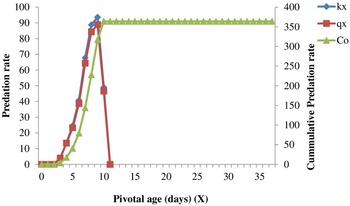
The first instar larvae of E. corollae emerged on the 3rd day of pivotal age with a 100% survival rate up to the 27th day of pivotal age. Immediately after emergence, the larvae of E. corollae started feeding and fed on an average of 4.00 aphids fed on that day (3rd day of pivotal age) (fig. 1). The age-specific predation rate (kx) varied from 4.00 to 92.50 aphids per day and attained a peak on the 10th day of pivotal age (92.50 aphids day−1). The maximum age-specific net predation rate (qx) was recorded in the third instar on the 10th day of pivotal age (fig. 1). The age-specific cumulative predation rate (C 0) varied from 4.00 to 379.95 aphids per day. The net lifetime consumption rate of E. corollae on B. brassicae was 379.95 aphids per day. The stable host kill rate and finite host kill rate were 18.63 and 21.07, respectively (Table 2). The transformation rate was 20.78 which predicted that the mean of aphids (20.78) need for E. corollae to produce one offspring (Table 2).
Age-specific predation (kx), net age-specific predation rate (qx) and cumulative predation rate (C 0) of E. corollae against B. brassicae.

Host kill parameters of E. corollae against B. brassicae

Functional response of E. corollae to B. brassicae
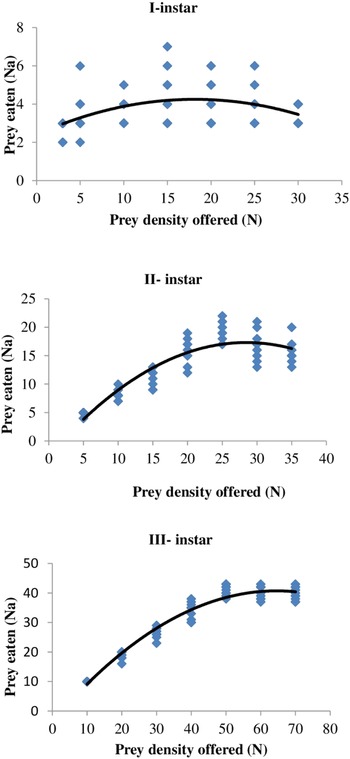
In all the experiments, the mean number of aphids consumed by first, second and third instar larvae of E. corollae differed significantly among the different aphid densities (fig. 2) (first instar: (F = 3.17; df = 6, 63; P < 0.001); second instar: F = 86.89; df = 6, 63; P < 0.001; third instar: F = 388.46; df = 6, 63; P < 0.001).
Type II functional response to fit to first and third instars of E. corollae to B. brassicae over the 24 h period for the prey density (N) against prey density eaten (Na).

Logistic regression analysis between the proportion of aphids consumed and initial aphid density showed the negative linear coefficient (p 1) confirming the type II functional response for first, second and third instar larvae of E. corollae (Table 3). After confirming the type II functional response, the Roger's equation for predator was fitted and the result indicated that the attack rate was highest for the third instar (0.336 h−1) followed by the second (0.168 h−1) and the first instar (0.183 h−1) (Table 4). The handling time was lowest for the third instar larvae (0.514 h) while highest for the first instar larvae (5.92 h). The maximum number of aphids consumed over 24 h by the third instar, followed by second and first instar larvae of E. corollae was 46.84, 32.17 and 5.43 aphids per larvae per day (Table 4).
Polynomial regression coefficient to determine the type of functional response of E. corollae against B. brassicae

Functional response parameters of different developmental stages of E. corollae against B. brassicae

Means superscripted within a row followed by the different letter are significantly different at p ≤ 0.05.
Discussion
The present study revealed that all the larval instars of E. corollae were the efficient predator of cabbage aphid. A significant difference between life time and daily consumption was recorded for all larval stages. The maximum consumption was recorded with third larval instar of E. corollae compared to the earlier instar which agree with Jalilian et al. (Reference Jalilian, Karimpour, Aramideh and Gilasian2016) who reported that 66.09% of total larval feeding was due to third larval instar of E. corollae against the apple aphid, A. pomi De Geer; Devi et al. (Reference Devi, Kalita and Singh2011) who reported third instar larvae of Episyrphis balteatus (de Geer) consumed on an average of 98.12 aphids per day of Lipaphis erysimi (kaltenbach); and Singh and Singh (Reference Singh and Singh2013) also reported that the higher consumption rate (167 aphids) of third instar larvae of syrphid flies with another aphid, L. erysimi. In our study, age-specific net predation rate (qx) increased after the 4th day and peak recorded on the 10th day of pivotal age in third larval instar. Similar findings were reported by Lillo et al. (Reference Lillo, Perez-Bañón and Rojo2021) that predatory capacity of E. corollae increased from the 4th day and peaked on the 6th day after hatching and consumed on an average 160 aphids. The present study recorded that the stable host kill rate and finite host kill rate of E. corollae were 18.63 and 21.07, respectively, against the B. brassicae and predicted that mean of 20.78 aphids needs for E. corollae to produce one offspring. Similarly, Lillo et al. (Reference Lillo, Perez-Bañón and Rojo2021) reported the finite kill rate of E. corollae against M. persiace (28.12 nymphs) and transformation rate (Qp) of 6.6 nymphs per eggs needed to produce one E. corollae.
All the larval stages of E. corollae showed a decreasing trend of proportion of aphid consumed with surge of aphid density. At higher prey density, the prey consumption was significantly at par with second and third instar larvae of E. corollae as the prey consumption was increased with increasing the prey density, which then decreased after attaining the upper asymptote (76.40 and 81.40% consumption, respectively). The present study matched with the Holling (Reference Holling1959) finding that the predator would be more effective at lower prey densities. The present study corroborates the study of Mills (Reference Mills1982) who reported significant reduction in prey consumption at higher prey densities which could be due to the attainment of satiation. A negative linear coefficient (P < 0) indicated the type II functional response for all larval instar of E. corollae against the B. brassicae. Results here are consistent with those observed by Jalilian et al. (Reference Jalilian, Fathipour, Talebi and Sedaraian-Jahromi2011) and Amiri-Jami and Sadeghi-Namaghi (Reference Amiri-Jami and Sadeghi-Namaghi H2014) who reported the type II functional response of E. balteatus with respect to prey density while the study of Khatua et al. (Reference Khatua, Mohapatra, Nayak and Dibyarani2020) reported the type II response for second instar and type III for the third larval instar. This variation may be due to the difference in the size of prey offered as the size of prey plays an important role to determine the type of functional response for a predator (Hassell et al., Reference Hassell, Lawton and Beddington1977).
The coefficient of attack rate (a) and handling time (Th) were calculated to measure the magnitude of the functional responses exhibited by the larval stages of E. corollae. Current studies indicated significant difference between the attack rate of all the larval stages (first = 0.183, second = 0.168 and third = 0.336) (F = 10.11; df = 2, 27; P = 0.001) of E. corollae against B. brassicae which showed that E. corollae have different behaviour to response with increasing prey density whereas time to capture the prey (Th) for second (0.880) and third instar (0.514) was significantly at par (F = 15.37; df = 2,27; P < 0.001). The maximum prey consumption was recorded for third instar of E. corollae with higher attack rate and lower handling time against B. brassicae followed by the second and first instar. In the present study, the attack rate of E. corollae larvae increased with increasing the larval size. This could be due to the larger size and higher consumption rate of third instar than younger instar. This inference strongly supported with the study of Pervez and Omkar (Reference Pervez and Omkar2004) who reported difference in the functional response parametric value could be due to the variation in size, voracity, hunger level, digestive ability and searching time. In general, the time spent to capture, eat and digest the prey affects handling time of predator (Hassell, Reference Hassell1978). The handling time also affects the type of functional response and suggests that the shorter the handling time, the faster the curve reaches the asymptote (Nordlund and Morrison, Reference Nordlund and Morrison1990). The present study is in line with the findings of Amiri-Jami and Sadeghi-Namaghi (Reference Amiri-Jami and Sadeghi-Namaghi H2014) who reported the searching efficiency (a) of the third instar larvae was higher than that of the younger whereas prey consumption was higher and handling time (Th) was lower for third instar larvae. Similarly, Arcaya et al. (Reference Arcaya, Perez-Banonb, Mengualc, Zubco-Vallejod and Rojob2017) also observed the lower attack rate and higher handling time for the third larval instar followed by second and first instars of Allograpta exotica (Wiedemann). Theoretically, maximum predation rate (K) of third instar larvae was 46.84 aphids per larvae per day which is significantly at par with second instar (32.17 aphids per larvae per day) and differed from the first instar (5.43 aphids per larvae per day). Amiri-Jami and Sadeghi-Namaghi (Reference Amiri-Jami and Sadeghi-Namaghi H2014) also reported that the maximum theoretical predation rate (T/Th) of third instar larvae of E. balteatus (269.19) was greater than that of younger instar larvae (125.35). The maximum number of prey consumed by third instar may be due to the larger size of this larval stage with additional energy requirement.
In conclusion, the present study revealed that third instar larvae of E. corollae were more voracious predators of B. brassicae with higher searching efficiency (a) and lower handling time followed by the second and first instars. The proportion of prey consumption decreased with increase of the prey density offered which confirmed the type II response of all the predatory larval stages of E. corollae against the cabbage aphid, B. brassicae. Thus, the results infer E. corollae as the potential biocontrol agent for the management of cabbage aphid, B. brassicae; however, further evaluation in the field is needed.
Acknowledgements
The authors are thankful to the Professor and Head, Department of Entomology, Dr YS Parmar University of Horticulture and Forestry, Nauni, Solan, Himachal Pradesh, India for providing facilities to conduct the experiment. The first author is thankful to the Indian Council of Agricultural Research, New Delhi, India for funding in the form of Senior Research Fellowship for study. The authors acknowledge Dr Anooj SS, Assistant Professor, Department of Entomology, Kerala Agriculture University, Kerala, India for identification and authentication of syrphid species.
Author contributions
S. P. conducted the experiments, collected the data, analysis and wrote the manuscript. S. C. V. designed the experiments and helped to write and improve the manuscript. P. L. S. and R. S. C. helped in designing the experiments and statistical analysis of data. A. S. S. helped in identification and authentication of syrphid fly species. We confirm that the manuscript has been read and approved by all named authors and also confirm that the order of authors listed in the manuscript has been approved by all of us. Corresponding author is responsible for communicating with the other authors about progress, submissions of revisions and final approval of proofs.
Financial support
None.
Conflict of interest
None.
Ethical standards
Compliance with ethical approval.