




No CrossRef data available.
Clinical assessment of depression in terminally ill cancer patients: A practical guide
Published online by Cambridge University Press: 13 April 2006
Abstract
Depression is commonly experienced by cancer patients at the end of life. The identification of patients suffering from depression is essential to provide clinicians with an opportunity to relieve considerable suffering. However, the assessment of depressive symptoms is complex and often challenging in a terminally ill cancer population. This article offers practical guidelines to assist clinicians with the diagnosis of depression, reviews the defining symptoms of depression and their unique presentation in patients at the end of life, suggests modifications of the standard diagnostic interview, and provides examples of specific assessment questions to target depressive symptoms at the end of life.
Information
- Type
- REVIEW ARTICLES
- Information
- Copyright
- © 2005 Cambridge University Press
INTRODUCTION
Depression is considered the most frequent mental health issue among terminally ill patients (Wilson et al., 2000). Specifically, among advanced stage cancer patients, prevalence rates for major depression range from 23% to 58% (Potash & Breitbart, 2002). Despite this, there is not a clear consensus in the field on how depression manifests in those approaching the end of life. These patients' complex medical issues make it difficult to determine which symptoms are the result of advancing illness and which are the result of a treatable mood disorder. Because it is typical for patients to express sadness over their diagnoses and prognoses, clinicians often overlook more severe and treatable levels of sadness and despair (Stiefel et al., 1990; Pessin et al., 2002). The stigma attached to the diagnosis of a psychiatric disorder may also preclude patients from reporting symptoms and clinicians from diagnosing disorders (Block, 2000). Physicians' time constraints and biases that treatment may be futile may stop them from diagnosing and treating depression among the terminally ill (Block, 2000). Finally, the standard assessment techniques generally used in mental health settings may be less effective in this population. Yet the correct identification of patients who are suffering from depression is imperative in order to provide clinicians with an opportunity to relieve considerable suffering in the dying.
This article is a practical guide to assist clinicians in the identification of depression in the terminally ill. This guide aims to help clinicians in two ways: First, it reviews the defining symptoms of depression and discusses how they may appear in patients at the end of life; second, it suggests modifications in standard assessment queries to help clinicians identify the core constructs underlying depressive disorders at the end of life. Finally, a list of questions is included (see Table 1) to provide specific guidance for how to modify the standard diagnostic interview.
Sample questions to evaluate symptoms of depression in palliative care patients

DIAGNOSTIC GUIDELINES
Existing guidelines for assessing depression in terminally ill cancer patients discuss the salient symptoms and provide some direction in how best to assess patients. Many authors recommend that clinicians who are working with terminally ill patients focus on psychological and cognitive symptoms rather than on somatic or vegetative symptoms (Cohen-Cole et al., 1987; Storey & Knight, 1997; Wilson et al., 2000; Lloyd-Williams, 2003; Rosenfeld et al., 2006). Passik et al. (2000) recommend that clinicians pay particular attention to the cognitive symptoms of worthlessness, hopelessness, excessive guilt, and thoughts of self-harm to minimize the confounding effects of illness. Massie and Shakin (1993) also emphasize the importance of taking a thorough history, which should focus on life stressors, previous depressive episodes, family history of depression or suicide, substance abuse, social supports, and possible treatment effects.
Somatic symptoms present the greatest confounding factor in the assessment of depression in terminally ill patients (Lloyd-Williams, 2003). Several symptoms of major depression, including weight loss, lack of appetite, inability to concentrate, insomnia, and fatigue are common sequelae of neoplastic disease, as well as many cancer treatments, although the Diagnostic and Statistical Manual of Mental Disorders–IV (American Psychiatric Association, 1994) dictates that somatic symptoms be excluded from consideration when directly caused by a medical condition. While a worthwhile goal, it is often impossible to tease apart the etiology of multiple symptoms in late-stage cancer. Beyond this difficulty is the practical problem that as more somatic symptoms of depression are excluded from consideration, it becomes increasingly difficult for patients to meet DSM-IV diagnostic criteria for depression. This would result in the underdiagnosis of depression and the identification and treatment of only the most severely depressed patients (Wilson et al., 2000). In contrast, Cassem (1990) recommends the inclusive approach, in which all symptoms are considered regardless of etiology. The clear drawback to this method is that it will almost certainly lead to overdiagnosis of depressive disorders in this population. Finally, Endicott (1984) devised the substitutive approach to replace somatic symptoms in the assessment of depression in the medically ill. He suggested replacing “changes in appetite and weight” with “tearfulness and depressed appearance”; replacing “sleep disturbance” with “social withdrawal and decreased talkativeness”; replacing “fatigue” with “brooding, self-pity, and pessimism”; and replacing “concentration difficulties and indecisiveness” with “lack of reactivity.”
For the purposes of this article, we are recommending the use of an inclusive approach with some modifications to provide a more thorough method of assessing each individual symptom that is more specifically tailored to a terminally ill population. Using Endicott's (1984) replacement suggestions as additional items rather than only as substitutions may also enhance the diagnostic process. The rationale behind these choices is that it is better to risk overdiagnosing depression in this setting in which emotional suffering is so prevalent and to expedite treatment than to potentially miss a patient who may benefit from psychiatric interventions.
SYMPTOM ASSESSMENT GUIDELINES
The guidelines offered below summarize and elaborate on existing recommendations. Each of the defining symptoms of depression will be reviewed, with particular attention given to anhedonia, depressed mood, suicidal ideation, worthlessness, guilt, and hopelessness, as many researchers have agreed that these symptoms are especially relevant and the more sensitive symptoms to depression among a palliative care population (Bukberg et al., 1984; Casey, 1994; Passik et al., 2000). Also, the difficulties assessing physical symptoms associated with depression, such as changes in sleep, appetite, concentration, as well as libido, and the implications for making accurate diagnoses will be addressed.
Anhedonia
Anhedonia is a hallmark symptom of depression in the terminally ill; however, it may present somewhat differently in this population than in a general psychiatric population. Due to the severity of illness there may be many limitations on sources of pleasure and feasible activities available to the patient. Therefore it is critical to carefully assess the patient's interest, will, and desire, rather than actual engagement in activities to determine if there is a loss of or diminished sense of pleasure. For instance, a patient may report difficulties spending time with relatives due to fatigue or severe pain but still might endorse a strong desire to do so. Patients may often focus on what they can no longer do. In some cases, the patient may make statements such as “I would like to play golf if I could, but I can't.” The expression of such a wish may be enough to rule out anhedonia. Another effective technique is to inquire about what the patient is still able to do or enjoy, such as eating, watching television, reading, visits, participation in hospital activities, interest in current events, and settling their affairs. Clinicians should also ask open-ended questions such as, “Is there anything you look forward to doing or find pleasure in now?” In the unusual instance that a patient reports no sources of pleasure after such a comprehensive evaluation has been conducted, anhedonia related to depression is strongly indicated.
Depressed Mood
Many patients near the end of life experience some feelings of dysphoria or find themselves tearful as part of the dying process. Patients may express appropriate sadness when discussing prognosis, medical decisions, or family issues. For example, a patient might cry frequently when speaking about not being able to see her young children grow up, but may not express or endorse other symptoms of depression. Although such transient feelings are normal, sustained, more severe symptoms such as profound despondency, constant crying, or a pervasive flatness of affect may indicate a clinical depression. To avoid the overdiagnosis of depression, the extent and duration of the sadness should be substantial (nearly every day, for most of the day, for several consecutive days). On the other hand, patients who report a lack of sadness and appear to have the opposite problem (a constriction of affect) may also be depressed, as the more severe cases of depression are characterized by a lack of affect. Finally, it may be appropriate to be lenient regarding the two-week-or-more time criteria because the need to treat quickly in this population is often imperative.
Suicidal Ideation
In the terminally ill, some thoughts about death and dying are appropriate and do not necessarily indicate suicidal ideation or depression. Typical concerns may include fears around the dying process, contemplation of an afterlife, and other existential issues. Although a fleeting wish for death is relatively common as death approaches, preoccupation with a desire to die for long periods of time is more unusual and warrants attention. Feelings that life is no longer worth living or expressing a desire to die may be more pathological and indicative of depression. Further, clinicians need to distinguish between readiness for death or the wish to die sooner rather than later and active suicidal ideation. For example, a patient might state, “If I died tomorrow that would be okay, but I'd never do anything to make it happen.” Therefore, it is essential to determine the presence of a current or future intent or plan for suicide. It is also important to be aware that a desire to die may result from severe, incapacitating pain or uncontrolled symptoms and not depression, in which case treatments geared toward symptom amelioration should be utilized and may result in a quick diminishing of desire for death.
Hopelessness
Hopelessness is often “the forgotten symptom” of depression in palliative care settings because clinicians tend to assume that all patients experience despair as they approach the end of life. However, research has demonstrated that elevated levels of hopelessness are not typical, occurring in only approximately 20% of patients (Breitbart et al., 2000; Chochinov et al., 1998). In addition, because hopelessness is highly predictive of desire for hastened death and suicidal ideation (Breitbart et al., 2000), it is crucial to assess among this population. When conducting such an assessment, one thing to keep in mind is that a clear understanding of one's prognosis should not be misunderstood as hopeless thinking. For example, a patient may state that she has given up hope for recovery and is expecting to die within a month. Such a statement, if corroborated by her medical records, is likely indicative of a realistic outlook rather than an irrational, hopeless one and is not indicative of depression. For many terminally ill patients, however, hope does not disappear, it changes. The specific nature of their hopes may change to such themes as a pain-free death, spending quality time with family, a better existence in the afterlife, or looking forward to an upcoming life event. When interviewing a patient, it is often useful to specifically mention these potential sources of hope and elicit that patient's reactions to them. People who are pervasively hopeless and are unable to find hope from any source should be further assessed for depression (Block, 2000).
Worthlessness and Guilt
Negative cognitions such as worthlessness and guilt are often strong indicators of depression. Caution should be taken when assessing worthlessness and guilt within a palliative care population. First, clinicians must distinguish feelings of worthlessness (feeling that one's life has no value) from helplessness linked to loss of functioning or independence. Many patients approaching death may struggle with feelings of helplessness due to their inability to care for themselves. Such feelings are common and may contribute to depression but not necessarily be indicative of depression. More global feelings of worthlessness that present more like a loss of self-esteem tend to be less common.
Assessing the presence of guilt can be challenging because many patients engage in a type of “life review,” noting proud moments and areas of regret as they approach the end of their lives. As with other symptoms, degree and intensity should be considered. Negative thoughts related to past deeds, such as disappointing a loved one or failing to uphold a responsibility, are relatively common. However, excessive feelings of guilt or the belief that one's illness is a punishment are more concerning. Guilt may also manifest as feelings of being a burden to loved ones.
Insomnia and Hypersomnia
Although change in sleep patterns, typically difficulty sleeping, is often indicative of possible depression among a physically healthy population, this is not necessarily so among patients with advanced disease. Hypersomnia is so ubiquitous in the terminally ill that it is almost impossible to determine the etiology. Conversely, many patients experience insomnia due to physical pain, inactivity during the day, or disruptions by nursing staff during the night, and it is very difficult to determine if depressive feelings or thoughts are contributing to the insomnia. Additionally, even when depression underlies the symptom of insomnia, it may be masked by sleep aids or analgesics. Although it is often impossible to determine the etiology of a patient's insomnia, it is useful to inquire about the thoughts the patient is having during the night when awake. If a patient is able to lie in bed and read until he returns to sleep, depression is an unlikely culprit. However, if the patient lies awake experiencing disturbing or negative thoughts, depression may be at least partially to blame and requires further assessment.
Changes in Appetite and Weight
Changes in appetite and weight often result due to advanced physical disease; therefore, the use of weight and appetite changes to diagnose depression in the terminally ill is minimally useful. Patients may lose their appetites due to the resulting physical discomfort when they eat, resulting in weight loss. Also, certain illnesses preclude the oral ingestion of food, again resulting in weight loss but a preservation of appetite. Finally, water retention, due to steroids or other medications, is common and often results in weight gain unrelated to increased appetite or food consumption. If a patient is able to eat without physical difficulties, lack of appetite and loss of weight may be indicative of depression. Similarly, if a patient explains that they are overeating to comfort himself when sad, it is possible that weight gain may be a symptom of depression.
Diurnal Variation
It is common for people experiencing major depression to experience a relative lift in mood later in the evening or at night compared to their mood during morning and midday. Such diurnal variation may appear to be similar in a depressed patient who is terminally ill compared to a depressed, physically health patient. When patients present with diurnal mood variation, clinicians should determine whether these mood changes may be influenced by visiting hours, staff shift changes, or a change in activity levels. In these instances, mood variation may be more due to these environmental changes than to true diurnal shifts.
Psychomotor Retardation and Agitation
Metabolic changes due to physical illness and medication can cause psychomotor retardation, making it difficult to determine whether such retardation may be due to depression in a terminally ill patient. It is useful to monitor motor movements that are unlikely to be caused by medical illness, such as eye contact, rate and tone of speech, and head turning, when assessing for depression in this population. Someone who fails to make eye contact when speaking or fails to turn his or her head toward the interviewer may be displaying retardation due to depression. Additionally, agitation, such as playing with one's hands, can also be caused by medications. However, it is also possible that fidgeting and restlessness experienced by a terminal patient may be due to anxiety or depression similar to that experienced by a physically healthy patient.
Hypochondriasis
Some degree of hypochondriasis should be considered appropriate unless extreme. Patients may routinely focus on or complain about specific symptoms, wounds, or pain, but if this becomes a preoccupation or obsessive in nature it may be problematic. Patients who are experiencing these difficulties will often offer unsolicited information about their health or discuss their somatic concerns in an overly detailed manner.
Concentration
Several factors make it difficult to assess concentration in the terminally ill. Medications, pain, fatigue, treatment-related side effects, and metabolic changes can impair concentration and attention span, making it difficult to assess depression. Changes in mental status may also be related to the onset of delirium. Efforts should be made to assess the quality of thinking and the ability to process information. It may also be helpful to determine if these changes are concurrent with the onset of mood fluctuations.
Sexual Symptoms
Assessing changes in libido, which are typically more relevant in a physically healthy population, may be perceived as inappropriate in this population and therefore should be discussed with sensitivity. It may be more appropriate to allow patients to raise concerns if they are present. Clinicians should assess whether these symptoms are related to physical or emotional factors.
CONCLUSION
The diagnosis of depression in the terminally ill is complicated by many factors. Hopefully, clinicians can meet these challenges more effectively by following the recommendations presented in this article. A good clinical assessment of depression should specifically target the unique presentation of symptoms of depression in patients at the end of life. Clinicians should approach the diagnosis of depression comprehensively, noting clusters of symptoms rather than any one symptom in isolation. Clinicians must also remain cognizant of the specific context surrounding the patient's symptomatology. Patients who present with multiple symptoms of depression, even when some are of questionable etiology, may be able to benefit from assessment and subsequent treatment. Although the assessment techniques recommended in this article may be somewhat lengthier than a “typical” evaluation, they should help to meet the ultimate goal of the relief of patient suffering. Ameliorating distress at the end of life can help patients to experience a more peaceful and dignified death.
ACKNOWLEDGMENTS
We thank the following colleagues: William Breitbart, M.D., Barry Rosenfeld, Ph.D., Robert Brescia, M.D., and James Cimino, M.D., for contributing their expertise in psychological assessment and palliative care. We gratefully acknowledge the terminally ill participants in our research projects for generously giving of their time. We appreciate the staff of Calvary Hospital for their help and support. This work was supported by a grant from the National Institute of Nursing Research (William Breitbart; Grant No. NIH/NINR SR01 NR05183-04).
References
REFERENCES
American Psychiatric Association.
(1994).
Diagnostic and Statistical Manual of Mental Disorders
(4th ed.)
Washington, DC:
American Psychiatric Association.
Block, S.
(2000).
Assessing and managing depression in the terminally ill
patient.
Annals of Internal Medicine,
132,
209–218.Google Scholar
Breitbart, W.,
Rosenfeld, B.,
Pessin, H.,
et al.
(2000).
Depression, hopelessness, and desire for hastened death in
terminally ill patients with cancer.
JAMA,
284,
2907–2911.Google Scholar
Bukberg, J.,
Penman, D., &
Holland, J.
(1984).
Depression in hospitalized cancer patients.
Psychosomatic Medicine,
46,
199–212.Google Scholar
Casey, J.
(1994).
Depression in the dying—Disorder or distress?
Progressive Palliative Care,
2,
1–3.Google Scholar
Cassem, E.H.
(1990).
Depression and anxiety secondary to medical illness.
The Psychiatry Clinics of North America,
13,
597–612.Google Scholar
Chochinov, H.M.,
Wilson, K.G.,
Enns, M.,
et al.
(1998).
Depression, hopelessness, and suicidal ideation in the terminally
ill.
Psychosomatics,
39,
366–370.Google Scholar
Cohen-Cole, S. &
Stoudemire, A.
(1987).
Major depression and physical illness: Special considerations in
diagnosis and biologic treatment.
Psychiatric Clinics of North America,
10,
1–17.Google Scholar
Endicott, J.
(1984).
Measurement of depression in patients with cancer.
Cancer,
53,
2243–2248.Google Scholar
Lloyd-Williams, M.
(2003).
Depression—The hidden symptom in cancer.
Journal of the Royal Society of Medicine,
96,
577–581.Google Scholar
Massie, M.J. &
Shakin, E.J.
(1993).
Management of depression and anxiety in cancer patients. In
Psychiatric Aspects of Symptom Management in Cancer Patients,
Breitbart, W. &
Holland, J. (eds.), pp.
1–21.
Washington, DC:
American Psychiatric Press.
Passik, S.D.,
Lundberg, J.,
Rosenfeld, B.,
et al.
(2000).
Factor analysis of the Zung Self-Rating Depression Scale in a large
ambulatory sample of oncology patients.
Psychosomatics,
41,
121–127.Google Scholar
Pessin, H.,
Rosenfeld, B., &
Breitbart, W.
(2002).
Assessing psychological distress near the end of life.
American Behavioral Scientist,
46,
357–372.Google Scholar
Potash, M. &
Breitbart, W.
(2002).
Affective disorders in advanced cancer.
Hematology/Oncology Clinics of North America,
16,
671–700.Google Scholar
Rosenfeld, B.,
Abbey, J., &
Pessin, H.
(2006).
Depression and hopelessness near the end of life: Assessment and
treatment. In
Psychosocial Issues near the End of Life: A Resource for
Professional Care Providers,
Werth, J.L. &
Blevins, D. (eds.), pp.
163–182.
Washington, DC:
American Psychological Association.
Stiefel, F.C.,
Kornblith, A.B., &
Holland, J.C.
(1990).
Changes in the prescription patterns of psychotropic drugs for
cancer patients during a 10-year period.
Cancer,
65,
1048–1053.Google Scholar
Storey, P. &
Knight, C.F.
(1997).
UNIPAC Two: Alleviating psychological and spiritual pain in the
terminally ill.
Gainsville, Florida:
American Academy of Hospice and Palliative Medicine.
Wilson, K.G.,
Chochinov, H.M.,
de Faye, B.J.,
et al.
(2000).
Diagnosis and management of depression in palliative care.
In
Handbook of Psychiatry in Palliative Medicine,
Chochinov, H.M. &
Breitbart, W. (eds.), pp.
25–49.
New York:
Oxford University Press.
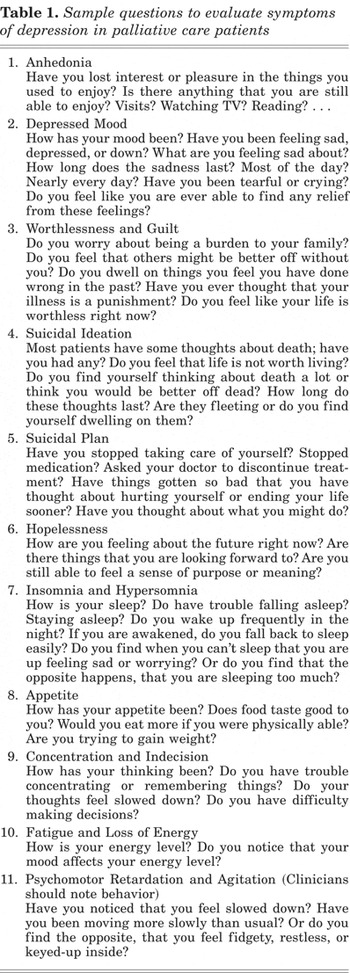
Sample questions to evaluate symptoms of depression in palliative care patients
 You have
Access
- 16
- Cited by