Thomas Digges and the new star of 1572
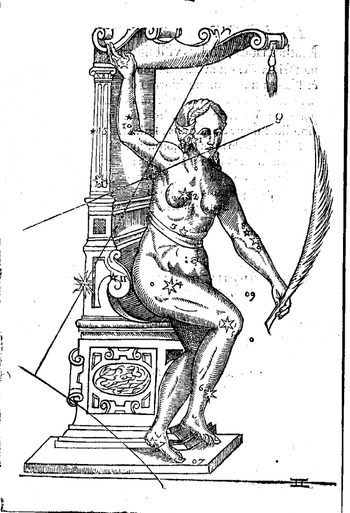
One night in the middle of November 1572 the puritan gentleman and leading English mathematician Thomas Digges observed a strange new light in the night sky in the constellation of Cassiopeia (Figure 1). The Danish astronomer Tycho Brahe first saw it on 11 November.Footnote 1 As November passed it became extremely bright, reportedly outshining Venus at its peak, when it was even visible in daylight. After a few months it began to fade and had apparently disappeared from view by February 1574. Observations from the period, including those by Digges, have been used recently to rediscover the remnant of what is sometimes called ‘Tycho's supernova’.Footnote 2
Diagram of the constellation of Cassiopeia, showing the position of the new star in her seat, from Thomas Digges, Alae seu scalae mathematicae, London: Thomas Marsh, 1573, sig. A verso.

Of course, Digges and his contemporaries had no concept of supernovae.Footnote 3 For them the ‘phenomenon’ (the non-committal term used by some baffled observers) was a puzzling anomaly. It attracted the attention, observations and opinions of countless astronomers and astrologers and natural philosophers, as well as powerful theologians and politicians, and it provoked many printed and manuscript works in the following months and years.Footnote 4 It immediately precipitated a debate throughout Europe about its location, cause and significance. Most commentators assumed that it was a comet, albeit a prodigious one, given that it did not seem to show the expected tail or proper motion through the sky. Digges was one of numerous experts who in many cases had been consulted by the authorities and who published their findings quickly.
One of the fastest responses, completed by 17 December and published in Paris ‘en l'an present 1572’ was La declaration d'un comete ou estoille prodigieuse. The author revealed his identity only as I.G.D.V.Footnote 5 This unexceptional tract will feature prominently in this story. It has received little attention and the identity of the author has remained in doubt. In his Catalogue alphabétique des textes astrologiques français, Jacques Halbronn notes that a contemporary attributed it to one Jean Gosselin de Vire.Footnote 6 This article presents evidence to confirm that identification. The author reported that his observations showed the phenomenon to be a comet. The ‘new star exhibits parallax and various positions on the sky, like things very close to the earth, which is not the case with the fixed stars that are in the eighth sphere.’Footnote 7
From their observations Tycho and Digges rapidly rejected the standard view that it was a strange comet for the extraordinary claim that it was a new star. The Dane's De Stella Nova appeared in 1573, his first publication, and his only publication for many years. Digges was admired in England as the publisher and developer of his father Leonard's advanced humanist style of practical mathematics. He had also published his own Mathematicall Discourse of Geometricall Solids in 1571, a work that Johnston calls ‘the most self-consciously advanced and novel work on geometry published in sixteenth-century England’.Footnote 8
Digges published his full observations, calculations and conclusions concerning the star in a groundbreaking work on astronomical parallax of 1573 which he called Alae seu scalae mathematicae. It was well received and did more than any other work by Digges to secure him the international reputation as a mathematician that he desired. We need to recall a few points about it. The full title of Alae seu scalae mathematicae makes clear that it was a very ambitious work. Digges described his work on parallax (in Latin) as Mathematical Wings or Ladders, with which to ascend to the furthest Theatres of the Heavens and, with a new and unheard-of Method, to explore the paths of all the Planets, and then to find out the Distance, Position and immense Magnitude of that portentous Heavenly Body shining with remarkable brightness in the Northern part of the World. There were two wings or ladders, advanced spherical geometry and the superior observations made possible by better instruments. Digges conceded that any planetary parallaxes were so small that they could ‘scarcely be perceived’. Nevertheless, he believed they were just detectable because, like Brahe, he accepted low estimates of planetary distances that made planetary parallaxes bigger and easier to detect.Footnote 9
What fascinated Digges about parallax, as it later fascinated Tycho, was that Copernicanism required greater variations than did Ptolemaic astronomy in the distance from Earth of the planets, notably Mars, and thus predicted bigger changes in parallax.Footnote 10 For Digges this observational asymmetry allowed his method to settle the dispute between geocentrists and heliocentrists with ‘not merely probable arguments but perhaps the surest demonstrations’.Footnote 11 Digges had reason to believe that more accurate observations with larger graduated instruments, such as the ten-foot cross staff devised by Richard Chancellor that he had used with John Dee, had given parallax methods the potential to prove Copernicus right.
Robert Goulding has recently raised questions about when and why Digges wrote his Alae seu scalae mathematicae.Footnote 12 Standard accounts treat it as his response to the new star, compiled in the few months between the star's appearance in November 1572 and its delivery to the press around March 1573. Goulding argues that Digges could not have developed all of his sophisticated geometrical techniques in that time. He also maintains (and I agree) that references to observations of the star itself in the Alae seu scalae mathematicae do not seem fully integrated. His controversial conclusion is that Digges had developed his grand project before the ‘phenomenon’ appeared in November 1572. Digges realized that the methods of the Alae seu scalae mathematicae could answer the question of the distance of the phenomenon from the Earth. He therefore incorporated the null result: the phenomenon exhibited no discernible parallax and was therefore a star, even further away than the planets that (so Digges hoped) should have a little parallax. Other experts are not convinced by Goulding's argument. It is not crucial to this article when Digges developed his methods, because all his writings on the star were compiled after November 1572.Footnote 13 But it is worth bearing in mind that Digges may have been more ready than most to measure any parallax in the new star.
Between the title page of the Alae seu scalae mathematicae and its dedication to William Cecil, Lord Burghley, Digges inserted a carefully engraved representation of Cassiopeia and her thirteen stars plus the new star (Figure 1). Facing it was a table of the positions of the thirteen stars. His caption explained that they were ‘taken from Copernicus (with the printer's errors corrected)’, corrections we know he made.Footnote 14 He had added the distances of the new star from them according to observations he had made in mid-February 1572/3, in order to leave a precise record of its location ‘if, before the dissolution of the sphere, by order of the Most Powerful, it should recede again’.Footnote 15
The body of the book contains few comments about the nature of the star. Digges noted that mathematicians who made the best observations and calculations of its parallax knew it to be a body in the high heavens. It could not be a comet because Aristotle had shown that comets did not belong in this region of ‘the purest Aether, where there can be no naturally occurring changes, novelties or alterations’. Digges's position was that those who say it is like other comets ‘either condemn or devalue this rarest sign, God's true miracle or messenger’. Beyond this, he was
determined not to write anything more on the history of this star, because that extraordinary man John Dee (most learned in these studies and a prodigy in the rest of philosophy, whom I esteem as my second Mathematical Father …) has taken on the task of expounding this material … I have no doubt that it will soon be published.Footnote 16
No one has ever suspected that Digges might have published something more on the star, but in this article I present strong evidence that he did. My discovery was serendipitous. I was systematically inspecting the ‘front matter’ or prefatory pages of the hundreds of works published in England between 1570 and 1625 whose content could loosely be called scientific. This was research for my AHRC-funded research project Science and Patronage in England, 1570–1625.
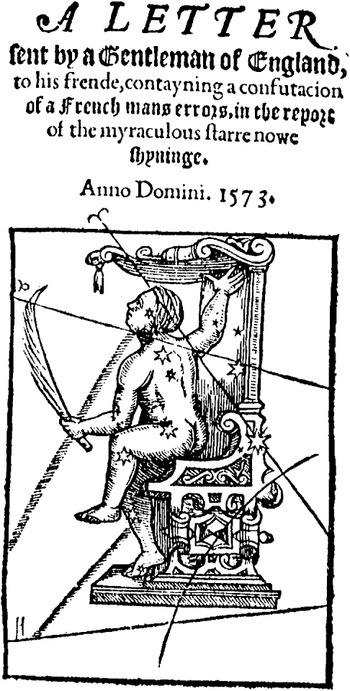
Proceeding alphabetically by author, I soon encountered a short pamphlet, listed under ‘Anon[ymous]’ in the Short Title Catalogue (STC), entitled A Letter sent by a gentleman of England, to his frende, contayning a confutacion of a French mans errors, in the report of the myraculous starre nowe shyning. Anno Domini. 1573 (Figure 2). It has the STC number 155253-1797, and the only extant copy of the pamphlet is to be found in the library at Lambeth Palace, London, where it is bound with a miscellaneous collection of pamphlets on diverse subjects. Unfortunately there is no provenance history for this volume and it does not appear to be in its original binding, but it bears the signs of being a cheap and hurried pamphlet.Footnote 17 I have appended a transcript (see Appendix), and online images of the original pages can be found in Early English Books Online.
Title page from Anon., Letter sent by a Gentleman, London: Thomas Marsh, 1573.

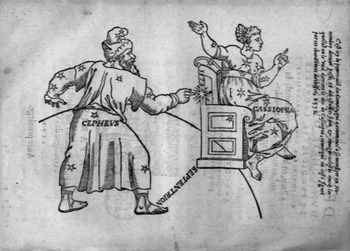
The surviving copy comprises a title page (Figure 2), including a representation of Cassiopeia showing the new star, nine pages of text, and a final page declaring that it was printed by Thomas Marsh in 1573.Footnote 18 It begins ‘Misopseudolugos Philomathei, salutem’, i.e. ‘The hater of false doctrine greets the lover of mathematics.’ It announces that it is the fulfilment of Philomathes's request for Misopseudologos's ‘opinion touching that French Pamflet of a blasing starre lately Englished’.Footnote 19 I have found no trace of any such translation, and I conclude that it was circulated in manuscript and since lost. This has created a textual problem fit for an Umberto Eco novel: the Letter sent by a gentleman was an anonymous commentary upon a lost English translation of an unnamed French work. To complicate matters further, the most likely Frenchman was known only as I.G.D.V. (Figure 3).
Diagram of the position of the new star in Cassiopeia from I.G.D.V., La declaration du comete ou estoille prodigieuse, Paris, 1572, sig. A v.

The Letter sent by a gentleman has been completely ignored by historians, and La declaration d'un comete ou estoille prodigieuse merely noted in the bibliography by Halbronn.Footnote 20 Perhaps this is because their titles suggest third-rate pieces of astrological controversy. From my perspective of patronage, the Letter sent by a gentleman to his frende seemed to indicate an equally uninteresting dyadic rather than client–patron relationship, with no dedication. I too was ready to pass over it until struck by the similarities with Digges's Alae seu scalae mathematicae, most immediately by the diagrams of Cassiopeia (reproduced with this article). What follows shows how Digges came to write this response to Gosselin's Declaration d'un comete ou estoille. That he was the author makes the text a very interesting work. It adds to the small corpus of texts by Thomas Digges, it sheds new light on the development of Digges's observations of and reflections on the star, it expresses a preference for Copernican cosmology which may well be the first such occasion by an English writer, and it shows the advice about the star that Digges gave to Elizabeth I's privy counsellors.
First responses to the ‘new comet or star’ in Paris and London
The new phenomenon was indeed prodigious. As the weeks went by it shone like the brightest planets and seemed not to develop the marked tail, beard or halo-like hairs of a comet. While many observers assumed that the novelty was a comet, experts were troubled by its star-like appearance. Observers such as Digges and Tycho soon concluded that it had not moved at all from the position amid the stars of Cassiopeia where it had first become visible: it had neither the proper motion nor parallax of a comet. If this were the case, then the phenomenon must be at an immense distance from the Earth, among the fixed stars or planets in contravention of accepted cosmology.
Conventional Aristotelian natural philosophy explained comets, and shooting stars and ‘meteors’ generally, as phenomena existing below the Moon. They were temporary concretions of inflammable matter that had become ‘impressed’ in the higher regions of the sublunary world and caught fire. Like winds and lightning, comets were meteorological phenomena originating and burning themselves out in the terrestrial realm of change, for their transitory nature meant that they could not be in the heavens. As Thoren notes, the fact that this axiom had survived apparently unfalsified for 1,900 years explains why so few questioned it in the aftermath of the star of 1572.Footnote 21 Nevertheless, the outstanding fifteenth-century astronomer Johannes Regiomontanus (1436–1476) had wondered whether comets could occasionally ascend from the sublunary into the superlunary region. He knew that the way to decide was to observe and calculate very accurately a comet's diurnal parallax. Viewed over a number of twenty-four-hour cycles, against the backdrop of the constellations that made up the sphere of the fixed stars, a comet should have appeared to shift its position somewhat, if close to the Earth, and less, if far away. Since the Moon demarcated the boundary between the changing terrestrial world and the unchanging celestial world, the amount of parallax exhibited by the Moon was Regiomontanus's benchmark. That amount was roughly one degree. Thus bodies with a parallax of more than one degree were sublunary. If bodies’ parallax decreased from one degree to approach zero they could be located further away from the Earth and closer to the fixed stars.
Regiomontanus recorded his methods for determining small parallaxes in a manuscript. He concluded that he lacked evidence for superlunary comets. But during the sixteenth century, particularly after his manuscript was printed in 1531, a few claimed to find some. Johann Hebenstreit found such parallax for the comet of 1556.Footnote 22 This nascent debate about whether comets could penetrate into the heavens, together with the unusual appearance of the ‘phenomenon’, perhaps explains why even an unremarkable observer like Gosselin attempted to measure parallax.Footnote 23 The accurate determination of very small parallaxes was not an easy matter. Tycho claimed that one reason he decided to publish De Stella Nova was his distress at assertions that the ‘comet’ was no more than fifteen Earth radii away, only a quarter of the distance to the Moon.Footnote 24 A good astronomer should have been able to determine whether the parallax of the star was more or less than 1°, hence whether it was below or above the Moon. However, to be confident that it had next to no parallax and was far above the Moon, probably beyond Venus and maybe in the eighth sphere, required a combination of resources rare in 1572: monstrously large instruments, new mathematical techniques and great self-belief. Thomas Digges was one of very few besides Tycho to have all three.
There was great debate about the divine purpose presaged by the extraordinary star, but mathematicians like Digges could agree that it was a godsend. Its appearance transformed the measurement of parallax from a technical issue in astronomy into a life-and-death question for philosophers, theologians and politicians of all countries. Mathematicians gained opportunities to serve noble patrons who wanted to know what the star signified. In Denmark, Tycho, who was often consulted by Frederick II, gave a grim astrological interpretation. The only precedent, he thought, was a new star observed by Hipparchus around 125 BCE. This had presaged both the decline of the Jews and the shift in the Mediterranean balance of power from Greeks to Romans. With a great conjunction due ten years ahead in 1582, when the fiery trigon would give way to the watery trigon, Tycho foresaw war and chaos.Footnote 25
For the French, the star had arrived as their Wars of Religion intensified after the slaughter of the Admiral of France Gaspard de Coligny and thousands of other Huguenots in the St Bartholomew's Day Massacre of 24 August 1572. Jean Gosselin may well have advised the Valois monarchy of Charles IX. Born in 1510 and dead in 1604, Gosselin had been patronized by Marguerite de Navarre and in 1560 was appointed keeper of the king's library. He is said to have published a Histoire des constellations in 1571.Footnote 26 Unlike his more famous successor as keeper, Isaac Casaubon, he expressed the Catholic pieties. He prayed that the star would lead people to ‘mend their bad ways, and in the times to come to live in accordance with the holy law, in the Catholic faith’.Footnote 27 Gosselin's typical view was that comets were ‘horrendous and cruel stars’ permitted by God for the punishment of sinners who had abused His grace.
The full title of Gosselin's tract is La déclaration d'un comete ou estoille prodigieuse laquelle a commence a nous apparoistre a Paris, en la partie Septentrionale du ciel, au mois de Novembre dernier, en l'an present 1572. & se monstre encores aujourd'huy. It was rushed out before the end of 1572 in Paris by Pierre l'Huillier ‘[a]vec privilege’.Footnote 28 Following the title page there is a carefully engraved illustration of the new star's position in Cassiopeia's seat, between Cassiopeia herself and Cepheus. There are then four pages of observations, and a final page of verses concerning comets by Manilius, Pontanus and an ‘Aristotelicus Poeta’.
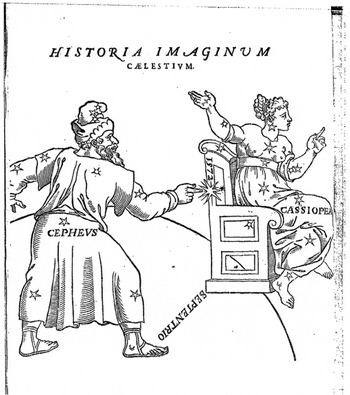
Just as the depiction of the new star in the Letter reminds one of Digges's Alae, so the depiction of it in La declaration d'un comete ou estoille prodigieuse shows that in the 1590s Hoyer correctly identified Gosselin as the author. The engraving is identical to the illustration in his 1577 work Historia imaginum caelestium nostro seculo accommodate … Authore Io. Gosselino Viriensi custode Bibliothecae Regis Francorum (Figure 4). To be fair to Gosselin, we should record that he now judged that it had been ‘a new star greater than the first magnitude of stars, and higher than the sphere of the moon’. He recorded that it had stopped shining on 18 February 1574, ‘on which day Henry [of Valois] entered Cracow as King of Poland’. Henry soon after became King of France in succession to his brother Charles IX, who died aged only 23 in May 1574.Footnote 29
Diagram from Jean Gosselin de Vire, Historia imaginum caelestium nostro seculo accommodate, Paris, 1577, p. 12.

It is Gosselin's astronomical observations of the ‘comet’ which are most germane to our story. He found it to be white like Jupiter, but bigger. It had ‘several rays or points, of which the largest, which one can call the comet's tail, is always turned and directed towards the east’. He had diligently observed and measured it almost every night from 15 November to 17 December. From its position in Cassiopeia men skilled in the mathematics of spherical triangles would ‘clearly see and conclude that the said comet is at the end of Pisces in the prime mover, in the region of its twenty-ninth degree’.Footnote 30 Crucially, its angular distance from the Pole Star varied. At its zenith above the Pole Star, it was at one time 25° and about 30′ distant, but after three days that had decreased to 24° and about 40′. When near the horizon it had been 24° and about 30′ from the Pole Star. Hence ‘the said new star exhibits parallax and various positions in the sky, as if it is very close to the earth, which is not the case with the fixed stars that are in the eighth sphere’.Footnote 31 Concerning its effects, Gosselin summarized the best advice of famous authors: comets caused extreme drought and bad air, which in turn produced humoral distemper leading to disputes, quarrels, wars and violent death. He made no particular prediction for the French lands, but considered that the evil effects would afflict people in eastern parts, because the comet's tail pointed eastwards.Footnote 32
With astrologers making these gloomy prognostications, it is not surprising that Queen Elizabeth I's privy counsellors were perturbed by the phenomenon. Lord Burghley, whom Elizabeth had just elevated from Secretary of State to become her Lord Treasurer, sought Thomas Digges's opinion about its likely influence less than a month after it appeared. His successor, Sir Thomas Smith, had an expert's interest in the star and followed other lines of enquiry. Smith's time at Queens’ College, Cambridge, had turned him from a sheep farmer's sickly son into an outstanding humanist scholar with considerable expertise in astronomy and astrology. He endowed Queens’ College with two fellowships, one in arithmetic and one in geometry, and bequeathed ‘my greate globe of myne owne makinge’ and the bulk of an enormous library which, according to a list made in 1566, contained forty-four mathematical works including modern texts such as Copernicus's De Revolutionibus and Reinhold's Tabulae Prutenicae. In the 1570s a court poet described him as ‘astronomus, physicus, theologus’, a true son of Urania, and the equal of Ptolemy.Footnote 33
Smith had learned something of the Parisian world of mathematics and astronomy during his periods as ambassador there.Footnote 34 He had returned to England in July 1572 following his final tenure of the post, and the aftermath of the St Bartholomew's Day Massacre was on his mind. Accordingly, he wondered what French experts were making of the star. He wrote to his successor at the Paris embassy, Sir Francis Walsingham, on 11 December 1572:
I am sure you have heard of, and I think have seen, the new fair star or comet, but without beard or tail, which has appeared now this three weeks here, on the back side of the chair of Cassiopeia, and on the edge of lactea via [the Milky Way] whose bigness is between the bigness of Jupiter and Venus, and keeps to my appearance (who have no instruments to observe it, and because of this cold weather also dare not) the precise order of the fixed stars. Such a one never have I observed nor read of. I pray you let me know what your wise men of France do judge upon it. I know they will not think it is [Coligny] the Admiral's soul, as the Romans did of the comet next appearing after the murder of Julius Caesar that it was his soul.Footnote 35
It may be Astraea, now peeking out afar off in the north to see what revenge shall be done upon so much innocent blood shed in France at a marriage banquet, and rare suppers after it.Footnote 36 It would do me good yet to understand what your astronomers and heaven gazers there do judge of it. If I were not so much occupied as I am, I would turn up all my old books, but I would say somewhat of it myself, and guess by chance even as wisely as they, though I would not publish it but to my friends, for folly the more it is kept in the better.Footnote 37
On the same day, 11 December, Thomas Digges answered Burghley's request for his opinion. Digges was not well enough to attend in person so sent a written account of his observations with a covering letter. The observations are unfortunately lost, but Digges's letter advised Burghley that he had ‘waded as far as ancient grounds of astrology and authors’ precepts of approved credit will bear me, to sift out the unknown influence of this new star or comet’. Digges may have agreed with Smith that the star remained in the same place in Cassiopeia or, as Smith put it, that it kept ‘to the precise order of the fixed stars’. But he was not yet able or willing to exclude its being a comet. Digges's hesitancy is perhaps what allowed Burghley or his clerk to write ‘comet’ on the outside of the document.Footnote 38
Gosselin's anonymous Declaration d'un comete ou estoille prodigieuse was printed and became available in Paris sometime between 17 and 31 December. The English moved quickly. Walsingham obtained a copy and sent it to Smith, together with some notes. The pamphlet was translated into English and the opinion of indigenous experts sought. Smith then sent the results back to Walsingham. All this had happened by 13 January 1573, when Smith wrote,Footnote 39
I thank you for the notes which you sent of the comet or new star. But in the placing of it, your astronomers and ours differ exceedingly. Yours there places it in the 29th degree of Pisces and ours in the 7th degree of Taurus. So they vary a whole sign & 8 degrees. Your printed book goes upon it suspenso pede.Footnote 40 If any have more boldly written of it in print I pray you let me see it. Our men do not deny but that he rises with that degree of Pisces or the first [third] of Aries. But it is one thing to rise with a degree of the Zodiac and to stand in a place or section of the Zodiac. And our men do find him far above the moon and above the height of the sphere of Venus. Then it cannot be a temporary comet (except now things above the moon do rise and die, which was never believed before) but either a new star made or an old star newly seen.
One cannot fail to notice how Smith's brief description of the French view exactly matches Gosselin's Declaration d'un comete ou estoille prodigieuse. Although Smith's letter to Walsingham was brief, the greater detail contained in the Letter sent by a gentleman confirms that the English were working from a full translation or the printed original of Gosselin's tract.
Whether it was ‘a new star made or an old star newly seen’, Smith's suggestions involved major transgressions of accepted cosmology. A new star would be the first since the birth of Christ, raising the likelihood of a miraculous cause and the imminent end of the world. This was an explosive possibility in an England where puritan beliefs that the world was entering the end times were widespread, beliefs seemingly shared by Digges himself. The alternative was redolent of John Dee's more naturalistic hypothesis that a previously invisible star had moved closer to the Earth. Smith seems to have been unusually receptive to astronomical theories ‘never believed before’. However, no Englishman was radical enough to suggest that the star had changed its intrinsic brightness, as we now believe it did.Footnote 41
Who were ‘our men’ who provided Smith with his radical critique? One may well have been John Dee. Dee was Digges's mentor and shared the younger man's interests in parallax and accurate astronomical observation. Dee owned a ten-foot and finely graduated cross staff devised by Richard Chancellor, which both he and Digges had used. He probably contributed the theory that the star might be ‘an old star newly seen’ because it had moved closer to the Earth. Dee would later discuss the idea with Christoph Rothmann and would claim to have written an unpublished Latin work of 1573 ‘on the marvellous star in Cassiopeia, sent down from heaven all the way to the orb of Venus, and then drawn up again perpendicularly into the depths of the heavens sixteen months after its first appearance’.Footnote 42 This was perhaps the book that Digges expected him to complete after his publication of the Alae seu scalae mathematicae and after Dee's completion of his book, the Parallacticae Commentationis Praxeosque Nucleus quidam. The Nucleus was Dee's brief exposition of the core mathematics behind parallax. It arose from what Goulding describes as a friendly rivalry between Digges and the man he called his ‘other, mathematical father’. In the end, they agreed to cooperate. Digges arranged for Dee's Nucleus, with its sheets already printed by John Day, to be bound with Thomas Marsh's printing of his own Alae seu scalae mathematicae.
However, there can be little doubt that Digges was the primary source of the opinions Smith relayed to Ambassador Walsingham, because they are developed in full in the Letter sent by a gentleman, and I am sure that the Letter was written by Digges. The evidence for Digges's authorship is assembled in the following section. To avoid confusing circumlocutions, I will henceforth assume that Digges wrote it. There can be no doubt that the Letter sent by a gentleman is a commentary upon Gosselin's Declaration d'un comete ou estoille prodigieuse, even if no Englishman mentioned his name.
The Letter sent by a gentleman and its author
Thomas Digges did not acknowledge authorship of the Letter sent by a gentleman. When he completed and published his father Leonard's Stratiotiocos in 1579, he included two lists of books, one of those he had already published, the other of books he had begun and intended to publish. The Letter is mentioned in neither list.Footnote 43 He included as already published his Pantometria, Alae and the 1576 edition of the Prognostication Everlasting which contained his own Perfit Description. The fact is the less surprising given that the Letter was a hasty, brief and anonymous work. I consider below the reasons why Digges might have published the Letter anonymously.
Digges found that the French book ‘although it have fewe lines, yet hath it manye errors and that of all sortes, Geometricall, Astronomicall, Physical, Cosmographicall and Historicall’.Footnote 44 The author first criticized the depiction of the constellation of Cassiopeia. Some of the thirteen stars were missing or misplaced and ‘the newe starre that is beneath the foote of her seate, is there situate farre higher’. He noted that the unnamed Frenchman
proceedeth to his observations, and declareth this newe starres distances from Alrucuba [sic] commonlye called the Pole starre, and another of Queene Cassiopeia, inferring that such as be skilfull in the doctrine of triangles Sphericall, will soone finde his place to be in the ende of ♓ about the 29. grade, wherby it appeareth that his own knowledge in Sphericall triangles was verye small, for admittinge his owne distances true, it falleth out in the first face of ♉, but his true longitude and place in deede, is esilye by sighte without Instrumente within one degree to be conjectured, of the meanest scholler in observations Astronomical, being more then that In sedis pede, a little starre harde by hym whose longitude by Copernicus is delivered 8. grades. 20. minutes, and lesse then that other by hym mencioned in Cassiopeia her thighe whose longitude is also .10. grades. This starre therefore being verye nighe in the meane betweene these two, is soone founde within 10. minutes of nyne grades in longitude, making accompte as Copernicus doth from the little starre in the horne of the Ramme. which in the olde Astronomers tyme stoode in the very intersection of the line Eclipticke and Equinoctial, but sithens by the stealinge course of the starres fixed, or rather of the earthe as Copernicus with better reasons proveth, is removed since that time 27. grades 49 minuts, which I have by certaine Calculation found to be Precessio Aequinoctiorum vera, for the Nativitye of oure Saviour last past, nyne grades therfore the longitude of this newe starre in the eyghte sphere by sighte onely collected, as I have before declared, unto the nomber of the true Praecession adjoyned, produceth 6. grades 49. minutes in ♉ for his longitude of place, and therefore I muse the more that anye man shoulde so much erre they would presume in a cause Mathematicall to write[.]Footnote 45
When we round 6° 49′ to 7° we have exactly the same French and English values recorded in Smith's letter. Smith went on to note his men's criticism that ‘it is one thing to rise with a degree of the Zodiac and to stand in a place or section of the Zodiac’. The Letter sent by a gentleman makes the same point, wondering whether ‘perhappes his meaninge was that this starres righte Ascension shoulde be about that grade, wherein thoughe it be very unproper to apply the Computation of right Ascension to the line Ecliptike, yet had his error bene that way the lesse’.Footnote 46
Smith next observed that ‘our men do find [the star] far above the moon and above the height of the sphere of Venus. Then it cannot be a temporary comet’. The Letter sent by a gentleman declares that the light is a ‘miraculous star’. Indeed, in direct contradiction of Gosselin, Digges asserted that it was a ‘newe starre in the eyghte sphere’. And so he particularly rebuked the Frenchman because
he ascendeth to discover a Parallaxe, and produceth observations flatte repugnaunt betweene themselves. I meane not so much for that hee giveth his new starre severall distances from Alrucuba [sic] at his greatest heighte, (which in deede is nothinge so) but hee attributeth also unto hym hys greatest Parallaxe above the Pole, and his lesser underneath, whiche is a matter so absurde, as oure Mathematicall infantes will laughe to scorne. [… Indeed] by this Auctors owne Parallaxis allowing him his own witnesses, they give it to be above the Moone, as any man may know that hath any meane sight, I say not in Spherickes triangles, but plaine and righte lined, and therefore unlesse he will make war with naturall Philosophers and explode Aristotle, he cannot terme hym a Comet.
The similarities between the Letter sent by a gentleman and Sir Thomas Smith's report to Walsingham are so great that we should note them, if only to exclude Smith himself as a candidate for the authorship. Had he not told Walsingham that ‘[i]f I were not so much occupied as I am, I would turn up all my old books, but I would say somewhat of it myself’? The description of him by his biographer Thomas Strype as no smatterer in astronomy may have been fair, but Smith made clear that the judgements in his letter were not his own but those of expert consultants. Strype's generous interpretation of the evidence from the letters to Walsingham has led recent scholars to misrepresent Smith as an astronomer who made his own observations of the new star, a claim Smith himself denied.Footnote 47
Smith was surely not the author. Given the burdens of his new post, he was right to say that he had no time to study astronomy again, and very few practitioners possessed the expertise manifested by the Letter sent by a gentleman. Smith is more likely to have been the recipient ‘frende’ whom Digges addressed as Philomathes, a fellow lover of mathematics who had the power to require Digges's opinion. It is plausible that a report from Digges was requested, by Burghley or Smith, for example, which Smith then used as the basis of his reply to Walsingham and which Digges then revised for publication as the Letter sent by a gentleman. Unlike Smith's candidature, there is a good weight of evidence, albeit circumstantial, to establish Digges as the author.
The Letter sent by a gentleman was printed by Thomas Marsh, Digges's regular publisher. Marsh had been a prolific printer of almanacs and innovative astronomical and astrological works since Matulind's Right Excellent Treatise of Astronomy with a Prognostication of 1554–1555, going on in 1556 to print John Feild's Reinholdian Ephemeris, the first English book to mention Copernicus's theory.Footnote 48 As well as a Latin edition of the astrological poet Palingenius, and works on surveying, architecture, shooting and medicine, he printed Thomas Digges's editions of his father Leonard's Prognostication Everlasting for 1564, 1567, 1576 (the edition which included his famous Copernican tract, the Perfit Description of the Celestiall Orbes), 1578, 1584 and 1585, as well as his Tectonicon in 1570. To judge from the Stationers’ Register Marsh received both the Alae seu scalae mathematicae and the Letter sent by a gentleman from Digges at nearly the same time in 1573. In the list of works published by him that year the two are separated by only one other work.Footnote 49
There are some more significant religious clues. Digges had puritan tendencies, and his study of mathematics was informed by his religion. Unsurprisingly he was an admirer of Philipp Melanchthon.Footnote 50 Indeed, his title Alae seu scalae mathematicae was borrowed from Melanchthon's astronomical interpretation of the wings mentioned by Plato in Phaedrus.Footnote 51 Tredwell has shown that, if Digges was a Calvinist in some ways, in others he was what she calls a mathematical Philippist.Footnote 52 The author of the Letter sent by a gentleman was clearly written by a zealous Protestant and mathematical Philippist. The texts to which it alludes touched on ecclesiastical corruption and were popular with such people. Several of them point directly to Digges. For example, the Letter sent by a gentleman quotes approvingly the astrological poem Zodiacus Vitae by Marcellus Palingenius Stellatus, seemingly the pseudonym of Pier Angelo Manzolli. Digges noted that while the Frenchman had apparently not studied ‘Ptolemey, Copernicus or other Mathematicianes, yet of Poetes as Palingenius he might have learned howe Cassiopea decem atq tribus stat lucida flammis’.Footnote 53 Since the French Catholic had quoted three poets as authorities while mangling his mathematics, Digges's dart was well aimed.
It was a very Protestant dart. The twelve books of the Zodiacus Vitae were published in 1543 in Calvinist Basel and banned for their heterodoxy in the very first Index Librorum Prohibitorum of 1559. Recuperated as the work of a ‘Stellifyed and Christian’ poet, the Zodiacus Vitae became popular among English Protestants. Volumes of the English translation by Barnabe Googe began to appear in 1560, dedicated to William Cecil, and the first Latin edition to be printed in England was made in 1569, by Digges's printer Thomas Marsh.Footnote 54 Among other things, Palingenius satirized the corruption of humanity in general and the Roman church in particular. Indeed, Googe had
many times much mused wyth my selfe, howe (living in so daungerous a place [as Italy]) he durst take upon him so boldely to controll the corrupte and unchristian lives of the whole Colledge of contemptuous Cardinalles, the ungracious overseeings of bloudthyrsty Bishops, the Panchplying practises of pelting Priours, the manifold madnesse of mischevous Monkes, wyth the filthy fraternitie of flattering Friers. Which surely he durst never haue done, but onely that he was heartened wyth a happy and heavenly spirite.Footnote 55
Palingenius turned to astronomy in Book XI, ‘Aquarius’. Digges was a great admirer of it. Gabriel Harvey recorded that ‘M. Digges hath the whole Aquarius of Palingenius bie hart: & takes mutch delight to repeate it often.’ It raised radical ideas, including those of life on other stars, and the idea that stars were at different distances with some too faint to be seen.Footnote 56 This must have been one inspiration for Digges’s idea that the stars were at different distances from the Earth. When he presented the idea in the Perfit Description he quoted some twenty lines from the Latin text of Palingenius in support of his infinite, Copernican cosmology.Footnote 57
Further evidence comes from Digges's allusions to biblical verses and in particular to verses from St Paul's letters to Timothy and Titus. These letters dealt with corrupt and proper behaviour among elders in the early church, and Jean Calvin had dedicated his commentary on them to Edward Seymour, Duke of Somerset (1500–1552), the Protestant Regent for Edward VI. As we have seen, the Letter sent by a gentleman purports to come from Misopseudologos. This apparently unique pseudonym means a ‘hater of false doctrine’. The ancient Greek adjective pseudologos (‘speaking falsely’ or ‘teaching lies’) had only one widely known usage, I Timothy 4:1–2. In the Geneva Bible favoured by Elizabethan Calvinists it is rendered, ‘Nowe the Spirit speaketh evidently, that in the latter times some shall depart from the faith, and shall give heede unto spirits of errour, and doctrines of devils, Which speake lies through hypocrisie, & have their consciences burned with an hote yron.’Footnote 58
Claims that an extraordinary celestial phenomenon was a sign of the Last Days were not unusual, but both the claim for the star's significance and the typically Protestant concern with eschatology are at least consistent with what we know about Digges's theological interests.Footnote 59 We recall his opinion in the Alae seu scalae mathematicae that those who say it is a comet ‘either condemn or devalue this rarest sign, God's true miracle or messenger’. And in the Letter sent by a gentleman Digges criticized Gosselin for reading nothing but ill into divine portents. The Last Days were something to be welcomed.
Yet another Protestant and Diggesian sign is the mention in the Letter sent by a gentleman of ‘filthy lucre’. ‘And thus’, Misopseudologos concluded, ‘exhortinge you to proceede in the passing pleasaunte studies of the noble sciences Mathematicall fit onely for fre[e] and noble mindes that stoupe not at filthy lucre I commit you to the protecting of the Almightye’.Footnote 60 This is Digges's signature trope, which I have not found in the work of any other mathematical practitioner of the time. In the Pantometria of 1571 he had presented himself in the mould of Euclid and Archimedes as opposed to ‘Epicurus, Midas, or their like, given onely to lucre and worldlye pleasure’.Footnote 61 In his letter of dedication of the Alae seu scalae mathematicae to Burghley in 1573 he would again contrast the likes of Epicureans with those noble minds ‘quae nihil vile sapiant lucrum’ (who are not acquainted with filthy lucre).Footnote 62 We can trace the evocative phrase ‘filthy lucre’ back from the King James Bible through the Geneva Bible to William Tyndale's Erasmian translation.Footnote 63 Indeed, it occurs specifically and exclusively in the epistles to Timothy and Titus. The verses associate the latter days with, as Digges might have called them, pseudologous preachers who will lie for money. There will ‘vaine talkers and deceivers of minds … whose mouthes must bee stopped, which subvert whole houses, teaching things, which they ought not, for filthie lucres sake’.Footnote 64
We can also trace Digges's contrast between noble and Epicurean minds, for it came from Melanchthon. Synthesizing Plato and Christianity, Melanchthon strongly asserted the place of mathematics, especially astronomy, in a Christian education. ‘The greatest success of geometry’, he wrote, ‘was that it did not cleave to trifling and lower machines, but took flight to the heavens’. But, he added, ‘there are some Epicurean theologians who mock this entire branch of learning. Not only do they take away credibility from the prophecies, but they disparage knowledge of motion; let us leave them to play the fool with Epicurus’. Knowledge of the motion of the heavens taught us to revere their Designer, and to appreciate their application to timekeeping, ‘not to mention in particular the part concerned with divination’. Melanchthon's concern stemmed from his conviction that rulers considered scholarship
an opponent of tyranny. Uneducated and Epicurean men enjoy the riches of the Churches. In all realms monstrous cruelty is deployed against men who are learned, pious and upright in their sentiments. Everywhere poor scholars are neglected, and this is done intentionally, so that studies be destroyed.
He prayed God to strengthen scholars for ‘the warfare for which they are chosen by divine providence’.Footnote 65 Melanchthon had been responding to the threat from Anabaptism but, as we shall see, Digges had grounds for feeling that his astronomical scholarship was neglected too.
From Erasmus, Digges drew a more secular trope. The Letter sent by a gentleman refers to the proverb of Apelles and the shoemaker, and specifically to Erasmus's commentary upon it.Footnote 66 Digges's jibe was that the Frenchman should have stuck to his last, for he was not skilled in astronomy and should ‘geve others leave to play the part on the Mathematicall stage’. As with the phrase ‘filthy lucre’, Digges used the Apelles proverb elsewhere in a signature manner. When discussing navigation and navigators in short sections he added to his father's Prognostication Everlasting in 1576, he suggested that navigators should leave it to mathematical experts to discern the difficult questions of navigation: ‘let them learn Apelles's lesson Ne Sutor Ultra Crepidam’.Footnote 67
The strongest evidence, however, comes from the similarities in the treatment of the new star between the Letter sent by a gentleman and the treatment that Digges provided in his Alae seu scalae mathematicae. Like other observers, such as Tycho and Hagecius, Digges brought a new exactitude to the constellation of Cassiopeia. His desire to locate the new star exactly made the positions of Cassiopeia's customary thirteen stars crucial. The book began with a table of unprecedented accuracy of those stars’ longitudes, latitudes and magnitudes, compiled from Digges's own corrections in his copy of Copernicus's De Revolutionibus.Footnote 68
‘Misopseudologos’ took the same great care to map the positions of the key stars in Cassiopeia. For him, the Frenchman's errors were that ‘[f]irst in the portrayture of Cassiopeia the very starres are mistaken, and the new star misplaced’.Footnote 69 As in the Alae seu scalae mathematicae, Digges carefully establishes from Copernicus the longitudes of the two nearest stars, in sedis pede and in coxa (now called kappa Cassiopeiae and gamma Cassiopeiae), as 8º 20′ and 10º exactly. The new star being between these values, the Letter sent by a gentleman finds it easy to conjecture ‘by sighte without Instrumente within one degree’ that ‘nyne grades therefore [is] the longitude of this new starre in the eyghte sphere by sighte onely collected, as I have before declared’.Footnote 70 Digges proceeded to show off his expertise in technical Copernican astronomy, unrivalled in England, by correctly calculating the star's position with respect to the ecliptic. This provided Digges with the opportunity to show that he had updated Copernicus's value for the precession of the equinoxes to ‘27. grades 49 minuts, which I have by certaine Calculation found to be Praecessio Aequinoctio vera, for the Nativitye of oure Saviour last past’, i.e. 25 December 1572. The adjustment ‘produceth 6. grades 49 minutes in Taurus for [the new star's] longitude of place’.Footnote 71 Misopseudologos/Digges was a supporter and expert user of Copernicus's heliocentric astronomy.
These displays of expertise were a prelude to a refutation of ‘the Frenchman's’ main error in concluding that the prodigious star exhibited sufficient parallax to be a ‘blasing starre’ or comet. The Frenchman ‘giveth his new starre severall distances from Alrucuba [sic] at his greatest heighte, (which in deede is nothinge so)’.Footnote 72 The Letter attacked the Frenchman's claim that the new star's ‘greatest Parallaxe [was] above the Pole, and his lesser underneath, which is a matter so absurde, as our Mathematicall infants will laughe to scorne’. In any case, the parallax the Frenchman claimed to have observed would ‘give [the body] to be above the Moone’.Footnote 73 The Letter contains very few data of its own. On the key question of parallax, it pointed out the inconsistency and implausibility of the Frenchman's work. It never denied that the star might show some very small parallax, although it did not give any determinations of its own. Likewise, it criticized the Declaration’s placement of the stars in Cassiopeia and the new star, but ventured only to say that the longitude of the star was between those ‘in sedis pede and in coxa’, which is not accurately reflected in the diagram.
The Letter sent by a gentleman becomes less interesting in the second half, where it discusses the Frenchman's prognostication of the phenomenon's likely effects. Digges denied the Frenchman's claim that the star had a comet-like tail but was more offended by another error. When the Frenchman
conjectureth by his imagined tayle, that his effect should fall out in the Orient and East partes of the world, he seemeth also therein to be as slender a Cosmographer, that knoweth not no part of the worlde to be East or West simplye or of it selfe.Footnote 74
The Letter accepted that comets were signs, but said it was false to say that they always signified malign events. Digges cited the case of Mithridates as recorded by Justinus in his Epitome.Footnote 75 Perhaps Justinus was one of the ‘authors’ precepts of approved credit’ which Digges told Burghley he had used ‘to sift out the unknown influence of this new star or comet’. Nevertheless, he insisted that ‘unfitly are the significations of Comets applied to starres, or Phaenomena that are aboute the Region Elementare’.Footnote 76 So ‘unlesse he will make warre with Naturall Philosophers and explode Aristotle, he cannot terme hym a Comet’.Footnote 77 This matches Digges's opinion in the Alae seu scalae mathematicae where, as Goulding notes, Digges rejected ‘the possibility that the star could be composed of cometary matter somehow carried up into the celestial realm: Aristotle had shown that terrestrial matter could never stray outside its own, sublunary sphere’.Footnote 78 Digges maintained an unusual combination of a radical Copernican cosmology and a conservative philosophy of the sublunary world. It featured again in Digges's Perfit Description, where he depicted an Earth in orbit around the Sun in an infinite universe, but still part of a sublunary and elemental ‘great orbe carrying this globe of mortalitye’.Footnote 79
Finally, and in agreement with Digges's view in the Alae seu scalae mathematicae that the star was not a comet but a miraculous sign from God, he was ready to agree with the French Catholic's conclusion. It was sufficiently Philippist
not to be disliked for that it contayneth both piety and veritie and no doubt it is as he sayth a forewarning of Gods inscrutable pleasure, which wil fall out to be no less straung and myraculous in effect, then this signe wherby it is forewarned is rare and supernaturall.Footnote 80
Digges's Letter sent by a gentleman as England's first pro-Copernican text
Confident that Digges wrote the anonymous letter, we can identify him as the author of the statement supporting the Copernican motion of the Earth. To locate the new star in Copernican fashion, the Letter sent by a gentleman needed to allow for the precession of the equinoxes in order to make
accompte as Copernicus doth from the little starre in the horne of the Ramme, which in the olde Astronomers tyme stoode in the very intersection of the line Ecliptike and Equinoctial [i.e. at the Spring equinox], but sithens by the stealinge course of the starres fixed, or rather of the earthe as Copernicus with better reasons proveth, is removed since that time 27. grades 49 minuts.Footnote 81
Copernicus's explanation of precession, which came to be rejected along with his commitment to solid spheres, involved the Earth's annual motion in its sphere being almost but not quite countered by an opposite ‘third motion’ of the Earth. This acted to keep the Earth's axis pointing at the celestial pole, with the slight slippage generating the 26,000-year cycle of precession. To be sure, in Digges's era the verb ‘to prove’ did not always mean apodictic demonstration. Nevertheless, Digges asserted that Copernicus had better reasons than the geostatic astronomers, and had ‘proved’ this motion of the Earth.
Although Digges's writings make his Copernicanism clear, he never committed himself unequivocally in print to the truth of heliocentrism. This remark in the anonymous Letter sent by a gentleman is a candidate for the strongest statement. In the Perfit Description of 1576 Digges introduced his translation of, with occasional commentary upon, Book I of De Revolutionibus in a studiously neutral way. He wanted ‘to publish this, to the end such noble English minds (as delight to reach above the baser sort of men) might not be altogether defrauded of so noble a part of Philosophy’.Footnote 82 Although he included phrases such as ‘demonstrations mathematicall’ or ‘demonstratively approved’ and, indeed ‘perfit description’, he ultimately left open the question of the physical truth of heliocentrism. Thus when discussing philosophical reasons for and against it, Digges writes,
for my own part in this case I will only say: there is no doubt but of a true ground truer effects may be produced than of principles that are false, and of true principles falsehood or absurdity cannot be inferred. If, therefore, the Earth be situate immoveable in the Center of the world, why find we not Theorickes upon that ground to produce effects as true and certain as these of Copernicus?Footnote 83
Digges promised to reveal his own position at a later date, and in a striking rhetorical form:
God sparing life, I mean though not as a Judge to decide, yet at the mathematical bar in this case to plead, in such sort as it shall manifestly appear to the World whether it be possible upon the Earth's stability to deliver any true or probable Theorick & then refer the pronouncing of sentence to the grave Senate of indifferent discreet Mathematical Readers.Footnote 84
Digges doubted that it was possible but, although God spared his life until 1595, he never marshalled a printed refutation. What case was he intending to plead? Most likely it would have drawn upon the method of measuring parallaxes for which Digges had had great hopes in the Alae seu scalae mathematicae of 1573 but which he was never able to bring to perfection. Digges explained how parallax offered a way of deciding between the otherwise observationally equivalent geocentric and heliocentric astronomies: his personal preference for heliocentrism was clear. The pro-Copernican statement in the Letter sent by a gentleman, admittedly a throwaway remark, is arguably a little stronger and made earlier than those of the Alae seu scalae mathematicae. If so, then it is the first expression of a preference for Copernicus's heliocentric cosmology (as opposed to his astronomy) to be published by Digges and, therefore, by any English writer.Footnote 85
Of course, Digges's Copernicanism continued to develop after his identification of the new star. In the Perfit Description of 1576 he published the first depiction of an infinite universe where ‘this orbe of starres fixed infinitely up extendeth hit self in altitude sphericallye, and therefore immovable’. The Letter sent by a gentleman may help us to understand how he arrived at his radical post-Copernican cosmos. In the Letter Digges assumed that the new star was in the eighth sphere of the fixed stars. Only weeks later, perhaps inspired by Dee's thoughts about the star, Digges wondered in the Alae seu scalae mathematicae whether the changing magnitude of the new star might depend on its changing distance from the Earth. This idea chimed with Palingenius's opinion that the universe contained stars too faint to be seen because of their distance. Such thinking raised a question: were the fainter stars intrinsically faint or were they at a greater distance from the Earth? Putting it another way, was the eighth sphere of the fixed stars not the thin shell required by geostatic astronomy and unnecessarily retained by Copernicus, but rather a sphere of great thickness comprising stars at considerably different distances?
As one of the few realist Copernicans in the 1570s, Digges held that the Earth rotated diurnally and that the stars were stationary. He retained the inner surface of the sphere of the stars and kept it concentric with the Sun, but had no physical reason to retain the upper boundary and he dispensed with it. Some stars were now considerably further, even infinitely distant, from the Earth. In such a cosmos the phenomenal star of 1572–1574 would have been free to approach and recede from the Earth. Perhaps, as the star faded away and God declined to end the world, Digges came to prefer a more naturalistic and less miraculous explanation.
Dating the Letter and the Alae
The contents of Digges's printed Letter sent by a gentleman expand those of the expert opinion that Sir Thomas Smith passed on to Walsingham in his own letter of 13 January 1573. It is reasonable to conclude that Digges was the major source of that opinion, which he revised into the Letter. The revisions would not have taken long and he might have completed them before finishing his magnum opus the Alae seu scalae mathematicae. He finished that work in late February 1573 and dated his ‘Praefatio Authoris’ accordingly. What Goulding describes as a ‘friendly rivalry’ between Digges and Dee led to his ‘mathematical father’ hurriedly preparing his own work for the press, and dating his prefatory letter 5 March 1573, no more than fifteen weeks after the star's appearance.Footnote 86
The Registers of the Company of Stationers for 1573 suggest that the Alae seu scalae mathematicae was registered by Thomas Marsh just before the Letter sent by a gentleman.Footnote 87 Even so, the Letter may well have been published first, because the Alae must have taken longer to put through the press. Given confusion at the time over the start of the year, it is possible but very unlikely that one or both of the Alae and the Letter were published in March 1573 old style, i.e. 1574 new style.Footnote 88 Were that the case, Digges and Dee would have had the time comfortably to develop their mathematics of parallax. However, if Digges had signed off the Alae in February 1573/4 (new style) he would surely have noted that the star had almost completely faded away. Moreover, it being more than one year since the star's appearance, it would have become clear to him that the fading was not an artefact of the annual revolution, a hypothesis he had entertained in the early months.Footnote 89
Internal evidence points to the Letter sent by a gentleman as the earlier work, with details which are superseded in the Alae seu scalae mathematicae. In the first place, the astronomy is cruder. The Letter mainly criticized Gosselin and mentioned only the simplest of naked-eye observations made without instruments and accurate only to half a degree. As Digges explained in the Alae, this was sufficient accuracy to refute erroneous claims that the phenomenon was sublunary. And that had been the raison d’être of the Letter sent by a gentleman. Nevertheless, the argument depended upon Misopseudologos demonstrating his mathematical superiority. It would have been odd had Digges left out of the Letter the very accurate positional data he had already put in the Alae.
Second, the depiction of Cassiopeia and her new star is more crudely drawn: indeed, the Letter sent by a gentleman generally gives the impression of a work more rushed than the Alae seu scalae mathematicae, as witness the uncorrected presence of Misopseudolugos and Alrucuba. Third, the Letter sent by a gentleman confidently affirmed what Gosselin denied, that the phenomenon was ‘a new starre in the eyghte sphere’.Footnote 90 However, the Alae seu scalae mathematicae considered the hypothesis mentioned by Dee, that the star was increasing and decreasing in brightness as it moved through the region of the planets. Finally, Digges declared in the Alae seu scalae mathematicae that he would not write again on the new star and would leave the field open to Dee, which suggests that his Letter had already been penned. His authorship would have been obvious to Dee and hardly concealed by the pseudonym.
Why, then, did Digges publish the Letter sent by a gentleman anonymously? Why, indeed, did he publish it at all? We can only speculate. Since the star and its astrological significance had been matters of state concern, publication was presumably sanctioned or even encouraged at a high level. Were Gosselin's gloomy prognostications circulating and causing concern in London, with publication of Digges's hatchet job as a calming countermeasure? We should consider that, slight work that it is, Digges had a personal commitment to the letter made manifest by its puritan and eschatological elements. He may have interpreted the star as a special sign of the Last Days or of the triumph of the true church. To assert that the star was merely a comet, presaging serious but astrologically familiar problems, was to deny this special sign of God's providence. Digges might even have viewed such denials as pseudology spread by astrologers wanting to make filthy lucre out of prognostications.
On either reading, it seems odd that Digges published pseudonymously. The tract was effective only if the author were more credible than ‘I.G.D.V.’. Although Digges's professional star had not reached its zenith, so to speak, he was a highly respected gentleman mathematician. Was the Letter sent by a gentleman anonymous because its small elite audience knew exactly who he was? Or because it contained observations he himself had not desired to be published? Or because he did not wish his name to be associated with bad astrology, when he had lofty aspirations for his forthcoming Alae? Or because I.G.D.V. had hidden his identity? Was it because Digges had cast the Frenchman as the shoemaker, and by implication himself as Apelles, the master who hides behind his work?Footnote 91 Whatever the reason, Misopseudologos maintained his mystery identity for well over four hundred years.
From the Letter to the Perfit Description
I propose the following reconstruction of Digges's involvement with the new star. When he answered Burghley's call for an opinion on 11 December 1572, Digges had concluded, as had some other observers, that the phenomenon in Cassiopeia was not an ordinary comet and in some respects looked like a fixed star. Yet neither his initial observations nor his search of classical texts allowed him to give Burghley a definitive answer about its nature or influence. Sometime between 17 December 1572 and 13 January 1572/3 Digges did two things. He read Thomas Smith's copy of I.G.D.V.’s Declaration d'un comete ou estoille prodigieuse and he completed sufficient naked-eye observations to reassure himself that any parallax was much less than one degree. The phenomenon had to be above the Moon and out beyond some or all of the planets. At this time he concluded that it was a fixed star ‘in the eighth sphere’. It was a sign from God and much more portentous than a mere comet. He provided Smith with a report of his observations and criticisms of I.G.D.V. Someone decided that a version of this report, redrafted as a letter between two learned gentlemen, was worth publishing as cheap quickly produced knocking copy, and Digges worked it up for his printer Thomas Marsh early in 1573. At the same time, John Dee was also working on the mathematics of parallax and thinking about the star. He probably offered advice to Elizabeth's government and may have contributed the idea that the star had pre-existed but had become newly visible. Digges exchanged ideas with Dee and raced to complete his long Alae seu scalae mathematicae while Dee finished his short Nucleus.
While completing the Alae seu scalae mathematicae in January and February 1573, Digges explored a new and detailed hypothesis which he may have got from Dee. This considered the star to be a very bright heavenly body that had previously been so distant from the Earth as to be invisible. It had approached the Earth until it was about as close as Venus and was shining brilliantly. If it were fading it was because it was receding from the Earth. Digges now realized that he urgently needed to observe the star and measure its parallax still more accurately. It was no longer sufficient to determine that the star exhibited little or no parallax, as he had done in the Letter sent by a gentleman. Just as the hypothesis of the Earth's annual motion predicted measurable changes in the parallax exhibited by planets like Mars, so Dee's hypothesis predicted that the star should have a little parallax, which would decrease if and when the star receded. Here was a unique opportunity to put his parallax methods to the test and to solve the riddle of the new star. But the task demanded better instruments and more observations. Fearing that the star might not be visible for much longer, he wanted to complete the work
if the short period of time and my other concerns allow. But currently I am forcibly dragged away and diverted from these celestial contemplations by several lower human affairs. I should have considered my good fortune during that time and forced myself to complete the book without alteration, and to draw up the tables by hand … However, once the obstacles of fortune and mundane matters have been sorted out and overcome, I will (with God's favour) return to my most pleasant mathematical sources.Footnote 92
Digges dedicated the Alae seu scalae mathematicae to his patron, Lord Burghley. He surely hoped Burghley would provide the time, resources and protection he needed for his grand astronomical project. He opened his letter to Burghley conventionally, saying that he had been looking for a way to show his gratitude as a client. ‘Then a suitable occasion happened when (at your command) I attempted to measure the place, size, distance and magnitude of the shining new star, or very rare phenomenon.’Footnote 93 He sought Burghley's protection of his ‘first ventures into astronomy’ and concluded with his hope that one might answer the question whether or not the ‘inharmonious (not to say monstrous)’ world system of antiquity ‘has been sufficiently corrected and fully reformed by Copernicus, that divine and altogether more than human genius’.Footnote 94 In the event Burghley appears to have been unwilling to support Digges's Copernicanism. Digges offered him a further astronomical treatise in 1574, an approach that brought no fruit.Footnote 95 His innovative Perfit Description appeared as nothing more than an appendix to the 1576 edition of an almanac.
Like Melanchthon, Digges must have thought that there were too many Epicurean and not enough noble minds in power. Although Digges continued to express interest in cosmology, he adjusted his enterprise to work with ‘lower machines’. He took up the patronage of Robert Dudley, Earl of Leicester, became an army administrator and worked on practical, especially military, mathematics. He would never plead for Copernicus at the bar and the world would never see the work in progress he listed in the preface to his military treatise Stratioticos of 1579, namely ‘Commentaries upon the Revolutions of Copernicus, by evidente Demonstrations grounded upon late Observations, to ratifye and confirme hys Theorickes and Hypothesis’. The work was dedicated to Leicester, his new and very mundane patron. Digges wrote wistfully of how he had
spent my younger years, even from my cradle, in the sciences liberal, and especially in searching the most difficult and curious demonstrations mathematical … yet finding none, or very few, with whom to confer and communicate those my delights, (and remembering also that grave sentence of the divine Plato, that we are not born for ourselves, but also for our parents, country, and friends), after I grew to years of riper judgement, I have wholly bent myself to reduce those imaginative contemplations to sensible practical conclusions of those my delectable studies, as also to be able, when time is, to employ them to the service of my prince and country.Footnote 96
The appearance of the star provoked the only real interest of Elizabethan patrons in the remarkable astronomy being developed by Thomas Digges. Epicurus-like, they had wanted to know the astrological significance of the new star, but not the Platonic significance of Digges's new astronomical methods. Digges had concluded his address to readers of the Alae with the hope that his wings would allow an escape from the sublunary world to the highest heavens, unattempted by Daedalus and ‘without any fear of Icarus's fall’.Footnote 97 When writing the Letter, Digges must have had high hopes. Yet he would soon know that his mathematical wings had failed to elevate him, to the detriment of astronomical learning in England.
Appendix
A LETTER sent by a Gentleman of England, to his frende, containing a confutacion of a French mans errors, in the report of the myraculous starre now shyninge.
Anno Domini. 1573.
[Diagram.]
[A3r/p.1Footnote 98]
Misopseudolugos [sic] Philomathei, Salutem.
Sir, whereas ye requyre my opynion touching that French Pamflet of a blasing starre lately Englished: Surely I cannot but condempne the rashness of him that did translate that same, for that at one time he offered two injuryes. First to the Frenche man that made the same, for whom it had beene sufficiente that Fraunce had knowen hys dotinges, and not England also to have bene made partaker of his follyes. Secondly the ill opynion hee seemed to have of his owne countryemen, that amonge the abundant choise of so many excellent Mathematicians, woulde rather publishe such a toye, then use thadvise of suche as mighte have taughte a veritye. For the Booke although it have fewe lines, yet hath it manye errors and that of all sortes, Geometricall, Astronomicall, Physical, Cosmographicall and Historicall[.] First in the portrayture of Cassiopeia the very starres are mistaken, and the newe starre misplaced. For the three other starres [A. iii v/p. 2] that frame a figure wyth hym of Geomitricianes commonly called Rhombus, are these, one of the thirde lighte in her breste, an other of the same light in her chayre nighe unto the thighe of Cassiopeia, the thirde in the middle ascense or backe of her Chaire, this beinge of the thirde light also, is by him quite misplaced, and in steede thereof another little starre of the fifte light placed, and the newe starre that is beneath the foote of her seate, is there situate farre higher. Hee wanteth also one starre in the toppe of her chayre, and an other in her foote, and notwythstandynge he hath clapte in one where never anye was, yet wanteth hee one of his nomber, which although hee had never redde Aratus Ptolomey, Copernicus or other Mathematicianes, yet of Poetes as Palingenius, he might have learned how Cassiopeia decem atque tribus stat lucida flammis. Hee proceedeth to his observations, and declareth this newe starres distances from Alrucuba commonlye called the Pole starre, and another of Queene Cassiopeia, inferring that such as be skilfull in [p. 3] the doctrine of triangles Sphericall, will soone finde his place to be in the ende of ♓ about the 29. grade, wherby it appeareth that his own knowledge in Sphericall triangles was verye small, for admittinge his owne distances true, it falleth out in the first face of ♉, but his true longitude and place in deede, is esilye by sighte without Instrumente within one degree to be conjectured, of the meanest scholler in observations Astronomical, being more then that In sedis pede, a little starre harde by hym whose longitude by Copernicus is delivered 8. grades .20. minutes, and lesse then that other by hym mencioned in Cassiopeia her thighe whose longitude is also .10. grades. This starre therefore being verye nighe in the meane betweene these two, is soone founde within 10. minutes of nyne grades in longitude, making accompte as Copernicus doth from the little starre in the horne of the Ramme. which in the olde Astronomers tyme stoode in the very intersection of the line Eclipticke and Equinoctial, but sithens by the stealinge course of the starres [p. 4] fixed, or rather of the earthe as Copernicus with better reasons proveth, is removed since that time 27. grades 49 minuts, which I have by certaine Calculation found to be Precessio Aequinoctiorum vera, for the Nativitye of oure Saviour last past, nyne grades therfore the longitude of this newe starre in the eyghte sphere by sighte onely collected, as I have before declared, unto the nomber of the true Praecession adjoyned, produceth 6. grades 49. minutes in ♉ for his longitude of place, and therefore I muse the more that anye man shoulde so much erre that would presume in a cause Mathematicall to write, but perhappes his meaninge was that this starres righte Ascention shoulde be about that grade, wherein thoughe it be very unproper to apply the Computation of right Ascension to the line Ecliptike, yet had his error bene that way the lesse, but not contented wyth these inferioure causes beinge in deede but Elementa artis, he ascendeth to discover a Parallaxe, and produceth observations flatte repugnaunt betweene themselves. I meane not so [p. 5] much for that hee giveth his new starre severall distances from Alrucuba [sic] at his greatest heighte, (which in deede is nothinge so) but hee attributeth also unto hym hys greatest Parallaxe above the Pole, and his lesser underneath, whiche is a matter so absurde, as oure Mathematicall infantes will laughe to scorne. And these hee sayth are the principall matters hee noted in hym since hys first appearaunce the 15 of November, wherin his credite may somthing be doubted also, considering others of as good judgement as he seemeth to bee, observinge that same figure of Cassiopeia coulde see no such starre the 16. night of the some moneth: His Mathematicall causes thus handled he entereth to judge of the effects ensuing, and for discovery thereof translateth the opinions of other writers concerning Comets, which by Aristotle in his booke of Meteores are affyrmed to be in the Region of the ayre, and wythin the concavitye of the Moones Orbe ingendred, affyrming them to be nourished wyth vapours and resolutions from the ball of earth and Occeane [sic], and therefore [p. 6] rather to signifye then to cause scarcity and sterilitye ensuinge, but by this Auctors owne Parallaxis allowing him his own witnesses, they give it to be above the Moone, as any man may know that hath any meane sight, I say not in Sphaerickes triangles, but plaine and righte lined, and therefore unlesse he will make war with naturall Philosophers and explode Aristotle, he cannot terme hym a Comet. Also Comets are into thre kindes devided, Crinitas, Barbatas & Caudatas: And this surelye by any sound sight to be wel founde none of them: for thoughe hee do suppose it hath a tayle recching into the Orient, whereuppon hee foundeth hys phantasticall divinations. Trulye the starre is troubled wyth no such thinge, howsoever his head was at the viewing thereof. Againe whereas hee conjectureth by his imagined tayle, that his effect should fall out in the Orient and East partes of the world, he seemeth also therein to be as slender a Cosmographer, that knoweth not no part of the worlde to be East or West simplye or of it selfe: But the thing he harpeth on and hath belike [p. 7] harde some talke of, as of the Parallaxe also, is this: Astronomers first by the signe wherein the Comet is, his Parallele, his situation in respect of the intersection of the Horizon and Meridian, his latitude, and by many other meanes also pronounce first of the provinces whereon theyr effect shal light and then by the direction of the tayle judge of the parts of those provinces and the countryes adjoyninge, and so in respecte of some one place determined, others may be called East or West, Occident or Orient, at pleasure. Againe where he pronounceth horrible effects always to ensue Comets, Historyes would have taught hym that sometime they promise unto some great felicitye, as Justine when he speaketh of the Comet at Methridates byrth sayth: Huius quoque viri magnitudinem Coelestia portenta nuntiabant, and at the invasion of Tamberlane, that famous Captayne that toke the Turke and vanquished his Empyre (ascending by militare vertue from base estate) had also a Comet which is noted to[ ]signifye his felicitye. But had al his Phisicall Collecti-[p. 8]ons beene true, yet unfitly are the significations of Comets applyed to starres, or Phaenomena that are about the Region Elementare. To conclude because you requyre my opinion of the booke and the Authors knowledge etc. For the matter as ye may perceive, it is farced [i.e. stuffed] so ful of errors apparant, that every one that savoureth any thing in the sciences Mathematical, shal sone find them. Of the man I cannot judge but ab affectu, and so take hys audacity much more then either his learning, or his descretion, that would presume to put himselfe in prease [sic] to tell a tale in presence of such a nomber of Geometers, Philosophers, Astronomers Cosmographers, and that of a matter in part concerninge all theyr sciences, and proceede so weekelye furnished. It had beene better for him to have first redde Erasmus Apothegmata, wher he shold have founde how Apelles to a Shomaker that presumed to talke in his science left this Proverbe Ne sutor ultra crepidam, which well noted might have caused this Auctour to content hymselfe to loke on, and geve others leave to playe the [p. 9] part on the Mathematicall stage.
His conclusion is not to be disliked for that it contayneth both piety and veritie, and no doubt it is as he sayth a forewarning of Gods inscrutable pleasure, which wil fall out to be no lesse straung and myraculous in effect, then this signe wherby it is forewarned is rare and supernaturall, I commende therefore herein his modestye, that he would not geve judgemente whether the same shoulde happen in Fraunce or els where. For surelye it were hard for a man of greater science then hee seemeth to bee, so to doe: But wheresoever any haynous outrage hath bene committed, eyther by great or small, heade or foote, they have as hee trulye collecteth, greate cause to stande on horrour of this myraculous signe, as a forerunner of Gods just Judgemente. And thus exhorting you to proceede in the passinge pleasaunte studyes of the noble sciences Mathematicall fit onely for fre and noble mindes that stoup not at filthy lucre I commit you to the protection of the Almghtye.
[p. 10]
Imprinted at London by Thomas Marshe.