Introduction
Sir Morell Mackenzie (1837–1892), was the pre-eminent laryngologist of his time. In 1863, he founded the Metropolitan Free Dispensary for Diseases of the Throat and Loss of Voice, which moved to 32 Golden Square, London, in 1865, and was renamed the Hospital for Diseases of the Throat.
In this article we discuss some of the content of Mackenzie's book The Pharmacopoeia of the Hospital for Diseases of the Throat, fourth edition.Reference Mackenzie 1
For this edition, Mackenzie augmented the previous pharmacopoeia, which had included substances from the Materia Medica. He made his own additions, chiefly, nasal bougies, pastils, insufflations, aural solutions and ear drops.
Before the preface, there is a quotation from Sir Jonathan Hutchison, the well-known surgeon, ophthalmologist, pathologist, dermatologist and venereal disease physician, in which he states ‘…it is the highest privilege of those who thus devote themselves to the reclaiming of new spots of territory, to be able after a while to hand them over to the commonwealth, to prove that they are now cultivated and well worthy of annexation’.
This quotation highlights the contribution made by Mackenzie to developing the specialty of laryngology. Mackenzie had travelled extensively and studied throughout Europe before being awarded the Jacksonian prize for his work on diseases of the larynx.Reference Weir, Mathew and Harrison 2 Laryngology hitherto had not been recognised as a specialty in its own right. Mackenzie popularised the use of the laryngoscope to visualise the larynx in the UK.Reference Wolfenden 3
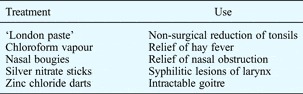
In this article, we describe some of the treatments outlined in the Pharmacopoeia, how they were received contemporaneously and how they relate to modern management. An overview of Victorian ENT treatments can be seen in Table I. Although many of these substances are listed today with a corrosive warning, in the late 1800s they were used as sedatives and as treatments for syphilis and for laryngitis.
Victorian ENT treatments

Treatments
Vapours
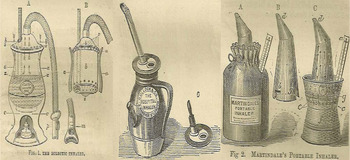
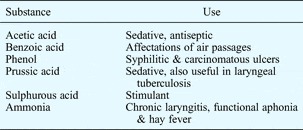
Vapours or inhalations constituted a large component of the Pharmacopoeia; these are listed in Table II. They were divided into five types: hot, cold, dry, spray or fuming. Mackenzie stated that the value of inhalations had long been recognised by the medical profession and the public.Reference Mackenzie 4 The different types of inhaler are shown in Figure 1.
Inhalers, as shown in the Pharmacopoeia.Reference Mackenzie 4

Vapours

‘The eclectic inhaler’ was designed by Mackenzie. Medicaments were placed in the large, vase-like container, which was filled with hot water to a specific line. There was an air space at the top and a lid with two layers. The lid layers were perforated so that hot air could rush between the apertures and up to the mouthpiece. There was also an opening in the lid for a thermometer. The specific instructions for use were: to use before meals, no more than six inhalations per 1 minute, and to avoid the cold for 30 minutes afterwards to prevent upper respiratory tract infection.
The hospital inhaler was manufactured by Bullock and Company, a well-known pharmacy at Three Hanover Street, London. Essentially, it was a large, stoneware jug with openings for a mouthpiece and thermometer. A lighter and more affordable option was Martindale's Portable Inhaler. This was made from tin and needed to be placed within a woollen jacket to prevent patients from burning their fingers.
Cold inhalations were recommended to affect the mucous membranes of the entire throat. They were deemed to be particularly useful in hot climates. Many of them could be used as a hot inhalation if the strength of medication was slightly reduced.
Vapour or inhalation treatments included the following medications. (1) Acetic acid is the substance that gives vinegar its characteristic taste, and is also useful as a solvent. (2) Benzoic acid is a weak acid commonly used as a food preservative. (3) Carbolic acid, also known as phenol, has multiple uses. Historically, it has been used as an antiseptic and in conversion to plastics. Notoriously, it was used in Nazi Germany as a means of rapid execution by intravenous injection. More recently, carbolic acid has been used in chemical facial peels and for lumbar sympathectomy. (4) Hydrocyanic acid, also known as prussic acid, is another highly toxic substance. Today, it is still used in gas chambers in some US states that employ judicial execution. It was also used as a means of mass murder in Nazi Germany. (5) Sulphurous acid is used chemically as a mild bleach and disinfectant. (6) Ammonia has multiple uses, including household cleaner, fertiliser and in textiles. It is also the main component of ‘smelling salts’.
Chloroform for hay fever
Hay fever in Victorian times caused particular problems. An article entitled ‘The treatment of hay fever’, 5 published in the British Medical Journal in 1903, stated that:
… sufferers have therefore had to bear their trial with such fortitude as they could command, perhaps in the thought that their complaint is, like early baldness according to the Prince Consort, a mark of breeding. … More distinctly than gout, it is an ailment of the well to do, for there is no poor man's hay fever.
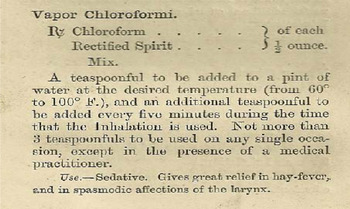
In the Pharmacopoeia, it is stated that great relief from hay fever could be gained by regular inhalations of chloroform, the anaesthetic agent.Reference Mackenzie 6 As Figure 2 shows, Mackenzie exercised moderation with the chloroform inhaler, limiting the quantity of chloroform to no more than three teaspoonfuls.
Instructions on the preparation and use of chloroform inhalation as a treatment, as shown in the Pharmacopoeia.Reference Mackenzie 6

This sentiment of moderation was not echoed by Lockard,Reference Lockard 7 who, in a 1903 edition of the Boston Medical and Surgical Journal, (which became the New England Journal of Medicine), recommended large doses of chloroform in combination with draconti (an emetic root) and belladonna (deadly nightshade). The same article recommended lemonade as a useful temporising measure for attacks of hay fever.
Zinc chloride darts
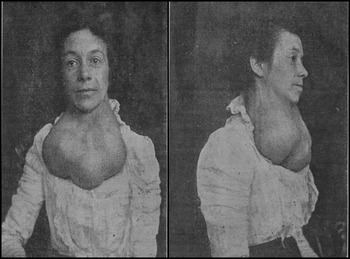
Zinc chloride darts were recommended by Mackenzie for fibrous goitres of the intractable type. They were to be plunged into the goitre via a cannula and left in place. No descriptive guidance was issued in the Pharmacopoeia as to how long they should be left in situ.
A 1874 case report by McNaughtonReference MacNaughton-Jones 8 described the case of a young machine worker who was successfully treated with such darts for 17 months. Another case report,Reference Payne 9 published in the British Medical Journal in 1903, described one of Mackenzie's former patients in whom zinc darts had been used for 14 months to no avail. This patient is shown in Figure 3. It is difficult to judge how successful these treatments were when there are only a handful of cases in the literature.
Photograph of one of Mackenzie's former patients, a 38-year-old woman with a goitre which had developed over 34 years. Reproduced with permission from the BMJ Publishing Group Ltd.Reference Payne 9

Today, the use of darts in medicine appears to be limited to the dart guns used by veterinarians to fire sedatives. However, the concept of zinc dart usage is somewhat similar to brachytherapy, whereby active treatment is brought closer to diseased tissues, or embedded within them, in order to affect them locally and limit damage to nearby healthy structures. This is not always possible with external radiation therapy.
Interestingly, three years after the publication of the Pharmacopoeia, at the 41st annual meeting of the British Medical Association, Mackenzie himself stated (in the Surgery Section) that injections of iodide into a goitre were preferable to setons and darts, to prevent suppuration.Reference Mackenzie 10 This was based on the work of the German professor, Lucke.
Silver nitrate
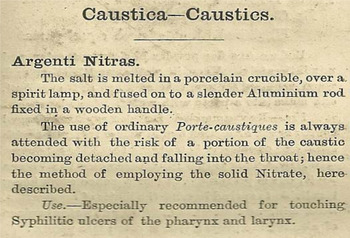
Silver nitrate is a substance widely used in ENT departments today in the management of epistaxis and for cautery of granulation tissue. In the Pharmacopoeia, Mackenzie highlighted its use in treating syphilitic lesions of the larynx (Figure 4).Reference Mackenzie 11
The preparation and use of silver nitrate as a treatment, as shown in the Pharmacopoeia.Reference Mackenzie 11

Historically, silver nitrate was popularised by the surgeon John Higginbottom, 12 , Reference Higginbottom 13 for wound care. He found multiple uses for silver nitrate and highlighted its importance in shortening in-patient care, for out-patients and in ambulatory care. The use of silver nitrate, however, extends as far back as medieval times. Its use was documented in 1635 by Alexander Read of London, who advocated silver nitrate for dealing with wound cavities.Reference Block and Block 14
‘London paste’
‘London paste’ was formulated by Morell Mackenzie. The principle constituents were caustic soda and unslaked lime, to which water was added. The paste, which was used to obliterate large tonsils or an elongated uvula, was considered by Mackenzie to be less painful and safer to use than ‘Vienna paste’, which contained potassium carbonate. Mackenzie recommended the use of London paste where the use of the guillotine, or removal of the tonsils with scissors, was contraindicated.
Many years after its invention, there was still concern about the safety and efficacy of London paste. Doctors were uncertain how long it should be used for and how many times it could be applied.Reference Moore 15 Some surgeons felt that it was an ineffective form of treatment and should not be used when surgical treatment with the guillotine was already well established.Reference Higginbottom 13
Another concern regarding London paste was that it caused considerable pain, despite the preliminary use of cocaine paste. Others felt that it was unsafe for use because it could spread to the faucial pillars, ulcerating them. Further condemnation came from colleagues of Mackenzie who stated that he [Mackenzie] himself rarely used the paste.Reference Moore 16
Nowadays, the destruction of tonsil tissue can be carried out by radiofrequency ablation (coblation), rather than by the application of caustic substances. In an echo of the debates 130 years ago, today's established methods of tonsil surgery are deemed safer than the newer ablative method of coblation.Reference Brown, Ryan, Yung, Browne, Copley and Cromwell 17
Nasal bougies
Bougies containing medicament are solid preparations that can be inserted into an orifice to create a local or systemic effect, in a similar manner to a suppository. The nasal bougies used in the Victorian era were made with a glycol-gelatine base, into which other medicaments were incorporated.Reference Marriot 18 They measured approximately 8 cm in length. Mackenzie had learned from Dr Catti about nasal bougies during his studies in Vienna.Reference Mackenzie 1 The bougies dissolved slowly with time, gradually exposing the nasal mucosa to their contents.
The contents of the bougies listed in the Pharmacopoeia were obvious from their names. They included: carbolic acid, used as an antiseptic and anaesthetic; bismuth, for nasal syphilis; copper sulphate, used as an antifungal agent; iodine, used as an antiseptic; morphine, used as an analgesic; scotch pine leaf oil, used as a disinfectant; lead acetate, a soothing ointment; thymol, used as an anti-fungal agent; and zinc sulphate, used as an astringent.
Today, the treatment of nasal disease is evidence-based.Reference Fokkens, Lund and Mullol 19 Mackenzie too tried to establish a scientific basis for his treatments. For this reason, he employed the pharmacists at Bullock and Company to conduct a series of experiments to ascertain the best formulae for his nasal bougies, as Catti's work had not included such details.
Discussion and conclusions
It is unlikely that many readers would volunteer for any of the above-mentioned treatments. Mackenzie, however, firmly believed in his treatments, although many of them are unrecognisable in the present day. At the time, the Pharmacopoeia was well received, being quoted by HaweisReference Haweis 20 as a ‘medical classic’. Furthermore, seven editions of the Pharmacopoeia were printed, which indicates its popularity. Many of our treatments today are not based on the most robust levels of evidence; one only has to look at the controversy surrounding the management of conditions such as Ménière's disease and laryngopharyngeal reflux to appreciate this.
-
• Morell Mackenzie's contribution to laryngology is often overshadowed by his care for the Crown Prince of Germany in 1887
-
• The several editions of his Pharmacopoeia are comparable to today's drug formularies
-
• He recorded the use of inhalers, vapours, darts, bougies and topical pastes
-
• His Pharmacopoeia provided a basis for ENT practice for almost a century, and a platform for advancement of the specialty
Despite this, Mackenzie's remedies had a relatively long life span. The recommendation of inhalations was still common in 1949, (see Diseases of the Nose and Throat by Thomson and Negus),Reference Thomson St and Negus 21 some 79 years after the publication of the Pharmacopoeia. On the other hand, with the exception of epistaxis, the application of caustic substances is no longer used for treatment of nose and throat pathology. It is interesting to see that London paste was still recommended in 1949 by Thomson and Negus for cases where tonsillectomy was not advised, or where the patient refused a surgical procedure. However, Thomson and Negus acknowledged that it was difficult to remove the whole tonsil solely using London paste, and that further bouts of tonsillitis may occur following use.
It is interesting to look back at these treatments and consider how many of today's treatment options will still be widely used in 140 years' time.
Acknowledgement
We would like to thank Mr N Weir for his help and suggestions for this paper.