1. INTRODUCTION
Both contemporaries and present-day historians have generally considered the system of poor relief in the Dutch Republic to be generous and relatively efficient. Many foreigners visiting cities in the Northern Netherlands in the seventeenth and eighteenth centuries were amazed by the charitable institutions they encountered. Almshouses for the elderly formed a regular tourist attraction and Dutch orphanages, such as the Amsterdam Burgerweeshuis, were admiringly described as palaces.Footnote 1 Economic historian Peter Lindert has recently substantiated contemporary opinions by estimating that, in terms of per capita expenditure on poor relief, the Dutch Republic was amongst the highest in Europe, only to be surpassed by England in the late eighteenth century.Footnote 2 In addition, social historians Maarten Prak and Marco van Leeuwen have convincingly argued that pre-industrial Dutch poor relief did not suffer as severely from periodic breakdowns as previously thought.Footnote 3
However, no different from in most other pre-industrial societies, the Dutch poor relief system did not comprise a uniform scheme, financed by an obligatory direct poor tax. Although, via indirect (mostly local) taxes and fines, public funds did trickle down to poor relief, the financial basis of the latter consisted primarily of private and voluntary donations, such as church collections, gifts and legacies. The well-functioning system of relief in the Dutch Republic, with probably the highest per capita spending on charity until well into the eighteenth century, may lead us to hypothesise that Dutch citizens had a relatively generous attitude towards the poor. Why did so many people give so much?
Investigating motives behind charitable behaviour is particularly relevant in the context of debates on civil society and community building.Footnote 4 In the past, historians have often analysed early modern charitable giving in terms of the relationships between the elites and the poor. For instance, Catharina Lis, Hugo Soly and Dirk Van Damme have argued that an important motive for elites to give to the poor was the prevention of social unrest among the labouring poor while at the same time providing social assistance enabled elites to preserve a cheap and flexible labour reserve.Footnote 5 Rather than emphasising the motive of social discipline, Sandra Cavallo has characterised charitable actions as expressions of conflict between the urban elites, as they could be a means of appropriating political power.Footnote 6 Although van Leeuwen has paid more attention to the reciprocity of charitable relations between the elites and poor people, he too has largely focused on the strategies and capabilities of these two particular groups in society.Footnote 7
More recently, historians have emphasised the role of the middle groups in (urban) society regarding the provision of social assistance. As Kate Lynch, for example, has shown, the close collaboration between civic, clerical and voluntary lay organisations providing social care in European towns involved relatively large groups from the urban community in organising relief for the civic poor.Footnote 8 Charles Parker has pointed to the fact that poor relief served as one of the pillars on which the Reformed Church and urban governments built and strengthened religious and civic communities within the towns of the newly established federal Republic.Footnote 9 Moreover, Anne McCants has argued that urban social care, at least in the Dutch Republic, was not only organised by but also predominantly directed towards the middle groups in society, who were established members of the bourgeoisie.Footnote 10
The central aim of this article is to find out what the specific role of the different groups in urban society was regarding the organisation and financing of urban early modern Dutch poor relief, what the motivations behind their involvement were, and how and why this changed over time. This will be investigated by looking at both the sources of income of Dutch urban poor relief organisations and at voluntary donations and bequests by citizens. By looking at the good causes to which citizens directed their charity, this article also aims to expose the extent to which they were aiming to help the really poor, or if their charitable actions instead were primarily directed at people of their own social status, to uncover the role of reciprocity in their charitable behaviour.
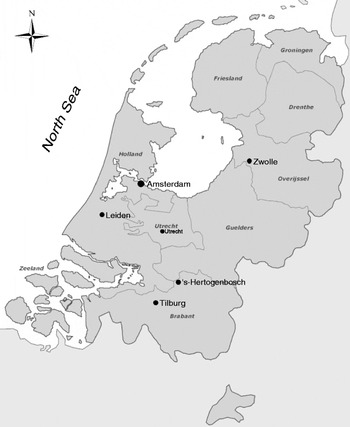
In order to answer these questions, voluntary gifts in three towns in three different provinces of the Dutch Republic were examined over the 1600 to 1800 period. The three towns are Leiden, situated in the province of Holland in the west of the Republic, Utrecht, in the province of Utrecht in the centre and Zwolle, in the eastern province of Overijssel (see Figure 1).
The Dutch Republic, c. 1580–1795.

As well as being geographically spread, the three towns also differed in size. Leiden was the second-largest Dutch town after Amsterdam for much of the early modern period, with approximately 67,000 inhabitants around 1670. Utrecht was a medium-sized town with a relatively constant 30,000 inhabitants, whereas Zwolle contained just 8,000–12,000 inhabitants during the early modern period. Furthermore, the three towns had very different economic structures. Leiden was the hub of the Dutch Republic's export-oriented woollen industry in this period, with a strong focus on textile production, but in the eighteenth century its commercial activities expanded, Utrecht was a typical ‘rentier town’ with a relatively large gentry and patrician elite, whereas Zwolle was a more regionally oriented centre, with some commercial activity and some industry, but no specific industrial specialisation.
This article is divided into seven sections. After this introduction the second section places the most important sources, wills, in context and briefly discusses the legal framework within which citizens in the Dutch Republic drew up their last will. The third section contains an analysis of the income structure of poor relief institutions in the three towns under investigation and asks how important were bequests and gifts compared with the total income of institutions and what does this tell us about the social structure of ‘givers’? In subsequent sections an analysis of the ‘supply side’ – the citizens who donated to charity – is given. Based on a sample of 1,200 wills from the three towns, drawn from four benchmark years (1600, 1670, 1740 and 1800), more information about those giving to charity will be uncovered. What was their social background? How generous were their donations, in relation to their social position? How did their bequests relate to voluntary inter vivos gifts? Not only will a geographical comparison be made, but trends over time will also be established. Before some final conclusions are drawn in section 7, section 6 discusses the extent to which redistribution of wealth may actually have been on the minds of the benefactors when designating to whom their donations should be given.
2. INHERITANCE LAW, WILLS AND LEGACIES
Inheritance law in the Dutch Republic varied according to province, but there were many similarities.Footnote 11 In the provinces of Holland, Utrecht and Overijssel, when people married their property formed a joint estate. When one of the spouses died, exactly half of the joint estate went to the surviving spouse; the other half was divided among the deceased's legal heirs.Footnote 12 Greater variation could be found when considering inheritance by more distant relatives, but in the cities studied here, inheritance laws were relatively similar. In Leiden, children were the first to inherit in equal parts. When children or their descendants were absent, parents would inherit; if the parents were absent, only then would any brothers or sisters or nieces or nephews of the deceased inherit. Grandparents formed the next line of inheritance, and if they were absent, the estate would pass to any surviving uncles and aunts.Footnote 13 In Utrecht and Zwolle, the first line of inheritors was also formed by the deceased's children, or their descendants, who all inherited equally. However, unlike in Leiden, grandparents in these cities inherited before any brothers or sisters did, but the effect of this difference was in practice quite small.Footnote 14 These inheritance practices remained unchanged throughout our period of investigation – even the coming of the French Revolutionaries in 1795 did not directly lead to changes in civil law. Only in 1809 were regional and provincial regulations abandoned in favour of the national Code Napoléon.Footnote 15
Within the confines of inheritance law, which granted a portion to each legal heir, people could make arrangements for their property in a last will.Footnote 16 Often, married couples drew up a will to safeguard property for the surviving spouse. Since husbands and wives were not each other's sole heir, they needed a will to protect the joint marital estate. Sometimes, their will bestowed children only with their legitimate portion, or granted usufruct (the use of the fruits of the estate) to the surviving spouse until his or her death, after which any remaining children would automatically inherit.Footnote 17 In a will, testators could also appoint other heirs apart from their blood relatives, or make arrangements for bequests in kind, in money or equities. People could make bequests to relatives or friends who would not automatically inherit, and also to charitable institutions.
Wills are an excellent source to investigate trends in charitable behaviour over an extended period of time. On the one hand, this is due to their consistency as a source, and on the other hand to the fact that they contain details that set the testators in a wider context. Not only do wills usually provide information about the sex and stage in the life cycle of the people involved, they also often inform us about their professional lives, their broader social networks, their family ties and even about conflicts in which they were already involved, or might expect to erupt, over the division of their inheritance.Footnote 18 By studying large numbers of wills, we can make quantitative analyses of the social background of benefactors and how this changed over time. Moreover, detailed qualitative information, such as their religious background and aspirations, or conditions expressing loyalty to the good cause to which they were giving, can inform us about their personal characteristics. By linking the data in wills to information from other sources, such as biographical data, census records, population registers, poor relief records and inventories, we can obtain a clearer view of which social groups tended to give to charitable institutions, and how this changed over time.Footnote 19
It is also possible to hypothesise about the motives that testators had for making charitable donations through their wills. Acquiring social status may not have been directly on their minds, since they would not live to enjoy it: stipulations in wills were generally not made public during a testator's lifetime, and after death the notary typically only informed those involved of the contents of a will. However, the honour of their family name or earning a special place in the afterlife may have been of importance to testators when making a bequest.Footnote 20 Furthermore, sympathy and identification with the good cause, based on a sense of empathy or shared fate, may have been important. Geographical, religious and social proximity may all have contributed to this sense of shared identity and solidarity with the community in which they lived.Footnote 21 It is estimated that about 50 per cent of the population of the Dutch Republic at some stage in their life cycle came to depend on poor relief, for a short or a longer period of time.Footnote 22 In this context, it is especially relevant to look at the social background of donors, in order to investigate the motive of reciprocity. This principle of do ut des – I give, so that you will return the favour – is quite common in historical and sociological analyses of giving behaviour, as it is often assumed that giving is not necessarily a purely altruistic deed, but that donors may expect something in return. In the case of bequests, this reciprocity obviously applied less to testators themselves, than to their descendants and/or the testators' social and religious peers. Therefore, it is useful to compare bequests with inter vivos donations, where reciprocity may have played a more direct role.
Although wills can thus be a rich source of information on the characteristics and motivations of benefactors and on the causes to which they donated, there are some problems to be reckoned with. First, there is the question of representativeness. As Michel Vovelle has pointed out, wills form a ‘socially selective source’ par excellence.Footnote 23 Indeed, the social structure of all testators does not mirror the social composition of early modern society at all. Because, in general, people tended to draw up a will when they had some form of property to transfer to, or protect for, future generations, members of the lower social strata are definitely underrepresented among the testators. This lack of representation does not, however, mean that lower-income groups did not give to charity – they simply could not do so by means of a will.Footnote 24 Most probably, the less fortunate donated by other means such as via church and door-to-door collections, by putting an minor sum of money in one of the poor boxes in the street, or by giving small alms to beggars.Footnote 25
Second, it is not always easy to determine the value of a legacy. Even though in highly monetised societies such as pre-industrial England and the Netherlands the majority of gifts were expressed in money, testators also made bequests in kind. Furthermore, when a charitable institution partly or entirely inherited the estate, wills do not give us the information about the total value of the inheritance. For this, we thus need additional sources, such as an inventory.Footnote 26 Also, we cannot always be certain that the intended legacy was in fact paid out after the testator died, because his or her financial situation may not, in the end, have allowed this.Footnote 27 Even if we do know the monetary value of the eventual donation, this does not tell us everything about the generosity of the testators. As William G. Bittle and R. Todd Lane have argued, in a critique of Wilbur Kitchener Jordan's work, great care has to be taken drawing conclusions about the charitable behaviour of benefactors based on absolute monetary values alone. For one thing, their gifts should be related to the total estimated value of their assets, by looking at probate inventories for instance, and for another, in order to make sensible comparisons over time, the data have to include corrections allowing for estimates of inflation.Footnote 28 The value of a legacy may also be put in perspective by relating it to the available data on the total revenue of the charitable institution, as will be shown in the next section.
3. INCOME STRUCTURE OF POOR RELIEF INSTITUTIONS
In contrast to many cities throughout Europe, towns in the Northern Netherlands did not drastically reform their rather fragmented and unspecialised medieval charitable institutions in the first decades of the sixteenth century. Instead, it was the Reformation in the 1560s, and consequently the establishment of a Protestant Republic (1579) that led to the breakdown of the Catholic poor relief system in the region, creating a need for a viable alternative, especially as the rise in the number of immigrants to the new Republic caused financial pressure on the receiving towns. At the same time, however, the confiscation of Catholic estates, together with a period of economic prosperity around 1600, created opportunities to reform the poor relief system. This did not mean, however, that a uniform system of social care came into being in the Northern Netherlands – every individual town had its own institutions, some more centrally controlled by the municipal authorities than others.Footnote 29
In Leiden, the city secretary Jan van Hout advocated drastic reforms of the existing poor relief system in his Armenrapport (Report on the poor) of 1577. In order to tackle the increasing problem of poverty, he introduced a more efficient relief system, by combining various urban poor funds into one central chest, that of the Huiszittenhuis (‘House of the Homedwellers’), for the assistance of the city's ‘righteous outdoor poor’. In 1583, the newly established Reformed diaconate, the most important institute for providing ecclesiastical assistance, was added to this central fund, which meant a far-reaching centralisation of Leiden poor relief.Footnote 30 Furthermore, some of the smaller Protestant congregations, such as the Walloons, the Reformed English, and the Lutherans, which were present amongst the many migrants Leiden attracted, were allowed to have their own diaconate from around 1600. This relatively centralised structure remained intact until the eighteenth century, when severe financial problems arose. From the early eighteenth century onwards, the Mennonites (1701), the Jewish community (1723) and the Catholics (1739) were told to provide for their ‘own’ poor.Footnote 31
In Utrecht in the first decades after the Reformation, the Reformed diaconate assisted all poor inhabitants. However, financial need and ideological debate concerning the extent to which the Reformed Church should assist those who did not practise the ‘true faith’ led to a request by the Utrecht church council and deacons to be relieved from the care of non-Reformed poor. Consequently, the City Almoners' Chamber (Stadsaalmoezenierskamer) was erected, governed by eight Reformed and eight Catholic regents (governors) and almoners, and supervised by the city council. The Almoners' Chamber functioned alongside the diaconate and the hospitals, which since the end of the sixteenth century had become more specialised and included old people's houses, a burghers' orphanage and a plague hospital.Footnote 32 Although the city council wanted to merge the diaconate, the Almoners' Chamber and the poor workhouse (established in 1619) into a ‘Common Bourse’, these plans were never carried through, because the Reformed deacons wanted to retain their independence. The co-operation between the Reformed and the Catholic regents and almoners did not run very smoothly, however, and between 1637 and 1660, the latter positions remained vacant due to religious issues. From 1660 onwards, Catholic regents were again admitted to the Almoners' Chamber, but they formed a minority with only two almoners. Finally, in 1674, a separate Catholic Almoners' Chamber was established; that from then on was responsible for the Catholic poor in town.Footnote 33
As everywhere else in the Dutch Republic, the Reformation in Zwolle led to immediate challenges for social assistance, because the Catholic Church could no longer perform this function. In 1580 the city council appointed four almoners to take care of the ‘righteous resident poor’. An important part of their financial means was derived from the Catholic possessions confiscated by the secular authorities. Apart from the city almoners, a Reformed diaconate was also established in this period. The city almoners and the Reformed deacons worked closely together, and in 1616 the town council formalised this collaboration by erecting the City Poor Chamber, which provided assistance to all poor in town, regardless of their religious denomination.Footnote 34 The deacons and almoners were responsible for distributing the weekly allowances. They visited every recipient once a year, registered their whereabouts and performed both church and door-to-door collections. Around the turn of the seventeenth century the City Poor Chamber faced increasing financial troubles. The insufficient funds were partly due to decreasing revenues from collections, and partly to the rising number of poor people. Repeatedly, the almoners turned for help to the city council, which tried to think constructively of structural measures to solve the deficits. Eventually, decentralisation, which meant that the municipal authorities handed over responsibility for certain religious groups to their own denomination, was the answer in Zwolle, as in many other Dutch towns in the first quarter of the eighteenth century.Footnote 35 As a result, secular charity and clerical charity were increasingly separated. Initially, in 1735, only the Catholics were requested to provide for their ‘own’ poor from then on. Soon, the Anabaptists and Jews were obliged to follow this example, and finally the Lutherans were also told that the City Poor Chamber could no longer assist them.Footnote 36
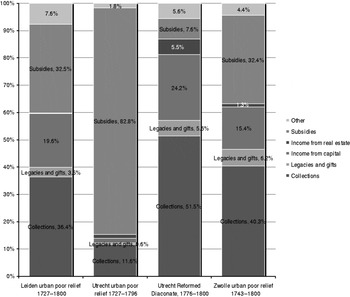
Figure 2 depicts the available data on the income structure of the three most important providers of poor relief in the three towns under investigation. It shows that the revenues of charitable institutions as a rule came from private gifts, including money raised through collections, legacies and inter vivos gifts, from rents on capital or land and from subsidies by the local government.Footnote 37
Average income structure of the Leiden Huiszittenhuis, the Utrecht Almoners' Chamber, the Utrecht Diaconate and the Zwolle Poor Chamber, 1727–1800. (Sources: Regional Archives Leiden (RAL), Stadsarchief van Leiden 1574–1816 (SA II), inv. nos. 9045–9093; Utrecht Archives (HUA), Almoners' Chamber, inv. nos. 1827/23–1827/86; HUA, Diaconate, inv. nos. 538–551; Historical Centre Overijssel (HCO), City Archives, inv. no. 10125.)

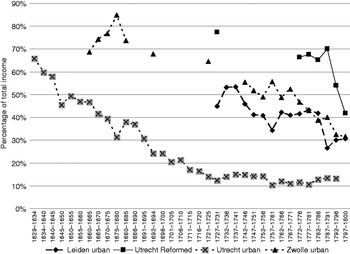
With the exception of urban poor relief in Utrecht, eighteenth-century Dutch poor relief for a large part continued to depend on voluntary donations. Figure 3 displays the long-term developments in the share of private donations, made as a result of collections, bequests and inter vivos gifts, compared with the total income of the Leiden Huiszittenhuis, the Utrecht Almoners' Chamber, the Utrecht Diaconate and the Zwolle City Poor Chamber. These shares varied across towns, but were generally well over 50 per cent, even 60 per cent, around 1720, and the Zwolle figures for the seventeenth century suggest even higher percentages in the seventeenth century. Clearly, in all towns a downward trend in the relative importance of private donations occurred over the period shown in Figure 3.
Voluntary donations as percentage of total income, 1657–1800 (5-year averages). (Sources: Regional Archives Leiden (RAL), Stadsarchief van Leiden 1574–1816 (SA II), inv. nos. 9045–9093; Utrecht Archives (HUA), Almoners' Chamber, inv. nos. 1827/1–1827/86; HUA, Diaconate, inv. nos. 538–551; Historical Centre Overijssel (HCO), City Poor Chamber, inv. no. 91; HCO, City Archives, inv. nos. 10105–10111, 10125.)

What do these graphs tell us about the social status of donors to charitable institutions, and about their motives to give? As Figure 2 has shown, the majority of income from private donations came from collections. Weekly church and door-to-door collections formed the backbone of the income structure of both clerical and urban poor relief institutions, although they were more substantial for the Utrecht Diaconate. However, the figures for the Utrecht Almoners' Chamber, the second column from the left in Figure 2, strongly deviate from this general picture. Even in the second half of the seventeenth century, private funding had already become relatively less important in Utrecht, although in absolute terms, the real caesura occurred in 1674, when the Catholics separated and established their own Chamber. Before this Catholics had given generously to public poor relief, as this was the only institution to which they could turn in time of need. The Reformed congregation, on the other hand, had their own diaconate. Unfortunately, financial data for the Reformed diaconate are only available for the late eighteenth century; these suggest that giving to one's ‘own’ poor was indeed an important motive behind charitable giving. Religious and altruistic feelings no doubt played a role, but a sense of community was obvious; people gave more generously to the poor of their own religious denomination. Another important source of income was that formed by subsidies from the urban government. It must be noted that direct subsidies were only irregularly provided – the majority of public contributions in Leiden, Utrecht and Zwolle consisted of a share in the taxes raised by the towns on various products, such as peat and beer.Footnote 38
Because both collections and, especially, taxes on everyday consumption goods were derived from inhabitants from all layers of urban society, and probably mostly from the poorer people, both because they formed the majority of the urban population and because they gave a greater portion of their income,Footnote 39 a first important conclusion must be that ‘ordinary people’ directly or indirectly provided the lion's share of the finance for both clerical and lay poor relief institutions. Much of the burden of poor relief was thus carried by all social layers of the urban community, either voluntarily and directly through church and door-to-door collections, or more indirectly, and perhaps less willingly, through their payment of taxes. Surely then, the relatively modest but consistent share of legacies and inter vivos gifts to charitable institutions must have come from the more prosperous people in society, who had the extra means to make such donations? Obviously, testators made a very conscious and private decision to donate to charity after their death, so it may be assumed that social pressure and civic duty were less important considerations for them. In the next section we turn to an analysis of the sample of 1,200 wills from the three towns to investigate to what extent this was indeed the case, and what this tells us about the motivations of people to give to charity.
4. CHARITABLE BEQUESTS AND INTER VIVOS GIFTS IN LEIDEN, UTRECHT AND ZWOLLE
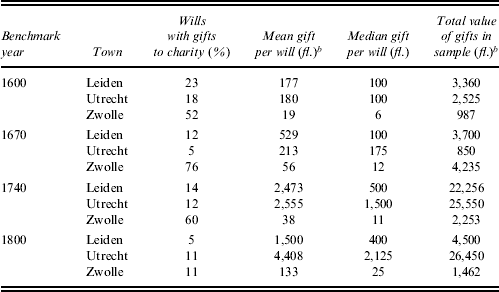
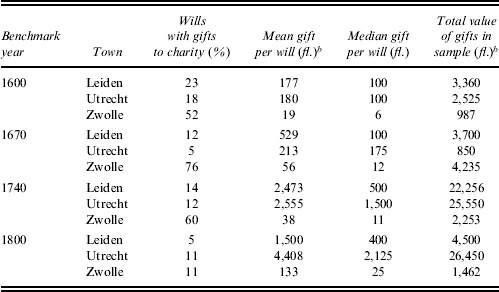
Table 1 gives an overview of charitable donations in the sample of 1,200 wills. The four benchmark years (1600, 1670, 1740 and 1800) were selected for several reasons. First, they roughly pinpoint economic trends in the Dutch Republic, with an upswing around 1600, stagnation around 1670, and general economic decline around 1740. The 60- to 70-year intervals between them are equally distributed over the entire study period, thus enabling the establishment of balanced long-term trends. Moreover, 1670, 1740 and 1800 closely coincide with years when local tax registers were drawn up (Klein Familiegeld 1672, Personele Quotisatie 1742, Censuses 1795). As occupation and wealth were often recorded in these census-type documents, data linkage with records containing information on occupation, income and wealth was possible.Footnote 40 For each town in each benchmark year, 100 wills were randomly selected from the archives, making 1,200 in total. Table 1 shows how many wills included a charitable bequest, what the mean and median gifts in these wills were, and the total amount given in a particular benchmark year in each town.
Bequests in Leiden, Utrecht and Zwolle, 1600–1800: sample of 100 wills from each town, for each of four benchmark yearsFootnote a
a Monetary amounts in guilders (fl.).
b Excluding wills with undefined gifts or gifts in kind. This accounts for undercounting in the total of gifts in each benchmark year.
Sources: Regional Archive Leiden (RAL), Old Notarial Archives, various notaries; Utrecht Archives (HUA), Notarial Archives before 1906, various notaries; Historical Centre Overijssel (HCO), City Archives Zwolle, Bench of Aldermen.
Leiden and Utrecht show some similarities, both in the relatively modest percentage of wills containing a charitable bequest and in the rather high mean gift, especially in 1740 and 1800. As the difference between the mean and median gifts in these particular years shows, there is some distortion by a few extraordinarily high donations both in Leiden and Utrecht.Footnote 41 The contrast with Zwolle is striking, however: here, average donations were much smaller, but the percentage of benefactors to charity among all testators was far greater than in the other two towns, apart from in 1800. This suggests that in much of the period it was far more common to give a bequest to charity in Zwolle than in Leiden or Utrecht, but that donations in Zwolle were smaller. It may have been of influence that in Zwolle people approached the Bench of Aldermen, a civic institution, to make their last will, whereas in Leiden and Utrecht citizens went to private notaries. A request from around 1680 shows that the almoners of the City Poor Chamber in Zwolle did indeed demand that the aldermen should encourage citizens who came to make a will to donate to charity, because ‘often sick people do not consider this’.Footnote 42
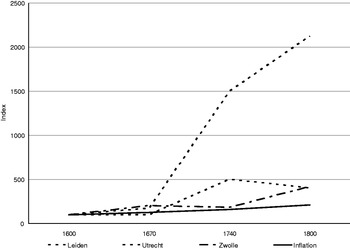
Apart from spatial differences, trends over time are also salient. Figure 4 displays the relative increase of the median gift in all three towns, including an index of the rate of inflation,Footnote 43 with 1600 as the benchmark given an index rate of 100. During the seventeenth century, which was a period of economic growth especially in the province of Holland where Leiden was situated, the increase in the value of charitable bequests only slightly exceeded the inflation rates in all three towns. However, in the eighteenth century, a period of stagnation and decline, the median gift rose more spectacularly, particularly when compared with inflation levels. This was most prominent in the case of Utrecht.
Index of increase in the value of the median gift, Leiden, Utrecht and Zwolle (1600=100). (Sources: Regional Archive Leiden (RAL), Old Notarial Archives, various notaries; Utrecht Archives (HUA), Notarial Archives before 1906, various notaries; Historical Centre Overijssel (HCO), City Archives Zwolle, Bench of Aldermen.)

Simultaneously, the actual number of people who drew up a will including a charitable bequest shows a downward trend, especially in Zwolle in the second half of the eighteenth century.Footnote 44
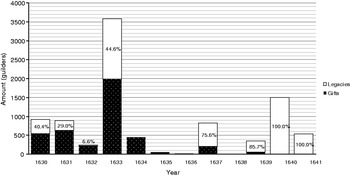
From the various financial records it becomes clear that, in general, inter vivos gifts, given while a donor was still alive, were relatively less important in value than legacies. Usually, liberal donations and legacies were administered together, because inter vivos gifts were so rare and so small. In only two instances was it possible to systematically compare both sorts of gifts: for the Utrecht Almoners' Chamber in 1630–1641 and for the Utrecht Reformed Diaconate in 1700–1720. The first instance is illustrated by Figure 5. Although they varied greatly from one year to the next, legacies on the whole seem to have been at least as important as inter vivos gifts, which in later years became ever less common.
Gifts and legacies compared, Utrecht Almoners' Chamber 1630–1641. (Source: Utrecht Archives (HUA), Almoners' Chamber, inv. nos. 1827/1–1827/3.)

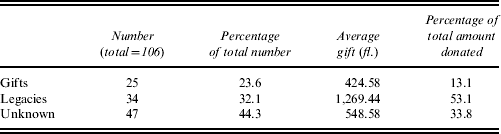
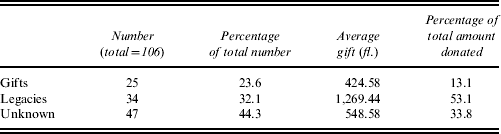
The second instance is presented in Table 2. Both numerically, and in terms of mean gifts, legacies also appear to have been more important among givers to the Reformed diaconate in the period 1700–1720. Admittedly, there are rather a large number of gifts where it has not been possible to establish if either a legacy or an inter vivos donation was involved. However, even if all unknown gifts were inter vivos gifts, which is unlikely, more than half of the total amount of money (53.1 per cent) would still have been donated to the diaconate via bequests. All these observations lead us to believe that inter vivos giving to charitable institutions – both urban and clerical – were less important than giving by legacy in the studied towns. Since the number of inter vivos gifts seems to have declined over time, the decline of charitable bequests can most probably not be explained by a rise in this form of giving.
Legacies and donations inter vivos to the Reformed Diaconate, Utrecht 1700–1720
Source: Utrecht Archives (HUA), Diaconate Archives, inv. no. 313, List of legacies and donations, 1700–1719.
In section 3, it was shown that poverty increased in the eighteenth century, and that at the same time, the share of private donations, especially from church collections, went down. While the impoverishment of the population increased the demand for poor relief, it probably also depressed the ability of the bulk of the population to contribute to poor relief funds. This may point to an increasing involvement of elite groups in the financing of poor relief over the course of the eighteenth century, especially in the city of Utrecht. To get a clearer view on these developments, the next section reports on a more in-depth analysis of the social background of the testators leaving the sample wills.
5. THE TESTATORS' SOCIAL BACKGROUND
Foreign visitors disapprovingly observed the apparent lack of social distinction in the Dutch Republic: many of them commented on the relative equality of people from different social strata. However, even if the division between social ranks and classes was less strict than in other countries, it was by no means absent.Footnote 45 First of all, there were the elites. The Northern Netherlands traditionally had a very small nobility, which virtually died out because it was legally impossible to obtain an aristocratic title other than by birth.Footnote 46 In cities and towns, the elite comprised a number of patrician families who filled positions in the local government, together with very rich merchants, rentiers, high officials and representatives of the free professions, such as lawyers and medical doctors. These groups, who had an average yearly income of over 1,000 guilders, formed about 8–10 per cent of the entire urban population. Subsequently, there were the higher middle groups, or the ‘broad bourgeoisie’: burghers with an income of 600 to 1,000 guilders per year (10 per cent of the urban population), and the lower middle groups, or the ‘small bourgeoisie’, earning 350 to 600 guilders per year (35 per cent). These were the artisans, retailers, lower officials and officers, who were all more or less successful in providing for themselves and their families, although the risks of illness, death and misfortune and the subsequent loss of status were never far away in early modern society. Finally, the lowest groups in society, low-skilled workers, day labourers, servants, and the really poor, earned less than 350 guilders per year and comprised about half of the population.Footnote 47
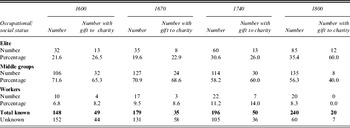
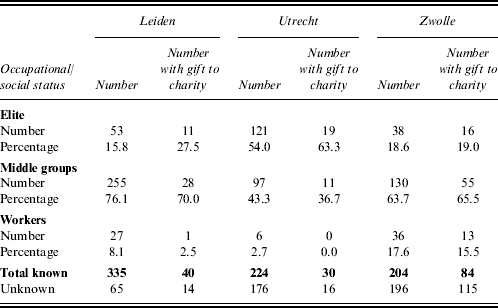
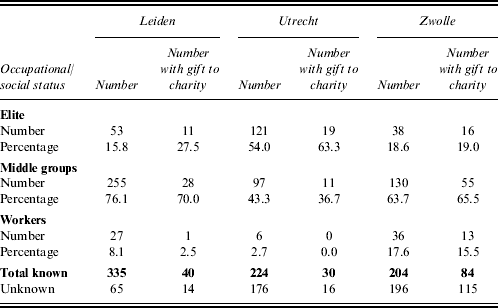
It was possible to find occupation or income data for almost two-thirds of the 1,200 testators; for the remaining third, an occupation could not be found in either the will or the additional sources. The testators have been categorised into three different groups: ‘elites’, ‘middle groups’ and ‘workers’. In only about 25 per cent of the cases could this information be found in the wills, and therefore the testators were traced in census registrations, marriage registers, notary acts and secondary literature in order to supply the information.Footnote 48Table 3 shows a trend over time of the social structure of the sample of testators. The table lists the social composition of all testators and also of only those who bequeathed to charity.
Testators in Leiden, Zwolle and Utrecht according to social status, 1600–1800Footnote a

a Percentages are of total testators whose social status is known.
Sources: Regional Archive Leiden (RAL), Old Notarial Archives, various notaries; Utrecht Archives (HUA), Notarial Archives before 1906, various notaries; Historical Centre Overijssel (HCO), City Archives Zwolle, Bench of Aldermen; also see note Footnote 48.
As anticipated, the ‘workers’ are very much underrepresented amongst testators in all benchmark years. Not only did people from this category seldom make a will, but also even when they did they seldom left a bequest to charity. A more unexpected observation is that especially in the seventeenth century, the middle groups in society were very much overrepresented compared with their share in the total population, both as testators in general and as benefactors to charity. In the eighteenth century, and especially towards its end, the elites became more prominent, not only among all testators, but also as charitable donors. When compared with the findings in the previous section, which showed a smaller number of charitable gifts in wills, but much higher mean and median donations, this leads to the conclusion that fewer people, but richer ones, started to become increasingly involved in charitable giving in the second half of the eighteenth century.
Apart from trends over time, some interesting differences between the three towns are visible in Table 4. Whereas in Leiden and Zwolle the middle groups in society were the most prominent charitable givers, this was not the case in Utrecht. In both the seventeenth and eighteenth centuries, but most notably in the eighteenth, the elites were very much overrepresented among Utrecht benefactors. Part of this can be explained by the fact that Utrecht was a relatively rich town, compared with Leiden and Zwolle. Especially in the eighteenth century, it was known as a ‘rentier town’, where many rich people decided to settle.Footnote 49 However, the values in Table 4 also imply that in Zwolle and Leiden making a will was a more common option for the middling groups than was the case in Utrecht.
Testators according to social status 1600–1800: comparison of Leiden, Utrecht and ZwolleFootnote a
a Percentages are of total testators whose social status is known.
Sources: Regional Archive Leiden (RAL), Old Notarial Archives, various notaries; Utrecht Archives (HUA), Notarial Archives before 1906, various notaries; Historical Centre Overijssel (HCO), City Archives Zwolle, Bench of Aldermen; also see note Footnote 48.
The increasing involvement of the elites in, or ‘elitisation’ of, charitable giving in the eighteenth century may quite easily be explained: economic stagnation and hardship had reduced the ability of the middle groups to donate to charity. What, then, had motivated them to give in the seventeenth century? Was it just the economic prosperity of the ‘Golden Age’ between 1580 and 1670, or were other factors also of importance?
Economic conditions may not have been the whole story, as becomes clear when the information on the social status of benefactors is compared with the value of their donation. In both Leiden and Utrecht in the seventeenth century the mean donations from people identified as belonging to the middle groups were higher than from people identified as ‘elite’, despite the latter group's greater wealth. In addition, people from the middle groups were more inclined to nominate charitable institutions as their sole heirs.Footnote 50
All this suggests that, especially in the seventeenth century, safeguarding property for future generations was relatively more important for the elites than for the middle groups in society. Of course, elites had more to protect, but they could also afford considerably more, as they too benefitted from the economic prosperity of the seventeenth century just as much, if not more than their social inferiors. However, in this period they were not inclined to leave as large bequests to charity as the middle groups in society. This may indicate that the middle classes were more actively involved than the elites in civic ‘community building’ through contributions to charitable urban institutions. From the late sixteenth century religious and civic authorities increasingly utilised poor relief systems for their ‘European community-building projects’, as Lynch calls them.Footnote 51 Apparently, their appeals to the urban population to contribute to the community in this way were more closely heeded by middle groups in society than by their elite fellow-citizens.
Apart from donating money to charitable institutions, representatives from the middle groups also most prominently contributed their time to these organisations. In most towns, the board of charitable institutions consisted of people from the upper middle class, and usually not from the richest families. While it was the start of a political career for some of these individuals, most of them never achieved the highest civil offices. Almoners or deacons were generally male citizens from the middle strata of society, and it was seen as their civic duty to take these positions which were closely connected with the concept of citizenship, as demonstrated by the fact that people who refused to take up such offices were sometimes threatened with the removal of their burghers' rights, as for instance occurred in Zwolle in 1687.Footnote 52 The really rich could, and often would, avoid taking on the duties of an almoner by paying heavy fines, something that happened regularly in Leiden.Footnote 53
Middle groups were more closely connected to the urban environment than members of elite families, who often left town for part of the year to travel or take up residence in their country houses.Footnote 54 For example, in his will the wealthy Leiden student Diderik Christian Piclat not only bequeathed 5,000 guilders to Leiden University, and 2,000 guilders to the Leiden Diaconate, but also 2,000 to the poor in the towns of The Hague, Rotterdam and Hattum, and 1,000 to the poor in Loosduinen, cities and towns with which he also had connections.Footnote 55 In the seventeenth century, which was a time both of great economic prosperity and of a sense of building the newly established republican confederation of cities, a more active involvement in the urban community from the middle groups may not be surprising, given that inter-urban relations probably held the greatest importance for them. Moreover, artisans and shopkeepers had much to gain by keeping good social order in the urban community, as it would be their bakeries and shops that would be in danger of raids and plundering if popular unrest were to arise in times of high food prices.Footnote 56 Finally, not only were they closer to the poor than members of the elite, who were not as directly and frequently confronted with poverty,Footnote 57 but also, their chances of becoming poor one day themselves were rather greater.Footnote 58 In the penultimate section of the paper, the possible motives of reciprocity and redistribution for charitable giving will be investigated.
6. SOME NOTES ON REDISTRIBUTION: WERE THE DESERVING POOR ALSO THE RECEIVING POOR?
To what charitable causes did our testators give? Analysing this on the one hand may help us explore to what extent donors expected to favour those of their own social or religious group, which sheds light on the closeness of the object of charity, and the possible returns or reciprocity they expected, as expressed for instance in their provision of care for their relatives. On the other hand, it may help to highlight to what extent donors were concerned with redistributing part of their wealth to the genuine poor. In Zwolle in 1600 and 1670, there were two principal good causes to which people left bequests: the outdoor poor assisted by the Poor Chamber, and the orphanage. Less often, testators left a house for one or more poor individuals to live in, or they left some money to a hospital. In 1740 and 1800, the Zwolle wills show much more variety in the good causes benefitting from bequests, including the Catholic Poor Chamber and other religious denominations. Furthermore, eighteenth-century donors made a more specific division between the poor of the diaconate and the City Poor Chamber in their wills, the differentiation of poor relief since the beginning of that century clearly making an impact on the variety of good causes to which testators decided to give. In Leiden in 1600, bequests were either granted to the outdoor poor (huisarmen) or to one of the hospitals in town. However, when poor relief was increasingly decentralised over the course of the seventeenth century, more specific charitable targets, the Walloon or Lutheran poor, for example, were mentioned in the wills from 1670 onwards. In Utrecht, where poor relief was never fully centralised, specific charitable goals were mentioned in all four benchmark years.
When, in the eighteenth century, mean donations rose notably in all three towns, ‘closeness’ of the recipient of the charity was clearly important: as noted above, people were generally more generous to fellow members of their religious community.Footnote 59 With regard to geographical distance, testators usually donated to a charitable body within their hometown, but sometimes institutions in other places benefitted, and, although it is not always clear, these were likely to be located in the testators' town of origin. For instance, Johan van Bolten, magistrate of Zwolle, who was born in the town of Kampen, not only bequeathed 50 gold guilders to the outdoor poor in Zwolle, and made several donations to the leper hospital and two other hospitals in the town, but also left 25 guilders to the poor in Kampen, as well as 5 guilders to a hospital, 5 guilders to the smallpox hospital and 1 guilder to the Nicholas Church there.Footnote 60 In 1601, Johan Spruijt left legacies of 20 guilders, both to the orphanage of Utrecht and to the orphanage in the neighbouring town of Amersfoort, from where he originated.Footnote 61 Sometimes, donating to another town was a means of taking care of a relative living there. Jan Louis Beek and Maria van Pappelendam, a married couple from Utrecht, left 250 guilders to the diaconate in the nearby village of De Bilt, in order to assist Arien Pappelendam, a close relative of Maria.Footnote 62
The examples of bequests being made to institutions associated with a specific religion and to institutions in the testators' town of origin both point to the importance of identification with, or proximity to, the chosen good cause. Sometimes, stipulations in wills also made it clear that testators considered it of importance that the poor who would benefit from their bequest should belong to the ‘deserving poor’. According to their will, drawn up in April 1599, the sick Herman Lubbergen and his wife Hermken Wolters both left 25 gold guilders to the ‘rechte armen’ (righteous poor) in Zwolle and Jennechien Berents, the widow of a miller, likewise gave 5 guilders to the poor of Zwolle, provided that they lived an honourable life.Footnote 63 Although in theory only those poor who lived a decent life, who were innocent, ill or aged, and did not beg or steal, were to be assisted by the urban charitable institutions, this was obviously not taken for granted by some of the testators.Footnote 64 The explicit statements made by testators as to the character of those who were to receive their charity were by no means a standard formula: they did indeed intend to direct their legacy only to the righteous poor.
Finally, some remarks about the recipients of poor relief in this period are in order. According to McCants, the Dutch system of social care was largely supported as well as consumed by citizens from the middling groups in society. She argues that ‘[m]uch of the prominent institutional “charity” of the republic's golden age was not ever intended to ameliorate the suffering of the genuinely poor’.Footnote 65 This may be true for the burghers' orphanages she has so thoroughly investigated, and perhaps also for institutions such as almshouses for elderly people, but doubts may be raised about this reasoning when discussing outdoor relief by diaconates and lay urban institutions.
For the city of Utrecht, not much is known about the recipients of poor relief. Llewellyn Bogaers claims that even in the sixteenth century, the poor relief system in Utrecht was in severe crisis, and there were insufficient funds to take care of the really poor until well into the seventeenth century. She describes how the confiscation of Catholic domains after the Reformation, instead of advantaging the town's poor relief institutions, mainly benefited the elites. According to Bogaers, the gap between rich and poor was widening in the seventeenth century, although she admits that little research has been done to confirm this.Footnote 66 In Utrecht poor relief authorities were very strict and there were many formal reasons which might deny applicants any assistance in the first half of the seventeenth century. In many other Dutch towns as well, any support given was almost never sufficient for a poor family to survive on.Footnote 67 However, it seems unlikely that the majority of people who depended on poor relief in Utrecht were from the middle groups in society. The same applies to Zwolle, where the receiving poor consisted of the lower middle classes and the lower groups in society. Of course, more ‘respectable’ citizens from higher social groups were also at risk of falling into poverty, but unlike the poorer citizens and residents of Zwolle, they often requested help from the city authorities directly, and artisans could fall back on guild welfare. The numbers of these so-called ‘shame-faced poor’ were not large, however, and they do not seem to have received much more assistance on average than the regular poor.Footnote 68
This does not mean that reciprocity was absent from the minds of charitable benefactors when they decided to donate. In Utrecht, at the end of the eighteenth century, this reciprocity took a very direct form: an increasing number of, generally elderly, people drew up a will, in which they donated, during their lifetime, several hundreds of guilders to the diaconate in return for lifelong assistance.Footnote 69 Although this type of arrangement may be viewed as a form of life insurance, the fact that the remainder of the sum donated would be distributed to the poor after the donor's death must have been in their minds when they signed the contract. This particular form of reciprocity was, of course, absent when making a will. Nevertheless, reciprocity also appears regularly in the conditions people added to their charitable bequests in wills, especially when making provision for relatives.
A fine example is that of Magdalena Vijns, the widow of Jan du Latere, a merchant who in 1600 had nominated the Leiden poor as the sole heirs of his part of the marital estate.Footnote 70 Apart from this charitable donation, du Latere had founded several poor houses during his lifetime, as the will from his widow, drawn up in 1623, makes clear. By that date, Vijns was ill in bed, stating that she had once bequeathed 600 guilders to the Huiszittenhuis to maintain her late husband's poor houses, in return for the right to residence in two of these dwellings. At the moment she made her will, however, she had not yet made use of this particular arrangement. Hence, she stipulated in her will that if she were to pass away before having lived in either of the poor houses, she would only donate 200 guilders to the Huiszittenhuis. In this case, she would donate the other 400 guilders to the deacons, whom she obliged to use this sum strictly for the sustenance of her blood relatives. Reciprocity of this kind was only one of Vijns's motives, however. From the rest of her estate, she donated 200 guilders to the poor, and the rest to ‘her close acquaintances’ the Reverend Henricus Fabritius and the urban magistrate Aert Willems van den Bosch, to distribute among the poor according to their good judgement.Footnote 71 In other words, this case displays a very complicated mix of altruism, reciprocity and family honour as motives behind charitable giving. Moreover, this example shows the importance of a testator's social network in distributing monies among the poor after the testator's death, an arrangement that can be found in several wills.
There are many other examples of people who gave to charity under the condition that some part at least of the bequest would be employed for the assistance of their relatives or friends. The above-mentioned Arien Pappelendam was one of these examples, and, in 1740, the rentier Maria de Man bequeathed 3,000 guilders to the Leiden Vrouwengasthuis provided that a place was reserved in this hospital for her heir Jannetje Swanenburgh.Footnote 72 Also in Leiden, in 1800, Maria Vierdag donated 400 guilders to the Oudemannen en -vrouwengasthuis, that is, the old peoples' home, on the condition that if her cousin Suzanna Vergenst were still alive, she would receive a half guilder allowance from this institution each week.Footnote 73 Another expression of reciprocity was formed out of gratitude. In 1670, a weaver's widow, Martgen Willems, bequeathed 50 guilders to the orphanage for the poor ‘in return and in gratitude for the alimentation [upbringing] she, the testatrix, has received in this orphanage’.Footnote 74 Thus, quite a few middle-class and elite Dutch men and women contributed to urban charitable institutions while at the same time providing for their descendants.
7. CONCLUSION
Charitable behaviour is multi-layered and based on a complex of motivations, of which many have only surfaced briefly in this article. The early modern Dutch system of charity was largely based on voluntary donations including collections, bequests and inter vivos gifts. An analysis over time has shown, however, that compared with the total income of relief institutions, voluntary donations became relatively less important in the second half of eighteenth century. This was especially due to a relative decline in the importance of collections, to which, of course, people from all social strata donated. Moreover, shortfalls in charity funds were increasingly rectified by subsidies and extra income generated from excise duties, which were in general also raised from the entire population of a town, albeit in a more indirect and possibly involuntary manner.
When one very specific, well-considered form of voluntary donations – charitable bequests – is considered it appears that in the seventeenth century, the middle groups, the broad and small bourgeoisie, donated more often and higher mean amounts to charitable organisations. In this article it has been argued that urban ‘community building’ – the formation and strengthening of urban society in these times of political, religious and social change – may help to explain this phenomenon. People made a very conscious decision when they drew up a will on whether or not to donate to charity. This decision did not have to be related to ‘tradition’ or social pressure, because making a will was a very private matter, certainly in Leiden and Utrecht, where this was done in the notary's office. In the newly established urban communities of the Dutch Republic the middle groups in society may have had the greatest incentive for contributing to the local poor relief institutions as they were most closely connected to the town and had to confront poverty more intensely in daily life than the elites. In the ‘Golden Age’ between 1580 and 1670 they also seem to have relatively often earmarked some, or even all, of their property for charitable purposes.
In the eighteenth century, the share of testators making charitable bequests declined, although the mean and median amounts rose, a process that may be typified as ‘elitisation’. The middle groups now had relatively less to spend and in general their chances of participating in the urban community and rising up the social ladder declined in this period, all of which may have encouraged them to be more cautious with regard to their charitable behaviour. The urban elites, on the other hand, it is suggested, may have been increasingly motivated to give to charity out of fear of social unrest caused by growing poverty over the course of the eighteenth century.
‘Proximity’ played a crucial role in determining the destination of bequests. Generally, people donated to their fellow religionists, fellow citizens, and at times indirectly to their own relatives via institutions which would care for them. In all three towns under investigation, the range of institutions to which people left bequests widened from the late seventeenth century onwards. This was, of course, partly due to the diversification of poor relief, which meant that the many religious denominations increasingly had to organise assistance for their own poor. The economic problems beginning at the end of the seventeenth century led to a harshening of the economic climate, in which the middle classes became less eager to donate to institutions that assisted the bulk of poor people, regardless of their religious background. With the retreat of the middle groups as givers, community building became a less prominent motive behind charitable behaviour.
ACKNOWLEDGEMENTS
I would like to thank the editors and anonymous referees of Continuity and Change for their valuable comments. Also, many thanks to the participants of the ESSHC session in Ghent 2010 and my to colleagues Lex Heerma van Voss, Marco van Leeuwen, Henk Looijesteijn and Daniëlle Teeuwen for their useful suggestions and critical reading.