The human body is placed, on the scale of magnitudes, halfway between the atom and the star.
At the ‘War Session’ of the 1917 Clinical Congress of Surgeons of North America, Sir Berkeley Moynihan, chairman of the British Army Medical Advisory Boards, linked the agricultural fecundity of French soil to the problem of infected wounds: ‘it is impossible to exaggerate the intimacy of the contact between the soldier and the soil on which he is fighting’. The Journal of the American Medical Association (JAMA) report of Moynihan's paper continued,
Flanders is probably the most highly cultivated region in all of France, the soil having been fertilized and refertilized for many years, with the result that the mud is of a particular bacterial malignancy. All the kinds of infection that occur in gunshot wounds are those which come from the fecal bacteria found in this soil, the streptococcus and bacillus of Welch being the most frequent.Footnote 2
Embedded in this assessment was much of the tragic irony of the Great War: the technical precision of bacterial identification and the sloppy violence of malignant mud, fertility exploding into death, the horror of war in a civilized land. The soldiers died and their limbs were amputated because they were infected with two millennia of civilization's shit.
One of the greatest ironies of the Great War was scientific. The prophets of science of the progressive era promised a healthier, more productive and prosperous world under the guidance of efficient scientific administration. But the stalemate on the Western Front embodied modernity's critics' fears of a dehumanizing and violent world. Acknowledging this dilemma in a 1915 article, ‘Science has perfected the art of killing – why not of saving?’, Alexis Carrel, a true believer in scientific progress, described a tour of the front lines:
When one sees the results of the war at the firing line, or at a little distance from the front, he is impressed by the high degree of efficiency to which the art of destroying has been developed. From the days of the arrow, the lance, the saber, we have come after several centuries to the ‘75’ with its extraordinary results. If, however, one studies, as we have done, the conditions found in the field ambulances and hospitals, he is led to ask if we surgeons have really progressed with a rapidity at all comparable with that of armament makers and engineers.Footnote 3
For Carrel, the lack of progress in the treatment of infected wounds during the previous forty years was not cause for despair but a call to action. With money from the Rockefeller Foundation and the reluctant cooperation of the French military, Carrel established an experimental hospital in Compiègne, just twelve kilometres from the front lines.Footnote 4 There Carrel managed a team of scientific specialists, including the British chemist Henry Dakin, that applied the laboratory techniques of experimental medicine to the problem of infected wounds to develop the Carrel-Dakin method. The method was officially adopted by the British Expeditionary Force in 1917.Footnote 5 When the US went to war, the Rockefeller Institute, in cooperation with the Army, built a War Demonstration Hospital on its grounds in Manhattan to teach military surgeons the method. At the war's end George Stewart, the War Demonstration Hospital's director, declared that surgeons had surpassed armament-makers: ‘The War has taught us how to save more lives than the war cost.’Footnote 6
Carrel's own assessment of medical progress through military research remained less sanguine. For the argument of this essay, however, his unfavourable comparison of surgery to artillery engineering is revealing for two reasons. First, in order to prove the efficacy of the method, Carrel used an engineering tool, the planimeter, to bring an unprecedented level of quantitative precision to his medical arguments. The proper treatment for infected wounds was vociferously contested during the first years of the war. The incorporation into their experimental system of the planimeter, originally a surveyor's instrument used to measure the area of irregular spaces on cadastral maps, enabled Carrel and his team of researchers to reduce the overwhelming complexity of a wounded soldier's body to a mathematical equation. Algebraic proof provided compelling evidence of the method's success.
Second, the model of scientific medicine exemplified by the Carrel-Dakin method was a conscious attempt to reform the social order of the medical profession into a hierarchical structure amenable to administrative control. In this respect, the history of the Carrel-Dakin method is analogous to the social transformation Ken Alder has described as instigated by French artillery engineers over a century earlier:
Integrating … various technological practices means taking a ‘systems’ approach to production, in which tools and human beings are consciously arranged into a purposeful whole. This generally removes know-how about production from the hands of ‘makers’ and concentrates that knowledge in the office of ‘planner-managers’ who have an overall view of the organization. This substitution of mechanical controls for immediate human judgment is necessarily an institutional achievement.Footnote 7
Of course, where artillery engineers in Alder's history struggled to create interchangeable parts out of metal and artisans, Carrel and his colleagues tried to invent a system that standardized wounded bodies and surgeons. The new ‘planner–managers’ were to be the laboratory trained scientist–physicians at the Rockefeller Institute and other elite institutions.
Alder describes the uniform production system of French artillery engineers as a forerunner of the scientific management advocated by Carrel's contemporary, Fredrick Taylor. Carrel and his colleagues explicitly invoked the logic of scientific management to justify the Carrel-Dakin method. This study supports Steve Sturdy and Roger Cooter's argument that science, particularly laboratory practices and physiological theory, was more strongly implicated in scientific management than is commonly acknowledged. In their examination of the social transformation of medicine in Britain they claim that laboratory science ‘constituted an administrative way of knowing’. The analytic laboratory practices of scientific medicine promised ‘the routine deployment of standard responses to the problems of public health’. The corporate, managerial organization of medicine reflected in the Carrel-Dakin method did not win an unequivocal victory in America, at least not in the sixty years following the First World War. But this case provides fertile grounds for exploring the relationship between laboratory knowledge and social order.Footnote 8
In the heat of the war it could appear that the Carrel-Dakin method had indeed triumphed. In retrospect, like Alder's engineers, Carrel's and his allies’ success is more easily identified in the social organization of their system than in the material outcome of the technique. Just as the performance of French guns was only marginally improved by the new production methods, it is not clear that the Carrel-Dakin technique actually worked better than other surgical practices. Although the method incorporated the best contemporary practices for the treatment of infected wounds, the widespread claims that it completely controlled infection were hyperbolic. By Carrel's strict definition, the method was often not practical outside the controlled conditions of the experimental laboratory hospital. Despite Stewart's confidence, it was quietly forgotten in peacetime.Footnote 9
This paper seeks to understand how the hotly contested treatment of infected wounds became standardized. Part of the answer lies in the extraordinary work performed in the experimental laboratory hospital in Compiègne. But the adoption of the Carrel-Dakin method was an institutional achievement, so a satisfactory answer can only be developed by exploring the social context from which this work emerged and in which it made sense. I first describe the intellectual and institutional world out of which Carrel's wound research developed; that is, experimental medicine and the Rockefeller Institute. Next the story moves to the experimental laboratory hospital on the Western Front and the quantification of wounds. Then I consider the propaganda and training campaign in support of the method at the War Demonstration Hospital located on the institute's New York City campus.
By embedding his experimental work in social history, my work reverses Carrel's. He isolated a particular biological scale from its complex context (for example, wounds from soldiers' bodies) in order to control it. As for an engineer, control demonstrated understanding.Footnote 10 This isolation was impossible to maintain outside the experimental system. Both inside and outside his laboratory, physiological control required social control. But, for Carrel, mastery of the physiological scale also justified governance of the social scale. Like many of his contemporaries, Carrel recognized the same problems and promises of specialization, interdependence and efficient control at every level of biological organization – from the intercellular to the organism to the community. Carrel understood the organism as a cellular community. The organic analogy was a metaphysical truth, not a metaphor. Natural knowledge was social knowledge.Footnote 11 Since the scientist–physician possessed the most profound knowledge of life, it followed that he should control it. The paradox of the simultaneous segregation and conflation of the biological and the social underlies this essay.
Tissue culture
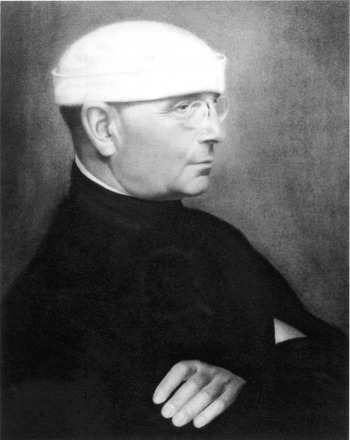
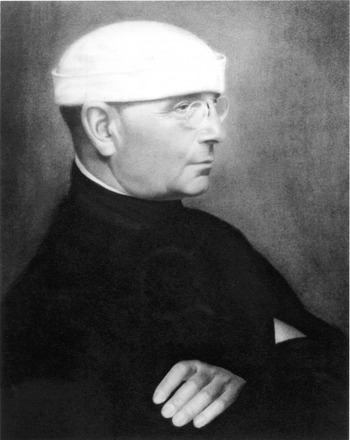
In 1906 Simon Flexner offered the French expatriate Alexis Carrel, then at the University of Chicago, a fellowship at the five-year-old Rockefeller Institute. Flexner was impressed by the stocky surgeon's audacious organ and limb transplants, which were made possible by the technique for suturing blood vessels for which he would win the Nobel Prize in Medicine and Physiology in 1912. In the more than three decades during which he directed the Division of Experimental Surgery at the Rockefeller Institute, Carrel maintained his surgeon's identity. He persisted in sporting his surgeon's cap and preached the need for precise technique (see Figure 1). His work during the First World War, however, was virtually the only surgery and experimentation he performed on humans. His innovative research was mostly in areas more recognizable as experimental biology or physiology: wound healing and tissue culture in the 1910s and 1920s; tissue culture and the microcinematography of living cells in the 1920s; tissue culture, organ culture, scientific popularization and social theory in the 1930s. It is useful, if simplistic, to imagine Carrel's professional focus expanding from a quest for control over cellular behaviour in the biological community of an organism to control over human behaviour in a civilized society.
During the war Carrel exchanged his surgeon's cap for a major's. Picture courtesy of the Rockefeller Archive Center.
Recent biographical sketches of Carrel in medical journals remember him as a visionary surgeon of consummate skill. These hagiographies tend to elide Carrel's alienation of the French medical establishment by his equivocal response after witnessing a miraculous cure at Lourdes and his collaboration with the Vichy government during the Second World War. Both of these episodes reveal important themes of Carrel's biography. His relationship with many French medical and scientific elites remained acrimonious. At a 1910 meeting of the Société de biologie in Paris, the French savants scoffed at Carrel's tissue cultures. The eminent biologist Justin Jolly asserted that Carrel had mistaken the process of dying for living.Footnote 12 Carrel's science was often based on a slippery experimental foundation. He believed that the true scientific spirit required credulity as much as scepticism; for example, it was unscientific to rule out the possibility of paranormal phenomena a priori. By the 1930s he had developed a fascistic, technocratic political ideology. His penchant for dramatic predictions and incredible experiments made Carrel a controversial scientific celebrity. His treatment for infected wounds made him a hero.
Carrel's investigations of cicatrization, or wound healing, began shortly after his move to the Rockefeller Institute. His goals were to ‘find the laws of the cicatrization of wounds’ and ‘perhaps … the methods for increasing its rate’.Footnote 13 In his first published article on the treatment of wounds Carrel revealed his ambition:
In the treatment of wounds, we content ourselves by protecting the tissues against infection, and we leave to Nature the care of cicatrization. Would it not be feasible to act on the processes of reparation themselves and to activate them? The wounds which now heal in a few days could possibly be caused to heal in a few hours.Footnote 14
Before the war, protecting tissues against infection was merely a trivial accomplishment for Carrel.
In fact, Carrel was convinced that wounds could be made to heal extraordinarily quickly. In a letter to Simon Flexner in 1909, he described witnessing such rapid healing:
I went to Lourdes, and after all kinds of troubles, I was allowed to observe a few patients. On a small ulceration, I saw the epithelisation occurring in a few minutes. This fact had never been exactly observed. I am more than pleased to have seen it. It demonstrates that my hypothesis of the possibility of an enormous activation of cicatrization of tissues is not a dream. Unfortunately I have not the faintest idea of the cause of the phenomenon.Footnote 15
Despite Lourdes's reputation for miraculous cures, it would be a mistake to presume that Carrel believed he had witnessed a miracle in the ordinary sense of the term. He was a more orthodox disciple of Claude Bernard, the father of experimental medicine, than of the Catholic Church. This meant that his responsibility as a scientist was to discover the physiochemical cause of the physiological phenomenon by learning to control it. From the very first months of his work on wound healing, Carrel experimented with applying various substances (e.g. blood, pus, pulverized thyroid gland) onto the surface of wounds to increase the rate of cicatrization.Footnote 16 Carrel believed that the growth of new tissue to repair and replace damaged and missing tissue ‘obeys the same general law’ as the regeneration of parts Spallanzani had discovered in the salamander's ability to re-grow amputated limbs.Footnote 17 If he could control the growth of new tissues in wound healing, perhaps he could grow new, healthy tissue to replace diseased organs. Discovering the conditions that stimulated cellular reproduction became his primary objective.
Thus when Ross Harrison announced his success in growing cultures of frog tissue cells in vitro in 1910, Carrel was anxious to learn the new technique. He quickly adapted the technique for mammalian cells and made it his primary experimental system. One of his innovations, which he termed ‘rejuvenation’, was regularly to wash the cells in a gentle antiseptic solution to eliminate bacteria and remove catabolic waste that poisoned the cell. Infection from bacteria was (and remains) a tissue culture's most common lethal threat. Sometimes infected cultures could be saved by excising the infected tissue and washing the remaining cultures in the antiseptic solution – an in vitro foreshadowing of the Carrel-Dakin method.
By 1911 Carrel had succeeded in keeping a culture of a portal vein alive for thirty-one days ‘outside of the body’. ‘These results’, he wrote, ‘demonstrate that rejuvenation of cultures of tissues is possible. They show also that, under the conditions and within the limits of the experiments, senility and death are not a necessary, but merely a contingent, phenomenon’.Footnote 18 Six months later the cultures of tissues were still thriving, and Carrel speculated that ‘these or … more perfect techniques … may lead to the solution of the problem of permanent life of tissues in vitro, and give important information on the characters acquired by tissues liberated from the control of the organism from which they were derived’. Footnote 19
The permanent life of cells growing in vitro had a special significance in contemporary physiology because cytology was not clearly differentiated from investigations into unicellular organisms.Footnote 20 As H. G. Wells and Julian Huxley explained it to the interested public twenty years later,
We may compare the body to a community, and the cells to the individuals of which this vast organized population is composed. It is very important to realize that this is not a merely allegorical comparison. It is a statement of proven fact, for – we resort here to the stress of italics – single cells can be isolated from the rest of the body, and kept alive.Footnote 21
According to E. B. Wilson's standard cytological textbook, ‘The more complex life of the higher plant or animal arises through the specialization of the cells, this way or that, for the better performance of particular functions; hence that “physiological division of labor” which, as in organized human society, leads to higher functional efficiency.’Footnote 22 Carrel's tissue culture experiments proved what cytologists since Rudolf Virchow had claimed: that the body was a sociological entity.Footnote 23
While the division of labour of the cells in metazoa led to higher functional efficiency, specialization was also considered the cause of death. In a series of articles titled ‘The biology of death’ in Scientific Monthly, Raymond Pearl, professor of biochemistry, vital statistics and biology at Johns Hopkins, attempted to articulate the scientific consensus on this phenomenon to the lay public. Death was ‘simply the price we pay for the privilege of enjoying those higher differentiations of structure and function’. It was ‘the differentiation and specialization of function of the mutually dependent aggregate of cells and tissues which constitutes the metazoan body which brings about death, and not any inherent or inevitable mortal process in the individual cells themselves’. If ‘in the view of the Church death is a consequence of sin’, then ‘what the theologian calls sin the biologist calls differentiation’.Footnote 24
For Carrel, differentiation caused death because each cell type required its own particular environment, but the internal milieu of the organism could only provide a sort of physiochemical compromise: good enough for each individual but ideal for none. Furthermore, he suspected that the internal milieu became polluted with some form of waste that the body did not excrete efficiently enough. By keeping a single strain of embryonic chick heart cells alive for long past the life expectancy of a chicken, Carrel proved that degeneration and death were not caused by any intracellular activity, but were a result of factors in the intercellular environment, or internal milieu, just as Bernard had emphasized.Footnote 25 The objective of the tissue culture experiments was to discover the ideal physiochemical environment for particular cells and to learn to manipulate this environment in order to control their behaviour. Tissue culture enabled the study of ‘cicatrization of wounds in vitro’.Footnote 26 This is what was meant by the liberation of tissues from the control of the organism. It was the isolation of cells from the complexity of the organism so that they could be studied and controlled. Released from the tyranny of the organism into the control of the scientist, life was liberated from death.
The Rockefeller Institute for Medical Research
Carrel's speculations regarding ‘permanent life’ were seized upon by the media. Even before the birth of Carrel's ‘immortal chicken heart’, Flexner felt it necessary to instruct a New York Times reporter that ‘Dr. Carrel's work has been sufficiently presented in popular literature in this country to satisfy all reasonable demands and interest concerning it, and I do not therefore approve of any further publication at present in the press of his work.’Footnote 27 Speculations that a fracture of the leg could be made to heal in a few days and hints of immortality made for sensational news. Carrel's popularity with journalists was problematic not just because their coverage was sensational, but also because he was at the centre of a passionate antivivisectionist movement that targeted the institute. The New York State Legislature repeatedly debated bills regulating vivisection, and the New York Herald tirelessly attacked the institute, particularly the Division of Experimental Surgery, for cruelty to animals. The antivivisectionists regaled all who would listen with ‘tales of torture’. They also worried about the ‘effect of the practice of vivisection on the surgeons who conduct the experiments’. ‘I sympathize with this agitation’, an antivivisectionist proclaimed at a rally, ‘not merely for the sake of the brutes whom it seeks to protect, but more for the sake of a profession I hold in honor, and most of all for myself and my fellow-humans, whom brutalized men are unfit to treat.’ Implicit in this comment was anxiety about the changing role and identity of physicians with the ascendance of scientific medicine.Footnote 28
The coverage in the New York Times of Carrel's work at the institute in the years before the war tended to frame it in terms of ‘marvels’ and ‘miracles’ that justified vivisection.Footnote 29 Advocates of experimental medicine pointed to the institute's accomplishments (such as Flexner's apparent discovery of a cure for cerebro-spinal meningitis) and promises (such as organ transplant and a cure for cancer). Antivivisectionists were ‘a small band of noisy and fanatical ignoramuses – and worse’ – who were ‘deliberately engaged in an attempt to distract and to impede the most brilliant and successful medical investigators now living in America’.Footnote 30
As the antivivisectionist controversy makes clear, managing the institute's public image required finesse. John D. Rockefeller endowed the institute with a strong financial foundation. His name, along with that of William H. Welch as president of the Scientific Board, assured that it would be recognized as a player of the rank of the institutes of Pasteur and Koch, on which it was modelled. Founded to support pure scientific research that would lead to practical, technical solutions to threats to public health, the institute quickly came to be imagined as a ‘temple of science’. Yet the association with Rockefeller's intimidating fortune, its power to shape American medicine, and moral unease at its methods could make the institute an object of suspicion.Footnote 31 Where a previous generation of economic elites had directed its philanthropy to volunteer hospitals for palliative treatment of the poor, Rockefeller channelled his wealth into scientific research. The institute was part of a new vision of philanthropy that sought not merely to fulfil a moral obligation to provide charity, but also to use efficient management practices and scientific research to solve social problems through public policies. Judith Sealander excludes the Rockefeller Institute from her incisive study of this movement because, unlike Rockefeller's foundations, it was not designed to reshape American social policy through engagement with the public sector.Footnote 32 This exclusion is unfortunate, however. The institute's prestige and productivity ensured that its esoteric experiments in microscopic nature played an important role in the shift to a narrower, more technical framing of effective public health policy that focused on individual illness and germs instead of environmental conditions.
To understand the institute's place in society, it is vital to acknowledge ‘how indistinct the line between state and society remained … how thin the apparatus of state management was, and how reliant it was on temporary and borrowed expertise’.Footnote 33 The institute can usefully be imagined as part of what in 1900 Everett Wheeler termed ‘the unofficial government of cities’: ‘private corporations, chartered by the legislature, but receiving no pecuniary aid from the state, … discharge a very considerable and important part of the functions which by charter are devolved upon [government] officials’.Footnote 34 Performing government functions on the private side of the porous border between the state and society allowed the Rockefellers to experiment with novel organizational forms and policies, as well as to bypass the messy politics of representative government.
Two other Rockefeller-supported institutions also functioned as a sort of unofficial municipal government in the years before the war. The Laboratory of Social Hygiene at the public Bedford Hills women's reformatory attempted to apply expert social and psychological knowledge to the assessment and treatment of inmates. The Bureau of Social Hygiene promoted a scientific solution to the public scourge of vice.Footnote 35 The Bureau of Municipal Research, which Rockefeller money partially underwrote, was staffed with experts who were charged with making government more efficient through oversight, policy proposals and public education. The bureau applied the principles of scientific management, borrowed from corporate managerial innovations, to the administration of municipal government.Footnote 36 Each of these institutions shared a common faith in science. Through scientific research and scientific management, the overwhelming complexity of five thousand factory workers, five million New Yorkers or over a thousand billion cells all working together could be analysed, understood and controlled.Footnote 37 Differentiation might be the modern world's original sin, but science provided the tools to manage the division of labour to obtain greater functional efficiency. Governments, prisons, hospitals and bodies, like corporations, could all be efficiently managed by empowered, scientifically enlightened experts.
While these institutions hoped to design technical solutions to social problems, this goal often proved elusive. One response to slow returns on research was to shift the mission to spreading the ‘scientific spirit’. This shift in strategy was adopted by the institute's hospital. The hospital was located on the institute's grounds but had its own laboratory facilities. From its beginning in 1910 the hospital was designed to incorporate laboratory research into hospital practice, which meant that the sick were both patients and experimental subjects. The hospital only accepted patients who suffered from diseases on which it was conducting research.Footnote 38 Discovering new effective treatments proved slow and difficult work. Thus, struggling to articulate the hospital's first-year accomplishments to the board, its director, Rufus Cole, wrote,
While the training of men has not been considered the fundamental purpose, and it must not be so considered, yet we ought not neglect this in counting up the results obtained, for the development of workers and the installation of the scientific spirit in a group of medical men may greatly increase the intangible but real influence of the hospital.Footnote 39
By 1914 this ‘installation of the scientific spirit’ in ‘medical men’ had become one of the hospital's principal functions. Cole put a positive spin on the loss of hospital staff to ‘full time academic positions’ by noting the influence these men would have on the transformation of ‘the teaching of internal medicine’. He continued,
In looking to the future development of the Hospital work, it is believed that, with the discovery of new methods which may be applied practically in the treatment of disease, definite organized efforts should be made by the Hospital, or by the Institute as a whole, to assist in putting these methods into more widespread and efficient operation.Footnote 40
In 1914 it was not clear that laboratory-based research scientists were the rightful leaders of the medical community. The hospital and the institute were not just research sites but also a strategic centre from which to direct the conversion of medical practice according to the gospel of the scientific spirit. The institute's vision of scientific medicine shifted authority to a new elite of university-trained experts. To administer their authority effectively, elite medical researchers had to standardize both illness and remedy, both patients and physicians' practices. They also had to persuade surgeons to trust in their brand of scientific medicine. The mobilization for the world war provided an opportunity to prove the institute's value and test its evangelical potential.
Hôpital complémentaire 21 and the Carrel-Dakin method
While wound infection was by no means the only health threat, in the early months of the war it was perceived as a medical catastrophe. During the war 240,000 British soldiers suffered partial or total limb amputation. Surgeons in the early years reported that between seventy and eighty per cent of amputations were the result of infection.Footnote 41 The amputees returned home, where they provided graphic evidence of the violence on the front and of medicine's at least partial failure.Footnote 42 These infections were particularly galling because the surgical revolution in the late nineteenth century from which orthodox medicine derived much of its heightened status was based on the elimination of infection during surgery through aseptic techniques. At first many surgeons took a passive approach to the treatment of wounds, believing it best to leave the body to heal itself.Footnote 43 But mortality from infection, particularly gas gangrene, quickly sent physicians scrambling to discover an effective intervention. Numerous methods were touted in the medical literature, such as continuous oxygenation of wounds to destroy anaerobic bacteria, open-air hospitals (recalling an earlier era's concern with miasma), ‘natural autogenous vaccine treatment’ involving the sucking of wounds and chewing of pus-saturated bandages to evoke an immune response, and mechanical stimulation by use of ‘vibrations, nerve frictions, and petrissage (dry massage)’ to promote blood and lymph circulation.Footnote 44
By the second year of the war the debate had distilled into a contest between the physiological, anti-antiseptic surgeons and the pro-antiseptic surgeons. Both sides were championed by prominent medical authorities. In Britain, the leader of the physiological school was the combative Sir Almroth Wright, known for developing an anti-typhoid inoculation, whose hypertonic salt treatment (in which wounds were packed with salt to draw out fresh lymph to assist the body's natural defences) enjoyed a brief period of ascendancy. The antiseptic school was represented among many others by Sir Watson Cheyne, president of the Royal College of Surgeons. These two knights of surgery battled in the British medical journals and in the process defined the terms in which the conflict would be fought.Footnote 45 Both Wright and Cheyne resorted to personal attacks.Footnote 46 Both invoked the support of esteemed colleagues and heroic founders (particularly Lister) and both presented case studies, personal experience and scientific theory in support of their arguments. In this frank debate Cheyne discredited French trials that had found antiseptics ineffective because the surgeons had not believed in the method and ‘the surgeon must believe that such disinfection is possible’ in order to discover that it is.Footnote 47 In the end, however, Wright summed up the failures of these strategies to evince conclusive proof:
It may well be seen that we have here only adverbial and adjectival quantitative expressions and nothing in the form of figures. And while it is, of course, in scientific as well as general discourse legitimate to substitute for numerals, adverbs and adjectives, the point is that if we have not behind these a definite backing of figures, we are not talking the language of science.Footnote 48
These two medical advocates described a scientific community in which truth was established through a combative political campaign. Yet the most effective rhetoric in which to wage the battle was the least inflammatory: numbers were the ‘language of science’. Neither Cheyne nor Wright produced the ‘definite backing of figures’.
One advocate for the hypertonic salt treatment attempted to generate some convincing numerals through a survey of surgeons (his subordinates) at the front.Footnote 49 More persuasive data were the case studies produced in 1916 by two surgeons who developed antiseptic treatments. Rutherford Morison described in detail ten cases treated with his antiseptic paste BIPP. Morison pleaded for the reader's trust: ‘the following cases have been selected as examples of our methods and results, and visitors to the Northumberland War Hospital can support my statement that they are not chosen as exceptional’.Footnote 50 The other study was designed to prove the efficacy of carbolic acid (Lister's preferred antiseptic). It controlled for the problem of selecting representative cases by including all cases of a particular type (fractures of the femur), and even claimed a control group of patients who received only the hypertonic salt treatment or some other method.Footnote 51 In these studies, however, the number of patients was fairly small. More importantly, each patient was presented as a unique case: age, rank, medical history, general condition and description of the wound were provided. The number and relative importance of variables affecting healing depended upon the specific case. The chaotic complexity and individuality of each wound was apparent. Surgical skill and judgement were an essential aspect of both methods.
This is a very rough sketch of the epistemological terrain on which Carrel attempted to construct an effective standard method for the treatment of infected wounds. Carrel, of course, was already an expert on wound healing. It took him only a year to devise the Carrel-Dakin method while working at Hôpital complémentaire 21 in the converted Rond Royal Hotel in Compiègne. Deft administration of the laboratory hospital allowed Carrel not only to control infection, but also to quantify his control in order to present evidence of the method's efficacy in the scientific language of numbers. The experimental hospital was modelled on the Rockefeller Institute Hospital. The hundred-bed hospital was designed to provide the facilities and freedom necessary for experimental research: ‘My scheme is to become completely independent from the French bureaucrats, although there is a host of them. A laboratory can be organized, and grafted on a surgical hospital.’Footnote 52 The Rockefeller Foundation paid the operating costs of the hospital (roughly $20,000 annually) through the institute. Carrel's reports to the Board of Scientific Directors of the institute were soon bound with the other divisions' reports. Carrel and his associates published their research in a series of articles titled ‘The cicatrization of wounds’ in the institute's Journal of Experimental Medicine. Although on the other side of the Atlantic and within range of hostile fire, the experimental hospital was buttressed by the institutional strength of the Rockefeller Institute. This buttressing was only metaphorical: in March 1918 Hôpital 21 was destroyed by German shelling. The work in Compiègne was heroic science in a way the work in Manhattan never was.
Like the institute's hospital, Hôpital complémentaire 21 contained its own laboratories and only accepted patients useful for experimental research. During heavy fighting this meant that the hospital was not overwhelmed with suffering soldiers, but instead could be especially selective in accepting cases. For example, in an article quantitatively establishing the inefficacy of the hypertonic treatment, Carrel used the ultimate control: ‘two wounds in the thigh, of about equal dimension, a small distance apart’.Footnote 53 The relative independence, strategic location and experimental mission of the hospital allowed Carrel to ‘use as well as possible the splendid clinical material given to us by the war’.Footnote 54 When the front was quiet, however, research was difficult. As Carrel noted in autumn 1915,
Thus, another complication occurred. That is, the lack of wounded – the front, near Compiègne, is very quiet, at present. The result is that, with the help of the bad will of the doctors, we received an insufficient number of wounded … Nevertheless, I started again to work scientifically a few weeks ago. I am studying the physicochemical conditions which promote the repair of wound, that is very much the same kind of work that I was doing at the Institute.Footnote 55
Although the French government had initially provided him with doctors, Carrel ‘found … that French Doctors are not able to do any efficient research work’ because the
scientific training they receive in the Medical Schools is insufficient. Moreover they are too conceited to learn the modern techniques. Therefore, I dismissed the Doctors who were working bacteriology and we are progressing more rapidly without them. The work is done by people who have no diploma, but who have open minds.Footnote 56
As Cheyne had argued, scientists could not prove what they did not believe in. Carrel needed assistants who believed in him. Carrel wrote to Flexner, ‘There is no chance of our method being extensively used in France on account of the antagonism of the Official Scientific Societies.’Footnote 57 He blamed the failure of the French fully to endorse his method on French ‘incompetence, vanity, and jealousy’.Footnote 58 Henry James, the Rockefeller Institute business manager during the first years of the war, wished Carrel was more politic: ‘[Carrel] may be right in his condemnation of the French organization and the attitude of the French doctors toward his work but I wish he would not utter his sentiments as freely as he probably does.’Footnote 59 The mutual distrust and antipathy of Carrel and the French medical establishment contrasted with his high status and institutional support in America. In terms of practical success, this was a critical difference because the French Army suffered so many more casualties that could have been treated according to the Carrel-Dakin method.Footnote 60
In the end, Carrel was able to staff the hospital laboratories with loyal and qualified specialists, including several scientists sent to Compiègne by the Rockefeller Institute, and Miss Lilly, his head nurse from the Division of Experimental Surgery. The staff included bacteriologists, chemists, physiologists, surgeons, instrument-makers, a team of female nurses and even a physicist–mathematician. There were also the necessary cooks, drivers and cleaners. With the aid of his wife Anne, Carrell ruled over all these workers as hospital administrator. He found the job exhausting, but Henry James compared his position favourably to Flexner's:
[Flexner] does not have any military power but he sometimes comes near exercising it and that is how he preserves himself. You ought to be congratulated on having that power. If I could only put a cook in jail when the cook gets drunk [as Carrel had] I should be considerably relieved.Footnote 61
The practice of experimental medicine changed surprisingly little when it moved to the Western Front. The laboratory was already a highly differentiated, hierarchical organization that the director commanded, though without the power to court-martial.
The most famous of the scientists sent to Compiègne by the institute was Henry Dakin. At Carrel's request Dakin, a prominent British chemist, tested over two hundred substances for their germicidal power and irritating or toxic side effects.Footnote 62 The result of these tests was Dakin's solution, a weak hypochlorite of soda (bleach) buffered with boric acid, which earned him second billing as inventor of the Carrel-Dakin method. But the Carrel-Dakin method was much more than a new and improved antiseptic; indeed, many surgeons used Dakin's solution but ignored the technique, and Carrel and his chemists continued to search for better antiseptics. Not surprisingly, the British medical literature always referred to the Carrel-Dakin method, whereas Americans commonly wrote of the Carrel method. The Carrel-Dakin method was essentially worked out by May 1915. It was a four-part procedure: one, thorough debridement of the wound and haemostasis (staunching of bleeding); two, continuous or intermittent irrigation with a mild antiseptic (Dakin's solution); three, bacteriological examination of smears taken from the wound and examined under a microscope; four, closure of the wound through strapping or suture once bacteriological examination pronounced it surgically aseptic. In essence, the method was an in vivo version of the ‘rejuvenation’ technique perfected in tissue culture. Carrel did not feed the wounds, but he did experiment with numerous chemical and biological substances to accelerate cicatrization. To his great disappointment, none worked.
Carrel and his advocates repeatedly stressed that
the application of these principles constitutes a ‘method’, that is to say, an entity, no portion of which should be altered at random. The deplorable results obtained in several hospitals by surgeons who believed they were using our methods, but who, in reality, were altering them according to their fancy, make clear the necessity for observing exactly the directions.Footnote 63
The method was proven to work. So failure to prevent or cure infected wounds indicated a failure exactly to adhere to the method.
Debridement was the most important step. Carrel advocated radical mechanical cleansing, in which, according to one surgeon, ‘the wound is laid open like a book’.Footnote 64 Essentially, debridement meant removing all foreign objects, bone fragments and necrotic tissue and excising the first two millimetres of the wound's surface. In a sense, radical debridement was highly conservative amputation. Both techniques removed infection by removing infected tissue. Debridement, however, was not unique to the Carrel-Dakin method. By 1916 debridement was in general practice on the Western Front.Footnote 65 In his address at the ‘War Session’, Moynihan stated that the ‘one certain thing is that if you get your patient early, if you operate ruthlessly, taking away all dead and contaminated tissues, you will find that you can get an early and a perfect healing of that wound by first intention.’Footnote 66 Because Moynihan did not endorse the Carrel-Dakin method at the conference, Carrel wrote to Flexner that Moynihan had ‘taught to the American surgeons last year many big errors which have caused the death of many men’.Footnote 67 Steps two and three gave the method a claim to originality and special efficacy.
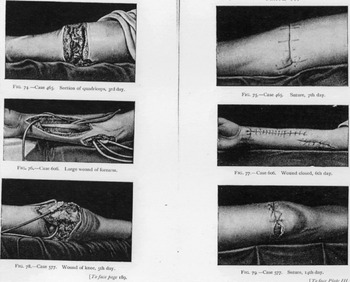
Step two, chemical cleansing, used rubber tubes to carry Dakin's solution to every surface in the wound. Nurses checked to make sure the flow of antiseptic was reliable and the patient as comfortable as possible. In drawings and photographs of patients receiving the treatment, the tubes look like curious worms exploring the nooks and crannies of the wound (Figure 2). Irrigation with Dakin's solution lasted until bacteriological investigation (step three) demonstrated that the wound was ‘surgically aseptic’, which could take from a few days to several weeks or even months. Clinical asepsis did not mean complete sterility, but that microscopic investigation revealed only one microbe in five or six fields of a slide for a few consecutive days. The number of microbes observed through bacteriological examination was expressed graphically on each patient's chart. The surgeon then returned to close the wound (step four) and the Carrel-Dakin method was complete.
Carrel tubes carrying Dakin's solution into the wound are shown in the bottom two plates of the left column. Note also the clean lines of the wound, evidence of mechanical cleansing. The wounds in the right-hand column have been shown to be clinically aseptic by bacteriological examination and therefore closed. From Alexis Carrel and George Dehelly, The Treatment of Infected Wounds, New York, 1917.

Rosemary Stevens has described the ‘fundamental characteristics’ of ‘the formal ideology of scientific medicine’ in this period as ‘technological efficiency, impersonality of treatment, regimentation of patients, dependence on diagnostic tests, importance of records, and focus on immediate results’.Footnote 68 By this accounting, the Carrel-Dakin method was the apotheosis of scientific medicine. The patient was visibly incorporated into a technological system through the Carrel tubes, and each patient underwent the same concatenation of procedures. Personal observation and judgement were suppressed because ‘clinical observation … yields no certainty’; instead, infection was diagnosed through laboratory tests.Footnote 69 Medical records, complete with a graphically expressed quantitative description of the patient, were essential to the method. There was a division of labour intrinsic in the method: ideally, surgeons performed steps one and four, chemists prepared Dakin's solution which nurses administered, and bacteriologists performed laboratory examinations. This division ensured that the method manifested the specialized, corporate vision of scientific medicine favoured by elite researchers.
Carrel was explicit about the reason for such a regimented, standardized system: success in the treatment of infected wounds ‘may be due partly to the skill of our surgeons and nurses. I want to be sure that the treatment in an ordinary hospital is efficient. A surgical method is practical only when it can succeed in the hands of unskilled and ignorant doctors.’Footnote 70 After he saw photographs of the method, Theodore Roosevelt wrote to Carrel,
If accepted in the army your new method of treatment will not only conserve life and limb, – which from the economic and military standpoint is of vital importance – but will also alleviate most of the pain and suffering of the wounded. I wish it were possible to standardize this method of treatment so as to give the wounded the best that science affords.Footnote 71
In the logic of the ‘gospel of efficiency’, standardization of surgery was the means by which science perfected the art of saving.
Calculating the normal wound
The key to both standardizing the method and proving its efficacy was Carrel's ability to isolate the wound from the complexity of the whole patient through quantification. Where other researchers offered case studies, surveys of surgeons or logical argument, Carrel provided controlled experiments, graphs and equations. This was the analytical and rhetorical power of laboratory-based experimental medicine, but it would not have been possible without the work of Pierre Lecomte du Nouy, a young French officer with a modest engineering background, considerable mechanical genius and a training in physics and mathematics. In order to speak the language of science, Carrel did the logical thing: he hired a mathematician. The first problem that du Nouy solved was the difficulty of accurately measuring a wound. Back at the Rockefeller Institute Carrel and his technicians had cut rectangular wounds on experimental animals that were easy to measure, but the bullets and shells of trench warfare produced irregular wounds that resisted precise quantification (although Carrel often selected ‘wounds of a regular shape’ for his experiments).Footnote 72 Du Nouy ‘suggested employing the planimeter, an instrument well known to engineers, which enables one to evaluate, in a few minutes, with precision, the area of any surface in square centimeters’. Before the introduction of the planimeter, the area of war wounds had been measured by tracing the outline of the wound onto cellophane, transferring this outline onto paper, cutting out ‘as exactly as possible’ the tracing, weighing the paper and finally calculating the surface area based on the known weight of the paper. This was a time-consuming and error-prone process.Footnote 73 The surveyor's tool brought the engineer's mechanical precision to the problem of wound measurement. The perimeter of the wound still had to be traced and transferred to paper. It should not be forgotten, though it was usually elided at the time, that the wounds were three-dimensional.Footnote 74 But the process was much quicker, more accurate and probably more trustworthy because of the association with engineering.
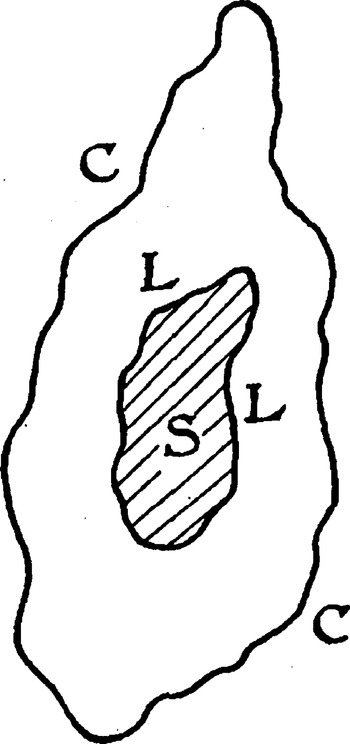
A popular planimeter of this period, the Prytz planimeter, was often referred to as the hatchet planimeter because it employed a blade to trace an area's outline.Footnote 75 Whether or not this was the planimeter used in Compiègne, the image of the planimeter as a knife excising the wound from the body in order to study it in isolation is appropriate. Carrel and his associates' articles on wound healing featured precise drawings of wounds, but these were often only a simple outline. The injured soldier was literally effaced, his body represented as a blank page (Figure 3). In the case studies Carrel published, the description of the patient was replaced by two numbers: ‘Patient 221, age 27 years’. The description of the wound is reduced to ‘old wound of the left foot; aseptic’, a table of measurements and a graphic representation of the ‘curve of cicatrization’.Footnote 76 Usually these descriptions included a chart enumerating the microbes found in the wound during the course of treatment. Carrel's strategy was to limit the problem of healing to three variables: age of patient, size of wound and number of bacteria. Carrel used the experimental laboratory hospital to isolate the wound as the vital unit. Before the war he had studied cicatrization in vitro through tissue culture. The exigencies of war forced him to devise an in situ method that provided the benefits of in vitro work.
Wound traced from a soldier's body. This image and many others like it reverse the cliché that a picture is worth a thousand words; they are remarkable for how much information they exclude. Reproduced from the Journal of Experimental Medicine (1917), 26, 279–95. Copyright 1917 The Rockefeller University Press.

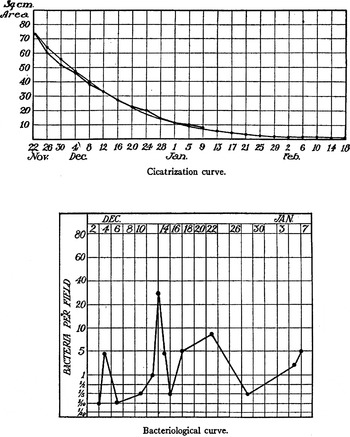
The curve of cicatrization was obtained by measuring the area of the wound every couple of days and graphically plotting the healing process (Figure 4). These graphs led to du Nouy's second major contribution to the study of wound healing and assured him a scientific career. He devised an equation to express the average curve of cicatrization algebraically, which became known as the du Nouy formula. By inserting the variables of the size of the wound and the age of the patient, the du Nouy formula allowed the surgeon to generate a normal curve of healing that the wound should match: ‘marked deviation from the calculated curve showed generally that infection had set in’. The utility of this formula was clear:
By means of the equation, a curve is obtained which represents the theoretical evolution of the cicatrization of a wound. This curve, being an expression of what should happen on a normal wound, healing aseptically, on a normal man, is a daily point of comparison to what appears actually on the observed wound, and allows one to study accurately the fluctuations of cicatrization on a given individual, and the action of different dressings and antiseptic substances.Footnote 77
The du Nouy formula was the mathematical representation of the laws of cicatrization that Carrel had first sought at the Rockefeller Institute in the winter of 1906. As Ian Hacking quipped in a different context, natural laws were ‘any equations with some constant numbers in them’.Footnote 78
The top graph shows a calculated curve of cicatrization and an observed curve. The bottom is a ‘bacteriological curve’ that shows the number of microbes per field. This case was part of an experiment to test the effect of saline solution on healing, but similar charts would have been a part of a patient's medical record. Reproduced from the Journal of Experimental Medicine (1918), 27, 165–78. Copyright 1918 The Rockefeller University Press.

The perceived power of the du Nouy formula was remarkable. For example, Dr Tuffier, a close ally of Carrel, described a phenomenon experienced by many Carrel-Dakin enthusiasts: ‘If a wound previously sterile becomes accidentally infected and then becomes sterile again, the observed curve which separated from the calculated curve often rejoins it rapidly, and cicatrization is complete within a few days of the time predicted.’Footnote 79 The normal curve functioned more like a normative law than an average. The wound seemed to strive to match the mathematically predicted rate of healing. It is impossible to know how the wounds could have been such obedient followers of du Nouy's algebra, but a letter from Carrel's assistant Carl Ebeling provides a clue. A few years after the war Ebeling used the du Nouy formula as a control in a study using wound healing to measure age, but at first the calculated curve did not match the observed curve. On second examination, however, Ebeling was able to reconcile the discrepancy:
I am enclosing a second series of curves which are the correct ones for the experiments which I have already sent you. I found, on going over the tracings carefully and checking up the measurements, that there were some mistakes, and that the averages which were reported in the first series of curves were not correct. I think you will find that these are more in agreement with what you expected.Footnote 80
Despite the mechanical objectivity provided by the planimeter, beneath each objective measurement lurked a human trace.
The du Nouy formula was a potent research tool because it provided an omnipresent experimental control: the normal curve of the normal wound. But it had two other effects that were at least as significant. First, the du Nouy formula was the ultimate tool for the scientific management of medical practice. The formula allowed the exact prediction of the date at which a given wound should be healed. Marked deviation from the normal curve indicated infection, which meant that the medical staff had erred in the application of the Carrel-Dakin method. The Carrel-Dakin method and the du Nouy formula were designed to control both the healing of wounds and the practice of physicians. This disciplinary objective was explicitly stated by a sign prominently displayed in each ward of Dr Tuffier's hospital: ‘Any one whose wound suppurates has the right to demand of his surgeon the reason why.’ It may have been intended to assure quality of care, but for surgeons and journalists alike this unequivocal guarantee was often the most compelling evidence of the method's efficacy.Footnote 81
Second, it established as fact that the rate of healing decreased regularly as organisms aged: a wound on a normal ten-year-old child healed four times faster than on a man of fifty.Footnote 82 The healing of wounds, therefore, could be presented as an accurate measurement of the physiological age of individuals: ‘After the size of the wound and the constant of cicatrization have been experimentally determined, the age of the patient is easily found.’ An individual's biological age might not match his or her chronological age: ‘Thus, it became possible to ascertain whether an individual is older or younger than his age.’Footnote 83 The measurement of physiological time did not have the profound repercussions of the measurement of intellectual age (IQ), a unit which also benefited from war work, but it is an example of how age norms were largely constructed and quantified during the first quarter of the twentieth century.Footnote 84
From the curve of cicatrization, it followed that if wounds were made to heal more quickly, the patient had been rejuvenated. Increasing the rate of healing, not merely controlling infection, was always Carrel's ambition. As Thomas Cole has argued, rejuvenation research during this period, of which Carrel's work is only one chapter, offered a technical solution to the problem of senility in industrial capitalism, which valued individual self-reliance and productivity. As the social bonds that supported family members in old age eroded in the acids of modernity, techniques that promised to alleviate the dependency of the elderly by targeting the individual body rather than altering the social system were appealing.Footnote 85 Perhaps it is appropriate that the biological age norm for the modern individual was derived from wounded soldiers in the Great War.
There certainly was a real need to establish a standard of care for the millions of wounded soldiers on the Western Front who were operated upon by thousands of surgeons, few of whom had experience with gas gangrene, war wounds or even much civilian surgery. But it is also worth recalling what was excluded from the triumvirate of variables (size of wound, age of patient, number of microbes) acknowledged to affect healing: all of those details that made case studies convincing descriptions of real wounds on real bodies. The complex, highly differentiated organism constructed of a thousand billion individual vital units was replaced by a simplified homogeneous organism during the war. The normal wound on the normal man existed only as a mathematical abstraction, a thin description of the individuals who occupied the beds in Hôpital 21 but who did not exist as individuals in the experiments performed on them. This was the standardized method's rhetorical strength but also its practical irrelevance. War surgeons had to operate on complicated individuals under stressful conditions that were largely outside of their control.
Although Carrel's work was portrayed as a miracle of science it also can be seen as a realization of the fears of antivivisectionists. The Great War enabled Carrel to report success in ‘experiments … made on eight wounds on patients of different ages, on a wound made on a guinea pig, and on two wounds made on cats’.Footnote 86 There was nothing particularly unethical about these experiments, but there was a brutal element in the transformation of wounded men into ‘splendid clinical material’. The mentality that made this manoeuvre possible was as much the logic of experimental medicine and industrial capitalism as the logic of war.
The War Demonstration Hospital
The American media faithfully followed Carrel's work. Consider four examples from four years of the war. In August 1915 the New York Times declared, ‘Drs. Carrel and Dakin Find New Antiseptic: Remedy Tested in French Hospital Said to Make Infection Impossible’.Footnote 87 In 1916 the New York City Tribune published a report submitted by a representative of the American Fund for French Wounded, who had visited Compiègne, under the headline ‘Dr. Carrel Uses Algebra to Heal: Reduces Wounds to Mathematical Equations in France’.Footnote 88 In 1917 H. L. Mencken wrote a laudatory feature extolling the method as an example of the practical miracles produced by science and common sense:
Carrel and Dakin, working in their little hospital in Compiègne, had actually accomplished the miracle [antiseptic sterilization]. I use the word ‘miracle’ only rhetorically: as a matter of fact, what they did was as simple almost as rolling off a log … In the old days the surgeons would perform a hurried amputation in order to save the patient; now they put their little tubes into his wound and let the hypochlorite trickle for a week or two and then simply sew him up and put him back to bed.Footnote 89
A 1918 article in Harper's began by quoting Dr Tuffier's famous sign banning pus from his hospital wards. This ‘victory over disease’, the article continued,
won in the first place within the sound of hostile cannon, is bound to prove a lasting boon to suffering humanity at large. This achievement is primarily the consequence of the brilliant work of Dr. Alexis Carrel, who, in the face of professional antagonism of a marked character, had the courage to attack what the great majority of his confrères declared a lost battle.Footnote 90
Carrel was portrayed as a medical ace. His method was as important for boosting public morale in the face of the horrors of trench warfare as it was for saving lives. It is impossible to assess precisely either the influence of popular media on public perception or public opinion's influence on scientific and medical knowledge. There is no doubt, however, that medical care of wounded soldiers who would not return quickly to the battlefield was not a direct military objective.Footnote 91 It may have been necessary for the war effort to secure the support of citizens and the willingness of soldiers to fight. There were also long-term economic incentives to provide life- and limb-saving medical care; surgeons certainly were determined to save lives. The popular image of the Carrel-Dakin method as a miracle cure enhanced its utility to a nation requiring the sacrifice of individuals to wage war.
Carrel's method not only was popular in the media, it also had many advocates in industrial surgery. The initial realization that the method could have industrial applications was Carrel's. Early in the war he wrote from France to the institute for help in recruiting industrial surgeons. James, the institute's business manager, soon wrote to him that he had ‘got Mr. Rockefeller moving on the subject of industrial accident surgery and we hope that the result may be that the Head of the Colorado Fule [sic] and Iron Company's medical service may make a visit to the other side’.Footnote 92 This trip was one of several by industrial surgeons to the Western Front. The pilgrims passionately embraced the Carrel-Dakin method.
William O'Neil Sherman, Chief Surgeon of the Carnegie Steel Corporation, was a leading Carrel-Dakin zealot. Sherman had seen the method performed on the Western Front by Dr Pedro Chutro, a Brazilian surgeon who had made his name by applying Fredrick Taylor's theories of scientific management to surgery.Footnote 93 It was Sherman who had interested Roosevelt in the method. In a 1917 JAMA article, he wrote that it ‘would be conservative to say that at least 150,000 lives and 75,000 amputations, with hundreds of thousands of cripples could have been prevented had Carrel's method been made obligatory in the allied armies.’Footnote 94 Three months before this article was published, he had already written to the Surgeon General to advise that the ‘treatment should be made compulsory throughout the service, not only from a humanitarian standpoint but from an economic standpoint’. The logic was clear: ‘If we are to standardize hospital equipment, why not standardize surgical technique and practice?’Footnote 95 In industrial surgery, Carrel found an influential corps of allies who shared his belief in the desirability of standardizing medical practice. The problem of coordinating and controlling an economic empire shared many of the challenges of conducting a world war. Techniques of efficient production and destruction were transferred easily between the military and industry because elites knew each other, struggled to control massive hierarchical bureaucracies and shared a conception of the proper relationship between the generic individual and the organization.
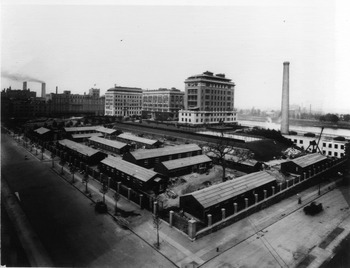
The month before Sherman wrote to the Surgeon General, the New York Times had already announced ‘Dr. Carrel Coming for War Work Here: Will Be in Charge of Military Hospital to be Erected by Rockefeller Institute: His Methods to be Taught: Treatment of Wounds Devised by Him and Dr. Dakin Is Now Famous In Europe.’Footnote 96 In March 1917 Flexner formally proposed that the institute build a hundred-bed War Demonstration Hospital on its grounds in Manhattan and the board resolved to allot $200,000 for its construction and operation.Footnote 97 The War Demonstration Hospital would teach the method and ‘demonstrate and test out the feasibility of a unit portable military hospital complete in every respect, modeled after the base hospitals’.Footnote 98 The full-scale model mobile war hospital was built of interchangeable units that could be disassembled and reassembled quickly in order to move it (Figure 5).
The War Demonstration Hospital at 65th Street and Avenue A in Manhattan. Courtesy of the Rockefeller Center Archive.

The hospital officially opened on 12 August 1917 with a demonstration of the method for Surgeon General William C. Gorgas and other notables. It accepted civilian patients with festering infections until it was formally designated Army Auxiliary Hospital No. 1 in August 1918. It received the first soldier with infected wounds on the 31st of that month. The Medical Department of the Army sent surgeons to the War Demonstration Hospital for a two-week course, after which they were usually detailed to one of fifty Army base hospitals spread throughout the country. The War Demonstration Hospital now functioned as an officially sanctioned, privately funded component of the US military: an official institution of the ‘unofficial government’, only now the federal government, not a municipal one.Footnote 99
During the mobilization campaign, in addition to instruction the hospital also tested new applications and variations of the Carrel-Dakin method. Surgeons expressed cautious confidence that the method would prove an effective treatment for syphilitic and tubercular ulcers, as well as pneumonia. Although the hospital's activities were largely curtailed during the influenza epidemic, it did unsuccessfully attempt to apply antiseptic treatment to flu victims. However, the hospital could not demonstrate the Carrel-Dakin method on gas gangrene or the other infections of the Western Front: of 357 patients treated during the life of the hospital, only three were reported infected with gas bacillus.Footnote 100 The lack of gangrene cases is to be expected because the disease was rare in civilian life. Since no effective treatment existed for a spreading infection, infected soldiers would be dead long before they could cross the Atlantic.
In all, the hospital taught forty-one surgical, six chemical and three laboratory classes. 1,016 medical officers and enlisted men received instruction as did fifty-six civilians and twenty-seven female nurses. But the influence of the hospital far exceeded these numbers. When graduates reported to the base hospitals they were expected to teach other surgeons the method and to report back to the director of the War Demonstration Hospital any resistance to the method. After Carrel returned to France to continue his experimental work, Major George Stewart took over as director of the hospital. Stewart was an energetic evangelist for scientific medicine in general and the Carrel-Dakin method in particular. He must have been gratified with the many letters like this one from Camp MacArthur in Waco, Texas: ‘Major Howard, who was in the same class as I was, is our Chief Operating Surgeon and between us our ambition is to put the hospital here absolutely on the Carrel Dakin technique.’Footnote 101 The Carrel-Dakin method may have been designed to standardize the work of ‘ignorant and unskilled’ physicians, but it gave those who mastered its techniques a sense of heightened status.
A letter to Stewart from Camp Sevier in South Carolina gives a sense of the zeal of Carrel-Dakin disciples:
On my arrival one of the officers who was endeavoring to be of service to me in many kindly ways slipt me the tip that [I] would do well to pass over the fact that I was a Carrel-Dakin enthusiast. I kept quiet and looked around a bit and kept my ears open. I found that whereas the powers that be here are not violently opposed to the treatment they are not for it. The reason was of course not far to seek. They are as ignorant of what ‘Carrel-Dakin’ means as a babe unborn. Dakin has been applied in some of their cases but with out a proper idea of its proper application. They also had the misfortune of having some chap here a few months ago who was enthusiastic but unfortunately did not know much if any surgery and made a rather bad mess of one or two cases that he was going to use to show startling results with.Footnote 102
Many graduates of the two-week course wrote to Stewart to report problems with high-ranking sceptics. To one of these, a Lieutenant Lear at Camp Mead, Stewart replied,
I will take up the matters you refer to with the Surgeon General personally and feel sure that we will be able to straighten things out. I wish all the men who have had the same difficulty that you have had would write in about it and give us more data to present to the Surgeon General. Don't give up the ship, but stick to your principles as taught here.Footnote 103
In at least two reports to the board Stewart suggested that he had indeed straightened things out at several bases. The War Demonstration Hospital provided a centre from which to control the practices of surgeons dispersed throughout the military. It also served as a base from which to attempt to control the coverage of the Carrel-Dakin method in the medical literature. For example, when the JAMA published an open letter to William Welch from Arthur Dean Bevan attacking the ‘very exaggerated claims’ for the method which had ‘gotten into our medical journals and even into the lay press’, and asking Welch to put a stop to the madness, Stewart was understandably concerned.Footnote 104 Bevan was the influential chairman of the American Medical Association's Council of Medical Education. Stewart was relieved when Starr Murphy, one of Rockefeller's lawyers and closest advisers, assured him that a suitable response had been coordinated in the form of two letters to the JAMA from prominent physicians: ‘Evidently Dr. Bevan did not know what he was doing when he pulled the chain of the shower bath. I am glad he is getting a ducking.’Footnote 105
As a proponent of scientific medicine and the standardization of medical education, it might be expected that Bevan would have supported the Carrel-Dakin method. Resistance to the method is also evident in many of the letters graduates sent back to the War Demonstration Hospital. There are several interconnected explanations for this resistance. As the debate over the treatment of infected wounds in the war's first years makes clear, there was pointed dissent over the power of antiseptics to cure infection. Vaccination was the state-of-the-art method, its reputation enhanced during the war by the performance of antitetanus serum. Indeed, members of the Rockefeller Institute and researchers throughout the world sought in vain for an anti-gangrene serum throughout the war. Antiseptics were an outdated miracle cure.
Critics who pointed to the exaggerated claims of antiseptics' power identified a crucial weakness of the Carrel-Dakin method: it could not stop a spreading infection in which bacteria were no longer confined to the wounds' surface regions. According to the War Department's official history, American soldiers serving in France suffered 128,265 wounds to the soft parts, with 9,719 deaths. Gangrene was only responsible for one per cent of these deaths, but the death rate of soldiers whose wounds were gangrenous was 48.52 per cent, even higher when associated with fractures.Footnote 106 ‘The very exaggerated claims’ made for the method threatened the legitimacy of scientific medicine. Sensational reports and impossible promises recalled the advertising techniques of patent medicines against which physicians defined themselves.
By far the most significant factor determining whether wounds were infected was the length of time between receiving the wound and operation.Footnote 107 This strongly suggests that improvements in the death rate of soldiers from infected wounds were due primarily to the recognition that ‘debridement of all contaminated wounds … at the earliest possible moment, is unquestionably the most efficient means of forestalling the development of gas gangrene’. Improved evacuation processes more than the installation of Carrel tubes dripping Dakin's solution saved lives and limbs. In discussing gas gangrene, the official medical history of the war does not even mention the method.Footnote 108 Now the first step of the Carrel-Dakin method was debridement and Carrel pushed to locate base hospitals close to the front lines to expedite early intervention and continuity of care. The destruction of Hôpital 21 represented just one reason this was not done. By the time America was mobilizing for the war, few surgeons would have objected to the fundamental tenets of the method but many deemed it impractical. Several American surgeons who had served on the Western Front, for example, joined Sir Berkeley Moynihan at the Clinical Congress of Surgeons' ‘War Session’ in insisting that ‘the moment one is confronted with the problems presented in the front area, it is absolutely impossible to carry out any complicated technic’.Footnote 109 The Carrel-Dakin method required the controlled conditions of the laboratory hospital in Compiègne or the War Demonstration Hospital in Manhattan.
Yet this reality does not adequately explain the urgency of Bevan's open letter, nor the hostility of surgeons at base hospitals to the method, which worked at least as well as any alternative ‘method’. Two related qualities of the standardized method explain the intensity of resistance: its explicit requirement that practitioners be organized into group practice subject to efficient administration, and its devaluation of the skills of individual surgeons.
The division of labour inherent in the Carrel-Dakin method was a manifestation of a vision of scientific medicine that curtailed the autonomy of the individual physician and thus was viewed as a threat to the medical profession. Group practice severed the exclusive and lucrative doctor–patient relationship and opened the door to turning physicians into employees. It makes sense that industrial surgeons, for whom this economic structure was already in place, were the most vocal advocates for the Carrel-Dakin method. Although group practice enjoyed a brief, though still limited, popularity for a few years following the First World War, it was never widely adopted, thanks largely to the resistance of the AMA.Footnote 110 More passionate resentment of the Carrel-Dakin method may have been engendered by its implicit devaluation of surgeons' skills and judgement. Although Carrel only expressed his exasperation towards the ‘ignorant and unskilled’ surgical masses in private letters, the method explicitly placed no faith in clinical judgement. Negative outcomes were the results of deviations from the method while success was proof more of the method's efficacy than of the surgeon's skill.
Sociologists of medicine have demonstrated that standardized treatments are the product of dialogue between a protocol's authors and its practitioners and that effective standardized methods must be adapted to (and thus adaptable in) a local context.Footnote 111 This sense of collective construction is recognizable in the history of the Carrel-Dakin method, but it sidesteps a crucial point. The standardized method channels credit up to its elite authors much as the corporate system channels profits up to the owners of capital.Footnote 112 Skill, judgement and experience, in practice, were vital to surgical success. The Carrel-Dakin enthusiast at Camp Sevier had learnt the protocol but ‘made a rather bad mess’ out of a patient because he ‘did not know much if any surgery’. The decisions surgeons made at the operating table were based as much upon the circumstances of battle as on the condition of the patient. Wounded soldiers could arrive minutes after injury or lie trapped in the mud for days before being evacuated.Footnote 113 Precisely because Carrel succeeded in isolating the wound by excluding the complexity of the whole body and the chaos of war, his method had to be adapted or discarded in work on patients during war. The official history of the Medical Department of the Army included countless descriptions of techniques, but it also described the necessary qualities of a military surgeon: self-control, adaptability, endurance and practical experience:
The frontline surgeon is no longer able to choose his own surroundings; he has to make the best of those in which his lot is cast. Of the wounded in detail he can see little; he sees them only en masse. The sine qua non of a good military surgeon is to submerge in a large degree his individuality as promptly and as thoroughly as possible. To succeed in surgery at the front a man must possess adaptability, good powers of observation, mental alertness, and judgment. He must not be carried away by a desire for elaborate and time-consuming technique … It goes without saying that a good physique is necessary … Above all, perhaps, the surgeon must not have forgotten his gross anatomy … Next in order of importance is a good practical acquaintance with infections; not the bacteriology of the laboratory and the microscope, but the clinical signs, the appearance of the tissues and their behavior when invaded by infectious material.Footnote 114
Conclusion
The development and institutionalization of the Carrel-Dakin method exemplifies the observation that ‘standardization is a thoroughly political enterprise’. It was adopted as the Army's official treatment for infected wounds through a process fraught with contention. The treatment was intended to reconfigure and formalize power relations in medical practice.Footnote 115 In narrating the history of the method, I have tried to avoid the ‘reductive view of politics’ Harry Marks claimed typifies ‘most contemporary work on the history and sociology of science’ that ‘rejects distinctions of either scale or substance’.Footnote 116 Moving between scales ranging from the cellular to the international, it becomes possible to produce a compelling argument for the concatenation of individuals, ideas and institutions responsible for the success and failure of the method.
The four-step procedure emerged from Carrel's pre-war experience in cicatrization and tissue culture. Borrowing an engineer's instrument, Carrel's team argued for the efficiency of its method in the scientific language of numbers. But this experimental virtuosity was only possible because of the resources of the Rockefeller Institute that underwrote the laboratory hospital. The method appealed to such powerful patrons because it exemplified the ideal of scientific medicine promoted by reforming elites in the medical profession and industrial philanthropists inspired by the promise of scientific management. This model of modern medicine resonated with the military's own longing for reason and order. It promised to help incorporate medicine into a massive technical system and provide tools to discipline surgical practice. Yet if Weber were correct in identifying the military as the vanguard of a rationalized bureaucratic modernity, it is also true that the military was constituted through informal networks and patronage relationships that spread out into the civilian sphere. Behind-the-scenes influence from powerful allies was instrumental in assuring formal approval for the method. It solved more than the administrative problem of training and managing professionally autonomous (though often marginally competent) surgeons. It also was a public-relations success anchored in Carrel's celebrity and expressed in rhetoric already honed through engagement in battles with antivivisectionists. It promised that science could indeed perfect the art of healing, not just of killing. It is beside the point to judge the relative importance of each of these factors in the brief ascendancy of the method. Indeed, the evidence that it was too inflexible to perform in the unpredictable context of battle, that claims for its efficacy were overstated, that many surgeons actively resisted it, and that it quietly disappeared after the war, suggest that all these factors were necessary to support its rather flimsy status as a medical miracle.
In the end a solution to the problem of infected wounds was achieved in Compiègne. On 11 November 1918 political and military leaders signed an armistice in the woods of the French village: a political solution to the biomedical problem. Infection and international politics, the biological and the social, always affect each other. Often this influence appears obvious. As Carrel noted when reflecting on the progress of medicine,
The past fifty years have been a period of triumph for medicine because the revelation by Pasteur of the role of microorganisms in disease has led to the creation of bacteriology and immunology … Not only has preventive medicine determined an increase in the quantity of human beings, but it has allowed profound modifications in their mode of living. Men are crowded into large cities and into factories where they work as part of the machines, without danger of great epidemics and without seriously impairing their health. Immense armies, which heretofore would have been rapidly reduced in size by infectious diseases, are kept in the field for years without large spontaneous losses … Life in tropical climates has been rendered possible for the white man, who has thus acquired the power to dominate the entire world.Footnote 117
As the first major conflict in which more soldiers were killed in battle than by disease, the First World War famously marked a watershed in the progress of medicine (although surely the armament-makers deserved some credit and the watershed is more remarkable if one ignores the influenza epidemic).
It has become a truism that technical systems are embedded in social systems. The successful medical innovations of the war were as much logistical, organizational and even cultural as biomedical. Carrel experienced his work in the war as a failure less because he was unable to accelerate wound healing than because French incompetence and jealousy prevented the comprehensive application of his method. But for the method to have worked on a large scale, the entire system of evacuation and hospitals on the front would have had to be changed, which would have precipitated changes in military tactics.Footnote 118 More broadly, the Carrel-Dakin method was part of the Rockefeller Institute's efforts to reconfigure the social relations of the medical profession. The vision of specialization, standardization and scientific management epitomized by the method was a product of both laboratory knowledge and managerial capitalism. It fitted well with the hierarchical organization of the Army but was too intricate and inflexible to respond to the contingencies of battle.
The analogy to Alder's French engineers is again appropriate. Not only were the new guns only effective with new systems of drill, troop formations and tactics, but also the new systems of artillery production reconfigured relations between labour, capital and the state. More importantly, the engineers used their technical expertise and intimate relations with the state to gain positions of political power. Alder argues that this represents the origins of technocracy. Carrel was not so successful, but not for lack of ambition. Carrel expressed his vision of a technocratic society in his 1935 bestseller Man, the Unknown. In this shocking book, Carrel calls for the establishment of a technocratic dictatorship led by a cadre of physician–scientists. Physicians, after all, have the most intimate knowledge of life: ‘He who has completely mastered [surgery's] techniques, who understands its spirit, who has acquired the knowledge of human beings and the science of their diseases, truly becomes like God.’ He called for the establishment of an Institute of Man in which a total knowledge of the natural laws of man could be discovered by an interdisciplinary team of experts who worked so closely together that they formed a single, synthetic brain. Experiments would last lifetimes and their results would dictate the organization of society. Criminals and the insane ‘should be humanely and economically disposed of in small euthanasic institutions supplied with proper gases’.Footnote 119 These and dozens of other ghastly statements must have made sense from Carrel's perspective. Just as the individual cells of the brain work as one to produce thought, so a group of men could learn to think as one; just as a cancerous tumour must be excised for the health of the body, so diseased individuals must be eliminated for the health of society. Yet the point here is not that the organic analogy leads to fascism. I have not sought to probe Carrel's biography to discover the origins of his white supremacy or misanthropy. The comparison between an organism and society is a flexible and powerful metaphor. Far better social theorists than Carrel have been inspired by physiology. Emile Durkheim, for example, productively borrowed Claude Bernard's theories of regulation. But a revealing irony emerges from this story. Carrel's claim to the technical expertise to govern society was founded upon a metaphor. In mistaking a powerful analogy for concrete knowledge, he claimed an impossible power: the power to see an atom and a star and everything in between in a single glance.