INTRODUCTION
The Gac plant, Momordica cochinchinensis Spreng., is a tropical dioecious (male and female plants) vine of the Cucurbitaceae family. It is a variable species, naturally distributed across South East Asia, Malesia, India and the Cape York Peninsula of Australia (Telford, Reference Telford1982; Wilde and Duyfjes, Reference Wilde and Duyfjes2002). The ripened flesh around Gac seeds (aril) is traditionally used in Vietnamese cuisine in the dish ‘Xoi Gac’ made for weddings and New Year celebrations. The aril has a lycopene concentration of at least five times that of tomatoes (Aoki et al., Reference Aoki, Kieu, Kuze, Tomisaka and Van Chuyen2002; Bauernfeind, Reference Bauernfeind1972), and a beta-carotene concentration of at least eight times that of carrots (Kandlakunta et al., Reference Kandlakunta, Rajendran and Thingnganing2008; Singh et al., Reference Singh, Kawatra and Sehgal2001). Greater use of this fruit by households may help to alleviate the problem of vitamin A deficiency in Vietnamese children (Vuong et al., Reference Vuong, Dueker and Murphy2002), and small-scale production of indigenous vegetables, such as Gac, in Vietnam by women growers has the capacity to increase household incomes (Newman, Reference Newman2011).
An increasing demand for the Gac aril is reflected in the health products developed recently by some Vietnamese and international companies. These products include drinks and capsules fortified with Gac, which are being marketed internationally. The natural carotenoids in Gac also have the potential to replace the artificial colourants, Tartrazine, Sunset yellow and Quinoline yellow, which are associated with behavioural problems in children (Bateman et al., Reference Bateman, Warner, Hutchinson, Dean, Rowlandson, Gant, Grundy, Fitzgerald and Stevenson2004), and are being phased out in the European Union. Future demand for the aril as an ingredient will require commercial production of Gac on a larger scale.
The dioecious nature of Gac is a challenge to its cultivation. There is no way to identify female and male plants until flowering occurs. Once they are identified, a male to female plant ratio of 1:10 is sufficient for pollination (by hand for best results; Maharana and Sahoo, Reference Maharana, Sahoo and Singh1995). However, with male seed being about 40% of that which is available (Joseph and Bharathi, Reference Joseph, Bharathi and Peter2008), production from seed yields unwanted male plants. Some research is aimed at developing varieties with bisexual flowers (Sanwal et al., Reference Sanwal, Kozak, Kumar, Singh and Deka2011); however, these varieties are not yet available and would be beyond the reach of poorly resourced growers. Further, the production of plants from seed allows growers to select plants that suit local conditions and markets. This access to genetically diverse germplasm for food crops has been identified as an important means of reducing poverty (Sthapit et al., Reference Sthapit, Rana, Eyzaguirre and Jarvis2008).
Developing practices to germinate Gac seed and to vegetatively propagate female plants would assist growers to increase their crop productivity by acquiring a larger number of female plants. Further gains in productivity can be achieved through greater control of the growing conditions using greenhouse and hydroponic technology. In some climates, heating is likely to be needed to avoid senescence and dormancy of the plant in winter. For example, in India, Gac grows in Assam at minimum temperatures of 6–8 °C and in Orissa it grows at a temperature range of 12–14 °C and these temperatures are associated with a decline in growth compared with Gac crops grown in the warmer Andaman Islands (Joseph and Bharathi, Reference Joseph, Bharathi and Peter2008; Mohanty et al., Reference Mohanty, Maharana, Tripathy and Senapati1994).
This study is aimed to investigate some agronomic techniques in growing and propagating Gac to highlight potential practices for increasing Gac yields. A further aim was to demonstrate how a greenhouse system could be used to overcome the problem of dormancy and senescence during a temperate winter.
MATERIALS AND METHODS
Two greenhouse experiments were carried out at the NSW Department of Primary Industries Research Station in Narara, NSW, Australia (151o19′E, 33o23′S).
Experiment 1 – crop production from seed
In May 2010 (autumn), 15 seeds were extracted from a single Gac fruit, sown in seed-raising mix (2:1:1 pinebark:sand:peat moss) and placed in a propagation house with an average temperature of 25 °C and an average relative humidity of 80%.
Following germination of all 15 seeds (21 days after sowing), plants were transplanted into 150-mm pots with potting mix (1:1 coir:perlite) and placed into a polyethylene production greenhouse. Seedlings were grown in a run-to-waste hydroponic system and fertigated with a complete nutrient solution with a target electrical conductivity (EC) of 1.2 dS/m and pH of 5–6.5. The greenhouse temperature was maintained between 18 °C and 25 °C and the relative humidity was maintained between 60% and 80%.
The plants were transplanted into coir grow bags after 40 days once true leaves and tendrils had established. Bags were placed 1-m apart and plants were grown up a horizontal trellis with wires placed at 1, 1.8 and 2.8 m above the ground. When the main stem reached the top wire, the growing point was removed and two main laterals were trained horizontally. Once at the flowering stage, the target EC of the nutrient solution was increased to 2.4 dS/m.
Pollen from male flowers was used to hand-pollinate female flowers by dabbing the stigma with the pollen on the stamen, applying fresh pollen to the stigma using a paint brush, or applying dried frozen pollen to the stigma using a paint brush. After pollination, fruit development was monitored and a mesh bag was used to support the weight of the fruit on the vine.
At harvest, the fruit length and diameter, seed number, and the fresh weight of aril and pericarp (skin and fleshy part of the fruit) were measured for each fruit. Three fruits were dried to determine their dry weights. The total number of fruits was tallied at the completion of the harvest.
Fruit quality was evaluated in terms of the number of developed seeds per fruit and the weight of the fresh aril expressed as a percentage of the whole fruit weight.
Experiment 2 – propagation from cuttings
In August 2011 (winter) cuttings were taken from the three female Gac plants identified from Experiment 1. Cuttings were between 15 cm and 20 cm in length with a median basal diameter between 3 mm and 6 mm. One leaf was retained and cut in half and the base of the cutting was diagonally cut with a scalpel to ensure a clean wound.
Cuttings were dipped into one of the two indole-3-butyric acid (IBA) hormone treatments, powder (3 g/kg) or gel (3 mL/L). The controls were not treated with hormone. Each of these three treatments was replicated 10 times in four types of growing media. The four growing media types included (1) rock wool blocks moistened with water and placed in seedling trays, (2) distilled water in sterile tubes covered with parafilm, (3) potting mix (2:1:1 pinebark:sand:peat moss) moistened with water and placed in 125-cm3 pots and (4) potting mix moistened with water and placed in 125-cm3 pots and sealed in plastic bags according to the closed media sachet technique (CMST; Mythili and Thomas, Reference Mythili and Thomas1999). The cuttings were placed in a propagation greenhouse and watered with overhead sprinklers. Relative humidity in the greenhouse ranged between 40% and 100% and the temperature ranged between 15 °C and 35 °C. Relative humidity and temperature at the surface of pots were 80–100% and 15–26 °C respectively.
Each cutting was given a health score each week for six weeks, where a score of 1 = dead, 2 = sick and 3 = healthy.
After six weeks, 50 healthy cuttings were removed from the media in which they were growing and potted up for further growth in the greenhouse under similar conditions as described for Experiment 1 to assess long-term survival.
Statistical methods
Experiment 1
The relation between fruit weight and pollination date was modelled using a nonlinear (exponential) regression model. An exponential curve was also used to describe the response of the number of viable seeds to increasing fruit weight and the response of aril weight as a percentage of fruit weight to fruit weight.
Experiment 2
Cutting survival was assessed by creating a two-level factor, which combined the cutting health scores 2 and 3 into a single ‘alive’ category with score 1 remaining ‘dead’. The survival proportion (number alive out of 10) was calculated for each media and hormone treatment combination. Since each growing media type was kept together as a group and not randomised to physical locations within the greenhouse, it was not statistically valid to test differences between them. A separate analysis for each media type considered the effect of hormone treatment on cutting survival at week 6 at the p = 0.05 significance level using a generalised linear model (GLM) with binomial error distribution and logit link function. GenStat (VSN International, 2010) was used for all statistical analyses.
RESULTS
Experiment 1 – crop production from seed
All 15 seeds germinated and seedlings were grown in the greenhouse. Three female and 12 male plants were produced. Male flowers were first observed 170 days following germination and 120 days following the planting of seedlings into coir grow bags. Female flowers first appeared 28 days after the first male flower.
From the three female plants obtained from 15 seeds, approximately 48 flowers were produced. These could not be traced back to the individual female plant since the canopy of all plants was well intertwined. Unfortunately, 15 of the flowers could not be pollinated as they were past anthesis when identified (or they opened after morning, the optimal time for anthesis). Thirty-three flowers were hand-pollinated: 30 with fresh pollen and three with dried-frozen pollen. Nine flowers terminated and 24 resulted in fruit. Of the fruit sets, four were damaged due to rotting of the fruit pedicel or fruit and the data for these were not complete.
The 20 undamaged fresh fruits weighed between 517 g and 2162 g (mean = 1212, SD = 443). The dry weight was recorded for three fruits (data not shown) giving an approximate dry weight percentage of 11%. Fruit size, measured by diameter and length, increased with increased fruit weight (data not shown).
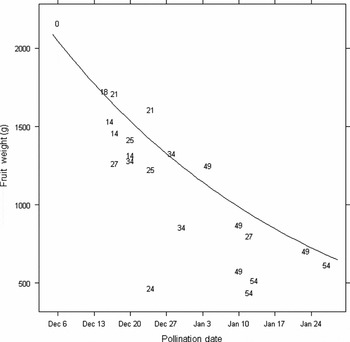
A decline in fruit weight was observed as the harvest progressed. The relationship between the fruit fresh weights and their flower pollination dates is shown in Figure 1. An exponential relation accounted for 71% of variability in fruit weight [y = 380 + 1893 × (0.9562x)].
Response of fruit weight to flower pollination date showing raw data and fitted line. The value assigned to each datum point represents the time of harvest for that fruit in days following the harvest of the first fruit. The fitted line is an exponential relation accounting for 71% of variability in fruit weight [y = 380 + 1893 × (0.9562x)].

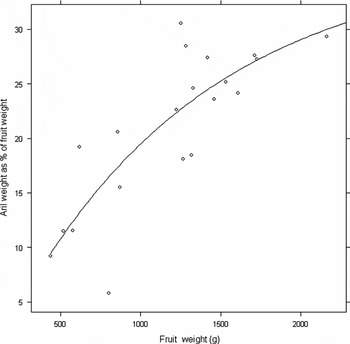
Fruit quality increased with an increase in fruit fresh weight. Quality was evaluated in terms of the number of developed seeds and the proportion of the fruit weight that was aril. Smaller fruits (lower weights) had fewer seeds that were fully developed and mature compared with larger fruits (higher weights). The fitted exponential relation accounted for 91.5% of variability in mature seed number [y = 54.47 – 88.29 × (0.99893x)] (Figure 2). Similarly, smaller fruits had relatively less aril than larger fruits. The fitted relation between aril weight as a percentage of fruit weight to fruit weight accounted for 63.8% of variability [y = 36.5 – 38.85 × (0.999172x)] (Figure 3).
Response of the number of developed seeds to fruit weight showing raw data and fitted exponential relationship. The fitted line accounts for 91.5% of variability in developed seed number [y = 54.47 – 88.29 × (0.99893x)].

Response of aril weight as a percentage of fruit weight to fruit weight showing raw data and fitted exponential relationship. The fitted line accounts for 63.8% of variability in aril weight as a percentage of fruit weight [y = 36.5 – 38.85 × (0.999172x)].

Experiment 2 – propagation from cuttings
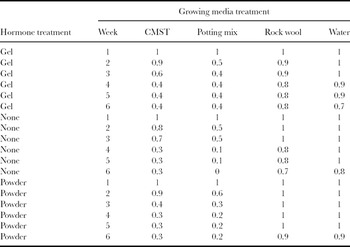
Cutting survival in the water and rock wool media types was consistently high over the six weeks for all three hormone treatments (Table 1). At week 6, there were no significant hormone treatment effects on cutting survival detected for the CMST, rock wool or water media types (p > 0.05). For the potting mix media at week 6, the difference in survival between hormone powder and gel treatment was not significant (p > 0.05). All 10 cuttings were dead in the no hormone treatment (Table 1).
Proportion of cuttings surviving each week for each media type and hormone treatment (10 cuttings per treatment × media combination). Week 6 data were analysed separately for each media type, with back-transformed approximate least significant differences as follows: closed media sachet technique (CMST) = 0.43, potting media = 0.42, rock wool = 0.39, water = 0.39.

Fifty healthy cuttings were potted up for greenhouse production and included individuals from each hormone media treatment combination (with the exception of the potting media treatment without hormone). All plants developed healthily as a greenhouse crop with flowering commencing 138 days following the start of the propagation experiment.
DISCUSSION
This study highlights some techniques that can be used to improve Gac production by households and farmers on a larger scale. It demonstrates that seed germination followed by propagation of plants by cuttings is possible with limited resources to increase the number of productive female plants. It also demonstrates a greenhouse Gac crop for the first time, highlighting its suitability for increasing production, particularly in cool climates, which would otherwise slow or inhibit growth. Further, this study identifies that maximising fruit weight will be an important means of enhancing the amount of aril obtained from Gac crops.
We propose suitable practices for increasing the number of female plants at the household and small farm levels. Seed germination was a simple process not affected by prolonged dormancy and did not require the deshelling of seeds. Seed dormancy of Gac can be a problem elsewhere but the issue is not well described (Joseph and Bharathi, Reference Joseph, Bharathi and Peter2008). Also, we showed that propagation of cuttings was successful in either rock wool or water growing media and that a rooting hormone is not necessarily required to easily strike roots. This raises the possibility of other materials locally available to households being suitable as a growing medium for striking cuttings. Future work could focus on identifying moisture and temperature conditions for maximising strike rates in specific media. On a small scale, it may also be feasible to increase production by utilising unwanted male plants as a rootstock and grafting female material onto these (Joseph et al., Reference Joseph, Nair and Nissar2011). However, we have shown that taking cuttings is a reliable and an alternative technique to grafting, with an advantage of requiring less skill.
For the purpose of increasing Gac production on a larger scale, this study has demonstrated the value of greenhouse technology, particularly in cold conditions. Greenhouse technology has the advantage of providing year-round control of climate and irrigation and nutrition through hydroponics. A further advantage is that the exclusion of soil from the system reduces the need for pesticides, and the greenhouse permits the use of biological controls. In this study the greenhouse and hydroponic system and practices used previously by the authors for bitter melon (Momordica charantia) (data not shown) permitted a healthy Gac crop during winter in a temperate climate. However, unlike bitter melon, the exclusion of insect pollinators by the greenhouse system does not hinder the productivity of Gac since hand pollination is recommended to obtain good fruit set in the field (Maharana and Sahoo, Reference Maharana, Sahoo and Singh1995).
Although a minor focus of this work, fruit set achieved using dried-frozen pollen for three fruits indicates the good storage potential of Gac pollen for the first time. There were insufficient data to discern the differences between the pollination techniques used (pollen applied with a paint brush or applied directly with the stamen) in achieving the fruit set. Other pollination methods that may save labour also need to be tested. An example includes spraying a suspension of pollen in water onto the stigma, and this has been described for the pollination of date palm (Phoenix dactylifera L.; Awad, Reference Awad2010).
Fruit weight appears to be important in determining the proportion of aril obtained from the fruit. We have shown that the larger and heavier fruits contain proportionally more aril than smaller and lighter fruits. This has great significance since the valuable aril represents only a small part of the fruit and maximising this would be of economic importance to the grower. In this study the highest anatomical component of Gac fruit is the pericarp (52–75% by weight) whereas the aril accounts for only 6–31% of weight. The aril weight has been reported elsewhere as 10, 18 and 24.6% of fruit weight (Ishida et al., Reference Ishida, Turner, Chapman and McKeon2004; Kha, Reference Kha2010; Nhung et al., Reference Nhung, Bung, Ha and Phong2010) and the pericarp weight as 49% of fruit weight (Kha, Reference Kha2010), corroborating our findings. However, no other study considers the impact of fruit size on the proportion of the aril obtained.
Factors known to affect fruit size in other cucurbits could be investigated as a means to developing systems that promote larger fruits in Gac. Plant density is important, with wider plant spacing leading to increased fruit size for vertically trained watermelon (Citrullus lanatus) and cantaloupe (Cucumis melo) (Ban et al., Reference Ban, Goreta and Borosic2006; Watanabe et al., Reference Watanabe, Nakano and Okano2003). Also, fruit production and the distribution of biomass to developing fruits in cantaloupe and squash (Cucurbita pepo) are affected by flower production and fruit removal (El-Keblawy and Lovett-Doust, Reference El-Keblawy and Lovett-Doust1996a, Reference El-Keblawy and Lovett-Doustb). This has implications for the practical management of plants through pruning and training practices.
CONCLUSION
We established in this study that special treatments are not required to germinate Gac seeds and that cuttings can be struck in a range of media without the assistance of rooting hormone. For the first time, a Gac crop was produced in a temperate winter using greenhouse technology. These findings have allowed us to propose small- and large-scale production systems to improve yields. Further understanding of processes such as resource allocation in Gac will be valuable in developing it as a high-yielding and high-quality crop.
Acknowledgements
This research was financially supported by the Rural Industries Research & Development Corporation (RIRDC) and the Australian Centre for International and Agricultural Research (ACIAR). The authors thank Joshua Jarvis for technical support.