

1. INTRODUCTION
According to the United Nations (2015), the total fertility rate (TFR) has been falling in developed regions from levels of 2.5–3.5 children per woman (Europe and Northern America in the 1960s) to levels far below the replacement rate of 2.1 children per woman in 2015. Africa started with a much higher TFR of 6.7 in the 1960s, which fell below the rate of six children per woman only in the 1990s. In 2015, the TFR in Africa was 4.7 children per woman, which is still far higher than in Europe and Northern America in the 1960s.
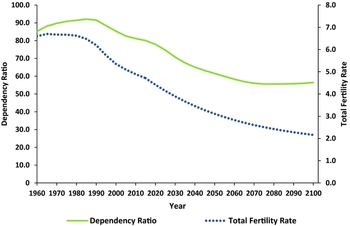
The transition from high to low fertility implies that the young, dependent population declines in relation to the working-age population over time. Figure 1 plots Africa's TFR and dependency ratio according to United Nations (2015) actual data and projections from 1960 to the end of the 21st century.Footnote 1 We observe that the fall in the dependency ratio is gradual and slower than the fall in fertility. The projections suggest that the dependency ratio will stabilize in the second half of the 21st century, and only when the TFR stops falling and the smaller cohorts begin to retire will it start to increase again because of the rise of old-age dependency.
TFR and dependency ratio (population age 0–14 and age 65+ divided by the population at age 15–64, ×100) for Africa according to United Nations (2015).

The decrease in the youth dependency ratio comes with various economic benefits, leading to what has been called the demographic dividend [cf. Bloom et al. (Reference Bloom, Canning and Sevilla2003)]. We can broadly decompose the demographic dividend into accounting effects and behavioral effects. The accounting effects capture the mechanical consequences of a declining population share of the young cohorts. Falling fertility gradually reduces the number of dependent young, while leaving the growth rate of the workforce unchanged until the smaller cohorts start to enter the workforce approximately one and a half to two decades later. As a consequence, the ratio of the working-age population to the dependent population increases, which tends to swell an economy's labor force, savings, and productive capacity on a per capita basis [cf. Coale and Hoover (Reference Coale and Hoover1958); Bloom and Freeman (Reference Bloom and Freeman1988); Kelley and Schmidt (Reference Kelley and Schmidt2005)]. In later phases of the fertility transition, when the relatively smaller cohorts start to enter the workforce, capital dilution is mitigated and growth in the medium run increases by the standard mechanism of capital deepening that is well known from the Solow (Reference Solow1956) model. In less-developed countries where land remains an important input factor, a positive effect on per capita output also arises from the higher land-to-labor ratio that comes with declining fertility [cf. Ashraf et al. (Reference Ashraf, Weil and Wilde2013)].
Changing individual choices under lower fertility drive the behavioral effects. We can distinguish among three main mechanisms. First, the decline in fertility tends to enable higher female labor force participation, which further raises the ratio of workers to the dependent population and thereby reinforces the corresponding accounting effect [cf. Bloom et al. (Reference Bloom, Canning, Fink and Finlay2009)]. Second, declining fertility allows families and governments to invest more in the health and education of each child, i.e., a substitution of child quality for child quantity occurs along the lines of Becker and Lewis (Reference Becker and Lewis1973) [see also Doepke (Reference Doepke2015) for an interesting overview]. Better health and education of the young boost aggregate productivity growth once the young cohort enters the workforce. Third, because a large number of children often substitutes for old-age insurance in societies where social security systems are poorly developed [Boldrin et al. (Reference Boldrin, De Nardi and Jones2015)], a decline in fertility implies that savings for retirement rise (either private savings or savings via a public pension system), which again reinforces capital deepening and thereby fosters growth in the medium run.
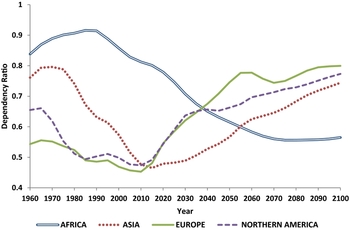
In Figure 2, we plot the dependency ratios for Africa, Asia, Europe, and Northern America according to United Nations (2015) data and projections. We observe that the dependency ratio started to fall in Northern America and in Europe in the 1960s (after the baby boom) and in Asia in the late 1970s and the early 1980s, spurred by the one child policy in China. At the same time, the dependency ratio was highest in Africa and even increased until the 1990s. It was still at a level of 80.1 in 2015, which was only slightly lower than Asia's 1965 dependency ratio of 80.3. United Nations (2015) projections for the next few decades imply that the dependency ratio will fall in Africa, while it has already started to rise in Europe and in Northern America because the baby-boom cohort has increased the number of retirees. By around 2040, Africa's dependency ratio will fall below the levels in Europe and in Northern America and stay lower throughout the rest of the 21st century.
Dependency ratios (population age 0–14 and age 65+ divided by the population at age 15–64, ×100) for different regions according to United Nations (2015).

These projected changes imply that Africa has, a priori, large potential to enjoy a demographic dividend. Whether it actually does so depends crucially on the policies that the leaders of African countries adopt and implement.Footnote 2 In this piece, we describe the main channels of and challenges to enjoying a demographic dividend, we quantify its potential economic growth effects, and we sketch possible ways for public policies to foster the emergence of a demographic dividend.
2. APPROACHES TO ANALYZING THE DEMOGRAPHIC DIVIDEND AND ITS CONSEQUENCES
The effects of declining fertility on economic growth are frequently assessed with simulated demographic-macroeconomic models along the lines of Lee and Mason (Reference Lee and Mason2010), Ashraf et al. (Reference Ashraf, Weil and Wilde2013), and Mason et al. (Reference Mason, Lee and Jiang2016). These frameworks calculate per capita output trajectories for various demographic scenarios, considering the effects on capital deepening, the propensity of parents to substitute child quality for quantity, and labor force participation. In particular, the models set forth in Ashraf et al. (Reference Ashraf, Weil and Wilde2013) and Mason et al. (Reference Mason, Lee and Jiang2016) allow us to trace the emergence over time of the “accounting” changes in the support ratio and the concomitant changes in physical and human capital investments.
Dynamic economic models that explain the economic stagnation before the industrial revolution and the ensuing rapid economic development [cf. Galor and Weil (Reference Galor and Weil2000); Galor (Reference Galor, Aghion and Durlauf2005, Reference Galor2011)] emphasize particularly the child quality–quantity substitution as the central mechanism behind a takeoff toward sustained long-run growth. An increase in education accompanies the decrease in fertility, leading to faster human capital accumulation and accelerated technological progress, and in turn driving growth of per capita GDP. Such unified growth models can also be applied to contemporaneous less-developed countries that are still in the midst of the transition to long-run economic growth [cf. Bloom et al. (Reference Bloom, Kuhn and Prettner2015)]. Conceptually, these models provide a theoretical foundation for the mechanisms and incentives underlying investments in physical and human capital. Furthermore, most of these models derive their projected macroeconomic impacts from household-level analysis, allowing for an assessment of how social norms and government policies are fostering or hindering economic takeoff. These models address issues as varied as gender roles and female empowerment [e.g. Galor and Weil (Reference Galor and Weil1996); de la Croix and Vander Donckt (Reference de la Croix and Vander Donckt2010); Doepke and Tertilt (Reference Doepke and Tertilt2014); Prettner and Strulik (Reference Prettner and Strulik2016a)], social norms about contraception and prices of contraceptives [Prettner and Strulik (Reference Prettner and Strulik2016b); Strulik (Reference Strulik2016)], health improvements [e.g. Soares and Falcao (Reference Soares and Falcao2008); de la Croix and Vander Donckt (Reference de la Croix and Vander Donckt2010); Bloom et al. (Reference Bloom, Kuhn and Prettner2015)], and public infrastructure [Agénor et al. (Reference Agénor, Bayraktar and El Aynaoui2008); Agénor (Reference Agénor2010)].
The empirical analysis of demographic effects on economic growth is typically based on cross-country convergence regressions of the type advanced by Barro (Reference Barro1991, Reference Barro1997). Bloom and Williamson (Reference Bloom, Williamson, Sachs and Bloom1997, Reference Bloom and Williamson1998) and Bloom et al. (Reference Bloom, Canning and Malaney2000) augment the framework to allow for a changing demographic structure. Their results also point to a favorable effect of a declining youth dependency ratio on economic development.Footnote 3 Crespo Cuaresma et al. (Reference Crespo Cuaresma, Lutz and Sanderson2014) show that these effects materialize predominantly through an expansion of education.
3. IMPLICATIONS FOR ECONOMIC GROWTH IN AFRICA
Using data from Nigeria, Ashraf et al. (Reference Ashraf, Weil and Wilde2013) and Mason et al. (Reference Mason, Lee and Jiang2016) study the impact of strong fertility decline relative to a scenario with moderate fertility decline. Ashraf et al. (Reference Ashraf, Weil and Wilde2013) show in their baseline simulations that reducing fertility from the medium variant of the United Nations (2010) projections to the low variant, which corresponds to reducing the TFR by 0.5 children per woman, raises per capita GDP by 11.9% after 50 years. This corresponds to an increase in annual economic growth by 0.225 percentage points—a sizeable effect. According to the United Nations (2015) projections, Africa's TFR will fall from 4.71 in the five-year period 2010-2015 to 2.71 in the five-year period 2060-2065. For such a fall, and provided that there are no strong nonlinearities regarding the magnitude of the effect or its timing, these numbers imply that the economic growth rate would increase by around 0.9 percentage points per year throughout this time span.
Building on the approach used in Ashraf et al. (Reference Ashraf, Weil and Wilde2013), the volume edited by Canning et al. (Reference Canning, Raja and Yazbeck2015) includes (in Chapter 4) a two-sector economic model, which suggests that reducing Nigeria's TFR from the high-variant level to a low-variant level would lead to a per capita income of over $13,000 by 2060 (compared to $9,000 in the high fertility scenario). The lower fertility variant also shows a larger and more rapid increase in the share of workers in manufacturing and a more rapid decline in agriculture.Footnote 4 Regarding actionable steps toward fertility reduction, Bloom et al. (Reference Bloom, Humair, Rosenberg, Sevilla, Trussell, Soucat and Ncube2014) show that fulfilling just one-third of the unmet need for contraceptives in Kenya, Senegal, and Nigeria could lead to respective 16%, 12%, and 9% increases in the countries’ per capita incomes by 2030.Footnote 5
Bloom and Canning (Reference Bloom and Canning2008) estimate that increasing the growth rate of the ratio of the working-age population to the total population by 1 percent leads, on average, to an increase in the per capita GDP growth rate of 1.394 percent. When applying the difference between the medium- and low-fertility variants in the Ashraf et al. (Reference Ashraf, Weil and Wilde2013) simulations to the implied growth rate of the fraction of the working-age population, reducing the TFR by 0.5 would lead to an annual growth rate that is higher by 0.123 percentage points. For the projected TFR reduction of two children per woman in Africa, this would still imply a sizeable increase in the annual economic growth rate by 0.5 percentage points. The results for Asian countries in regressions by Bloom and Williamson (Reference Bloom and Williamson1998) and Bloom and Finlay (Reference Bloom and Finlay2009) and in growth accounting exercises by Mason (Reference Mason2001) are even larger. These studies find that approximately one-third of East Asia's growth miracle—or 2 percentage points per year—can be explained by the favorable demographic shifts that followed a decline in fertility. Additionally, Bloom and Sachs (Reference Bloom and Sachs1998) estimate that the relatively youthful age structure of sub-Saharan Africa accounted for 19% of the gap between the region's economic growth and that of the rest of the world from 1965 to 1990.
The simulations in Ashraf et al. (Reference Ashraf, Weil and Wilde2013) and Mason et al. (Reference Mason, Lee and Jiang2016) also allow us to identify the main drivers of the demographic dividend and how they evolve over the transition phase. Despite some differences in the modeling approach and in the variable of concern—per capita income in Ashraf et al. (Reference Ashraf, Weil and Wilde2013) versus per capita consumption in Mason et al. (Reference Mason, Lee and Jiang2016)—both papers find that while “accounting” changes in the support ratio initially drove the impact, investments in physical and human capital turned out to be the dominant drivers over the second part of the transition (broadly 50–100 years after the onset of fertility decline).Footnote 6 Mason et al. (Reference Mason, Lee and Jiang2016) show in addition that the increase in human capital rather than physical capital drives the demographic dividend once it becomes quantitatively important.Footnote 7 UNFPA (2014) estimates that if countries in sub-Saharan Africa invest judiciously in human capital and combine it with effective labor market, capital market, and trade policies, and sound macroeconomic management and governance, they could collectively reap $500 billion a year in economic benefits for up to 30 years, an economic boom akin to that experienced by East Asian countries during their period of rapid income growth. While this experiment relies on the optimistic assumption that the corresponding policies are enacted, it has the virtue of at least providing an upper bound on the expected demographic dividend.
4. CRUCIAL CHANNELS AND THE ROLE OF COMPLEMENTARITY
The simulations by Ashraf et al. (Reference Ashraf, Weil and Wilde2013) and Mason et al. (Reference Mason, Lee and Jiang2016) show that a full demographic dividend in Africa will only materialize if a substantial increase in human capital investments accompanies—and in fact reinforces—the fertility decline. However, it is not clear this will happen: Social norms and the complementarity among longevity, health investments, and education tend to induce a process that either boosts economic takeoff or stifles it, with the possible consequence of countries remaining in a development trap.
As multiple studies (cited earlier) show, social norms that are biased against gender equality tend to stifle female labor force participation, leading to low opportunity costs of children and thus to persistently high fertility. The same applies to social norms that militate against the use of contraception. With fertility remaining at high levels, the quality–quantity substitution cannot kick in, so investments in the human capital of children remain low. This observation points to the value of policies aimed at overcoming the social norms underlying persistently high fertility, including educational campaigns, facilitating female labor market access (even against a norm), and reducing labor market discrimination against women [cf. Schober and Winter-Ebmer (Reference Schober and Winter-Ebmer2011); Rees and Riezman (Reference Rees and Riezman2012)]. These policies may also involve less obvious measures, such as the creation or expansion of marketplaces which, based on Kenyan data, has been shown to dampen fertility by enhancing information exchange on modern methods of family planning [Kohler et al. (Reference Kohler, Behrman and Watkins2001)].
Complementarity hinders or boosts economic development through two channels: complementarity between health and education and complementarity between different forms of health investments (or behaviors) within a competing risk setting. With regard to the former, several studies document empirically that improvements that reduce (maternal) mortality and morbidity tend to boost (female) labor force participation and educational investments [e.g. Bleakley (Reference Bleakley2007); Jayachandran and Lleras-Muney (Reference Jayachandran and Lleras-Muney2009); Lucas (Reference Lucas2010); Albanesi and Olivetti (Reference Albanesi and Olivetti2016)], or as Bleakley (Reference Bleakley2010) points out, the productivity of education. Confirming the quality–quantity trade-off, Bleakley and Lange (Reference Bleakley and Lange2009) show that eradicating hookworm in the American south triggered a reduction in fertility. Significantly, health-education complementarity also translates across generations. Field et al. (Reference Field, Robles and Torero2009) show for Tanzanian data how maternal iodine deficiency lowers cognitive ability and educational attainment, especially for daughters. Given that health deficiencies may thus hinder an education transition, the intergenerational persistence of poor health that has increased in Africa over the period 1970–2000 is of particular concern [Bhalotra and Rawlings (Reference Bhalotra and Rawlings2011)].
The complementarity between general survival chances and specific health behaviors may lead to persistently poor health. As Oster (Reference Oster2012) shows for sub-Saharan Africa, individuals were more willing to reduce risky sexual behaviors in the face of HIV/AIDS when facing better general survival prospects (as measured by lower child mortality or lower incidence of malaria). This points to a clear risk of individuals doing little to prevent HIV due to low life expectancy overall, but at the same time it suggests that individuals may be investing little in general health due to the presence of HIV. Oster (Reference Oster2012) points out that this vicious cycle is naturally broken by policies that support health and healthy behavior in general.Footnote 8 Whether or not (persistently) high levels of HIV lead to a drag on growth is subject to some controversy: Young (Reference Young2005) shows that, paradoxically, South Africa may benefit from HIV if shrinking the labor force triggers a wage increase, which stifles fertility by raising the opportunity cost of children.Footnote 9 In contrast, Azomahou et al. (Reference Azomahou, Boucekkine and Diene2016) confirm a growth drag induced by HIV, which is relatively stable in the early stages of an epidemic due to a direct loss of available labor [see also Cuddington and Hancock (Reference Cuddington and Hancock1994); Bloom et al. (Reference Bloom, Mahal and Sevilla2001)], but then increases sharply due to the reduction in educational investments [see also Fortson (Reference Fortson2011)]. This closes the loop with our earlier considerations and illustrates that thoughtful policies have considerable potential to turn complementary incentives into a virtuous cycle of development.
5. POLICY CHALLENGES
A coherent political strategy is likely to maximize the chances of an economy realizing a demographic dividend. Economic policies that foster fertility decline may be particularly effective. Direct policies may promote the use of contraceptives and family planning [Bhattacharya and Chakraborti (Reference Bhattacharya and Chakraborty2014); Baudin et al. (Reference Baudin, de la Croix and Gobbi2015); Prettner and Strulik (Reference Prettner and Strulik2016b); Strulik (Reference Strulik2016)]. By providing maternal support and child health care, they may also seek to lower child mortality as a means of curbing precautionary fertility [Kalemli-Ozcan (Reference Kalemli-Ozcan2003)]. Indirect policies aim at educating women, improving their health status, and facilitating female labor market access; these policies enhance female empowerment as an objective in its own right. But by improving the bargaining position of women, who typically prefer fewer and better educated children [Schultz (Reference Schultz1990); Thomas (Reference Thomas1990)], and by raising the opportunity costs of children, they also contribute to lower fertility [Bloom et al. (Reference Bloom, Kuhn and Prettner2015); Prettner and Strulik (Reference Prettner and Strulik2016a)]. At the same time, these policies may erode traditional social norms that are associated with high fertility. The crux is that escaping from development traps grounded in social norms and complementarities typically requires the coordination of policies across many areas (health, education, family planning). Furthermore, the most effective policies may be intensive early on and may only be relaxed once complementarities and social multipliers induce a takeoff. This raises issues as to whether local governments can cope with the coordination and front-loaded finance of such policies.
Once the youth dependency ratio decreases and unleashes resources for the government and for families to invest, the chances of enjoying a demographic dividend can then be further increased by resources being spent effectively on accumulating physical capital and human capital, particularly for the young population. Adequate policies, therefore, require combating corruption [Gyimah-Brempong (Reference Gyimah-Brempong2002); Bah and Fang (Reference Bah and Fang2015)] as well as building sound political, financial, and economic institutions [Ndulu and O'Connell (Reference Ndulu and O'Connell1999); Block (Reference Block2002)] and education and health care sectors with universal access.Footnote 10 As the simulations by Ashraf et al. (Reference Ashraf, Weil and Wilde2013) and Mason et al. (Reference Mason, Lee and Jiang2016) show, such measures, if successful, would strongly reinforce an initial decline in fertility. At the same time, policymakers would need to advance an environment with employment prospects for an increasingly well-educated population to avoid a brain drain to developed countries. Indeed, Hatton and Williamson (Reference Hatton and Williamson2003, Reference Hatton and Williamson2011) report unmitigated emigration pressure from Africa.Footnote 11 Open trade policies may have a role to play here; however, controversy remains as to whether (and what) forms of trade liberalization and promotion of foreign direct investment (FDI) may be conducive to development in general and whether or not Africa is different with regard to the trade/FDI-growth nexus [e.g. Collier and Gunning (Reference Collier and Gunning1999); Asiedu (Reference Asiedu2002); Santos-Paulino and Thirlwall (Reference Santos-Paulino and Thirlwall2004); Masanjala and Papageorgiou (Reference Masanjala and Papageorgiou2008); Frazer and van Biesebroeck (Reference Frazer and van Biesebroeck2010)].
Possibly, the largest challenge to Africa enjoying a demographic dividend may come from climate change, which has been shown to have a strong direct impact on both output and output growth across all sectors [Dell et al. (Reference Dell, Jones and Olken2012)] with further indirect effects through its detrimental impact on health and political stability [Dell et al. Reference Dell, Jones and Olken2012, Reference Dell, Jones and Olken2014]. Collier et al. (Reference Collier, Conway and Venables2008) provide a survey of the consequences of climate change for Africa and possible policy responses, and Marchiori et al. (Reference Marchiori, Maystadt and Schumacher2012) provide evidence on the substantial impact of climate change on internal and external migration in sub-Saharan Africa. While these issues are beyond the scope of this survey, there are plausible indications that climate change and its consequences have the potential to undermine the conditions under which a demographic dividend may materialize for Africa.
A final challenge will arise if Africa actually enjoys a demographic dividend. Depending on how rapid the decline in fertility is, Africa would sooner or later face the challenge of an ageing population.Footnote 12 This prospect, however, has been extensively dealt with elsewhere (e.g. Bloom et al. Reference Bloom, Canning and Sevilla2003) and, at least for most parts of Africa, seems remote enough not to be included in this survey.
6. CONCLUSIONS
Africa's potential for enjoying a demographic dividend is large. Over the next few decades, we expect the fertility rate to fall substantially, such that the dependency ratio decreases significantly. This will unleash resources to invest in education, infrastructure, health, and other productive areas. However, corruption and rent seeking by an extractive ruling elite could lead to a situation in which the gains from declining fertility are largely wasted and a demographic dividend does not emerge. In order to mitigate the effects of this possibility, African countries can try to establish inclusive institutions and follow growth-promoting economic policies to ensure that the window of opportunity presented by declining fertility can be used to raise welfare in the long run.
ACKNOWLEDGEMENTS
Preparation of this article was partly supported by the National Institute on Aging, National Institutes of Health, under award number P30AG024409-12. The authors thank Alex Khoury for excellent research assistance and Niels Geiger and Anne Goujon for their thoughtful comments.