

%20--%3e%3c!DOCTYPE%20svg%20PUBLIC%20'-//W3C//DTD%20SVG%201.0//EN'%20'http://www.w3.org/TR/2001/REC-SVG-20010904/DTD/svg10.dtd'%3e%3csvg%20version='1.0'%20id='Layer_1'%20xmlns='http://www.w3.org/2000/svg'%20xmlns:xlink='http://www.w3.org/1999/xlink'%20x='0px'%20y='0px'%20width='64px'%20height='64px'%20viewBox='5.5%20-3.5%2064%2064'%20enable-background='new%205.5%20-3.5%2064%2064'%20xml:space='preserve'%3e%3cg%3e%3ccircle%20fill='%23FFFFFF'%20fill-opacity='0'%20cx='37.785'%20cy='28.501'%20r='28.836'/%3e%3cpath%20fill='%23595959'%20d='M37.441-3.5c8.951,0,16.572,3.125,22.857,9.372c3.008,3.009,5.295,6.448,6.857,10.314%20c1.561,3.867,2.344,7.971,2.344,12.314c0,4.381-0.773,8.486-2.314,12.313c-1.543,3.828-3.82,7.21-6.828,10.143%20c-3.123,3.085-6.666,5.448-10.629,7.086c-3.961,1.638-8.057,2.457-12.285,2.457s-8.276-0.808-12.143-2.429%20c-3.866-1.618-7.333-3.961-10.4-7.027c-3.067-3.066-5.4-6.524-7-10.372S5.5,32.767,5.5,28.5c0-4.229,0.809-8.295,2.428-12.2%20c1.619-3.905,3.972-7.4,7.057-10.486C21.08-0.394,28.565-3.5,37.441-3.5z%20M37.557,2.272c-7.314,0-13.467,2.553-18.458,7.657%20c-2.515,2.553-4.448,5.419-5.8,8.6c-1.354,3.181-2.029,6.505-2.029,9.972c0,3.429,0.675,6.734,2.029,9.913%20c1.353,3.183,3.285,6.021,5.8,8.516c2.514,2.496,5.351,4.399,8.515,5.715c3.161,1.314,6.476,1.971,9.943,1.971%20c3.428,0,6.75-0.665,9.973-1.999c3.219-1.335,6.121-3.257,8.713-5.771c4.99-4.876,7.484-10.99,7.484-18.344%20c0-3.543-0.648-6.895-1.943-10.057c-1.293-3.162-3.18-5.98-5.654-8.458C50.984,4.844,44.795,2.272,37.557,2.272z%20M37.156,23.187%20l-4.287,2.229c-0.458-0.951-1.019-1.619-1.685-2c-0.667-0.38-1.286-0.571-1.858-0.571c-2.856,0-4.286,1.885-4.286,5.657%20c0,1.714,0.362,3.084,1.085,4.113c0.724,1.029,1.791,1.544,3.201,1.544c1.867,0,3.181-0.915,3.944-2.743l3.942,2%20c-0.838,1.563-2,2.791-3.486,3.686c-1.484,0.896-3.123,1.343-4.914,1.343c-2.857,0-5.163-0.875-6.915-2.629%20c-1.752-1.752-2.628-4.19-2.628-7.313c0-3.048,0.886-5.466,2.657-7.257c1.771-1.79,4.009-2.686,6.715-2.686%20C32.604,18.558,35.441,20.101,37.156,23.187z%20M55.613,23.187l-4.229,2.229c-0.457-0.951-1.02-1.619-1.686-2%20c-0.668-0.38-1.307-0.571-1.914-0.571c-2.857,0-4.287,1.885-4.287,5.657c0,1.714,0.363,3.084,1.086,4.113%20c0.723,1.029,1.789,1.544,3.201,1.544c1.865,0,3.18-0.915,3.941-2.743l4,2c-0.875,1.563-2.057,2.791-3.541,3.686%20c-1.486,0.896-3.105,1.343-4.857,1.343c-2.896,0-5.209-0.875-6.941-2.629c-1.736-1.752-2.602-4.19-2.602-7.313%20c0-3.048,0.885-5.466,2.658-7.257c1.77-1.79,4.008-2.686,6.713-2.686C51.117,18.558,53.938,20.101,55.613,23.187z'/%3e%3c/g%3e%3c/svg%3e)
%20--%3e%3c!DOCTYPE%20svg%20PUBLIC%20'-//W3C//DTD%20SVG%201.0//EN'%20'http://www.w3.org/TR/2001/REC-SVG-20010904/DTD/svg10.dtd'%3e%3csvg%20version='1.0'%20id='Layer_1'%20xmlns='http://www.w3.org/2000/svg'%20xmlns:xlink='http://www.w3.org/1999/xlink'%20x='0px'%20y='0px'%20width='64px'%20height='64px'%20viewBox='5.5%20-3.5%2064%2064'%20enable-background='new%205.5%20-3.5%2064%2064'%20xml:space='preserve'%3e%3cg%3e%3ccircle%20fill='%23FFFFFF'%20fill-opacity='0'%20cx='37.637'%20cy='28.806'%20r='28.276'/%3e%3cg%3e%3cpath%20fill='%23595959'%20d='M37.443-3.5c8.988,0,16.57,3.085,22.742,9.257C66.393,11.967,69.5,19.548,69.5,28.5c0,8.991-3.049,16.476-9.145,22.456%20C53.879,57.319,46.242,60.5,37.443,60.5c-8.649,0-16.153-3.144-22.514-9.43C8.644,44.784,5.5,37.262,5.5,28.5%20c0-8.761,3.144-16.342,9.429-22.742C21.101-0.415,28.604-3.5,37.443-3.5z%20M37.557,2.272c-7.276,0-13.428,2.553-18.457,7.657%20c-5.22,5.334-7.829,11.525-7.829,18.572c0,7.086,2.59,13.22,7.77,18.398c5.181,5.182,11.352,7.771,18.514,7.771%20c7.123,0,13.334-2.607,18.629-7.828c5.029-4.838,7.543-10.952,7.543-18.343c0-7.276-2.553-13.465-7.656-18.571%20C50.967,4.824,44.795,2.272,37.557,2.272z%20M46.129,20.557v13.085h-3.656v15.542h-9.944V33.643h-3.656V20.557%20c0-0.572,0.2-1.057,0.599-1.457c0.401-0.399,0.887-0.6,1.457-0.6h13.144c0.533,0,1.01,0.2,1.428,0.6%20C45.918,19.5,46.129,19.986,46.129,20.557z%20M33.042,12.329c0-3.008,1.485-4.514,4.458-4.514s4.457,1.504,4.457,4.514%20c0,2.971-1.486,4.457-4.457,4.457S33.042,15.3,33.042,12.329z'/%3e%3c/g%3e%3c/g%3e%3c/svg%3e)
Highlights
-
• Healthcare systems in many countries are facing demographic challenges and staff shortages, and DHTs are increasingly proposed as a strategy to address these challenges by reducing clinicians’ time burden.
-
• Current guidelines for health economic evaluation and HTA should be updated to ensure that the value of clinicians’ time is appropriately reflected in the assessments.
-
• Based on a narrative review, this article proposes two specific suggestions for improving economic evaluation of DHTs: (1) systematic collection and reporting of data on the effects of digital technologies on TNT, and (2) the application of shadow prices to capture the economic value of clinicians’ time.
Introduction
Across most European countries, a major challenge facing healthcare systems is the demographic shift toward aging populations with a growing prevalence of chronic diseases, combined with a shrinking workforce and a declining number of healthcare professionals (1). According to the Danish Commission on Health System Structure (2):
By 2035, there will be 250,000 more citizens aged 65 and over. Towards 2050, the elderly population will increase by an additional 340,000 people, and the proportion of the oldest Danes—those aged 80 and above—will double.
At present, Danish hospitals are already struggling to recruit both nurses and physicians. Data from The Danish Agency for Labour Market and Recruitment, based on a national survey with managers responsible for job postings from June 2022 to November 2022, shows that 28 percent of the job postings in the health and social care sector could not find a qualified person for the job (3).
A similar outlook was presented in Norway, where the Healthcare Personnel Commission highlighted comparable concerns about future staffing and education (4). The Norwegian Minister for Research and Higher Education, Ola Borten Moe, summarized the findings as follows (5):
The committee confirms that we will run out of people before we run out of money. This means that we cannot simply educate our way out of the challenges.
These concerns are echoed across Europe. The OECD and the European Commission (6) identified a shortage of around 1.2 million doctors, nurses, and midwives across the EU as of 2022. Moreover, over one-third of doctors and one-quarter of nurses are aged fifty-five years or older, indicating that retirements will soon intensify the existing workforce shortage (6).
In response to these demographic pressures, many countries have initiated healthcare reforms focused on digital transformation. In Denmark, for example, a structural reform aims to shift care from hospitals to primary care and municipalities, while leveraging DHTs. DHTs are, in the following, defined in accordance with the European Commission (7) as hardware and software systems that use digital technologies to support the prevention, diagnosis, treatment, monitoring, management, and delivery of healthcare. A central goal of the digital transformation is to reduce the time healthcare professionals (clinicians) spend per patient, thereby increasing overall productivity (8). Similar digital health strategies have been adopted across Europe (Reference Novillo-Ortiz, Barros, Saigí-Rubió and De Fatima Marin9).
However, HTA frameworks and guidelines for health economic evaluation have largely remained unchanged, with a continued emphasis on clinical outcomes and incremental cost-effectiveness ratios (ICERs) of healthcare interventions. The effects of new technologies on healthcare professionals are often only indirectly considered, such as through Diagnosis-Related Group (DRG) tariffs or treatment prices in general practice, as described in guidelines from, for example, the United Kingdom and Denmark (10;11). For example, when the Danish Medicines Council evaluates new pharmaceuticals, assessments typically include clinical outcomes, safety, and costs but seldom provide explicit data on use of clinician time or workload.
The Danish Health Technology Council (12), by contrast, uses a broader HTA framework that includes four domains: clinical effectiveness and safety, patient perspective, organizational implications, and health economics. Organizational implications may include data on healthcare professionals’ experiences and attitudes. Health economic evaluations may also consider how new technologies impact staffing needs in hospitals, primary care, or municipalities.
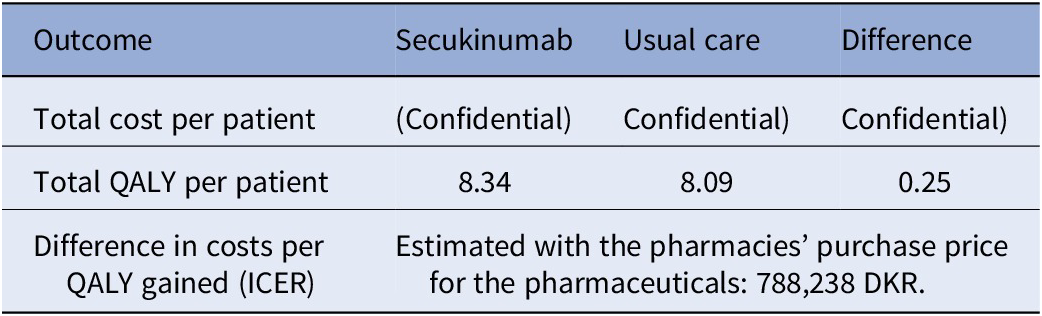
Nevertheless, while both Danish councils incorporate staff-related effects to some extent, the impacts are often implicit and not prominently featured in the evaluation results. For example, in the 2025 evaluation of Secukinumab for inflammatory skin disease by the Danish Medicines Council (13), the main findings were limited to changes in total costs and the patients’ quality of life (QALY) as described in Table 1.
Result of the Danish Medicines Council’s economic evaluation of Secukinumab

Table 1. Long description
A table with four columns: Outcome, Secukinumab, Usual care, and Difference.
* The first row, Total cost per patient, lists all values as Confidential for Secukinumab, Usual care, and the Difference.
* The second row, Total Q A L Y per patient, shows 8.34 for Secukinumab, 8.09 for Usual care, and a Difference of 0.25.
* The final row spans the three data columns for the outcome Difference in costs per Q A L Y gained (I C E R). It states: Estimated with the pharmacies purchase price for the pharmaceuticals: 788,238 D K R.
Based on the results, this specific assessment concludes that (13):
The Danish Medicines Council assesses that the costs of the new treatment are high compared to standard treatment, but overall considers the costs to be reasonable in relation to the effect.
The conclusion does not address staff-related effects, either directly, such as additional nursing requirements, or indirectly, such as increases in the number of outpatient visits.
Aim
Many European countries are attempting to address demographic challenges by investing in DHTs that have the potential to reduce staff workload. At the same time, these investments are assessed using HTAs that focus primarily on clinical outcomes and cost-effectiveness, often overlooking the value of clinician time, even though HTAs may apply a broad social perspective (10;12).
To ensure that assessments of DHT reflect the current demographic challenges and staff shortage, this paper aims to review the literature on the effects of DHTs on staff workload and clinician time and to present arguments and practical tools for an adjustment of economic evaluation and HTAs.
Methods
The arguments presented are informed by a meta-narrative review. This type of review is particularly useful for exploring under-researched topics and for generating new insights regarding well-developed fields by making sense of contradictions and tensions within the literature (Reference Sukhera14). The objective of the review was to provide an overview of how DHT affects healthcare professionals’ workload and use of time, and to identify implications for HTA and economic evaluation of DHTs.
The review was inspired by findings from a previous review of telemedicine study protocols by Kidholm et al. (Reference Kidholm, Jensen, Johansson and Montori15), which found that only 12–14 percent of studies included an assessment of the effects of telemedicine on clinician time. Additional motivation came from Gomez et al. (Reference Gomes, Murray and Raftery16), who emphasized that health economic evaluations of DHTs often assume that such interventions improve efficiency by achieving the same level of output with fewer inputs, including clinician time.
The review included review articles indexed in PubMed. Articles should describe the impact of DHTs on workload or clinician time. Articles published in languages other than English, non-peer-reviewed publications, and opinion pieces were excluded.
Search terms were selected to identify reviews of studies examining DHTs and the impact on workload and clinician time in healthcare systems. The following search strategy was used: (“digital health technology” OR telemedicine OR telehealth OR mHealth OR eHealth) AND (workload OR “clinician time” OR “staff shortage”). Only reviews published between 2020 and 2026 were included. Dual screening was performed for 25 percent of abstracts and full texts. No patients were involved in the development of the review.
Based on the objective of the study, we inductively identified a set of broad, recurring themes across the reviews retrieved. The relevance of these themes was discussed and agreed upon among the authors. Particular attention was paid to descriptions of both positive and negative effects on clinicians’ use of time, as well as concepts and measures used in the reviews.
Results
The PubMed search was conducted on 7 May 2026, and identified 765 records. Following abstract screening, ninety-four articles were selected for full-text assessment. Of these, sixty-seven review articles were considered relevant, as they included information on the impact of DHTs on workload or clinician time.
The sixty-seven reviews covered a wide range of DHTs, including telemedicine, video consultations, patient-facing applications, electronic health record systems, remote monitoring, and home monitoring technologies. Although artificial intelligence (AI) was not included as a search term, approximately one in five reviews included AI-based technologies. Based on the synthesis of the sixty-seven reviews, the following three overarching themes were identified regarding the impact of DHTs on workload and clinician time.
Defining the effects of DHTs on clinician time
The included reviews used several concepts and measures to describe and assess the effects of DHTs on clinician time. First, clinician time was often defined as the time spent by healthcare professionals delivering a digital service, either measured as minutes per patient or as total time spent across a patient population, similarly to the definition of Time Needed to Treat (TNT) (Reference Kidholm, Jensen, Johansson and Montori15). Examples of studies measuring clinician time were identified in reviews of telephone consultations (Reference Caffery, Catapan and Taylor17;Reference Carrillo de Albornoz, Sia and Harris18), video consultations (Reference De Guzman, Snoswell, Caffery and Smith19;Reference Lampickienė and Davoody20), remote monitoring of implantable devices (Reference Chiu, Gerrits and Guglielmo21), telehealth in palliative care (Reference Gordon, Mason and Smith22), AI in radiology (Reference Magni, Cozzi, Schiaffino, Colarieti and Sardanelli23) and perinatal care (Reference El Arab, Al Moosa and Albahrani24), AI-supported speech recognition for clinical documentation (Reference Atiku, Owolanke and Olakotan25–Reference Razaghi, Hafez and Farina28), and in studies of electronic health record systems (Reference Olakotan, Samuriwo, Ismaila and Atiku29).
Second, some reviews described the effects of DHTs in terms of changes in efficiency or productivity, as defined by Gomes et al. (Reference Gomes, Murray and Raftery16) as either increasing output (e.g., the number of consultations) while using the same level of inputs (e.g., clinician time), or by achieving the same output with fewer inputs. Examples of reviews addressing efficiency were found in relation to video consultations (Reference Lampickienė and Davoody20), telehealth (Reference Gujral, Illarmo, Jacobs and Wagner30), remote monitoring (Reference Huang, Takemura and Abu-Odah31), eHealth in general practice (Reference Keuper, van Tuyl and de Geit32), and AI for speech recognition (Reference Avendano, Gallagher and Hawes33).
Third, reviews described the effects of DHTs in terms of clinicians’ workload (Reference Keuper, van Tuyl and de Geit32;Reference Mohammadnejad, Freeman, Klassen-Ross, Hemingway and Banner34–Reference Sæterøy-Hansen and Reime36). Workload was conceptualized and measured in different ways, often based on the NASA Task Load Index (37) that includes subscales on mental demand, physical demand, temporal demand, performance, effort, and frustration.
The need for quantitative assessment of effects on clinician time
Some reviews have highlighted the need for quantitative assessments of the effects of DHTs on clinician time. One review of health economic evaluations of telemedicine (Reference Gujral, Illarmo, Jacobs and Wagner30) emphasized the limited evidence regarding the impact of telehealth on provider productivity and argued that more robust studies are needed, including studies that measure provider time costs.
Another review of AI-based digital scribes found that most studies relied on self-reported measures of clinicians’ documentation time, thereby introducing the potential for recall and social desirability bias. The authors recommend the use of more objective measures, such as the use of an independent observer or electronic health record log data (Reference Kanaparthy, Villuendas-Rey and Bakare26).
The need for improved measurement is further supported by several reviews demonstrating that assessments of clinician time are rarely included in evaluations of DHTs. A review of digital and mobile health technologies reported that only 5 percent of 20 included studies assessed costs and staff time (Reference Moon, Sobolev and Kane38), while a review of seventy-nine randomized controlled trials of telemedicine found that only 10 percent included measures of staff workload or time use (Reference Sugawara, Hirakawa, Iwagami, Inokuchi, Wakimizu and Nangaku39).
The importance of measuring clinician time is further underlined by the fact that DHTs do not consistently demonstrate superior clinical outcomes compared with conventional care for all patient groups. Although some technologies have shown clear clinical benefits—for example, remote monitoring of cardiac implantable electronic devices, which enables earlier detection of arrhythmias (Reference Ploux, Strik, Varma, Eschalier and Bordachar40)—this cannot be seen as general evidence. For instance, reviews of telemedicine in orthopedics observed no significant differences in most clinical outcomes (Reference Petersen, Karpinski, Backhaus, Bierke and Häner41;Reference Haider, Aweid, Subramanian and Iranpour42). A review of digitally asynchronous communication (e-visits) involving multiple patient groups suggested that e-visits can provide equivalent outcomes to in-person care (Reference Nguyen, Alishahi Tabriz, Huo, Hanna, Shea and Turner43). Finally, a review of deterioration alerts in hospitalized adults found that “most studies did not report statistically significant associations between alert implementation and better patient outcomes” (Reference Blythe, Parsons, White, Cook and McPhail44).
Different kinds of effects on clinician time
Some reviews suggest that specific DHTs may reduce the need for clinician time. For example, a review of telehealth in primary care identified five studies reporting shorter consultation times (Reference De Guzman, Snoswell, Caffery and Smith19). Similarly, reviews of AI-assisted digital breast tomosynthesis have reported reduced image interpretation time (23;44).
However, other reviews identify mechanisms through which DHTs may increase the workload and use of clinician time. These include clinician time for training, workflow redesign, and implementation activities (Reference Ghatnekar, Faletsky and Nambudiri45;Reference Stiel, Virtanen, Bakker, Heponiemi, Kainiemi and Kaihlanen46). Additionally, DHTs may increase the total clinician time required to treat a patient population when they improve access to care (Reference Laukka, Huhtakangas and Heponiemi47), increase the number of false-positive screening results (Reference Kidholm, Jensen, Johansson and Montori15), generate additional administrative and documentation tasks (Reference Keuper, van Tuyl and de Geit32), or promote greater patient adherence, requiring clinician interaction (Reference Ghatnekar, Faletsky and Nambudiri45). AI-based digital scribes may increase documentation time indirectly by generating longer clinical notes, a phenomenon referred to as “note bloat” (Reference Kanaparthy, Villuendas-Rey and Bakare26;Reference Razaghi, Hafez and Farina28). Finally, incomplete implementation and insufficient training may lead staff to use traditional workflows alongside the DHTs, creating “workarounds” (Reference Olakotan, Samuriwo, Ismaila and Atiku29), which increases overall use of clinician time.
Implications
Findings from the literature review include arguments for adjusting economic evaluations and HTAs of DHTs to make the effects on clinician time more explicit and thereby reflect the demographic challenges and the shortage of clinicians. These insights form the basis for two recommendations:
-
• Incorporating estimation of digital technologies’ effects on TNT
-
• Applying shadow pricing to more accurately account for the opportunity cost of clinicians’ time.
The following sections discuss problems in the existing guidelines for health economic evaluation and HTA, propose improvements, and offer practical tools to implement these recommendations.
Estimating effects on TNT
Economic evaluations of DHTs often adhere to the framework presented in Drummond et al.’s handbook on economic evaluation of healthcare programs (Reference Drummond, Claxton, Stoddart and Torrance GW48). This framework recommends including program costs—both variable (e.g., clinician time and consumables) and fixed costs (e.g., equipment and infrastructure)—as well as estimates of health and economic consequences. It outlines a continuum of costing precision from macro-level estimates (e.g., DRG tariffs or average per diems) to micro-costing, involving detailed measurement of resource use at the patient level.
In accordance with the framework (Reference Drummond, Claxton, Stoddart and Torrance GW48), the Danish Health Technology Council generally values treatment resources using national DRG tariffs (12). Program costs are often estimated using resource use data including clinician time per patient. This mirrors practices in other HTA organizations, where macro-costing based on top-down estimates or DRG tariffs is often included (Reference García-Mochón and Espín J49).
Practical tools
To make economic evaluations and HTAs more relevant to health care systems under the current demographic pressures, we propose two key actions:
A1. Include direct measurement of clinician time use in digital health intervention studies. A2. Report effects on TNT as a separate outcome alongside clinical outcomes and cost-effectiveness metrics.
For A1, clinician time use can be measured using:
-
• Digital registration systems (Reference Hsu, Lau and Huang50)
-
• Surveys or interviews with healthcare staff (Reference Kleinpell, Barden, Rincon, McCarthy and Zapatochny51)
-
• Electronic Health Record data (Reference Rasmussen, Clemensen and Zachariassen G52)
Time and Motion Studies (TMS) is a method for capturing detailed time-use data (Reference Chiu, Gerrits and Guglielmo21;Reference Olakotan, Samuriwo, Ismaila and Atiku29). TMS has been described as a technique that records the duration of specific tasks to improve workflow and resource efficiency (Reference Kalne53). It typically involves an independent observer recording time spent on predefined clinical tasks and has been widely used in evaluations of electronic medical records and is increasingly applied to telemedicine studies (Reference Seiler, Biundo and Di Bacco54).
For A2, TNT should be reported as a distinct outcome in economic evaluations. This aligns with Johansson et al. (Reference Johansson, Guyatt and Montori55) who argue that clinical guidelines should incorporate clinician TNT. This could be defined as the absolute TNT, equal to the total time required implementing a clinical recommendation across all eligible patients. Johansson et al. (Reference Johansson, Guyatt and Montori55) highlight that neglecting TNT can obscure substantial opportunity costs, which may limit the feasibility of guideline implementation. For instance, a study estimated that implementing European hypertension guidelines in Norway would require more general practitioners than are currently available (Reference Petursson, Getz, Sigurdsson and Hetlevik56).
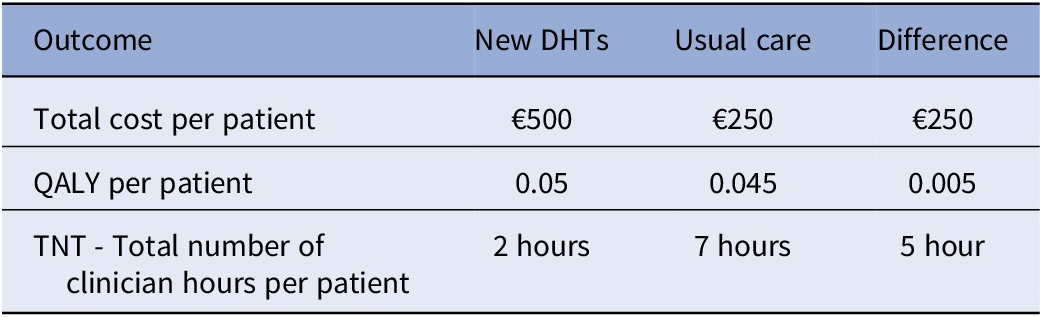
To illustrate how the inclusion of TNT in HTAs could significantly improve decision making, consider the following hypothetical example in Table 2.
Example of reporting of economic evaluation including TNT as an outcome

Table 2. Long description
The table consists of four columns: Outcome, New D H T s, Usual care, and Difference. It contains three rows of data:
* Total cost per patient: New D H T s is 500 Euros, Usual care is 250 Euros, with a Difference of 250 Euros.
* Q A L Y per patient: New D H T s is 0.05, Usual care is 0.045, with a Difference of 0.005.
* T N T - Total number of clinician hours per patient: New D H T s is 2 hours, Usual care is 7 hours, with a Difference of 5 hours.
In this example, the ICER is €50,000 per QALY gained. However, the cost per staff hour saved by investing in this DHT is €50 (€250 divided by 5 hours), approximately equivalent to a nurse’s hourly wage, for example, in Denmark (12). Thus, it demonstrates that this DHT provides staff resources at a price similar to hiring a new nurse. Including TNT explicitly allows decision makers to consider workforce capacity and opportunity costs, particularly relevant in health systems facing staffing shortages. It helps align HTA results with strategic goals such as improving system productivity and capacity. It should be noted that adding this metric of “cost per staff hour saved” to the usual ICER metric of “cost per QALY gained” changes the cost-effectiveness analysis into a cost-consequences analysis. This may produce conflicting results across metrics and outcome domains, where decision makers should not rely on a single metric but should make an explicit judgment about the relative importance of the outcomes (Reference Mauskopf, Grant and Stergachis A57).
Estimation of shadow prices
Whereas the first recommendation, regarding the measurement of clinician time, was directly based on the literature review, this second recommendation is more indirectly related to the review and focuses on the valuation and pricing of time.
Both the Danish Medicines Council and the Danish Health Technology Council estimate unit costs of clinician time based on the average annual labor costs for various healthcare professionals (e.g., nurses and physicians). According to the Health Technology Council’s guideline for economic evaluations (12), the unit costs used in analyses should reflect market prices. The average annual labor cost is estimated at DKK 543,029 for a hospital nurse and DKK 1,194,194 for a consultant physician (12;58). When adjusted for effective working hours, including holidays, sick leave, and so on, the hourly cost is DKK 484 and DKK 1,064, respectively.
The UK’s National Institute for Health and Care Excellence (NICE) recommends in its HTA guidelines (58) that reference-case analyses be based on prices reflecting actual NHS expenditures. While NICE advocates the use of Healthcare Resource Groups (HRGs) for estimating service costs, it also acknowledges micro-costing for evaluating novel technologies.
However, Drummond et al. (Reference Drummond, Claxton, Stoddart and Torrance GW48), within a welfarist framework, caution that market prices may not always reflect true opportunity costs due to market failures. Such failures include imperfect competition, monopolies, and regulation (e.g., minimum wages), all of which distort prices from representing the alternative costs, as originally described by Sugden and Williams (Reference Sugden and Williams59). For example, if the healthcare labor market is at full employment, hiring a nurse in one hospital may effectively divert that professional from another productive role in another hospital. In such cases, the opportunity cost may exceed the regulated wage.
To address this discrepancy, economists recommend using shadow prices referring to imputed values that better approximate the true economic cost of resources when market prices are distorted or unavailable (Reference Drummond, Claxton, Stoddart and Torrance GW48). Shadow prices can be derived through competitive market rates, international price comparisons, replacement cost methods, and techniques that reveal stakeholder preferences. (Reference Drummond, Claxton, Stoddart and Torrance GW48).
Practical tools
To address the above challenges, we recommend estimating clinician time costs using shadow prices. Several practical approaches are available:
-
• B1: Prices from Competitive Markets
When public healthcare providers are unable to recruit staff, they often turn to private employment agencies. For example, one Danish agency offers nurses at an hourly rate of DKK 595 (60). This figure exceeds the public sector’s average labor cost, suggesting that the shadow price in this case is approximately 23% higher than the standard rate.
-
• B2: Replacement Costs
Another approach involves using public regional employment agencies such as Vagtordningen at Odense University Hospital (61), where temporary nurses receive a 30% wage supplement over standard pay.
Another practical way to find replacement is, based on local experience, to train newly graduated nurses when experienced professionals are unavailable. This approach often involves an initial investment in training over 6–12 months, potentially adding 10%–20% to the total labor cost over a five-year employment period.
Taken together, these examples suggest that under current labor market conditions in Denmark, the shadow price of clinical staff—particularly nurses—may exceed official wage costs by 10–30 percent. Integrating shadow prices into economic evaluations would consequently increase the estimated value of DHTs that reduce hospital admissions or outpatient visits and, by extension, reduce demand for clinician time.
Shadow prices will likely vary depending on region, healthcare setting, professional group, and even specific job functions. Therefore, they should be contextually estimated for each economic evaluation to reflect the true opportunity costs associated with clinician time in that setting.
Discussion
Based on the review of DHT effects on clinical workload and clinician time, this article proposes two key adjustments to HTA and economic evaluations to better align with the political and practical imperative of addressing demographic pressures and staff shortages on the healthcare system:
-
1. Explicitly estimate and present effects on TNT, and
-
2. Apply shadow pricing to more accurately account for the opportunity cost of clinician time.
Practical examples and methodological tools for implementing these adjustments are also provided. These recommendations aim to ensure more accurate valuation of the effects of DHTs. If DHT demonstrates reduced clinician time, this may improve their attractiveness as investment opportunities within healthcare systems.
However, several challenges are associated with these proposed modifications. First, the estimation of clinician time effects requires the collection of detailed, often patient-level data as part of clinical studies. This can increase the resource burden of such studies and necessitates clear guidelines on evidence standards and reporting formats for time-related outcomes.
Second, although DRG tariffs are widely used in economic evaluations and include some implicit measure of clinician time (62), the actual cost of clinician time within these aggregate figures is often unclear. Moreover, high-cost components such as drugs or procedures may obscure the contribution of clinician time in the overall cost structure. This ambiguity can reduce transparency and may lead to underestimation of the value of time-saving innovations.
Third, measurement of TNT should not be limited to time per patient, but also capture changes in total activity when DHTs are introduced. This is particularly relevant when DHTs increase access to care for populations with low risk or mild disease, as described in the themes from the narrative review.
Fourth, if TNT is presented as an explicit outcome alongside cost and clinical effectiveness, there is a risk of double-counting—if time-based costs are also included in the evaluation. To avoid this, TNT should either be reported strictly as an outcome measure, or clinician time should be valued using shadow pricing.
In addition, the limitations of the narrative review that forms the basis for the recommendations should be considered. These include limited reproducibility, the risk of selection bias, and the absence of a formal risk-of-bias assessment of the included studies (Reference Sukhera14). A systematic review would therefore be relevant to strengthen the evidence base for the recommendations.
The adoption of these adjustments would likely lead to a higher valuation of the time-related effects of DHTs and could shift the balance in decision-making processes. Introducing TNT as a separate outcome, for example, in a cost-consequences evaluation (Reference Mauskopf, Grant and Stergachis A57), might also lay the groundwork for a new decision criterion alongside the traditional measure of willingness to pay per QALY gained. Specifically, policy makers could begin considering the willingness to pay for reducing the need for one full-time healthcare professional per year. Under conditions of full employment, this willingness to pay would align with average labor costs. However, in the context of staff shortages, the willingness to pay may exceed average wages, consistent with the concept of shadow pricing outlined earlier.
Moreover, a greater focus on clinician time in HTA could influence how new technologies are designed and evaluated, shifting priorities to also emphasize time efficiency in addition to clinical outcomes (Reference Gomes, Murray and Raftery16). This shift could lead to the development of more cost-effective DHTs and increase the likelihood of successfully addressing the demographic and workforce challenges facing modern healthcare systems.
Conclusion
Health economic evaluations and HTAs have generally not accounted for the staff shortage in the health care systems resulting from demographic challenges currently, despite strong political attention to these issues. HTAs and economic evaluations typically focus on clinical outcomes and cost-effectiveness but often overlook how new technologies might affect the time requirements for healthcare professionals.
This oversight may result in the under-prioritization of digital and other technologies that could help mitigate staffing shortages by reducing the workload on clinical staff. This article has presented conceptual arguments and practical methods to adjust health economic evaluations and apply cost-consequence analysis to better reflect demographic challenges. By explicitly measuring TNT or applying shadow prices to clinician time, assessments of DHTs can more accurately capture their full value, potentially leading to better-informed investment and policy decisions that support a more sustainable healthcare system.
Funding statement
This research received no specific grant from any funding agency, commercial, or not-for-profit sectors.

 Open access

