Human kinship involves what it means to be kin, to act like kin, and how we are kin in a mutually understood manner through kinship relations. Kinship relations can be expressed either genealogically, by recursively tracing from one individual to another (Bennardo & Read Reference Bennardo and Read2007; Leaf & Read Reference Leaf and Read2010; Read Reference Read, Feinberg and Ottenheimer2001; Reference Read, Jones and Milicic2010; submitted) using parent, child and spouse relations, or by kin terms that identify categories of genealogical relations: “if there is any universal here … all speech communities use both category and genealogy … in explaining kinship to themselves and to others” (Parkin Reference Parkin2009, p. 165). That is, we should view “the genealogical and the terminological spaces as co-existing conceptual structures with overlap arising through application of the symbols from these two conceptual structures to the same domain of persons.” (Read 2001, p. 80; contra Jones's misrepresentation in sect. 5.2).
But why two systems, and what is the relationship between the two systems? Jones does not address the first question and wants to answer the second by mapping genealogical relations to kin terms with OT rules. To see the problem, start with the usual answer to the first question, namely that categorization makes the combinatorial explosion produced through genealogical tracing cognitively manageable.
The categories, as we will now show, are determined through computing kin relations directly and without reference to genealogy using a kin term product for a pair of kin terms, K and L, defined as the kin term, M, that Ego would (properly) use for alter2 when Ego (properly) refers to alter1 by the kin term L and alter1 (properly) refers to alter2 by the kin term K (Read 1984; 2001; Reference Read2007 among others). For English speakers, the kin term product of daughter and uncle is cousin, for if you (Ego) refer to a man (alter1) as uncle and that man refers to a girl (alter2) as daughter, then you know to refer to that girl as cousin from knowledge of your kinship terminology even without knowing the genealogical relations involved.
That people in all societies compute kin relations through kin terms products is well documented through numerous ethnographic examples quoted in Read (2001; Reference Read2007). For example:
“Kinship reckoning on Rossel [New Guinea] does not rely on knowledge of kin-type strings…. What is essential in order to apply a kin term to an individual X, is to know how someone else, of a determinate kinship type to oneself, refers to X. From that knowledge alone, a correct appellation can be deduced. For example, suppose someone I call a tîdê ‘sister’ calls X a tp:ee ‘my child’, then I can call X a chênê ‘my nephew’, without having the faintest idea of my genealogical connection to X” (Levinson Reference Levinson2006, p. 18; emphasis added).
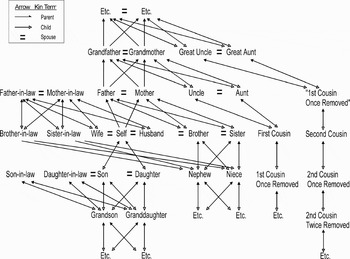
This computational knowledge embedded in a kinship terminology can be made explicit through systematic elicitation of kin terms using kin term products with the kin terms for the core, structural positions in a family (Leaf Reference Leaf2006; Leaf & Read Reference Leaf and Read2010) and displaying the structural relations among the elicited terms through a kin term map (see Fig. 1). The form of the map is terminology specific. From this map we can calculate kin term products without reference to genealogy; for example, the kin term product, nephew of grandmother, yields first cousin once removed since one goes from self to nephew in the map by the kin term product, child of child of parent, and that product takes us from grandmother to first cousin once removed.
Figure 1.
Kin term map for the American kinship terminology based on kin term products with the primary kin terms parent, child and spouse. An arrow indicates the result of taking the kin term product of the kin term at the base of the arrow with the primary kin term represented by that arrow. Double-headed arrows are used in lieu of a pair of parallel arrows.
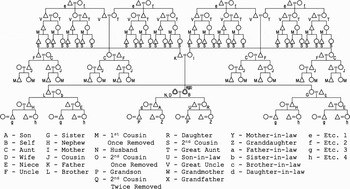
We now construct (hence predict) the genealogical definitions of the English kin terms from the kin term map. First map the primary kin terms to their corresponding genealogical categories: mother→{m}, father→{f}, son→{s} and daughter →{d}. Then express any kin term as a product of primary kin terms and compute the set product for the corresponding genealogical categories to determine the predicted category of genealogical relations for that kin term. For example, from the kin term map, uncle=son of grandmother+son of grandfather+husband of daughter of grandmother+husband of daughter of grandfather, so uncle→{mm, fm}{s}∪{ff, fm}{s}∪{mm, mf}{d}{h}∪{ff, fm}{d}{h}={mms, fms, ffs, fms, mmdh, mfdh, ffdh, fmdh}={mb, fb, mzh, fzh}, where∪is set union, b is the genealogical relation brother, z is the genealogical relation sister, h is the affinal relation husband, and genealogical strings are written in the reverse order from kin term products. Using this procedure, we obtain 100% agreement between predicted and actual genealogical definitions of kin terms (see Fig. 2). This accounts for the genealogical definitions of kin terms upon which the OT rules are based. The rules, then, are just describing the inverse of this fundamental mapping to genealogy determined from the cultural knowledge embedded in the system of kin terms.
Figure 2.
Predicted mapping of American kin terms shown in Figure 1 onto genealogical positions in a genealogical grid. The predicted mapping agrees perfectly with the genealogical definition of kin terms. Δ – male marked position, ○ – female marked position,=– spouse relation, vertical line – parent/child relation, horizontal line – sibling relation. Note: 2nd Cousin Once/Twice Removed not shown due to size of the grid.
Even more problematic, we may generate a kinship terminology using kin term products in accordance with established universal properties of kinship terminology structures and without reference to genealogy (Read 2001; Reference Read2007). Terminology structures begin with a core structure of ascending kin terms generated using either (1) a parent kin term as a generating term (this accounts for the properties of descriptive kinship terminologies such as the American/English terminology) or (2) a parent kin term and a sibling kin term as generating terms (this accounts for the properties of classificatory terminologies such as the Seneca terminology discussed by Jones), then expand the structure with a structure of descending kin terms isomorphic to the ascending structure (along with structural equations that define reciprocity between ascending and descending generating kin terms), then introduce sex marking of kin terms, and lastly generate affinal terms through a spouse, generating the term. The kinship terminology generated in this manner has the form of an algebraic structure, hence the use of algebraic formalism to express the underlying generative logic. The grammar of a kinship terminology lies in this generative account (see Read 2001, table 2; Bennardo & Read Reference Bennardo and Read2007, Fig. 1), not the OT rules as they only address the consequences of the generative logic of a terminology.
Lastly, the rules posited by Jones violate the required universality of constraints: “Optimality theory hypothesizes that the set of well-formedness constraints is universal: not just universally available to be chosen from, but literally present in every language” (Prince & Smolensky Reference Prince and Smolensky1997, p. 1605; emphasis added). Jones uses terminology specific constraints (see especially Note 1) and achieves the appearance of universality only through low ranking of constraints irrelevant to a terminology. Consider the terminology of the !Kung San, a hunter-gatherer group in the northwestern part of Botswana among whom I did fieldwork. Their kin term usage depends on a name giver-name receiver relationship established when a newborn is named for a close relative (Marshall Reference Marshall1976). A constraint based on the name giver–name receiver relationship would not be universal and placing it low in the ranking for other terminologies does not make it universal. Without universality, OT rules reduce to description and hence have unclear connection, if any, to cognitive processes.





Human kinship involves what it means to be kin, to act like kin, and how we are kin in a mutually understood manner through kinship relations. Kinship relations can be expressed either genealogically, by recursively tracing from one individual to another (Bennardo & Read Reference Bennardo and Read2007; Leaf & Read Reference Leaf and Read2010; Read Reference Read, Feinberg and Ottenheimer2001; Reference Read, Jones and Milicic2010; submitted) using parent, child and spouse relations, or by kin terms that identify categories of genealogical relations: “if there is any universal here … all speech communities use both category and genealogy … in explaining kinship to themselves and to others” (Parkin Reference Parkin2009, p. 165). That is, we should view “the genealogical and the terminological spaces as co-existing conceptual structures with overlap arising through application of the symbols from these two conceptual structures to the same domain of persons.” (Read 2001, p. 80; contra Jones's misrepresentation in sect. 5.2).
But why two systems, and what is the relationship between the two systems? Jones does not address the first question and wants to answer the second by mapping genealogical relations to kin terms with OT rules. To see the problem, start with the usual answer to the first question, namely that categorization makes the combinatorial explosion produced through genealogical tracing cognitively manageable.
The categories, as we will now show, are determined through computing kin relations directly and without reference to genealogy using a kin term product for a pair of kin terms, K and L, defined as the kin term, M, that Ego would (properly) use for alter2 when Ego (properly) refers to alter1 by the kin term L and alter1 (properly) refers to alter2 by the kin term K (Read 1984; 2001; Reference Read2007 among others). For English speakers, the kin term product of daughter and uncle is cousin, for if you (Ego) refer to a man (alter1) as uncle and that man refers to a girl (alter2) as daughter, then you know to refer to that girl as cousin from knowledge of your kinship terminology even without knowing the genealogical relations involved.
That people in all societies compute kin relations through kin terms products is well documented through numerous ethnographic examples quoted in Read (2001; Reference Read2007). For example:
“Kinship reckoning on Rossel [New Guinea] does not rely on knowledge of kin-type strings…. What is essential in order to apply a kin term to an individual X, is to know how someone else, of a determinate kinship type to oneself, refers to X. From that knowledge alone, a correct appellation can be deduced. For example, suppose someone I call a tîdê ‘sister’ calls X a tp:ee ‘my child’, then I can call X a chênê ‘my nephew’, without having the faintest idea of my genealogical connection to X” (Levinson Reference Levinson2006, p. 18; emphasis added).
This computational knowledge embedded in a kinship terminology can be made explicit through systematic elicitation of kin terms using kin term products with the kin terms for the core, structural positions in a family (Leaf Reference Leaf2006; Leaf & Read Reference Leaf and Read2010) and displaying the structural relations among the elicited terms through a kin term map (see Fig. 1). The form of the map is terminology specific. From this map we can calculate kin term products without reference to genealogy; for example, the kin term product, nephew of grandmother, yields first cousin once removed since one goes from self to nephew in the map by the kin term product, child of child of parent, and that product takes us from grandmother to first cousin once removed.
Kin term map for the American kinship terminology based on kin term products with the primary kin terms parent, child and spouse. An arrow indicates the result of taking the kin term product of the kin term at the base of the arrow with the primary kin term represented by that arrow. Double-headed arrows are used in lieu of a pair of parallel arrows.
We now construct (hence predict) the genealogical definitions of the English kin terms from the kin term map. First map the primary kin terms to their corresponding genealogical categories: mother→{m}, father→{f}, son→{s} and daughter →{d}. Then express any kin term as a product of primary kin terms and compute the set product for the corresponding genealogical categories to determine the predicted category of genealogical relations for that kin term. For example, from the kin term map, uncle=son of grandmother+son of grandfather+husband of daughter of grandmother+husband of daughter of grandfather, so uncle→{mm, fm}{s}∪{ff, fm}{s}∪{mm, mf}{d}{h}∪{ff, fm}{d}{h}={mms, fms, ffs, fms, mmdh, mfdh, ffdh, fmdh}={mb, fb, mzh, fzh}, where∪is set union, b is the genealogical relation brother, z is the genealogical relation sister, h is the affinal relation husband, and genealogical strings are written in the reverse order from kin term products. Using this procedure, we obtain 100% agreement between predicted and actual genealogical definitions of kin terms (see Fig. 2). This accounts for the genealogical definitions of kin terms upon which the OT rules are based. The rules, then, are just describing the inverse of this fundamental mapping to genealogy determined from the cultural knowledge embedded in the system of kin terms.
Predicted mapping of American kin terms shown in Figure 1 onto genealogical positions in a genealogical grid. The predicted mapping agrees perfectly with the genealogical definition of kin terms. Δ – male marked position, ○ – female marked position,=– spouse relation, vertical line – parent/child relation, horizontal line – sibling relation. Note: 2nd Cousin Once/Twice Removed not shown due to size of the grid.
Even more problematic, we may generate a kinship terminology using kin term products in accordance with established universal properties of kinship terminology structures and without reference to genealogy (Read 2001; Reference Read2007). Terminology structures begin with a core structure of ascending kin terms generated using either (1) a parent kin term as a generating term (this accounts for the properties of descriptive kinship terminologies such as the American/English terminology) or (2) a parent kin term and a sibling kin term as generating terms (this accounts for the properties of classificatory terminologies such as the Seneca terminology discussed by Jones), then expand the structure with a structure of descending kin terms isomorphic to the ascending structure (along with structural equations that define reciprocity between ascending and descending generating kin terms), then introduce sex marking of kin terms, and lastly generate affinal terms through a spouse, generating the term. The kinship terminology generated in this manner has the form of an algebraic structure, hence the use of algebraic formalism to express the underlying generative logic. The grammar of a kinship terminology lies in this generative account (see Read 2001, table 2; Bennardo & Read Reference Bennardo and Read2007, Fig. 1), not the OT rules as they only address the consequences of the generative logic of a terminology.
Lastly, the rules posited by Jones violate the required universality of constraints: “Optimality theory hypothesizes that the set of well-formedness constraints is universal: not just universally available to be chosen from, but literally present in every language” (Prince & Smolensky Reference Prince and Smolensky1997, p. 1605; emphasis added). Jones uses terminology specific constraints (see especially Note 1) and achieves the appearance of universality only through low ranking of constraints irrelevant to a terminology. Consider the terminology of the !Kung San, a hunter-gatherer group in the northwestern part of Botswana among whom I did fieldwork. Their kin term usage depends on a name giver-name receiver relationship established when a newborn is named for a close relative (Marshall Reference Marshall1976). A constraint based on the name giver–name receiver relationship would not be universal and placing it low in the ranking for other terminologies does not make it universal. Without universality, OT rules reduce to description and hence have unclear connection, if any, to cognitive processes.