


Introduction
Thriving at work has been defined as a positive psychological state that fosters personal growth in the workplace (Niessen, Sonnentag, & Sach, Reference Niessen, Sonnentag and Sach2012; Spreitzer, Porath, & Gibson, Reference Spreitzer, Porath and Gibson2012). Thriving occurs through the joint sense of vitality (e.g., feeling energized) and learning (e.g., continuously acquiring and applying knowledge). Meta-analytical findings (Kleine, Rudolph, & Zacher, Reference Kleine, Rudolph and Zacher2019) indicate that the social embeddedness framework of thriving at work (Spreitzer, Sutcliffe, Dutton, Sonenshein, & Grant, Reference Spreitzer, Sutcliffe, Dutton, Sonenshein and Grant2005) has been gaining traction in recent years. More than 60 studies have been published since Spreitzer et al.'s (Reference Spreitzer, Sutcliffe, Dutton, Sonenshein and Grant2005) seminal work and several research designs have been used within the thriving scholarship. Indeed, diary studies (Niessen, Sonnentag, & Sach, Reference Niessen, Sonnentag and Sach2012), cross-sectional investigations (Paterson, Luthans, & Jeung, Reference Paterson, Luthans and Jeung2014), multilevel/multiwave studies (Walumbwa, Muchiri, Misati, Wu, & Meiliani, Reference Walumbwa, Muchiri, Misati, Wu and Meiliani2018), multisource research (Alikaj, Ning, & Wu, Reference Alikaj, Ning and Wu2021), and mixed-method studies (Hennekam, Reference Hennekam2017; Taneva & Arnold, Reference Taneva and Arnold2018) have been used to examine the thriving nomological network. Furthermore, research findings across various industries suggest that thriving at work is critically important from a managerial standpoint (Walumbwa et al., Reference Walumbwa, Muchiri, Misati, Wu and Meiliani2018). Empirical work showed that thriving is positively associated with outcomes such as employees' health, individual performance (task and creative), unit performance, and negatively with turnover intentions (Alikaj, Ning, & Wu, Reference Alikaj, Ning and Wu2021; Anjum, Marri, & Khan, Reference Anjum, Marri and Khan2016; Taneva & Arnold, Reference Taneva and Arnold2018; Walumbwa et al., Reference Walumbwa, Muchiri, Misati, Wu and Meiliani2018). Thus, understanding the factors that underpin thriving at work is key for sustaining organizational competitiveness.
Spreitzer et al.'s (Reference Spreitzer, Sutcliffe, Dutton, Sonenshein and Grant2005) theoretical model suggested individual, relational, and contextual enablers of the thriving experience. Lower levels of perceived stress, positive affect, high-quality relationships with coworkers, coworker support, and feeling treated with respect, all contribute to increased levels of thriving at work (Carmeli, Brueller, & Dutton, Reference Carmeli, Brueller and Dutton2009; Carmeli & Spreitzer, Reference Carmeli and Spreitzer2009; Niessen, Sonnentag, & Sach, Reference Niessen, Sonnentag and Sach2012; Paterson, Luthans, & Jeung, Reference Paterson, Luthans and Jeung2014; Porath, Spreitzer, Gibson, & Garnett, Reference Porath, Spreitzer, Gibson and Garnett2012; Zhai, Wang, & Weadon, Reference Zhai, Wang and Weadon2020). In contrast, the role of job stressors on the thriving experience is far from being clearly understood (Kleine, Rudolph, & Zacher, Reference Kleine, Rudolph and Zacher2019; Prem, Ohly, Kubicek, & Korunka, Reference Prem, Ohly, Kubicek and Korunka2017). For instance, although it is known that relational resources such as high-quality relationships with coworkers are inherently motivating and foster growth (Niessen, Sonnentag, & Sach, Reference Niessen, Sonnentag and Sach2012; Spreitzer et al., Reference Spreitzer, Sutcliffe, Dutton, Sonenshein and Grant2005), less attention has been directed to explore whether job stressors influence the quality of coworkers' interactions (Walumbwa, Christensen-Salem, Perrmann-Graham, & Kasimu, Reference Walumbwa, Christensen-Salem, Perrmann-Graham and Kasimu2020). Following recent calls to further investigate the role of stressors and relational resources in the thriving experience (Paterson, Luthans, & Jeung, Reference Paterson, Luthans and Jeung2014; Prem et al., Reference Prem, Ohly, Kubicek and Korunka2017; Rego, Cavazotte, Cunha, Valverde, Meyer, & Giustiniano, Reference Rego, Cavazotte, Cunha, Valverde, Meyer and Giustiniano2020; Walumbwa et al., Reference Walumbwa, Christensen-Salem, Perrmann-Graham and Kasimu2020; Yang & Li, Reference Yang and Li2021), this study's first goal is to examine the role played by workplace agism, namely negative age metabeliefs and associated reactions, in shaping thriving at work. Aging societies and increasingly age diverse workforces (Boehm, Kunze, & Bruch, Reference Boehm, Kunze and Bruch2014; Scheuer & Loughlin, Reference Scheuer and Loughlin2020) have been transforming the organizational landscape in most Western countries and, hence, age is becoming a salient social category for age-based categorizations and stereotyping. By extension, negative age-based metastereotypes, that is, individual negative beliefs concerning stereotypes other age groups hold about one's ingroup (Finkelstein, Ryan, & King, Reference Finkelstein, Ryan and King2013) are likely to be activated. In line with recent developments that showed negative age-based metastereotypes predict relevant work outcomes in different age groups (von Hippel, Kalokerinos, Haanterä, & Zacher, 2019), we anticipate negative associations between agist beliefs and thriving at work across the lifespan. Additionally, we seek to address whether agist negative beliefs trigger a hindrance, a challenge, or both types of response (Lazarus & Folkman, Reference Lazarus and Folkman1984; Searle & Auton, Reference Searle and Auton2015). With that in mind, we posit that age-based stereotype threat and challenge mediate the relationship between negative age-based metastereotypes and thriving throughout the working life. Besides measuring thriving at work as a composite of learning and vitality, this study also measures the two components of thriving independently. The reason thereto is twofold: on the one hand, the lack of studies describing the role of agist beliefs and associated reactions as antecedents of thriving at work, and, on the other hand, the risk of overlooking valuable information by relying exclusively on thriving as a compound measure (Kleine, Rudolph, & Zacher, Reference Kleine, Rudolph and Zacher2019; Oliveira, Reference Oliveira2021). For example, it is important to examine whether age bounded phenomena like the late-career work disengagement (Damman, Henkens, & Kalmijn, Reference Damman, Henkens and Kalmijn2013) are or are not reinforced by negative age metabeliefs, and thus undermine the overall thriving experience of older workers.
Given that turnover intentions are commonly regarded as one of the best proxies of actual voluntary turnover (Wong & Cheng, Reference Wong and Cheng2020), this study's second aim is to investigate the relationship between thriving at work and turnover intentions. To disentangle each dimension role in the relationship with turnover intentions, both overall and dimension scores will be analyzed (Kleine, Rudolph, & Zacher, Reference Kleine, Rudolph and Zacher2019). In doing so, this study examines the extent to which (dis)agreement between learning and vitality scores predicts turnover intentions, thus enhancing our knowledge of thriving at work consequences.
Bringing the thriving at work and agism scholarships together, this study aims to contribute to the development of the thriving at work nomological network in several ways. By putting the spotlight on how negative age metabeliefs influence the thriving experience throughout working lives, this study seeks to contribute to the development of evidence-based HR interventions tailored to different age groups. Relatedly, this study aims to broaden the research about thriving dimensionality (Prem et al., Reference Prem, Ohly, Kubicek and Korunka2017; Yang & Li, Reference Yang and Li2021) by examining the relationships between both overall and thriving dimensions separately, their antecedents, and an attitudinal outcome. To our knowledge, this is one of the first studies to systematically analyze and report both overall and thriving dimension scores, thereby extending the Spreitzer et al.'s (Reference Spreitzer, Sutcliffe, Dutton, Sonenshein and Grant2005) model of thriving at work. Against this background, a theoretical model was developed (Figure 1).
Theoretical model.

Theoretical background and hypotheses
Thriving at work
Thriving at work refers to ‘the joint sense of vitality and learning, which communicates a sense of progress or forward movement in one's self-development’ (Spreitzer et al., Reference Spreitzer, Sutcliffe, Dutton, Sonenshein and Grant2005, p. 538). Defined as a positive psychological state and developed within a social embeddedness framework (Spreitzer et al., Reference Spreitzer, Sutcliffe, Dutton, Sonenshein and Grant2005), thriving at work fosters personal growth in the workplace (Spreitzer, Porath, & Gibson, Reference Spreitzer, Porath and Gibson2012). Thriving occurs through the simultaneous experience of vitality (e.g., feeling energized and enthusiastic) and learning (e.g., continuous acquiring and applying knowledge). These two dimensions capture the affective and cognitive aspects of psychological growth, respectively, and they both need to be high for an employee to experience thriving (Alikaj, Ning, & Wu, Reference Alikaj, Ning and Wu2021). Thriving at work is distinct from related concepts such as flow, flourishing, resilience, subjective well-being, positive affect, and work engagement (Spreitzer et al., Reference Spreitzer, Sutcliffe, Dutton, Sonenshein and Grant2005) to the extent that it emphasizes the positive experience of human growth and development founded on the joint sense of vitality and learning (Kleine, Rudolph, & Zacher, Reference Kleine, Rudolph and Zacher2019). Differently from subjective well-being, thriving combines hedonic and eudaimonic elements, and it exhibits incremental predictive validity above and beyond positive affect and work engagement for task performance and burnout (Kleine, Rudolph, & Zacher, Reference Kleine, Rudolph and Zacher2019).
The socially embedded model of thriving at work (Spreitzer et al., Reference Spreitzer, Sutcliffe, Dutton, Sonenshein and Grant2005) comprises individual (e.g., perceived stress), relational (e.g., heedful interactions), and contextual (e.g., trust climate) enablers of the thriving experience. Following recent calls to investigate further (a) the role of stressors (Prem et al., Reference Prem, Ohly, Kubicek and Korunka2017; Yang & Li, Reference Yang and Li2021), and (b) relational resources in the thriving experience (Paterson, Luthans, & Jeung, Reference Paterson, Luthans and Jeung2014; Rego et al., Reference Rego, Cavazotte, Cunha, Valverde, Meyer and Giustiniano2020; Walumbwa et al., Reference Walumbwa, Christensen-Salem, Perrmann-Graham and Kasimu2020), this study aims to examine the role played by workplace agism, namely metabeliefs and associated reactions, in shaping thriving at work.
Workplace agism
Agism was first defined as a set of conceptions about age expressed through attitudes and discriminatory practices usually against older people (Butler, Reference Butler1969). Today, this definition is broader as it is accepted that agism may target any age group. In fact, age discrimination often targets younger and older employees (Duncan & Loretto, Reference Duncan and Loretto2004; European Commission, 2012). Workplace age discriminatory behaviors are grounded in age stereotypes, that is, in shared beliefs and expectations about workers due to their age (Posthuma & Campion, Reference Posthuma and Campion2009). Based on the process of categorization and group membership, stereotypes are a key aspect of intergroup behavior by allowing group members to make sense of intergroup relationships. Against the backdrop of increasing age diversity in the workplace (Scheuer & Loughlin, Reference Scheuer and Loughlin2020), age has become a more salient social category for age-based sub-grouping in Western countries (Boehm, Kunze, & Bruch, Reference Boehm, Kunze and Bruch2014), thus contributing to separate workers in classes such as ‘old,’ ‘young,’ and ‘middle-aged.’ Most research on workplace stereotypes focuses on older worker stereotypes, although some scholars have extended research to younger and middle-aged worker stereotypes (Finkelstein, Ryan, & King, Reference Finkelstein, Ryan and King2013). Although negative stereotypes about older workers far exceed positive ones (Posthuma & Campion, Reference Posthuma and Campion2009), the picture gets more nuanced regarding younger and middle-aged worker stereotypes. For instance, Finkelstein, Ryan, and King (Reference Finkelstein, Ryan and King2013) found that younger workers were predominantly stereotyped in negative terms by their middle-aged colleagues, whereas older workers held essentially positive stereotypes about the younger workers age group. Additionally, middle-aged workers were mostly characterized in positive light by other work age groups, although negative stereotypes about this age group were also found.
Negative age-based metastereotypes
Despite its contributions, research on workplace age stereotypes is of limited value as regards understanding intergroup relations. With organizational age diversity increasing (Scheuer & Loughlin, Reference Scheuer and Loughlin2020), research about metastereotypes, that is, stereotypical beliefs other age groups hold about one's ingroup (Finkelstein, Ryan, & King, Reference Finkelstein, Ryan and King2013), seems to be in the best place to fill that gap (Judd, Park, Yzerbyt, Gordijn, & Muller, Reference Judd, Park, Yzerbyt, Gordijn and Muller2005). In fact, recent research shows that negative age-based metastereotypes may call into question the quality of intergenerational dynamics in the workplace (Finkelstein, Ryan, & King, Reference Finkelstein, Ryan and King2013, Reference Finkelstein, Voyles, Thomas and Zacher2019; von Hippel et al., Reference von Hippel, Kalokerinos, Haanterä and Zacher2019). For instance, negative age metastereotyping was negatively associated with job satisfaction and organizational commitment, and positively associated with work disengagement and organizational disidentification among workers from different age groups (Oliveira & Cabral-Cardoso, Reference Oliveira and Cabral-Cardoso2018; von Hippel, Kalokerinos, & Henry, Reference von Hippel, Kalokerinos and Henry2013; von Hippel et al., Reference von Hippel, Kalokerinos, Haanterä and Zacher2019). In this context, it seems reasonable to assume that negative age-based metastereotypes may also influence thriving at work and do so in at least two ways. First, employees may feel depleted by the demands posed by a negative view of their ingroup held by coworkers, and as a result they may experience lower levels of vitality. Second, as negative age metastereotyping diminishes the likelihood of interactions and cooperation with coworkers of other age groups (Oliveira & Cabral-Cardoso, Reference Oliveira and Cabral-Cardoso2018), acquiring new knowledge and learning may become more challenging. Indeed, high-quality relationships with coworkers were positively linked to thriving (Niessen, Sonnentag, & Sach, Reference Niessen, Sonnentag and Sach2012), and coworker support and feeling treated with respect seems to help employees feel powerful in their pursuit for personal growth (Carmeli, Brueller, & Dutton, Reference Carmeli, Brueller and Dutton2009; Zhai, Wang, & Weadon, Reference Zhai, Wang and Weadon2020).
Relations with coworkers have a major influence on how employees make sense of their work environment (Takeuchi, Yun, & Wong, Reference Takeuchi, Yun and Wong2011), and explain employee outcomes above and beyond direct supervisor's influence (Chiaburu & Harrison, Reference Chiaburu and Harrison2008). Therefore, coworkers are one of the primary referents in most workplaces (Chiaburu & Harrison, Reference Chiaburu and Harrison2008). Given that social exchanges with coworkers are shaped by attributed intergroup beliefs (Shiu, Hassan, & Parry, Reference Shiu, Hassan and Parry2015), age identity threats may become an important workplace stressor (Walumbwa et al., Reference Walumbwa, Christensen-Salem, Perrmann-Graham and Kasimu2020). Heedful relating to coworkers may be obstructed because stereotyped employee's need for a positive age identity is not met (Tajfel & Turner, Reference Tajfel, Turner, Austin and Worchel1979), and, for that reason, positive social exchanges based on mutual trust, interdependence, and reciprocity are not developed (Cropanzano & Mitchell, Reference Cropanzano and Mitchell2005). By extension, coworkers helping and supporting behaviors that foster learning and vitality at work are not likely to materialize due to avoidance or conflict behaviors (Finkelstein, Voyles, Thomas, & Zacher, Reference Finkelstein, Voyles, Thomas and Zacher2019; Niessen, Sonnentag, & Sach, Reference Niessen, Sonnentag and Sach2012). Herewith, we contend that employees may not thrive or exhibit lower levels of thriving as an effect of the negative social identities conveyed by negative age-based metastereotypes (Tajfel & Turner, Reference Tajfel, Turner, Austin and Worchel1979). Specifically, dealing with negative age-based metastereotypes can be effortful, increase perceived stress and hence vitality might be hindered. At the same time, as thriving at work occurs through high-quality interactions with others (Spreitzer et al., Reference Spreitzer, Sutcliffe, Dutton, Sonenshein and Grant2005), negative age-based metastereotypes have the potential to decrease the rate and the quality of social interactions with coworkers, thus diminishing learning opportunities. Taken together, these arguments suggest negative associations between agist beliefs and thriving at work across the lifespan. Notwithstanding the scarcity of middle-aged workers negative age stereotypes (Posthuma & Campion, Reference Posthuma and Campion2009), middle-age negative age-based metastereotypes were identified (Finkelstein, Ryan, & King, Reference Finkelstein, Ryan and King2013). We, therefore, posit that, along with their younger and older counterparts (Finkelstein et al., Reference Finkelstein, Voyles, Thomas and Zacher2019; von Hippel et al., Reference von Hippel, Kalokerinos, Haanterä and Zacher2019), middle-aged workers are also vulnerable to negative age-based metastereotypes activation and related consequences. The following hypothesis is, hence, formulated:
Hypothesis 1: Negative age-based metastereotypes are negatively related to overall thriving at work.
Although differential effects of job stressors and lifespan development constructs like occupational future time perspective on the learning and vitality dimensions have been evinced (Oliveira, Reference Oliveira2021; Prem et al., Reference Prem, Ohly, Kubicek and Korunka2017, respectively), recent meta-analytical evidence showed that researchers usually do not report results for vitality and learning separately (Kleine, Rudolph, & Zacher, Reference Kleine, Rudolph and Zacher2019). Hence, this study aims to fill this gap by examining separately the association between negative age-based metastereotypes and the two components of thriving. Since thriving at work has been defined as the joint sense of learning and vitality (Spreitzer et al., Reference Spreitzer, Sutcliffe, Dutton, Sonenshein and Grant2005), a negative relationship between negative age-based metastereotypes and at least one of the thriving components is likely to hinder workers' thriving. We thus hypothesize that:
Hypothesis 1a: Negative age-based metastereotypes are negatively related to learning.
Hypothesis 1b: Negative age-based metastereotypes are negatively related to vitality.
Negative age-based metastereotype reactions: age-based stereotype threat and challenge
Consistent with the age-based metastereotype activation model (Finkelstein, King, & Voyles, Reference Finkelstein, King and Voyles2015) and with empirical evidence (Finkelstein et al., Reference Finkelstein, Voyles, Thomas and Zacher2019; von Hippel et al., Reference von Hippel, Kalokerinos, Haanterä and Zacher2019), employees may interpret metastereotypes either as challenges or as threats. Stress appraisal style theory (Lazarus & Folkman, Reference Lazarus and Folkman1984) categorizes job stressors as challenge stressors or hindrance stressors. A challenge appraisal is made when the employee perceives a situation as having potential for growth or gain, whereas a hindrance appraisal reflects one's frustration of being inhibited to pursue self-development (Lazarus & Folkman, Reference Lazarus and Folkman1984; Searle & Auton, Reference Searle and Auton2015). Importantly, challenge appraisal and hindrance appraisal are not mutually exclusive given that the same situation may be perceived as both a challenge and a threat (Searle & Auton, Reference Searle and Auton2015; Yang & Li, Reference Yang and Li2021). Moreover, research has evinced that although both types of job stressors have negative effects, challenge appraisals may give rise to desirable outcomes such as engagement and performance (LePine, LePine, & Jackson, Reference LePine, LePine and Jackson2004; LePine, Podsakoff, & LePine, Reference LePine, Podsakoff and LePine2005; Yang & Li, Reference Yang and Li2021). For instance, in a recent diary study with 124 knowledge workers, Prem et al. (Reference Prem, Ohly, Kubicek and Korunka2017) investigated the differential effects of two job stressors (time pressure and learning demands) on thriving at work and concluded that challenge stressors have a positive total effect on learning, but no total effect on vitality. In line with these findings, we contend that a better understanding of employee thriving at work would be obtained by the examination of the mediated relationships between negative age-based metastereotypes and thriving at work. Specifically, this study examines the mediation role of two negative age-based metastereotype reactions: threat and challenge (Finkelstein, King, & Voyles, Reference Finkelstein, King and Voyles2015).
A considerable amount of literature has been published about the positive relationship between negative age-based metastereotype and age-based stereotype threat (e.g., Voyles, Finkelstein, & King, Reference Voyles, Finkelstein and King2014). Age-based stereotype threat refers to the worry or concern of being at risk of confirming a negative age stereotype about one's group (Steele & Aronson, Reference Steele and Aronson1995). Recent findings suggest that negative age-based metastereotype and age-based stereotype threat are separate components of the age-based stereotype threat nomological network, and that the latter is likely to occur as an emotional reaction to negative metabeliefs (Finkelstein et al., Reference Finkelstein, Voyles, Thomas and Zacher2019; Oliveira & Cabral-Cardoso, Reference Oliveira and Cabral-Cardoso2018). Age-based stereotype threat was positively associated with conflict and avoidance, and negatively with engagement (Finkelstein et al., Reference Finkelstein, Voyles, Thomas and Zacher2019; Kulik, Perera, & Cregan, Reference Kulik, Perera and Cregan2016). Building on the aforementioned findings, it is argued that age-based stereotype threat is likely to mediate the relationship between negative age metabeliefs and thriving at work. Indeed, findings highlight lower engagement levels and lower-quality interactions between age groups as recurrent consequences of age-based stereotype threat in organizations (Finkelstein et al., Reference Finkelstein, Voyles, Thomas and Zacher2019; von Hippel et al., Reference von Hippel, Kalokerinos, Haanterä and Zacher2019). In this type of work contexts, negative age metabeliefs may trigger stereotype threat, which in turn may yield intergenerational tensions harmful to the thriving everyday experience. Following this rationale, hypothesis 2 is formulated:
Hypothesis 2: Age-based stereotype threat mediates the relationship between negative age-based metastereotypes and overall thriving.
Since thriving occurs through the concurrent experience of high levels of learning and vitality (Spreitzer et al., Reference Spreitzer, Sutcliffe, Dutton, Sonenshein and Grant2005), two hypotheses were set to specifically address the effects of age-based stereotype threat on thriving components:
Hypothesis 2a: Age-based stereotype threat mediates the relationship between negative age-based metastereotypes and learning.
Hypothesis 2b: Age-based stereotype threat mediates the relationship between negative age-based metastereotypes and vitality.
Although a growing body of literature has investigated negative age metastereotype consequences (Finkelstein et al., Reference Finkelstein, Voyles, Thomas and Zacher2019; von Hippel, Kalokerinos, & Henry, Reference von Hippel, Kalokerinos and Henry2013), a comprehensive view of the reactions elicited by metastereotypes is far from being accomplished. Besides triggering age threat, negative metastereotypes may also prompt mixed reactions (e.g., pride and resentment) to the negative stereotypical belief (Finkelstein, King, & Voyles, Reference Finkelstein, King and Voyles2015). This type of reaction was dubbed challenge and refers to the motivation to confront and disprove the negative age-based metastereotype. The degree to which workers respond to negative metastereotypes by feeling worried or/and by trying to prove them false seems to be contingent on the (im)balance between personal and contextual demands and resources (LePine, Podsakoff, & LePine, Reference LePine, Podsakoff and LePine2005; Mendes & Jamieson, Reference Mendes, Jamieson, Inzlicht and Schmader2012; von Hippel et al., 2019). Challenge reactions are more likely in situations in which stigmatized workers feel they have the resources to overcome the demands, and conversely, a threat reaction is to be expected when workers feel overburden by workplace demands (Lazarus & Folkman, Reference Lazarus and Folkman1984; Mendes & Jamieson, Reference Mendes, Jamieson, Inzlicht and Schmader2012). The challenge reaction has been positively associated with job satisfaction (Cavanaugh, Boswell, Roehling, & Boudreau, Reference Cavanaugh, Boswell, Roehling and Boudreau2000), job engagement, and with commitment (von Hippel et al., Reference von Hippel, Kalokerinos, Haanterä and Zacher2019). Additionally, a recent daily diary study highlighted the positive relationship between challenge and engagement with others (Finkelstein et al., Reference Finkelstein, Voyles, Thomas and Zacher2019), which in turn may contribute to increased learning levels as engaging behaviors facilitate higher-quality interactions with coworkers (Finkelstein, King, & Voyles, Reference Finkelstein, King and Voyles2015). Drawing on the above explanations, we posit that:
Hypothesis 3: Challenge mediates the relationship between negative age-based metastereotypes and overall thriving.
Hypothesis 3a: Challenge mediates the relationship between negative age-based metastereotypes and learning.
Hypothesis 3b: Challenge mediates the relationship between negative age-based metastereotypes and vitality.
Turnover intentions
Our rationale for the right side of the conceptual model is as follows. Due to the critical value of human capital, the identification of turnover intention determinants is at the heart of the agenda of organizations willing to retain their most strategic asset (Chang, Wang, & Huang, Reference Chang, Wang and Huang2013). Turnover intentions are a negative job attitude that refers to the conscious and deliberate willingness to leave an organization (Chang, Wang, & Huang, Reference Chang, Wang and Huang2013). Since turnover intentions are commonly regarded as a direct antecedent of actual voluntary turnover behavior (Wong & Cheng, Reference Wong and Cheng2020), a better understanding of the individual and contextual features that inhibit intentions to leave the organization would help managers increase the effectiveness of retention practices (Chang, Wang, & Huang, Reference Chang, Wang and Huang2013). This knowledge is particularly useful in countries high in power distance and low in masculinity – like Portugal – in which the turnover intentions–behavior link is stronger (Wong & Cheng, Reference Wong and Cheng2020).
Given that thriving at work occurs through the simultaneous experience of acquiring new competencies and feeling energized (Spreitzer et al., Reference Spreitzer, Sutcliffe, Dutton, Sonenshein and Grant2005), it is likely that this positive psychological state of growth and development reduces turnover intentions (Anjum, Marri, & Khan, Reference Anjum, Marri and Khan2016; Hennekam, Reference Hennekam2017). This might be the case because professional contexts in which workers thrive are likely to be perceived as supportive and hence attractive environments for employees (Cho, Johanson, & Guchait, Reference Cho, Johanson and Guchait2009; Zhai, Wang, & Weadon, Reference Zhai, Wang and Weadon2020). Furthermore, a recent meta-analysis showed that thriving at work correlates weakly and negatively with turnover intentions (Kleine, Rudolph, & Zacher, Reference Kleine, Rudolph and Zacher2019). Following recent calls for research on thriving at work to report both overall and dimension scores (Kleine, Rudolph, & Zacher, Reference Kleine, Rudolph and Zacher2019; Prem et al., Reference Prem, Ohly, Kubicek and Korunka2017), the following set of hypotheses was formulated:
Hypothesis 4: Overall thriving at work is negatively related to turnover intentions.
Hypothesis 4a: Learning is negatively related to turnover intentions.
Hypothesis 4b: Vitality is negatively related to turnover intentions.
Methodology
Participants and procedures
The participants of this study were recruited through the researcher professional and personal networks. The resulting convenience sample (Shaughnessy, Zechmeister, & Zechmeister, Reference Shaughnessy, Zechmeister and Zechmeister2014) totaled 326 workers aged 19-to-68 (123 males, 203 females) working in 20 companies located in Portugal. Considering that 80% of the participants work in the service sector, the gender distribution of the sample (62.3% female) mirrors reasonably well the female labor force participation rate in the tertiary sector in Portugal. As of 2020, women accounted for 57.2% of the total Portuguese labor force in this sector (FFMS, 2021). Fifty-seven percent of the participants work in large companies (with more than 249 workers), 88% work full-time, and 22% hold a supervisor role. Most respondents were in a relationship (76%) and about 55% had completed higher education. The average age of participants was 41.84 years (sd = 12.78), the average tenure in the organization 12.93 years (sd = 11.58), and the average seniority in the job 14.02 years (sd = 11.71).
Participants' socio-demographic information and focal measures were collected using an online survey. The agism-related measures in the survey were randomized to avoid the order effect bias and to improve the quality of survey responses (Shaughnessy, Zechmeister, & Zechmeister, Reference Shaughnessy, Zechmeister and Zechmeister2014). From the onset, participants were ensured that the survey followed the EU General Data Protection Regulation 2016/679 (GDPR), informed about the aims of the study, and about whom to contact regarding data confidentiality issues (Podsakoff, MacKenzie, Lee, & Podsakoff, Reference Podsakoff, MacKenzie, Lee and Podsakoff2003). Participation in the study was individual, voluntary, and dropping out of the research was possible at any time. Upon this information, written informed consent was obtained from every participant.
All the scales were selected from the literature and then translated into Portuguese by translation experts using a translation/back-translation procedure. As negative age-based metastereotypes concern stereotypical beliefs other age groups hold about one's ingroup (Finkelstein, Ryan, & King, Reference Finkelstein, Ryan and King2013), three age groups were generated using the following thresholds: younger workers (less than 35 years old); middle-aged workers (35–49 years old), and older workers (50 years old or above). This comprehensive age group classification is commonly used in the literature (Hennekam, Reference Hennekam2017; Peters, Van der Heijden, Spurk, De Vos, & Klaassen, Reference Peters, Van der Heijden, Spurk, De Vos and Klaassen2019) and aims to surpass the shortcomings of studying a single age group, thus providing an across lifespan research perspective (Bohlmann, Rudolph, & Zacher, Reference Bohlmann, Rudolph and Zacher2018).
Bearing in mind the concerns raised by single respondents and the study's cross-sectional design, data were examined for common method variance through the Harman's single-factor test (Podsakoff et al., Reference Podsakoff, MacKenzie, Lee and Podsakoff2003). No single variable explained above 50% of the total variance in any of the three age group models. Subsequently, the marker variable technique (Lindell & Whitney, Reference Lindell and Whitney2001) was used. Following recommendations (Lindell & Whitney, Reference Lindell and Whitney2001; Schaller, Patil, & Malhotra, Reference Schaller, Patil and Malhotra2015), a theoretically unrelated marker variable – safety compliance (Neal & Griffin, Reference Neal and Griffin2006) – was included in the survey. The safety compliance scale refers to behaviors that develop an environment that supports safety. It comprises three items (e.g., ‘I use all the necessary safety equipment to do my job’), and it was measured with the same 7-point Likert scale used for measuring criterion variables. The computation of zero-order correlations and corrected partial correlations was followed by the assessment of the significance of the corrected correlations (Lindell & Whitney, Reference Lindell and Whitney2001; Schaller, Patil, & Malhotra, Reference Schaller, Patil and Malhotra2015). Partial correlations were not significantly smaller than the corresponding zero-order correlations, and hence concerns that common method variance inflates results are alleviated.
Mediation hypotheses were tested with model 4 of the Hayes macro PROCESS v3.5 for SPSS Statistics (Hayes, Reference Hayes2018). Following the guidelines suggested by Hayes (Reference Hayes2018), significance tests for the indirect effects were based on percentile bootstrap confidence intervals (95% CIs, seed number = 007) derived from 10,000 bootstrapped samples. The right part of our model was examined with polynomial regression with response surface analysis (Shanock, Baran, Gentry, Pattison, & Heggestad, Reference Shanock, Baran, Gentry, Pattison and Heggestad2010) to explore whether the (in)congruence between learning and vitality scores is related to changes in the relationship between thriving and turnover intentions (Bohlmann, Rudolph, & Zacher, Reference Bohlmann, Rudolph and Zacher2018; Kleine, Rudolph, & Zacher, Reference Kleine, Rudolph and Zacher2019).
Measures
Unless stated otherwise, participants answered on a 5-point response scale ranging from 1 (never) to 5 (all the time). Single-source data were collected given that focal variables are inherently idiosyncratic constructs.
Negative age-based metastereotypes
Six items were adapted from Oliveira and Cabral-Cardoso (Reference Oliveira and Cabral-Cardoso2018) to measure negative age-based metastereotypes held by each of the three age groups under examination (younger, middle-aged, and older). In this way, three scales were developed. Items were structured as follows ‘My [younger/middle-aged/older] colleagues feel that I contribute less because of my age.’ The interitem reliabilities of these measures range from α = .90 (middle-aged workers) to α = .95 (younger workers).
Age-based stereotype threat
Workers rated their experience of threat through a 3-item scale developed by Shapiro (Reference Shapiro2011) with interitem reliabilities of α = .94 (younger workers) and α = .95 (middle-aged and older workers). An example item is ‘I am concerned that my actions might poorly represent workers of my age group.’
Challenge
A 3-item measured adapted from Finkelstein, King, and Voyles (Reference Finkelstein, King and Voyles2015, Reference Finkelstein, Voyles, Thomas and Zacher2019) captured the challenge reaction. A sample item is ‘I'm feeling motivated to show others at work that I am better than their expectations they have of me because of my age,’ and the interitem reliabilities of these scales range from α = .71 (middle-aged workers) to α = .76 (older workers).
Thriving at work
Building on the measure validated by Porath et al. (Reference Porath, Spreitzer, Gibson and Garnett2012), the overall thriving at work scale comprised of 10 items, five for learning (one reversed) and five for vitality (one reversed). All items were measured with a 7-point Likert scale, from 1 = strongly disagree to 7 = strongly agree. A sample item of the learning component is ‘I continue to learn more and more as time goes by,’ and of the vitality component is ‘I feel alive and vital.’ All the thriving scales showed good interitem reliabilities (Tables 1–4). Additionally, confirmatory factor analyses (CFA) were performed for each age group separately. The analyses showed that the two sets of five items loaded above .50 on separate latent learning and vitality dimensions for younger (χ2(33, N = 104) = 52.26, RMSEA = .08, CFI = .95, TLI = .94), middle-aged (χ2(33, N = 119) = 57.43, RMSEA = .08, CFI = .95, TLI = .94), and older workers (χ2(33, N = 102) = 43.43, RMSEA = .06, CFI = .97, TLI = .96). Moreover, these two factors loaded on a second-order latent factor representing thriving at work (χ2(34, N = 104) = 63.92, RMSEA = .09, CFI = .93, TLI = .91), (χ2(34, N = 119) = 75.79, RMSEA = .10, CFI = .92, TLI = .90), and (χ2(34, N = 102) = 58.04, RMSEA = .08, CFI = .94, TLI = .92), for younger, middle-aged and older workers, respectively.
Descriptive statistics and correlations (overall sample)

Notes. *p < .05, **p < .01, ***p < .001 level (two-tailed), N = 326 for all variables. Reliabilities (coefficient alpha) are in parentheses.
Descriptive statistics and correlations (younger workers)
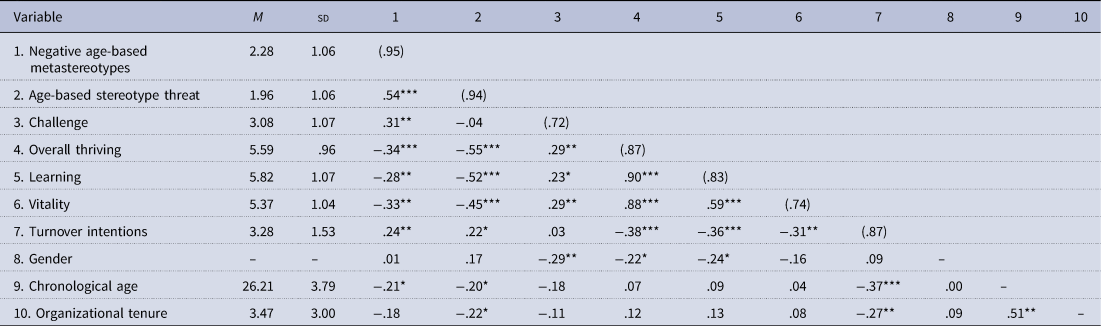
Notes. *p < .05, **p < .01, ***p < .001 level (two-tailed), N = 104 for all variables. Reliabilities (coefficient alpha) are in parentheses.
Descriptive statistics and correlations (middle-aged workers)
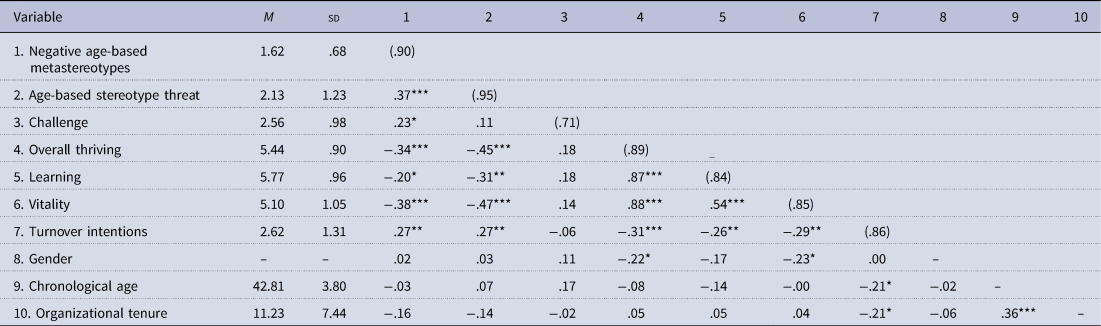
Notes. *p < .05, **p < .01, *** p < .001 level (two-tailed), N = 120 for all variables. Reliabilities (coefficient alpha) are in parentheses.
Descriptive statistics and correlations (older workers)

Notes. *p < .05, **p < .01, ***p < .001 level (two-tailed), N = 102 for all variables. Reliabilities (coefficient alpha) are in parentheses.
Turnover intentions
Turnover intentions were measured with a 4-item scale (one reversed) and rated on a 6-point Likert scale, from 1 = strongly disagree to 6 = strongly agree (Nissly, Mor Barak, & Levin, Reference Nissly, Mor Barak and Levin2005). A sample item is ‘I occasionally think about leaving this organization.’ In this study, the interitem reliabilities of these measures range from α = .70 (older workers) to α = .87 (younger workers).
Control variables
Chronological age, gender, and organizational tenure were included as control variables since previous research showed that these between-person variables may be related to thriving (Hennekam, Reference Hennekam2017; Niessen, Sonnentag, & Sach, Reference Niessen, Sonnentag and Sach2012), as well as with turnover intentions (Chang, Wang, & Huang, Reference Chang, Wang and Huang2013).
Results
Table 1 presents descriptive statistics, the correlation matrix, and Cronbach's alphas across the entire sample. Tables 2, 3, and 4 report the statistics for the younger, middle-aged, and older age groups, respectively. All scales have reasonable to very good internal consistency alphas.
Analytical procedures
The factorial structure of the scales (negative age-based metastereotypes, age-based stereotype threat, challenge, learning, and vitality) was analyzed through CFAs conducted in AMOS.
For reasons of clarity, CFA results are hereafter reported by age group. Younger workers' CFA results showed that all items loaded higher than .40 on their respective scales and that a five-factor model (χ2(196, N = 104) = 300.39, RMSEA = .07, CFI = .94, TLI = .92) fits the data better than (1) a four-factor model with negative age-based metastereotype reactions combined (χ2(199, N = 104) = 376.92, RMSEA = .09, CFI = .89, TLI = .87: χ2 difference [df = 3] = 76.53, p < .001), (2) a four-factor model with thriving dimensions combined (χ2(199, N = 104) = 335.14, RMSEA = .08, CFI = .92, TLI = .90: χ2 difference [df = 3] = 34.75, p < .001), and (3), a three-factor model with agism measures combined (χ2(202, N = 104) = 616.71, RMSEA = .14, CFI = .74, TLI = .71: χ2 difference [df = 6] = 316.32, p < .001). Regarding the middle-aged workers group, item loadings were also above. 40 on the respective scales and a five-factor model (χ2(195, N = 119) = 333.43, RMSEA = .08, CFI = .92, TLI = .91) fits the data better than (1) a four-factor model with negative age-based metastereotype reactions combined (χ2(198, N = 119) = 415.34, RMSEA = .10, CFI = .88, TLI = .86: χ2 difference [df = 3] = 81.91, p < .001), (2) a four-factor model with thriving dimensions combined (χ2(199, N = 119) = 419.33, RMSEA = .10, CFI = .88, TLI = .86: χ2 difference [df = 4] = 85.9, p < .001), and (3), a three-factor model with agism measures combined (χ2(201, N = 119) = 820.07, RMSEA = .16, CFI = .65, TLI = .60: χ2 difference [df = 6] = 486.64, p < .001). Finally, along the same lines of the previously mentioned CFAs, older workers' CFA results showed similar loading values and that a five-factor model (χ2(194, N = 101) = 332.42, RMSEA = .08, CFI = .91, TLI = .910) fits the data better than (1) a four-factor model with negative age-based metastereotype reactions combined (χ2(198, N = 101) = 414.69, RMSEA = .11, CFI = .86, TLI = .84: χ2 difference [df = 4] = 82.27, p < .001), (2) a four-factor model with thriving dimensions combined (χ2(198, N = 101) = 436.92, RMSEA = .11, CFI = .85, TLI = .82: χ2 difference [df = 4] = 104.5, p < .001), and (3), a three-factor model with agism measures combined (χ2(201, N = 101) = 770.77, RMSEA = .17, CFI = .64, TLI = .59: χ2 difference [df = 7] = 438.35, p < .001). Furthermore, collinearity statistics indicated that multicollinearity was not a concern – Variance Inflation Factor (VIF) ranging from 1.06 (middle-aged workers' challenge scale) to 1.65 (younger workers negative age-based metastereotypes scale), and tolerance values ranging from .61 (younger workers negative age-based metastereotypes scale) to .94 (middle-aged workers' challenge scale).
Hypotheses testing
For parsimonious reasons, gender was retained in the younger and middle-aged worker mediation models, and chronological age and organizational tenure were excluded from further mediation analyses (Carlson & Wu, Reference Carlson and Wu2012). Since mediator effects may change due to the presence of other mediators, hypotheses 1 to 3b were tested through a parallel multiple mediator model (Hayes, Reference Hayes2018). Moreover, our theoretical model predicted a detrimental (via age-based stereotype threat) and a beneficial (via challenge) mediation pathway from negative age-based metastereotypes to thriving (MacKinnon, Coxe, & Baraldi, Reference MacKinnon, Coxe and Baraldi2012). Regression coefficients and other statistics pertinent to mediation models' analyses are summarized in Table 5. Path coefficients are covered in the statistical diagrams in Figure 2.
Parallel multiple mediator models. Path coefficients for younger workers (panel A), middle-aged workers (panel B), and older workers (panel C). Numbers inside parentheses represent the total effect of negative age-based metastereotypes on thriving at work. ***p < .001, **p < .01, *p < .05.

Regression coefficients, standard errors, and parallel multiple mediation model summary information

Negative age-based metastereotypes were negatively associated with overall thriving across age groups. Hence, hypothesis 1 was supported. Taking a closer look at the relationships between negative age-based metastereotypes and both components of thriving, a rather nuanced picture emerges. No significant relationships were found between younger and middle-aged workers negative age-based metastereotypes and learning, and between older workers negative age-based metastereotypes vitality. Herewith, hypotheses 1a and 1b were partially supported.
For the sake of clarity, results are henceforth reported by age group. Analyses showed significant indirect effects of younger workers negative age-based metastereotypes through age-based stereotype threat on overall thriving (β = −.21, 95% CI [−.37, −.08]), and also through challenge (β = .11, 95% CI [.03, .21]). Overall, the partially mediated model explained 43% of the thriving variance. The middle-aged group mediation model explained 36% of the thriving variance, with the following indirect effects through age-based stereotype threat (β = −.14, 95% CI [−.24, −.05]), and through challenge (β = .07, 95% CI [.01, .15]). Similarly, the older workers mediation model explained 35% of the thriving variance, and indirect effects on overall thriving through age-based stereotype threat (β = −.19, 95% CI [−.31, −.08]), and through challenge (β = .07, 95% CI [.01, .14]) were found. Pairwise comparisons between the two indirect effects in this model showed a statistically significant difference (C1 = .12, 95% CI [.01, .24]). Taken together, these results supported hypotheses 2 and 3.
Hypotheses 2a, 2b, 3a, and 3b rest on the assumption that the way stressors are understood may yield differential effects on learning and vitality (Prem et al., Reference Prem, Ohly, Kubicek and Korunka2017). As can be seen in Table 5, mixed results were found. Specifically, indirect effects on learning through age-based stereotype threat for younger (β = −.23, 95% CI [−.40, −.09]), and middle-aged workers (β = −.10, 95% CI [−.21, −.02]) were evinced, whereas no significant effect was observed in the older workers age group (β = −.10, 95% CI [−.21, .02]). Furthermore, positive indirect effects of negative age-based metastereotypes on learning through challenge were found for younger (β = .09, 95% CI [.01, .19]), and middle-aged workers (β = .06, 95% CI [.01, .13]), and no significant effect was found for older workers (β = .04, 95% CI [−.01, .11]). Therefore, hypotheses 2a and 3a were partially supported. As regards vitality, statistically significant indirect effects of both mediators were found across age groups. The threat and the challenge effect were higher among older workers (β = −.22, 95% CI [−.34, −.10]), and younger workers (β = .11, 95% CI [.03, .20]), respectively. Hence, hypotheses 2b and 3b were supported.
The right part of our model was explored through hierarchical multiple regression (chronological age, gender, and organizational tenure as control variables), and polynomial regression with response surface analysis. The fourth hypothesis proposed that overall thriving is negatively related to turnover intentions. As predicted, these two constructs were negatively associated (β = −.34, se = .06, p < .001), supporting hypothesis 4. In line with expectations, learning (β = −.26, se = .06, p < .001) and vitality (β = −.13, se = .06, p < .05) were also negatively linked to turnover intentions. Therefore, hypotheses 4a and 4b were supported. Although unpredicted, regression analyses by age group showed the usefulness of considering thriving dimensions discretely. Learning was negatively related to turnover intentions among younger (β = −.22, p < .05, se = .11), and older workers (β = −.33, p < .001, se = .09), but unrelated to middle-aged workers turnover intentions (β = −.18, p = .08, se = .10). Conversely, a significant negative relationship between vitality and turnover intentions was only found in the middle-aged workers group (β = −.21, p < .05, se = .09).
Post hoc examination of learning and vitality (in)congruence
Considering that both learning and vitality predict turnover intentions in the overall sample, and following recent recommendations on the thriving and aging literature (Bohlmann, Rudolph, & Zacher, Reference Bohlmann, Rudolph and Zacher2018; Kleine, Rudolph, & Zacher, Reference Kleine, Rudolph and Zacher2019; Prem et al., Reference Prem, Ohly, Kubicek and Korunka2017), we examined whether or not the (dis)agreement between learning and vitality scores predicted turnover intentions. In order to disentangle effects of different combinations of learning and vitality on turnover intentions, we followed the approach suggested by Shanock et al. (Reference Shanock, Baran, Gentry, Pattison and Heggestad2010). As such, descriptive information about the discrepancy level between the two thriving dimensions was computed (Table 6). Since most participants held discrepant values, we proceeded to polynomial regression with response surface analysis.
Frequencies of learning levels over, under and in-agreement with vitality levels

Note. N = 326.
Results depicted in Figure 3 show the benefits of the post hoc examination. The negative slope (a1: β = −.40, p < .001, se = .12) along the line of congruence (x = y) indicates that turnover intentions decreased as both learning and vitality increased. The concave surface along the line of incongruence (a4: β = −.22, p = .05, se = .11) is marginally significant, indicating that turnover intentions decreased more sharply as the degree of the discrepancy between learning and vitality increased. Overall, turnover intentions decreased as learning and/or vitality increased, although the joint sense of learning and vitality had a stronger effect on reducing turnover intentions.
Turnover intentions as predicted by the learning and vitality (in)congruence.

Discussion
This study was set out aiming to: (1) examine the role played by workplace agism, namely negative age metabeliefs and associated reactions in shaping thriving at work and (2) explore the relationship of overall thriving at work and different combinations of learning and vitality with turnover intentions.
Regarding the first aim, our findings clearly demonstrated that negative intergroup age metabeliefs (Shiu, Hassan, & Parry, Reference Shiu, Hassan and Parry2015) were negatively associated with thriving at work. Consistent with the idea that younger workers are especially concerned about how they are perceived by others (Wang, Burlacu, Truxillo, James, & Yao, Reference Wang, Burlacu, Truxillo, James and Yao2015), and with recent empirical research (Finkelstein et al., Reference Finkelstein, Voyles, Thomas and Zacher2019; von Hippel et al., Reference von Hippel, Kalokerinos, Haanterä and Zacher2019), younger workers experienced higher levels of negative age-based metastereotypes than older and middle-aged workers. Additionally, this study indicated that middle-aged workers are also vulnerable to metastereotype consequences, thus challenging the assumption that ‘middle-aged workers seem to represent an idealized worker about whom expectations are consistently quite positive’ (Finkelstein, Ryan, & King, Reference Finkelstein, Ryan and King2013, p. 21). It is interesting to note that although negative age-based metastereotypes were negatively related to overall thriving throughout the working life, no significant relationships were found between metastereotypes held by younger and middle-aged workers and learning. Given that younger and middle-aged workers are offered more opportunities to learn when compared with older workers (Raemdonck, Beausaert, Fröhlich, Kochoian, & Meurant, Reference Raemdonck, Beausaert, Fröhlich, Kochoian, Meurant, Bal, Kooij and Rousseau2014), and tend to have a more expansive occupational future time perspective than older workers (Rudolph, Kooij, Rauvola, & Zacher, Reference Rudolph, Kooij, Rauvola and Zacher2018), metastereotypes per se are not likely to obstruct learning experiences in these two age groups. In contrast, organizational obstacles for older workers learning stemmed from negative stereotypes about these workers willingness to participate in learning activities (Ng & Feldman, Reference Ng and Feldman2012; Raemdonck et al., Reference Raemdonck, Beausaert, Fröhlich, Kochoian, Meurant, Bal, Kooij and Rousseau2014) which might reduce their learning opportunities. Additionally, this result may be explained by a few individual level factors. Because older workers have a more constrained perception of their future in the employment context, there is a preference for social relatedness over knowledge-related goals (Rudolph et al., Reference Rudolph, Kooij, Rauvola and Zacher2018). It is likely that they are protecting themselves from the strain generated by learning activities through avoidance behaviors since those types of activities might confirm negative stereotypes damaging older workers group reputation and image (Kanfer & Ackerman, Reference Kanfer and Ackerman2004; Oliveira & Cabral-Cardoso, Reference Oliveira and Cabral-Cardoso2018; Raemdonck et al., Reference Raemdonck, Beausaert, Fröhlich, Kochoian, Meurant, Bal, Kooij and Rousseau2014; Tajfel & Turner, Reference Tajfel, Turner, Austin and Worchel1979). Another related finding was that vitality was not negatively associated with older workers negative age-based metastereotypes. These results differ from recent work that showed that older workers tend to react to negative age metabeliefs by means of disengagement (von Hippel et al., Reference von Hippel, Kalokerinos, Haanterä and Zacher2019). This discrepancy may be due to ingroup identification levels of older workers. Since the likelihood of negative age-based metastereotypes to trigger avoidance behaviors and work disengagement is greater in highly identified older workers (Oliveira & Cabral-Cardoso, Reference Oliveira and Cabral-Cardoso2017), it seems possible that these results may be due to low levels of ingroup identification. Indeed, dissociative age-group responses are one of the coping strategies older individuals often use to deal with age stigma (Weiss & Lang, Reference Weiss and Lang2012). Additionally, since older workers are more likely to focus on prevention or regulation of losses than on career growth (Damman, Henkens, & Kalmijn, Reference Damman, Henkens and Kalmijn2013), the hindering effect negative age metabeliefs could play in reducing older workers growth opportunities becomes negligible.
This study confirmed that negative age-based metastereotypes trigger a mixed set of responses, which in turn shape thriving at work to different extents. Both threat and challenge responses were found across all age groups (Finkelstein et al., Reference Finkelstein, Voyles, Thomas and Zacher2019; LePine, Podsakoff, & LePine, Reference LePine, Podsakoff and LePine2005; Searle & Auton, Reference Searle and Auton2015), with threat and challenge exhibiting a negative and a positive effect on overall thriving, respectively. Interestingly, the challenge reaction was significantly higher in younger workers when compared with other age groups. This could partly be explained by the fact that younger workers are especially prone to feedback seeking behaviors to fit coworkers' expectations (Wang et al., Reference Wang, Burlacu, Truxillo, James and Yao2015). Therefore, to promote their need to belong and to be seen by others in positive light (Tajfel & Turner, Reference Tajfel, Turner, Austin and Worchel1979), negative metastereotypes must be challenged. Findings are in line with this rationale, as challenge appraisals among younger workers gave rise to higher levels of learning and vitality than in any of the other age groups (LePine, LePine, & Jackson, Reference LePine, LePine and Jackson2004, Reference LePine, Podsakoff and LePine2005; Prem et al., Reference Prem, Ohly, Kubicek and Korunka2017). In short, demands placed upon younger workers by negative age-based metastereotypes seem to be perceived partially as surmountable and having potential for growth, and for this reason, younger workers invest their energy and engage in learning activities to overcome those demands (Lazarus & Folkman, Reference Lazarus and Folkman1984; Mendes & Jamieson, Reference Mendes, Jamieson, Inzlicht and Schmader2012). Mediation models' results across age groups indicated that the magnitude of the negative total effect is quite similar, and that indirect effects of negative age-based metastereotypes through age-based stereotype threat were greater than through challenge. Taken together, these findings indicate that negative age-based metastereotypes may become an important workplace stressor (Lazarus & Folkman, Reference Lazarus and Folkman1984; Searle & Auton, Reference Searle and Auton2015; Yang & Li, Reference Yang and Li2021). This may be particularly acute for older workers as results show that the two indirect effects are statistically different (Hayes, Reference Hayes2018), suggesting that the detrimental effect of negative agist metabeliefs on thriving is far from being canceled by the attempt to challenge negative age-based metastereotypes (Finkelstein et al., Reference Finkelstein, Voyles, Thomas and Zacher2019). This is in line with previous studies which proposed negative age-based metastereotypes as relevant drivers of older workers age-based stereotype threat experience (Oliveira & Cabral-Cardoso, Reference Oliveira and Cabral-Cardoso2017, Reference Oliveira and Cabral-Cardoso2018), and reported negative links between negative agist metabeliefs and desirable job attitudes (von Hippel et al., Reference von Hippel, Kalokerinos, Haanterä and Zacher2019). Furthermore, it is worth noting that the magnitude of the relationships between negatively framed constructs like negative age-based metastereotypes or age-based stereotype threat and thriving may well be underestimated due to the positive manifold effect (Kleine, Rudolph, & Zacher, Reference Kleine, Rudolph and Zacher2019). If that is the case, workers of all ages may be even more vulnerable to the harmful consequences of negative age-based metastereotypes than our findings indicate.
As with direct effects, the analysis of the mediation's total effects for learning and vitality separately sheds important light on the mechanisms by which agism influences the thriving experience. For instance, examination of mediation results on overall thriving alone fails to capture important specific characteristics of the agism–thriving link, particularly among middle-aged and older workers (Kleine, Rudolph, & Zacher, Reference Kleine, Rudolph and Zacher2019; Prem et al., Reference Prem, Ohly, Kubicek and Korunka2017). Although negative age-based metastereotypes had a homologous negative total effect on younger workers learning and vitality, results showed that the total effect is much larger on vitality than learning among middle-aged workers, and the opposite trend was observed in the older workers age group. Those two latter findings are somewhat surprising. Regarding middle-aged results, they might be related to the canceling effects on thriving dimensions of the threat and challenge reactions (LePine, Podsakoff, & LePine, Reference LePine, Podsakoff and LePine2005; Searle & Auton, Reference Searle and Auton2015), and to the aforementioned lack of connection between middle-aged workers negative age-based metastereotypes and learning. Another possible explanation for this may be that being used to be seen in positive light (Finkelstein, Ryan, & King, Reference Finkelstein, Ryan and King2013), middle-aged workers negative age-based metastereotypes impair quite seriously the quality of interactions with coworkers (Chiaburu & Harrison, Reference Chiaburu and Harrison2008; Tajfel & Turner, Reference Tajfel, Turner, Austin and Worchel1979), which in turn may have a disproportionate negative effect on vitality levels (Niessen, Sonnentag, & Sach, Reference Niessen, Sonnentag and Sach2012; Spreitzer et al., Reference Spreitzer, Sutcliffe, Dutton, Sonenshein and Grant2005). Against a background of negative consequences of negative age-based metastereotypes on vitality, the low levels of negative age-based metastereotypes experienced by middle-aged workers found in this study turn out to be positive for them. As regards older workers, and contrary to expectations (LePine, LePine, & Jackson, Reference LePine, LePine and Jackson2004, Reference LePine, Podsakoff and LePine2005), the challenge reaction did not positively affect learning at work, while age-based stereotype threat seemed to discourage employees from acquiring new knowledge, hence reducing workplace learning. Concurrent explanations for the older workers thriving experience may be found on the negative direct effect of metastereotyping on learning (Niessen, Sonnentag, & Sach, Reference Niessen, Sonnentag and Sach2012; Prem et al., Reference Prem, Ohly, Kubicek and Korunka2017), on the fact that no link was observed between metastereotyping and vitality, and on the larger effect of threat on vitality (Finkelstein et al., Reference Finkelstein, Voyles, Thomas and Zacher2019; Kulik, Perera, & Cregan, Reference Kulik, Perera and Cregan2016). Overall, these findings showed that, in order to better understand employee growth and development, the thriving scholarship would benefit from more investigation that combines thriving as a compound with a look at learning and vitality separately (Oliveira, Reference Oliveira2021).
The second aim of this study was to assess the relationship of overall thriving at work and different combinations of learning and vitality with turnover intentions. Consistent with Spreitzer et al.'s (Reference Spreitzer, Sutcliffe, Dutton, Sonenshein and Grant2005) definition of thriving and with empirical evidence (Anjum, Marri, & Khan, Reference Anjum, Marri and Khan2016), turnover intentions decreased as learning and/or vitality increased, although the joint sense of learning and vitality had a stronger effect on reducing turnover intentions. Importantly, although turnover intentions were negatively predicted by overall thriving and by each of the thriving dimensions in the entire sample, results by age group provide additional evidence for the relevance of looking at learning and vitality consequences separately (Kleine, Rudolph, & Zacher, Reference Kleine, Rudolph and Zacher2019). For instance, learning was driving the results among younger and older workers, whereas vitality had no effect on reducing turnover intentions. In contrast, for middle-aged workers only vitality seemed to play a role in diminishing intentions to leave the organization. The present findings are significant in at least two major respects. First, although learning opportunities are frequently part of the retention package most organizations offer to younger workers, seldom is the same level of learning provision available to older workers (Raemdonck et al., Reference Raemdonck, Beausaert, Fröhlich, Kochoian, Meurant, Bal, Kooij and Rousseau2014). Even considering that older workers commonly have lower turnover intentions than younger workers (Chang, Wang, & Huang, Reference Chang, Wang and Huang2013), and that older workers mean age in this study is relatively low (M = 56.65) placing them about 10 years from reaching retirement age, organizations willing to retain this growing segment of the workforce (Boehm, Kunze, & Bruch, Reference Boehm, Kunze and Bruch2014) should include the provision of more learning activities in their older workers retention efforts. Second, previous research has emphasized that heedful interactions with others are among the most frequent reasons for experiencing vitality (Niessen, Sonnentag, & Sach, Reference Niessen, Sonnentag and Sach2012; Paterson, Luthans, & Jeung, Reference Paterson, Luthans and Jeung2014). In this vein, it seems likely that for middle-aged workers, high-quality working relationships and supportive coworker behaviors are the main factors explaining their turnover intentions (Cho, Johanson, & Guchait, Reference Cho, Johanson and Guchait2009). In other words, middle-aged workers who experience heightened levels of vitality likely perceive the work environment as more attractive, and as a result, do not want to leave the organization. Taken together, this study's findings indicate that a clearer distinction between thriving dimensions role might serve as a valuable catalyst for research on the thriving throughout the lifespan.
Implications for theory and practice
By intersecting the agism and thriving literature, this research has valuable theoretical and practical implications. First, findings emphasize that negative age-based metastereotypes are chiefly perceived as workplace stressors that hinder thriving at work. Therefore, we contend they should be included as antecedents in the thriving nomological network. Second, alongside with negative metastereotypes pivotal role in shaping the thriving experience, we enrich the literature on thriving at work by confirming thriving differential relationships with workplace agism reactions (Prem et al., Reference Prem, Ohly, Kubicek and Korunka2017). Moreover, this research contributes to an across the lifespan perspective of thriving at work by reporting findings by age group, which, in turn, point to the need for more theoretical refinement to account for different agism coping profiles contingent on workers age group (Finkelstein et al., Reference Finkelstein, Voyles, Thomas and Zacher2019; Wang et al., Reference Wang, Burlacu, Truxillo, James and Yao2015). For instance, findings challenge the assumption that negative age-based metastereotypes do not influence middle-aged workers' work experience. In the same vein, a third contribution pertains the usefulness of the examination of thriving dimensions separately (Oliveira, Reference Oliveira2021). Given that thriving refers to the joint sense of elevated levels of learning and vitality (Spreitzer et al., Reference Spreitzer, Sutcliffe, Dutton, Sonenshein and Grant2005), antecedents that obstruct one of these components are sufficient to impede thriving. This study showed, for example, that older workers negative age-based metastereotypes do not seem to influence vitality, but that they seem to prevent the acquisition of new knowledge/skills. Relatedly, this study revealed a set of nuanced relationships between thriving dimensions and turnover intentions across age groups. In short, this study provides additional evidence for the relevance of looking at learning and vitality combinations to better understand the thriving at work nomological network.
This study suggests several courses of action for practitioners. Our findings suggest that to foster thriving across the lifespan, organizational interventions should focus on reframing metastereotypical negative beliefs as challenges (Casad & Bryant, Reference Casad and Bryant2016; von Hippel et al., Reference von Hippel, Kalokerinos, Haanterä and Zacher2019). Interventions that simultaneously value positive social identities of stereotyped workers (Tajfel & Turner, Reference Tajfel, Turner, Austin and Worchel1979), and emphasize an overarching sense of identity with the workgroup/organization (Haslam, Eggins, & Reynolds, Reference Haslam, Eggins and Reynolds2003), are in the best place to circumvent the harmful effects of negative age-based metastereotypes on thriving. For instance, collective self-enhancement programs like mentoring or reverse mentoring are likely to contribute to the creation of cross-cutting ties between workers of all ages, hence allowing the development of heedful relationships with coworkers (Niessen, Sonnentag, & Sach, Reference Niessen, Sonnentag and Sach2012). Furthermore, these interventions may be perceived as an organizational endorsement of the value of intergenerational collaboration, thus providing age identity safety to stigmatized workers which sets the ground for workers to reciprocate such organizational support by engaging, for instance, in more learning activities and being more energetic at work (Cropanzano & Mitchell, Reference Cropanzano and Mitchell2005; Kleine, Rudolph, & Zacher, Reference Kleine, Rudolph and Zacher2019). Another important practical implication is that organizations interested in retaining particularly younger and older workers would benefit greatly by providing context and opportunity for distinct types of learning activities. Such an environment should include formal and non-formal training, but especially informal learning as it is often not perceived as learning by the learners themselves, thus bypassing even workers negative self-images (Eraut, Reference Eraut2004).
Limitations and suggestions for future research
Several caveats are acknowledged in this research, which bring about questions requiring further investigation. First, because most constructs are hard to capture from sources other than workers themselves, constructs were assessed through self-reports. Although we alleviated common method bias concerns, there is still the risk that findings are a product of the measurement method (Podsakoff, MacKenzie, & Podsakoff, Reference Podsakoff, MacKenzie and Podsakoff2012). Also, we cannot exclude the endogeneity problem as omitted variables might be driving the associations between constructs in our model (Antonakis, Bendahan, Jacquart, & Lalive, Reference Antonakis, Bendahan, Jacquart and Lalive2010). Given that boundary conditions were not included in our model, future research regarding the moderation role played by individual factors such as core self-evaluations in the appraisal of workplace stressors such as negative age metabeliefs (Finkelstein et al., Reference Finkelstein, Voyles, Thomas and Zacher2019), would be of great help in crafting organizational interventions aimed at facilitating thriving. Second, the cross-sectional design of this study is not the most suitable to capture age-related effects over time and hence we do not exclude that reverse and reciprocal effects may exist between, for instance, turnover intentions and thriving at work dimensions. Although we believe sound theoretical explanations for relationships between variables were provided, this means causal claims in our model are open to debate. In this context, longitudinal designs and experience sampling methods are needed to analyze the temporal nature of the agism–thriving link. Specifically, since there has been scant research exploring the challenge reaction, and because middle-aged workers have been mostly left aside by research, we suggest future investigations about these two topics should be undertaken. Finally, since agism entails complex patterns rooted, among others, in gender dimensions (Duncan & Loretto, Reference Duncan and Loretto2004) and considering the gender imbalance of our sample, researchers could try to replicate our findings with different gender sample distributions. Overall, forthcoming research in this area should clearly concentrate on the investigation of the thriving dimensions role throughout the lifespan to better inform the thriving scholarship.
Conclusion
This paper started with the claim that ‘every coin has two sides’ and developed several arguments to support this assertion regarding thriving at work. Our findings showed the theoretical relevance and practical usefulness of considering the two sides of the ‘thriving coin’ (learning and vitality) throughout the lifespan. It is said that Protagoras once stated that ‘there are two sides to every question.’ It might well be the case of thriving at work in today's organizations.
Financial support
This research has been financed by Portuguese public funds through FCT – Fundação para a Ciência e a Tecnologia, I.P., in the framework of the project with reference UIDB/04105/2020.
Eduardo Oliveira holds a PhD in Management from the University of Porto and he is the Economics and HRM Master Course Director at the University of Porto. He is currently a member of the Sloan Research Network on Aging & Work. His research focuses on aging workforces, humor at work, and work attitudes.



