

Introduction
The Upland Goose Chloephaga picta is a migratory species endemic to South America. The species usually breeds in Patagonia and then migrates to the south of the Pampas region (Pedrana et al. Reference Pedrana, Seco Pon, Pütz, Bernad, Gorosabel and Muñoz2018, Reference Pedrana, Pütz, Bernad, Muñóz, Gorosábel and Castresana2020; Petracci et al. Reference Petracci, Marbán, Ibáñez, Meriggi, Cereghetti and Klimaitis2019). It spends the winter there and can form mixed flocks with other sheldgoose species (C. poliocephala and C. rubidiceps) (Petracci Reference Petracci2011; Summers and McAdam Reference Summers and McAdam1993). However, some authors consider the existence of permanent resident populations or secondary wintering sites linked to the energetic cost involved in migration (Martin Reference Martin1984; Pedrana et al. Reference Pedrana, Seco Pon, Pütz, Bernad, Gorosabel and Muñoz2018; Punta Reference Punta2019).
The ability to use cultivated areas as a food source, combined with the expansion of the agricultural frontier, has led to conflicts with rural producers in Argentina, eventually forcing the Upland Goose to concentrate in smaller areas (Canevari Reference Canevari1996; Casares Reference Casares1934; Petracci et al. Reference Petracci, Ibáñez, Scorolli, Cozzani, Blanco and De la Balze2008; Rumboll Reference Rumboll1975). As a result, the species was declared a national plague in 1931, despite the lack of scientific studies to support this claim, contributing to a decline in its population (Bucher Reference Bucher1984; Pergolani de Costa Reference Pergolani de Costa1955; Plotnick Reference Plotnick1961). Nowadays, habitat loss, illegal hunting, and predation by invasive mammals on eggs, chicks, and adults at breeding grounds, are factors that negatively affect this species (Blanco and de La Balze Reference Blanco, De la Balze, Boere, Galbraith and Stroud2006; Cossa et al. Reference Cossa, Fasola, Roesler and Reboreda2017; Madsen et al. Reference Madsen, Matus, Blank, Benegas, Mateazzi and Blanco2003; Martin Reference Martin1984; Matus et al. Reference Matus, Blank, Blanco, Madsen, Benegas and Mateazzi2000). Although the Upland Goose is globally classified as ‘Least Concern’ by the International Union for Conservation of Nature (IUCN) (BirdLife International 2024), its population status in Argentina is more delicate, where it is considered threatened (MAyDS y AA 2017).
The Upland Goose is herbivorous, and its diet varies depending on location and seasonal availability of food sources (Summers and McAdam Reference Summers and McAdam1993). Like other wild birds, geese tend to use different habitats seasonally to maximise access to food resources (Hughes and Green Reference Hughes, Green and Kear2005). During the winter they usually prefer rural areas with planted pastures due to their high nutritional value (Hughes and Green Reference Hughes, Green and Kear2005), while in the breeding season they use mainly wetlands and grasslands, often in association with livestock (Martin Reference Martin1984; Punta Reference Punta2021; Punta et al. Reference Punta, Domínguez and Crespo2024). For migratory birds such as the Upland Goose, obtaining essential nutrients during critical stages of their life-cycle, such as wintering, is vital. The success of migration to breeding areas and the onset of the reproductive cycle depend on the physiological condition attained during the winter (Evans Reference Evans, Perrins, Lebreton and Hirons1991). Therefore, understanding the use of trophic resources is crucial, not only for its ecological implications but for the species’ conservation (Cooch and Cooke Reference Cooch, Cooke, Perrins, Lebreton and Hirons1991), as the reliance on cultivated resources has been a major cause of the conflict that led to its population decline in the last century. Moreover, the species continues to face a negative perception from rural producers.
Studies on the diet of the Upland Goose are scarce in the literature (Gorosábel et al. Reference Gorosábel, Pedrana, Bernad, Caballero, Muñoz and Maceira2019; Martin Reference Martin1984; Punta Reference Punta2019; Punta et al. Reference Punta, Domínguez and Crespo2024; Summers and McAdam Reference Summers and McAdam1993), especially in environments with natural vegetation, or where the diet during breeding and non-breeding seasons are compared, as these areas often do not overlap.
The Sarmiento Valley in central Argentine Patagonia, in Chubut Province, encompasses vast steppes, natural plains, and cultivated areas used for livestock farming. This site is used by the Upland Goose during breeding, migration, and when wintering, during which latter period it reaches maximum population numbers (Punta Reference Punta2019). The aim of this study was to describe and compare the diet of the Upland Goose between breeding and non-breeding seasons, and to evaluate dietary preferences. It was expected that the diet and preferences of the Upland Goose would differ between the breeding and non-breeding seasons, due to variations in nutritional needs and plant availability.
Methods
Study area
The study was conducted in the Sarmiento Valley, also known as the Senguer River Valley, located in the south-east of Chubut Province, Argentina, between Musters and Colhué Huapi lakes (45°35’12.55"S, 69°4’7.60"W) (Figure 1), with an extension of 42,000 ha, comprising vast steppes and natural plains irrigated by the Senguer river and an important channelling system. The main economic activity is cattle breeding, carried out on both on natural and cultivated pastures. According to Corporación de Fomento del Chubut (CORFO 2015, personal communication), of a total of 14,466 ha surveyed, 1,898 ha are cultivated pastures, 168 ha alfalfa Medicago sativa, and 12,400 ha natural wetlands.
The Sarmiento Valley, in Chubut Province, Argentina.

The weather conditions of Sarmiento are typical of the central Patagonian region, with scarce precipitation (average annual precipitation is 166 mm) and high evapotranspiration, caused by winds and low relative humidity (PROSAP 2013). The average temperature of the study period was 10.5°C, oscillating between 7.6°C in winter and 21.8°C in summer (Oliva et al. Reference Oliva, García, Ferrante, Massara, Rimoldi and Díaz2017). Phytogeographically, Sarmiento belongs to the ‘Low shrub steppe’ (Patagonian Province, Central District, Wasteland) vegetation unit, according to the classification proposed by Oyarzabal et al. (Reference Oyarzabal, Clavijo, Oakley, Biganzoli, Tognetti and Barberis2018), formed by low cushion-shaped shrubs and a few grass species that together constitute less than 50% ground cover (León et al. Reference León, Bran, Collantes, Paruelo and Soriano1998). In low-lying areas like the Sarmiento Valley, some halophilic species of the genus Atriplex spp., Lycium ameghinoi, and Neltuma denudans can be found, while in flooded locations, Juncus balticus and Distichlis spp. are observed (Soriano Reference Soriano1956).
Upland Goose in the Sarmiento Valley
The species is present annually in the Sarmiento Valley, with numbers fluctuating between seasons and years. The maximum number of individuals recorded between 2016 and 2019 ranged from 5,806 to 22,966 during the non-breeding season. During the breeding season, spanning mid-September to January, estimated population sizes range between 3,010 and 12,560 individuals (Laztra 2025, unpublished data).
Diet analysis
Since sheldgeese have a simple digestive system with a short intestine and only digest 38% of ingested food, they compensate for this inefficiency by eating good quality food during most of the day (Summers and McAdam Reference Summers and McAdam1993). This low digestibility enables the identification of microscopic plant fragments in faeces, making them appropriate for a microhistological study of diet. This has largely replaced stomach analysis as a procedure for assessing the diet of wild herbivores, since it gives better sampling accuracy and does not require animal sacrifice. Microscopic identification of plant fragments in faeces is based, mainly, on recognition of the epidermis. It should be noted that microhistological analyses may affect the representation of plant taxa, because highly digestible species may be under detected, while species with more resistant epidermal tissues may be overrepresented (Holechek et al. Reference Holechek, Vavra and Pieper1982).
Composite samples (pool of samples) were used for the diet analysis, according to Latour and Pelliza (Reference Latour and Pelliza1981). Each sample comprised 10 fresh faeces from different individuals within the same flock, collected between 2014 and 2019. Composite samples were collected from 21 flocks of Upland Goose, 11 during the breeding seasons (October–January) (n = 11 × 10), and 10 during the non-breeding seasons (March–August) (n = 10 × 10). Samples were collected by randomly selecting flocks throughout the study area.
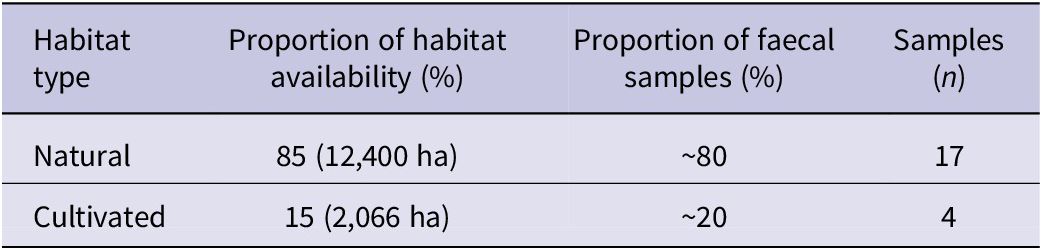
We conducted stratified random sampling across the two predominant habitat types of the study area: natural habitat (≈85% of total area) and cultivated pasture (≈15%) (CORFO 2015, personal communication). Faecal samples were collected proportionally to habitat availability, with approximately 80% of samples obtained from natural habitats and 20% from cultivated habitats (Table 1).
Habitat availability (proportion of cultivated and natural habitats), percentage of each habitat sampled, and total number of samples collected in the Sarmiento Valley, Chubut (2014–2019)

For the microhistological analysis, the faeces of each composite sample were dried in a stove at 60°C and subsequently ground with an analytical grinder (IKA A11). Five slides were made per composite sample, and 20 systematically distributed microscopic fields were analysed on each of the slides (Latour and Pelliza Sbriller Reference Latour and Pelliza1981). Plant items were identified to the lowest possible taxonomic level and classified into three groups: grasses (Poaceae), graminoids (Cyperaceae and Juncaceae), and eudicots (herbaceous eudicots excluding all graminoids). In traditional classifications, eudicots were referred to as ‘dicotyledons’.
The habit (perennial or annual herb) and status (endemic, native or exotic) were indicated where possible. When identification reached only the genus level, it was not always possible to assign a specific habit, as the genus may include multiple species with varying statuses and habits. For the taxa for which status could be assigned (55% of the taxa, 70% of numerical items), the numerical proportion of native versus cultivated items was calculated for both seasons.
To create a reference collection, plant specimens were collected during the study period at the study area. Some plants were collected, identified, and deposited in the Herbario Regional Patagónico of the Facultad de Ciencias Naturales y Ciencias de la Salud (Universidad Nacional de la Patagonia San Juan Bosco) and others were processed in the laboratory to prepare standard slides.
For plant items in faeces that were identified to at least the genus level, the frequency of occurrence (%FO) per sample (composite samples) was calculated. In addition, the numerical frequency (%N) was calculated, defined as the total number of each item in relation to the total number of identified plant items. The Shannon–Weaver index was used to assess dietary diversity. This index ranges from 0.5 to 5, where values below 2 are considered low and values above 3 are considered high (Magurran Reference Magurran1988).
From the numerical values (N), the diets in the breeding and non-breeding seasons were compared by a multivariate analysis of similarity (ANOSIM) using the R package vegan (Oksanen et al. Reference Oksanen, Blanchet and Kindt2016). Firstly, matrices were generated using the Bray–Curtis similarity coefficient (Clarke and Warwick Reference Clarke and Warwick2001). Secondly, permutation procedures were carried out to compare the dissimilarities of the samples by ranges and evaluate statistical differences. The ANOSIM R statistic reaches its maximum value (1) when the dissimilarities between groups are greater than the dissimilarities within groups, and its minimum value (~0) when there are no differences between groups. Finally, to estimate the overlap of the diet between seasons, similarity percentages were calculated: (1-R) × 100. In all cases, R software 4.4.1 was used (R Core Team 2024).
Plant group selection
Vegetation surveys were conducted at 60 randomly selected sites within the study area. The Canfield method was applied, using a 30-m long linear transect that allowed quantitative estimation of plant cover by cluster. Four plant groups were considered for the preference analysis: grasses, graminoids, eudicots, and shrubs. The selection of the main plant groups present in the environment was assessed using the Savage Selection Index (Savage Reference Savage1931), taking values between 0 (maximum rejection) to infinite (maximum selection), where 1 indicates indifferent to resource intake. To determine whether the selectivity value obtained was significant, the method of Manly et al. (Reference Manly, MacDonald and Thomas1993) was applied.
Results
A total of 18 taxa, comprising both perennial and annual herbs belonging to eight families (Juncaceae, Cyperaceae, Poaceae, Fabaceae, Amaranthaceae, Asteraceae, Chenopodiaceae, and Rosaceae) were identified through the analysis of faeces samples (Table 2). The diversity in dietary composition was similar between the breeding and non-breeding seasons (Shannon–Weaver Index: 2.4 and 2.2, respectively). Grasses were the most abundant (%N) and most frequent (%FO) group, with Distichlis spp. the most consumed species, followed by Hordeum spp. and Bromus setifolius. Graminoids were the second most frequent group, represented mostly by Eleocharis spp. Finally, eudicots were the least abundant group (Table 2), with Nitrophila australis, Trifolium repens, and Chenopodium sp. the most consumed species. Chenopodium sp. was more frequent during the non-breeding season. The numerical proportion of native species (60%) was higher than for cultivated species (10%).
Diet of the Upland Goose from the Sarmiento Valley, Chubet during breeding and non-breeding seasons between 2014 and 2019. Numeric percentage (%N) and frequency of occurrence (%FO) of plant species. No. of items = Number of total plant fragments; No. of composite samples = Number of composite faecal samples (×10)

P Perennial herb
A Annual herb.
A high degree of overlap (98%) in diet composition was found, with no significant differences between breeding and non-breeding seasons (ANOSIM, R = 0.041, P = 0.23).
The most abundant group in the environment during both the breeding and non-breeding seasons was grasses, followed by eudicots, graminoids, and lastly, shrubs (Table 3). Among these four groups, grasses and graminoids were significantly selected (P <0.05), whereas eudicots were consumed in proportion to their availability (indifference), and shrubs were avoided (Table 3). Despite their low availability, graminoids represented a high proportion of the diet, making them the group with the strongest selection.
Savage selection index (Wi) of the main plant groups in the diet of the Upland Goose from the Sarmiento Valley, Chubut, during breeding and non-breeding seasons. Pi = availability; U = proportion in the diet

* Significant results (λ = 3.8415, P <0.05).
Discussion
The botanical composition of the Upland Goose diet in the Sarmiento Valley exhibited moderate species richness, with 18 recorded taxa. Previous studies conducted in areas dominated by natural pastures, where intensive cultivation is not practised, reported higher species richness (Summers and Grieve Reference Summers and Grieve1982). For example, in wetlands of the north-west of Río Negro, Martin et al. (Reference Martin, Pelliza de Sbriller, Bellati and Bonino1981) identified 45 species. This difference could be attributed to the reduced plant diversity observed in intensively cultivated environments, such as those found in the Sarmiento Valley. Human intervention typically favours species of commercial value (Vázquez Yanez Reference Vázquez Yanes1997), leading to a decline in native species coverage. Similar results have been reported in other agricultural areas, such as the Inferior Valley of the Chubut River, where between 12 and 16 species were recorded (Punta Reference Punta2019) and in Buenos Aires Province where 13 species were identified during the wintering season (Gorosábel et al. Reference Gorosábel, Pedrana, Bernad, Caballero, Muñoz and Maceira2019).
The high degree of dietary overlap between seasons may be related to the perennial nature of the most consumed plants, which remain available year-round in the different environments used by sheldgeese for feeding.
Grasses have been identified in dietary studies as the main food group consumed by migratory sheldgeese (Gorosábel et al. Reference Gorosábel, Pedrana, Bernad, Caballero, Muñoz and Maceira2019; Martin Reference Martin1984; Punta Reference Punta2019; Punta et al. Reference Punta, Domínguez and Crespo2024; Summers and McAdam Reference Summers and McAdam1993). In the Sarmiento Valley, grasses were also the most consumed group in both seasons; however, there were differences in dominant species between sites. In north-west Río Negro, the Malvinas/Falkland Islands, and north Tierra del Fuego (Martin Reference Martin1984; Summers and Grieve Reference Summers and Grieve1982), Poa pratensis predominated. In an extensive area of southern Patagonia (Punta et al. Reference Punta, Domínguez and Crespo2024), Poa spp. was the main group consumed; in north-east Chubut, Festuca gracillima was dominant (Punta Reference Punta2019); in Buenos Aires Province, Lolium sp. was most common (Gorosábel et al. Reference Gorosábel, Pedrana, Bernad, Caballero, Muñoz and Maceira2019). In the Sarmiento Valley, Distichlis spp., Hordeum spp., and Bromus setifolius were the prevailing grasses.
The histology of the genus Distichlis is unique, providing resistance to salinity and aridity. It is also an important forage species in soil communities where other grasses have limited growth or are absent (Pelliza et al. Reference Pelliza, Borelli and Bonvissuto2005). Distichlis is typically abundant and forms extensive grasslands due to the high soil salinity in Sarmiento. Although the nutritional quality of Distichlis spp. is higher in summer (Somlo et al. Reference Somlo, Durañona and Ortiz1985), it was a common dietary component in both seasons, likely explained by its high annual availability. However, even though grasses were the most consumed group, they were not the plant group most selected by the Upland Goose in this study. Similarly, the grass Poa pratensis was the main species of the diet in Bariloche city but it was not the preferred species either (Martin Reference Martin1984). These observations suggest that these commonly consumed plant species are not always selected in the same way.
Graminoids were the second most represented taxonomic group in this study and the most preferred. Within this group, Eleocharis spp. were the most frequently consumed component during both seasons, available on all sampling dates. It is a high-quality native forage plant, forming part of the diet of domestic and wild herbivores in Patagonia. It is also associated with the use of wetlands at different times of the year (Pelliza et al. Reference Pelliza, Willems, Nakamatsu, Manero and Somlo1997), and has a growth cycle that peaks in late spring and ends in early summer (Buono and Nakamatsu Reference Buono and Nakamatsu1997).
According to existing research on the trophic ecology of geese, which indicates a rapid passage of food through the intestine and an inability to digest most of the cellulose, they are likely to select items with high nitrogen concentrations to satisfy their nutritional needs (Doiron Reference Doiron, Gauthier and Lévesque2013; Durant Reference Durant, Fritz and Duncan2004). This need could be met by species in the graminoid group, such as Carex spp., Juncus balticus, and Eleocharis spp. (Durant Reference Durant, Fritz and Duncan2004; Orellana Reference Orellana, Castellaro and Escanilla2021; Wang et al. Reference Wang, Fox, Zhuang, Cao, Meng and Cong2014).
The eudicots group was the least represented in the diet throughout both seasons. However, it should be noted that this group includes herbaceous species that are highly digestible, which may lead to an underestimation in the analysis (Pelliza Reference Pelliza1993). In this study, no preference for this group was observed; they appeared in the diet in proportions similar to their availability.
Alfalfa and white clover (Trifolium repens), both introduced and forage species, were highly selected and consumed in the diets of Upland Geese from other locations (Martin Reference Martin1984; Punta Reference Punta2019). In contrast, in the Sarmiento Valley alfalfa was consumed in very low proportions and only during the breeding season, more precisely in November. The low presence of this legume in the diet could be related to its limited cultivated area in the study region, where of the 14,466 ha surveyed, only 168 ha correspond to the cultivation of alfalfa (CORFO 2015, personal communication). Regarding white clover in the study area, it was the most consumed eudicot plant, along with Nitrophila australis, a species endemic to Patagonia, with a restricted distribution (Villamil et al. Reference Villamil, De Villalobos and Scoffield2009).
The presence of cultivated species in the diet of Upland Goose in this study was low compared with existing information from other locations, where the use of cultivated areas by sheldgeese, particularly during the wintering season, has been highlighted (Marateo et al. Reference Marateo, Archuby, Gado, Moreno, Leiss and Castresana2023; Petracci et al. Reference Petracci, Ibáñez, Scorolli, Cozzani, Blanco and De la Balze2008; Punta Reference Punta2019). Although sampling effort was greater in natural than in cultivated habitats, we are confident that the overall design accurately reflected both the proportional availability of habitats in the Sarmiento Valley (≈20% cultivated, 80% natural) and the actual habitat use of feeding flocks (Laztra 2025, unpublished data). Consistent with this, our dietary results indicate that Upland Geese make limited use of cultivated fields for grazing, which likely translates into a low impact on agricultural lands. This behaviour could contribute to the mitigation of the negative perception of local rural producers towards sheldgeese. Additionally, Gorosábel et al. (Reference Gorosábel, Pedrana, Bernad, Caballero, Muñoz and Maceira2019) have highlighted the positive effects of sheldgeese on crops in wintering areas, such as promoting the entry of nitrogen and phosphorus into the nutrient cycle and consuming species that may be considered weeds in agricultural settings.
In conclusion, this study demonstrated that, contrary to expectations, the diet of Upland Goose did not vary significantly between breeding and non-breeding seasons. This is likely explained by a continuous availability of food year-round, which could account for the species presence during both the breeding and non-breeding seasons. The continuous availability of resources is remarkable, considering the latitude of the study site, where the seasons are well-defined, with significant temperature and daylight differences between summer and winter. Furthermore, a notable finding of this study, which differed from most other studies undertaken in cultivated areas, was that the diet was primarily composed of native species. This combination of year-round availability of native food supply along the migration route of this regionally threatened bird species highlights the importance of this area for roosting and grazing during migration and wintering, in addition to offering a convenient breeding and foraging habitat. This area appears to be beneficial, as it provides valuable and strategic year-round trophic resources, potentially helping to avoid long migrations. It also underscores the need for the sustained preservation of the natural habitats that they depend on. Further studies on population fluctuations and habitat use of the Upland Goose could help to improve our understanding of the little-known migration strategies of this wintering population in Central Patagonia and detect possible threats.
Acknowledgements
The authors are grateful to the National University of Patagonia San Juan Bosco for providing the space for the laboratory work. The fieldwork was conducted with the authorisation of the Dirección de Flora y Fauna Silvestre of Chubut Province (Permit N° 28/2016. DFyFS-M.P).