1. Introduction.
1.1. Syncretism and underspecification.
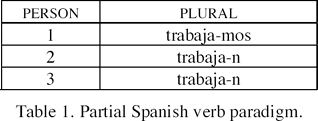
Realizational theories of the syntax-morphology interface assume late (post-syntactic) insertion of vocabulary items. In languages with complex inflectional paradigms, there are typically fewer inflected forms available than there are possible grammatical combinations of morpho-syntactic features (Blevins 1995). Thus, the “same” vocabulary item may surface in more than one context, a phenomenon known as syncretism. In realizational theories of the syntax-morphology interface, syncretism in inflection is accounted for in terms of underspecification of morpho-syntactic features associated with vocabulary items (though not of corresponding syntactic terminal nodes) (Börjars & Donahue 2000, Bresnan 2001, Cowper 2005, Kiparsky 2005). As a result of under-specification, a given item may be compatible with more than one morphosyntactic context. As an example, consider the present tense plural portion of a Spanish verb paradigm given in table 1. In this paradigm, the 2nd and 3rd person plural cells are filled with the “same” form, trabajan ‘you all work’ or ‘they work’.

The partial paradigm in table 1 can be analyzed as containing just two person/number suffixes. The 1st person plural suffix /-mos/ has the features [1st person] and [plural]. Since the suffix /-n/ surfaces in both 2nd and 3rd person contexts, it is possible to leave this form unspecified for person, as in 1.

Underspecification of vocabulary items allows for a principled account of systematic syncretism, and ultimately a more economical morphology insofar as fewer vocabulary items need to be listed in the grammar (Archangeli 1988a,b, Mohanan 1991, Embick 2003). However, by allowing underspecification it becomes possible that more than one form, a “default” form and a more specific or restricted form, may be compatible with the morphosyntactic requirements of a given terminal node, insofar as more than one vocabulary item is an exponent of a subset of the morphosyntactic features associated with the targeted terminal node. In our example, both suffixes in 1 are compatible with a 1st person singular environment since neither suffix expressly clashes with that syntactic context. However, allowing underspecification means that something has to be said about how the grammar chooses appropriate vocabulary items from among multiple compatible items.
1.2. The Elsewhere Condition.
Where more than one vocabulary item (or, depending on one's preferred terminology, inflectional rule) is compatible with a given morpho-syntactic context, realizational morphologies invoke the Elsewhere Condition (EC) (Kiparsky1973, Halle & Marantz 1993)—also known as Morphological Blocking (Aronoff 1976, Ackerman 1990, Andrews 1990, Blevins 1995), the subset principle (Halle, 1997), or Pānini's Principle (Stump 2001).1
Morphological blocking is also invoked to explain why suppletive forms beat regularly formed variants (for example, went > goed), as well as the preference for morphological (synthetic) expression over syntactic (analytic) expression where possible (Sadler & Spencer 2001). The Elsewhere Condition was introduced to modern linguistics by Kiparsky, who attributes the idea to Pānini, as a way to avoid extrinsic ordering of phonological rules. Halle & Marantz (1993) also credit Pānini.

Or, somewhat less succinctly, Halle (1997:428) characterizes the principle as in 3.

In our example, both suffixes in 1 are compatible with a 1st plural context, but since 1a has more features than 1b, it will be the winning form. The suffix /-mos/ in 1a is incompatible with a 2nd or 3rd person plural context, given that it is specified for 1st person; [1st person] is a feature absent from the syntax of 2nd or 3rd person contexts. In this case, the most specific suffix will be 1b, the default plural suffix /-n/.
By whatever name, this mechanism has seen heavy use in linguistic theory, is useful for accounting for a wide variety of phenomena, and is the heart of the syntax-morphology interface for realizational theories of morphology. However, this principle is routinely violated in noun phrases in some Germanic languages. In particular, attributive adjectives in Icelandic alternate between two inflection types, traditionally called strong and weak.2
A nearly identical alternation occurs in Faroese (Lockwood 1964) as well. Old English also had a strong/weak alternation based on definiteness. A similar alternation in attributive adjective form is also found in Standard High German. The analysis presented here extends straightforwardly to Faroese, and with some modification to German as well (Hughes 2003).
1.3. Overview.
I show below that the EC, as applied to the syntax-morphology interface, can be recast in terms of two discrete violable constraints on the correspondence of vocabulary items and terminal nodes (McCarthy & Prince 1995). Essentially, I claim that morphological blocking is an instance of morphological faithfulness to syntactic requirements. By reanalyzing morphological blocking in this way, we can account for the same set of data traditionally accounted for by means of this principle. In addition, we can extend it in a principled way to account for apparent violations of the EC in Icelandic (and, by extension, other Germanic languages).
In section 2, I discuss the relevant data. First, I look at the distribution of strong and weak morphology in Icelandic NPs. Next, I argue that weak suffixes are, in fact, morphosyntactically less specific than strong suffixes insofar as they are exponents of fewer features. Interestingly, while weak suffixes cause a local violation of morphological blocking, the combination of strong and weak suffixes in the NP actually causes More morphosyntactic features to be expressed than would otherwise be the case. After consideration of the data, I discuss morphological blocking and show how it can easily be recast as a pair of ranked, violable constraints on correspondence between features of vocabulary items and the terminal node the items are competing to fulfill. With this sort of conception, it is possible that some constraint or constraints should be able to come between the two that instantiate morphological blocking. Finally, I posit an additional faithfulness constraint on correspondence between syntactic nodes and vocabulary items that accounts for the Icelandic phenomenon in a straightforward way.
2. Concord in Icelandic.
Icelandic NP concord morphemes are fusional in the sense that a single morpheme may be an exponent of multiple inflectional categories. Determiners, quantifiers, and possessive adjectives (henceforth we refer to this class of words as determiners for the sake of convenience) show concord for gender (masculine, neuter, and feminine), case (nominative, accusative, genitive, and dative), and number (singular and plural). In indefinite NPs, attributive adjectives accept the same set of concord suffixes as most determiners. However, in definite NPs, attributive adjective suffixes are drawn from a different set of suffixes, which also signal definiteness morphologically.3
Definite determiners and quantifiers, although semantically definite, do not signal definiteness morphologically, as we show below.
2.1. Concord in indefinite NPs.
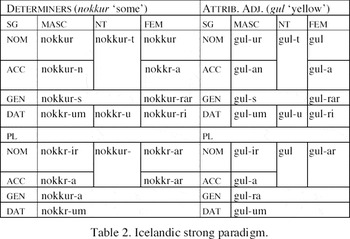
In Icelandic, indefinite NPs, attributive adjectives, and most determiners and quantifiers are inflected alike. In 4a, the same suffix occurs on both nokkur ‘some’ and gul ‘yellow’. The examples given in 4a,b are neuter nominative or accusative singular, but the pattern of identical (strong) inflection on determiners and adjectives in indefinite NPs holds throughout the paradigm.4
The term paradigm is used here descriptively to refer to the set of inflected forms for a given lexical category. Likewise, the term suffix is a term of convenience, whether suffixes are listed as discrete items or as rules has no particular bearing on the issue at hand.

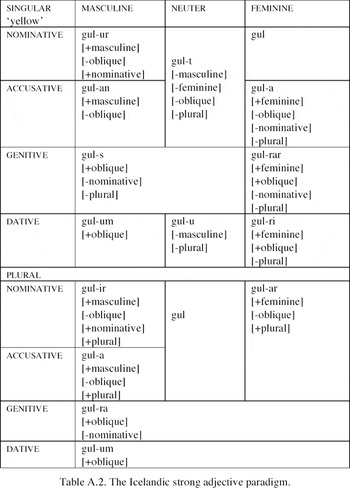
In addition to bare NPs, NPs which contain the determiners allur ‘all’, flestur ‘most’, margur ‘many’, fár ‘few’, Ekki ‘no’, or summur ‘some’ follow the same pattern as 4a, in which determiner and attributive adjective are inflected alike (Einarsson 1949, Kress 1982). The set of suffixes that applies to determiners and to adjectives in indefinite NPs is traditionally referred to as the strong paradigm. The strong paradigm for Icelandic is given in table 2.

The data discussed in this section lead to the following generalization:
Generalization 1: In indefinite NPs, attributive adjectives and determiners are inflected according to the same paradigm (the strong paradigm).
2.2. Concord in definite NPs.
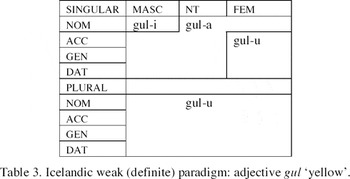
In definite NPs, Icelandic attributive adjectives bear different suffixes than determiners. Determiners, by and large, are inflected in the same way in both indefinite and definite contexts, according to the strong paradigm. Adjectives in definite NPs, however, are inflected according to a different paradigm; traditionally these suffixes are referred to as weak suffixes. Weak suffixes only attach to attributive adjectives. In 5, the definite article is a suffix on the noun, inflected with a reflex of the dental suffix for neuter nominative/accusative singular. The adjective in 5 bears the weak suffix /-a/, rather than the strong /-t/, which surfaces in indefinite NPs like those in examples 4a,b above.

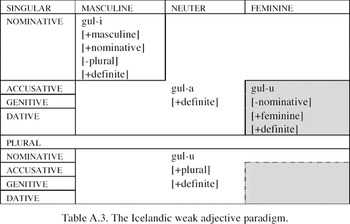
Table 3 presents the weak suffixes for adjectives.

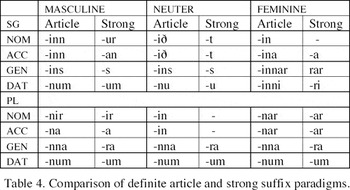
Table 4 presents a comparison of the definite article (/-in-/) paradigm side-by-side with the strong suffix paradigm (s-suffix). While it is clear that there are slight differences in the desinences (for example, masculine accusative singular and non-oblique neuter singular), it is also readily apparent that the overall pattern of the paradigms are the same.

While there is no widely agreed upon standard definition of what it means for a noun phrase to be definite, I follow Hawkins (1978), Lambrecht (1994), and Lyons (1999), and assume that a definite NP is one whose referent is identifiable by both speaker and hearer, and which is unique in the sphere of discourse. In addition to appearing in phrases that are plainly definite by virtue of the fact that they contain the definite article, weak adjective inflection occurs in a number of additional contexts that qualify as definite according to this definition.
The adjective is weak when the NP contains an inflected possessive adjective. In 6, the possessive bears the strong neuter singular /-t/. Icelandic requires that possessive NPs of this sort still contain the definite article suffix. The article suffix also bears a reflex of the strong concord suffix. However, the adjective bears the weak /-a/ rather than /-t/, which would be expected in indefinite NPs.

Attributive adjectives are also weakly inflected when they occur with demonstratives, another sort of definite NP:

It is important to note that while the definite determiner and possessive adjective, both of which presuppose a referent unique and identifiable in the discourse, are semantically definite, they do not signal definiteness morphologically, insofar as strong suffixes plainly can surface in both definite and indefinite contexts.
Weak adjectives may also occur in NPs that do not contain determiners, but which nonetheless must be considered definite. For instance, attributive adjectives are weakly inflected when there is a genitive NP in specifier position, as in 8.

The NP is definite since the book is identifiable and unique in the sphere of discourse. Attributive adjectives are weakly inflected when occurring with proper names and in direct address, as in 9a,b.

The corresponding strong forms are goður and kær. It is important to note that attributive adjectives in NPs like those in 9a,b are in the weak form in the absence of any lexical determiner whatsoever. This fact strongly suggests that morphosyntactic properties of the NP, rather than any special properties of co-occurring determiners, are the impetus for weak inflection.5
A number of analyses of the strong/weak alternation in German (Bierwisch 1967, Zwicky 1986, Kathol 1999) have suggested that the weak suffix arises as a result of some sort of government of the adjective by the determiner. While the data cited here are not definitive proof that such a process is not active in Ice-landic, they are certainly strongly suggestive. See Börjars & Donohue 2000 (pp. 342–344) and Hughes (2003) for other arguments against this sort of analysis.
2.3. Summary and Generalizations.
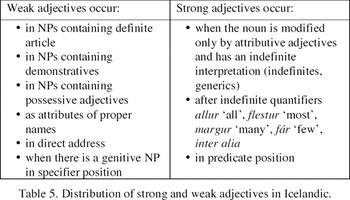
Attributive adjectives in Icelandic are subject to a morphological alternation between two suffix types, traditionally termed strong and weak. Table 5 lists the contexts in which each type of adjective suffix occurs. In addition, determiners are always inflected according to the strong paradigm, regardless of whether the containing NP is definite or indefinite.

Given these data, we can make two further generalizations about inflection in Icelandic NPs:
Generalization 2: In definite NPs, determiners are inflected according to the strong paradigm, but attributive adjectives are inflected according to the weak paradigm.
Generalization 3: Strong suffixes surface in both indefinite NPs (on determiners and attributive adjectives) and definite NPs (on determiners).
Generalization 3 proves to be very important, as demonstrated below. The fact that strong suffixes surface in both definite and indefinite contexts indicates that strong suffixes are morphologically neutral with regard to definiteness. That is, while Icelandic definite determiners, possessive adjectives, and demonstratives clearly convey definiteness semantically, they do not indicate definiteness morphologically in any way. Icelandic attributive adjectives, by contrast, clearly have different morphological forms depending on whether the containing NP is definite or not.6
In fact, I am not the first to propose such a bifurcation of features. Sadler & Spencer (2000), for example, argue for the need for syntactic features (s-features) and morphological features (m-features), and they note that there is not necessarily a one-to-one mapping between the two sorts of features.
Weak suffixes only occur in definite environments, suggesting that they are positively specified for the morphosyntactic feature [definite]. In terms of the EC, then, strong suffixes are compatible with both definite and indefinite contexts, but weak suffixes are only compatible with definite contexts.
In the next section, I take a closer look at the strong and weak paradigms. It is evident see that weak suffixes are generally less specific than strong suffixes, and therefore should, according to the EC, always be blocked by strong suffixes. Following this discussion, I suggest a reason why weak suffixes fail to block strong suffixes. Then I re-examine the definition of the EC, and show that it can easily be reformulated in terms of Optimality Theoretic (OT) correspondence constraints. Given this reformulation, it is possible, within the bounds of OT, to provide a satisfactory analysis of the Icelandic facts that still preserves the basic insights of the Elsewhere Condition/Morphological Blocking.
3. The Weak Paradigm is Less Specific than the Strong Paradigm.
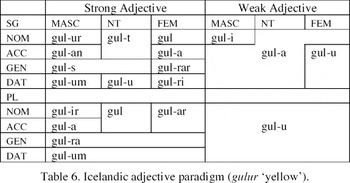
The full strong and weak paradigms for attributive adjectives are given in table 6. The strong paradigm contains 15 inflected forms. The weak paradigm, in contrast, contains only four (if we count the /-u/ suffix twice, once in the feminine singular and once in the plural; otherwise, the paradigm has only three suffixes).

This distribution of suffixes across paradigms strongly suggests that weak suffixes are generally less specific than their strong counterparts. Recall that one suffix is less specific than another if it encodes fewer morphosyntactic properties. The relevant properties for these paradigms include features for gender, case, and number. In addition, I have suggested that a feature for definiteness is also relevant for weak suffixes, since they are barred from appearing in indefinite NPs. We can see that the weak paradigm is less specific in a couple of ways, without engaging in a full morphological analysis of these forms.7
The full set of morphosyntactic feature specifications for all inflected forms is found in the Appendix.
Consider first just the plural portions of the paradigms. The weak plural suffix /-u/ expresses neither gender nor case properties of the containing NP. That is, it is compatible with any gender or any case specification. This form cannot, therefore, be associated with gender or case features, since assigning this suffix any gender or case features would incorrectly make it incompatible with some plural contexts in which the suffix appears. The plural of the strong paradigm, by contrast, encodes all three gender distinctions, at least in the nominative and accusative cases. In addition, all four cases are distinguished. Holding number constant, then, the strong paradigm expresses numerous case and gender distinctions not present in the weak paradigm. The same observation holds true in the singular, where three weak suffixes cover the same morphosyntactic territory as ten strong suffixes.
Another way of looking at the issue is that the same paradigmatic space that is filled by a single plural suffix in the weak paradigm is filled by six different plural forms in the strong paradigm. Thus, any suffix in the strong paradigm provides more information about case or gender (or both) than almost any suffix in the weak paradigm. This holds true of the singular halves of the paradigm as well. For instance, the feminine non-nominative weak suffix /-u/ corresponds to three distinct strong suffixes. Similarly, the weak /-a/ suffix corresponds to six distinct forms in the strong paradigm.
We can also illustrate this issue by comparing individual cells. For example, in addition to expressing plurality, the masculine nominative plural /-ir/ has to express masculine gender, since it contrasts with distinct neuter and feminine forms; and it has to express case, since it contrasts with distinct accusative and oblique forms. The weak plural /-u/ suffix does not preserve either contrast. The weak /-u/ must be neutral with respect to gender, since it surfaces in all three, and it must be neutral with respect to case, since it surfaces in all four. The /-ir/ suffix is specific to a single cell in the paradigm, the plural /-u/ suffix is common to twelve cells.
Thus, it is clear that weak suffixes express fewer morphosyntactic distinctions than strong suffixes, and are therefore less specific. This fact is not, in itself, problematic. However, as I showed in the above sections, weak suffixes appear in environments where more specific strong suffixes are also compatible. The EC predicts that weak suffixes should be blocked by strong suffixes. To see why this is so we need to compare the features associated with the syntax and the features associated with the competing suffixes. Let us consider a masculine nominative plural context discussed above (see full paradigms in the Appendix).
We assume that the relevant morphosyntactic features associated with the adjective's terminal node are those in 10. As noted above, the strong form gulir in 11a has to be specified for gender since it contrasts with both neuter and feminine forms, it must have case features since it contrasts with three other case-specific masculine forms, and it must be specified for number since it contrasts with a masculine nominative singular form. Recall that the strong form surfaces in either definite or indefinite NPs, and is therefore neutral or unspecified for that feature. The weak form in 11b can have no gender or case features, since it occurs in all three genders and all four cases. It contrasts with singular forms and therefore has the feature [+plural], and since it only surfaces in definite NPs it must be barred from surfacing in indefinite NPs by the feature [+definite].


The EC states that any form that fills a syntactic position may not (a) have any features that clash with the position, and (b) must be the most specific available vocabulary item. For the context in 10, at least the strong form in 11a and the weak form in 11b will be candidates to fill this slot, since neither candidate in 11 has any feature that conflicts with the syntactic context in 10. We also know this is true since both suffixes may ultimately surface in a definite NP. However, the strong suffix will be associated with a determiner. The second provision of the EC is that the selected form be the most specific available form. The candidate gulir in 11a has four features in common with the syntax, while the candidate gulu in 11b has only two. Since both forms are compatible with the syntax, and 11a is clearly more specific than 11b, the EC predicts that 11b should be blocked by 11a. As we saw above, however, it is not. This fact is demonstrated in 12a. Example 12b shows, however, that the strong suffix may surface on attributive adjectives.

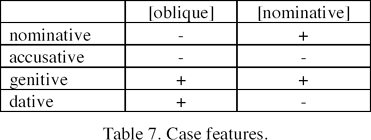
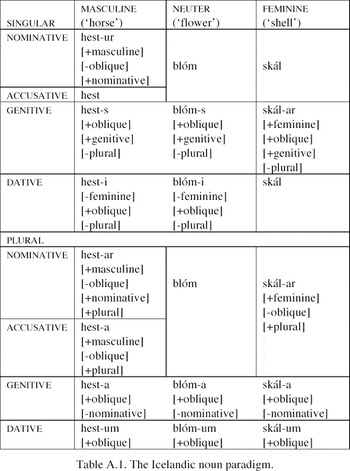
Before moving on to a discussion of how to resolve this conflict, we need to consider the feature system of Icelandic. Two features are necessary to describe the three-gender system, and two for the four-case system; a single feature [+/-plural] suffices for number, as does a single feature for definiteness, [+/-definite]. We propose that the dominant dividing line with respect to case is along the direct (nominative and accusative) versus oblique line (genitive and dative). We label nominative and accusative as [-oblique]; genitive and dative are labeled [+oblique]. We call the feature that separates direct cases from one another and oblique cases from one another [+/-nominative]. The name for this feature recognizes the similarity of nominative and genitive cases as those that occur in specifier position. However, nothing of theoretical import depends on the name of this feature. Case features are distributed as depicted in table 7.

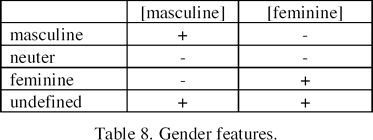
Since our two gender features theoretically allow for four genders, we must also assume that one combination of values is undefined for Ice-landic. The features we propose are [masculine] and [feminine]. Features are distributed as depicted in table 8.

It is important to note that [-feminine] does not automatically imply [+masculine], nor does [-masculine] imply [+feminine], since neuter gender has a negative value for both features. Furthermore, I follow Archangeli (1988a,b), Blevins (1995, 1998), and Börjars & Donohue (2000) among others, in assuming a system of radical underspecification, such that features are only assigned to a form if necessary to maintain a contrast with other forms (that is, in order to restrict a form from occurring in some environment). As noted above, the full array of feature values that we assume for Icelandic concord paradigms is provided in the Appendix.
To summarize, with only a couple of exceptions (masculine nominative singular, and those cells where the strong form of the adjective are uninflected), I argued that weak suffixes are less specific than strong suffixes, though both suffix types are compatible with definite environments. As a result, the EC predicts that weak suffixes should be blocked by corresponding strong suffixes. I argued, in discussion of examples 8–9, that weak suffixes do not surface as a consequence of syntactic properties of the co-occurring determiner. Finally, I discussed technical details of the feature system used to account for concord in Icelandic. In the next section, I take a close look at a recent formulation of the EC, and show how easily it can be translated into two OT constraints. Following this discussion, I propose an additional constraint that allows us to account for Icelandic weak inflection.
4. The EC and OT.
Halle's (1997:428) formulation of the EC (3 above) is repeated in 13 for convenience.

Börjars & Donohue (2000) observed that the EC can be reformulated as a pair of OT constraints in a straightforward way. I briefly discuss why this is so here.
All formulations of the EC contain two provisions. The first provision states that features of a vocabulary item constitute a subset of the features of the targeted syntactic terminal node. The second provision states that the vocabulary item with the most features in common with the terminal node is inserted, pace the first provision. In other words, the two provisions are ranked with respect to each other. Provision 1 takes precedence over provision 2 (a given vocabulary item could have more features in common than the item that surfaces, but still have a clashing feature). Furthermore, the second provision, at least, is violable, insofar as it is possible that a less specific vocabulary item that conforms to provision 1 will be preferred over a more specific vocabulary item that violates provision 1.
Given that the provisions of the EC are ranked and violable, it seems natural to reformulate the EC in terms of OT correspondence constraints (McCarthy & Prince 1995, Prince & Smolensky 2004). I assume, with Distributed Morphology, that syntactic terminal nodes are distinct formal items from vocabulary items. Terminal nodes are fully specified for their syntactic environment, but vocabulary items may be underspecified. Furthermore, I assume that syntactic nodes and vocabulary items, as distinct formal elements, may be placed in correspondence relationships. I further assume that vocabulary items compete for association with terminal nodes. How well a given vocabulary item fares in the competition is determined by how it fares with respect to constraints on correspondences between its features and features of the terminal node.
The first provision of the EC states that features of a vocabulary item must constitute a subset of the features of the syntactic terminal node. The vocabulary item may not contain features not found on the terminal node. In other words, what features the vocabulary item may express depends on what features are associated with the syntactic terminal node. This constraint is formulated as Morphosyntactic-Dependence(Ms-Dep), and a definition is provided in 14.

The constraint in 14 prevents feature clash. Any feature of a vocabulary item that has a value distinct from its corresponding syntactic feature, or any feature that lacks a syntactic correspondent will result in a violation of this constraint. For instance, in a [-definite] syntactic environment, a vocabulary item with a [+definite] attribute will violate the constraint in 14, as illustrated in the tableau in 15. In this and the following tableaux, the feature specifications of the syntactic terminal node are given in the “input” cell of the tableau. In principle, the candidate set for each evaluation could be any lexical item in Icelandic (or even any possible word). However, I assume that at the point in the evaluation that we are concerned with, higher ranked constraints will have winnowed the viable candidate set to vocabulary items with the appropriate lexical meaning for the input. To save space, I do not include every available adjective or determiner form in these tableaux, as indicated by the ellipsis in the final candidate cell, though I assume that at least all 20 distinct forms available for adjectives (16 strong + 4 weak) and all 16 determiner forms (the strong paradigm) will be represented in the candidate set. For any given evaluation, the majority of forms in both the determiner and adjective paradigms will be ruled out by Ms-Dep, since most forms will have at least one feature that clashes with the syntactic environment (the input). In the tableau in 15, we are only considering how well attributive adjectives fare, though the same constraints would apply to other elements in the NP, as well. The tableau in 15 represents the evaluation of an indefinite masculine nominative plural NP. Note, however, that the constraint in 14 only penalizes vocabulary items that contain at least one feature whose value clashes with its correspondent on the targeted syntactic terminal node.

Morphosyntactic Dependence cannot decide between vocabulary items that contain no clashing features. In the example above, this means that there are at least three candidates that are compatible with the given syntactic environment.8
I assume that the bare form of the adjective is not marked for any morpho-syntactic features. This is not a necessary assumption (see Börjars & Donohue 2000 for discussion). However, it is the most economical for these data. Note, also, that the unmarked form never violates Ms-Dependence, since it has no features that might clash with the syntactic environment.
The necessary constraint is a mirror image of Ms-Dep. The constraint in 13 is “upward looking” in the sense that it checks to see if features of an output candidate (a vocabulary item), are instantiated in the input (the terminal node). To find the most specific vocabulary item, we need a constraint that is “downward looking,” or one that checks to see that features of the terminal node (the input) are instantiated on the vocabulary items (the output candidates). The vocabulary item with the most features in common with its associated terminal node fares the best on this constraint. I propose the constraint Maximize Morphosyntax (Max-Ms), defined in 16.9
This constraint could also be formulated as an identity constraint, insofar as the most faithful vocabulary item would be one that contained the identical set of attributes as the containing terminal node.

Given the constraint ranking in 17, and appropriate morphological analysis, these two constraints account for the same range of data as the EC.

If we add Max-Ms to the evaluation in 15, we obtain an appropriate result; only one candidate is optimal for this syntactic context, as demonstrated in the tableau in 18. Note that no candidate vocabulary item is fully specified for this syntactic context, so all violate Max-Ms to some degree. Since 18a has four features in common with the syntactic context, it only violates Max-Ms for the two features it lacks. All other candidates have fewer features in common with the context, and so violate the relevant constraint more times. The third violation is thus fatal.10
We note that, given morphosyntactic underspecification, it is possible that a form will better conform to Max-Ms than a competing form yet still not be optimal by virtue of violating Ms-Dep (for example, a form might agree in all case and number properties, but clash on gender features). In particular, this will nearly always be the case when the unmarked form is the winning candidate. In such instances the unmarked form will violate Max for every feature in the syntax, but it never violates Dep. In order to save space, I have chosen not to illustrate such a case.

Now let us briefly consider the evaluation of a masculine nominative plural definite NP. This evaluation is depicted in the tableau in 19. Recall from previous examples that the definite form of the adjective, in this case candidate 19b gulu, is the attested form. However, as we see from the tableau, the EC, as embodied by these two constraints, predicts that candidate 19a should be the winner. Once again, neither candidate violates Ms-Dep, since neither candidate instantiates any clashing features. Since 19a has more features (four) in common with the targeted environment, it fares better than 19b, which only has two features in common. These two constraints alone cannot account for the Icelandic definite inflection pattern.

In this section, I noted important similarities between traditional formulations of the EC and OT. In particular, we noted that the EC consists of two ranked constraints, at least one of which can be construed as violable. I described a straightforward way of capturing the EC by means of two constraints from the well-known family of faithfulness constraints, Dependence, and Maximize constraints. Morphosyntactic Dependence requires that a vocabulary item not clash with its syntactic environment, while Maximize Morphosyntax favors those vocabulary items with more features in common with the syntax than competitors. However, I also demonstrated that simply restating the EC in OT terms is not sufficient to account for Icelandic weak (definite) adjectives. As 19 shows, the EC predicts that weak adjectives should always be blocked by more specific strong forms. In the next section, I discuss how the EC can be overridden in a way that accounts for these facts without sacrificing the basic functions of the EC.
5. Phrasal Concord.
What purpose could overriding the EC in Icelandic NPs serve? As it turns out, pairing a strong and a weak suffix in a definite NP allows more morphosyntactic features to be expressed across the whole NP than would be possible if the same suffix were repeated. This fact is illustrated in 20. Note that two reflexes of the strong suffix are present in this NP, once as a suffix on the head noun and again as a suffix on the (suffixed) definite article. Repetition of the same suffix on the adjective would fail to realize any additional morphosyntactic features of the NP. Note, however, that the presence of the weak suffix on the attributive adjective allows the NP to express the feature [+definite] in addition to all of the features expressed by the strong suffixes associated with the head noun and determiner.11
I also note, in passing, that the definite suffix at the left edge of the NP allows for immediate identification of the NP as definite, without the hearer having to “wait” for the occurrence of the definite marker at the end of the phrase.

I call this phenomenon phrasal concord, because it appears that Icelandic prefers that a noun phrase express the most possible morpho-syntactic features globally (across the whole phrase) over a noun phrase that maximizes expression of morphosyntactic features locally (at the level of the terminal node).12
Durell (1979) observed this about German as well, though definiteness does not appear to play a role in German.

The constraint in 21 is violated for every morphosyntactic concord feature of the NP that is not instantiated somewhere in the NP. I take it to be uncontroversial that the concord features (that is, features for gender, case, and number) of the maximal projection are identical to the concord features of the individual terminal nodes. A single occurrence of a feature is sufficient to satisfy the constraint. Note that no feature is given privileged status or treated any differently from others by this constraint. Multiple instantiations of any given feature do not occasion a violation. Given the ranking in 22 these constraints are sufficient to account for phrasal concord in Icelandic, as exemplified in 23.


Max-Ms/np has the effect of subverting “local” faithfulness to features of individual terminal nodes in favor of “global” faithfulness to features of the whole NP. That is, Max-Ms/x0 favors the inflected form that most faithfully expresses the morphosyntactic features of the terminal node with which it is associated. Max-Ms/np, by contrast, favors NPs in which the greatest number of distinct features is expressed, allowing individual forms to express fewer features. In other words, in Icelandic the domain of morphosyntactic faithfulness is not just the terminal node, but also the whole NP. Strong suffixes are common to both definite and indefinite determiners, thus the same effects are produced, regardless of whether the determiner is a free or bound morpheme. Recall also that weak suffixes always violate Dep-Ms in indefinite NPs by virtue of being associated with the feature [-definite].
6. Conclusion.
I argued in the sections above that the central mechanism of the syntax-morphology interface in realizational theories of morphology, the EC, cannot account for the distribution of concord affixes in Icelandic NPs, since less specific weak suffixes routinely block more specific strong suffixes in definite contexts. I showed that the EC is traditionally formulated in terms of two ranked constraints on the correspondence of terminal nodes and the vocabulary items that fill them, and discussed a way to recast the EC in OT terms. This move by itself did not resolve the issue, because definite adjective suffixes surface in lieu of more specific strong suffixes; however, the OT framework did provide a way to do so. I argued further that Icelandic has a constraint on the correspondence of terminal nodes and vocabulary items that intervenes between the two constraints constituting the EC. This constraint promotes global faithfulness of constituent vocabulary items to the features of the whole NP, potentially at the expense of local faithfulness of a single vocabulary item to its associated terminal node. It is not clear how traditional (non-OT) formulations of the EC could be so naturally amended as to account for the Icelandic data.
The morphosyntactic faithfulness constraints proposed are quite general in their application. That is, the constraints range over all terminal nodes and all morphosyntactic features. No faithfulness constraint is keyed to particular features or word classes, though the domain of a constraint may vary (X0 or XP). The same constraints that enforce faithfulness between the determiner node and its associated lexical form enforce faithfulness of adjectives and nouns to their associated syntactic terminal nodes. By the same token, all morphosyntactic features are treated alike by the constraints. Faithfulness to case features, for instance, is equally important as faithfulness to other concord features. This is significant since it reduces the number of possible constraints. A lower number of constraints means that there are fewer permutations of constraint rankings, and hence fewer possible distinct grammars. Furthermore, the generality of these constraints means that, although not active in every language, the same constraints can apply in different languages, despite the fact that the languages may differ in terms of the number and categories of concord features and their distribution in the lexicon.
An additional advantage of this approach is that all of the features I have posited are morphosyntactic (features for case, gender, number, or definiteness). The features posited are motivated by properties of specific suffixes, the paradigms in which they take part, and the syntactic contexts in which the suffixes appear. I have not posited any features not linked to demonstrable morphosyntactic distinctions made in Icelandic. The terms strong and weak are entirely descriptive; they play no role in selecting the proper form. In fact, beyond allowing suffixes to differ with respect to the number and names of morphosyntactic features they express, I have not posited any difference between the strong and weak adjective paradigms. Thus, all of the alternations and patterns of inflection are attributed to the interaction of constraints on the expression of morphosyntactic properties and the interaction of these constraints with the content of the lexicon.
The EC (morphological blocking) has a venerable history in linguistic theory, both in phonology and morphology. The EC effects in the syntax-morphology interface can be achieved through the specific ranking of constraints on morphosyntactic faithfulness. However, I have shown that the important data cannot be accounted for by means of the EC alone. The fact that morphological blocking has to be modeled in terms of two separate constraints, however, presented an opportunity to account for the problematic data. Since two constraints are needed, it is possible that other constraints can intervene between them. With additional constraints interjected, morphological blocking effects are masked and otherwise problematic data can be accounted for.
Furthermore, by appealing to an OT formulation, the definition of the EC is considerably simplified and can be expressed in terms of two ranked correspondence constraints. Correspondence constraints have been widely employed in OT to address a wide range of phenomena, from phonology to syntax. There is no reason to assume a priori that the EC should conform to standard OT constraint families. That the same sorts of constraints can apply relatively straightforwardly to the syntax-morphology interface lends additional evidence for the existence of faithfulness as a driving force in natural language grammars. In this paper, I have argued that the EC is “just” another instance of faithfulness in grammar. Though different kinds of faithfulness are given different weights by the grammar, morphology may express faithfulness to terminal nodes or, in some cases, to maximal projections.
APPENDIX
Features in Icelandic Paradigms