The library is traditionally considered a site for research and intellectual pursuit whereas a studio is viewed as a dynamic creative working environment. Writing on the topic of design pedagogy, John Wood identifies a division between research and studio, describing the former as ‘stemming from the cloistered scriptoria of the monasteries’ and the latter as ‘evolved from the medieval craft guilds.’Footnote 1 The Information Service at the University for the Creative Arts (UCA) seeks to redress this division and promotes the library as an extension of the studio. Information literacy is not a pre-requisite for the production of art however, it is essential to meet course learning outcomes and assessment criteria. The ability to identify credible resources, critically evaluate information and synthesise findings enables students to develop proficient academic writing skills alongside a culturally informed and ethical creative practice.
In 2016, I undertook a Master's Degree research project that set out to identify the information needs and behaviours of first-year Fine Art undergraduates in relation to the strategic and pedagogical objectives of UCA. The cohort comprised 80 students; 63 female and 17 male ranging from 18 to 63 years of age with varying skill sets, learning styles and social backgrounds. The case study identified a shared repertoire of behaviours and summarised findings that acknowledged idiosyncrasies. The recommendations of the study intended to enrich provision by enhancing outreach both in the physical environment and online. The findings are time and context-specific and not intended for generalisation, however the salient themes identified have potential to be transferrable to other art libraries if there is resonance.
In recent years, legislative changes have accentuated the importance of student retention and achievement for securing the financial sustainability of the University. The BA(Hons) Fine Art course at UCA Canterbury sought to improve attainment levels and initiated a collaboration with the Library & Student Services department in 2015/2016. Workshops with the Learning Development Tutor and Learning & Teaching Librarian formed part of the unit timetables, essential reading extracts were digitised for the virtual learning environment (VLE) and supplementary texts listed by unit code on the library catalogue. Though this case study was discrete, it considered the value of this embedded support model as part of observing how students searched, evaluated and used information to meet the learning outcomes of the course. The study focused on research and studio units that ran from Monday 18 January to Friday 22 April 2016. The concurrent running of theory and practical units aims to facilitate the synthesis of theoretical and technical understandings as students develop a research-led practice. For this reason, the study also observed student perceptions of interplay across these units.
Literature review
It has been argued that art ‘celebrates an infinite variability of outcomes even when people use the same material in the most structured of ways.’Footnote 2 Despite this diversity of practice, studies on the information needs and behaviours of artists have resulted in consistent findings and an information model has emerged. Studies have repeatedly found a marked preference for printed material, interpersonal sources and serendipitous discovery through browsing behaviours. Retrieval of information outside of the subject-area is also evident. Upon reviewing the literature in 2008, William HemmigFootnote 3 surmised that art students and practitioners alike require four types of information, these were ‘inspiration’, ‘specific visual elements’, ‘knowledge of materials and techniques’ and ‘career guidance’. These categories are a simplification of complex phenomena however, they were considered in correlation with data collected at UCA as they allowed for an examination of how needs vary.
To arrive at an information model, studies have collected primary data from specific communities, chiefly from a library-centric perspective. Efforts to underplay the library were evident in some cases, with participants interviewed in the studio. The scope of studies on art students is particularly limited and in the main consists of surveys or case studies. A cultural bias is clear with a majority of primary research conducted in North America and the UK, though in recent years international studies have increased and reach as far afield as Hong KongFootnote 4.
Independent researcher Helen KaraFootnote 5 argues that creativity is a phenomenon that has also been under-researched in the past. The romantic notion of creativity as a divine gift bestowed to a fortunate few is becoming obsolete under increasing scrutiny by experts from a range of disciplines. This study reviewed three key perspectives that informed the analysis of data collected. Firstly, cognitive theorists consider creativity to be innovation realized through the amalgamation of new and existing knowledge. Creative thought switches between consolidation and active searching when information needs are most likely to be expressed. Individuals also allow their mind to wander during the latter with dormant needs potentially unveiled as students scan library shelves or online search results in the hope that this will result in fortuitous discovery. Secondly, Socio-Personality theorists are concerned with intrinsic and extrinsic motivations. For this study, intrinsic motivation is evident when a student perceives an activity as stimulating. Academic achievement is an extrinsic motivation as students carry out tasks in order to pass set assessment criteria. Thirdly, Confluence theorists examine how these ‘cognitive processes, personality traits and motivations’Footnote 6 converge with the wider context. Creativity is shaped by the interaction between individual, domain and field. The domain refers to the pervading culture; the canon of Fine Art. Convenient access to domain-specific information is integral to the creative process. The field is the social context and for the research population of the study consisted in the main of academics, professional support, peers, friends and family. The differences in personality, experience and motivations will effect individuals’ engagement with the domain and field. It was expected that students at UCA would satisfy perceived information needs in a myriad of ways.
Method
Developing an understanding of needs and behaviours is complex in today's networked society where communication and information retrieval occurs across a plethora of devices anywhere and at any time. I sought to gather data from participants of differing levels of engagement with professional support services, including non-users of the library. Restricting the focus solely to information behaviours relating to the service would have provided too partial an account of the phenomenon. Hence, interviews were conducted in the studio and were in the form of open, exploratory questions. Also, questionnaires were circulated ahead of timetabled research workshops to reveal which resources students used prior to receiving guidance from the librarian. Liaison with the course convenor from the outset was important to gain access to the research population, identify information-rich cases and to encourage participation.
The act of manipulating and synthesizing information is idiosyncratic and not deduced from ordinal data alone. Instead, an emergent design that used a range of collection methods allowed for a rich description of the phenomenon. Collection activities took place until it was felt that the sample group was representative and no new data was being added. A total of 20 students participated, equating to a quarter of the cohort. Harvesting anonymous data from electronic systems with permission allowed for an unobtrusive exploration of information behaviours and use. Data acquired included:
• Circulation statistics from the library management system
• Access data from the VLE and OpenAthens
• Citation analysis of submissions
This quantitative data situated and corroborated qualitative data gathered through a questionnaire, interviews and observation. In addition to interviewing students, I also met with the course convenor and a studio tutor to gain further insight. Triangulation of all data sets bolstered findings and confirmed or refuted purported behaviours.
Findings
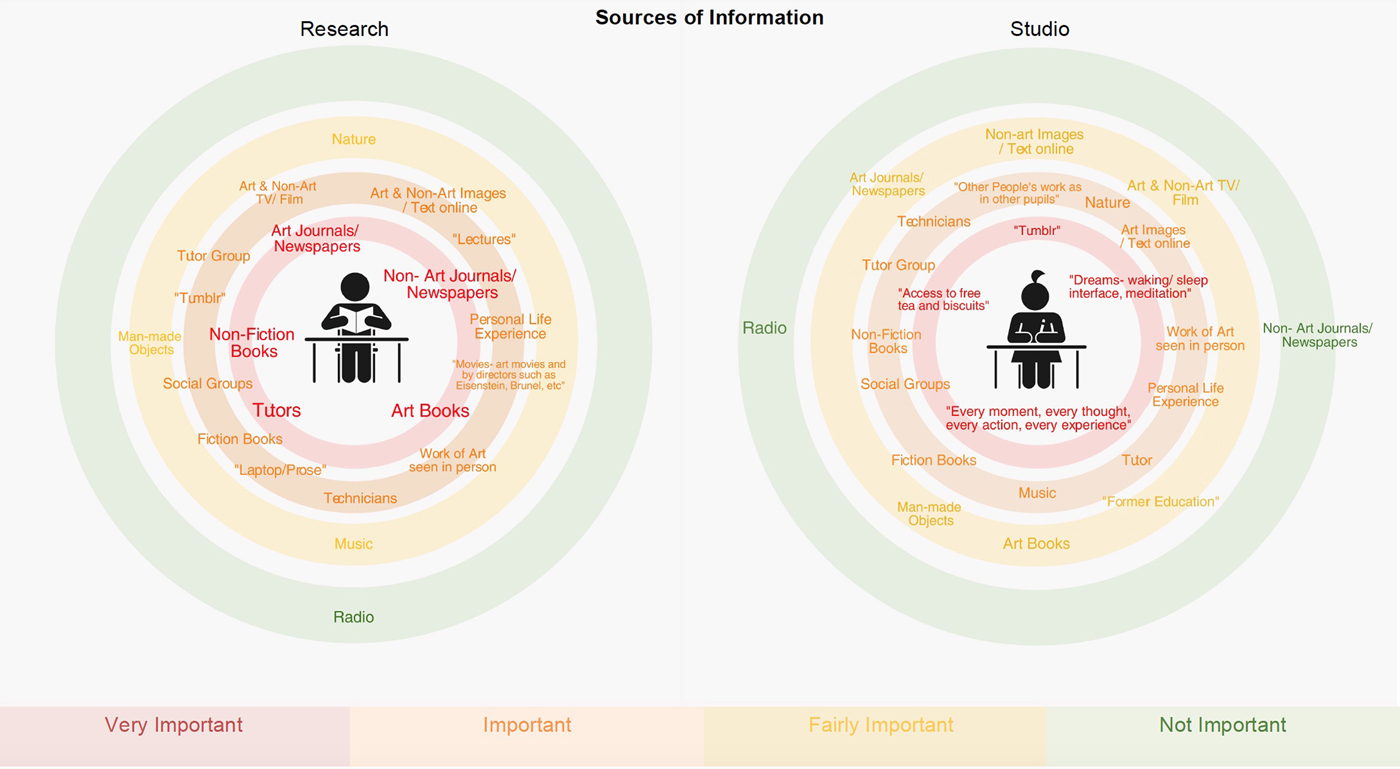
Collected data was examined in relation to the information needs identified by HemmigFootnote 3. Firstly, sources of inspiration were gathered in the questionnaire and expanded upon at the interviews (Fig. 1). Inspiration was drawn from a vast array of sources and subject areas with any aspect of the physical environment acting as a stimulus. For example, Participant B commented:
“Even in the underground, you see posters, you see book titles, you see past the shop window, so it's not just in here, its outside where you are.”
Correspondingly, students identified a need for information outside of their subject area, especially for the studio unit. Interview discussions provided insight into the creative process and supported cognitive theory that creativity happens through the association of experiences and ideas. Participant Q observed:
“It's my subconscious working it all out; it spits ideas into my conscious mind.”
A need for knowledge of materials and techniques was largely satisfied by the studio workshops and the research lectures. The latter introduced students to an array of new techniques and mediums, which were occasionally explored further through technical manuals and monographs borrowed from the library.
Marketing and career guidance was not evident as a need of the research population. This is consistent with a HEA report that found ‘career orientation’ to be ‘much weaker’ for fine art.Footnote 7 These needs may develop as students progress through their course. More apparent was a need to keep up-to-date with current trends and this was largely satisfied through social media. These channels were also accessed habitually to find visual references for inspiration on image-sharing sites such as Instagram and Tumblr.
Data visualization of questionnaire responses.

Preference for print?
The study found that students’ accessed print and electronic information interchangeably, with the latter more commonly used for exploratory research on a subject of interest due to convenience and accessibility. The use of printed media informed both research and provided visual references, however engagement was higher amongst mature students.
The digitised unit readings on the VLE attracted just over one view per student. The peak hours were just prior, during or following the accompanying lecture. Though it is possible that students printed the texts for prolonged use. On the contrary, there was a low level of clickthroughs to eBooks from the essential reading list. Similarly, the number of essential and recommended reading borrowed or referenced by participants was low in comparison to use of digitised readings. Students were also hesitant to use the online resources promoted by the library. Many felt that these were not as easy to navigate as search engines. This supports a recent study of library use patterns amongst undergraduate students at the University of Huddersfield that found arts students benefit ‘the least’Footnote 8 from online resources.
The use of audio-visual material extended across physical and electronic boundaries with increased weighting falling on the latter. Content such as YouTube videos are an accessible medium that students purported to use to understand complex theories, gain new perspectives and generate ideas.
Browsing and serendipitous discovery
Beyond the VLE, a pattern of behaviour was clear with many students iteratively retrieving information by initially entering unstructured queries into a search engine then trawling through the results and selecting resources based on relevance to interests. Exposure to domain-specific jargon at the lectures is likely to have determined the search terms used for research and studio units. Students did not recognize an information literacy skill gap in retrieving or appraising information and expressed confidence in using search engines, particularly Google. Participant E described their method as non-targeted, explaining that:
“You got the research magnet like a headlamp and you're attracting, you're looking, you're scanning.”
Some were aware of the importance of credibility, yet none claimed to formulate a search strategy or use advanced options. The statistical data gathered, and the sources referenced in the bibliographies, evidenced that gallery and artist websites were held in high esteem, particularly the Tate. Many of the websites listed contain images or video, signalling a preference for visual and kinaesthetic learning.
Similar behaviours play out in the library with many of the students claiming to browse the shelves to find items of interest serendipitously. In most instances, participants initially entered a search query into the catalogue to find the relevant section, at other times participants navigate directly to the shelves.
Recommendations
The Library & Student Services Department at UCA supports students in developing information literacy skills, enabling individuals to become independent researchers and practitioners. Credible resources are embedded within the course, yet there was a marked preference for the immediacy and currency of information offered by other platforms. The search engines, social media channels and dynamic websites identified by participants all operate with algorithms that tailor content to increase relevancy based on a user's previous online interactions. This reduces the possibility of serendipitous discovery, could be said to nurture confirmation bias and potentially exposes users to misinformation. Furthermore, in this de-contextualized and often de-authorised environment where metadata is uncontrolled and is in the main comprised of folksonomies, visual sources are easily reinterpreted and consequently stripped of their original meaning or purpose.
The study recommendations were separated into three categories:
1. Education
Art is rarely an explicit manifestation of an individual's theoretical understanding and insight, therefore it is assessed in conjunction with associated written texts that elucidate whether or not these have been successfully realised. Information Professionals must continue to develop partnerships with the Course Teams to provide bespoke embedded literacy instruction that enables students to meet particular assessment criteria. In turn, regularly updating the academics’ knowledge of library services raises awareness of information literacy and can inform teaching. The information professional can also encourage students to become ethical content producers; creating, sharing and referencing information accurately to aid discovery.
2. Curation
It is recommended that the information professional adopt new tools and standards to bring credible resources to students’ desktops more effectively. The department's webpages, information retrieval systems and physical collections must enable effortless navigation, satisfying Ranganathan's fourth law of library science; save the time of the reader.
3. Inspiration
The library can inspire creative practice through facilitating serendipitous discovery and encouraging curiosity. Potential vehicles of inspiration include temporary displays, featured resources, social media posts and pop-up events. It must balance the provision and display of stimulating print and e-resources alongside offering quiet spaces for reflection.
Libraries now operate alongside an abundance of information providers and the role of the Information Professional has expanded from custodian to curator and educator as a consequence. Throughout the UK, students have increasingly assumed the role of consumer following changes to tuition fees, driving a need for the continuous improvement of service provision.
This study was time and context-specific and not intended for generalisation, however a comparison with data sets from similar organisations could provide an invaluable insight that can inform a reassessment of the current value and future trajectory of art libraries. As technology and information infrastructure continues to develop at a pace, it is important that we maintain continuous dialogue with our users to anticipate their behaviours and provide content efficiently.