We are banded together for a single purpose and no other. Our sole aim as a body is to restore to the House of Representatives complete power of legislation in accordance with the will of a majority of its members. We are striving to destroy the system of autocratic control which has reached its climax under the present speaker.Footnote 1
— Resolution adopted by the Insurgent Bloc, January 10, 1910“I present a matter made privileged by the Constitution!”Footnote 2 Rising from his seat, Rep. George W. Norris (R-NE) strode past his Republican colleagues to the well of the House floor. Handing the waiting clerk a sheaf of papers, Norris turned to Speaker Joseph Cannon (R-IL) and demanded that his proposal be recognized. Though House rules would normally have found the matter out of order, Norris cited Cannon's ruling from the previous afternoon, stating that measures pertaining to the Constitution were granted privilege over regular House business.Footnote 3 Given the Speaker's recent ruling and the fact that his proposal concerned a matter explicitly discussed in the Constitution, Norris argued that the measure superseded existing legislation scheduled for consideration. In the congressman's own words:
It was the hour for which I had been waiting patiently. I had in my pocket a resolution to change the rules of the House. Unknown to anyone, even to my closest insurgent colleagues, I had carried it for a long time, certain that in the flush of its power the Cannon machine would overreach itself. The paper upon which I had written my resolution had become so tattered it scarcely hung together. That was the best evidence of long waiting for the minute that had come, and the frequency with which I had studied it alone in my office.Footnote 4
As the clerk prepared to read the resolution aloud to the chamber, Cannon granted that if the matter was in fact privileged by the Constitution, then Norris had a right to present it. Whispers became shouts as House members learned the resolution would strip the Speaker of his power to sit on and appoint legislators to the Committee on Rules, the primary means by which majority party leaders controlled floor activity and managed the chamber body.Footnote 5 Realizing his perilous position, Cannon sought delay as he mustered Republican supporters to vote down the rules change. Over the next several days, the House debated the proposed resolution and Norris's right to introduce it, while the Speaker deliberated with his closest colleagues over the best course of action.Footnote 6 Eventually, Cannon was forced to allow the Norris resolution to come to a vote, ever hopeful that the Republicans loyal to him would outnumber the cross-party coalition rallied against him. Ultimately, an amended version of the resolution passed, 191 to 156, ending the era of czar rule in the House.Footnote 7
A legislative “breakpoint,” the passage of the Norris resolution profoundly transformed congressional operation.Footnote 8 Indeed, in an institution renowned for its continuity, the Cannon Revolt marks one of the few times in American history where the structure of Congress substantially changed. Although the 1910 rebellion did not itself greatly compromise the majority party's control of House activity, it prompted a series of reforms that would lead to the gradual disintegration of traditional modes of partisan authority and the creation of new patterns of legislative governance.Footnote 9 Moreover, because the Cannon Revolt's success hinged on cooperation between a small segment of the Republican Party and a unified Democratic minority, the episode stands as a testament to the transformative power of cross-party coalitions. At the level of mass politics, the successful pursuit of parliamentary reform illustrates the capacity of partisan and legislative institutions to respond to sectional pressures. For these reasons, scholars have rightfully pursued a rich understanding of this moment in congressional history.
Consistent with his own account, both historical and contemporary treatments of the Cannon Revolt tend to identify Norris as the central actor responsible for executing the rebellion.Footnote 10 Although many of these works acknowledge the important role of the minority party in helping to build a procedural majority in favor of rules reform, scholars often take Democratic support for granted, paying little attention to the structural conditions internal to the Republican Party that facilitated Norris's success and assured the cooperation of House Democrats. Binder, for example, argues that it was Norris who “secured” the necessary Republican votes to form what she terms an “easily fostered” coalition with the minority party.Footnote 11 Likewise, Sheingate writes, “Beyond [his] opportunistic timing, Norris exploited the complex features of House rules . . . to move authority over the rules out of the hands of Speaker Cannon . . . [and to] the House floor, where the power of a procedural majority held sway.”Footnote 12
This article, by contrast, highlights the efforts of Norris's Republican allies to construct an intraparty organization, and demonstrates how the development of such organizational capacity was essential to the successful prosecution of rules reform.Footnote 13 As I demonstrate in the following pages, intraparty organization enabled a ragtag group of Republican dissidents to draft and unite behind a common rules reform proposal, and to build the cross-party coalition that scholars agree was critical to the legislation's passage. From a developmental perspective, the structure and capacity of the so-called “Insurgency” expanded incrementally, as Republican reformers struggled to balance their strong sense of individualism and diverse convictions with the need for disciplined action and alliance with the minority party. After finding informal means of coordination insufficient to either hold members to a common objective, or draw Democratic support, the Insurgent reformers worked to institutionalize their presence—devising a series of mechanisms to foster consistent participation, cohesive strategy, and electoral and political security for individual reformers.
In tracing the development of Insurgent organization, I hope to persuade the reader that one cannot attribute the reformers' success merely to the combined circumstances of Norris's ingenuity and Democratic support for rules reform. First, as a matter of historical record, Norris's strategic exploitation of Cannon's ruling on constitutional privilege reflected a tactic proposed and considered by the Insurgent Committee on Procedure in 1909. Second, the resolution Norris offered on the floor of the House in March 1910 was nearly the same resolution the Insurgent bloc had drafted and passed in February 1909. Third, the procedural majority of Democrats and progressive Republicans in favor of rules reform was a necessary but not sufficient condition for the revolt to succeed. Indeed, archival materials indicate that Democratic participation was not inevitable. Rather, the cross-party coalition formed between the minority party and Republican dissidents resulted from the Insurgency's hard-fought efforts to win the trust of Democratic leaders. In sum: if the Republican reformers were to have seceded en masse from their party coalition at any point during the 60th (1907–1909) and 61st (1909–1911) Congresses, they would have comprised a bloc of votes sufficient to grant the Democrats majority status. However, organization would prove essential to assure the Insurgents' collective defection and to construct a procedural majority in favor of rules reform.
In this article, I argue that Insurgent Republican intraparty organization furthered three objectives essential to challenging Speaker Cannon and reforming House rules. First, the organization enabled reformers to coordinate strategy amongst themselves, helping to resolve among Insurgents both ideological disputes over what aspects of rules reform would take first priority, as well as practical disagreements over how their policy goals would best be achieved. That is, intraparty organization offered a structural apparatus through which the dissidents could design, field-test, and ultimately promote their “common carrier” proposals.Footnote 14
Second, intraparty organization provided the Insurgents with a variety of mechanisms to encourage continued collective action. By leveraging their connections with influential progressive newspaper and magazine editors, the reformers were able to reward loyal members, and rebuke—to devastating effect—those who rejoined the Speaker. Additionally, reformers deployed their intraparty organization to promote the electoral prospects of loyal Insurgents, rally constituent support for the group's agenda, stoke animosity toward their opposition, and solicit and disburse campaign assistance to vulnerable members. Although individual Insurgents had long cooperated on an informal, ad hoc basis with members of their state delegations, this new electoral alliance operated at a scale and scope previously reached only by organized political parties.Footnote 15 These activities helped reformers to offset and minimize the cost of their disloyalty and to increase the cost to Republican leaders of continuing to persecute them.
Third, by promoting group cohesion, intraparty organization helped to make the Insurgents a more credible partner for the Democratic opposition, as many minority members shared the reformers' desire to limit Cannon's authority, but doubted the strength of the Republican dissidents' convictions. With limited prospects for success absent an organized bloc of Republican defectors, House Democrats were unwilling to pursue parliamentary reform aggressively—despite having pledged to prioritize changes to chamber rules in their 1908 party platform.Footnote 16 In fact, many members of the minority party preferred to bide their time in anticipation of upcoming elections and allow Cannon to remain in office as a convenient symbol of Republican intransigence. However, as the Democratic leadership observed the Insurgents maintain unity in the face of considerable pressure from “Regular” Republicans, they came to believe that a viable coalition was indeed possible.
In many ways, the Cannon Revolt stands as a singular event in congressional history. However, in a nation governed by two heterogeneous parties, it is not uncommon for a faction of majority party legislators to find themselves at ideological odds with their party leadership, yet lacking in sufficient leverage to successfully bargain for more favorable policies. In this respect, the Cannon Revolt is but one case in a more regular pattern in American legislative politics. As I develop in the following section, and demonstrate through a detailed archival study of the Cannon Revolt, intraparty organization offers dissident majority party members one possible strategy to address this challenge.
1. ORGANIZING DISSENT: A THEORY OF INTRAPARTY ORGANIZATION
Through organization, dissident Republicans sought to construct a pivotal bloc out of a group of legislators whose individual views and actions clashed with those of their party leaders. In his seminal account of Cannon's leadership, Charles Jones argues that the Insurgents “could always take their one bargaining advantage—the vote—and join the Democrats to curb the powers of the Speaker.”Footnote 17 However, with a House body of several hundred members, any one Insurgent was unlikely to hold the vote that would tip the balance of power from a Republican majority opposing rules change to a cross-party coalition favoring parliamentary reform.Footnote 18 In part, this was because Speaker Cannon and his allies had a range of opportunities and resources with which to secure the necessary number of votes without winning the support of any one dissident party member.
In more theoretical terms, Cox and McCubbins have argued that the range of tools at the disposal of majority party leaders—including the capacity to set the chamber's agenda and to punish dissident members—serves the interests of the majority party at large. In their view, members of the majority party agree to delegate agenda-setting powers and the authority to punish recalcitrant legislators to the leadership of the party. Party leaders, in turn, use these powers to further the preferences of a majority of the majority coalition, while preventing attempts to fracture the coalition with alternative proposals. Cox and McCubbins conclude that this sort of cooperation amounts to “cartelized” control of the chamber's agenda and procedures, and predict that only those proposals favored by the leadership of the majority party are likely to come to a vote on the chamber floor.Footnote 19
A prominent critic of party-cartel theory, Krehbiel has questioned the extent to which majority party leaders are able to control legislative proceedings and dictate the behavior of their membership. In his view, the floor median retains ultimate say over the chamber's agenda. If dissatisfied by any given proposal put forward by the majority party, the majority party member at the floor median may choose to side with the opposition, thereby granting it control. Aware of this possibility, majority party leaders condition their proposals on the preferences of the median member, even when doing so leads to an outcome they do not prefer. For Krehbiel, the pivotal role of the floor median extends even to procedural considerations.Footnote 20 According to this model, a dissident member of the majority party located at the floor median can extract significant concessions from party leaders in exchange for her vote.
Striking a balance between these two models of congressional activity, Rohde argues that the power of party leaders waxes and wanes as the uniformity of members' preferences change. When members strongly agree on the substance of their party's agenda, they are more willing to delegate power to leaders who will promote that agenda. Conversely, when a party is internally divided over matters of policy, members prefer to retain as much individual power as possible.Footnote 21 Further developing Rohde's analysis, Schickler and Rich condition the relative influence of the floor median on the size and ideological homogeneity of the majority party. In their view, the majority party member at the floor median can exert maximum influence when she is included among a “sufficient number of party dissidents to constitute a permanent majority should [she] ally with the minority party.”Footnote 22 With a slim majority, party leaders have limited incentive to punish the floor median should she defect on an individual vote, for fear they would lose her permanently to the opposition. It is only when party leaders control a sizable and unified majority that they can exert the sort of legislative control described in the party-cartel model. However, to the extent that majority party leaders can obtain members' cooperation by providing material inducements or threatening punishment, even the median voter is subject to some influence by majority party leaders.
In debating the nature of majority party control, all of the authors cited make similar assumptions about the floor median. Adopting a spatial logic, both Cox and McCubbins, and Krehbiel, conceptualize the floor median as a single actor. Schickler and Rich imply that the floor median is either one individual or a group of individuals at or near the median acting with single purpose; in their view, dissidents will choose to defect from the majority party en masse or not at all.
However, these assumptions do not always hold. As Schickler and Rich suggest, it is often the case that majority party leaders must contend with a collection of dissident members clustered at the floor median. In spatial terms, these members may be so closely concentrated that no one individual is necessarily pivotal to chamber outcomes in instances in which some but not all of these “median members” are required to maintain a majority coalition. When combined with the prospect of partisan carrots and sticks, this insight reveals a crucial collective-action dynamic.
Stated succinctly, when multiple members are concentrated at the floor median, each member has an incentive to let her peers do the work of defection and herself accept a side payment or simply avoid punishment in exchange for holding the party line. In this view, even though dissidents share a common interest in getting their majority leadership to compromise on a given policy or procedural matter, each individual legislator may be better able to maximize her personal gain through cooperation with party leaders, provided that sufficient numbers of her colleagues successfully defect and thereby pull the policy or procedural outcome toward the median.Footnote 23 In short, the optimal strategy for any individual is to “free ride” on the defection of others. Even when members share the same policy or procedural interest and are committed to bearing the burden of defection, they may have difficulty translating their broad agreement into a specific set of policy proposals or procedural tactics.Footnote 24 Party leaders can exploit these weaknesses further, co-opting certain proposals as necessary to divide median members and maintain a floor majority.
To return to the Cannon Revolt: absent a guarantee that any individual Insurgent's vote would be pivotal to unseating the Speaker, the reformers were collectively at the mercy of Republican leaders. The influence of party dissidents like George Norris and his Insurgent colleagues hinged on their collective capacity to hang together in sufficient numbers to hold the balance of power in the chamber—in effect, organizing all potentially pivotal votes into one bloc essential to sustaining the majority party coalition. Having secured a pivotal role within the Republican coalition, the reformers could more credibly negotiate with Cannon and the Democratic leadership, and more freely defect from their party's ranks. Indeed, the intraparty organization developed by dissident Republicans provided them the requisite credibility to parley with Democratic leaders, and gave minority leaders the confidence that any resulting alliance would not erode in the face of majority party pressure.
Given the potential for division and disorder among co-partisan dissidents, organization is imperative to transform votes into substantive outcomes. As I demonstrate in the remainder of this article, intraparty organization helps legislators to commit to a common strategy and, in banding together on a course of unified action, limit the threat of partisan punishment. Intraparty organization also promotes members' electoral prospects, which, in turn, recommits individuals to the organization's cause. Finally, intraparty organization centralizes authority and decision making, such that dissident members can negotiate effectively with majority and minority party leaders and credibly redeem the terms of their agreements. In these ways, intraparty organization offers a powerful scaffolding from which dissident majority party members can achieve more desirable policy and procedural outcomes at the expense of their party leaders.
Despite its clear advantages, intraparty organization is not without significant cost. Like institution-building more generally, constructing and then maintaining this kind of organization requires a considerable outlay of time, creative energy, and material resources. Moreover, intraparty organization generates leverage by committing its members to adhere to the group's positions, once they are taken, thus constraining individual autonomy for the sake of organizational unity. In light of these costs, members of Congress are likely to rely on existing legislative institutions to effect their desired outcomes, where possible. Only when the costs of organization are outweighed by its benefits will legislators pursue intraparty organization. As we shall see, the Republican reformers embraced intraparty organization only as a last resort. After having failed to achieve their desired policy goals through independent action, the reformers sought increasingly formalized modes of organization to achieve their collective aims.
Although intraparty organization enabled progressive reformers to assure themselves a pivotal position within Republican ranks, their relationship with the Democratic minority proved more complicated. On the one hand, without united Democratic support, the Insurgent bloc lacked sufficient votes to curb the Speaker's powers, making Democratic cooperation crucial to the reformers' success. On the other hand, without Republican defectors, the Democratic Party would remain in the minority, unable to redeem the pledge of its 1908 platform. Running counter to the Democrats' desire for rules reform was the belief held by many in the party that it would soon be in the majority; consequently, some “Democrats were not eager to destroy the sources of the [S]peaker's power.”Footnote 25 Anticipating their rise to power, Democratic leaders weighed the benefits of redeeming their party pledge with the electoral advantage of Cannon's “utter unpopularity … . throughout the country.”Footnote 26 As I demonstrate, Democratic leaders strategically balanced these competing ambitions—actively leveraging their cross-party coalition with Insurgent members to extract key concessions favorable to the minority from Republican leaders, while simultaneously pressing the Republican dissidents to moderate their proposed rules changes in favor of majority rights.
In contrast to the view of House Democrats as “a strong minority party fighting to reinforce minority rights,” the historical record makes clear that Democratic legislators viewed themselves as auxiliaries in the fight against Cannon, relying on the Insurgents to develop a successful floor strategy and initiate reform proposals.Footnote 27 Writing to Rep. Victor Murdock (R-KS) in November 1909, Rep. Richmond Hobson (D-AL) requested that the Insurgents notify him “if there is anything which you ‘Progressives’ have planned . . . in which the Democrats will be called upon to assist,” explaining to Murdock that it was up to the Insurgents to dictate the terms of any engagement.Footnote 28 Although unified Democratic support, like Insurgent cohesion, was necessary to curb Cannon's authority, Democratic participation in the revolt hinged on the Insurgents' own initiative. Unity within the Democratic caucus was far from assured, and would require aggressive efforts by minority leaders to solidify their ranks. These actions, in turn, depended on Democratic leaders' own confidence that the Insurgents would uphold the terms of cross-party cooperation.Footnote 29
2. METHODOLOGICAL APPROACH AND SOURCES OF EVIDENCE
In this article, I treat the Cannon Revolt as a case study to illustrate how attention to intraparty organization can improve our understanding of this major episode of legislative development. Although a case study research design limits our ability to generalize with certainty about the role of intraparty organization in the U.S. Congress, we can nevertheless derive analytic leverage “from a close knowledge of the case and context, which can directly contribute to more valid descriptive and causal inference,” as Brady and Collier observe.Footnote 30 Here, I seek to convince the reader that the Cannon Revolt was unlikely to occur as it did without the establishment and development of Insurgent organization. I exploit the longitudinal variation within the case itself to maximize analytic traction and to help rule out alternative explanations. As we will see, the Republican dissidents initially sought to achieve rules reform independently; it was the failure of these efforts that led them to pursue greater collaboration. The reformers' inability to curb the powers of the Speaker through individual action strongly suggests that some type of organization was necessary to achieve the reformers' ends. Likewise, the Insurgents' subsequent decisions to work ever more closely indicates that their initial de minimis organization was insufficient. Given this within-case variation, it is reasonable to conclude that a strong, formal Insurgent organization was instrumental in changing House rules. Additionally, variation in the Democratic response to the Insurgency lends credence to the view that demonstrated dissident cohesion was a necessary condition for the formation of a cross-party coalition in favor of rules reform.
To trace the development of the Insurgent bloc as it formed in the House at the turn of the twentieth century, I exploit a diverse collection of archival evidence. Specifically, I draw on the personal papers of Insurgent legislators and Republican leaders in Congress and the White House, period newspapers and the papers of Progressive Era journalists, and materials published in the Congressional Record and House Journal. To detail the substance and development of Insurgent strategy, I rely on the organization's internal records, including meeting minutes, proposed resolutions, and attendance logs. These materials were collated and maintained by Rep. John M. Nelson (R-WI), who was appointed by his colleagues to act as secretary for the Insurgent organization. Nelson's materials reveal no evident bias; his records are attentive to both the successes and limitations of the Insurgent organization. Though these records provide the best available account of the bloc's internal workings, including the thought processes and preferences of its membership, I also draw on Insurgent correspondence where possible to verify and contextualize the data.Footnote 31
As the article unfolds, the reader will observe that the scope of the inquiry widens at certain stages to include nonlegislative actors, including members of the progressive-affiliated press and the Taft Administration. I introduce these actors for two reasons. First, Insurgent leaders regularly communicated with progressive editors to inflame public opinion against Cannon, and later to reward loyal reformers and punish those who deserted their cause. In other words, Insurgent leaders deployed the progressive press as a mechanism to encourage continued collective action.Footnote 32 Likewise, the Insurgents sought Taft's endorsement of their reform efforts throughout their campaign, hopeful that the president would persuade Cannon to relinquish his powers gracefully. Perhaps more important, Cannon and his allies appealed to Taft both to counter the Insurgents' mobilization and to defend the reputation of the Republican Party.Footnote 33 Second, in light of the critiques leveled at “institution by institution” accounts of American politics, broadening the narrative's focus to include nonlegislative actors permits a more comprehensive treatment of Insurgent organization and Republican mobilization to police irregularity in the party's ranks.Footnote 34
In the following section I briefly describe the political and economic conditions that precipitated Insurgent unrest and the reformers' revolt against Speaker Cannon. I then detail the development of the House Insurgent organization, paying particular attention to the reasons the Insurgents sought to collaborate and to the particular organizational mechanisms they implemented over time. Where appropriate, I further consider how House Democrats reacted to Insurgent activity. To conclude, I revisit the fateful series of events that led to Cannon's downfall, tracing out how the Insurgent bloc made George Norris's entrepreneurship and Democratic collaboration possible, and how the organization was later adapted to accommodate new progressive causes.
3. PRECIPITATING UNREST
In his early years as Speaker, Cannon's drive to centralize party leadership and consolidate it in House institutions met with little resistance from the chamber's Republican and Democratic membership. Using the same tools vested in the speakership that others had used to expand the power of that office, Cannon extended his control over committee and floor activity.Footnote 35 Coupled with his strategic post as chairman of the Committee on the Rules, Cannon could fully regulate the flow of legislation, debate, and amendment—blocking those bills he opposed, while expediting the passage of those he favored. As Schickler argues, these changes initially proved advantageous to Republican representatives, assuaging party infighting by preventing consideration of divisive legislation. Likewise, House Democrats and Republicans collectively benefitted from the chamber's increased clout in intra- and interbranch negotiations.Footnote 36
Regrettably for Cannon, his pursuit of legislative and partisan control ultimately ran afoul of the agrarian crisis smoldering in the western regions of the country. In the years following the Civil War, the railroads' penetration into western territories, and innovations in agricultural science and machinery, encouraged farmers in the region to devote more of their resources and land to agricultural production.Footnote 37 Newly settled in the region, Union veterans were the backbone of farm expansion, supplying the human capital necessary to cultivate greater acreage.Footnote 38 To afford the machinery that would make it possible to grow and harvest crops sufficient for railroads to transport to meet eastern demand, farmers required additional financial capital. To acquire such capital they mortgaged their land, which often resulted in permanent debt, as well as enmity toward the eastern companies that supplied farmers with mortgages.Footnote 39 Agrarian debt was compounded by the appreciation of the dollar's purchasing power as crop prices fell.Footnote 40 At the same time, farmers faced exorbitant prices on machinery and equipment because these industries were protected by a series of domestic tariffs. Farmers' limited access to banks drove up interest rates, further exacerbating the plight of the debtor.Footnote 41
Faced with the loss of property and savings, rural communities demanded relief from their state and national governments. At the state level, politicians—foremost among them, then-Governor Robert La Follette (R-WI)—responded by wresting political control of the region from railroad and corporate interests.Footnote 42 At the national level, William Jennings Bryan and his populist Democrats, along with progressive Republicans, pressed for further regulation of the railroads, conservation of natural resources, the establishment of postal savings banks, more equitable taxation, and direct democracy.Footnote 43 Cannon, however, refused to accommodate the restive constituencies agitating for nationwide economic and political reform. Firmly allied with eastern finance capital and industrial interests, the Speaker found the reformers' agenda of government activism unacceptable. Unwilling to alter the status quo or yield to Republicans who advocated principles that ran counter to strict party regularity, Cannon used the tools of his office to rebuff efforts to pass reform legislation. However, “[b]y constricting the opportunities for individual members . . . to shape House decision making, Cannon created an explosive situation where members were willing to attack the House to effect change.”Footnote 44 Indeed, without the institutional means to meet their constituents' demands for assistance, Republican reformers trained their sights on the chamber's parliamentary rules and procedures.Footnote 45
4. THE LIMITS OF INDEPENDENT ACTION AND INFORMAL ORGANIZATION
The first attacks against Cannon's command of House proceedings were levied by individual Republican dissidents. These sporadic strikes met with little success. Relying on his control of the “right to recognition” and the House Rules Committee, Cannon easily diffused their protests. Having failed to achieve reform independently, the dissidents attempted to work more collaboratively, first by circulating a petition and later through private correspondence and impromptu gatherings on the House floor. In both instances, the reformers sought to move beyond a consensus that changes to House rules were necessary, but found that their limited organization was insufficient to effectively coordinate and prioritize members' preferences and, in turn, to develop a shared plan of action.
Over the course of the first session of the 60th Congress, calls for parliamentary reform were made by those legislators who later became the mainstays of the Insurgent organization.Footnote 46 Frustrated by Cannon's steadfast refusal to entertain western legislators' private appeals for programmatic relief in their home states, progressive Republicans Nelson and Murdock repeatedly spoke out against “the immense power concentrated in the Speakership.”Footnote 47 Though their speeches garnered considerable favor from President Theodore Roosevelt, reform-minded representatives and senators of both parties, and members of the press, they cost both men politically.Footnote 48 Never content to turn a blind eye to the “slings and arrows” of parliamentary reform or a breach in party regularity, Cannon “vowed vengeance.”Footnote 49 From Cannon's perspective, it was a relatively simple and routine matter to punish individual dissenters. The Speaker shunted Nelson to dead committees and threatened Murdock through the Kansas Republican machine.Footnote 50 Although both men objected to Cannon's actions, neither could muster an effective response to lessen or counter his penalty's toll.Footnote 51
More important, reformers Nelson and Murdock were ill-equipped to overcome the peculiar procedural features of the House that effectively precluded rules reform. Parliamentary reformers faced at least three different procedural obstacles. First, the Speaker controlled the right to recognition, severely constraining a legislator's opportunity to mount a protest on the House floor. Second, if the Speaker were to grant recognition and a legislator were to introduce an amendment to reform House rules, the Committee on Rules—packed with members loyal to the Speaker—would have jurisdiction and thus the ability to bury the proposal.Footnote 52 Third, were the Committee on Rules to report the resolution to the floor (a very improbable scenario), a single legislator would be unlikely to have the capacity to forge the cross-party coalition necessary to win passage. As historian and former member of Congress Kenneth Hechler observes, Nelson and Murdock would come to see that the “reason the Insurgents needed to throw up a connected series of breastworks was their failure to achieve any results through haphazard individual effort.”Footnote 53
In March 1908, mindful that the institutional environment necessitated some measure of coordination, Nelson circulated a petition calling “for a change in some of the rules” among like-minded Republicans.Footnote 54 The purpose of the petition was twofold. First, the reformers needed a politically sensitive means to identify potential colleagues with whom to collaborate. Though some, like Norris, approached Nelson and Murdock following their speeches in the House, others sympathetic to the cause were cautious to express their support. Second, the early Insurgents sought to commit fellow reformers to action; the petition would act as a contract among members to press for substantive change. For Nelson, “[T]his was the beginning . . . of the [I]nsurgent movement.”Footnote 55
In fact, it would prove to be a slow start. Without a clear sense of what “change in some of the rules” entailed, and lacking a plan to guide the reformers' efforts or a means to enforce the petitioners' pact to prioritize the matter, other concerns took precedence. In western states, surging populist sentiment forecast a strong Democratic year, with Bryan leading the ticket. With the 1908 presidential election in full swing, members of the Republican Party—Insurgent and “Regular” alike—were pressed into service on party nominee Taft's behalf.
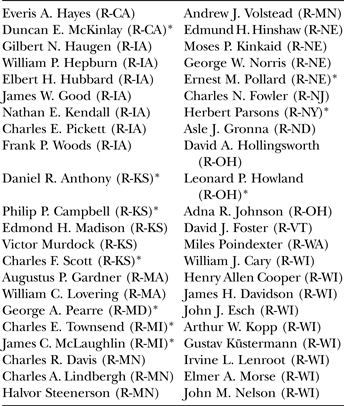
The results of the 1908 election gave the Insurgents much to celebrate. The GOP maintained its majority in the House (219–172) and progressive Republican losses were few. Swept into office by the tide of western opinion inimical to Cannon's rule, a new cohort of legislators swelled the Insurgents' ranks. As shown in Table 1, although the majority of Insurgents hailed from midwestern states—seven from Iowa, five from Kansas, four each from Nebraska and Minnesota, three from Ohio, and nine from Wisconsin—roughly a third of the membership drew from eastern and western delegations, including Vermont, Massachusetts, New York, New Jersey, Maryland, California and Washington.Footnote 56 Were the thirty-odd Insurgents to join with House Democrats, the Republican leadership would lose control of the chamber, making parliamentary reform possible.Footnote 57 However, building a cross-party coalition would require a level of organization and commitment to cooperation the Insurgents lacked. Indeed, the loose federation generated by Nelson's petition was insufficient to compel adherence to any common plan or strategy.Footnote 58
Insurgent Membership by State Delegation

* These ten Insurgents were identified as having “cold feet” in the bloc's February whip count and winter attendance logs. Of the ten congressmen, seven left the Insurgent organization (Scott, Anthony, Campbell, McLaughlin, Pearre, McKinlay, and Foster).
Source: Nelson, “Attendance Records” and “Vote on Resolution of Feb. 9 & 10,” WHS, Nelson Papers, Box 10.
Writing several decades after the Cannon Revolt, Norris recalled “that the single objective which brought these men together was the taking from the Speaker of the vast, brutal power which the rules of the House gave him.”Footnote 59 Though the Insurgents agreed on the necessity of parliamentary reform, they remained deeply divided over its prospective substance. In letters and impromptu conversations on the floor of the House, members entertained a variety of strategies they hoped would best achieve legislative accord.Footnote 60 Rep. Miles Poindexter (R-WA) and Rep. Charles Fowler (R-NJ) argued that removing the Speaker from his seat on the Committee on Rules would be sufficient to end the House dictatorship. Among those who believed autocratic committee assignments to be the source of legislative discord, Rep. William Hepburn (R-IA) suggested the Speaker be allowed to fill no more than one-third of each committee's seats. Others argued this proposal would unduly restrict the majority party, suggesting instead that the Speaker appoint no more than three-fifths of all seats. Norris, for his part, proposed that the Speaker be stripped of the power of appointment altogether. Still others viewed restrictions on recognition as the source of Cannon's authority; some proposed changes to the legislative calendar, such that weekly committees were given the opportunity to introduce legislation on the floor.Footnote 61 Rules to discharge legislation from committees—in the form of petitions or other procedures—were favored as alternatives.Footnote 62
Nor could the Insurgents reach agreement on more practical matters of political strategy, as evidenced by their initial haphazard efforts to challenge Cannon for the speakership. Indeed, upon returning to Washington in November 1908, many Insurgents worked at cross-purposes, promoting a crowd of names to oppose Cannon, rather than throwing their combined support behind a consensus candidate.Footnote 63 Correspondence among Insurgents reveals a host of competing ambitions, as individuals sought to solicit support for themselves or regional allies.Footnote 64 With the opposition to his rule deeply divided, Cannon had little to fear.Footnote 65 For the Insurgents, the lesson of their initial campaign was clear: absent organizational mechanisms to translate members' broad commitment to rules reform into an agreed-upon and actionable plan, their efforts were unlikely to succeed.
5. THE SEEDS OF COLLECTIVE ACTION
Cognizant that prolonged internal wrangling would jeopardize their cause, Nelson called a formal meeting to devise a cohesive strategy for the bloc.Footnote 66 As Nelson recounted, “All those Republicans whom we believed favored a change of the rule [were invited to attend] . . . We found that they numbered about thirty-five.”Footnote 67 In this meeting, and throughout the winter of 1908–9, the Insurgents worked to establish rules of procedure and a committee structure to facilitate the group's decision making. The Insurgents were particularly concerned that their most radical members would balk at compromising with the bloc's more moderate rules reformers and, instead, set out on their own. Accordingly, they implemented several mechanisms to bind these and other members to the organization without resorting to explicit coercion. Hoping to redirect the energies of radical dissidents into the organization itself, the Insurgents appointed them to various leadership positions within the group. To discourage defection more generally and promote consistency in debate, they relied on official note taking to record the statements made in conference by Insurgent members as a means for holding them accountable in private, and, if necessary, in public. Determined to widen public support for rules reform among the electorate, the Insurgents carefully cultivated relationships with sympathetic newspaper and magazine editors. As we shall see, these efforts would later prove crucial to the success of the organization; in the summer and fall of 1909, the reformers relied heavily on their relationship with the press to reward legislators loyal to the Insurgency and to punish those who defected from its ranks.
Persuading those amenable to rules reform to broach the issue without the sanction of the Republican caucus proved difficult. Potential Insurgents feared the consequences of open participation in a group that sought to defy the Speaker, well aware that Cannon had dealt harshly with party dissidents in the past.Footnote 68 Answering this set of concerns represented a key organizational challenge for the Insurgency. A solution presented itself when, after some discussion, Hepburn volunteered to host the Insurgent meetings in his committee room. Though a “dyed-in-the-wool machine man on other issues,” Hepburn believed strongly in the importance of parliamentary reform and the decentralization of power away from the Speaker.Footnote 69 Hepburn's party orthodoxy on other matters reassured would-be participants that their involvement in the rules reform effort would not damage their Republican credentials. Moreover, as an established figure in the Republican hierarchy, the congressman's presence offered cover for Insurgents apprehensive about Cannon's possible response.Footnote 70
Meeting in Hepburn's committee room in early December 1908, the Insurgents agreed that the first step must be to define the scope and nature of the parliamentary reforms they would collectively pursue. To this end, the group elected a regionally and politically diverse subcommittee, led by Hepburn, to identify and prioritize the possible changes to House rules.Footnote 71 The following week the Insurgents reconvened to hear the subcommittee's report. The subcommittee identified House committee assignments and the legislative calendar as initial targets for reform. First, the subcommittee proposed that the House appoint a committee of nine members who would be charged with making assignments to standing committees.Footnote 72 Second, to ensure that legislation flowed freely from committees to the House floor, they recommended that two free days be allocated each week during which the Speaker would be required to call upon each committee to report out legislation.Footnote 73 By instituting these “calendar days,” the reformers hoped to increase floor access, particularly for less powerful committees.
In subsequent meetings in January 1909, the Insurgents debated the merits of the subcommittee's report and the substance of its proposals. Although the group agreed on the importance of reforming committee assignment procedure, members divided over how drastic the changes should be. Hard-line reformers like Norris insisted that the Speaker be explicitly stripped of his power to assign committee seats, whereas others believed party leaders ought to work together with a proposed new House-appointed “Committee on Committees.” Ultimately, the bloc agreed with Norris, voting 18–5 in support of completely divesting the Speaker of appointment authority.
In an effort to address what some western Insurgents believed to be the outsized influence of eastern industrial and finance capital interests within the Republican coalition, the reformers decided to make geographical representation an explicit part of their agenda. To this end, the Insurgents proposed that when appointing members to the Committee on Rules, each legislator's regional affiliation be taken into account. Concerned that the Speaker might continue to exert influence in this domain, Norris sought to imbue regional delegations with the authority to directly elect one representative apiece, proposing to the Insurgents “that the Committee on Rules should be elected by the membership of the House from geographical divisions.”Footnote 74 In the end, the group decided that the Committee on Rules, with a mechanism in place to ensure that its membership would be regionally representative, would also assume the duties of the proposed “Committee on Committees” and assign committee seats.Footnote 75 Unlike concern over the role of the Speaker, which divided the Insurgents, prioritizing geographical representation proved to be an appealing and popular notion, as members from all states stood to benefit from a procedural guarantee of regional interests.Footnote 76
Over the course of these winter meetings, the Insurgents developed a series of internal organizational procedures. For expediency's sake, the group agreed to formally adopt the basic structure of the typical congressional conference. Committees would be created to manage discrete tasks, reporting their progress at regularly held member-wide meetings.Footnote 77 Attendees would follow basic rules of parliamentary order, and one individual would act as chair to settle disputes and keep matters germane. Though the duty of chair would rotate among members, Nelson was appointed permanent secretary of the House Insurgency. As secretary, Nelson was responsible for calling meetings, arranging meeting space, keeping detailed meeting minutes, and occasionally acting as whip for the group.
These organizational choices promoted two critical objectives. In part, these duties facilitated group efficiency: with logistics accounted for, members could focus on the substantive business at hand. But these same features also furthered collective action. As Nelson explained:
[I] kept very complete minutes of all of the meetings; Murdock once objected to this while I was reading the minutes, but I realized that only by recording every motion and speech could all of the members of our group be tied together and kept from drifting back. Another technique was to give certain people committee chairmanships to maintain their interest; thus Murdock was made Chairman of the Publicity Committee.Footnote 78
Nelson's account makes clear that Insurgent leaders were concerned about two potential sources of defection from their ranks. On the one hand, some Insurgent members might be persuaded to return to Cannon's fold, unwilling or unable to bear the costs of achieving rules reform. To prevent these members from “drifting back,” the Insurgent leadership kept careful records of their debate proceedings, so that any individuals who might consider abandoning the cause could be reminded of their initial commitment to reform. On the other hand, the Insurgent leaders initially feared the defection of members who were deeply committed to a specific vision of rules reform and unwilling to compromise to ensure group cohesion.Footnote 79 To prevent these individuals from abandoning the Insurgent cause, the bloc's leadership sought to deepen their investment in the organization, as well as the cause—offering them leadership positions “to maintain their interest,” and provide an outlet for their entrepreneurial proclivities.Footnote 80
Though anxious to unify their bloc, the Insurgents nevertheless sought to preserve a meaningful degree of autonomy for individual members. Attentive to the potential contradictions of modeling the Insurgent bloc on the centralized authority of the Republican machine, the group tried to reflect in its organizational design a critique of the party structure it was seeking to reform. Indeed, as Hechler argues, in designing the bloc's administrative arrangements, the Insurgents were keenly aware that “centralizing power and authority in one leader . . . would be aping the very organization that they were fighting in the House.”Footnote 81 Although majority votes were deemed acceptable during internal debates over the substantive details of the Insurgents' proposed resolution, the majority would not be permitted to dictate how individual members would vote if the resolution were to reach the chamber floor.
The Insurgents also declined to implement organizational mechanisms that would empower the group's leadership to enforce collective behavior.Footnote 82 Rather, the Insurgents hoped that knowledge that unity was the bloc's singular point of leverage would be sufficient to motivate consensus and cooperation.Footnote 83 Indeed, in the months preceding the opening of the 61st Congress in March 1909, the Insurgents carefully screened members of the incoming congressional class to ensure that new recruits would not threaten the group's hard-won consensus. Representing western, midwestern, and eastern interests, respectively, Rep. Everis A. Hayes (R-CA), Murdock, and Rep. George Pearre (R-MD) distributed literature on rules reform to newly elected Republican members of Congress, and corresponded individually with interested legislators to assess their “sympathy with [Insurgent] principles . . . and [their] support of this movement.” In so doing, the Insurgents were able to incorporate those new members who supported the substance of the organization's desired reforms.Footnote 84
During this period, the Insurgents met frequently to develop a strategy for winning passage of their parliamentary reforms. As Rep. Ernest Pollard (R-NE) reported from the Committee on Procedure, they had not yet found a way to bring up the proposed rules changes for consideration with the Speaker's consent. However, Pollard suggested it might be possible to offer “amendments to some proposed rule of the Committee on Rules, and then vot[e] to over-turn the decision of the Speaker” that the rules amendments were out of order. Pollard believed that forcing a vote against the Speaker on a ruling at any time in the congressional session might be used to secure certain concessions from the majority leadership. After considerable discussion of Pollard's idea, the Insurgents agreed that “it would be unwise to do anything revolutionary.”Footnote 85 Better to wait for the opening of the new Congress in March 1909, when the rules would once again come up for adoption. Though the evidence is only suggestive, one may wonder whether Norris recalled Pollard's proposal when, a year later, he offered his own resolution on the House floor with the aim of overthrowing the Speaker.Footnote 86
Though the majority of the Insurgents' formal conferences were devoted to debating the substance and logistics of procedural change, a subsection of the group coordinated with their colleagues in the Senate to rally public opinion in favor of reform measures.Footnote 87 Throughout the Insurgent campaign, reformers with strong ties to popular progressive Republican newspapers and magazines worked together with sympathetic journalists outside the halls of Congress to “spread sentiment against the present House rules” and to dispel allegations made against the bloc by “stand-pat” newspapers.Footnote 88
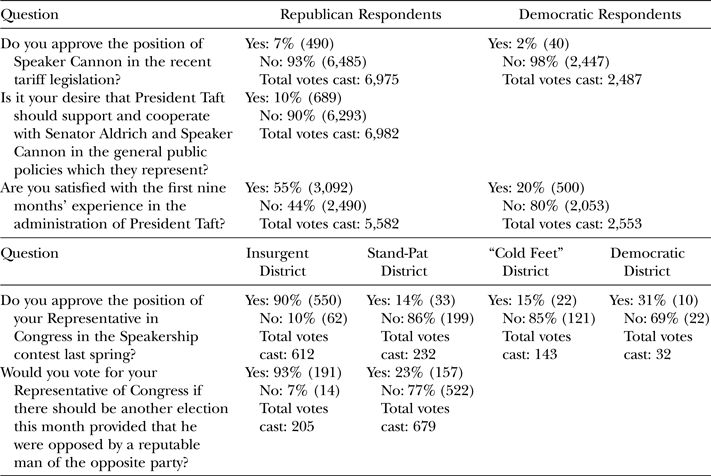
For their part, progressive newspapers and magazines routinely commissioned Insurgent members to write articles describing their activities in Congress and explaining the rationale behind their reform efforts.Footnote 89 They also encouraged their readership to write to Cannon, imploring the Speaker to acquiesce to the Insurgent cause. These efforts culminated in a campaign by Success Magazine, a widely read national publication during this period, to document public support for rules reform and opposition to the present Speakership. Success Magazine mailed ballots to 22,500 of its subscribers, asking recipients to vote on proposed rules reform measures and to evaluate Cannon's and Taft's performances in office.Footnote 90 Readers were asked to return the completed ballots to the magazine at their own expense. The magazine received an astonishing number of completed ballots— more than 18,000— along with hundreds of letters from readers articulating their views on parliamentary procedure, Speaker Cannon, and the Taft administration.
After compiling the results of its informal public opinion poll, Success consulted with Insurgent members “on the question of getting the largest possible influence on the figures by method of presentation to Congress.”Footnote 91 Ultimately, in addition to publishing the results of the survey in their magazine, the editors of Success decided to provide a copy to every member of Congress and to the White House (as summarized in Table 2).Footnote 92 At a time when intercontinental correspondence was costly and modern public opinion polling did not yet exist, Success Magazine's national campaign was a very impressive achievement. Moreover, the effort provides evidence for the unique partnership between congressional reformers and progressive members of the press.
Selected Results of the Success Magazine Survey
Blank cells indicate cases where the data were not tabulated by the editors of Success.
Source: “Is President Taft Leader or Follower in His Party?” Success Magazine, January 1910, pp. 31–32.
At the close of February 1909, the Insurgents worked to finalize the resolution they would present at the opening of the new Congress the following week. After months of revision, the final resolution denied the Speaker membership on any standing or conference committee, and expanded the size and scope of the Committee on Rules to accommodate greater political and geographical representation.Footnote 93 Members of the newly designated Committee on Rules and Committees would be selected by representatives grouped together into geographical regions, such that each region would select one legislator to join the Committee. Thus constituted, the Committee would appoint House members to all other standing committees. Additional provisions specified the details of the revised legislative calendar.Footnote 94 With only a few modifications, this resolution—drafted, debated, and passed by the Insurgents in 1909— would be submitted to the House by Norris one year later.Footnote 95
6. COLD FEET: A SETBACK FOR THE INSURGENCY
Up to this point, the Insurgents had managed to balance the need for coordination and consensus with the preservation of individual opinion. The crucial vote to adopt the Insurgent resolution upset this hard-won equilibrium; Nelson's written whip count for the resolution reveals a growing reticence within a significant fraction of the Insurgent membership. To the surprise of Insurgent leaders, the individuals balking at the reform proposal were not the group's most radical dissidents—whose strident views had long been feared as an obstacle to compromise—but rather the bloc's moderate membership. Scribbling “cold foot” next to eleven names, Nelson identified a contingent of Insurgents who believed the proposed reforms to be overly broad and extreme.Footnote 96 Though the Insurgents had successfully kept their radical members in line, the group's internal vote revealed a new fracture. The reformers would have to find new institutional tools to manage this unexpected challenge.
The reticence of “cold foot” Insurgents discouraged the bloc's leaders. Why were members abandoning their commitment to parliamentary reform now that the resolution was finally drafted? Had the Insurgent leaders ignored seeds of discord sown months before, and were only now seeing them bear fruit? Nelson believed that the Insurgents had long harbored a subset of members ultimately indifferent to rules reform, but he had also assumed they would not have remained with the bloc for so long had they intended to defect. For his part, Murdock blamed the Regular Republicans, arguing that Cannon had coerced more vulnerable Insurgents—legislators with sizable stand-pat constituencies, pending legislation before the House, or patronage requests for which Cannon's favor would be necessary—to return to the party's Old Guard.Footnote 97 In the end, twenty-nine Insurgents joined in signing the resolution, eight of the ten “cold foot” members voted for a resolution pertaining only to the legislative calendar, and seven then seceded from the group.Footnote 98 With its membership thus diminished, the Insurgents' successful pursuit of rules reform now depended on every member of the Democratic minority voting in favor of the measure.Footnote 99
The divisive internal vote proved to be a critical moment of realization for Insurgent leaders. For Nelson and his colleagues, it was a reminder that mere agreement on the group's broad goal of parliamentary reform would not be sufficient to secure the measure's passage. By design, the organization was ill prepared to enforce discipline or voting regularity in its ranks. Unwilling to compromise individual autonomy by implementing a binding majority vote, the Insurgents insisted that collective action be assured without coercive measures. Despite this, Nelson and fellow members of the Steering Committee concluded that they needed new ways to incentivize cohesion and prevent future eleventh-hour defections.Footnote 100
For others, the vote underscored the continued power of the party leadership and the corresponding weakness of the Insurgent organization to defend itself from the Speaker's incursion. Murdock, for one, recognized that Cannon could continue to weaken the organization by siphoning off individual members or small groups of members over time. Rep. Henry Allen Cooper (R-WI) shared Murdock's concern, and believed that the Democratic leadership would not view the bloc as a credible ally for this precise reason.Footnote 101 And, without the support of the Democratic minority, the Insurgents' revision of House rules would be impossible to achieve.
But despite the divisions laid bare by the internal vote on their reform resolution, the Insurgents' coordination and resolve impressed the Democratic leadership. Initially concerned that the Insurgents would seek compromise with the Speaker, securing little for the minority party, the bloc's size and organization now persuaded the Democratic leadership that a profitable alliance could be formed with the remaining twenty-nine Insurgents.Footnote 102 Together, the Insurgent bloc and the Democratic minority would constitute a chamber majority capable of enacting parliamentary reform. In the days before the start of the 61st Congress, Minority Leader James “Champ” Clark (D-MO) worked closely with the Insurgent Steering Committee—Nelson, Rep. Augustus Gardner (R-MA), and Rep. Edmond Madison (R-KS)—to decide upon a joint plan of action.Footnote 103 The legislators agreed to press for the adoption of the Insurgent resolution during the perfunctory adoption of House rules at the opening of the new Congress.Footnote 104 If the Insurgency remained unified and the cross-party coalition held, reform would be assured. If, instead, the Insurgents divided over the resolution on the floor, the Democrats made clear the consequence. Writing to Murdock, Clark's clerk warned: “The Democrats will stand fast if the insurgents muster their forces . . . if the latter lose their courage and fail that day, there will be no use for them to get Democratic aid later on.”Footnote 105
7. FRACTURING THE CROSS-PARTY INITIATIVE FOR RULES REFORM
Before the coalition could act on its plan, however, the Republican Regulars surprised the House by proposing a resolution to establish a legislative calendar very similar to that favored by the eight “mild” Insurgents.Footnote 106 Just as the Regulars intended, the “Calendar Wednesday” proposal widened the breach between the militant Insurgents intent on stripping the Speaker of his power to appoint committees and the more moderate reformers who sought a more limited intervention. Drawing laughter on the House floor, Murdock characterized the resolution as “a Trojan Horse . . . and sticking out of the paunch of that horse I think I see several notable cold feet.”Footnote 107 Though the Democrats and Insurgent leaders denounced the resolution, many members of both parties were hard pressed to oppose the Regulars' proposal. The eight men who preferred limiting rules changes to the legislative calendar sided with the Republican machine, along with two other “cold foot” Insurgents identified by Nelson in his February whip count. Despite uniform Democratic opposition, the Insurgent bloc was too small in size to prevent the Regulars' resolution from passing by a slim majority, 168–163.Footnote 108
Meeting in Hepburn's committee room following the vote, the Insurgents agreed that they had much to learn from Cannon's victory and the “cold foot” defections from their ranks. On the one hand, the episode made clear that the Insurgent organization could not withstand attrition by small concessions. Unless the Insurgents could find a way to prevent the majority leadership from picking off the group's more moderate members, the bloc would cease to be pivotal. On the other hand, the slim majority of the recent vote suggested that the Insurgents' cross-party alliance might be sufficient to break the Speaker's hold on the House. Had the Insurgents prevented just three of their members from defecting, the Speaker's majority would have fallen.Footnote 109
For students of congressional politics, this episode reveals at least two details of theoretical significance. First, Cannon's careful pursuit of less radical reformers suggests that the Speaker considered some portion of the Insurgent membership to be critical to maintaining a Republican majority. In this view, the moderate reformers Cannon targeted were, as individuals, pivotal to the policy outcome. Had they not defected from the bloc, the entire Insurgent group would have been pivotal—the reformers' unity would have assured Cannon's defeat.
Second, Cannon's tactical concession to fracture the Insurgent bloc speaks to the danger of co-optation for intraparty organizations. By incorporating a relatively innocuous part of the Insurgent agenda into Republican doctrine, the Speaker forced the bloc into a quandary: either the Insurgents could require those members who would have been satisfied with Cannon's concession to stick with their more radical colleagues to secure a better outcome, or the organization could permit members to vote as they saw fit. In either event, Insurgent cohesion was likely to fray considerably, suggesting that co-optation is an efficient strategy for party leaders looking to weaken intraparty organization. However, the Insurgent case also suggests that there are limits to the appeal of co-optation as a means of undermining intraparty organization. As the preferences of mild, less radical members of the intraparty organization diverge farther from those of party leaders, the larger the concession the party will need to offer to break these members' allegiance to the bloc. Additionally, to the extent that an intraparty organization's more radical members are able to keep more moderate concessions off the bloc's agenda, these members can reduce the potential risk of co-optation by party leaders.
Anxious to further fracture the nascent Insurgent-Democratic coalition before the House prepared to adopt new rules, Cannon petitioned President Taft for aid. The Speaker persuaded the president that the Insurgents' proposal for rules reform would destroy the machinery necessary to pass the upcoming tariff bill and other critical Republican legislation.Footnote 110 Confronting the Insurgent leadership in a meeting at the White House, Taft condemned the bloc for “conniv[ing]” with Democrats “to overthrow the House Organization.”Footnote 111 Though the Insurgents tried to assure the president that they had no intention of disrupting the passage of tariff legislation, Taft remained unconvinced.Footnote 112 Leaving the White House, Nelson described the group's newly formed consensus on Taft: “We realized then that he was against us.”Footnote 113 Even Democrats marveled at Taft's commitment to Cannon and the stand-pat faction of the Republican Party. As a clerk in Clark's office observed: “much pressure is being brought to bear by Cannon and his forces and by Taft, who has gone over bag and baggage to the reactionaries.”Footnote 114
Taft's opposition to the Insurgent bloc fortified Cannon and offered new means to discipline the party's dissenting faction. Indeed, in the days that followed their tense meeting with the president, the Insurgents found that “the whole administration was brought to bear against [them].” The White House threatened to withhold patronage, the Republican National Committee promised to mount primary challenges and limit campaign assistance, and senators from Insurgent states pressed their counterparts in the House to abandon the fight and rejoin the Speaker.Footnote 115
To Cannon's and Taft's surprise, the Insurgent bloc proved remarkably resistant in the face of the administration's assault.Footnote 116 In part, as we have seen, the Insurgents' solidarity can be attributed to the support and encouragement of the progressive press, which the reformers had carefully cultivated in the preceding months. The editors of McClure's Magazine, Everybody's Magazine, American Magazine, The Outlook, and Collier's Weekly—national publications with some of the widest circulations in the country—privately urged the bloc to continue fighting against “Cannonism.”Footnote 117 In print, they excoriated the Speaker and ran in-depth features on Insurgent members, extolling their efforts against Cannon and branding them American patriots. The close vote over the Regulars' legislative calendar resolution further bolstered the Insurgents' resolve to hold together.Footnote 118 Despite their loss, the Insurgents believed themselves well positioned to cast the deciding votes on rules reform.Footnote 119
Cannon, however, had other plans. While the Insurgents looked forward to victory, the Speaker quietly negotiated a series of backroom deals with Democrats to forge a majority coalition opposed to significant changes in House rules.Footnote 120 The Speaker awarded tariff favors, promised top committee assignments, and agreed to a few minor rules changes that enhanced minority rights in order to secure sixteen Democratic votes against the Insurgent-Democratic resolution amending House procedure, and another seven defectors to enact Cannon's approved rules reform.Footnote 121 Using distributive politics to build an alternative cross-party coalition, Cannon reallocated the pivotal votes from the Insurgents to this group of defecting Democrats.Footnote 122
On March 15, 1909, the Insurgent bloc and Democratic leadership readied for a close—but, they expected, ultimately victorious—fight to adopt new House rules. Their hopes were dashed, however, on the rocks of Cannon's new alliance. After defeating the motion to re-adopt the old rules as planned, Clark proposed a modified version of the Insurgent resolution and moved for a vote on the proposition.Footnote 123 Although the Insurgents voted as a bloc in favor of Clark's resolution, the measure nevertheless failed, due to Democratic defection to the Cannon camp.Footnote 124 Following the failure of Clark's resolution, a Democratic defector introduced the rules proposal agreed to by the Speaker, which generally preserved the status quo but granted an extension of some minority rights.Footnote 125 During debate over the resolution, the Insurgents met repeatedly to “conference,” in a last-ditch effort to counter Democratic defections.Footnote 126 Insurgent efforts notwithstanding, Cannon's distributive coalition held together and the measure passed, 211–173, despite uniform opposition from the Insurgent bloc and a majority of Democrats.Footnote 127
Approaching the Insurgent group after the failed vote, Clark apologized to Nelson and the bloc's leadership: “You kept your word—you gave me one more vote than you promised, but I lost [the] Democrats.”Footnote 128
Frustrated by the defeat, the Insurgents nonetheless took heart that their organization remained united throughout the battle.Footnote 129 Had Cannon failed to reorient existing party coalitions to create a new set of pivotal votes, the Insurgents would have controlled the twenty-one votes necessary to maintain the Republican majority and sufficient to turn the balance of power over to the Democratic leadership. Perhaps more important, Clark and his House Democrats had learned that the reformers could deliver on the terms of a future alliance. The minority leader vowed that he would not fumble a second chance to achieve rules reform if one were provided by the Insurgents.Footnote 130
8. REGROUPING THE RANKS, REBUFFING THE REGULARS
Given the tight vote on their resolution, the Insurgents' task was clear: they had to continue to hold together in the face of Cannon's renewed efforts to fragment their organization, while granting Clark sufficient time to whip his coalition into line. With this in mind, the reformers redoubled their efforts to prevent defection from their ranks—abstaining from other divisive policy battles, leveraging their organization to promote the electoral fortunes of loyal Insurgent members, and deploying the press in a new, targeted way to deter disloyalty—in the hopes of holding the group together for the remainder of the 61st Congress.Footnote 131
Believing the window for rules reform temporarily closed (at least until the opening of a new Congress), the Insurgents debated the merits of pursuing other progressive policy goals, in particular, tariff reform. Gardner, and more conservative members of the Insurgency, were in strong support of the tariff bill's swift passage, and encouraged the bloc to rally around Cannon's legislation. At the same time, “a few radical Insurgents wanted to use the threat of delaying the tariff as a club to force Taft to support the anti-Cannon movement,” and urged the organization to refrain from supporting the House bill.Footnote 132 Unwilling to risk fracturing the bloc over issues tangential to their primary cause, the bloc's Steering Committee advised that the Insurgent organization abstain from the tariff fight altogether. Following the Steering Committee's recommendation, the Insurgents agreed to keep their organization out of the tariff debate and to cease work on rules revision until the pending legislation safely passed.
Like their Insurgent counterparts, Republican Regulars had learned from their near-death experience. Troubled that his continued dominance over the chamber was due only to Democratic defections, the Speaker and his stand-pat allies persuaded Taft to join forces in punishing the party's dissidents, rather than merely reprimanding them for their disloyalty. The White House believed Cannon's growing unpopularity to be a liability, but the Speaker shrewdly exploited the president's growing insecurity that his predecessor, Roosevelt, would use the Insurgency as a platform to challenge Taft for the 1912 Republican nomination. If Taft were unable to quash the Insurgency and unite the Republican Party, Roosevelt would have all the more reason to return to national politics.Footnote 133 In consultation with the Speaker, Taft denied the Insurgents patronage appointments and funded primary challengers in dissident districts.Footnote 134 In the House, Cannon “cut off the heads of the [Insurgent] Republicans who had chairmanships,” assigning one to “the worst committee in the House - the Committee on Ventilation and Acoustics.”Footnote 135
Although scholars dispute the extent and efficacy of the Regulars' disciplinary strategy, the historical record leaves little doubt that the Insurgents both experienced and feared Republican retribution.Footnote 136 Correspondence among House Insurgents suggests that “some fellows were worried a great deal about patronage,” while others felt “the old machine crowd . . . growing in activity.”Footnote 137 Even the Insurgent leadership acknowledged “the risk of calling a meeting of the House Insurgents” when “[reformist] sentiment here [in Congress] is struggling against the fumes of Chloroform.”Footnote 138 Insurgent Rep. William Cary (R-WI) confided to Poindexter: “We are going to be punished for our stand . . . the ‘System’ is working hard . . . and will spend plenty of money.”Footnote 139 Floor speeches and news coverage from the period corroborate these accounts.Footnote 140
Faced with Cannon's aggressive counterattacks, the Insurgents' efforts to maintain their organization took on increased urgency. With an eye toward the upcoming primary elections of 1910, the Insurgents continued to use the progressive-affiliated press to stir up anti-Cannon sentiment in their districts. Reaching out to sympathetic members of the press, the Insurgents provided ammunition for the widespread denunciation of the Speaker and his “corrupt system.”Footnote 141 In so doing, they hoped not only to defend their own seats against primary challenges sponsored by the Republican machine, but also to make it increasingly untenable for Taft to support Cannon. These anti-Cannon jeremiads afforded an additional benefit: in Nelson's words, the Insurgents could use “these powerful organs of public opinion . . . in bringing wayward members back into the [I]nsurgent ranks.”Footnote 142
The shift in public sentiment occasioned by Insurgent maneuvering prompted some Republican Regulars to consider “whether it would not be more expedient to support the Insurgent fight against Cannon.”Footnote 143 The Regulars hoped that, by dropping Cannon and thus appeasing the Insurgents, the party might present a more united front against Democrats in the 1910 elections. Public opinion was such that even Taft began to weigh the cost of his allegiance to the Speaker.Footnote 144 Ultimately, the public relations campaign lessened the Regulars' capacity to criticize the Insurgents' efforts publicly, improved the bloc's ability to remain unified, and defrayed the political cost to individual reformers of rebellion.
To supplement the work of the press, the reformers initiated a collaborative campaign to defend Insurgent seats. Members routinely drafted letters of support and requested the same from their colleagues. These letters were then published in district news outlets and circulated more broadly within the community as evidence of a particular member's Insurgent bona fides.Footnote 145 Insurgent legislators also travelled regularly to their fellows' districts to give speeches and rally local elites to the anti-Cannon cause.Footnote 146 Finally, the reformers organized a wide-ranging campaign finance program, in which members donated surplus funds to colleagues identified by the Insurgent leadership as particularly in need of assistance.Footnote 147 With nearly unanimous participation from the bloc's twenty-odd members, the Insurgents' electoral collaboration represented an increasingly important aspect of their organization. It is important to note, however, that collaboration to defend Insurgent seats did not take place independently of the group's broader efforts. Indeed, there is no evidence that these types of activities took place prior to the summer of 1909 or after the collapse of the Insurgent organization in the aftermath of its success.Footnote 148
As the Insurgent campaign moved into the fall of 1909, the group turned to the press with a new aim, distinct from its broader campaign to foster public opposition to Cannon. Here, the group focused on members “who were pledged to stand against Cannon and didn't,” legislators like Rep. Charles Townsend (R-MI)—a “cold foot” defector who, having declared himself against Cannon and for “revision and liberalizing of House rules” in his 1908 election campaign, permanently abandoned the Insurgency after the Calendar Wednesday vote.Footnote 149 Insurgent leaders collaborated with friendly progressive editors to make clear to the public that “leading Insurgents felt that Mr. Townsend had virtually deserted their cause and gone over to the ‘Cannonites’ in the final ‘show-down,’” and that “in voting he was neither with the [I]nsurgents nor with the [R]egulars—he just straddled.”Footnote 150 The press attacks against Townsend were so fierce that he was forced to explain why, “at a critical stage of the contest in his own party to curtail the power of the speaker, [he] deserted to the speaker's forces,” and to defend his actions in a series of interviews and editorials printed in locally circulating newspapers and magazines.Footnote 151
In criticizing Townsend's actions, the Insurgents did not expect to draw the errant congressman back into their fold. Rather, the Insurgent leadership hoped to make an example of Townsend—to “start a backfire in his district”—and thus deter future defections by the bloc's remaining members.Footnote 152 For those members still wavering on the fringes of the Insurgent organization, Nelson recounted that the Steering Committee “built fires underneath them through the newspapers in their districts, and induced certain of their constituents to bring pressure to bear upon them, and as a result they stayed with us.”Footnote 153 Combining the power of the press and shrewd electoral maneuvering, the Insurgents held their ground together throughout the summer and fall of 1909, demonstrating a continued resolve to implement rules reform both to their Republican antagonists and potential Democratic partners.
Having withstood the Regulars' barrage, the Insurgents could now bring their coalition of pivotal votes to bear in the investigation of Taft's Secretary of the Interior, Richard Ballinger. In November 1909, a series of magazine reports were published alleging that Ballinger had engaged in illegal activities to permit and conceal the sale of land slated for conservation by the U.S. Forestry Service. In January 1910, the House voted to appoint a special committee to investigate the matter. On January 7, as the chamber debated a resolution authorizing the investigatory committee, Norris offered an amendment requiring that the House, rather than the Speaker, elect the proposed committee's members. The amendment carried, 149–146, with twenty-six Insurgents joining the Democrats to subdue Cannon's forces.Footnote 154 Meeting the next day, the Insurgents agreed that they would insist on the appointment of one of their own to the committee and would also refuse to allow Cannon's most loyal aides to be seated.Footnote 155 Eager to avoid a public battle, Taft assured the Insurgents that their views would receive full consideration. The bloc succeeded in getting an Insurgent appointed to the committee, and when the Regulars threatened to reject two of the Democratic nominees, the reformers forced a compromise.Footnote 156 The size and resilience of the Insurgent bloc privileged the group during negotiations with the president and the Republican caucus, giving it, in Gardner's words, “the advantage of trading with the Regulars.”Footnote 157
Over the next several weeks, the Insurgents continued to meet to discuss the results of the investigatory committee and the prospect for future rules reform. Concerned that the public might confuse the progressive reformers' alliance with the Democrats and the group's involvement in the investigation with its primary, Republican, aim of parliamentary reform, the bloc agreed that all rules resolutions ought to be proposed by a Republican Insurgent. To make this distinction clear to the public, the Insurgents drafted a statement to be circulated in their districts explaining their “single purpose.”Footnote 158 The bloc also considered strategies to counter Taft's repeated charge that the Insurgents sought to delay progressive legislation with rules reform, debating how to “emphasize to the country that [they] were not obstructing . . . consideration [of such reform,] but endeavoring to bring [it] up.”Footnote 159 During discussion of rules reform, the Insurgents further debated the merits of expanding the Committee on Rules, but came to little agreement.Footnote 160 With “tacit agreement in our group that no resolution be sprung suddenly,” the Insurgents settled in for the long wait to the opening of the 62nd Congress.Footnote 161
9. AN UNEXPECTED VICTORY
“The break came before we expected it.”Footnote 162 On March 17, 1910, Norris submitted the resolution that would ultimately undo Cannon's control of the Rules Committee. By all accounts, Norris alone recognized that Cannon's ruling on constitutional privilege provided a window of opportunity to present the Insurgents' sought-after parliamentary reforms on the House floor. Indeed, the congressman's astute procedural move caught his fellow reformers unawares. The substance of his proposal, however, was quite familiar to them: the so-called “Norris Resolution” was an amended version of the internal resolution passed by the Insurgent organization in 1909, outlining the substance of the group's preferred rules changes.Footnote 163 Moreover, to secure passage of “his” resolution, Norris relied crucially on the Insurgency's hard-won alliance with the Democratic minority. In short, the congressman's entrepreneurial efforts directly followed from the work and strategy of the Insurgent organization.
As soon as it became clear to the House that Norris had struck a critical blow for parliamentary reform by bringing to the floor the Insurgent resolution, the Republican leadership sought to parry the congressman's procedural move. The Regulars objected, arguing that the proposal ought not to fall under the Speaker's expanded notion of privilege. In the debate that followed, the Insurgents marshaled their forces to defend the resolution and Norris's right to propose it. In an effort to secure Democratic support, Poindexter began the Insurgents' line of defense with the argument that rules reform “is of greater importance for the minority than it is for the majority.”Footnote 164 To impress upon the House the necessity of limiting the Speaker's power, Cooper called upon Murdock, Norris, and Fowler to describe the punishment Cannon meted out as a consequence of their rebellion.Footnote 165 Minority Leader Clark and his deputies endorsed the resolution and offered a litany of parliamentary precedents in support of Norris's view of constitutional privilege. Without sufficient votes on the floor to defeat the Insurgent-Democratic coalition, the Regulars frantically deployed members to corral those colleagues absent from the chamber. In an effort to obstruct this mobilization, the Insurgents refused Republican demands for a recess, badgering the House Sergeant-at-Arms to bar legislators from leaving the chamber on the grounds that a quorum had to be maintained.Footnote 166
Unable to immediately muster sufficient numbers to assure their majority, the Regulars were forced to negotiate with the Insurgent bloc and Democratic leadership to reach a compromise. Initially, the Regulars proposed that the Rules Committee be expanded to allow the Speaker to retain his seat on the committee. Adamant that the Speaker relinquish control over House rules, the Insurgents refused the plan. In the hopes of luring remaining moderate reformers from the Insurgent ranks, the Regulars offered a “gentleman's agreement” that the Speaker would not sit on the new committee. This potentially divisive offer was also rebuffed. The Regulars returned with an offer to further expand the proposed committee to fifteen legislators, so long as the Speaker would remain a member. Again, the Insurgents insisted that Cannon's removal from the Committee on Rules was nonnegotiable.
Hamstrung by the Speaker's command that under no circumstances should his deputies capitulate on his committee membership, the Regulars had little choice but to yield on everything else—agreeing to the entire Norris resolution, on the condition that Cannon remain on the Rules Committee. Pressing their advantage, the Insurgents leveraged their bloc of pivotal votes to win complete concession. If Cannon refused to relent, the Insurgents threatened, the bloc would give up negotiations and join the Democrats to pass the Norris resolution in its entirety. Summarizing the bargaining dynamic, one Regular lamented: “They didn't offer us anything; I think we'll be beaten.”Footnote 167 Unwilling to believe that some favorable compromise could not be reached, and ever hopeful that further delay would provide sufficient time to muster Republican supporters to vote down the rules change, Cannon insisted that negotiation continue.Footnote 168
Though in a strong position to bargain with the Regulars, the Insurgents were forced to modify the proposed resolution to meet Democratic demands. The minority leadership persuaded the bloc to strike the provision requiring that the Committee on Rules be geographically representative. They also persuaded the Insurgents to reduce the size of the proposed committee from fifteen to ten members, a suggestion previously made by the Regulars but rejected by the bloc. While the Democrats conceded that the Speaker must be barred from sitting on the newly constituted Rules Committee, they stipulated that the Speaker's power to assign members to other standing committees remain intact. Though the Insurgents opposed these changes, the bloc had little choice but to accept the Democrats' requests. For Norris, “The Democrats knew their votes meant victory . . . we could not win this fight without agreeing to the Democratic proposal . . . as bitter as the dose was, we must take it.”Footnote 169
In contrast to the Insurgents' pivotal status within the Republican coalition, the group lacked sufficient leverage to dictate the terms of the resolution to House Democrats. Without the minority party's votes, the Insurgents knew that parliamentary reform of any sort would be impossible to achieve. Similarly, the Democratic minority understood they would get little reform without the Insurgent bloc. However, the Democratic leadership saw an advantage in preserving “Cannonism” as a campaign issue and believed it possible to displace Republicans in the next election. Consequently, they were not entirely opposed to the status quo. Indeed, the Insurgents believed there was some likelihood that Clark would renege on the reformers' cross-party alliance for just these reasons. In this view, the Insurgents' capacity to maintain their pivotal status, and obtain favorable policy outcomes, was crucially limited by the actions and incentives of the minority party.
Negotiations having deteriorated, Cannon accepted that he had little recourse but to rule that Norris's claim to constitutional privilege and his resolution were out of order. And as expected, Cannon's decision was overturned 182–163, with the Democrats and Insurgents voting solidly against the Speaker.Footnote 170 Then, voting on the amended resolution favored by the minority leadership, the House passed the rules change, 191–156, again with the Insurgent-Democratic coalition holding sway.Footnote 171 As the last of the votes were tallied, the Insurgents congratulated themselves. Where haphazard individual effort had failed, intraparty organization had succeeded—empowering the Insurgent reformers to negotiate with leaders of both parties to extract policies more favorable than the status quo. Against all odds, they had successfully forged an alliance with the Democratic minority, overwhelmed the Republican machine, and forced concessions on rules reform.Footnote 172
Though the reformers' intraparty organization fragmented in the immediate aftermath of the Cannon Revolt, the bones of the Insurgency were resurrected a decade later to serve similar ends. At the close of the 67th Congress in December 1923, progressive Republicans once again mobilized in favor of rules reform and in opposition to their party's choice for the Speakership. Despite efforts by Republican leaders to dissipate their resistance, the reformers demonstrated remarkable unity, opposing the Speaker in nine ballots on the chamber floor and forcing House leaders to allow full debate on rules changes in return for their votes. As was the case during their fight against Cannon, the reformers' success can be attributed to their organizational efforts. Just as their colleagues had a decade prior, the reformers appointed a cadre of leaders to serve as the organization's vanguard and met regularly in conference to plan strategy and articulate the substance of their desired parliamentary changes. Perhaps not surprisingly, these efforts produced a similar political dynamic. Indeed, as Schickler argues, this “formal organization among the progressive Republicans enabled them to stay together through the long series of roll calls on the speakership, and to select leaders to negotiate a settlement.”Footnote 173 Adopting more theoretical terms, we can observe that this second Insurgency proved successful precisely because the dissidents—like their predecessors—found a way to coordinate their defection and discourage potential free-riding.
10. REVISITING THE SPEAKER'S FALL
Although the 1910 parliamentary reforms were more modest in scope and effect than their advocates had initially hoped, the Cannon Revolt was nonetheless an extraordinary episode in congressional development.Footnote 174 In the face of a seemingly intractable status quo, progressive members of the Republican Party devised an institutional arrangement powerful enough to overcome the Speaker's vast political machine and revise House rules. Between 1908 and 1910, the Insurgent reformers developed mechanisms to encourage consistent participation, cohesive strategy, and individual electoral and political security. In uniting members behind a common plan of action, the Insurgents were able to establish their sought-after alliance with the Democratic minority. Having secured cross-party cooperation, the reformers presided over a coalition sufficient to break the Speaker's hold on the House. Absent their organization, it is unlikely that individual reformers would have successfully drafted or passed new procedures to govern chamber activity.
Insurgent organization provides an excellent example of the strategic benefit and substantive influence of intraparty organization. And, as this account demonstrates, there is much to be gained from the study of intraparty dynamics. First, students of legislative politics have long highlighted the role of the majority party in driving congressional development, but little attention has been paid to the ways in which intraparty groups—like the House Insurgents—can durably reshape their political environment.
Second, the Insurgents' campaign to achieve rules reform makes clear that coordination and organization are not the purview solely of majority party leaders, but are also integral to the success of dissident blocs. Analyzing intraparty organization allows us to advance the debate over the power of “parties versus pivots” by incorporating a dynamic dimension. By focusing on the need for strategic action among potentially pivotal members of Congress, we can better understand when congressional pivots will be able to fully exercise their authority over party leaders and when, by contrast, party leaders will be able to fully control their rank and file.
Third, the Insurgents' reliance on the Democratic minority to implement rules reform suggests that intraparty power is conditioned by an interparty dynamic. Specifically, the extent to which the Insurgents were pivotal was bounded by their ability to credibly threaten to work against the interests of their own party by defecting to the opposition. Simply put, a legislator is pivotal only if she can threaten to leave, and a legislator can only threaten to leave if she can credibly work with the other party. Drawing from the Insurgent case, had the Democratic leadership expressed hostility to reformers' aims, the bloc would have had difficulty persuading the Speaker that its threat to ally with the minority was credible. Consequently, in understanding the conditions under which legislators are likely to influence their party's agenda, we must account for each party's willingness to collaborate with its opposition's dissident membership.
Finally, an emphasis on intraparty politics reveals that political parties are not the only organizations that matter in Congress. In fact, the Insurgents' successful pursuit of parliamentary reform suggests that intraparty organization may be a critical means of securing responsiveness in both congressional and partisan institutions. In this respect, the Insurgency functioned as a “pseudo-party.” Not only did the Insurgents secure rules reform, but they gave an early voice to the progressive elements of the national electorate in Congress, working to institutionalize their presence within the confines of the American two-party system and laying the foundation for the formation of the Progressive Party.
APPENDIX: ARCHIVES CONSULTED
Bentley Historical Library, University of Michigan (BHL). Ann Arbor, MI.
Charles Townsend Papers
Library of Congress, Manuscript Division (LOC). Washington, DC.
Robert La Follette Papers
Victor Murdock Papers
William Howard Taft Papers
William Allen White Papers
New York Public Library, Rare Books and Manuscript Division (NYPL). New York, NY.
James Schoolcraft Sherman Papers
Special Collections Library, University of Washington (UWSC). Seattle, WA.
Miles Poindexter Papers
Wisconsin Historical Society (WHS). Madison, WI.
John Mandt Nelson Papers