1. Introduction
The family of flip-flop processes corresponds to a class of piecewise-linear Markov processes that converge, in some sense, to a standard Brownian motion. Specifically, for
 $\lambda>0$
, let
 $\varphi^\lambda=\{\varphi^\lambda(t) \}_{t\ge 0}$
be a Markov jump process with state space
 $\{+,-\}$
and intensity matrix
 \begin{align*} \left[\begin{array}{c@{\quad}c} -\lambda & \lambda\\ \lambda & -\lambda \end{array} \right]. \end{align*}
Let
 $r(\!+\!) = \sqrt{\lambda}$
and
 $r(\!-\!)=-\sqrt{\lambda}$
, and define
 \begin{align} F^\lambda(t) = \int_0^t r(\varphi^\lambda(s)) \, \textrm{d} s, \qquad t\ge 0.\end{align}
We call
 $\{(F^\lambda(t), \varphi^\lambda(t))\}_{t\ge 0}$
a flip-flop process. It can be shown (see, e.g., [Reference Ramaswami and Latouche18]) that
 $\mathcal{F}^\lambda=\{F^\lambda(t)\}_{t\ge 0}$
converges weakly to a standard Brownian motion
 $\mathcal{B} =\{B(t)\}_{t\ge 0}$
as
 $\lambda\rightarrow\infty$
. In other words,
 \begin{align} \lim_{\lambda\rightarrow\infty}\mathbb{E}\left[h(\mathcal{F}^\lambda)\right] = \mathbb{E}\left[h(\mathcal{B})\right]\end{align}
whenever
 $h \colon \mathcal{C}([0,\infty))\mapsto\mathbb{R}$
is a bounded Borel-measurable functional continuous with respect to the topology of uniform convergence on compact intervals. Weak convergence implies that the family of probability laws induced by
 $\{\mathcal{F}^\lambda\}_{\lambda>0}$
is tight, and that, for any
 $0\le t_1 < t_2 <\dots <t_n <\infty$
,
 \begin{align*} \lim_{\lambda \rightarrow \infty} \big(F^\lambda(t_1),F^\lambda(t_2),\dots,F^\lambda(t_n)\big) \buildrel{\textrm{d}} \over{=} (B(t_1), B(t_2),\dots, B(t_n)).\end{align*}
These two properties are also sufficient conditions for (1.2) to hold (see, e.g., [Reference Billingsley4]). As weak convergence is a statement regarding probability laws, the stochastic processes involved do not need to be defined on a common probability space.
An alternative definition of the flip-flop process
 $(\mathcal{F}^\lambda,\varphi^\lambda)$
is as follows. For
 $t > 0$
, let
 $N^\lambda(t) =N^\lambda(0) + \#\{s\in(0,t]\;:\;\varphi^\lambda(s^-) \neq \varphi^\lambda(s)\}$
and
 $N^\lambda(0)= 0$
. Then,
 $\{N^\lambda (t)\}_{t\ge 0}$
is the Poisson process of intensity
 $\lambda$
which counts the jumps of
 $\{\varphi^\lambda(t)\}_{t\;\ge\;0}$
, and we can rewrite (1.1) as
 \begin{align*} F^\lambda(t) = \sqrt{\lambda}\int_0^t (\!-\!1)^{N^\lambda (s)\;+\;Z} \, \textrm{d} s, \qquad t\ge 0,\end{align*}
where
 $Z=\textbf{1}\{\varphi^\lambda=-\}$
. The process
 $\mathcal{F}^\lambda$
defined like this was first considered in [Reference Goldstein6,Reference Kac11], where a link between its transition probabilities and the telegraph equation was developed. In this context,
 $\mathcal{F}^\lambda$
became known as a telegraph process or uniform transport process, for which the weak convergence to
 $\mathcal{B}$
was proved in [Reference Pinsky17,Reference Watanabe19].
Later on, it was proved in [Reference Griego, Heath and Ruiz-Moncayo10] that such a convergence also holds in a pathwise sense. More precisely, the authors showed that there exists a common probability space in which the family of flip-flop processes
 $\{(\mathcal{F}^\lambda, \varphi^\lambda)\}_{\lambda>0}$
and a standard Brownian motion
 $\mathcal{B}$
are defined such that, for any
 $T>0$
,
 $\lim_{\lambda\rightarrow \infty}\sup_{0\le t\le T}\left| F^\lambda(t) - B(t) \right| = 0$
almost surely (a.s.). Whenever this holds, we say that
 $\mathcal{F}^\lambda$
converges strongly to
 $\mathcal{B}$
as
 $\lambda\rightarrow\infty$
. By applying the bounded convergence theorem to (1.2), we trivially get that strong convergence implies weak convergence. Strong convergence results also lead to stronger approximations for diffusions and for solutions to stochastic differential equations (see, e.g., [Reference Gorostiza7] and [Reference Gorostiza and Griego8], respectively). In [Reference Gorostiza and Griego9], the rate of strong convergence of
 $\mathcal{F}^\lambda$
to
 $\mathcal{B}$
was computed. The key step in [Reference Gorostiza and Griego9,Reference Griego, Heath and Ruiz-Moncayo10] consisted in embedding certain values of
 $\mathcal{F}^\lambda$
into
 $\mathcal{B}$
using the Skorokhod embedding theorem.
In recent years, the study of flip-flop processes has generalised in different directions, most of which are based on the following. Consider a process
 $(\mathcal{R}, \mathcal{J}) = \{(R(t), J(t))\}_{t\;\ge\;0}$
where the phase process
 $\mathcal{J}$
is a Markov jump process on a finite state space
 $\mathcal{S}$
, initial distribution
 $\boldsymbol{p}$
, and intensity matrix Q, and the level process
 $\mathcal{R}$
is defined by
 \begin{align} R(t) = \int_0^t \mu_{J(s)} \, \textrm{d} s + \int_0^t \sigma_{J(s)} \, \textrm{d} B(s), \qquad t\ge 0,\end{align}
with
 $\mu_i\in\mathbb{R}$
and
 $\sigma_i \ge 0$
for
 $i\in\mathcal{S}$
. If
 $\sigma_i = 0$
for all
 $i\in\mathcal{S}$
, the process
 $(\mathcal{R}, \mathcal{J})$
is known as a stochastic fluid process (SFP). If
 $\sigma_i>0$
for all
 $i\in\mathcal{S}$
, then
 $(\mathcal{R}, \mathcal{J})$
is called a Markov-modulated Brownian motion (MMBM). In [Reference Latouche and Nguyen13], it was shown that for any given MMBM there exists a family of SFPs that converges weakly. This result was later used to study MMBM with two boundaries in [Reference Ahn1,Reference Latouche and Nguyen12,Reference Latouche and Nguyen14], Markov-modulated sticky Brownian motion in [Reference Latouche and Nguyen15], and MMBM with a temporary change of regime at zero in [Reference Latouche and Simon16].
In this paper, for any given MMBM we construct a sequence of stochastic fluid processes which converges strongly to it. More specifically, we prove the following result.
Theorem 1.1. For any given
 $\boldsymbol{p}$
, Q,
 $\{\mu_i\}_{i\in\mathcal{S}}$
, and
 $\{\sigma_i > 0\}_{i \in\mathcal{S}}$
, there exists a probability space
 $(\Omega, \mathcal{G}, \mathbb{P})$
which supports an MMBM
 $(\mathcal{R}, \mathcal{J})=\{(R(t), J(t))\}_{t\;\ge\;0}$
defined as in (1.3) and a sequence of stochastic fluid models
 $\{(\mathcal{R}^n, \mathcal{J}^n)\}_{n\;\geq\;0} =\{(R^n(t), J^n(t))\}_{t\;\ge\;0}$
, where
 $\mathcal{J}^n$
has the state space
 $\{+,-\}\times\mathcal{S}$
, such that, for all
 $T \geq 0$
,
 \begin{equation*} \lim_{n\rightarrow \infty} \sup_{0\;\le\;s\;\le\;T} \left| R(s) - R^n(s) \right| = 0 \quad \mbox{a.s.}, \qquad \lim_{n\rightarrow\infty}\pi_2(J^n(T)) = J(T) \quad \mbox{a.s.},\end{equation*}
where
 $\pi_2 \colon \{+,-\}\times\mathcal{S}\mapsto \mathcal{S}$
denotes the second-coordinate projection.
In fact, Theorem 1.1 is a consequence of the following result which concerns the rate of the strong convergence of
 $\{(\mathcal{R}^n, \mathcal{J}^n)\}_{n\;\geq\;0}$
to
 $(\mathcal{R}, \mathcal{J})$
.
Theorem 1.2. Fix
 $T\in[0,1)$
, and consider the probability space
 $(\Omega, \mathcal{G}, \mathbb{P})$
of Theorem 1.1.
-
(i) For each
 $q>0$
there exists a constant
$\alpha=\alpha(q)>0$
such that (1.4)with
\begin{align} \mathbb{P}\left(\sup_{0 \le s\le T} \left|R(s) - R^n(s)\right| > \alpha \varepsilon_n\right) = o(n^{-q})\qquad\mbox{as } n\rightarrow\infty,\end{align}
$\varepsilon_n \;:\!=\; n^{-1/2} \log(n)$
, where o(g(n)) for
$g:\mathbb{N} \mapsto \mathbb{R}_+$
denotes a function
$f \colon \mathbb{N} \mapsto \mathbb{R}$
such that
$\lim_{n\rightarrow\infty} f(n)/g(n)= 0$
.
-
(ii) Furthermore, the process
$\{\pi_2(J^n(t))\}_{t\ge 0}$
converges in an almost sure local uniform sense to
$\{J(t)\}_{t\ge 0}$
; that is, (1.5)
\begin{equation} \lim_{\rho\downarrow 0}\left[\limsup_{n \rightarrow \infty} \left( \sup_{s\in(T-\rho,T+\rho)} d \left(\pi_2(J^n(s)), J(s)\right)\right)\right] =0\qquad\mbox{a.s.}, \end{equation}








where
 $d(\cdot,\cdot)$
denotes the discrete metric in
 $\mathcal{S}$
.
The case
 $T\in[0,1)$
of Theorem 1.1 is a consequence of Theorem 1.2 and the Borel–Cantelli lemma, with the case
 $T\ge 1$
following by elementary time-scaling arguments.
Remark 1.1. The proof of Theorem 1.2 is inspired by [Reference Gorostiza and Griego9], where we replace the use of the Skorokhod embedding theorem with a Poissonian observations argument. Our approach yields tighter and simpler bounds, which ultimately enables us to obtain a faster rate of convergence than [Reference Gorostiza and Griego9] (which was proportional to
 $n^{-1/2}(\log(n))^{5/2}$
) when reduced to the case of the standard Brownian motion.
This paper is structured as follows. In Section 2 we construct the probability space
 $(\Omega, \mathcal{G}, \mathbb{P})$
and describe the distributional characteristics of each stochastic fluid process
 $(\mathcal{R}^n, \mathcal{J}^n)$
for
 $n\ge 0$
. We compute in Section 3 the rate of convergence of
 $\mathcal{R}^n$
to
 $\mathcal{R}$
, from which the proof of Theorem 1.2, and thus that of Theorem 1.1, follows. Finally, in Section 4 we develop some implications of Theorem 1 regarding the down-crossing probabilities of
 $\mathcal{R}$
and
 $\mathcal{R}^n$
; in particular, we exhibit a new link between the solutions of certain Riccati and quadratic matrix equations.
2. Construction of
$\{(\mathcal{R}^\boldsymbol{n}, \mathcal{J}^\boldsymbol{n})\}_{\boldsymbol{n} \geq 0}$

First, we construct a probability space suitable for proving Theorems 1.1 and 1.2. Fix
 $\boldsymbol{p}$
, Q,
 $\{\mu_i\}_{i \in\mathcal{S}}$
, and
 $\{\sigma_i >0\}_{i\in\mathcal{S}}$
of Theorem 1.1. Let
 $\lambda_0=2\max_{i\in\mathcal{S}}|Q_{ii}|$
, and consider a sequence
 $\{\lambda_n\}_{n\ge 1}$
such that
 $\lambda_n\ge \lambda_{n-1}$
for
 $n\ge 1$
and
 $\lim_{n\rightarrow\infty}\lambda_n = \infty$
. Let
 $(\Omega, \mathcal{G}, \mathbb{P})$
be a probability space that supports:
-
a standard Brownian motion
$\mathcal{B}=\{B(t)\}_{t\ge 0}$
, -
a Poisson process
$\mathcal{M}^0=\{M^0(t)\}_{t\;\ge\;0}$
of rate
$\lambda_0/2$
, -
a sequence of Poisson processes
$\{\mathcal{\widetilde{M}}^n\}_{n\;\ge\;1}$
, where
$\mathcal{\widetilde{M}}^n$
has rate
$(\lambda_{n}-\lambda_{n-1})/2$
, -
a discrete-time Markov chain
$\mathcal{X}^0=\{X^0(k)\}_{k\;\ge\;0}$
with state space
$\mathcal{S}$
, initial distribution
$\boldsymbol{p}$
, and transition probability matrix
$P_0\;:\!=\;I + (\lambda_0/2)^{-1}Q$
,








with
 $\mathcal{B}$
,
 $\mathcal{M}^0$
,
 $\{\mathcal{\widetilde{M}}^n\}_{n\ge 1}$
, and
 $\mathcal{X}^0$
being independent of each other. All the elements stated in Theorem 1.1 (and the rest of the paper) will be constructed in
 $(\Omega, \mathcal{G}, \mathbb{P})$
. To construct
 $(\mathcal{R},\mathcal{J})$
on
 $(\Omega, \mathcal{G}, \mathbb{P})$
, let
 \begin{equation} J(t)=X^0(M^0(t)), \qquad t\ge 0.\end{equation}
The uniformisation method implies that
 $\mathcal{J}=\{J(t)\}_{t\ge 0}$
is a Markov jump process with initial distribution
 $\boldsymbol{p}$
and intensity matrix Q. Let
 $\mathcal{R}=\{R(t)\}_{t\ge 0}$
be defined as in (1.3), so that
 $(\mathcal{R},\mathcal{J})$
corresponds to a Markov-modulated Brownian motion.
Next, for each
 $n \geq 0$
, we construct the process
 $(\mathcal{R}^n,\mathcal{J}^n)$
as follows. Define the arrival process
 $\mathcal{M}^{n} = \{M^n(t)\}_{t \geq 0}$
to be the superposition of
 $\big\{\mathcal{M}^0, \mathcal{\widetilde{M}}^{1}, \mathcal{\widetilde{M}}^{2},\dots, \mathcal{\widetilde{M}}^{n}\big\}$
. Then,
 $\mathcal{M}^n$
is itself a Poisson process of intensity
 $\lambda_0/2 + \sum_{\ell=1}^n(\lambda_\ell - \lambda_{\ell-1})/2 = \lambda_{n}/2$
, and its arrival epochs form a subset of the arrival epochs of
 $\mathcal{M}^{n + m}$
for any
 $m\ge 0$
. In other words,
 $\{\mathcal{M}^n\}_{n\;\ge\;0}$
is a sequence of Poisson processes with nested time epochs whose new arrivals, as n increases, are created independently of the existing ones. We emphasise that choosing to have Poissonian observations with rates
 $\lambda_{n}/2$
allows a direct comparison of our construction with the models of [Reference Gorostiza and Griego9,Reference Ramaswami and Latouche18] in the special case of flip-flop approximations to a standard Brownian motion.
Intuitively, our aim is to construct
 $(\mathcal{R}^n,\mathcal{J}^n)$
in such a way that
 $\mathcal{R}^n$
visits the levels of
 $\mathcal{R}$
inspected at the arrival epochs of the Poisson process
 $\mathcal{M}^n$
. To that end, we employ the well-known Wiener–Hopf factorisation for a Brownian motion with drift; see [Reference Bladt and Nielsen5, Corollary 2.4.10] for a proof.
Theorem 2.1. (Wiener-Hopf factorisation for Brownian motion.) Let
 $\{W_t\}_{t\;\ge\;0}$
be a Brownian motion with variance
 $\sigma^2>0$
, drift
 $\mu$
, and initial point
 $W_0=0$
. Let S be a stopping time, and for fixed
 $\beta>0$
let
 $T \sim \exp(\beta)$
, independent of
 $\{W_t\}_{t\;\ge\;0}$
. Then,
 $W_S - \min_{0\;\le\;t\le\;T} W_{S + t}$
and
 $W_{S+T} - \min_{0\;\le\;t\;\le\;T} W_{S + t}$
are independent and exponentially distributed with respective rates
 \begin{equation*} \omega = \sqrt{\frac{\mu^2}{\sigma^4} + \frac{2\beta}{\sigma^2}} + \frac{\mu}{\sigma^2} , \qquad \eta = \sqrt{\frac{\mu^2}{\sigma^4} + \frac{2\beta}{\sigma^2}} - \frac{\mu}{\sigma^2} . \end{equation*}
Theorem 2.1 implies that, restricted to an exponentially distributed time interval, we can track both the value of the minimum over this period and that value at the right endpoint of a Brownian motion with drift. Moreover, such minimum and right endpoint values can be described using exponential random variables. Our aim is to exploit Theorem 2.1 to construct the process
 $\mathcal{R}^n$
in such a way that it sequentially visits the points
 $R_s$
for all observation epochs
 $s\in\mathcal{M}^n$
, as well as the minima that
 $\mathcal{R}$
reaches between those observation epochs. This means that heuristically
 $\mathcal{R}^n$
resembles
 $\mathcal{R}$
. Furthermore, we will show that, as n tends to infinity, since the observation epochs
 $\mathcal{M}^n$
get denser,
 $\mathcal{R}^n$
converges in a pathwise sense to
 $\mathcal{R}$
. We explicitly construct
 $\mathcal{R}^n$
next.
Let
 $\{T_k^n\}_{k\;\ge\;1}$
be the interarrival times of the process
 $\mathcal{M}^n$
, and define
 $\theta_0^n \;:\!=\; 0$
,
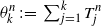 $\theta_k^n\;:\!=\; \sum_{j=1}^k T^n_j$
(
 $k \geq 0$
); thus,
 $\{\theta_k^n\}_{n\;\geq\;0}$
are the arrival epochs of
 $\mathcal{M}^n$
. See Figure 1 for an illustration.
Blue dots correspond to arrivals
 $\{\theta^{0}_k\}_{k \geq 0}$
of
 $\mathcal{M}^0$
, red diamonds the arrivals
 $\{\theta^n_k\}_{k \geq 0}$
of
 $\mathcal{M}^n$
, and black squares the jump epochs of
 $\mathcal{J}$
. As
 $\mathcal{J}$
is given by (2.1), its jump epochs form a subset of the arrival times of
 $\mathcal{M}^0$
.

As
 $\{\theta_k^n\}_{n \geq 0}$
contain all the arrival epochs of
 $\mathcal{M}^0$
, (2.1) implies that
 $\{J(t)\}_{t\ge 0}$
remains constant on each interval
 $[\theta_k^n, \theta_{k\;+\;1}^n)$
,
 $k\ge 0$
. Consequently, given
 $J({\theta_k^n})=i$
on
 $[\theta_k^n, \theta_{k\;+\;1}^n)$
,
 $\{R(t)\}_{t\;\ge\;0}$
behaves like a Brownian motion with drift
 $\mu_i$
and variance
 $\sigma^2_i$
. Thus, by sequentially using the Wiener–Hopf factorisation between arrival epochs of
 $\mathcal{M}^n$
, we can keep track of
 $\{ R(\theta_k^n)\}_{k\ge 0}$
and of
 $\big\{\!\min_{\theta_k^n\le t\le \theta_{k+1}^n} R(t)\big\}_{k\ge 0}=\big\{\!\min_{0\le t\le T_{k+1}^n} R(\theta_k^n + t)\big\}_{k\ge 0}$
in a simple manner, which we explain in detail next.
For each
 $k\ge 0$
, define the random variables
 $X^n(k) \;:\!=\; J(\theta_k^n)$
,
 $L^{n}_{k+1} \;:\!=\; R(\theta_{k}^n) - \min_{0\le t\le T_{k+1}^n} R(\theta_k^n + t)$
, and
 $H^{n}_{k+1} \;:\!=\; R(\theta_{k+1}^n) - \min_{0\le t\le T_{k+1}^n} R(\theta_k^n + t)$
. By Theorem A.1 in the Appendix,
 $\mathcal{X}^n=\{X^n(k)\}_{k\ge 0}$
is a discrete-time Markov chain with transition probability matrix
 $P_n\;:\!=\; I + (\lambda_n/2)^{-1}Q$
. The strong Markov property of
 $\{(R(t), J(t))\}_{t\ge 0}$
and Theorem 2.1 imply that, conditioned on
 $\mathcal{X}^n$
,
 $\{L^{n}_{k+1}\}_{k\ge 0}$
is a collection of independent random variables. More specifically, given
 $X^n_k=i$
,
 $L^{n}_{k+1}$
is exponentially distributed with rate
 \begin{equation*} \omega_i^n \;:\!=\; \sqrt{\frac{\mu^2_i}{\sigma^4_i} + \frac{\lambda_n}{\sigma^2_i}} + \frac{\mu_i}{\sigma^2_i}.\end{equation*}
Similarly,
 $\{H^{n}_{k+1}\}_{k\ge 0}$
is a collection of conditionally independent random variables for which, given
 $X^n_k=i$
,
 $H^{n}_{k+1}$
is exponentially distributed with rate
 \begin{align*} \eta_i^n \;:\!=\; \sqrt{\frac{\mu^2_i}{\sigma^4_i} + \frac{\lambda_n}{\sigma^2_i}} - \frac{\mu_i}{\sigma^2_i}.\end{align*}
Moreover,
 $\{L^{n}_{k+1}\}_{k\ge 0}$
is conditionally independent of
 $\{H^{n}_{k+1}\}_{k\ge 0}$
. Note that
 $\{L^{n}_{k+1}\}_{k\ge 0}$
and
 $\{H^{n}_{k+1}\}_{k\ge 0}$
completely describe
 $\{ R(\theta_k^n)\}_{k\ge 0}$
and
 $\big\{\!\min_{\theta_k^n\le t\le \theta_{k+1}^n} R(t)\big\}_{k\ge 0}$
, in the sense that, for all
 $k\ge 0$
,
 \begin{equation} R(\theta_k^n) = \sum_{j=1}^k \left( -L^{n}_{j} +H^{n}_{j}\right), \qquad \min_{\theta_k^n\le t\le \theta_{k+1}^n} R(t) = \sum_{j=1}^k \left(-L^{n}_{j} +H^{n}_{j}\right) - L^{n}_{k+1}. \end{equation}
For all
 $k\ge 1$
, if
 $X^n(k-1) = i$
, define
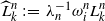 $\widehat{L}^{n}_{k} \;:\!=\; \lambda_n^{-1}\omega_i^n L^{n}_{k}$
and
 $\widehat{H}^{n}_{k} \;:\!=\; \lambda_n^{-1}\eta_i^n H^{n}_{k}$
. Then, the collections
 $\big\{\widehat{L}^{n}_{k}\big\}_{k\ge 1}$
and
 $\big\{\widehat{H}^{n}_{k}\big\}_{k\ge 1}$
are independent and identically distributed random variables exponentially distributed with parameter
 $\lambda_n$
. Let
 $\chi_n^0 \;:\!=\; 0$
, and define, for all
 $k\ge 1$
,
 $\chi_k^n\;:\!=\;\sum_{j=1}^k \left(\widehat{L}^{n}_{j} + \widehat{H}^{n}_{j}\right)$
. Let
 $\mathcal{J}^n = \{J^n(t)\}_{t\ge 0}$
be the process with state space
 $\{+,-\}\times\mathcal{S}$
defined by
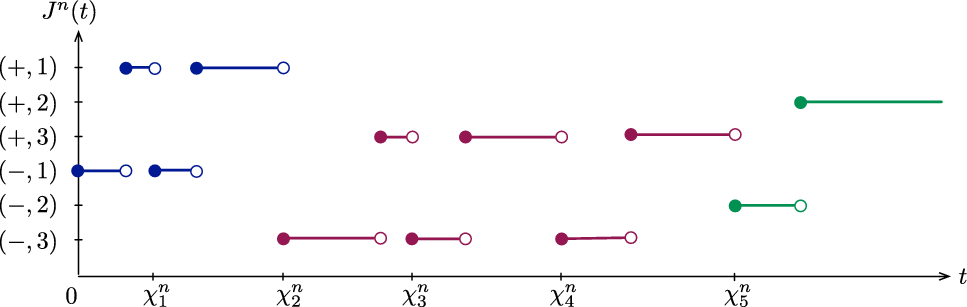
 \begin{align*} J^n(t) =\left\{\begin{array}{cl}(-,i)\;\;\;\;\;\; & \mbox{if } t\in[\chi^n_k,\chi^n_k + \widehat{L}^{n}_{k+1})\mbox{ for some $k\ge 0$ and }X_k^n = i,\\[5pt] (+,i)\;\;\;\;\;\; & \mbox{if } t\in[\chi^n_k + \widehat{L}^{n}_{k+1}, \chi^n_{k+1})\mbox{ for some $k\ge 0$ and }X_k^n = i. \end{array}\right.\end{align*}
Figure 2 shows a sample path of
 $\mathcal{J}^n$
with
 $\mathcal{S} = \{1, 2, 3\}$
.
A sample path of
 $\{J^n(t)\}$
with
 $\mathcal{S} = \{1,2, 3\}$
.

The process
 $\mathcal{J}^n$
jumps alternately between
 $\{-\}\times\mathcal{S}$
and
 $\{+\}\times\mathcal{S}$
with intensity given by
 $\lambda_n$
; furthermore, changes in its second coordinate, which occur according to
 $P_n$
, are only possible at jump instants from
 $\{+\}\times\mathcal{S}$
to
 $\{-\}\times\mathcal{S}$
. Thus,
 $\mathcal{J}^n$
is a Markov jump process with state space
 $\{+,-\}\times\mathcal{S}$
(ordered lexicographically), initial distribution
 $({\bf{{0}}},{\bf{{p}}})$
(where
 ${\bf{{0}}}$
denotes a row vector of zeros of size
 $|\mathcal{S}|$
), and intensity matrix given by
 \begin{equation*} \left[\begin{array}{c@{\quad}c} -\lambda_n I & \lambda_n P_n\\\lambda_n I & -\lambda_n I\end{array}\right] = \left[\begin{array}{c@{\quad}c} -\lambda_n I & 2 Q + \lambda_n I\\\lambda_n I& -\lambda_n I \end{array}\right].\end{equation*}
Note that the sequence of states in
 $\mathcal{S}$
visited by
 $\pi_2(\mathcal{J}^n)$
coincides with that of
 $\mathcal{J}$
, or, more precisely,
 \begin{equation} \pi_2({J}^n(\chi^n_k))=J(\theta^n_k)\qquad\mbox{for all } k\ge 0.\end{equation}
Also notice that the jumps of
 $\pi_2(\mathcal{J}^n)$
can occur only at
 $\{\chi^n_k\}_{k\ge 0}$
while the jumps of
 $\mathcal{J}$
can occur only at
 $\{\theta^n_k\}_{k\ge 0}$
. In general,
 $\{\chi^n_k\}_{k\ge 0}\neq\{\theta^n_k\}_{k\ge 0}$
; nevertheless,
 \begin{align*}\mathbb{E}\left[\theta^n_k\right]& = \mathbb{E}\left[\sum_{j=1}^k T^n_j\right] = k \mathbb{E}\left[T^n_1\right] = \frac{2k}{\lambda_n},\\\mathbb{E}\left[\chi^n_k\right]&=\mathbb{E}\left[\sum_{j=1}^k \left(\widehat{L}^{n}_{j} + \widehat{H}^{n}_{j}\right)\right] = k \mathbb{E}\left[\widehat{L}^{n}_{1} + \widehat{H}^{n}_{1}\right] = \frac{2k}{\lambda_n}.\end{align*}
In words, the average jump times of
 $\pi_2(\mathcal{J}^n)$
coincide with the average jump times of
 $\mathcal{J}$
, so that the process
 $\pi_2(\mathcal{J}^n)$
is indeed similar to
 $\mathcal{J}$
. A more precise and stronger version of this statement is proven in Section 3.
In order to construct
 $\mathcal{R}^n$
, define
 $r^n \colon \{+,-\}\times\mathcal{S} \mapsto \mathbb{R}$
by
 $r^n(+,i) \;:\!=\; \lambda_n/\eta_i^n$
,
 $r^n(-,i) \;:\!=\; -\lambda_n/\omega_i^n$
. Let
 $R^n(t) \;:\!=\; \int_0^t r^n(J^n(s)) \, \textrm{d} s$
,
 $t\ge 0$
. The pair
 $(\mathcal{R}^n, \mathcal{J}^n)$
is indeed a stochastic fluid process. Moreover, from the construction of
 $\mathcal{J}^n$
and (2.2), it follows that, for all
 $k \ge 0$
,
 \begin{align} R^n\left(\chi_k^n\right) & = \sum_{j=1}^k\left(-L^{n}_{j} + H^{n}_{j}\right) = R(\theta_k^n), \end{align}
 \begin{align} R^n\left(\chi_k^n + \widehat{L}^{n}_{k+1}\right) = \sum_{j=1}^k \left(- L^{n}_{j} + H^{n}_{j}\right) - L^{n}_{k+1}=\min_{\theta_k^n\le t\le \theta_{k+1}^n} R(t). \end{align}
This implies that the values at the inflection points of the level process
 $\mathcal{R}^n$
coincide with the values of
 $\{ R(\theta_k^n)\}_{k\ge 0}$
and
 $\big\{\!\min_{\theta_k^n\le t\le \theta_{k+1}^n} R(t)\big\}_{k\ge 0}$
. In conclusion, the values of
 $\mathcal{R}$
at the arrival epochs of
 $\mathcal{M}^n$
, and the minimum level attained between them, are embedded in
 $\mathcal{R}^n$
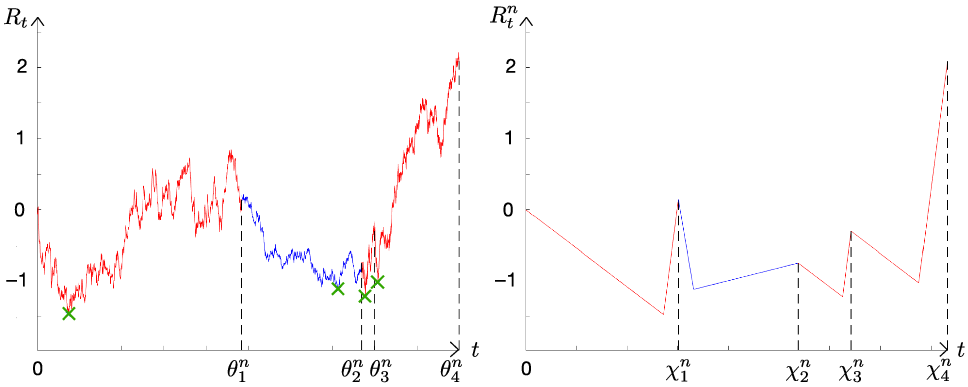
. Figure 3 illustrates the construction of the stochastic fluid process
 $(\mathcal{R}^n, \mathcal{J}^n)$
corresponding to the Markov-modulated Brownian motion
 $(\mathcal{R}, \mathcal{J})$
.
(Left) A sample path of an MMBM
 $(\mathcal{R},\mathcal{J})$
with
 $\mathcal{J}$
being on
 $\mathcal{S} = \{1, 2\}$
: arrivals corresponding to
 $\mathcal{M}^n$
occur at
 $\{\theta_i^n\}_{i \geq 0}$
, and the minima of
 $\mathcal{R}$
attained between these arrivals are highlighted with green crosses. When
 $J(t) = 1$
(red),
 $\mu_1 = 5$
and
 $\sigma_1^2 = 4$
. When
 $J(t) = 2$
(blue),
 $\mu_2 = -2$
and
 $\sigma_2^2 = 1$
. (Right) An associated sample path of a stochastic fluid process
 $(\mathcal{R}^n,\mathcal{J}^n)$
: jumps from
 $\{+\}\times\mathcal{S}$
to
 $\{-\}\times\mathcal{S}$
occur at
 $\{\chi_i^n\}_{i \geq 1}$
. The values of
 $R^n(\chi_i^n)$
match with those of
 $R(\theta_i^n)$
for
 $i = 1, \ldots, 4$
.

3. Proof of Theorem 1.2
In order to prove Theorem 1.2 we measure the absolute difference between
 $\mathcal{R}$
and
 $\mathcal{R}^n$
. First, we make use of the triangle inequality to cover the sample space by a number of possibly overlapping events. Then, using the subadditivity property of the probability measure, we bound the difference between
 $\mathcal{R}$
and
 $\mathcal{R}^n$
on each of these events. Below we define such events and obtain bounds for their probability.
As
 $\lambda_n \rightarrow \infty$
, the grids
 $\{\theta^n_k\}_{k\ge 0}$
and
 $\{\chi^n_k\}_{k\ge 0}$
become finer. Intuitively, this and (2.4) indicate that
 $\mathcal{R}^n$
approximates
 $\mathcal{R}$
as
 $n\rightarrow\infty$
, which is stated more precisely in Theorems 1.1 and 1.2. We devote this section to rigorously proving Theorem 1.2, from which Theorem 1.1 follows as a corollary.
Let
 $\lambda_n=2n^2$
; this makes our results and rates comparable to those of [Reference Gorostiza and Griego9] and related papers. Fix
 $T \in [0,1)$
,
 $q>0$
, and without loss of generality consider
 $n\ge 2$
throughout.
Proof of Theorem 1.2(i). In order to prove (1.4), notice that
 \begin{align} \mathbb{P}\left(\sup_{0 \le s\le T} |R(s) - R^n(s)| > \alpha \varepsilon_n\right)\le \mathbb{P}(A^n) + \mathbb{P}(\chi^n_{n^2} < T),\end{align}
where
 \begin{align*} A^n \;:\!=\; \left\{\sup_{0 \le s\le \chi^{n}_{n^2}} |R(s) - R^n(s)| > \alpha \varepsilon_n\right\} = \left\{\max_{1 \leq k \leq n^2} \sup_{\chi^{n}_{k-1} \le s \le \chi^{n}_{k}} |R(s) - R^n(s)| > \alpha \varepsilon_n\right\},\end{align*}
with
 $\alpha$
a constant to be determined later. We now show that each of the quantities
 $\mathbb{P}(A^n)$
and
 $\mathbb{P}(\chi_{n^2}^n < T)$
are
 $o(n^{-q})$
.
The triangle inequality implies that
 $A^n \subseteq B_1^n\cup B_2^n\cup B_3^n\cup B_4^n$
, where
 \begin{align*}B_1^n & \;:\!=\; \left\{\max_{1 \le k\le n^2}\sup_{\chi_{{k - 1}}^n \le s\le \chi_{{k}}^n } |R(s) - R(\chi_k^n)| > \alpha \varepsilon_n/4\right\},\\[5pt] B_2^n & \;:\!=\; \left\{\max_{1 \le k\le n^2} |R(\chi_k^n) - R(k/n^2)| > \alpha \varepsilon_n/4\right\},\\[5pt] B_3^n & \;:\!=\; \left\{\max_{1 \le k\le n^2} |R(k/n^2) - R^n(\chi_k^n)| > \alpha \varepsilon_n/4\right\},\\[5pt] B_4^n & \;:\!=\; \left\{\max_{1 \le k\le n^2}\sup_{\chi_{{k - 1}}^n \le s\le \chi_{{k}}^n} |R^n(\chi_k^n) - R^n(s)| > \alpha \varepsilon_n/4\right\}.\end{align*}
By (2.4),
 $B_3^n$
can be rewritten as
 $B_3^n = \left\{\max_{1 \le k\le n^2} |R(\theta_k^n) - R(k/n^2)| > \alpha \varepsilon_n/4\right\}$
, so that the events
 $B_1^n$
,
 $B_2^n$
, and
 $B_3^n$
concern only the process
 $\mathcal{R}$
, not
 $\mathcal{R}^n$
.
Let
 $\{\delta_n\}_{n\ge 0}$
be any positive and decreasing sequence. Making a further partition, we obtain
 \begin{align} A^n \subseteq \left(\left(B_1^n\cup B_2^n\cup B_3^n\right) \cap \left( C^n_\chi \cup C^n_\theta\right)^\textrm{c} \right) \cup \left( C^n_\chi \cup C^n_\theta\right) \cup B_4^n,\end{align}
where
 $C^n_\chi \;:\!=\; \left\{\max_{1 \le k\le n^2} |\chi_k^n - k/n^2|>\delta_n\right\}$
,
 $C^n_\theta \;:\!=\; \left\{\max_{1 \le k\le n^2} |\theta_k^n - k/n^2|>\delta_n\right\}$
. On
 $(C^n_\chi\cup C^n_\theta)^\textrm{c}$
, for all
 $k = 1, \ldots, n^2$
we have
 $\chi_k^n, \theta_k^n, \chi_{k + 1}^n \in [k/n^2 - \delta_n, (k + 1)/n^2 + \delta_n]$
. Let
 $x_+\;:\!=\;\max\{x,0\}$
for
 $x\in\mathbb{R}$
. If there exists
 $a, b \in [k/n^2 - \delta_n, (k + 1)/n^2 + \delta_n]$
such that
 $|R(a_+) - R(b_+)| > \alpha \varepsilon_n/4$
, then by the triangle inequality either
 $|R([k/n^2 - \delta_n]_+) - R(a_+)| > \alpha \varepsilon_n / 8$
or
 $|R([k/n^2 - \delta_n]_+) - R(b_+)| > \alpha \varepsilon_n / 8$
. Therefore,
 \begin{align} \left(B_1^n\cup B_2^n\cup B_3^n\right) \cap \left(C^n_\chi \cup C^n_\theta\right)^\textrm{c} \subseteq D^n, \end{align}
where
 \begin{align*} D^n &\;:\!=\; \left\{\max_{1 \le k\le n^2}\sup_{a \in [k/n^2 - \delta_n, (k + 1)/n^2 + \delta_n]} \left|R\left((k/n^2 - \delta_n)_+\right) - R\left(a_+\right)\right| > \alpha \varepsilon_n/8\right\}\\[5pt] &\;= \left\{\max_{1 \le k\le n^2}\sup_{s \in [0, n^{-2} + 2\delta_n]} \left|R\left((k/n^2 - \delta_n + s)_+\right) - R\left((k/n^2 - \delta_n)_+\right)\right| > \alpha \varepsilon_n/8\right\}. \end{align*}
 \begin{align} \mathbb{P}(A^n) \le \mathbb{P}(D^n) + \mathbb{P}(C^n_\chi ) + \mathbb{P}(C^n_\theta) + \mathbb{P}(B^n_4).\end{align}
In the following, we show that with an appropiate choice of
 $\alpha$
and
 $\{\delta_n\}_{n\ge 1}$
, each summand on the right-hand side of (3.4) is an
 $o(n^{-q})$
function. For the remainder of the section,
 $K_j$
(
 $j \in \mathbb{N}$
) denote generic constants that are used to simplify bounds and are not dependent on q or n.
Bounding
 $\mathbb{P}(B^n_4)$
. Let
 $\omega_{\min}^n \;:\!=\; \min\limits_{i\in\mathcal{S}}\omega_i^n$
,
 $\eta_{\min}^n \;:\!=\; \min\limits_{i\in\mathcal{S}}\eta_i^n$
,
 $\kappa_n \;:\!=\;\omega_{\min}^n\wedge\eta_{\min}^n$
. Then,
 \begin{align}\mathbb{P}(B_4^n)&\le \sum_{1\le k\le n^2}\mathbb{P}\left(\sup_{\chi_{{k - 1}}^n \le s\le \chi_{{k}}^n} \left| R^n(\chi_k^n) - R^n(s)\right| > \alpha \varepsilon_n/4\right) \nonumber \\[5pt] &\le \sum_{1\le k\le n^2}\mathbb{P}\left(H^{n}_k>\alpha \varepsilon_n/4\right) + \mathbb{P}\left(L^{n}_k>\alpha \varepsilon_n/4\right) \nonumber\\[5pt] &\le n^2\left(\textrm{e}^{-\omega^n_{\min}\alpha \varepsilon_n/4} + \textrm{e}^{-\eta^n_{\min}\alpha \varepsilon_n/4}\right)\nonumber\\[5pt] &\le n^2 \left( 2\textrm{e}^{-\kappa_n(\alpha \varepsilon_n/4)}\right). \nonumber\end{align}
By definition,
 \begin{align*} \kappa_n \;:\!=\; \min_{i\in\mathcal{S}}\left\{\left(\sqrt{\frac{\mu^2_i}{\sigma^4_i} + \frac{2n^2}{\sigma^2_i}} + \frac{\mu_i}{\sigma^2_i}\right)\wedge\left( \sqrt{\frac{\mu^2_i}{\sigma^4_i} + \frac{2n^2}{\sigma^2_i}} - \frac{\mu_i}{\sigma^2_i}\right)\right\}= O(n),\end{align*}
where the notation O(g(n)), for
 $g \colon \mathbb{N}\mapsto \mathbb{R}_+$
, denotes a function
 $f \colon \mathbb{N}\mapsto \mathbb{R}$
such that
 $\limsup_{n \rightarrow \infty} |f(n)|/g(n) \le M$
for some
 $M\in\mathbb{R}$
. Then, there exists
 $n_1$
such that
 $\kappa_n >n^{1/2}$
for all
 $n\ge n_1$
, and so, for
 $n\ge n_1$
,
 \begin{align*} \mathbb{P}(B_4^n)&\le n^2 \left(2\textrm{e}^{-\kappa_n(\alpha/4)n^{-1/2}\log(n)}\right) \le n^2 \left(2\textrm{e}^{-(\alpha/4)\log(n)}\right) =K_1n^{2-\alpha/4} . \end{align*}
Choose
 $\alpha$
to be larger than
 $\alpha_1\;:\!=\;8q+8$
. Then,
 $\mathbb{P}(B_4^n)$
is an
 $O(n^{-2q})$
function, and thus it is an
 $o(n^{-q})$
function.
Bounding
 $\mathbb{P}(C^n_{\chi})$
and
 $\mathbb{P}(C^n_{\theta})$
. Let
 $\{p_n\}_{n\ge 0}$
be a sequence taking values in
 $\mathbb{N}$
. By Doob’s
 $L_p$
-maximal inequality,
 \begin{align} \mathbb{P}(C^n_\chi )\le\frac{\mathbb{E}[(\chi_{n^2}^n - 1)^{2p_n}]}{(\delta_n)^{2p_n}}. \end{align}
Since
 $\chi_{n^2}^n$
is a convolution of
 $2n^2$
exponential random variables of rate
 $2n^2$
,
 $\chi_{n^2}^n\sim\mbox{Erlang}(2n^2, 2n^2)$
, so that (3.5) and Lemma A.1 (in the Appendix) imply that
 \begin{align}\mathbb{P}(C^n_\chi )&\le(\delta_n)^{-2p_n} \frac{(2p_n)!\sqrt{2n^2}}{(2n^2)^{2p_n}} \frac{\sqrt{2n^2}^{2p_n+1}-1}{\sqrt{2n^2}-1}\nonumber\\[5pt] & \le K_2 \frac{(\delta_n)^{-2p_n}(2p_n)! }{n^{2p_n-1}}\nonumber\\[5pt] & \le K_2 n\left(\frac{2p_n }{\delta_n n}\right)^{2p_n}.\end{align}
Similarly, since
 $\theta_{n^2}^n\sim \mbox{Erlang}(n^2, n^2)$
, we have, for
 $n \geq 2$
,
 \begin{align}\mathbb{P}(C^n_\theta)\le K_3 n\left(\frac{2p_n }{\delta_n n}\right)^{2p_n}.\end{align}
Set
 $\delta_n \;:\!=\; 2p_nn^{(q+1/2)/p_n - 1}$
,
 $n\ge 1$
. With this choice of
 $\{\delta_n\}$
, both (3.6) and the right-hand side of (3.7) are proportional to
 $n^{-2q}$
, so that
 $\mathbb{P}(C^n_\chi )$
and
 $\mathbb{P}(C^n_\theta)$
are
 $o(n^{-q})$
functions.
Bounding
 $\mathbb{P}(D^n)$
. Set
 $p_0\;:\!=\;0$
and
 $p_n \;:\!=\; \lfloor\log(n)\rfloor$
for
 $n\ge 1$
; we can verify that with this choice of
 $\{p_n\}_{n\ge 0}$
, the sequence
 $\{\delta_n\}_{n\ge 0}$
is an
 $O(n^{-1}\log(n))$
function. Define
 $\mu_{\max}\;:\!=\;\max_{i\in\mathcal{S}}|\mu_i|$
,
 $\sigma_{\max}\;:\!=\;\max_{i\in\mathcal{S}}\sigma_i$
, and
 ${\delta}'_{\!\!n} \;:\!=\; 2\delta_n + n^{-2}$
, and let
 $n_2\ge n_1$
be such that
 $\alpha_1\varepsilon_n/8-\mu_{\max}{\delta}'_{\!\!n}>0$
for all
 $n\ge n_2$
. Then, for any
 $\alpha\ge \alpha_1$
, we have
 $\alpha\varepsilon_n/8-\mu_{\max}{\delta}'_{\!\!n}>0$
for all
 $n\ge n_2$
. Thus,
 \begin{align*} \mathbb{P}(D^n) & \leq {\sum_{k = 1}^{n^2} \mathbb{P} \left(\sup_{0 \leq s \leq {\delta}'_{\!\!n}} \left| R\left((k/n^2 - \delta_n)_+\right) - R\left((k/n^2 - \delta_n + s)_+\right) \right| > \alpha \varepsilon_n/8\right)}\nonumber \\[5pt] & \leq { \sum_{k = 1}^{n^2} \sum_{i \in \mathcal{S}} \mathbb{P}\left( \sup_{0 \leq s \leq {\delta}'_{\!\!n}} \left| R\left((k/n^2 - \delta_n)_+\right) - R\left((k/n^2 - \delta_n + s)_+\right) \right| > \alpha \varepsilon_n/8 \; \Big | \; G_{i, k, n} \right)}, \nonumber \\ & {\rm{where}} \, G_{i,k,n} \;:\!=\; \{J(k/n^2 - \delta_n) = i\}. {\rm{By \, the \,strong \,Markov \,property, \,we \,can \,rewrite \,the \,above}} \nonumber \\[5pt] & {\rm{right-hand \,side \,to \,obtain}} \nonumber \\[5pt] & \mathbb{P}(D^n) = {n^2\sum_{i \in \mathcal{S}} \mathbb{P}\left(\sup_{0 \leq s \leq {\delta}'_{\!\!n}} \left| R(s) \right| > \alpha \varepsilon_n/8 \; \Big | \; J(0) = i \right)} \nonumber \\[10pt] &\le n^2m \left[\frac{4}{\sqrt{2\pi}\,}\frac{\sqrt{\sigma_{\max} {\delta}'_{\!\!n}}}{\alpha \varepsilon_n / 8 - \mu_{\max} {\delta}'_{\!\!n}}\exp\left(-\frac{(\alpha\varepsilon_n/8-\mu_{\max}{\delta}'_{\!\!n})^2}{2\sigma_{\max}{\delta}'_{\!\!n}}\right)\right]\nonumber \\[10pt] &\le K_4n^2\exp\left(-\frac{(\alpha\varepsilon_n/8-\mu_{\max}{\delta}'_{\!\!n})^2}{2\sigma_{\max}{\delta}'_{\!\!n}}\right),\qquad n\ge n_2, \end{align*}
where the first inequality follows from Lemma A.2 (in the Appendix).
Let
 $n_3\ge n_2$
be such that
 $\varepsilon_n\le 1$
and
 ${\delta}'_{\!\!n}\le 3\delta_n$
for all
 $n\ge n_3$
. Then
 \begin{align}\mathbb{P}(D^n)&\le K_4n^2 \exp\left(-\frac{(\alpha\varepsilon_n/8)^2 + (\mu_{\max}{\delta}'_{\!\!n})^2 - 2(\alpha\varepsilon_n/8)(\mu_{\max}{\delta}'_{\!\!n}) }{2\sigma_{\max}{\delta}'_{\!\!n}}\right) \nonumber\\[5pt] & \le K_4 n^2 \exp\left(-\frac{(\alpha\varepsilon_n/8)^2 - 2(\alpha\varepsilon_n/8)(\mu_{\max}{\delta}'_{\!\!n}) }{2\sigma_{\max}{\delta}'_{\!\!n}}\right) \nonumber\\[5pt] & \le K_4 n^2 \exp\left(-\frac{(\alpha\varepsilon_n/8)^2}{2\sigma_{\max}{\delta}'_{\!\!n}} + \frac{\alpha\mu_{\max}}{8\sigma_{\max}}\right)\nonumber\\[5pt] & \le K_5 n^2 \exp\left(-\frac{(\alpha\varepsilon_n/8)^2}{6\sigma_{\max}\delta_n}\right)\nonumber\\[5pt] &= K_5 n^2 \exp\left(-\frac{\alpha^2n^{-1}(\log(n))^2}{K_6\lfloor\log(n)\rfloor n^{(q+1/2)/\lfloor\log(n)\rfloor -1}}\right)\nonumber \\[5pt] & \le K_5 n^2 \exp\left(-\frac{\alpha^2\log(n)}{K_6 n^{(q+1/2)/\lfloor\log(n)\rfloor}}\right),\qquad n\ge n_3.\end{align}
Let
 $\gamma(q)=\sup_{n\ge n_3} K_6 n^{(q+1/2)/\lfloor\log(n)\rfloor}$
, which is finite since
 $n^{(q+1/2)/\lfloor\log(n)\rfloor}$
converges to
 $\textrm{e}^{q + 1/2}$
. If
 $\alpha > \alpha_2\;:\!=\;\sqrt{(2q+2)\gamma(q)}$
, by (3.8) we have
 \begin{align*}\mathbb{P}(D^n) & \le K_5 n^2 \exp\left(-\frac{(2q + 2)\gamma(q)\log(n)}{ K_6 n^{(q+1/2)/\lfloor\log(n)\rfloor}} \right) \\& \le K_5 n^2 \exp\left(-(2q + 2)\log(n)\right) \\& = K_5 n^{-2q}, \qquad n\ge n_3,\end{align*}
which implies
 $\mathbb{P}(D^n)$
is an
 $o(n^{-q})$
function. Thus, all four terms on the left-hand side of (3.4) are
 $o(n^{-q})$
functions, and so is
 $\mathbb{P}(A^n)$
.
Finally, let
 $n_4\ge n_3$
be such that
 $\delta_n<1-T$
for all
 $n\ge n_4$
. Then,
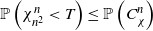 $\mathbb{P}\left(\chi^n_{n^2} < T\right)\le \mathbb{P}\left(C^n_{\chi}\right)$
for all
 $n\ge n_4$
, meaning that (3.1) is an
 $o(n^{-q})$
function. The proof of (1.4) is now complete.
Proof of Theorem 1.2(ii). Now, let
 $\{\rho_{\ell}\}_{\ell\ge 1}$
be a sequence with
 $\rho_{\ell}\downarrow 0$
, and define
 $E^\ell \;:\!=\; \bigcap_{j=1}^\infty \bigcup_{n=j}^\infty \left\{\pi_2(J^n(s))\neq J(s) \mbox{ for some }s\in(T-\rho_\ell, T + \rho_\ell)\right\}$
. Proving (1.5) is equivalent to showing that
 $\mathbb{P}\big(\cap_{\ell=1}^\infty E^\ell\big) = 0$
, which in turn is equivalent to proving that
 $\lim_{\ell\rightarrow\infty}\mathbb{P}(E^\ell)=0$
.
Define
 $\beta_0\;:\!=\;0$
,
 $\beta^n_0\;:\!=\; 0$
for
 $n\ge 0$
. For
 $k\ge 0$
, let
 $\beta_{k+1} \;:\!=\;\inf\left\{s>\beta_k\;:\;J(s^-)\neq J(s)\right\}$
,
 $\beta_{k+1}^n \;:\!=\; \inf \left\{s>\beta_k^n\;:\;\pi_2(J^n(s^-))\neq \pi_2(J^n(s))\right\}$
(
 $n\ge 0$
). For any
 $a,b\in\mathbb{R}$
, define
 $M^0[a,b]\;:\!=\; M(b_+)-M(a_+)$
; recall that
 $\mathcal{M}^0$
is a Poisson process of rate
 $\lambda_0/2$
defined in Section 2. Then,
 $E^\ell \subseteq \left\{M^0[T-2\rho_\ell, T+2\rho_\ell]>0\right\} \cup \left(\left\{M^0[T-2\rho_\ell, T+2\rho_\ell]=0\right\} \cap E^{\ell}\right)$
. Note that
 $\mathbb{P}(M^0[T-2\rho_\ell, T+2\rho_\ell]>0) \le 1-\textrm{e}^{-(\lambda_0/2)4\rho_\ell} \rightarrow 0$
as
 $\ell\rightarrow\infty$
. Thus, in order to prove that
 $\lim_{\ell\rightarrow\infty}\mathbb{P}(E^\ell)= 0$
, it is sufficient to show that
 \begin{equation*}\lim_{\ell\rightarrow\infty}\mathbb{P}\left(\{M^0[T-2\rho_\ell, T+2\rho_\ell]=0\}\cap E^\ell\right)=0,\end{equation*}
which we do next. A path inspection reveals that
 \begin{align}& \{M^0 [T-2\rho_\ell, T+2\rho_\ell]=0\}\cap E^\ell\nonumber\\&\subseteq\left\{\bigcup_{k\ge 0}\left\{ \beta_k<T-2\rho_\ell < T+2\rho_\ell<\beta_{k+1}\right\}\right\}\cap E^\ell \nonumber\\&=\bigcup_{k\ge 0}\bigcap_{j=1}^\infty\bigcup_{n=j}^\infty \left\{\begin{array}{cc}\{\beta_k<T-2\rho_\ell< T+2\rho_\ell<\beta_{k+1}, T-\rho_\ell < \beta^n_k \} \; \cup\\\{\beta_k<T-2\rho_\ell < T+2\rho_\ell<\beta_{k+1}, \beta^n_{k+1}<T+\rho_\ell \}\end{array}\right\}\nonumber\\&\subseteq\bigcup_{k\ge 0}\bigcap_{j=1}^\infty\bigcup_{n=j}^\infty \left(\{|\beta_k - \beta_k^n|>\rho_\ell, \beta_k< T-2\rho_\ell \}\cup\{|\beta_{k+1} - \beta_{k+1}^n|>\rho_\ell, \beta^n_{k+1}< T+\rho_\ell \}\right)\nonumber\\&\subseteq \left(\bigcap_{j=1}^\infty\bigcup_{n=j}^\infty \left\{\max_{k:\theta^n_k< T-2\rho_\ell}|\chi^n_k - \theta^n_k|>\rho_\ell\right\}\right) \; \cup \; \left(\bigcap_{j=1}^\infty \bigcup_{n=j}^\infty \left\{\max_{k:\chi^n_k< T+\rho_\ell}|\chi^n_k - \theta^n_k|>\rho_\ell\right\}\right)\nonumber\\&\subseteq \left(\bigcap_{j=1}^\infty\bigcup_{n=j}^\infty \left\{\max_{1\le k\le n^2}|\chi^n_k - \theta^n_k|>\rho_\ell\right\}\right) \cup \left(\bigcap_{j=1}^\infty \bigcup_{n=j}^\infty\{ \theta^n_{n^2}<T-2\rho_\ell\}\right) \nonumber \\& \quad \cup \left(\bigcap_{j=1}^\infty \bigcup_{n=j}^\infty\{\chi^n_{n^2}<T+\rho_\ell\}\right).\end{align}
Since
 $\{\delta_n\}_{n\ge 1}$
is a sequence such that
 $\delta_n\downarrow 0$
, we have, for each
 $\ell\ge 1$
,
 \begin{align*} \mathbb{P}\left(\bigcap_{j=1}^\infty\bigcup_{n=j}^\infty\Big\{\max_{1\le k\le n^2}|\chi^n_k - \theta^n_k| > \rho_\ell\Big\}\right)\le \mathbb{P}\left(\bigcap_{j=1}^\infty\bigcup_{n=j}^\infty\Big\{\max_{1\le k\le n^2}|\chi^n_k - \theta^n_k| > 2\delta_n\Big\}\right) = 0,\end{align*}
where the last equality follows from the fact that
 $\mathbb{P}\left(\max_{1\le k\le n^2}|\chi^n_k - \theta^n_k| > 2\delta_n\right)\le \mathbb{P}(C^n_\chi\cup C^n_\theta)=o(n^{-q})$
, and applying Borel–Cantelli (choosing, say,
 $q = 2$
). Similar arguments follow for the two other events in (3.9). Thus,
 $\lim_{\ell\rightarrow\infty}\mathbb{P}(E^\ell)=0$
and so (1.5) follows.
4. An application: First passage probabilities
Theorem 1.1 implies that some first passage properties of
 $(\mathcal{R},\mathcal{J})$
can be analysed as the limiting first passage properties of
 $(\mathcal{R}^n,\mathcal{J}^n)$
as
 $n\rightarrow\infty$
. In particular, for any Borel set
 $A\subset\mathbb{R}$
define
 $\tau_A \;:\!=\;\inf\left\{s\ge 0\;:\;R(s)\in A\right\}$
,
 $\tau^n_A \;:\!=\;\inf\left\{s\ge 0\;:\;R^n(s)\in A\right\}$
(
 $n\ge 0$
). Then, Theorem 1.1 implies that, for any open set A and
 $j\in\mathcal{S}$
,
 $\tau_A= \lim_{n\rightarrow\infty}\tau_A^n$
a.s., and on the event
 $\{\tau_A<\infty\}$
,
 $\left\{J(\tau_A)=j\right\}=\bigcup_{i=0}^\infty\bigcap_{n=i}^\infty\{\pi_2(J^n(\tau_A))=j\}$
a.s.
In the case that A takes the form
 $(\!-\!\infty,-x)$
for
 $x\ge 0$
, we have the following.
Proposition 4.1. For
 $x\ge 0$
and
 $n\ge 0$
define
 $\tau_x\;:\!=\;\tau_{(-\infty,-x)}$
,
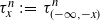 $\tau_x^n\;:\!=\;\tau_{(-\infty,-x)}^n$
. Then, for all
 $j\in\mathcal{S}$
,
 $\{\tau_x<\infty, J(\tau_x)=j\} = \{\tau^n_x<\infty, \pi_2(J^n(\tau_x^n))=j\}$
.
Proof. Fix
 $x\ge 0$
and
 $n\ge 0$
. Let
 $N\;:\!=\;\sup\{k\ge 0\;:\;\tau_x\ge \theta^n_k\}$
. This implies that
 $\tau_x\in[\theta^n_N,\theta^n_{N+1})$
on
 $\{N<\infty\}$
, and since
 $\mathcal{J}$
is constant between the epochs
 $\{\theta^n_k\}_{k\ge 0}$
, then
 $J(\theta^n_N)=J(\tau_x)$
. Similarly, if we define
 $N^n\;:\!=\;\sup\{k\ge 0\;:\;\tau_x^n\ge \chi^n_k\}$
, then
 $\pi_2(J^n(\chi^n_{N^n}))=\pi_2(J^n(\tau_x^n))$
on
 $\{N^n<\infty\}$
. Equations (2.4) and (2.5) imply that
 $N_n=N$
, and since
 $J(\theta^n_k)=\pi_2(J^n(\chi^n_k))$
for all
 $k\ge 0$
(see (2.3)),
 $J(\tau_x)=J(\theta^n_N)=\pi_2(J^n(\chi^n_{N^n}))=\pi_2(J^n(\tau_x^n))$
on
 $\{N<\infty\}$
, and the result follows.
The following result describes one central first passage distributional property of our construction.
Theorem 4.1. For
 $n\ge 0$
, let
 $U_n$
denote the infinitesimal generator associated to the process
 $\{\pi_2(J^n(\tau^n_x))\}_{x\ge 0}$
. Then,
 $U_n$
is a solution to the quadratic matrix equation
 \begin{align} X^2 + 2\Delta_{\mu}\Delta_{\sigma}^{-2}X + 2\Delta_{\sigma}^{-2}Q=0 ,\end{align}
where
 $\Delta_{\mu} = \textrm{diag}\{\mu_i\;:\;i\in\mathcal{S}\}$
,
 $\Delta_{\sigma}=\textrm{diag}\{\sigma_i\;:\;i\in\mathcal{S}\}$
. Furthermore,
 $U_n$
corresponds to the infinitesimal generator associated to
 $\{J(\tau_x)\}_{x\ge 0}$
.
Proof. Let
 $\Psi_n$
be the
 $p\times p$
-dimensional matrix defined by
 \begin{align*} (\Psi_n)_{ij}=\mathbb{P}\left(\tau^n_0 <\infty, J^n(\tau_0)=(-,j) \mid R^n(0)=0, J^n(0)=(+,i)\right), \qquad i,j\in\mathcal{S}. \end{align*}
Define
 $ \Delta_{r^n_+} =\mbox{diag}\{r^n(+, i)\;:\;i\in\mathcal{S}\}$
,
 $\Delta_{r^n_-} =\mbox{diag}\{|r^n(-, i)|\;:\;i\in\mathcal{S}\}$
, and
 \begin{align*} \left[\begin{array}{c@{\quad}c} T_{++} & T_{+-} \\ T_{-+} & T_{--}\end{array}\right] \;:\!=\; \left[\begin{array}{c@{\quad}c} -\lambda_n I & 2 Q + \lambda_n I \\\lambda_n I & -\lambda_n I \end{array}\right].\end{align*}
It is known [Reference Bean, O’Reilly and Taylor3] that
 $\Psi_n$
is the minimal nonnegative solution to the Riccati matrix equation
 \begin{align} \Delta_{r^n_+}^{-1}T_{++}\Psi_n + \Psi_n\Delta_{r^n_-}^{-1}T_{--} + \Psi_n\Delta_{r^n_-}^{-1}T_{-+}\Psi_n + \Delta_{r^n_+}^{-1}T_{+-} = 0, \end{align}
and that
 $\mathbb{P}(\tau^n_0 <\infty, J^n(\tau_x)=(-,j) \mid R^n(0)=0, J^n(0)=(-,i))={\bf{{e}}}_i^{\top}e^{U_n x}{\bf{{e}}}_j$
, where
 \begin{align} U_n & = \Delta_{r^n_-}^{-1} (T_{--} + T_{-+}\Psi_n) =\lambda_n \Delta_{r^n_-}^{-1} (\Psi_n - I),\end{align}
with
 ${\bf{{e}}}_i$
being the ith unit column vector.
Premultiplying (4.2) by
 $\Delta_{r^n_-}^{-1}$
and commuting
 $\Delta_{r^n_-}^{-1}$
with
 $\Delta_{r^n_+}^{-1}$
give
 \begin{align*} -\lambda_n \Delta_{r^n_+}^{-1} \Delta_{r^n_-}^{-1}\Psi_n -\lambda_n \Delta_{r^n_-}^{-1}\Psi_n\Delta_{r^n_-}^{-1} + \lambda_n\Delta_{r^n_-}^{-1}\Psi_n\Delta_{r^n_-}^{-1}\Psi_n + \Delta_{r^n_+}^{-1}\Delta_{r^n_-}^{-1}(2Q + \lambda_nI) = 0,\end{align*}
which leads to
 $(\Delta_{r^n_-}^{-1}-\Delta_{r^n_+}^{-1})U_n+ \lambda_n^{-1}U_n^2 + 2\Delta_{r^n_+}^{-1}\Delta_{r^n_-}^{-1}Q = 0$
. As
 $\Delta_{r^n_-}^{-1}-\Delta_{r^n_+}^{-1} = 2\lambda_n^{-1}\Delta_{\mu}\Delta_{\sigma}^{-2}$
and
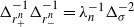 $\Delta_{r^n_+}^{-1}\Delta_{r^n_-}^{-1} = \lambda_n^{-1}\Delta_{\sigma}^{-2}$
, we obtain
 $U_n^2 + 2\Delta_{\mu}\Delta_{\sigma}^{-2}U_n + 2\Delta_{\sigma}^{-2}Q=0$
. That
 $U_n$
is also the infinitesimal generator of
 $\{J(\tau_x)\}_{x\ge 0}$
follows from Proposition 4.1.
Remark 4.1. Theorem 4.1 provides a novel understanding of the classic quadratic matrix equation associated to the down-crossing records of an MMBM (see [Reference Asmussen2]). Indeed, to compute the infinitesimal generator solution of (4.1), which is unique by [Reference Latouche and Nguyen13], we can instead compute the minimal nonnegative solution to the Riccati matrix equation (4.2), say
 $\Psi_n$
. The solution of (4.1) is then given by
 $U_n$
as defined in (4.3). A comparable result is that of [Reference Latouche and Nguyen13], where the authors constructed a sequence of matrices
 $\{U^*_n\}_{n\ge 0}$
that is shown to converge to U. One advantage of our construction is that each element of the sequence
 $\{U_n\}_{n\ge 0}$
obtained through Theorem 4.1 is identical to U.
A. Appendix
The following are some standalone results used in Sections 2 and 3.
Theorem A.1. Let
 $\mathcal{A}=\{A(t)\}_{t\ge 0}$
be a Poisson process of parameter
 $\lambda_a>0$
, and
 $\mathcal{X}=\{X(n)\}_{n\ge 0}$
an independent discrete-time Markov chain with state space
 $\mathcal{S}$
and transition probability matrix P. Define the Markov jump process
 $\mathcal{J}=\{J(t)\}_{t\ge 0}$
as
 $J(t)= X(A(t))$
,
 $t\ge 0$
. Let
 $\mathcal{B}=\{B(t)\}_{t\ge 0}$
be an independent Poisson process of parameter
 $\lambda_b>0$
. Define
 $\mathcal{C}$
to be the superposition of the Poisson processes
 $\mathcal{A}$
and
 $\mathcal{B}$
, and denote by
 $\{\tau_k\}_{k\ge 0}$
the arrival times of
 $\mathcal{C}$
. If we let
 $Y(n)=J(\tau_n)$
,
 $n\ge 0$
, then the process
 $\mathcal{Y}=\{Y(n)\}_{n\ge 0}$
is a Markov chain, independent from
 $\mathcal{C}$
, with transition probability matrix given by
 \begin{equation*} \frac{\lambda_a}{\lambda_a+\lambda_b}P + \frac{\lambda_b}{\lambda_a+\lambda_b}I.\end{equation*}
Proof. First, we show that
 $\mathcal{Y}$
is a Markov process. Let
 $i\in\mathcal{S}$
and
 $k\ge 1$
. Then,
 \begin{align*}\mathbb{P}(Y(k) & = \ i \mid Y(0), Y(1), \dots, Y(k-1))\\[5pt] & = \mathbb{P}(J(\tau_{k})=i \mid J(\tau_0), J(\tau_{1}), \dots, J(\tau_{k-1}))\\[5pt] & = \mathbb{P}(J(\tau_{k})=i \mid J(\tau_{k-1}))\qquad\mbox{(strong Markov property of $\mathcal{J}$)}\\[5pt] & = \mathbb{P}(Y(k)=i \mid Y(k-1)),\end{align*}
so that the Markov property holds.
Next, let
 $\mathcal{C}^*$
be the marked Poisson process with arrivals corresponding to the superposition of
 $\mathcal{A}$
, arrivals which we mark with an a, and
 $\mathcal{B}$
, arrivals which we mark with a b. The kth arrival of
 $\mathcal{C}^*$
occurs at
 $\tau_k$
carrying a mark
 $m_k\in\{a,b\}$
, say. Then,
 \begin{align*} \mathbb{P}(Y(k) &= j \mid Y(k-1)=i,\mathcal{C}) \\[5pt] & = \mathbb{P}(Y(k)=j, m_k=a \mid Y(k-1)=i,\mathcal{C}) + \mathbb{P}(Y(k)=j, m_k=b \mid Y(k-1)=i,\mathcal{C})\\[5pt] & = \mathbb{P}(Y(k)=j \mid Y(k-1)=i, m_k=a,\mathcal{C})\mathbb{P}(m_k=a \mid Y(k-1)=i,\mathcal{C})\\[5pt] &\quad + \mathbb{P}(Y(k)=j \mid Y(k-1)=i, m_k=b,\mathcal{C})\mathbb{P}(m_k=b \mid Y(k-1)=i,\mathcal{C}).\end{align*}
The event
 $\{m_k=a\}$
is clearly independent of
 $\{Y(k-1)=i,\mathcal{C}\}$
: the mark of a given Poisson arrival is independent of the history of arrivals. Thus,
 \begin{equation*}\mathbb{P}(m_k=a \mid Y(k-1)=i,\mathcal{C}) = \mathbb{P}(m_k=a) = \frac{\lambda_a}{\lambda_a+\lambda_b}.\end{equation*}
Similarly,
 \begin{equation*}\mathbb{P}(m_k=b \mid Y(k-1)=i,\mathcal{C}) = \mathbb{P}(m_k=b) = \frac{\lambda_b}{\lambda_a+\lambda_b}.\end{equation*}
Next, since
 $\mathcal{J}$
only (possibly) jumps at arrival times marked with a, then
 $\mathbb{P}(Y(k)=j \mid $
 $ Y(k-1)=i, m_k=b,\mathcal{C}) = \delta_{ij}$
, where
 $\delta_{ij}$
denotes the Kronecker delta. Finally, since
 $\mathcal{J}$
is piecewise constant between the arrival times
 $\{\tau_k\}_k$
,
 $\{Y(k-1)=i\} = \{J(\tau_{k-1})= i\}=\{J(\tau_{k}^-)= i\}$
. This implies that
 \begin{align*}\mathbb{P}(Y(k)=j \mid Y(k-1)=i, m_k=a,\mathcal{C}) & = \mathbb{P}(J(\tau_{k})= j \mid J(\tau_{k}^-)= i, m_k=a,\mathcal{C}) = p_{ij},\end{align*}
where time homogeneity is used in the last equality. Consequently,
 \begin{align*}\mathbb{P}(Y(k)=j \mid Y(k-1)=i, \mathcal{C}) = p_{ij}\frac{\lambda_a}{\lambda_a+\lambda_b} + \delta_{ij}\frac{\lambda_a}{\lambda_a+\lambda_b},\end{align*}
implying that
 $\mathcal{Y}$
is independent of
 $\mathcal{C}$
and completing the proof.
Lemma A.1. For
 $a\in \mathbb{N}_{+}\backslash\{1\}$
and
 $b>0$
, let
 $Y\sim\textrm{Erlang}(a,b)$
. Then
 \begin{align} \mathbb{E}\left[(Y-\mathbb{E}[Y])^k\right] \le \frac{k!\sqrt{a}}{b^k} \frac{\sqrt{a}^{k+1}-1}{\sqrt{a}-1}, \qquad k\in\mathbb{N}_{+}.\end{align}
Proof. Without loss of generality, suppose that
 $b=1$
. Equation (A.1) can be rewritten as
 \begin{align} \mathbb{E}\left[(Y-\mathbb{E}[Y])^k\right] \le {k!}\sum_{j=1}^k\sqrt{a}^j.\end{align}
We use induction to prove that (A.2) holds. First, since
 $\mathbb{E}[Y-\mathbb{E}[Y]]=0< 1!\sqrt{a}$
, the case
 $k=1$
holds trivially. Now, suppose (A.1) holds for all
 $k\in\{1,2,\dots, k_0\}$
for some
 $k_0\ge 1$
. By [Reference Willink20, third formula on p. 704],
 \begin{equation*} \mathbb{E}\left[(Y-\mathbb{E}[Y])^{k_0+1}\right] = k_0!a\sum_{i=0}^{k_0-1} \frac{\mathbb{E}\left[(Y-\mathbb{E}[Y])^{i}\right]}{i!} =k_0!a\left[1 + \sum_{i=2}^{k_0-1}\frac{\mathbb{E}[(Y-\mathbb{E}[Y])^{i}]}{i!}\right]. \end{equation*}
Using the induction hypothesis on the right-hand side of this equation, we get
 \begin{align*}\mathbb{E}[(Y-\mathbb{E}[Y])^{k_0+1}] & \le k_0!a\left[1 + \sum_{i=2}^{k_0-1}\sum_{j=1}^i\sqrt{a}^j\right] \le k_0!a\sum_{i=1}^{k_0-1}\sum_{j=1}^i\sqrt{a}^j\\ &= k_0!a\sum_{j=1}^{k_0-1}\sum_{i=j}^{k_0-1}\sqrt{a}^j= k_0!a\sum_{j=1}^{k_0-1}(k_0-j)\sqrt{a}^j\\ & \le (k_0+1)!a\sum_{j=1}^{k_0-1}\sqrt{a}^j\le (k_0+1)!\sum_{j=1}^{k_0+1}\sqrt{a}^j,\end{align*}
which proves (A.2) and thus (A.1).
Lemma A.2. Let
 $(\mathcal{R}, \mathcal{J}) = \{(R(t), J(t))\}_{t\ge 0}$
be a Markov-modulated Brownian motion defined as in (1.3). Then, for any
 $i\in\mathcal{S}$
,
 $t > 0$
, and
 ${a > \mu_{\max} t}$
,
 \begin{equation*}\mathbb{P}\left(\sup_{0 \le s\le t}|R(s)|> a \; \Big| \; J(0) = i \right)\le \frac{4}{{\sqrt{2 \pi}\,}}{\frac{\sqrt{\sigma_{\max}t}}{a - \mu_{\max}t}}\exp\left(-\frac{(a-\mu_{\max}t)^2}{2\sigma_{\max}t}\right),\end{equation*}
where
 $\mu_{\max}\;:\!=\;\max_{i\in\mathcal{S}}|\mu_i|$
and
 $\sigma_{\max}\;:\!=\;\max_{i\in\mathcal{S}}\sigma_i.$
Proof. Let
 $\{W(t)\}_{t\ge 0}$
be a standard Brownian motion, independent of
 $(\mathcal{R},\mathcal{J})$
. A standard bound for the Brownian motion based on the reflection principle gives, for
 $b > 0$
,
 \begin{align*} \mathbb{P}\left(\sup_{0 \le s\le t}|W(s)|> b\right) &\le 2\mathbb{P}\left(\sup_{0 \le s\le t}W(s)> b\right)\le 4 \int_b^{\infty} \frac{1}{\sqrt{2\pi t}\,}\textrm{e}^{-x^2/ 2t} \, \textrm{d} x \\ & \leq 4 \int_{b}^{\infty} \frac{x / b}{\sqrt{2 \pi t}\,} \textrm{e}^{-x^2/ 2t} \, \textrm{d} x \le \frac{4}{\sqrt{2 \pi}\,} \left(\frac{\sqrt{t}}{b}\right)\textrm{e}^{-b^2/2t}.\end{align*}
Note that
 $\mathcal{R}$
is identically distributed to
 $\{W(I^\sigma_t) + I^\mu_t\}_{t\ge 0}$
, where
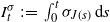 $ I^\sigma_t \;:\!=\; \int_0^t\sigma_{J(s)} \, \textrm{d} s$
and
 $I^{\mu}_t \;:\!=\;\int_0^t\mu_{J(s)} \, \textrm{d} s$
. This implies that
 \begin{align*}\mathbb{P}&\left(\sup_{0 \le s\le t}|R(s)|> a \;\Big| \; J(0)=i\right) = \mathbb{P}\left(\sup_{0 \le s\le t}|W\left(I^\sigma_s\right) + I^\mu_s|> a\;\Big| \; J(0)=i\right)\\ & \le \mathbb{P}\left(\sup_{0 \le s\le t}|W(I^\sigma_s)| > a - \sup_{0 \le s\le t}|{I^\mu_s}|\;\Big| \; J(0)=i\right)\\ & = \mathbb{E}\left(\mathbb{P}\left(\sup_{0 \le s\le t}\left|W(I^\sigma_s)\right| > a - \sup_{0 \le s\le t}|{I^\mu_s}| \; \Big| \; J(0)=i, \{I^\sigma_s\}_{0\le s\le t}, \{I^\mu_s\}_{0\le s\le t} \right)\;\Big|\;J(0)=i\right) \\ & \le \mathbb{E}\left(\frac{4}{{\sqrt{2\pi}}\,}{\left(\frac{\sqrt{\sup_{0 \le s\le t}|{I^\sigma_s}|}}{a-\sup_{0 \le s\le t}|{I^\mu_s}|}\right)} \exp\left(-\frac{(a-\sup_{0 \le s\le t}|{I^\mu_s}|)^2}{2\sup_{0 \le s\le t}|{I^\sigma_s}|}\right)\;\Big| \; J(0)=i\right)\\ & \le \mathbb{E}\left(\frac{4}{{\sqrt{2 \pi}}\,}{\frac{\sqrt{\sigma_{\max}t}}{a - \mu_{\max}t}}\exp\left(-\frac{(a-\mu_{\max}t)^2}{2\sigma_{\max}t}\right)\;\Big| \; J(0)=i\right) \\ & = \frac{4}{{\sqrt{2 \pi}}\,}{\frac{\sqrt{\sigma_{\max}t}}{a - \mu_{\max}t}}\exp\left(-\frac{(a-\mu_{\max}t)^2}{2\sigma_{\max}t}\right),\end{align*}
which completes the proof.
Funding Information
Both authors are affiliated with the Australian Research Council (ARC) Centre of Excellence for Mathematical and Statistical Frontiers (ACEMS). We would like to also acknowledge the support of Australian Research Council grant DP180103106.
Competing Interests
There were no competing interests to declare which arose during the preparation or publication process of this article.