I
Alternative finance refers to the financial channels and instruments which, in recent years, have emerged outside the traditional financial system represented by banks and capital markets. Examples include online consumer lending, fund-raising platforms and cryptocurrencies. Britain is one of the countries at the forefront of this new industry. One reason for this is the UK's experimental financial regulatory ‘sandbox’ system which has received widespread acclaim and global support. As of November 2018, 89 companies operated under its ‘light-touch’ purview. The fact that the Financial Conduct Authority (FCA) recently admitted a fourth sandbox cohort, which includes distributed ledger technology firms (a key technology underlying cryptocurrencies), indicates their interest in analysing how these markets operate. Such alternative financial firms along with regulators and traditional financial institutions are concerned with the same questions: how to stimulate financial innovation while offering ample consumer protection, and at what point does the need arise for more formal regulatory mechanisms.
In this article, we provide three historical case studies in Britain that closely parallel developments in modern alternative financial markets. Similar to today, a century and more ago Britain possessed one of the most developed financial sectors in the world, where new alternative financial products and firms emerged and prospered alongside the traditional financial system. All three historical cases demonstrate how entrepreneurial and innovative businesses responded to unmet consumer and firm demand. In each case, we document how these new markets emerged free of regulatory scrutiny and why the government subsequently responded to correct market failures, perceived, actual or anticipated. The first case looks at unsecured consumer lending from the late nineteenth century onwards, analogous to today's alternative fund-raising platforms; the second case draws insights from the junior IPO markets in the early twentieth century; and the third compares eighteenth-century private currency markets with modern cryptocurrencies. There are lessons for alternative finance today to be drawn from these historical examples. Not least is the suggestion that a continuation of an initially laissez-faire or experimental regulatory system should not be taken for granted and stricter, sometimes debilitating, regulation is likely to follow.
II
In August 2018, Wonga, a major UK-based payday lender, collapsed into administration. Wonga was once considered a rising fintech disruptor with the potential for a billion-pound stock flotation. Following the Global Financial Crises, Wonga grew rapidly and raised its profile through advertising, including a football sponsorship with Newcastle United. Soon after, politicians and the media questioned the payday lending business model and were offended by its high interest charges. In response, in 2015 the FCA investigated the sector and implemented price caps on all payday loans. As expected, under price controls the supply of funds contracted, and numerous lenders ceased operating. This episode was not the first time that regulators have targeted the high-cost consumer credit sector. This case study examines the origin of Britain's small-loan regulation and identifies three lessons applicable to the modern alternative financial industry, including how regulators: (1) struggled to define the alternative product; (2) attempted to draw boundaries between the alternative sector and traditional banking; and (3) avoided licensing the sector. It demonstrates that while entrepreneurial financial companies grew in response to consumer demand, it was precisely during periods of market expansion that the state responded with regulation. While in the 1900s the government employed light-touch regulation, by 2015 the state had implemented heavy-handed price controls.
This case study focuses on high-cost, small-value, short-term unsecured loans. Historically, this type of credit was known as a promissory note. Whereas savings banks and friendly societies provided financial services to workers with secure employment, moneylenders catered to a borrowing population that balanced weekly expenses on an unpredictable and limited income (Horne Reference Horne1947, p. 232). Simply put, these alternative credit providers offered a service that traditional institutions avoided or could not service profitability. Moneylenders, and their modern counterparts, payday lenders, issue funds based on the borrower's ability to repay out of future wages. Before the 1990s, loans were repaid through a series of small regular payments, spread out over a period of many months. While these loans were considered as ‘scraps from the banker's plate’, moneylenders were responding to the unique borrowing needs of the working poor in urgent need of cash. The cost of these scraps was high, at times approaching 3,000 per cent APR. Moneylenders justified their rates owing to high administration expenses and the risk associated with unsecured lending. Still, regulatory activists argued that moneylenders price-gouged vulnerable borrowers. During an age of supposed Victorian free trade, what factors generated regulatory interest in this private market solution to a demand for cash?
Late Victorian moneylenders operated without regulatory oversight. In fact, the sector had inadvertently benefited from a sweeping act of credit price deregulation in 1854. In that year, reversing centuries of tradition, the British Parliament repealed the usury law. The rationale behind the repeal was to facilitate commercial transactions that were demanding larger and more sophisticated loan products. Few politicians were concerned with small-value consumer credit, and yet the repeal ‘brought into existence these swarms of moneylenders’ (Farrow Reference Farrow1895). Thus, an unintended consequence of the government's decision to free traditional banks from interest rate restrictions was to incentivise alternative providers into the market.
In the 1890s, policymakers and the media focused on the sector's growth, high interest rates and advertising. At the turn of the twentieth century, it is likely that professional moneylenders numbered between 4,000 and 6,000 operating in 8,000 offices.Footnote 1 Advertising was problematic for moneylenders. While it was vital to generate new business, it also drew attention to the sector's high interest rates. For concerned policymakers, the sheer volume of advertisements was proof enough that the sector was growing rapidly. The Daily Telegraph and Standard carried an estimated 18,000 moneylending advertisements annually.Footnote 2 Alongside these advertisements, newspaper headlines drew attention to the often-dire circumstances of borrowers. In 1897, one newspaper reported that Simpson and Co. lent £5 16s to Arthur Slater, a railway fitter earning approximately £84 annually.Footnote 3 Slater had borrowed the money to pay medical bills. After paying £9 12s to Simpson, a balance of £9 10s still remained. Reform advocates considered Slater's loan, and the many thousands like it, as predatory. Tellingly, with abundant advertising and market growth, the political will to restrict the sector was increasing. With support from Arthur Balfour MP (the future prime minister), the Moneylenders Select Committee 1897 convened to uncover the ‘alleged evils’ of high-interest loans.
The data suggest that loans carried an average 60 per cent APR, typically ranging between 60 and 600 per cent APR.Footnote 4 Over seven and a half years, Fieldings Limited had issued 34,344 loans, 99.2 per cent of which were on promissory notes with an average rate of 60 per cent APR. Moneylenders attempted to educate the 1897 Select Committee as to the workings of their business. Isaac Samuel, a moneylender, compared small-loan lending to insurance underwriting, as both employed risk-based pricing.Footnote 5 Pushing the analogy further, Fieldings Limited claimed that they did not charge interest, ‘but an insurance premium on sold money’. Another analogy treated moneylenders as money retailers, Samuel explained, ‘We sell £5 for £6 5s … if a butcher sold 5s worth of meat and it cost him 4s that would be a shilling on the transaction; that is 20 per cent. If that was multiplied as you multiply moneylender's interest that would be 7,000%’ APR.Footnote 6 Like retailers, lenders’ gross profit had to cover all expenses, the owner's salary and a return on capital. The evidence suggests that net income rates averaged 11 per cent, a sum that moneylenders argued was not at all excessive.Footnote 7
Still, sceptical policymakers remained unconvinced of the necessity of such high interest rates and felt that the industry's growth necessitated a regulatory response. Parliament debated legislative remedies including price controls, banning advertisements, disclosure requirements and licensing. While the particulars of the debate fall outside the scope of this study, insight can be provided by the political and regulatory problem of defining and legitimising an alternative financial product.
If the impending regulation was to be effective, and for moneylenders to be certain of their legal status, Parliament needed to state what constituted a moneylending business. However easy this may seem, because the basic function of a moneylender is to provide funds to a willing borrower, it was difficult for the 1897 Select Committee to define how a moneylender differed from a ‘proper’ banker. Parliament focused on how moneylenders identified themselves to the public. Without an existing legal restriction, moneylenders were free to declare themselves a ‘bank’, ‘finance’ or ‘trust company’. Parliament took offence at the notion that a moneylender's trade name could insinuate that they were a bank. Their goal was not only to find a way to protect the reputation of bankers, but also to ensure that any moneylending regulation did not unduly interfere with ‘legitimate’ commerce.Footnote 8 It was clear that boundaries were required to separate bank from non-banking lending.
This raises the question: how did Victorian policymakers define bankers? Bankers were understood as people who engaged in the activity of banking. Less formally, one witness identified that the source of capital distinguished bankers from moneylenders, with the former taking deposits while the latter did not. Another remarked that ‘no respectable bank ever acts oppressively or takes an exorbitant rate of interest’.Footnote 9 However true (or untrue) that may be, Arthur Balfour showed little interest in segmenting the market by interest rates nor did he even hint at reinstating a usury law. Working from the legal phraseology assigned to bankers, the Moneylenders Act 1900 defined moneylenders as, ‘every person whose business is that of money-lending’. The 1900 Act also defined the sector by exclusion, that is, four specific industries were mentioned as not being moneylenders. These were pawnbrokers, friendly societies, any group granted special powers by Parliament to lend money and ‘any person bona fide carrying on the business of banking or insurance’. Whether it was by exclusion or in comparison to banking, policymakers struggled to define their position vis-à-vis traditional banking; after all, both institutions lent money to a willing borrower.
Still, a definition was in place, and from there the 1897 Select Committee debated two mechanisms to track and control the industry. The less burdensome proposal called for the creation of a moneylending registry, which was nothing more than a list of business names and locations. While the registry was meant to track the industry, it offered no control. The only listing requirement was payment of an annual fee, after which the registrant could conduct business legally. Surprisingly, many moneylenders sought a more robust regulatory system. They viewed government regulation as a road to legitimacy and sought stringent licensing, capital requirements, posted bonds, a requirement for audited financial statements, and an industry standards board. Moneylenders believed a government-issued licence requiring a screening process and monitoring of lender behaviour would add a much-needed dose of credibility to their profession.
As it turns out, Parliament agreed with this line of argument, which is why they decidedly rejected the licensing measure. Simply put, the sector was considered as unworthy to hold such a designation. It was recognised that a government licence implied approval of the applicant and by extension the sector. The 1897 Select Committee was adamantly against any licensing scheme as ‘some sort of approval or badge of respectability’.Footnote 10 Though certain MPs believed that moneylenders provided a needed financial service, fear of legitimising the market was too great. Instead, the 1900 Act charged the Inland Revenue with maintaining a registry. Ironically, though Parliament sought to protect consumers, it avoided an enhanced licensing scheme because it feared sending mixed market signals concerning the legitimacy of the loan product.
Though the 1900 Act included a definition of the sector, in reality Parliament had failed to draw boundaries around the alternative financial product. In doing so, the legislative measure failed to address the key question: how does a moneylender differ from a banker? Not long after its passage the Act's shortcomings became apparent. In 1901, Horace Mansfield MP asked why the Inland Revenue had not prosecuted a single moneylender for failing to register.Footnote 11 This reveals how misunderstood and ill-crafted the Act was. The Inland Revenue was charged with registering moneylenders, but had no power to prosecute failure to do so. As expected, without a precise definition, it was unclear which businesses were required to register. In turn, the registry itself was of little value and the Inland Revenue did not devote sufficient resources to it.
From a business perspective it may seem beneficial that the 1900 Act was ineffective in policing the sector. However, without clearly defined rules, judges were left to decide the merits of moneylending transactions appearing in court. As opposed to a uniformly enforced law, an individual judge could decide whether a transaction had harmed a borrower (Collard Reference Collard1912, p. 172). While for some regulatory interference was unwelcome, the increased business risk of a case-by-case approach was far more problematic. After a period of renewed growth and heavy advertising, the issue of a moneylending licensing was revisited in the 1920s. The Moneylenders Act of 1927 introduced a licensing requirement, but it also failed to draw boundaries around the sector. As the credit markets grew increasingly complex, this failure caused significant issues across the entire alternative consumer credit market.
By the late 1960s there was a sense of urgency about the legal status of finance houses, hire-purchase companies and instalment credit under the poorly designed 1927 Act. While banks were exempt, it was unclear which, if any, non-bank lenders required a moneylending licence. It didn't matter that these new forms of credit had nothing to do with small cash sums issued to cover emergency and basic expenses: without a boundary all non-exempted consumer credit loans were at risk. Eventually, a regulatory patchwork solution exempted finance houses in 1967, and later the Consumer Credit Act 1974 provided a definitive solution. Unlike previous consumer credit licensing schemes which segmented providers by form, that is moneylender, pawnbroker, hire-purchase, bank, under the 1974 Act, financial institutions could issue all types of consumer credit under a single consumer credit licence. For the most part, this arrangement held until the FCA targeted payday lending in 2015.
Lessons can be drawn from this case study that are relevant to the alternative finance markets today. For decades Parliament struggled to define and draw boundaries around an alternative credit product. This created uncertainty and increased business risk. At first, policymakers feared sending mixed market signals concerning the credibility and legitimacy of these niche players and opted for a light touch. As the market matured, so too did the regulatory system. Based on recent history, once a company or sector reaches a critical mass, political interest in consumer protection and regulatory oversight soon follows. Moreover, policymakers often default to understanding new financial markets and products as they relate to the traditional banking sector. History demonstrates that financial regulation of all stripes is influenced by the incumbent banking system.
III
Britain, in the shape of the London Stock Exchange (LSE), had the most developed stock market in the world by the early twentieth century (Rajan and Zingales Reference Rajan and Zingales2003). Whilst being subsequently overhauled by the US equity market in the middle of the century, it has nonetheless remained an important stock market to the present day. This is reflected in the more than 6,000 firms that have gone public on the LSE since 1900 – a total which is only surpassed by the US.
The regulatory approach to IPOs has changed dramatically over this long span of time, most particularly, in the case of the LSE's junior market – known today as the Alternative Investments Market (AIM). In contrast to the main market, the junior market has been the listing venue of choice for younger and smaller firms. From 1900 to 1929 the junior market was essentially an ‘alternative finance’ platform for early-stage firms raising funds from retail investors. Until the mid twentieth century UK-listed equities were at least 80 per cent owned by retail investors (Michie Reference Michie1999). Hence, this market displays some similarities with equity crowd-funding and International Coin Offerings (ICOs), which have emerged more recently.
Similar to today, firms a century ago could go public on the main market or on the junior market. In this earlier period, the LSE was self-regulated (and not statutorily regulated as it is today). However, only IPOs on the main market were subject to minimum listing requirements and were part of the formal capital markets in London. IPOs on the junior market, known as the Special Settlements market, were completely unregulated. Although firms had to apply to the LSE for a listing, permission was very rarely withheld provided a market maker could be found, unlike in the case of the main market, known as the Official List (see Burhop, Chambers and Cheffins Reference Burhop, Chambers and Cheffins2014 for more detail). Indeed, junior market share prices were not collected and published in the official LSE price lists until 1915. In addition, prospectus disclosure was minimal; investors received little or no protection under the law (Chambers and Dimson Reference Chambers and Dimson2009). For investors, it was a case of caveat emptor.
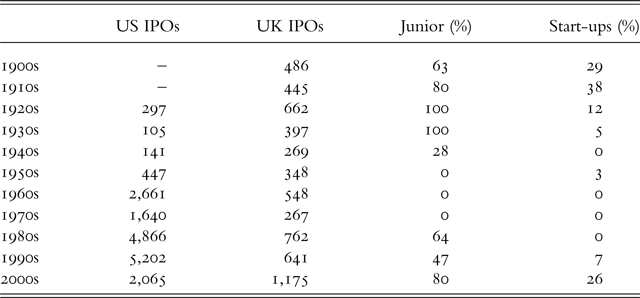
As a result, the junior IPO market in the early twentieth century was set up to provide entrepreneurs with fast access to external equity finance. Table 1 illustrates just how successful this alternative financial market was in the first half of the last century in this regard. Although we lack US IPO data for the first two decades of the last century, there were far more IPOs in London than in New York in the 1920s, 1930s and 1940s. Most of these UK IPOs were on the junior market. In the three decades up to 1929, around one in four of the junior market IPOs were start-ups, that is, newly established firms floated directly on the stock market. Thereafter, there is a marked decline in the number of start-up IPOs in the 1930s before they then totally disappear – except for a few new property development firms in the 1950s. Consistent with this drop off in start-ups, there is an accompanying rise in the average age at IPO of firms going public from less than 20 years to 50 years. Start-ups did not reappear and average age at IPO did not fall back to levels seen before 1929 until the launch of AIM at the end of the twentieth century.
Number of IPOs on the LSE since 1900

Sources: UK data from Burhop, Chambers and Cheffins (Reference Burhop, Chambers and Cheffins2014) for 1900–13; Chambers (Reference Chambers2010) for 1919–39; Chambers and Dimson (Reference Chambers and Dimson2009) for 1940–96; Paleari et al. (Reference Paleari, Piazzalunga, Signori, Trabucchi and Vismara2014) for 1997–2009. US data from Simon (Reference Simon1989) for 1926–39; Gompers and Lerner (Reference Gompers and Lerner2003) for 1940–59 and Jay Ritter's website for 1960–2009.
This pattern in start-ups and firm age at IPO across the century is related to the ebb and flow in IPO regulation. From 1900 to 1929, regulation was non-existent on the junior market. In the following decade, the LSE imposed minimum listing requirements for all firms going public, including those on the junior market, in terms of firm age at IPO and profitability and dividend records pre-IPO. This ultimately led to the shut-down of the junior market in 1947. Thereafter only profitable, mature firms went public and only on the main market. However, the UK IPO market became moribund in the 1970s and this contrasted sharply with the US, where IPO activity was boosted by the success of the launch its own junior market, NASDAQ (see Table 1). The NASDAQ example pushed the UK into reintroducing a junior market itself, with less strict listing requirements, in the shape of the Unlisted Securities Market (USM) in 1980; it was succeeded by AIM in 1995. This in turn led to younger firms gaining access to public equity again.
There is here a clear pattern of light-touch IPO regulation at the beginning and end of the last century coinciding with the existence of junior markets together with an intervening period of strict IPO regulation in the mid twentieth century. However, whilst there are similarities between the beginning and end of the last century, the modern AIM has one important difference compared to the junior market of the early twentieth century. In the latter case, firms going public very rarely had a reputable underwriter handling the IPO (Burhop, Chambers and Cheffins Reference Burhop, Chambers and Cheffins2014). In other words, poorly protected investors had nobody to certify the quality of the IPO. In contrast, firms going public today on AIM are required to appoint a nominated adviser (‘Nomad’) from among a pre-screened group of London brokerages, and it is the responsibility of the Nomad to ensure that there has been full disclosure to the market about the business and affairs of the listing firm (Gerakos, Lang and Maffett Reference Gerakos, Lang and Maffett2013, appendix i).
Whilst entrepreneurs clearly benefitted from getting their IPOs away, we must next consider what a lack of IPO regulation in the early twentieth century meant for investors in these IPOs. One way to answer this question is to examine firm survival (failure) rates post-IPO. Whilst estimating long-run returns post-IPO yields a more precise answer, there is considerable difficulty in accurately tracking what happens to firms that merge since merger terms are difficult to establish the further we go back in time. Although failure rate ignores the upside delivered by IPO winners, it serves to focus attention on the downside risks of IPO investing. Failure is defined as the proportion of IPOs in a given year which delist due to the disappearance or (involuntary) liquidation of the firm, where shareholders receive no consideration within the five years following an IPO. Note that IPOs which subsequently disappear because of a merger with another firm and where the shareholders receive value for their shares are not regarded as having failed.
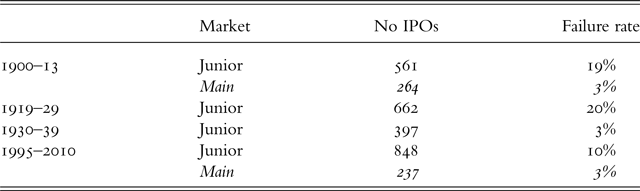
Table 2 summarises IPO failure rates estimated in previous studies over periods at the beginning and end of the last century and into the twenty-first century. Between 1900 and 1929 failure rates of junior market IPOs were 20 per cent. In other words, one in five firms going public had delisted by the fifth anniversary of going public and investors lost everything. This experience contrasts markedly with IPOs on the main market at that time where failure rates were only 3 per cent, very similar to today, and contrasts with more recent experience on AIM where failure rates are considerably lower at around 10 per cent. Early IPO markets also went through hot and cold periods just as they do today. There were hot IPO markets in 1911–12 and in 1928–9 and the failure rates of these IPO cohorts rose sharply above the average. For example, in the case of 1928–9 IPOs, 2 in 5 subsequently failed within five years. Entrepreneurs floated some weird and wonderful schemes, and those investors who believed them suffered substantial losses. This was venture capital-type investing but in the public markets with no evidence of big IPO winners to offset the numerous failures (Burhop, Chambers and Cheffins Reference Burhop, Chambers and Cheffins2014).
IPO failure rates

Sources: Burhop, Chambers and Cheffins (Reference Burhop, Chambers and Cheffins2014) for 1900–13; Chambers (Reference Chambers2010) for 1919–39; Vismara, Paleari and Ritter (Reference Vismara, Paleari and Ritter2012), table 5, for 1995–2010.
What becomes clear from the foregoing is that there is a relationship between IPO failure rates and IPO regulation. In the absence of regulation (and reputable underwriters), failure rates were high in the first three decades of the last century. After the poor performance of firms floated in 1928–9, the LSE decided to steadily raise listing requirements under pressure from the government and the Bank of England, starting in the 1930s. The process of regulatory tightening continued over the following two decades. This had a dramatic effect on young firms and start-ups, which were squeezed out of the public equity markets in the third quarter of the twentieth century. Since venture capital did not establish itself until the 1980s in the UK, there were no private markets able to fill this funding gap. The IPO regulatory pendulum had swung too far in the other direction. Eventually, the lighter-touch regulatory approach accompanying the re-emergence of a junior market in the 1980s and 1990s has once again catered to the needs of young entrepreneurial firms wishing to access the public equity market as quickly as possible, whilst attempting to offer minority investors protection from fraudulent schemes.
Three things become apparent from this case study of early IPO markets in the UK that are relevant to alternative finance markets today. First, regulation (including self-regulation) needs to strike a balance between providing entrepreneurs with flexible and fast access to new pools of capital, on the one hand, and protecting outside investors, on the other. Second, regulators reacting to the emergence of new markets will, in all likelihood, not get this balance right. They may under-react, or, as in this case, over-react once problems (investor losses) arise. Along the way, some institutional learning takes place. It took the LSE the best part of a century to learn from their experiences and arrive at a more appropriate balance. Third, the experiences of early IPO investors would not have mattered if these investors were ‘sophisticated’ in the sense that they understand the investment risks involved and were sufficiently wealthy to easily withstand the IPO losses. The total absence of any regulation regarding investor suitability in the early twentieth almost certainly meant that unsophisticated investors were duped into these IPOs.
IV
Throughout history, market transactions have relied on currency or credit – more likely for those who shared a common location or culture – as a medium for exchange of goods and services. Generally, the sovereign state owned the monopoly on the issuance of currency. Yet before currency existed, and at various points in the history of Europe, North America and Asia, token currencies and currency solutions – the latter generally consisting of ledgers accounting for debts resulting from market transactions – provided by private companies or citizens were used alongside or in place of sovereign money for small market transactions (Gilbert and Helleiner Reference Gilbert and Helleiner1999, p. 3). Private tokens were not considered legal tender and were generally not able to satisfy tax obligations. The usage of private tokens requires trust in the issuers, or at least the trust that the token will be accepted in subsequent transactions. As an alternative to currency, state backed or private, the records of market trades can be kept in (private) ledgers by merchants, temples or churches. Such private institutional arrangements have been documented in the fourth millennium bce in Mesopotamia (most likely predating money), ancient Greece and Rome, medieval England and the postbellum US (Spufford Reference Spufford1988, pp. 102–3; Muldrew Reference Muldrew2001, pp. 101–5; Goetzmann Reference Goetzmann2016, p. 51). Ledgers, like tokens, were only possible because individuals trusted in those holding the ledger: the local vicar, or a trusted merchant. Yet ledgers have weaknesses that only tokens can overcome.
Private token currencies can develop outside the formal monetary system, and yet can dominate sovereign money for long periods. Often, such tokens circulated nationally, as they did in England over a very long timeframe (see below), in China over many centuries but especially the long sixteenth century and in the US from time to time (Falkner Reference Falkner1901; Klein Reference Klein1974; Peng 1994; von Glahn Reference Von Glahn1996; Kuroda Reference Kuroda2005; Goetzmann Reference Goetzmann2016, p. 387). Whilst private money can exist in small communities, it also can surprise in geographic scope and scale, at times completely dominating the national economy (Martin Reference Martin2013, p. 238). Generally, merchants and their clienteles were sophisticated enough to manage many different sovereign, private and even foreign metallic and token coins readily, and adjusted their prices accordingly (Kuroda Reference Kuroda2005). Indeed, Jean-Baptiste Say specifically stated that ‘there can never be any shortage of money, since the enterprising mercantile class will always be able to improvise an alternative’ (Martin Reference Martin2013, p. 206). In this particular instance, we are speaking of currency mostly as a medium of exchange and unit of account.Footnote 12
Due to a combination of economic dogma, low salience among the governing elite and occasionally state weakness (leading to a lack of enforcement of the currency laws), Britain – like many other countries – suffered from a shortage of small currency, beginning with the Great Recoinage of 1696–9. The result is known more generally as ‘the big problem of small change’ (Cipolla Reference Cipolla1956). This section describes the experience of England between the 1740s and 1817 and uses this period as an illustration of a more general model for private currency solutions. When taken together with other cases of the adoption of private currency or currency systems, a set of common themes present themselves. New markets that tend to develop with little intervention from the state eventually attract the state's attention. Laissez-faire gives way to intervention. Such government regulation or control is not always good for all members of society, but it equally doesn't have to have negative consequences. While banning private currencies without remedying state failures can severely impact citizens, certain government responses can provide a more robust currency compared with the purely private solution.
Bitcoin and similar cryptocurrencies are simply the most recent and most technologically advanced of a wide variety of private solutions for replacing sovereign money in certain transactions.
Private currencies throughout history are important precursors to today's distributed ledger currencies such as Bitcoin and evolved in ways easily discernable in today's modern fintech markets. Successful private currencies can be classified by (1) the level of trust in the key private institutions and (2) the degree of state failure in the currency markets. The latter is evidenced by either a lack of trust in the central government or an otherwise unfulfilled need. Cryptocurrencies exhibit some of the same characteristics as the private solutions of the past, and they address similar needs, even if technology is now used to ensure private trust.Footnote 13 As such, analysing the history and development of alternative (private) currencies may provide useful guidance for policy related to new non-state cryptocurrencies.
The use of any currency as a store of value, unit of account or medium for exchange requires trust in some third-party institution rather than in the parties to a transaction. For local (and often frequent) transactions among those familiar with each other, credit can sometimes take the place of money. But physical currency – or sometimes uncoined metal – is often needed if there is not complete trust between two parties. Typically, sovereign governments issue and control currency and money (Gilbert and Helleiner Reference Gilbert and Helleiner1999). The issuance of currency can earn the state significant returns in the form of seigniorage, profiting from the provision of currency. Currently, holders of any of the major, fiat currencies must generally trust in the issuing government, in what is referred to here as ‘public trust’. Under the gold standard, currency users also needed to trust that the government would fulfil its convertibility into ‘specie’ in the form of precious metals such as gold or silver. At other times, the worry was that devaluation would occur via a reduction in the amount of precious metal content in coin or via lowering the conversion ratio. In the modern era, trust is required in the sovereign entity to accept the currency as payment for taxes, to not seize currency holdings unexpectedly, and to not devalue the currency to such a degree that holdings of cash become almost worthless, or transactions become impossible. Occasionally, the sovereign fails in this trust, and does not provide adequate media for commercial exchanges. At certain other times, trust in the public institutions tasked with maintaining currency value can be very low. In such situations, citizens need to demonstrate ‘private’ trust in non-governmental entities providing ledgers or token currencies.
When a big problem of small change occurred, state governments were either ignorant of the problem or chose to ignore it, while small denominations were technically difficult and costly to mint (Sargent and Velde Reference Sargent and Velde2002). Throughout history, there have been many instances of the state failing to provide enough small change for local merchants and their clients to undertake the day-to-day transactions. In other cases, the state simply fails to provide any stable currency at all. For a private solution to succeed, trust is vital. In high private trust situations, the promise – written or verbal – of the buyer is adequate to establish proof of a claim on another. In lower trust situations, possession of some sort of token representing an obligation is required. When public trust is highest, national currencies more than fulfil the requirements of the citizens as long as denominations are small enough to allow low-value transactions to take place. Otherwise, private currencies arise where a failure exists. This section details one specific case in England between the 1740s and 1817 when there was an unsatiated demand for small change at time when there existed high levels of private trust.
England has had a long history of private currency solutions to meet the government failure to provide enough small-denomination currency. Ledgers were also common from medieval times. Although such solutions were considered treasonous, they were either difficult to prosecute or were tacitly accepted by the state (Ruding Reference Ruding1840). In fact, England's ban on non-sovereign coins was rescinded in Ireland in 1339 as it was impossible to enforce. Numerous counterfeit and duplicate coins were observed in 1351, 1402 and 1510, for example (Sargent and Velde Reference Sargent and Velde2002). Unsanctioned foreign coins were also commonplace. But the situation for local citizens and merchants became much worse after the Elizabethan Great Debasement of 1560. From then on, policy towards small coins was highly volatile, moving between state-licensed private mints, government monopoly (and the consequent shortages) and laissez-faire. In general, it was considered ‘beneath the dignity’ of the crown to issue small coins in any great quantity (Whiting Reference Whiting1971). Privately minted coins under warrant from the appropriate state authority were made with such low amounts of the valuable metal content that they were not widely accepted and used as coins. As such, wholly private solutions flourished.
There were three key laissez-faire periods, with the first running from just after the Great Debasement in 1560 until 1613, the second from 1644 to 1672 and the third from the 1740s until 1817. During that time, private firms would issue their own coinage, while the state refrained from competing with their own mintings. Crucially for merchants and the citizenry, private issuers were able to meet the need for small change in its entirety (Sargent and Velde Reference Sargent and Velde2002, p. 292). The English Civil War worsened the shortage of official small change. With no monarch to enforce the monopoly on issuing currency, copper token currency grew rapidly beginning in 1648 (Whiting Reference Whiting1971). Another restructuring of the sovereign money, the Great Recoinage of 1696 to 1699, caused an even greater shortage of small change.
Here, we largely discuss the period known as the free token era from the 1740s, which included a period from 1754 where official coinage was entirely halted. Numismatists and similar scholars have written extensively on the tokens of this period, including Ruding (Reference Ruding1840), Peck (Reference Peck1960), Whiting (Reference Whiting1971) and Larkin and Hughes (Reference Hughes and Larkin1973). From 1740, many counterfeits entered the market, but there were also ‘evasions’, which were similarly meant to avoid prosecution but were not duplicates of sovereign issues. The earlier private tokens – of the 1600s – were mostly copper or brass but could also be leather or paper (Falkner Reference Falkner1901). They were mostly round but there was very little standardisation.
By 1787, accurately round and consistently weighted privately issued ‘trade’ tokens, often referred to as ‘Conder’ tokens (see Figure 1), became the most common form of small change due to coins being struck using a steam-driven press (Peck Reference Peck1960; Selgin Reference Selgin2003). In 1775, the king had discontinued the minting of small token coins, just at the time when the Industrial Revolution required the use of small coins to pay wages and to facilitate the purchase of necessities by the new generation of factory workers. Conder tokens filled that gap, dominating coin circulation from 1787 to the turn of the century (Selgin Reference Selgin2003). While the state was unable or unwilling to use the new minting technology to grease the wheels of commerce, the private sector was able to do so and adopted the new minting technology as soon as it became viable. The private sector had found the solution in the late 1780s, and this proved a success for trade and commerce and the consumer over the following two decades. Interestingly, it took the state until 1817 to catch up with the private sector when the copper token system was nationalised.
Anglesey ‘Conder’ pennies, for Parys Mine Co., promising to pay to the bearer one penny

The private solution was not entirely satisfactory, however. By 1797, even the private mints could not keep up with demand and the state, watching the circulation closely by now, stepped in to issue one and two penny coins and attempted to halt the production of the private tokens. Yet tokens remained popular, and their issuance continued until the early nineteenth century. But the product was not perfect. Some businesses went bankrupt even after issuing thousands of coins. Private failure had replaced the public failure. One reason why the state's re-monopolisation was not entirely and immediately successful was because the official coins remained underweight due to a shortage of copper coinciding with the War of 1812 and the Napoleonic Wars. As late as 1812, tokens were circulating at five to ten times the rate of official currency (Falkner Reference Falkner1901). It wasn't until 1817, after the shortage of copper abated, that the state monopolised issuance of copper token currency by decree. The transfer of copper token coin supply from private issuers to the sovereign mint was practically complete.
For most of the seventeenth and eighteenth centuries, private currency dominated the circulation of small coins in England. It was these private markets that satisfied the citizenry and effectively solved the big problem of small change during this important time period, which spans both the agricultural and industrial revolutions. ‘Entrepreneurs’ kept the economic model in ‘equilibrium, allowing the monetary system to function properly’ (Sargent and Velde Reference Sargent and Velde2002, p. 302). For example, it is highly likely that private ledgers allow the velocity of money to increase even as the quantity of money falls, thus avoiding the worst deflation. Secondly, private currencies – including counterfeits – often met the needs of the local citizenry and merchants, especially around harvest time (Kuroda Reference Kuroda2006, p. 8). Monopolising the issuance was the obvious solution when the private sector could not meet the ever-increasing demand for coin. The private sector had proven the worth of the copper coin as an instrumental factor in the provision of commerce before and during the industrial revolution. The copper penny has survived into the present day. It can be argued that the modern fiat token coin framework – as in most if not all modern currency systems – would not exist in its current form without the private solution developed in the 1700s (Sargent and Velde Reference Sargent and Velde2002, p. 303). Private copper mintings on a scale made possible by the steam press gave way to the copper penny we know today in the United Kingdom and elsewhere.
Throughout history, the private sector has often been able to satisfy the needs of the wider public for small-denomination coins with which to transact and fulfil their basic needs on a daily basis. The public need to trust the private sector, or, at the very least, trust it more than the state: sometimes they don't have any choice. The state can have a tremendous impact on private currency and currency systems. It sets the stage for private competitors by failing to provide its citizens with enough usable currency, or by eroding the value of the sovereign money that is available. It can then choose how to address private competition to its sovereign rights. This generally involves either an outright ban or – importantly – often a laissez-faire approach, which typically ends with a re-monopolisation.
Private solutions continually risk interference from the sovereign state. Successful private currencies tend to be implicitly accepted by the state for some time, as they are recognised as filling important needs that are otherwise ignored by sovereign entities. To add the Chinese example to the British one above, the Ming state accepted that temporary needs could be met by the private sector (Kuroda Reference Kuroda, Latham and Kawkatsu2000, p. 191). Banning usually happens almost immediately, if it is going to happen at all. Successes generally operate in parallel with state-backed currencies. However, there comes a time when the state simply re-monopolises the supply of currency, even if it comes at a cost to the public and therefore society at large. State interference has generally not been driven by meeting the needs of the public, but rather to regain control of the money supply as well as to capture seigniorage profits. A pattern of re-monopolisation is recognisable in the monetary histories of different countries. England, China and the US, often over long periods, are three important and representative examples. For example, the incoming Qing government solved the shortage by issuing more copper coins, and grain trading between regions was outlawed. Such a government response to a shortage came at a great cost to both the state (via negative seigniorage) and certain provinces (who were unable to market surplus grain, or purchase grain that was desperately needed). Notwithstanding this great cost, the state monopoly of currency given up by the Ming dynasty was restored (Kuroda Reference Kuroda2005).
Private markets have consistently identified needs that can be profitably met through innovation. Private demand drives such innovations. Equally, throughout history, there are many and varied state responses to such financial innovation and the resultant growth. State responses do not necessarily destroy markets and may increase consumer welfare, as the English case outlined here tends to indicate. In the best case, private innovation often informs and then incites new state-backed currency solutions, often eliminating the private element. At other times, such as in Qing dynasty China and in the US in 1674 and 1741 (Timberlake Reference Timberlake1981), the interference was negative: banning without providing a replacement.
The history of private currencies suggests some valuable lessons for practitioners and policy makers involved in the cryptocurrency revolution. For example, the biggest risk to Bitcoin is competition from sovereign currencies. While the banning of successful private currencies is a risk, the more likely response is a re-monopolisation using state fiat currencies as a result of lessons learned from the private currencies. Once the central banks fully understand blockchain technology and its applications, they should be able to continue to dominate electronic payments. However, there are private solutions to the current limitations experienced in international and online transactions that could succeed – for example, the need for extremely small denominations (micropayments) as well as for a more efficient means for retail-sized cross-border payments.
V
In the very recent past, online consumer lending, ICOs and cryptocurrencies have emerged and flourished. In this article, we examine three historical case studies of new non-traditional financial markets and emphasise some implications for alternative finance today. The first insight is that the private sector can generally be counted on to meet otherwise unmet needs. Moneylenders filled a gap unaddressed by the banking system of the day. Private currencies replaced sovereign token coins in most transactions at various points in history. Junior market IPOs provided access to funds for smaller companies that might otherwise have struggled to raise external finance. The second insight is that these new financial markets and instruments will eventually attract the attention of regulators. The initial regulatory response may be inadequate and is likely to evolve over time. Lastly, these examples are also a warning to industry not to take for granted any existing regulatory approach. In all three cases, harsher regulation – in some cases even to the point of shutting down the products and markets concerned – arrived after prolonged periods of observation.