The research for this article was funded by a grant from the Social Sciences and Humanities Research Council of Canada. The article is an expanded version of a paper presented at the 47th Annual Convention of the International Studies Association, San Diego, USA, 22–25 March 2006. The authors are grateful to Gary Horlick, Douglas Irwin, and the anonymous reviewers for their comments.
1. Introduction
The dispute over Canada's exports of softwood lumber products to the United States has been one of the most serious and complex in world trade. The conflict has been going on since 1982, although with varying levels of intensity. It has been primarily marked by phases of litigation, followed by periods of relative calm after ad hoc temporary settlements could be reached, such as the one concluded in October 2006, that have invariably entailed restrictions on Canadian lumber shipments to the US territory. Softwood lumber represents an important economic sector for Canada, with exports to the United States accounting for 70% of its lumber production and amounting to nearly CDN$ 10 billion in 2001. The fourth and so far most acrimonious episode of the dispute, known as Lumber IV, took place from 2001 to 2006.Footnote 1
In particular, this dispute involves key issues about what constitutes a subsidy. If ‘subsidy’ is generally understood as any state aid received by firms, agreement among countries on the scope of this notion has proven problematic. In the softwood lumber case, the United States argues that Canadian forest policies, notably the fees charged by Canada's provincial governments to private firms to harvest trees on public lands (stumpage rights), result in subsidization of Canadian lumber, as such measures would not ensure a ‘fair market value’ for timber in Canada. For its part, Canada insists that its forestry practices represent general public policies that cannot be equated with subsidies and unfair conditions of competition. The Canadian economy being deeply and increasingly dependent on the American economy, Canada has been subjected to such US policy pressure before and more strongly than any other country. Hence, debates over policy differences in US–Canada relations may arguably be seen as preview of what is to take on increasing significance throughout the world as a result of economic globalization and the resort to international trade rules.
The issue of subsidies is one of the main problems for the international trading regime. As the salience of tariffs and quotas decreased, government aids were bound both to be more widely used and to attract more attention as trade impediments. However, these are less amenable than tariffs to international negotiations. Subsidies may take many forms, e.g. grants, low-interest loans, tax incentives, or the provision of goods (as in the softwood lumber case), and some of these are difficult to identify and even more to quantify. But, above all, subsidies represent a politically sensitive issue as they often serve important national objectives not purportedly and only tangentially related to trade. More fundamentally, subsidization comes to the heart of different conceptions on the role of the state in the economy and, thus, involves the very issue of sovereignty.Footnote 2 In the case of the United States, although not necessarily reflective of its own domestic practices, a greater emphasis on the unfettered working of the market mechanism and a resulting hostile stance on subsidies in international forums have been at odds with the views prevailing in Canada and in the rest of the industrialized world. The United States has insisted on strengthening the disciplines governing subsidies, whereas most other countries have insisted on maintaining their latitude to use subsidies to serve socio-economic objectives and have been primarily interested in disciplining the US use of countervailing duties (CVDs).
Within the past 25 years, a number of US trade provisions and decisions have been adopted in response to the softwood lumber dispute, notably through an expansion of the notion of countervailable subsidy. At the multilateral level, efforts by states, especially those of the Canadian government, have been directed at preventing or limiting the extension of countervailable subsidies. As the regime governing international trade, the World Trade Organization (WTO) is the forum where such issues are discussed and negotiated upon. Canada and most states have held that the concept of subsidy should be defined as a ‘government financial contribution’ that confers a ‘benefit’ on firms and that is ‘specific’. This position was indeed reflected in the first multilaterally agreed upon definition of subsidy. The latter figures in the Agreement on Subsidies and Countervailing Measures (ASCM) that resulted from the Uruguay Round of multilateral trade negotiations that concluded in 1993. However, the United States sought (and continues to favour) a more expansive definition with ‘any government action or combination of government actions which confers a benefit on the recipient firm(s)’ (GATT, 1989: 5; McDonough, Reference McDonough and Stewart1993: 892).
In view of its importance and the central issues it raises, the softwood lumber dispute proved a significant background to the negotiations that led to the present multilateral definition of subsidy and the ensuing WTO case law. In US–Softwood Lumber IV,Footnote 3 the specifics of the case have mostly pertained to the government provision of goods, and notably natural resources, at less than fair market value, as well as the bestowal of indirect subsidies, particularly the pass-through of benefits from direct recipients to unrelated producers of subject merchandise. Our key hypothesis in this article is that, in the absence of any need or desire to significantly modify the ASCM in the Doha Round, not to mention the stalemate in the Round itself, the WTO jurisprudence and particularly the findings in US–Softwood Lumber IV are bound, for the foreseeable future, to provide the essential setting from which issues involving the provision of goods and services as well as indirect subsidization are to be addressed.
We will see that the WTO rulings in US–Softwood Lumber IV have interpreted the definition of subsidy so as to cover natural resource subsidies and upstream subsidies, to which no specific multilateral provisions apply. We will pay particular attention to (a) the question of the specificity of stumpage programs, (b) the concept of financial contribution in the case of the provision of goods, (c) the issue of cross-border benchmarks in order to determine both the existence and amount of benefit, (d) the requirement for a pass-through analysis in the case of upstream subsidies, and (e) the implementation of WTO rulings in this case. In so doing, our objective is to summarize and comment on how the WTO adjudication process in US–Softwood Lumber IV has contributed to clarify these key, mostly outstanding, issues over the existence and assessment of subsidies and, thereby, provide some indications as to the development of WTO case law as it pertains to subsidies and CVDs.
The structure of the article is as follows. Following this introduction, a second section identifies the subsidy and CVD provisions in the General Agreement on Tariffs and Trade (GATT) and the ASCM that are of relevance to the softwood lumber dispute. The third section concentrates on the definition and determination of subsidies as analyzed by WTO authorities in the US–Softwood Lumber IV case. This main section is followed by some complementary remarks from the concurrent lumber subsidy adjudication process under the North American Free Trade Agreement (NAFTA). A fifth section discusses, in the light of US–Softwood Lumber IV, specific proposals for amendments to existing WTO subsidy provisions in the Doha Round negotiations. A conclusion ensues.
2. The GATT/ASCM subsidy and CVD provisions
The treatment of subsidies in international trade has been firstly characterized by a distinction between export and import substitution subsidies, on the one hand, and domestic or production subsidies, on the other. While the former are in great part prohibited, the latter are allowed, although actionable in case of adverse trade effects (WTO, 1994a: Article XVI; 1994b: Articles 3–7). Remedies are mainly in the form of CVDs (WTO, 1994a: Article VI; 1994b: Part V), but also through established mechanisms for dispute settlement (WTO, 1994a: Articles XXII and XXIII; 1994c). The softwood lumber case relates solely to domestic non-agricultural or industrial subsidies.
A CVD, a self-help remedy, is defined as ‘a special duty levied for the purpose of offsetting any bounty or subsidy bestowed, directly or indirectly, upon the manufacture, production or export of any merchandise’ (WTO, 1994a: Article VI.3) and should not exceed ‘the amount of the subsidy found to exist, calculated in terms of subsidization per unit of the subsidized and exported product’ (WTO, 1994b: Article 19.4). Up to the 1980s, GATT members had not defined ‘subsidy’, estimating that any attempt to define the term would be either under or over-inclusive. Incidentally, this left countries effectively free to retaliate against subsidized imports based on their own understanding of the notion of subsidy. However, by the 1980s, the resulting unpredictability, increased CVD litigation in the United States, and serious problems with the (lack of) implementation of the provisions of the 1979 Subsidies Code convinced states of the necessity to agree on a definition of subsidy (McDonough, Reference McDonough and Stewart1993: 819–821; Anderson and Husisian, Reference Anderson, Husisian and Stewart1996: 305).
Article 1 of the ASCM, entitled ‘Definition of a Subsidy’, in its first paragraph, provides that ‘a subsidy shall be deemed to exist if: (a)(1) there is a financial contribution by a government … i.e. where: (i) a government practice involves a direct transfer of funds (e.g. grants, loans, and equity infusion), potential direct transfers of funds or liabilities (e.g. loan guarantees); (ii) government revenue that is otherwise due is foregone or not collected (e.g. fiscal incentives such as tax credits); (iii) a government provides goods or services other than general infrastructure, or purchases goods; (iv) a government makes payments to a funding mechanism, or entrusts or directs a private body to carry out one or more of the type of functions illustrated in (i) to (iii) above which would normally be vested in the government and the practice, in no real sense, differs from practices normally followed by governments … and (b) a benefit is thereby conferred’ (emphasis added) (WTO, 1994b: Article 1.1). The key terms in this definition are ‘financial contribution’ and ‘benefit’. A ‘financial contribution’ does not amount to a subsidy unless it confers a ‘benefit’ on the recipient. Unlike ‘financial contribution’, however, the notion of ‘benefit’ is not defined in the ASCM. In a case such as softwood lumber, we will see that there are issues as to whether a benefit exists and, if so, its amount.
To be actionable, a subsidy must be, in law or in fact, specific to an enterprise or industry or group of enterprises or industries (certain enterprises) within the jurisdiction of the granting authority. Such determination should be clearly substantiated on the basis of positive evidence and made according to certain principles. A subsidy is de jure specific when its access is explicitly limited to certain enterprises. However, a subsidy is not to be considered specific when eligibility for, and the amount of, the subsidy are limited on the basis of explicit, verifiable, and objective criteria, as long as eligibility is automatic and the criteria are strictly adhered to. Such criteria or conditions must be neutral, not favour certain enterprises over others, be economic in nature and horizontal in application, such as number of employees or size of enterprise.
If, nevertheless, there are reasons to believe that a subsidy may be de facto specific, other factors may be considered: use by a limited number of certain enterprises, predominant use by certain enterprises, the granting of disproportionately large amounts to certain enterprises, and the manner in which discretion has been exercised by the granting authority. To assess the discretionary application of an aid program, information on the frequency with which subsidy applications are approved or refused, and the reasons for such decisions, should be pondered. Account must also be taken of the extent of diversification of economic activities and the length of time the subsidy program has been operative (WTO, 1994b: Articles 1.2 and 2). It should be pointed out that the meaning and scope of ‘certain enterprises’, especially the notion of ‘industry’, were left undefined. It is also the case for the weight and the particular application of any of the four de facto specificity factors. As we will see later, this has led to Canadian proposals for clarifications on the application of the specificity test in the course of the Doha Round.
Another relevant issue pertains to the method by which the amount of a subsidy should be calculated. Article 14 of the ASCM, entitled ‘Calculation of the Amount of a Subsidy in Terms of the Benefit to the Recipient’, specifies that, with regard to the imposition of countervailing measures, ‘any method used by the investigating authority to calculate the benefit to the recipient … shall be provided for in the national legislation or implementing regulations … and its application to each particular case shall be transparent … adequately explained [and] consistent with the following guidelines’. In the context of governmental provision of goods or services, Article 14(d) reads:
[T]he provision of goods or services or purchase of goods by a government shall not be considered as conferring a benefit unless the provision is made for less than adequate remuneration, or the purchase is made for more than adequate remuneration. The adequacy of remuneration shall be determined in relation to prevailing market conditions for the good or service in question in the country of provision or purchase (including price, quality, availability, marketability, transportation and other conditions of purchase or sale) [emphasis added]. (WTO, 1994b: Article 14)
As is to be discussed in the next section, the above italicized words from Article 14 led to conflicting interpretations among the main actors involved in US–Softwood Lumber IV.Footnote 4
3. The lumber subsidy case at the WTO
US authorities launched CVD and anti-dumping duty investigations on Canadian softwood lumber in April 2001. In a preliminary CVD determination, in August 2001, the US Department of Commerce (DOC) found that Canada's lumber was subsidized at a rate of 19.31% ad valorem (US, 2001), followed by a final determination, revised in May 2002, concluding to a 18.79% subsidy (US, 2002). Canada referred both US CVD decisions to the WTO. The two dispute panels established to examine the provisional and definitive US CVD determinations reached essentially similar conclusions. Both the United States and Canada were later to seize the Appellate Body of some elements of the report of the panel on the final US CVD determination.
Lumber IV alone was the object of 12 proceedings in the WTO. Canada challenged the US determinations of subsidy, dumping, and threat of injury; in all three cases, panel reports were issued, the first two were appealed, leading to three panel reports on compliance, each followed by reports from the Appellate Body.Footnote 5 Although two prior referrals to the GATT had been made by Canada in 1986 and 1991, Lumber IV is the first phase where the central issues in the conflict have been thoroughly investigated in the light of the provisions of the multilateral trading regime.
In this section, we examine how, in US–Softwood Lumber IV, the definition and determination of subsidies have been adjudicated within the WTO, together with the decisions of the panel in US–Softwood Lumber III as these two cases involved the same key issues. These revolve around the notions of specificity, financial contribution, benefit, and pass-through. On these four issues, the main arguments resorted to by Canada and the United States are synthesized and contrasted, while the ensuing findings from WTO authorities are emphasized. These arguments and findings are contextualized in the light of WTO jurisprudence from some prior rulings in relevant subsidy cases. When appropriate, we also refer to elements of US trade law, as well as to other referrals of the lumber subsidy issue under the GATT and the North American trading regime.Footnote 6
The criterion of specificity
Before the adoption of applicable multilateral provisions, the specificity test in US law had become ever stricter and was at the centre of the softwood lumber dispute. The concept of specificity was first considered within the WTO as part of the lumber case. In US–Softwood Lumber IV, Canada resorted to arguments it had already used with success in prior litigation of this conflict. It argued that for a subsidy to be specific, provincial authorities must have deliberately limited its access to a group of enterprises producing similar products, and that the USDOC was required to examine all four factors for a determination of de facto specificity, instead of a mere factor, such as the limited number of enterprises using a subsidy program. In Lumber I in 1983, the USDOC did not conclude to specificity as any limitation on the type of industries benefiting from stumpage programs was a result only of the ‘inherent characteristics’ of timber and not due to any government action. Although, in 1985, the US Court of International Trade in the Cabot case had affirmed a finding of specificity based solely on the existence of too few or a limited number of users, the panel established under the USCFTA to review the US subsidy determination in Lumber III concluded in 1993 that the USDOC was required to consider all four of the de facto specificity criteria, together with any other relevant record of evidence in making a specificity determination.
The ASCM mentions four factors that may be taken into account in a determination of the actual specific character of a subsidy and the wording does not say whether only one or all listed factors should be looked at. On the other hand, the US implementing legislation of the results of the multilateral trade negotiations, the Uruguay Round Agreements Act (URAA), provides that only one of the factors is sufficient for a determination of specificity, while the US CVD regulations stipulate that such factors are to be examined sequentially (US, 1994; 1998: 65407; see also Ragosta and Shanker, Reference Ragosta and Shanker1994). In the present case, the USDOC found Canadian stumpage programs to be used by a limited group of wood product industries, i.e. pulp and paper mills as well as sawmills and remanufacturers. In view of the formulation of ASCM specificity rules, such a US decision could only be deemed a permissible interpretation or application (Gagné, Reference Gagné1998: 19–22). Indeed, the panelFootnote 7 considered the US specificity determination ‘not inconsistent’ with the ASCM. The panel ruled in substance that stumpage programs were not broadly available and were used by a limited group of industries. It concluded that specificity should be determined at the enterprise or industry level, not at the product level, and that there was no obligation to examine and evaluate all four factors for a finding of de facto specificity (WTO, 2003b: paras 7.106–7.125). Revealingly, Canada did not appeal these conclusions from the panel.Footnote 8
The condition of financial contribution
With respect to the existence of a financial contribution, except for some considerations in US–Export Restraints, softwood lumber is so far the only case, since the inception of the WTO, to involve the issue of government provision of goods or services. Canada in 2000 challenged before the WTO a provision of the URAA, which has sought to expand the scope of countervailable subsidies by maintaining US latitude to countervail log export restrictions, as it had done during Lumber III (US, 1994). The panel in US–Export Restraints mentioned that the requirement of financial contribution from the outset was intended precisely to ensure that not all government measures conferring benefits could be deemed to be subsidies and that export restraints in no way constituted a financial contribution and were, therefore, not countervailable. In response to US claims, the panel stated that ‘an export restraint … cannot constitute government-entrusted or government-directed provision of goods in the sense of subparagraph (iv) [of ASCM Article 1] and hence does not constitute a financial contribution’. The panel further specified that the ‘entrusts or directs’ standard required ‘an explicit and affirmative action of delegation or command’, rather than mere government intervention in the market by itself leading to a particular result or effect (WTO, 2001: paras 8.44, 8.65, 8.75; Hudec, Reference Hudec1999: 266–269).
The key issue raised before the panelsFootnote 9 and the Appellate Body in US–Softwood Lumber IV was whether stumpage programs ‘provide goods’. Canada argued in substance that stumpage is rather a levy, or a tax, on the exercise of the existing right to harvest timber and that standing timber cannot be equated with a ‘good’. However, such Canadian contention had arguably been rejected by the GATT panel in US–Softwood Lumber II (GATT, 1995: paras 164, 346). For the panels and the Appellate Body in US–Softwood Lumber IV, the fact that the ASCM subsidy definition does not make any exception for natural resources, as it does for general infrastructure, was meant precisely to encompass such measures. The United States highlighted the panel report in US–Export Restraints which stated that ‘the appropriate way to conceive of “financial contribution” is purely as a transfer of economic resources by a government to private entities in the market, without regard to the terms of the transfer’ (WTO, 2001: fn. 135). The Appellate Body pointed out that an evaluation of the existence of a financial contribution involves consideration of the nature of the transaction through which something of economic value, either money, goods or services, is transferred by a government. For the United States, by granting a right to harvest timber, Canadian provincial governments provide goods for less than ‘adequate remuneration’, understood as fair market value, thereby conferring a benefit. Both the panels and the Appellate Body were of the view that stumpage programs constituted a financial contribution through the provision of a good (here, standing timber) and found the US determination not inconsistent with the ASCM (WTO, 2002a: paras 7.6–7.30; 2003b: paras 7.2–7.30; and 2004: paras 46–76).
The determination of benefit
The panels and the Appellate Body diverged, however, on the question of using cross-border benchmarks with a view to establishing the existence and amount of benefit. As a benchmark, the USDOC used stumpage prices in certain bordering US states, making adjustments to account for differences in conditions between those states and Canadian provinces. The USDOC considered that such prices represented world market prices available in Canada and were duly adjusted to reflect Canadian prevailing market conditions. Canada emphasized, inter alia, that cross-border comparisons do not account for comparative advantages arising from differences in natural resource endowments between countries.
Following the URAA, the USDOC in 1998 issued regulations in order to apply the ‘adequacy of remuneration’ standard, identifying a hierarchy of benchmarks to determine whether a benefit is conferred through the provision of goods or services. These benchmarks are: (1) market-determined prices from actual transactions in the country under investigation (including imports); (2) world market prices that would be available to purchasers within the country in question (here, in Lumber IV, the world market prices used were US prices); and (3) an assessment of whether the government price is consistent with market principles (US, 1998: 65412).
For Canada and the panels, Article 14(d) limits the comparison exclusively with the Canadian private market. Otherwise, for the panels, allowing cross-border comparisons would run afoul of a mandatory element explicitly provided in ASCM rules, stipulating that the adequacy of remuneration shall be determined in relation to prevailing market conditions in the country of provision. The USDOC argued that Canadian private prices could not be used as a benchmark because they are not market-based, the term ‘market conditions’ in Article 14(d) implying a market unaffected by the very financial contribution at issue in the form of dominant government-provided timber. For the United States, the latter effectively determines Canadian private stumpage prices, which would render circular a comparison with such prices. In view of the USDOC's acknowledgement of the existence of a private stumpage market in Canada, even if the latter may be distorted, both panels nonetheless found the use of US prices as a benchmark to be inconsistent with the ASCM (WTO, 2002a: paras 7.31–7.59; and 2003b: paras 7.31–7.65).Footnote 10
On appeal, the United States again referred to the Appellate Body's interpretation of the term ‘benefit’ in the Canada–Aircraft case, which provided the first clarification of the requirement that a benefit must be conferred for a subsidy to exist. In Canada–Aircraft, the Appellate Body held that ‘there can be no “benefit” … unless the “financial contribution” makes the recipient “better off” than it would otherwise have been, absent that contribution [and that] the marketplace provides an appropriate basis for comparison’ (emphasis added) (WTO, 1999: para. 157). For the Appellate Body, the provisions of Article 14(d), particularly in light of the meaning of the phrase ‘in relation to’, do not dictate that domestic private prices are to be used as the exclusive benchmark in all situations. In accordance with US views, the Appellate Body stated that the reference to ‘any’ method consistent with the ‘guidelines’, in the chapeau of Article 14, also clearly implies that more than one methodology is available to national investigating authorities (WTO, 2004: paras 77–103). In the end, the Appellate Body ruled that:
[A]n investigating authority may use a benchmark other than private prices of the goods in question in the country of provision, when it has been established that those private prices are distorted, because of the predominant role of the government in the market as a provider of the same or similar goods. When an investigating authority resorts, in such a situation, to a benchmark other than private prices in the country of provision, the benchmark chosen must, nevertheless, relate or refer to, or be connected with, the prevailing market conditions in that country, and must reflect price, quality, availability, marketability, transportation and other conditions of purchase or sale, as required by Article 14(d). (WTO, 2004: para. 103)
The Appellate Body declined to suggest alternative methods in cases when domestic private prices are distorted due to the government's predominant role in the market. Because the panel had previously ruled that no proxy could be used, it did not address the issue whether the USDOC had sufficient evidence of price suppression or conducted a proper analysis of the alleged distorting effect of the government's dominant presence in the market. Neither did the panel address whether the benchmark or proxy resorted to by the United States in lieu of the prevailing market conditions in Canada was adequate, i.e. whether the USDOC made proper adjustments to US stumpage prices to reflect Canadian market conditions. As a result, and due to a lack of undisputed facts in the record, there was not a sufficient factual basis for the Appellate Body to examine the appropriateness of the USDOC's methodology. The Appellate Body, then, did not make findings on whether the US determination of the existence and amount of benefit, and consequent CVD imposition, in US–Softwood Lumber IV were consistent or inconsistent with the ASCM (WTO, 2004: paras 104–122, 167(d); see also Yanovich and Voon, Reference Yanovich and Voon2006).
The pass-through of benefit
Even though the issue of pass-through is not intrinsic to natural resource subsidies and is a case-by-case, fact-specific one, softwood lumber is by far the main WTO dispute to date that has led to a clarification regarding the conditions for a pass-through investigation in the case of upstream subsidies. The latter refer to a subsidy bestowed on a product used in the manufacture of a downstream product. As stated by the panel, ‘[w]here the subsidies at issue are received by someone other than the producer of the investigated product, the question arises whether there is subsidization in respect of that product’ (WTO, 2003b: para. 7.85). A pass-through analysis addresses whether, and to what extent, a subsidy to an input product benefits unrelated downstream producers of the subject merchandise. The need for such an analysis is not written explicitly into the GATT and the ASCM, but stems from the obligation of a WTO member to ensure that duties are not levied in excess of the subsidy accruing, either directly or indirectly, to the countervailed products.
In US–Canadian Pork, a GATT panel held that, because the producers of swine and pork belonged to separate industries operating at arm's length, the USDOC should have examined if, and in what amount, the subsidies bestowed on the upstream swine producers benefited the downstream pork producers (GATT, 1991). Since WTO's inception, although in a somewhat different context, i.e., pre-privatization subsidies, two other cases, US–Lead and Bismuth II and US–Countervailing Measures on Certain EC Products, have had to do with the pass-through issue. In both instances, the WTO authorities ruled that the United States should not have presumed that a subsidy to state-owned enterprises passed through even after a fair market value or arm's length price had been paid in subsequent privatizations by the buyers (WTO, 2000 and 2002b). The Appellate Body, in US–Countervailing Measures on Certain EC Products, clarified that ‘investigating authorities, before imposing [CVDs], must ascertain the precise amount of a subsidy attributed to the imported products under investigation’ (WTO, 2002b: para. 139).
In softwood lumber, the alleged stumpage subsidy is received by timber harvesters, whereas the CVDs are imposed on downstream lumber producers. While timber is harvested and logs produced by those who are the direct recipients of stumpage programs, the merchandise subject to investigation in this case, i.e. primary and remanufactured lumber or, in US terminology, ‘certain softwood lumber’ products, may also be produced by unrelated firms only partly or not at all benefiting from the stumpage subsidy. Thus, what was at issue in US–Softwood Lumber IV concerns the situations where the activities of harvesting standing timber, processing logs into softwood lumber, and further processing lumber into remanufactured products are not carried out by vertically integrated enterprises. Then, there are arm's length sales of logs and lumber by entities, none of which is related through common ownership or in any other way.
Canada insists that a significant portion of harvesting is done by entities operating at arm's length from lumber producers. At the time of the US CVD investigation, Canadian authorities submitted, among other evidence, that approximately 30% of the timber harvested from public lands in Ontario was sold by tenure holders to third parties for processing. In British Columbia, around 24% of the public timber was harvested by companies that do not own sawmills and at least 18% of the logs produced from public lands was purchased at arm's length (WTO, 2002a: para. 7.62; and 2003b: para. 4.45). The USDOC did not examine, in its CVD investigation, whether the alleged subsidy benefit from stumpage programs was passed through, in arm's length transactions, between timber harvesters (both those who also own sawmills and, hence, produce lumber and those who do not) and unrelated sawmills (both those that also hold stumpage contracts and those that do not), and between sawmills and unrelated lumber remanufacturers.Footnote 11
In US view, a pass-through analysis is required only when a subsidy is bestowed indirectly on producers of subject merchandise. In US–Softwood Lumber IV, the United States argued that stumpage subsidies are not received by entities other than lumber producers, since these are received directly by tenured timber harvesters who own sawmills and are thus also producers of softwood lumber. For the American authorities, a pass-through investigation is not required in respect of arm's length sales of logs or lumber, by such timber harvesters owning sawmills, to unrelated sawmills or lumber remanufacturers. In such a situation, where both entities involved in a transaction produce the merchandise subject to investigation, the pass-through of the subsidy can be presumed. The United States acknowledged that a pass-through analysis is necessary in the case of transactions between timber harvesters not owning sawmills, and hence not producing softwood lumber, and unrelated sawmills, but that it did not conduct this analysis as such transactions are insignificant. US authorities claimed that there are no truly arm's length transactions between harvesters and lumber mills. The vast majority of public timber enters harvesters' own sawmills and, even when tenure holders do not own sawmills, provincial regulations, such as processing requirements and other restrictions, preclude arm's length transactions. As its CVD investigation was conducted on an aggregate basis, the United States submitted that producers of subject merchandise to whom no benefit had passed through were entitled to a subsequent review for a company-specific rate. In Canada's view, by failing to conduct a pass-through analysis, the United States presumed, rather than determined, the existence and amount of subsidy. Canada objected that the USDOC's methodology imposed CVDs without establishing the existence of indirect subsidization and failed to ensure that CVDs were not in excess of the subsidy found to exist (WTO, 2002a: paras 7.60–7.79; 2003b: paras 7.66–7.92; and 2004: paras 123–147).
The panel reviewing the preliminary US CVD determination specified that where there is ‘complete identity between the tenure holder/logger and the lumber producer, no pass-through analysis is required’. As already clarified by the Appellate Body in US–Lead and Bismuth II (WTO, 2000: para. 68), the panel further confirmed that an investigating authority ‘may not assume that a subsidy provided to producers of the “upstream” input product automatically benefits unrelated producers of downstream products, especially if there is evidence on the record of arm's-length transactions between the two’. In such circumstances, the panel found that an authority ‘should examine whether and to what extent the subsidies bestowed on the upstream producers benefited the downstream producers’. ‘By failing to examine whether the independent lumber producers paid arm's-length prices for the logs that they purchased’, the US authorities' determination that a benefit had passed through to those producers was deemed inconsistent with the ASCM (WTO, 2002a: paras 7.71–7.72, 7.74). In accordance with the findings in US–Canadian Pork, the panel reviewing the final US CVD determination reiterated that ‘investigating authorities ha[ve] the affirmative obligation to make a determination of subsidization in respect of a product, and could not simply assume such subsidization where the subsidies [are] bestowed in respect of a product (the input product) that [is] different from the product subject to [CVD], and where the input producers [are] unrelated to the producers of that subject merchandise’ (WTO, 2003b: para. 7.92). The panel then found the USDOC's failure to conduct a pass-through analysis in respect of upstream transactions for log and lumber inputs between unrelated entities to be inconsistent with the ASCM and the GATT (WTO, 2003b: para. 8.1(c)). Beyond the pass-through issue, there is a long history of GATT/WTO cases where any assumption of facts was ruled out and factual evidence had to be provided.
The key question before the Appellate Body was whether the panel erred in finding that the USDOC's failure to conduct a pass-through analysis in regard to arm's length sales of logs and lumber by timber harvesters owning sawmills and producing lumber, to unrelated sawmills and lumber remanufacturers, was inconsistent with the ASCM and the GATT. Although it confirmed the US right to conduct an aggregate or country-wide investigation, the Appellate Body insisted that, before being entitled to impose CVDs on a processed product for the purpose of offsetting an input subsidy, a WTO member must establish that the benefit conferred directly on the input producer has been passed through, at least in part, to the producer of the processed product. In this case, for both the panel and the Appellate Body, the USDOC could not presume the pass-through of the benefit with respect to arm's length sales of logs by tenured harvesters/sawmills to unrelated sawmills. However, in regard to arm's length sales of lumber to unrelated remanufacturers, the Appellate Body reversed the panel's finding and concluded that a further pass-through analysis between producers of subject merchandise (primary and remanufactured lumber) was not required in an aggregate investigation, thereby holding that the requirement for a pass-through analysis is limited to transactions involving non-subject (or input) and subject products. Finally, as it was not appealed by the United States, the Appellate Body declined to address, and thus upheld, the panel's finding that the USDOC's failure to conduct a pass-through analysis in respect of log sales to unrelated lumber producers by tenured harvesters not owning sawmills, and thus not producing the merchandise subject to investigation, was inconsistent with the ASCM and the GATT (WTO, 2003b: paras 7.93–7.105; and 2004: paras 148–166).
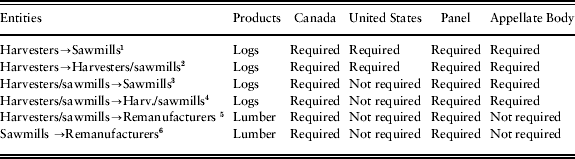
WTO – US–Softwood Lumber IV – Analysis of the pass-through of the input stumpage subsidy benefit from direct recipients (harvesters and harvesters/sawmills) to unrelated entities (sawmills and lumber remanufacturers) producing the subject merchandise (primary and remanufactured lumber)
Types of transactions, with entities and products involved, and actors' views on the requirement for a pass-through analysis in an aggregate CVD investigation
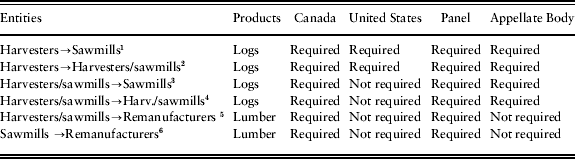
Notes: 1 Refers to the situation where a tenured timber harvester who does not own a sawmill, and thus does not produce softwood lumber, sells logs at arm's length, for processing into lumber, to unrelated sawmills, the latter not holding a stumpage contract. This type of transactions is also, in more general terms, referred to as ‘independent harvester’ transactions.
2 Refers to the situation where a tenured timber harvester who does not own a sawmill, and thus does not produce softwood lumber, sells logs at arm's length, for processing into lumber, to unrelated sawmills, the latter also holding a stumpage contract (‘Independent harvester’ transactions).
3 Refers to the situation where a tenured timber harvester owns a sawmill and processes some of the logs it harvests into softwood lumber, but, at the same time, sells at arm's length some of the logs it harvests, for processing into lumber, to unrelated sawmills, the latter not holding a stumpage contract (‘Sawmill-to-sawmill’ transactions).
4 Refers to the situation where a tenured timber harvester owns a sawmill and processes some of the logs it harvests into softwood lumber, but, at the same time, sells at arm's length some of the logs it harvests, for processing into lumber, to unrelated sawmills, the latter also holding a stumpage contract (‘Sawmill-to-sawmill’ transactions).
5 Refers to the situation where a tenured timber harvester owns a sawmill, processes the logs it harvests into softwood lumber, and sells at arm's length some or all of the lumber it produces, for further processing, to unrelated lumber remanufacturers, regardless of whether the latter also hold a stumpage contract and produce primary lumber (‘Remanufacturer’ transactions).
6 Refers to the situation where a sawmill, not holding a stumpage contract, sells at arm's length some or all of the lumber it produces, for further processing, to unrelated lumber remanufacturers, regardless of whether the latter also hold a stumpage contract and produce primary lumber (‘Remanufacturer’ transactions).
The implementation of WTO rulings
The US determinations of specificity and financial contribution were upheld by the panel and, for the latter, also by the Appellate Body, whereas the panel's findings on benefit were reversed, leaving the analysis of this issue incomplete. Hence, the only findings and recommendations to act upon for American authorities pertained to the conduct of a pass-through investigation. The implementation of these recommendations contained in the panel report, as amended by the Appellate Body, proved problematic. The United States was required to demonstrate if, and in what amount, the alleged input stumpage subsidy passes through, in arm's length sales of logs, to unrelated enterprises producing the countervailed product, i.e., softwood lumber.
A pass-through analysis is conducted according to the USDOC's regulations on upstream subsidies, providing for preferential benchmarks (US, 1998: 65415). In this case, it involves comparisons of log sale prices to a benchmark market price to establish whether, and to what extent, a benefit is conferred on the recipients that use the inputs, i.e., logs, in the production of lumber, the subject merchandise. As benchmark input prices, the USDOC used company-specific prices or, when unavailable, a weighted average of publicly available prices for logs harvested from private lands and for imported logs in the respective provinces (WTO, 2005b: Annex B-2, paras 34–39).
On 6 December 2004, the United States issued its determination under Section 129 of the URAA to implement the WTO recommendations in US–Softwood Lumber IV, following which the CVD rate on Canada's lumber was slightly reduced by 0.17 point to 18.62%, effective on 10 December 2004 (US, 2004a). Concurrently, pursuant to its retrospective duty assessment system and irrespective of WTO proceedings, the United States published the results of its first assessment review. The latter determined the cash deposit rate to be levied, as of 20 December 2004, on Canadian lumber imports, and led to a duty, soon revised, of 16.37% (US, 2004b). US-prescribed conditions regarding sales and data resulted in only a small proportion of log transactions being actually examined for pass-through in the Section 129 determination and none in the first assessment review.
In late December 2004, Canada requested that the original dispute panel be reconvened to investigate the US failure to comply with WTO rulings. Canada claimed that the USDOC completely excluded entire groups of transactions, on the basis that these were not arm's length sales. The Canadian authorities pointed out that the USDOC continued to presume pass-through in regard to all log purchases between tenured sawmills (transactions no. 4 in Table 1), the latter constituting the vast majority of inter-sawmill transactions in Canada. In addition, Canada claimed that, in its first assessment review, the USDOC presumed pass-through in respect of all sawmill-to-sawmill transactions (types 3 and 4 in Table 1). The Canadian authorities further argued that the USDOC erred by rejecting the aggregate transaction and pricing data they provided in support of their pass-through representations, the United States requiring instead company-specific, transaction-by-transaction evidence. Canada finally submitted that, in the instances where a pass-through analysis was performed, the USDOC applied benchmarks unrepresentative of the market conditions in the provinces for which they were used, and, as a result of all the above, the amount of CVDs was impermissibly inflated.
For the United States, whether the entities operate at arm's length is more than just a question of formal affiliation, it involves an analysis of whether one party effectively ‘controls’ the other or whether the parties have roughly equal bargaining power. The American authorities concluded that the transactions were not at arm's length, or otherwise ineligible for a pass-through analysis, when they determined that any of the sales was affected by one or several of five factors identified as part of an ‘external factor’ test. Such a test was apparently developed within the USDOC's calculation methodology elaborated specifically to handle the softwood lumber case. These factors relate to: (1) limitations on log sales in crown tenure contracts, such as appurtenancy and local processing requirements; (2) wood supply commitment letters; (3) the payment of the stumpage fees by the downstream log purchaser; (4) the structure of certain log purchase agreements; and (5) fibre exchange agreements between tenured sawmills. The United States argued that its five factor test addresses the issue of control, since many of the circumstances of log sales in Canada are affected by government mandates and other imposed conditions. For Canada, such a test cannot excuse the United States from its obligation to conduct the required benefit pass-through analysis and, in any case, does not alter the fact that sellers of logs attempt to obtain the best price available in transactions with unrelated purchasers.
In August 2005, the compliance panel ruled that the United States was required to conduct a pass-through analysis in respect of all log sales by tenured harvesters (whether or not also lumber producers) to unrelated sawmills (types 1 to 4 in Table 1), irrespective of any considerations as to whether or not such sales were ‘arm's length’. On the issue of log sales by tenured harvesters/sawmills to unrelated sawmills (types 3 and 4), the United States argued that, unlike the panel's finding, the ruling from the Appellate Body referred only to ‘arm's length’ transactions and that its scope was limited to sales to ‘sawmills’ as defined in the Appellate Body report (WTO, 2004: fn. 151), i.e. enterprises that do not hold a stumpage contract (type 3). However, as the panel pointed out, the Appellate Body must be presumed to have upheld its findings on inter-sawmill transactions as they were not explicitly modified. Therefore, by failing to analyze pass-through in regard to inter-sawmill transactions involving log purchases by (unrelated) sawmills holding a stumpage contract, the compliance panel found that the United States did not properly implement WTO rulings.
On the reject of Canadian aggregate data by the USDOC and its insistence on company-specific and/or transaction-specific information, in the absence of relevant provisions in the ASCM, the panel declined to rule, being reluctant to instruct national investigating authorities on what data to collect and how to use them. With regard to the reliance on ‘inappropriate’ benchmark prices, this claim was rejected by the panel as falling outside its terms of reference since Canada's request only pertained to the pass-through analysis and not to the methodology or the data used by the USDOC in the calculations of pass-through of benefits (WTO, 2005b: paras 4.51–4.115, 5.1–5.7). However, to the extent that a determination of either direct or indirect benefit involves resort to a similar market benchmark, we will see that the benchmark issue was addressed in the NAFTA proceedings.
The compliance panel then concluded that, in view of the lack of a satisfactory pass-through analysis, the United States remained in violation of the relevant ASCM and GATT provisions and, consequently, had nullified or impaired benefits accruing to Canada under the WTO. The United States appealed the panel's ruling over the scope of a review under Article 21.5 of the Dispute Settlement Understanding (WTO, 1994c). The United States argued that its first assessment review could not be considered as a measure ‘taken to comply’ with WTO rulings, the relevant determination having been made under Section 129, specifically designed to respond to WTO recommendations. The panel had ruled that, to the extent that the first assessment review was a measure that had an effect on the US compliance with WTO rulings insofar as the pass-through analysis was concerned, it had jurisdiction to review it (WTO, 2005b: paras 4.2–4.50). In December 2005, the Appellate Body upheld the panel's finding on this issue (WTO, 2005d: paras 95–97).
4. The lumber subsidy case in NAFTA
When the numerous remands to US agencies are added to the reviews of the original subsidy, dumping, and threat of injury determinations, together with an extraordinary challenge relating to the injury adjudication, no less than 13 proceedings under NAFTA pertained to Lumber IV. Canada opted for an all-out strategy to have its positions vindicated internationally and the resort both to the WTO and NAFTA presented some reinforcing advantages, despite the possibility of inconsistent findings. Although under NAFTA Article 2005, once dispute procedures have been initiated by a member at either forum, the one selected shall be used to the exclusion of the other, there is no such requirement for binational dispute settlement in anti-dumping and CVD matters. Chapter 19 provisions can be invoked simultaneously or successively with the WTO dispute resolution system, partly because there are no applicable NAFTA provisions on dumping and subsidies per se. While WTO panels examine a case in the light of international trade rules, i.e. the primary standard against which Canada wanted its forestry measures to be evaluated, the mandate of NAFTA panels is to review whether a member's imposition of trade remedies is consistent with its own domestic trade laws. Even though the latter must conform with WTO provisions, they tend to be more detailed. WTO rulings are not self-executing and only prospective, whereas NAFTA's are binding under US law, have retrospective effect, i.e. all duties illegally collected must be refunded, and, in accordance with NAFTA Article 103, member states' rights and obligations under the latter forum shall prevail over the WTO's.Footnote 12
Although not per se impacting on WTO proceedings, the Lumber IV subsidy case, as adjudicated in NAFTA, provides interesting insights, especially as the key issue centred on the methodology to assess the adequacy of remuneration, i.e. the very analysis that could not be completed at the WTO. Besides, the NAFTA dispute panel reviewing the US subsidy determination not only upheld the findings on specificity and financial contribution, but also with respect to the pass-through issue; in the latter instance, deferring to the USDOC's evidence and decision not to undertake such an analysis. The NAFTA subsidy panel found the use of cross-border benchmarks in this case to be inconsistent with US law, expressed the opinion that an analysis based on market conditions in Canada was required, and remanded the analysis of benefit to American authorities (NAFTA, 2003: 34–35). On the basis of the third tier of its 1998 regulations to measure the adequacy of remuneration, the USDOC then assessed whether provincial stumpage prices were consistent with market principles. US authorities derived market-based stumpage prices from private log prices in Canada, both domestic and imports, and compared such derived weight-averaged prices with government stumpage fees. Where public fees were less than the derived market prices, a benefit was deemed to exist (NAFTA, 2004).
Following five remands from the NAFTA panel, dealing with the proper starting points for such calculations and the elements, such as profit, to be deducted, the Canadian-wide ad valorem subsidy amount went from 18.79% in the original US determination to less than 1%, the level de minimis under which no CVDs can be levied (NAFTA, 2006). The panel emphasized that it simply required the USDOC to apply in a consistent way the methodology it had itself decided to investigate the case. One should point out that the US lumber industry objected to the use of Canadian domestic log prices as a component for a suitable benchmark, arguing that these were depressed as a result of the government's predominant role in the market (NAFTA, 2004: 12). Thus, the method to determine the adequacy of remuneration and, beyond, the existence and amount of subsidy in softwood lumber represents an issue far from over.
5. The lumber subsidy issue and the Doha Round
The Doha Round negotiations on subsidies, since 2002, have been conducted within the Negotiating Group on Rules, which has dealt with the topics of regional trade agreements, anti-dumping, subsidies and countervailing measures, including fisheries subsidies. Although in a communication of March 2003, the United States pointed to the need for further clarification and improvement to the rules and remedies concerning ‘natural resource and energy pricing’ (WTO, 2003a: 3), there seemed to have been no serious response or discussion from other countries. In July 2005, among 55 ‘elaborated proposals’, the bulk of which relating to trade remedies and mostly anti-dumping, six referred to the ‘existence/amount of subsidization’, all tabled by the United States and Canada. Two relevant Canadian proposals pertained to the pass-through and specificity issues, while none of the four US proposals had much to do with the softwood lumber case (WTO, 2005a).
On the basis of GATT/WTO jurisprudence, Canada has insisted that guidelines be included in the ASCM for the conduct of pass-through analyses. In a revised communication submitted in November 2005 after being streamlined in light of other states' comments, it suggested a footnote to be added to ASCM Article 1.1(b), which would specify that the pass-through of the benefit of a financial contribution from one entity to an unrelated entity cannot be presumed, but rather, must be demonstrated, along the provisions of Article 14. This proposed footnote reads:
Where there is evidence suggesting that a financial contribution, within the meaning of that term in Article 1.1(a)(1), is received by one entity and a benefit, within the meaning of that term in Article 1.1(b), is conferred thereby to an unrelated entity so as to constitute the bestowal of an indirect subsidy, the Member concerned shall determine whether, and to what extent, the benefit of the financial contribution was actually passed through from the former to the latter in accordance with the provisions of Article 14 of [the ASCM] applied mutatis mutandis. A pass-through analysis shall be conducted in a transparent manner and a finding that all or part of the benefit of a subsidy has been passed through to another entity shall be adequately explained. For greater clarity, the requirement to demonstrate that the benefit of a financial contribution has passed from one entity through to another is limited to transactions within the territory of the Member in which the subsidy was bestowed (WTO, 2005c).
In another scaled down submission dealing with specificity, after the list of the four factors which may be considered for a determination of de facto specificity, Canada proposed to add a sentence, which would stipulate: ‘These factors shall be evaluated based on the totality of the facts, and no one or several of them can necessarily give decisive guidance.’ The Canadian delegation also wanted that in Article 2.1(c) a footnote be inserted right after the mention of ‘the granting of disproportionately large amounts of subsidy to certain enterprises’, which would read: ‘Disproportionality shall be determined by reference to a relevant objective benchmark, such as the relative importance of recipient industries, in terms of production value, within the territory of the granting authority’ (WTO, 2006a: 1–2). Unsatisfied with a single-factor approach for a specificity determination, Canada hoped that such clarifications could have prevented a finding of specificity of the timber stumpage subsidy in US–Softwood Lumber IV.
On 30 November 2007, the chair of the Rules Negotiating Group finally circulated a first draft consolidated text on anti-dumping and another on subsidies and countervailing measures, including fisheries subsidies. These are intended as proposed revisions to the existing agreements. Neither of Canada's two proposals on pass-through and specificity has been retained, yet its concerns as to indirect subsidization have been duly translated in the draft text. The US concerns over natural resource and energy pricing have also, at least partly, been taken into consideration. On the definition of subsidy, the only proposed change is in a footnote to Article 1.1(b), which, based on the ruling from the Appellate Body in Canada–Aircraft, would clarify that a benefit is to be determined in reference to what would otherwise be commercially available to the recipient in the market, including, where applicable, as provided for in the guidelines in the proposed revised Article 14.1 (WTO, 2007: 42, 98). On specificity, the draft text would insert a sentence in Article 2.1(c) right after the mention of the four factors for a de facto specificity determination, which reads: ‘In the case of subsidies conferred through the provision of goods or services at regulated prices, factors that may be considered include the exclusion of firms within the country in question from access to the goods or services at the regulated prices’ (WTO, 2007: 43). Even though the issue mostly pertains to ‘dual pricing’ and to instances of state monopolies and state-owned or state-controlled enterprises, it could be of some relevance to the softwood lumber case, insofar as the United States could use the exclusion of US firms from access to Canada's timber as an indication of specificity.
With the exception of a proposed long Annex VIII dealing with fisheries subsidies, the main proposals for change pertain to Article 14 on ‘Subsidy Calculation’. The article would be significantly expanded to include three paragraphs: a first reinstating, with changes, the content of the existing Article 14; a second on input subsidies; and a third on the methods to attribute subsidy benefits to particular time periods, some of which partly incorporating the relevant WTO case law, especially from the Appellate Body's ruling in US−Softwood Lumber IV. With respect to the application of countervailing measures, the draft text would add to the proposed Article 14.1(d) the following qualification:
Where the price level of goods or services provided by a government is regulated, the adequacy of remuneration shall be determined in relation to prevailing market conditions for the goods or services in the country of provision when sold at unregulated prices, adjusting for quality, availability, marketability, transportation and other conditions of sale; provided that, when there is no unregulated price, or such unregulated price is distorted because of the predominant role of the government in the market as a provider of the same or similar goods or services, the adequacy of remuneration may be determined by reference to the export price for these goods or services, or to a market-determined price outside the country of provision, adjusting for quality, availability, marketability, transportation, and other conditions of sale. (WTO, 2007: 58)
It ought to be noticed that this proposed language appears to make it almost routine to resort to out-of-country benchmarks in cases where a government is a significant supplier of the good or service, whereas the Appellate Body's ruling in US–Softwood Lumber IV emphasized that this possibility was very limited (WTO, 2004: para. 102). More importantly, the allowance of cross-border benchmarks by the Appellate Body has raised issues and the United States is seeking a change to the language of the proposed Article 14.1(d) as it is now to avoid losing future cases.Footnote 13 Further, a proposed Article 14.2 would specify that in order to attribute a subsidy to an input to a downstream product, when the latter's producer is unrelated to the producer of the input, it must be demonstrated that the input was obtained on terms more favourable than those commercially available in the market or, where that market is distorted, in relation to other sources such as world market prices (WTO, 2007: 58, 101).
To the extent that, unlike the outcomes of the subsidy negotiations, the Uruguay Round did not lead to significant advances on anti-dumping measures, and bearing in mind that the latter are much more common than CVDs, one should not be surprised that anti-dumping has been the focus of the work in the Rules Committee since the launch of the Doha Round. For its part, the relative paucity of proposals directly relating to subsidies, as against CVDs, may be explained by the fact that, on the whole, states have been satisfied with the results and implementation of the ASCM. Although very few trade disputes since 1995 have involved natural resource and upstream subsidies, the significance of such issues has not been lost. Certain US and Canadian proposals as well as key proposed changes included in the draft text on subsidies and countervailing measures emanate from the softwood lumber dispute. Yet, insofar as addressing natural resource and input subsidy issues entails more extensive regulations on state aid, the international community may consider this either too constraining or premature, not to mention that such an exercise could upset the uneasy balance of rights and obligations between the advocates of subsidy and CVD disciplines.
6. Conclusion
The WTO panels, and particularly the Appellate Body, in US–Softwood Lumber IV interpreted the nature and scope of the ASCM provisions in a way favourable to the US position. The American views prevailed insofar as stumpage programs have been held to be specific and to constitute a financial contribution through the provision of goods. Should such goods be found to be provided for less than adequate remuneration and, thereby, to confer a benefit, stumpage rights would be deemed to subsidize Canadian lumber products. However, Canada's objections to the US conclusion on the extent of the benefit accruing to lumber producers were considered legitimate by the panels and the Appellate Body, in spite of their different interpretations of what an appropriate benchmark ought to be. They both insisted on the need for a pass-through analysis of the input stumpage subsidy to unrelated lumber producers and, as a result, found the US CVD determination to be inconsistent with the ASCM and the GATT. Yet, for the United States, the benchmark and pass-through issues pertain to the calculation of the rate of subsidization (and, hence, the amount of applicable CVDs), rather than the existence of a subsidy.
Although the question of the existence and calculation of benefit should normally have received as much, if not more, attention as the pass-through issue, the examination of the former by the panel remained limited and led to a lack of evidence for the Appellate Body to rule on this matter. Hence, definitive conclusions on some essential issues raised in US–Softwood Lumber IV could not be reached. The question before the compliance panel had only to do with the pass-through inquiry as the benchmark issue was not touched upon. Also, had the USDOC conducted a pass-through investigation as recommended by WTO authorities, the ensuing case law could have been more exhaustive. Thus, two key issues remain outstanding, i.e. the existence and amount of the input stumpage subsidy, together with the extent of its beneficiaries. First, a WTO-compatible methodology or benchmark to assess the adequacy of remuneration remains to be determined. Second, a proper pass-through analysis still needs to be conducted by US authorities. Depending on whether, and the extent to which, the stumpage subsidy is found to benefit lumber products, the level of US CVDs could be significantly lower, if at all applicable.Footnote 14
As regards a methodology to demonstrate the existence and amount of the benefit conferred on Canada's softwood lumber producers by provincial stumpage programs, the ruling from the Appellate Body specified that a benchmark other than private prices in the country of provision could be used, when it has been established that the government's predominant role in the market as a provider of the same or similar goods distorts those prices. This implies that such determination could only be made on the basis of positive evidence, but, as we saw, this issue was not tackled by WTO authorities in US–Softwood Lumber IV. To the extent that the NAFTA proceedings may shed some light, even though the panel that reviewed the original subsidy determination deferred to the USDOC's analysis and conclusion of price distortion, it also found the analysis to be minimal and the conclusion sometimes based on weak anecdotal evidence (NAFTA, 2003: 26). In their remand determinations, even if US authorities had used another benchmark, such as American and Canadian log prices, since it would still have to properly reflect market conditions as they prevail in Canada, it is not yet clear whether, and to what extent, stumpage policies could be found to bestow a subsidy. All will depend on the benchmark(s) deemed acceptable under WTO rules and on the scope of the required adjustments to these market benchmarks to make them relate to the Canadian prevailing conditions.
As for the pass-through issue, we saw that softwood lumber is a remarkably complicated case, with various types of transactions, entities, and products involved, from inputs to the countervailed downstream merchandise. As allowed under GATT and ASCM provisions, the USDOC has always conducted its investigations against Canadian lumber on an aggregate basis, as company-specific inquiries have been considered impracticable. The question is whether a requirement for a pass-through analysis would transform every aggregate investigation into a company-specific one, as is the US contention. The WTO authorities thought this would not necessarily be so and mentioned some possible means to avoid this situation, such as inquiries into possible relationships between the entities involved and the use of sampling or other statistical techniques, but, in the absence of relevant multilateral provisions, declined to rule on this issue. During its purported implementation of the rulings in US–Softwood Lumber IV, the USDOC rejected Canadian aggregate data and other alternative approaches. The American authorities requested evidence on virtually all arm's length log transactions between unrelated parties; which for British Columbia alone, with questionnaires and attachments, would have amounted to millions of pages of data. Hence, unless the United States accepts aggregate information, a WTO pass-through requirement may prove a double-edged sword for Canada, in view of the nature and weight of the evidence deemed necessary by US authorities to conduct such an analysis.
The WTO adjudication process in Lumber IV stopped after Canada and the United States (again) reached a (temporary) bilateral settlement of their conflict and so notified the WTO Council on 12 October 2006 following amendments to their agreement (Canada, 2006a and 2006b). The outcomes of the WTO and NAFTA proceedings may have had an impact on the terms of this compromise, although it is not self-evident. Due to shortcomings in the dispute deliberations, the issue of the WTO definition of subsidy, as adjudicated in US–Softwood Lumber IV, has not been entirely settled as some key factual and legal findings could not be made. Nevertheless, the WTO rulings in US–Softwood Lumber IV have significantly clarified the conditions under which measures of public policy such as stumpage rights can be considered to subsidize Canadian lumber producers. With no major imperative or willingness in the otherwise stalemated Doha Round to modify or expand the existing ASCM subsidy provisions, the WTO jurisprudence from US–Softwood Lumber IV is bound to provide an essential backdrop for assessing the issues over natural resource subsidies and input subsidies. Indeed, the proposed changes to the existing rules on subsidies are, to a significant degree, drawn from the WTO case law inherited from the lumber case, as revealed in the Doha draft text released in late 2007. To the extent that questions over natural resource and input subsidies are illustrative of growing concerns over subsidization in a globalizing context, the softwood lumber case is to influence the development of international trade law.